

Should You Visit Plymouth, America’s Hometown?
Quick Answer
Yes, you should visit Plymouth, Massachusetts, especially if you enjoy American history.
Plymouth is where the Mayflower Pilgrims established one of the earliest permanent English settlements in North America in 1620.
For many Americans, Plymouth represents the beginning of the Thanksgiving story and one of the earliest chapters of colonial America. For history enthusiasts and families, it offers one of the most important historical destinations in New England.
However, for travelers with little interest in early American history, Plymouth may feel better suited as a half-day or full-day excursion from Boston or Cape Cod rather than a standalone vacation destination.
What Is Plymouth?
Plymouth is New England’s oldest municipality. Founded in 1620 by the Mayflower Pilgrims, the town continues to celebrate its founding history.
Unlike Boston or Philadelphia, Plymouth is not a major tourist city.
Instead, Plymouth is a historic coastal town connected to some of the most recognizable stories in American history:
- The arrival of the Pilgrims
- The Mayflower voyage
- The First Thanksgiving
- The establishment of Plymouth Colony
Today, visitors explore museums, monuments, waterfront areas, historic homes, and reconstructed settlements that help explain the challenges and realities of early colonial life.
Plymouth and the First Thanksgiving
While Plymouth is best known as the home of the Thanksgiving story, the town represents much more than a single meal shared in 1621.
Plymouth tells the larger story of early colonial settlement, the challenges faced by the Pilgrims, and the complex relationship between European settlers and Indigenous peoples.
The Real Plymouth Experience
The Plymouth experience comes from understanding the scale of what happened here.
It is more than an opportunity to check off a famous landmark on a bucket list.
Standing beside Plymouth Rock, looking across Plymouth Harbor, or walking through Plimoth Patuxet Museums helps visitors imagine what life was like for the people who crossed the Atlantic and attempted to build a new community in an unfamiliar land.
Plymouth is not a perfectly preserved colonial village. It is a place where visitors can connect with one of America’s earliest chapters.
Let’s look at the three biggest reasons to visit America’s Hometown.
Three Biggest Reasons to Visit Plymouth
Travelers continue to visit Plymouth because it preserves one of America’s founding stories, offers one of New England’s best historical experiences, and combines history with a beautiful coastal setting.
1. The Story of America’s Early Colonists
Few places in the United States carry as much symbolic importance.
Visitors can stand where:
- Plymouth Colony was established
- The Pilgrims came ashore in 1620
- One of America’s earliest English settlements began
If Philadelphia explains America’s founding documents and Lexington explains the fight for independence, Plymouth explains the earliest chapter of America’s colonial story.
2. History and Waterfront Combined
Many historical destinations focus entirely on museums and monuments.
Plymouth offers something different.
Visitors can enjoy:
- Historic sites
- Museums
- Harbor views
- Coastal scenery
- New England seafood restaurants
The result feels less like an outdoor museum and more like a living New England town.
3. Easy Addition to a Boston or Cape Cod Trip
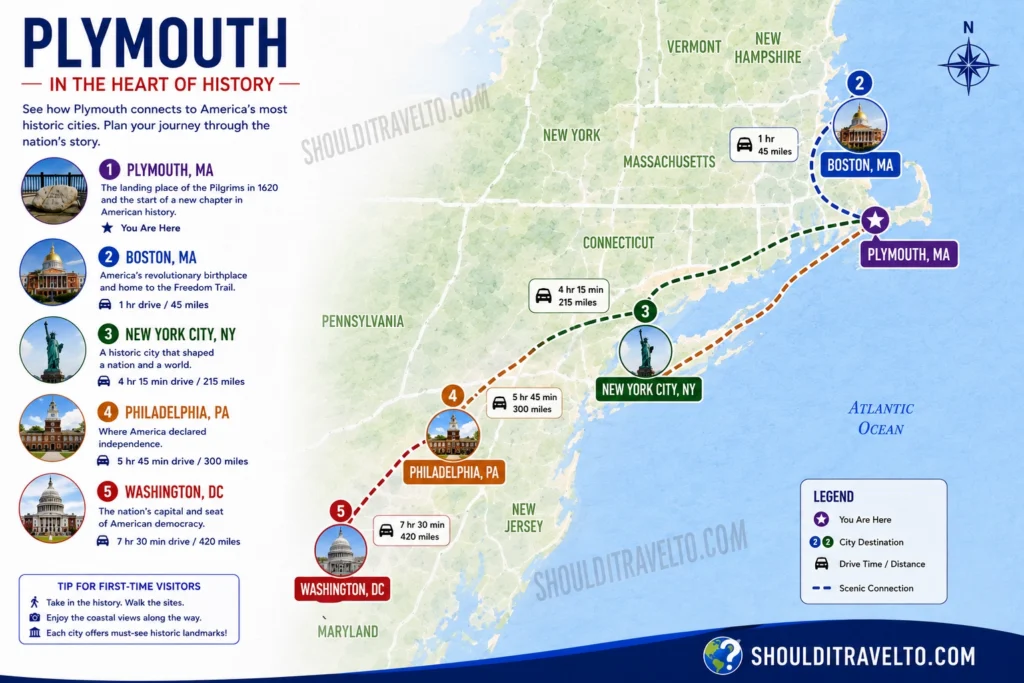
Plymouth sits conveniently between Boston and Cape Cod.
It works extremely well as:
- A day trip from Boston
- A stop on the way to Cape Cod
- Part of a larger New England road trip
Few historical destinations fit so naturally into an existing itinerary.
Nearby Destinations:
- Boston
- Cape Cod
- Newport
- Salem
- Providence
Now, let’s look at the three biggest downsides of visiting Plymouth.

Three Biggest Downsides of Visiting Plymouth
Because Plymouth is familiar to many travelers from history books, expectations can sometimes exceed reality. For visitors traveling long distances, combining it with other New England destinations creates a more complete experience.
1. Historical Expectations Can Exceed Reality
Many visitors arrive expecting a preserved seventeenth-century town.
Plymouth is a modern Massachusetts community with historical sites rather than an entirely preserved colonial city.
Managing expectations helps improve the experience.
2. Better as Part of a Larger Trip
Most visitors can comfortably see the major attractions in half a day or a full day.
Plymouth works best when combined with:
- Boston
- Cape Cod
- Newport
- Other New England destinations
Because Plymouth works best as part of a larger New England itinerary, most visitors arrive by car from Boston, Cape Cod, or Providence.
3. Car Required to Visit
Plymouth is not a centrally located city. Instead, it is a coastal town in Massachusetts. Local buses service the town and connect to the MBTA commuter line, but most travelers should opt to rent a car when visiting America’s Hometown.
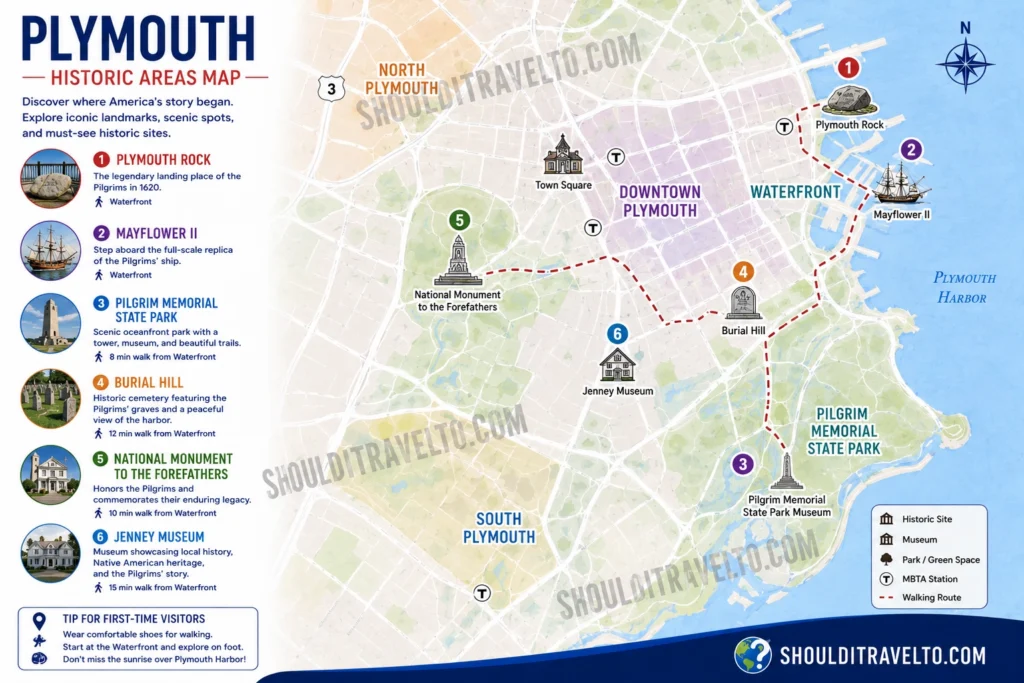
Once in Plymouth, the historic waterfront and Pilgrim Memorial State Park are very easy to explore on foot.
Plymouth: Don’t Miss These Landmarks
Must See
- Pilgrim Memorial State Park: Plymouth’s historic waterfront park preserves the places most closely associated with the arrival of the Pilgrims in 1620. The park includes Plymouth Rock, the Mayflower II, and views of Plymouth Harbor, creating the setting where visitors can connect the famous Thanksgiving story with the actual landscape where Plymouth Colony began.
- Mayflower II: A full-scale reproduction of the original Mayflower, helping visitors understand the voyage that brought the Pilgrims to New England.
- Plimoth Patuxet Museums: One of America’s best living history museums, featuring recreated colonial and Indigenous communities from the seventeenth century.
- Burial Hill: One of the oldest cemeteries in the United States and the resting place of many early settlers.
- Plymouth Waterfront: A scenic harbor area that combines history, restaurants, and a coastal New England atmosphere.
Hidden Gems
- National Monument to the Forefathers: One of the largest granite monuments in the United States and an overlooked masterpiece of nineteenth-century sculpture.
- Brewster Gardens: A peaceful riverside park near the historic district.
- Pilgrim Hall Museum: The oldest continually operating public museum in the United States and home to original Pilgrim artifacts.
- Jenney Grist Mill: A reconstructed working mill that offers a glimpse into colonial industry.
- Historic Town Center: A walkable district filled with colonial architecture, local shops, and restaurants.
- Leyden Street: One of the oldest continuously occupied streets in America and part of Plymouth Colony’s original layout.
Perfect Trip Length for Plymouth
Most visitors can comfortably explore Plymouth in a day.
Half Day:
- Plymouth Rock
- Waterfront
- Mayflower II
Full Day:
- Plimoth Patuxet Museums
- Burial Hill
- Museums and historic sites
Multi-Day Trip:
- Combine with Boston
- Add Cape Cod
- Continue to Newport or Salem
These itinerary options help travelers manage their time and enjoy their vacations while making a detour to America’s Hometown.
Best Time to Visit Plymouth
🌸 Spring ★★★★☆
☀️ Summer ★★★★★
🍁 Fall ★★★★★
❄️ Winter ★★☆☆☆
Seasonal Appeal Matters
Summer and fall offer the best overall experience.
Winter can feel quiet, while summer crowds increase significantly around school vacations and patriotic holidays.
Summer offers warm weather and the liveliest atmosphere along the waterfront.
Fall combines comfortable temperatures with classic New England scenery and fewer crowds.
Winter is quieter but less ideal for exploring outdoor historical sites.
Who Should Visit Plymouth?
Plymouth is one of the rare destinations where visitors can connect a familiar history lesson with a real place they can explore today.
Plymouth is Best For:
- American history enthusiasts
- Families
- School-age children
- First-time New England visitors
- Boston day-trippers
- Travelers visiting Cape Cod
For families, it offers something especially valuable: the chance to turn a story children learn in school into a place they can actually visit.
Skip Plymouth If:
- You dislike museums or history
- You prefer nightlife and entertainment
- You want a destination with endless attractions
- You are looking for beaches or outdoor adventure
Many visitors may feel a sense of satisfaction knowing that they stood where the first Pilgrims once stood.
Final Verdict
Plymouth is not a destination for everyone.
But for travelers interested in early American history, Plymouth remains one of the most important places in the United States.
Standing beside Plymouth Rock, boarding the Mayflower II, or walking through Plimoth Patuxet Museums offers something few destinations can match:
the opportunity to experience the beginnings of colonial America.
For many travelers visiting New England, Plymouth is absolutely worth the detour.
Interest in more historical American destinations?