

Should You Visit Boston, the birthplace of the American Revolution?
Quick Answer
Yes. You should visit Boston if you enjoy history, walkable cities, charming neighborhoods, and a slower-paced urban experience than New York City.
Boston combines centuries of American history with excellent food, beautiful waterfront views, and one of the most pedestrian-friendly layouts in the United States.
While it can be expensive and doesn’t offer as many attractions as larger cities, its character and accessibility make it one of America’s most rewarding destinations.
The Biggest Mistake First-Time Boston Visitors Make
Many first-time visitors assume they can drive everywhere in Boston.
Known as “America’s Walking City,” Boston’s historic street layout predates the automobile by centuries. Narrow roads, one-way streets, limited parking, and heavy traffic often make walking or taking public transportation easier than driving.
Visitors who embrace Boston as a walking city usually enjoy the experience far more.
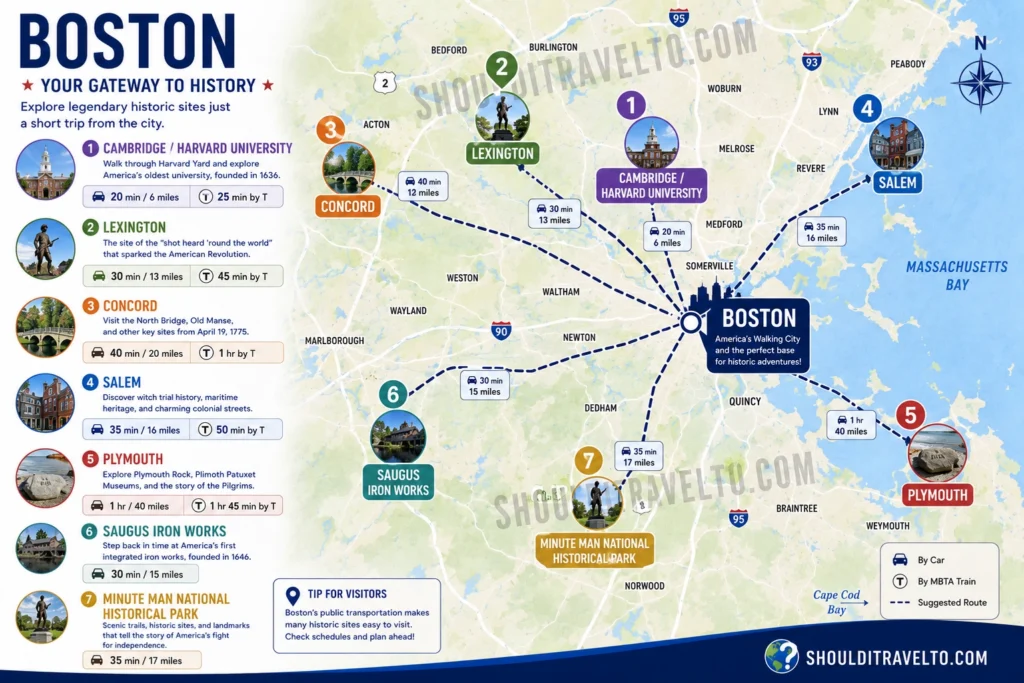
The Biggest Difference: Boston Is the Gateway to New England
Most city vacations are confined to the city itself.
Boston is different.
Visitors can spend the morning walking the Freedom Trail, the afternoon touring Harvard University, and the next day standing on the battlefields of Lexington and Concord, where the American Revolution began.
Within easy reach of Boston are:
- Harvard University
- MIT
- Lexington & Concord
- Salem
- Plymouth
- Cape Cod
- Newport, Rhode Island
- Yale University
As a result, Boston often feels larger as a travel destination than the city itself.
Few American cities offer so many historically significant destinations within such a short distance.
The 3 Biggest Pros of Visiting Boston
Boston is where America rebelled, and where the American Revolution began.
In addition, Boston feels like a city-sized history museum that people still live and work in.
Millions of people visit Beantown annually to see the site of the Boston Tea Party and walk the same cobblestone roads as Samuel Adams, John Hancock, and Paul Revere.
Visitors also get to experience modern Boston, which features green spaces, a revitalized Harbor, and the arts.
1. The Birthplace of the American Revolution
Boston played a central role in the events that led to the American Revolution.
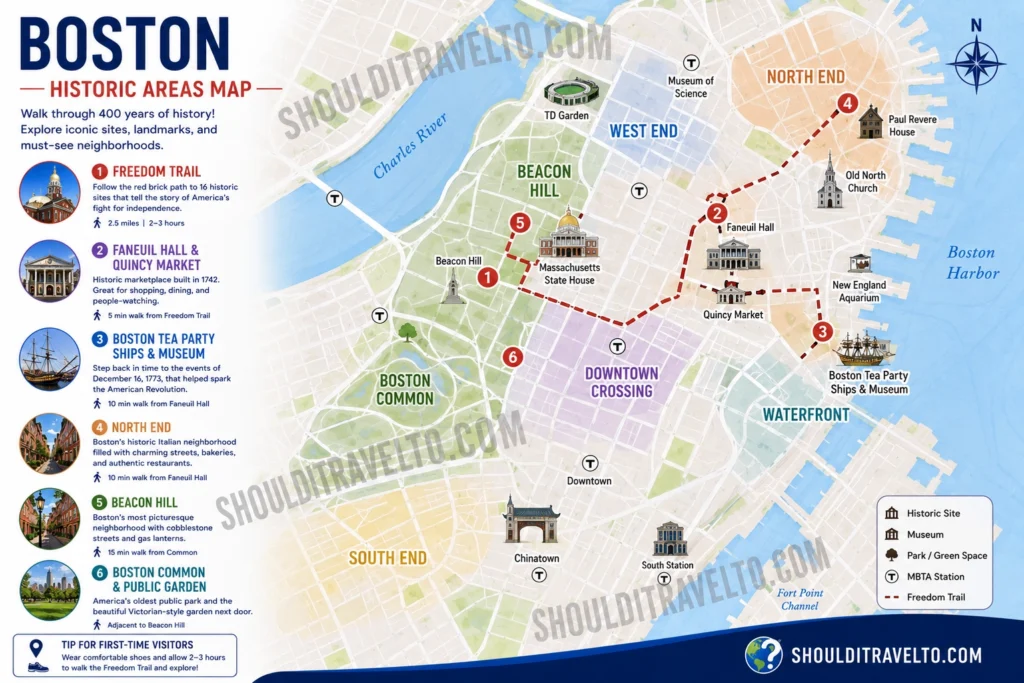
Visitors can walk the Freedom Trail, visit the site of the Boston Massacre, explore Paul Revere’s House, tour Old North Church, and stand near the Boston Tea Party sites.
Unlike many historic destinations, Boston’s landmarks are integrated into the modern city. Colonial churches, Revolutionary War sites, and centuries-old buildings sit alongside skyscrapers, universities, and modern developments.
2. One of America’s Most Walkable Cities
Few major American cities are easier to explore on foot.
Boston’s compact size allows visitors to walk between many of its most popular attractions, restaurants, neighborhoods, and historical sites.
Unlike Los Angeles, Orlando, or many Sun Belt cities, Boston rewards travelers who enjoy exploring on foot.
Most visitors spend their time in Downtown Boston, Back Bay, Beacon Hill, the North End, the Waterfront, and nearby Cambridge. Because these areas are relatively compact, Boston is one of the easiest major American cities to explore without a car.
You can see much of what Boston offers in a few days.
3. Distinctive New England Character
Brick buildings, waterfront views, seafood restaurants, historic streets, and local traditions give Boston a strong sense of place that many travelers find appealing.
Boston remains grounded in blue-collar grit, community loyalty, and Puritan stoicism.
The city feels distinctly different from New York, Philadelphia, Chicago, or Washington, DC.
Between the historic architecture, waterfront setting, seafood culture, sports fandom, and academic influence, Boston delivers an experience that feels unmistakably New England.
The 3 Biggest Cons of Traveling to Boston
Like other must-see East Coast destinations, Boston experiences high demand for limited supply, so tourists can expect to pay a premium.
Other downsides of visiting Boston include a smaller selection of attractions and harsh winters.
1. Hotels Can Be Expensive
While generally cheaper than New York City, Boston can still be costly, particularly during peak seasons and major events.
Boston’s historic layout limits large-scale expansion in the city center, which helps keep hotel demand high and prices elevated.
Visitors can book rooms at lower rates, but they’ll stay farther from historic Boston, in places like Woburn, Waltham, and Norwood.
2. Smaller Attraction Portfolio
Boston has excellent attractions, but travelers seeking nonstop entertainment for a week or more may find fewer options than destinations like New York, Chicago, or Los Angeles.
Much of Boston’s appeal comes from quality rather than quantity.
Beantown is ideal for a three- to five-day stay with plenty of daytime and evening activities, but not 24/7.
The lack of nightlife allows visitors to use it as a break to recharge before they head out to landmarks outside Boston, such as Lexington and Concord.
3. Winters Are Tough
Cold temperatures, snowstorms, and icy conditions can make winter visits less enjoyable for travelers seeking comfortable sightseeing weather.
Those tempted to spend the Holidays in Boston must pack accordingly.

The Should I Travel To … Boston Scorecard
Here’s how Boston scores on the Should I Travel To … scorecard.
Cost / Value: Average Cost
Boston isn’t cheap, but it is often more affordable than New York City and San Francisco. Hotels can be expensive during peak travel seasons, especially summer and fall, but visitors can enjoy many historic attractions and neighborhoods without spending heavily.
Weather: Good
Best Time to Visit: September–October
Fall is arguably Boston’s best season, offering comfortable temperatures, colorful foliage, and ideal walking conditions. Summers are pleasant, while winters can be cold, snowy, and unpredictable.
Crowds & Tourist Density: Moderate
Boston attracts millions of visitors each year, especially during summer and fall, but it generally feels less crowded than destinations like New York City, Orlando, or Las Vegas. Popular historic sites can be busy, but long waits are uncommon.
Walkability & Transportation: Car-Free Paradise
Boston is one of the most walkable cities in America. Many major attractions are located within a compact area, and the MBTA subway system makes it easy to explore without renting a car.
Things to Do: Very Strong
Most visitors can comfortably fill three to five days exploring Boston’s historic landmarks, museums, waterfront districts, sports venues, and nearby destinations such as Cambridge, Harvard University, and MIT.
Boston punches above its weight. Between:
- Freedom Trail
- USS Constitution
- Fenway Park
- Harvard
- MIT
- Museum of Fine Arts
- Isabella Stewart Gardner Museum
- Boston Tea Party Ships
- North End
- Beacon Hill
- Salem day trips
- Lexington & Concord
There’s plenty.
Boston’s score is boosted by its proximity to nearby destinations such as Harvard, MIT, Lexington, Concord, Salem, Plymouth, and Cape Cod.
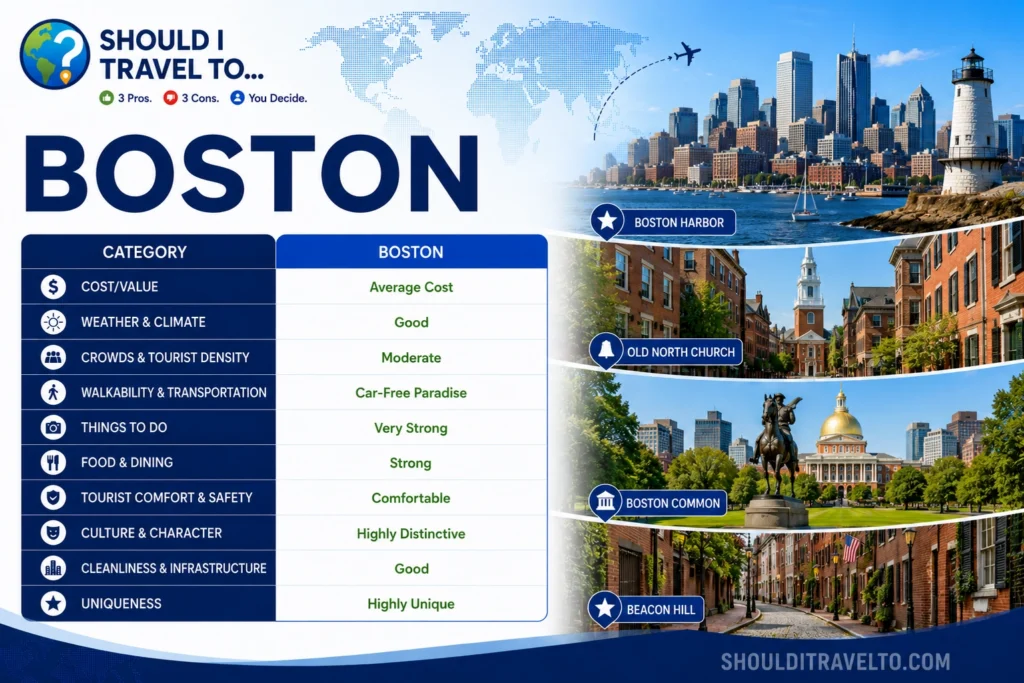
Food & Dining: Strong
Boston is known for its seafood, Italian dining, historic taverns, and growing restaurant scene. Fresh lobster rolls, clam chowder, and seafood dishes are major highlights for many visitors.
Tourist Comfort & Safety: Comfortable
Boston is generally easy to navigate and welcoming for visitors. Tourist areas are well-traveled, and the city’s compact layout helps travelers feel comfortable exploring on foot.
Culture & Character: Highly Distinctive
Few American cities possess the same blend of colonial history, academic influence, sports culture, and New England identity. Boston feels different from nearly every other major U.S. city.
Cleanliness & Infrastructure: Good
The city is generally well-maintained, with attractive neighborhoods, public parks, and historic districts. Some infrastructure is aging, but visitors rarely find it disruptive.
Uniqueness: Highly Unique
Boston’s combination of American history, walkable streets, waterfront scenery, and academic institutions creates an experience that is difficult to replicate elsewhere in the United States.

Trip Length
Ideal: 3–5 days
One of Boston’s strengths is that its core attractions are concentrated in a manageable area.
Unlike New York City or Los Angeles, visitors can experience many of Boston’s highlights in a few days.
The city itself is compact, but nearby destinations dramatically expand the number of possible activities.
Many visitors spend:
- 1 day on the Freedom Trail
- 1 day exploring downtown and the waterfront
- 1 day in Cambridge visiting Harvard and MIT
- Additional time visiting Salem, Lexington, or Concord
Winner: Excellent long-weekend destination, including for Thanksgiving.
Atmosphere / Vibe
Boston is historic without feeling frozen in time.
Many would describe the atmosphere in Boston as:
- Historic
- Academic
- Walkable
- Waterfront-oriented
- Sports-focused
- More polished than Philadelphia
- Smaller and calmer than New York
- Distinctly New England
Many Americans know what “New England” means, but Boston is where many visitors first experience it.
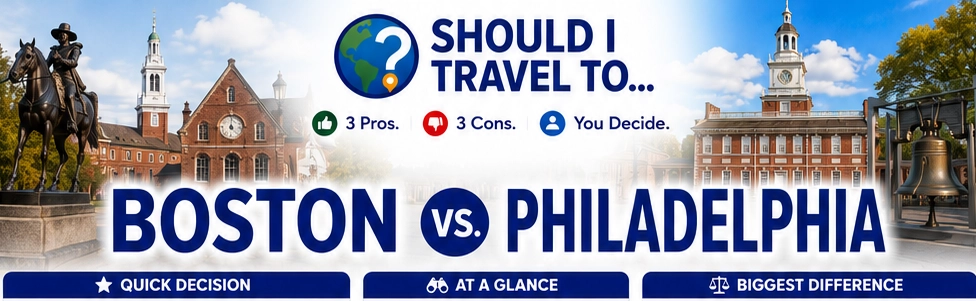
Boston Compared to Nearby Cities
When you need to choose between Boston and nearby cities, here’s how Boston fares.
Choose Boston over Philadelphia if:
- You want a more polished city
- You want New England character
- You want to visit Harvard and MIT
or Choose Boston over New York City if:
- You prefer history over entertainment
- You want a calmer pace
- You prefer a smaller, walkable city
or Choose Boston over Washington, DC if:
- You care more about Revolutionary history
- You want a stronger local identity
- You want easier access to New England
Boston wins on walkability, Revolutionary history, and access to the broader New England region.
Additional Comparisons
Who Should Travel To Boston?
Beantown suits a wider range of visitors, especially those interested in exploring early American history in person.
Boston Is Best For:
- History enthusiasts
- Couples
- Walkability-focused travelers
- First-time visitors to New England
- Food lovers, especially seafood fans
- Sports fans
Boston Is Not Ideal For:
- Travelers seeking warm weather year-round
- Visitors looking for major nightlife destinations
- Travelers wanting a week-plus of nonstop attractions
- Budget travelers during peak seasons
Final Verdict
Boston may not be America’s largest city, but it is one of its most distinctive.
Few destinations combine Revolutionary history, world-famous universities, walkable neighborhoods, waterfront scenery, and New England character as successfully as Boston.
For travelers interested in American history, Boston belongs near the top of the list. For travelers looking to experience New England for the first time, there may be no better starting point.
The best destination isn’t the one with the highest score. It’s the one whose strengths match what you’re looking for.
3 Pros. 3 Cons. You Decide.
Boston Frequently Asked Questions
Is Boston worth visiting?
Yes, Boston is worth visiting. As the birthplace of the American Revolution, visitors can walk on the same streets as Samuel Adams, John Hancock, and Paul Revere. Several historic structures still stand, including the home of Paul Revere.
How many days do you need in Boston?
Visitors can easily fill three to five days with sights and experiences in Boston. Travelers who opt to stay longer can use the time to visit landmarks near Boston, such as Cambridge, Lexington and Concord, and Plymouth.
What is the best time of year to visit Boston?
The best time of the year to visit Boston is early September through the end of October. The humidity levels and temperatures drop, and so do the summer crowds.
Is Boston expensive to visit?
Yes, Boston is expensive to visit. Like older East Coast cities, it is constrained by its original borders, which do not accommodate outward growth. Therefore, demand often exceeds the supply of accommodations and activities, causing prices to rise.
Is Boston walkable for tourists?
Boston is walkable for tourists and recommended. Known as the “Walkable City,” the city makes it much easier to navigate its historic neighborhoods, including “Little Italy.”
What is Boston known for?
Boston is known as the birthplace of the American Revolution.
What are the top attractions in Boston?
The top Boston attractions include:
- Freedom Trail
- Fenway Park
- Harvard University
- Boston Common
- Faneuil Hall
- North End
- USS Constitution
Can you visit Boston without a car?
Yes, you can visit Boston without a car. Renting a car or using rideshare services comes in handy for driving out of Boston and to nearby historic landmarks, such as Plymouth and Salem.
Is the Freedom Trail worth it?
For many travelers, following the Freedom Trail is worth it. The 2.5-mile line allows tourists to visit 16 American Revolution-related landmarks, including Boston Common, the Granary Burying Ground, and the Old State House.
Can you visit Harvard University?
Boston visitors can also visit Harvard in Cambridge. The school has a department dedicated to visitors who would like to tour the campus.
Is Boston good for history lovers?
Boston is one of the best cities to visit for history lovers.
Why do people say Boston is the gateway to New England?
Boston serves as the transportation and cultural hub of New England.
Visitors can easily reach destinations such as Cambridge, Salem, Lexington, Concord, Plymouth, and Cape Cod, while longer trips to Newport or Yale University are also possible.
Is Boston Better than Philadelphia?
Boston and Philadelphia are two of America’s best historical destinations. Boston offers Revolutionary War history, New England character, and easy access to nearby destinations such as Salem, Lexington, Concord, and Harvard University. Philadelphia generally offers better value, a stronger food scene, and the landmarks associated with the Declaration of Independence and the Constitution.