

Should you visit Washington, DC, America’s Capital?
Quick Answer
Yes, especially if you enjoy history, museums, monuments, and walkable cities. Washington, DC, offers many of the country’s most iconic landmarks, some of the world’s best museums, and an excellent public transportation system.
While it can feel busy during peak tourist seasons, and summer weather can be hot and humid, the combination of attractions and free activities makes it one of America’s most rewarding destinations.
The Biggest Mistake First-Time Washington, DC Visitors Make
Many first-time visitors try to see everything in two or three days.
Washington isn’t just the National Mall.
Visitors often spend so much time rushing between monuments that they skip Georgetown, Arlington National Cemetery, Mount Vernon, Alexandria, and some of the world’s best museums.
The most successful Washington trips focus on a handful of attractions each day rather than trying to see the entire city at once.
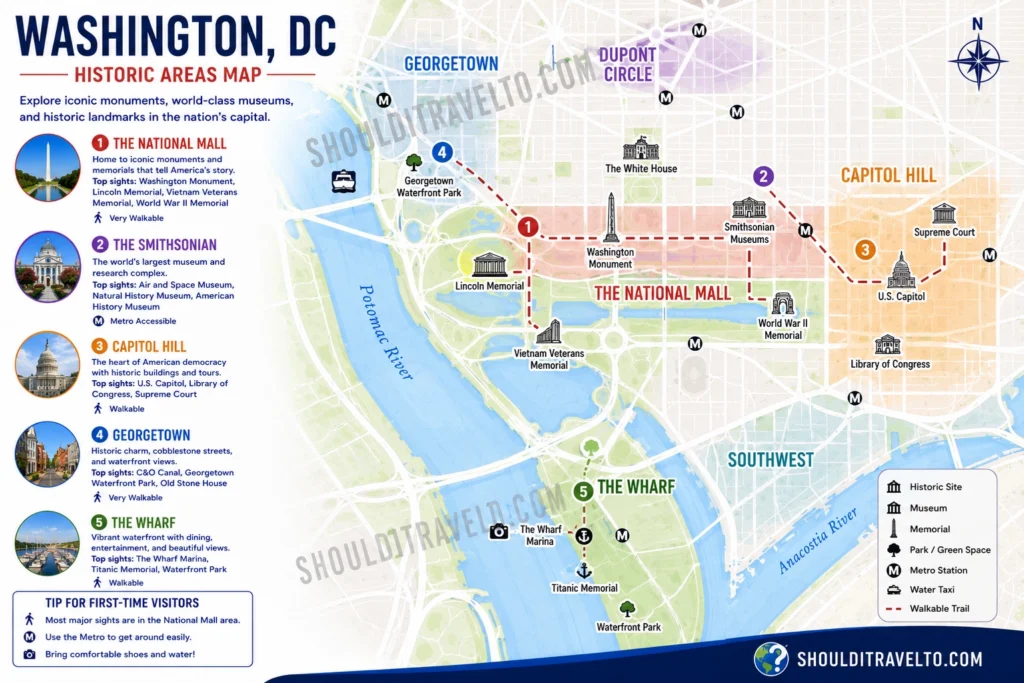
The Biggest Difference: Washington Is America’s Museum
Most cities are built around neighborhoods, food scenes, entertainment districts, or natural attractions.
Washington, DC, is different.
The city feels like a giant museum dedicated to American history, government, and culture.
Visitors can walk from the White House to the Lincoln Memorial, tour the National Air and Space Museum, visit the National Museum of American History, and stand inside the US Capitol, all within the same trip.
Few destinations in the world offer such a concentration of nationally significant landmarks and museums in such a compact area.
The 3 Biggest Pros of Visiting Washington, DC
There are several reasons why everyone should visit Washington, DC, at least once. These are the three biggest pros, including the museums and iconic landmarks.
1. Incredible Museums, and Many of Them Free
Washington is home to some of the finest museums in the world, and many of them charge no admission. Visitors can spend days exploring art, science, history, aviation, and culture without purchasing a single ticket.
No destination in America offers a museum experience comparable to Washington, DC.
Seventeen Smithsonian museums, the National Gallery of Art, the National Archives, the Library of Congress, and numerous specialty museums allow visitors to spend an entire week exploring American history, science, aviation, space, art, and culture.
Must-See Museums
- National Air and Space Museum
- National Museum of Natural History
- National Museum of American History
- National Gallery of Art
Excellent Additional Museums
- International Spy Museum
- National Postal Museum
- Smithsonian American Art Museum
Moreover, most of the museums are within walking distance of each other. Visitors can explore the National Museum of Natural History and then walk over to the National Museum of American History.
Why are Washington, DC, museums free?
All 17 Smithsonian museums in DC, as well as others such as the National Postal Museum, are free because congressional appropriations fund them.
2. Iconic Monuments and Landmarks
A trip to Washington, DC, is not complete without visiting a few of its iconic monuments and landmarks.
The Lincoln Memorial, Washington Monument, US Capitol, White House, and numerous other sites make Washington one of the most recognizable destinations in America.
Must-See Monuments
- Lincoln Memorial
- Washington Monument
- Jefferson Memorial
Often Overlooked Memorials
- World War I Memorial
- Korean War Veterans Memorial
- Vietnam Veterans Memorial
- George Mason Memorial
- US Navy Memorial
Must-See Government Landmarks
- United States Capitol
- White House
- Supreme Court
- Library of Congress
- National Archives
As with the museums, visitors can easily walk from one landmark to another without missing a beat.
3. Easy to Explore Without a Car
Most major attractions are connected by the Metro system or located within walking distance of one another, making sightseeing straightforward and convenient.
Washington, DC, traffic is not as heavy as traffic in Los Angeles, but the highways do get crowded during commute hours.
It’s also best to skip renting a car for exploring Washington, DC, because parking is scarce, inconvenient, and expensive.
Instead, visitors can rent scooters and bikes to avoid walking.

The 3 Biggest Cons of Traveling to Washington, DC
There are some downsides to visiting Washington, DC, such as the summer heat and humidity, and expensive hotel rates.
1. Summer Heat and Humidity
The East Coast experiences hot and humid summers. DC’s geography means that the capital experiences that heat and humidity on another level, trapping it through the concrete and asphalt.
Washington summers can be hot, humid, and uncomfortable, especially during long days spent outdoors visiting monuments and memorials. Therefore, visitors must dress and prepare accordingly.
2. Hotels Can Be Expensive
Accommodation prices can climb quickly, particularly during peak travel seasons, including Thanksgiving in DC, major events, and the cherry blossom period.
DC also hosts dignitaries and politicians, which further drives up prices.
3. Some Visitors Expect More Nightlife and Entertainment
Washington excels at history, museums, and culture, but travelers seeking the nonstop energy of New York City or Las Vegas may find the city quieter than expected.
Because Washington’s downtown is heavily influenced by government offices, some business districts become noticeably quieter after normal working hours compared with cities such as New York or Chicago.

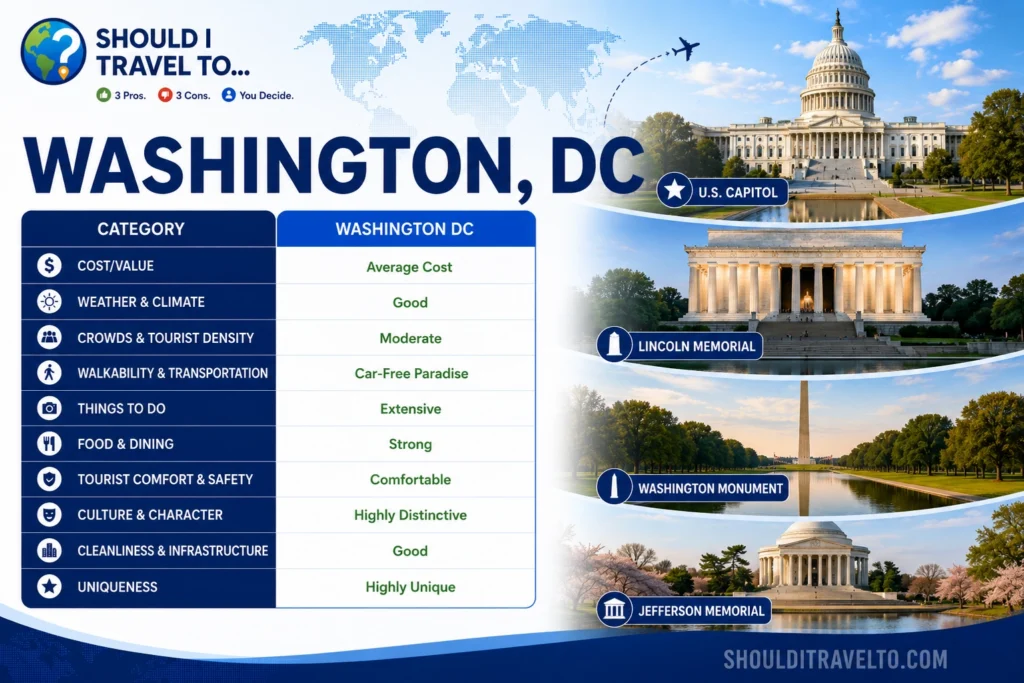
The Should I Travel To … Washington, DC, Scorecard
Here are some other factors to consider before booking your trip to Washington, DC.
Cost / Value: Average Cost
Washington, DC, is not a cheap destination, but visitors receive excellent value thanks to the many free attractions. Hotels can be expensive, especially near the National Mall, but free museums and monuments help offset costs.
Weather: Good
Best Time to Visit: March–May and September–October
Spring brings blooming cherry blossoms and comfortable temperatures, while fall offers pleasant weather and smaller crowds. Summers are often hot and humid, and winters can be cold but generally manageable.
Crowds & Tourist Density: Moderate
Popular attractions around the National Mall can become crowded, particularly during spring and summer. However, Washington generally feels less congested than destinations such as New York City, Orlando, or Las Vegas.
Walkability & Transportation: Car-Free Paradise
Washington is one of the easiest cities in America to explore without a car. The Metro system is extensive, attractions are clustered together, and many visitors spend most of their trip walking between major landmarks.
Things to Do: Extensive
Unlike many American cities, where visitors run out of major attractions after a few days, Washington feels like America’s museum.
Visitors can spend:
- Multiple days exploring Smithsonian museums
- Several evenings visiting monuments and memorials
- Time touring government landmarks
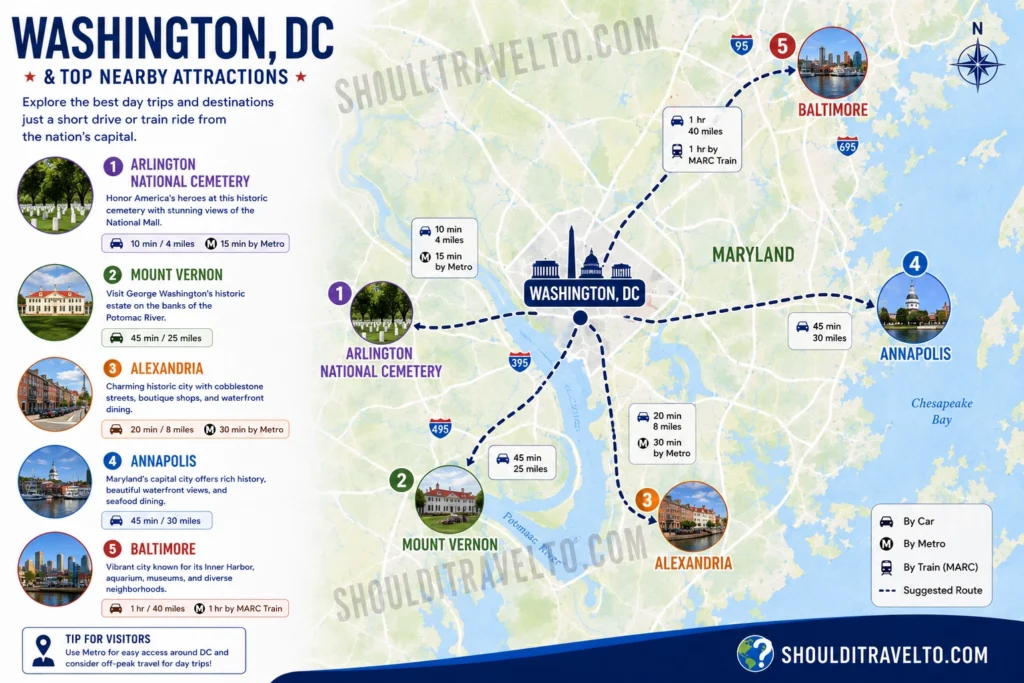
- Additional days exploring Arlington, Alexandria, Mount Vernon, and Gettysburg
Most travelers can comfortably fill five to seven days without repeating attractions. One day may focus on aviation, another on American history, another on monuments, and another on government. The attractions don’t feel repetitive because each museum and landmark tells a different part of America’s story.
Historic Sites Nearby: Beyond Downtown DC
- Arlington National Cemetery
- Mount Vernon
- Old Town Alexandria
- Gettysburg
- Annapolis
Food & Dining: Strong
Washington’s dining scene has grown significantly over the past two decades. Visitors can find excellent international cuisine, upscale restaurants, food halls, and local favorites throughout the city.
Tourist Comfort & Safety: Comfortable
The primary tourist districts are generally easy to navigate and heavily visited. Most travelers feel comfortable exploring major attractions, although standard city awareness is always recommended.
Culture & Character: Highly Distinctive
Few cities in the world have the same concentration of political, historical, and cultural significance. Washington’s monuments, museums, and institutions create an atmosphere unlike any other destination in the United States.
Cleanliness & Infrastructure: Good
Washington is generally well-maintained and visitor-friendly. Public spaces, parks, monuments, and tourist areas are well maintained, and the transportation network makes getting around relatively easy.
Uniqueness: Highly Unique
The combination of national monuments, government institutions, museums, and historical significance makes Washington difficult to replicate elsewhere. While other cities have museums and history, none offer this particular experience.
Atmosphere / Vibe
Washington feels different from every other major American city.
Rather than revolving around entertainment districts or nightlife, the city revolves around government, museums, monuments, and diplomacy.
Visitors often describe Washington as:
- Monumental
- Educational
- International
- Professional
- Walkable
- Museum-focused
- Politically connected
Compared with nearby cities:
- More formal than Boston
- More polished than Philadelphia
- Less hectic than New York
During the workweek, visitors often find themselves walking alongside members of Congress, diplomats, military personnel, journalists, and government employees. That atmosphere gives Washington an energy unlike any other American city.

How Washington, DC, compares to Nearby East Coast Cities
The historic North East cities share several characteristics. Here’s how Washington, DC, matches up to them.
DC vs Boston
- Choose DC for museums and government landmarks.
- Choose Boston for Revolutionary history and New England.
or DC vs Philadelphia
- Choose DC for museums
- Choose Philadelphia for food
DC vs New York City
- Choose DC for history
- Choose New York City for entertainment
or DC vs Chicago
- Choose DC for museums
- Choose Chicago for architecture
Washington, DC, is America’s capital and America’s museum. It wins in terms of museums to visit and education.
Who Should Travel To Washington, DC?
Every year, millions of tourists and students descend on Washington, DC. The destination suits travelers interested in familiarizing themselves with iconic landmarks and monuments and visiting museums that house complementary artifacts.
Washington, DC, is Best For:
- History enthusiasts
- Museum lovers
- First-time visitors to the United States
- Families
- Students
- Travelers who enjoy walking and public transportation
- International visitors
Washington, DC, is Not Ideal For:
- Travelers seeking beaches or outdoor adventure
- Visitors looking primarily for nightlife
- Travelers who dislike museums or historical attractions
- People visiting during the peak summer heat
Moreover, Washington, DC, fits specific travel trips, such as Veterans Day.
Final Verdict
If Boston tells the story of the American Revolution and Philadelphia tells the story of America’s founding, Washington, DC, tells the story of the nation that emerged from both.
Washington, DC, is one of the most educational, inspiring, and accessible destinations in the United States. The city’s combination of iconic landmarks, world-class museums, and walkable layout creates an experience that appeals to a wide range of travelers.
If you’re interested in understanding how the United States works, where it came from, and what it represents today, there is no better destination in America.

Washington, DC, Frequently Asked Questions
Is Washington, DC worth visiting?
Yes, DC is worth visiting. Washington, DC, is one of America’s most rewarding destinations thanks to its monuments, museums, government landmarks, and walkability. It’s a tourist and educational destination.
How many days do you need in Washington, DC?
For DC trips, most visitors should plan for four to seven days.
Three days is enough to see the highlights, but a longer stay allows time for museums, Arlington National Cemetery, Mount Vernon, and Alexandria.
What is the best time to visit Washington, DC?
The best time to visit DC is March through May and September through October offer the most comfortable weather.
Is Washington, DC, expensive?
Washington can be expensive, particularly for hotels, but many of its top attractions are free.
Can you visit Washington, DC, without a car?
Yes, you can visit DC without a car.
Washington is one of the easiest cities in America to explore without a car thanks to the Metro system and walkable attractions.
Are Smithsonian museums free?
Yes, most Smithsonian museums are free to visit in Washington, DC.
What are the top attractions in Washington, DC?
The top Washington, DC, attractions include:
- Lincoln Memorial
- Washington Monument
- White House
- US Capitol
- National Air and Space Museum
- National Museum of Natural History
- National Archives
- Arlington National Cemetery
Is the White House open for tours?
Limited tours of the White House are available but require advance arrangements through a congressional office.
Is Arlington National Cemetery worth visiting?
Yes, Arlington National Cemetery is worth visiting.
Many visitors consider Arlington National Cemetery one of the most powerful and memorable experiences in the Washington region.
Is Mount Vernon worth visiting?
Yes, Mount Vernon is worth visiting.
Mount Vernon offers one of the best opportunities in America to learn about George Washington and the early United States.
What is Washington, DC, known for?
Washington is known for being the capital of the United States and for its monuments, museums, government institutions, and national landmarks.
Is Washington, DC, good for families?
Yes, DC is good for families.
Many museums are free, interactive, and family-friendly, making Washington one of America’s best destinations for families.
Is Washington, DC safe for tourists?
Washington’s primary tourist areas, including the National Mall, Smithsonian museums, Georgetown, Capitol Hill, and the Wharf, are generally comfortable for visitors. As with any major city, remain aware of your surroundings, particularly at night and outside the main tourist districts.