

Should You Visit New York City, the City That Never Sleeps?
Quick Answer
Yes. You should visit New York City if you want world-famous landmarks, exceptional museums, Broadway shows, extraordinary food, and one of the world’s most recognizable urban experiences.
New York City offers a combination of attractions, neighborhoods, entertainment, history, and cultural diversity that few destinations can match. You can visit the Statue of Liberty, walk through Central Park, see a Broadway performance, explore the Metropolitan Museum of Art, and enjoy food from around the world without renting a car.
But New York City isn’t the right destination for everyone.
New York also changes dramatically throughout the year.
A summer trip feels different from a Christmas vacation. Thanksgiving brings the Macy’s Thanksgiving Day Parade, New Year’s Eve transforms Times Square, and fall offers colorful parks, seasonal events, and generally comfortable sightseeing weather.
For travelers who enjoy major events, New York can be worth visiting more than once simply to experience it during different seasons.
The biggest question isn’t whether New York City has enough to do.
It’s whether you enjoy the kind of vacation New York offers: energetic, crowded, walkable, expensive, and filled with possibilities.
For travelers who thrive in that environment, New York City is one of America’s strongest destinations.
New York City at a Glance
| Category | New York City |
| Location | New York State, Northeastern United States |
| Best known for | Skyline, Broadway, Central Park, Statue of Liberty, museums, food |
| Best time to visit | September–November; spring is another strong option |
| Best trip length | 5 days for first-time visitors; 4–7 days overall |
| Cost | Expensive |
| Weather | Four distinct seasons; hot summers and cold winters |
| Crowds | High, especially at major attractions and holidays |
| Walkability | Excellent in many visitor neighborhoods |
| Public transportation | Extensive subway, bus, rail, and ferry connections |
| Rental car | Not recommended for most visitors |
| Food | World-class variety |
| Atmosphere | Fast-paced, international, energetic, crowded |
| Best for | First-time visitors, food lovers, museum enthusiasts, theater fans, city explorers |
| Biggest drawback | High costs, crowds, and an intense pace |
Quick Verdict: New York City is one of the best American destinations for travelers who want a major urban vacation filled with iconic attractions and cultural experiences. Its biggest advantage is variety. Its biggest drawback is that experiencing that variety requires time, money, and energy.
The Biggest Mistake First-Time New York City Visitors Make
The biggest mistake first-time visitors make is trying to experience all of New York City in one trip.
New York isn’t simply a collection of famous attractions concentrated around Times Square.
It’s a city of five boroughs: Manhattan, Brooklyn, Queens, the Bronx, and Staten Island.
Each has its own neighborhoods, communities, food traditions, attractions, and identity.
Most first-time visitors spend much of their time in Manhattan because many of the city’s best-known landmarks are located there. That’s a reasonable approach, especially if you have only three or four days.
But Manhattan isn’t the entire city.
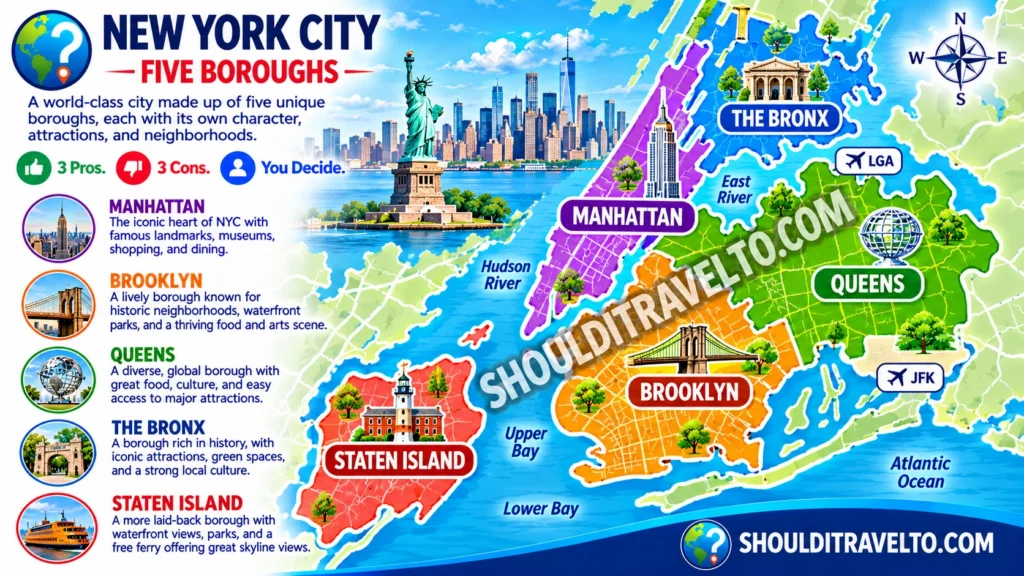
Brooklyn offers waterfront views, parks, restaurants, and neighborhoods with distinct character. Queens is especially appealing for international food and cultural diversity. The Bronx is home to Yankee Stadium, the New York Botanical Garden, and the Bronx Zoo. Staten Island offers a quieter perspective on the city and is accessible by ferry from Lower Manhattan.
You don’t need to visit every borough to have a successful trip.
You do need to recognize that moving between neighborhoods takes time.
A visitor who schedules the Statue of Liberty, the Metropolitan Museum of Art, a Broadway show, and a Brooklyn attraction on the same day may spend more time rushing than enjoying the experience.
The better approach is to organize your itinerary geographically.
Spend one day in Lower Manhattan, another around Midtown, and another exploring Central Park and nearby museums. Add Brooklyn or Queens when your interests and available time justify the trip.
The goal isn’t to see everything. It’s to experience enough of New York City to understand why people return.
What Makes New York City Special?
New York City’s greatest distinction is the scale and variety of its urban experience.
Other American cities have excellent museums, restaurants, sports, historic neighborhoods, and entertainment.
New York combines all of them in an unusually dense environment.
The city is a global center of finance, media, fashion, art, theater, immigration, and international culture. Its skyline is recognized worldwide, and many of its streets and landmarks are familiar even to people who have never visited.
But the city’s appeal extends beyond its famous buildings.
New York’s neighborhoods are constantly changing, shaped by generations of residents and immigrants who brought languages, food, traditions, and businesses from around the world.
A trip can take you from the Financial District and historic streets of Lower Manhattan to Broadway theaters in Midtown, Brooklyn’s residential neighborhoods, and Queens’ diverse restaurant corridors.
You can spend an entire day exploring museums or simply walking through neighborhoods and discovering places that weren’t on your itinerary.
That flexibility sets New York apart from many other destinations.
It’s also why the city rewards repeat visits.
A first trip may focus on the Statue of Liberty, Times Square, Central Park, and Broadway. Then, a second trip might focus on restaurants, museums, neighborhood walks, and cultural events.
A third could focus entirely on Christmas, Thanksgiving, New Year’s Eve, or another major celebration.
New York City offers more than one vacation experience. It offers many different vacations within the same destination.
The 3 Biggest Reasons to Visit New York City
1. An Extraordinary Variety of Things to Do
New York City offers one of the greatest concentrations of attractions and experiences in the United States.
Its most recognizable landmarks include the Statue of Liberty, Empire State Building, Brooklyn Bridge, Times Square, Rockefeller Center, and Central Park.
But the city is equally impressive for its museums, theaters, sports, parks, and neighborhoods.
The Metropolitan Museum of Art is one of the world’s great art museums. The Museum of Modern Art, the American Museum of Natural History, the Guggenheim Museum, and the Whitney Museum offer additional reasons to visit.
Broadway provides a theatrical experience that few cities can rival.
Professional sports, concerts, comedy, nightlife, and cultural festivals add still more options.
And some of New York’s most enjoyable experiences don’t require a major attraction ticket.
Walking across the Brooklyn Bridge, exploring Central Park, visiting neighborhood markets, or admiring the skyline from a waterfront park can be memorable parts of a trip.
For travelers who enjoy variety, New York is difficult to beat.
The challenge isn’t finding things to do. It’s deciding which experiences matter most.
2. One of the World’s Great Food Cities
New York City’s food scene reflects its international population and neighborhood diversity.
Visitors can enjoy classic New York pizza, bagels, deli sandwiches, and cheesecake alongside cuisines from almost every part of the world.
The city offers everything from inexpensive counter-service restaurants and neighborhood bakeries to celebrated fine-dining establishments.
But the real advantage is variety.
You can explore Chinatown, enjoy Italian-American restaurants, visit Jewish delis, discover South Asian food in Queens, or seek out Caribbean, Latin American, Middle Eastern, African, and East Asian cuisines across the boroughs.
New York’s food culture is also closely connected to its neighborhoods.
A meal can become a reason to explore an area you might otherwise overlook. That makes food more than a supporting part of the vacation.
For many travelers, it’s one of the primary reasons to visit. The trade-off is cost.
Some restaurants are expensive, reservations can be hard to get, and popular places can have long lines.
But travelers willing to explore beyond the most famous tourist areas can find excellent meals at a range of prices.
3. An Exceptional City to Explore Without a Car
New York City is one of the easiest major American destinations to visit without renting a car.
Its extensive subway system connects neighborhoods across Manhattan, Brooklyn, Queens, and the Bronx, while buses, ferries, and commuter rail provide additional options.
Many popular areas are also highly walkable.
Visitors can explore Midtown attractions on foot, walk between sites in Lower Manhattan, and combine Central Park with nearby museums.
This gives New York a major advantage over car-dependent destinations such as Los Angeles.
Instead of planning around parking and driving distances, travelers can build days around neighborhoods and public transportation.
A rental car is usually more trouble than it’s worth.
Traffic can be heavy, parking is expensive, and navigating the city can be stressful for visitors unfamiliar with its streets.
Public transportation isn’t perfect. Stations can be crowded, service changes occur, and some stations lack step-free access.
But for most visitors, New York’s transportation network is one of the city’s greatest strengths.
The 3 Biggest Downsides of Visiting New York City
1. New York City Is a Premium Experience
New York City is one of America’s most expensive major vacation destinations.
Hotels are often the largest expense, particularly in Manhattan and during high-demand periods such as Christmas, Thanksgiving, major events, and popular fall weekends.
Broadway tickets, observation decks, museums, restaurants, and other paid attractions can add up quickly.
Visitors who want to experience several major attractions in one trip may find that admission costs add up quickly.
However, New York isn’t expensive in every category.
Public transportation is relatively economical compared with renting a car, and visitors can enjoy parks, neighborhood walks, waterfront views, and many public spaces without paying admission.
Food also ranges from inexpensive counter-service meals to premium dining.
The biggest opportunity to control costs is choosing accommodation carefully and prioritizing paid attractions.
New York can provide excellent value in terms of experiences. But it rarely qualifies as an inexpensive vacation.
2. Crowds Are Part of the Experience
New York City attracts enormous numbers of visitors while also serving as home and workplace to millions of people.
That level of activity can feel overwhelming, especially for first-time visitors.
Times Square, Rockefeller Center, Midtown Manhattan, the Statue of Liberty, and popular museums can become extremely crowded.
Holiday events intensify the experience.
The Macy’s Thanksgiving Day Parade, Rockefeller Center Christmas Tree, and Times Square New Year’s Eve celebration attract visitors who travel specifically for those events.
Even ordinary weekdays can involve crowded sidewalks, busy subway platforms, and long waits at popular attractions.
But crowds aren’t equally distributed throughout the city.
Some neighborhoods and parks offer a more relaxed atmosphere, and visitors can often improve their experience by exploring early in the day or outside the busiest tourist areas.
The important thing is to arrive with realistic expectations.
New York isn’t designed to feel empty or quiet. Its density is part of what makes the city distinctive.
3. The Pace Can Be Exhausting
New York’s energy is one of its greatest attractions. It’s also one of its biggest drawbacks.
Visitors may spend entire days walking, climbing subway stairs, navigating crowded streets, and moving between attractions.
The city can be noisy, and traffic, construction, sirens, and other urban sounds are common.
Even a well-organized itinerary can feel demanding.
Travelers who schedule too many attractions may finish the day exhausted rather than satisfied.
The solution is to build breaks into the vacation.
Spend time in Central Park, enjoy a relaxed meal, explore one neighborhood in depth, or schedule a museum visit instead of constantly moving between landmarks.
New York rewards active travelers. But it also rewards visitors who understand when to slow down.
The Should I Travel To … New York City Scorecard
New York City serves as one of the strongest benchmarks in the Should I Travel To … framework for attractions, food, transportation, and uniqueness.
Its weaknesses are primarily cost, crowds, and the intensity of the urban environment.
Cost / Value: Expensive
New York City is expensive, especially for accommodation, major attractions, and entertainment.
However, visitors can reduce costs through public transportation, free attractions, neighborhood dining, and careful hotel selection.
The city offers enormous value in the variety of experiences available, but travelers should expect a substantial overall trip budget.
Weather & Climate: Good
Best Time to Visit: September–November
Fall generally provides comfortable sightseeing temperatures and colorful parks, although October and November can bring busy weekends and seasonal price increases.
Spring is another attractive season, especially for walking and outdoor activities.
Summer can be hot and humid, while winter brings cold weather and occasional snow.
Crowds & Tourist Density: Very Crowded
New York City is one of America’s busiest tourist destinations.
Times Square, Midtown, major observation decks, and famous attractions regularly experience heavy visitor traffic.
Holiday periods and major events can create particularly intense crowds.
Travelers who prefer quieter experiences should explore beyond the busiest tourist corridors.
Walkability & Transportation: Car-Free Paradise
New York’s subway, buses, ferries, and walkable neighborhoods make it one of America’s easiest major cities to explore without a car.
Visitors can reach most major attractions using public transportation.
The system’s age, crowds, and accessibility limitations are drawbacks, but its coverage remains a major advantage.
Things to Do: Endless
New York City is the benchmark for things to do among major American cities.
Museums, Broadway, professional sports, landmarks, restaurants, nightlife, shopping, parks, and cultural events provide enough variety for repeated visits.
A week is not enough to experience everything.
Food & Dining: World-Class
New York offers extraordinary culinary variety.
Visitors can enjoy inexpensive neighborhood favorites, international cuisine, historic restaurants, and premium dining.
Few American cities can match its range of food experiences.
Tourist Comfort & Safety: Generally Comfortable, but Busy
Most visitors can enjoy New York City comfortably by using normal urban precautions.
Popular tourist districts are heavily traveled, but conditions vary by neighborhood and time of day.
Visitors should research accommodation locations, remain aware of their surroundings, and avoid leaving valuables unattended.
Crowded transit stations, traffic, and the city’s intensity may be more noticeable to tourists than direct safety concerns.
Culture & Character: Iconic
Commerce, architecture, art, entertainment, and neighborhood diversity shape New York City’s character.
Its cultural influence extends far beyond the United States. Each borough offers a different perspective on the city’s identity.
Cleanliness & Infrastructure: Mixed
New York’s public transportation and pedestrian infrastructure are major strengths.
But visitors will also encounter aging subway stations, construction, crowded sidewalks, litter, and uneven street conditions.
The city functions remarkably well given its density, although it doesn’t always feel polished or orderly.
Uniqueness: One-of-a-Kind
New York City offers an urban experience unlike any other American destination.
Its combination of skyline, landmarks, neighborhoods, food, entertainment, and cultural influence makes it one of the world’s most recognizable cities.
Other destinations may offer better weather, lower costs, or a calmer atmosphere. But none offers precisely the same experience.
Planning Your Trip to New York City
A successful New York City vacation depends less on finding enough attractions and more on organizing your time, budget, and transportation.
The city’s size can be intimidating, but first-time visitors don’t need to master all five boroughs.
Start with a few neighborhoods, choose a convenient hotel, and prioritize the experiences that matter most.
What Is the Atmosphere Like in New York City?
New York City feels:
- Fast-paced
- International
- Energetic
- Ambitious
- Crowded
- Diverse
- Constantly changing
The atmosphere varies considerably by neighborhood.
Times Square and Midtown offer the bright lights, skyscrapers, theaters, and constant activity that many visitors associate with New York.
Greenwich Village and parts of Brooklyn provide a more neighborhood-oriented experience, with restaurants, shops, parks, and residential streets.
Lower Manhattan combines historic landmarks, financial institutions, waterfront scenery, and newer developments.
Central Park provides an important contrast to the surrounding density.
Queens and the Bronx offer additional cultural and neighborhood experiences that many first-time visitors overlook.
New York can feel exciting one moment and exhausting the next. That’s part of the destination’s character.
Travelers who enjoy busy cities may find that energy invigorating. Those seeking relaxation may prefer another destination.
When Is the Best Time to Visit New York City?
September through November is generally the best period to visit New York City.
Fall offers comfortable conditions for walking, changing foliage in the parks, and a full calendar of cultural activities.
But New York is a year-round destination, and each season offers different advantages.
Spring: March–May
Spring is a great time to explore New York as temperatures warm and parks begin to bloom.
Central Park, the Brooklyn Botanic Garden, and neighborhood streets become increasingly attractive for outdoor sightseeing.
March can still feel like winter, while April and May generally offer more comfortable walking conditions.
Rain is possible throughout the season.
Spring is a good choice for travelers who want to combine museums, restaurants, and outdoor attractions without the peak summer heat.
Summer: June–August
Summer brings long daylight hours, outdoor events, concerts, parks, waterfront activities, and an energetic city atmosphere.
Visitors can enjoy Central Park, outdoor performances, neighborhood festivals, and seasonal attractions.
But New York summers can be hot and humid.
Subway platforms may feel uncomfortable, and walking long distances during the hottest part of the day can be tiring.
Summer works best for travelers who enjoy outdoor activities and don’t mind the heat.
Fall: September–November
Fall is the strongest overall season for many first-time visitors.
Temperatures are often comfortable for sightseeing, and the city’s parks become increasingly colorful as the season progresses.
Central Park, Prospect Park, and other green spaces provide attractive fall scenery.
October and November also bring major cultural events and seasonal traditions. But fall isn’t necessarily inexpensive or uncrowded.
Popular weekends, holidays, and major events can increase demand.
Winter: December–February
Winter is one of New York’s most distinctive seasons.
December transforms the city with Christmas decorations, holiday markets, ice skating, seasonal performances, and holiday-decorated landmarks.
New Year’s Eve brings the Times Square Ball Drop, one of the world’s most recognizable annual celebrations.
January and February can be quieter for general sightseeing, although winter weather may limit outdoor comfort.
Snow is possible but never guaranteed.
Winter is best for travelers who want holiday atmosphere, indoor attractions, theater, and museums.
How Many Days Should You Spend in New York City?
Five days is the ideal starting point for most first-time visitors.
That gives you enough time to see several major landmarks, visit museums, enjoy restaurants, attend a performance, and explore more than one neighborhood without constantly rushing.
But the ideal trip length depends on how much you want to see.
3 Days: The Major Highlights
Three days can provide a memorable introduction to New York.
Focus on Manhattan’s most recognizable attractions, such as Central Park, Times Square, Rockefeller Center, Lower Manhattan, and one major museum or observation deck.
A Broadway show or a walk across the Brooklyn Bridge can round out the experience.
But three days isn’t enough to explore the city in depth. Visitors should prioritize a few experiences rather than trying to see everything.
5 Days: The Best Balance
Five days offer a stronger first-time itinerary.
You can devote different days to Midtown, Lower Manhattan, Central Park and nearby museums, Brooklyn, and neighborhoods that interest you.
This also provides flexibility for restaurants, entertainment, shopping, and unplanned discoveries.
For most travelers, five days strikes the best balance between cost and experience.
7 Days: Neighborhoods and Deeper Exploration
A full week allows visitors to explore New York beyond its most famous attractions.
You can spend more time in Brooklyn and Queens, visit additional museums, attend multiple performances, or build your trip around a major seasonal event.
Seven days also lets you take a slower pace.
You won’t see everything, but you’ll have more opportunities to experience New York as a collection of neighborhoods rather than a checklist of landmarks.
Where Should You Stay in New York City?
Hotel location can greatly affect the cost and convenience of a New York vacation.
The best neighborhood isn’t necessarily the one closest to Times Square.
It’s the one that balances your budget, transportation needs, and preferred atmosphere.
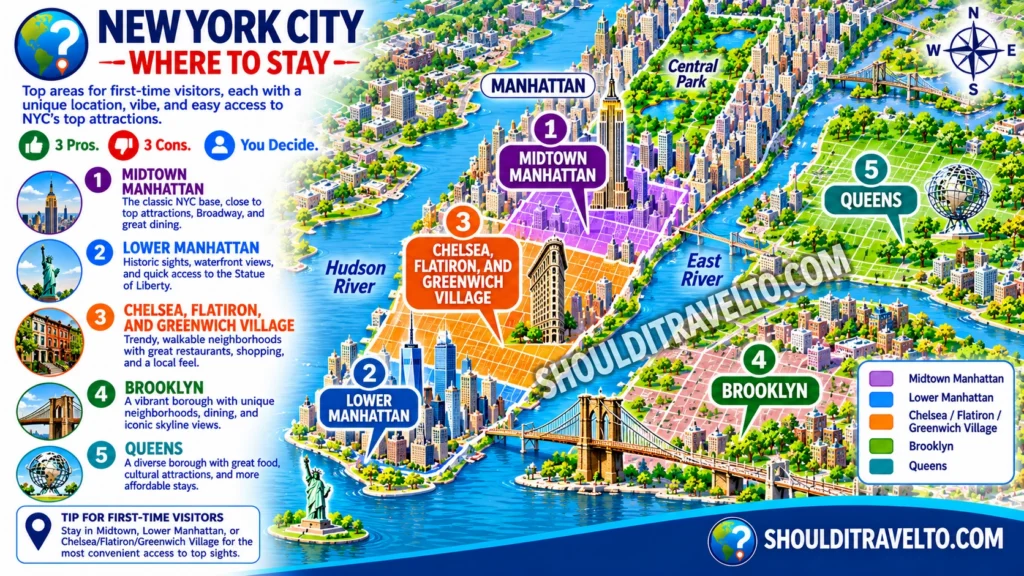
Midtown Manhattan: Best for First-Time Visitors
Midtown is convenient for Times Square, Broadway, Rockefeller Center, Fifth Avenue, and many major attractions.
It also offers extensive subway connections.
For first-time visitors who want to minimize complicated transportation, Midtown can be a practical choice. But it can be crowded, noisy, and expensive.
Lower Manhattan: Best for History and Downtown Attractions
Lower Manhattan provides access to the Financial District, Battery Park, the World Trade Center area, and historic neighborhoods.
It’s a useful base for visitors interested in American history and downtown sightseeing.
The atmosphere can vary considerably between the business district and nearby residential neighborhoods.
Chelsea, Flatiron, and Greenwich Village: Best for Neighborhood Atmosphere
These areas offer restaurants, shops, walkable streets, and access to major attractions without staying directly in Times Square.
They may appeal to travelers who want a more neighborhood-oriented experience. Hotel prices can still be high.
Brooklyn: Best for Neighborhood Exploration and Skyline Views
Parts of Brooklyn offer restaurants, waterfront parks, neighborhood character, and Manhattan skyline views.
Areas with convenient subway access can be good alternatives to Midtown.
But Brooklyn is large. A hotel in one part of the borough may be much farther from Manhattan attractions than another.
Always evaluate the specific location rather than choosing a hotel based only on the borough.
Queens: Best for Food and Potential Hotel Value
Queens offers extraordinary international food and a variety of neighborhoods.
Some areas with convenient subway access to Manhattan may provide better accommodation value.
But savings depend on the location, season, and hotel. Compare total travel time and transportation convenience before booking.
Getting Around New York City
For most visitors, walking and public transportation are the best ways to explore New York.
Subway
The subway is the backbone of New York’s transportation system.
It connects many major neighborhoods and attractions and operates around the clock, although service patterns can change overnight and on weekends.
Visitors should use current route information and check for planned service changes.
Walking
Walking is one of the best ways to experience New York.
Many neighborhoods reward exploration on foot, and some major attractions are close enough to combine into a single outing.
But distances can be deceptive. A day that looks manageable on a map may involve several miles of walking.
Buses and Ferries
Buses can be useful for destinations that aren’t convenient to subway stations.
Ferries offer transportation and, on some routes, attractive views of the skyline and waterfront.
The Staten Island Ferry is a well-known option for views of New York Harbor.
Taxis and Rideshares
Taxis and rideshares can be convenient for luggage, late-night travel, or destinations with limited transit connections.
But traffic can make them slow and expensive.
Treat them as occasional alternatives rather than your primary transportation plan.
Should You Rent a Car?
No, not for a typical New York City vacation.
A rental car usually adds parking costs, traffic complications, and unnecessary stress.
Consider renting a car only if you’re planning excursions beyond the city where public transportation isn’t practical.
Don’t Miss
New York City has far more attractions than most visitors can experience on a single vacation.
For first-time travelers, these are some of the most recognizable and rewarding places to consider.
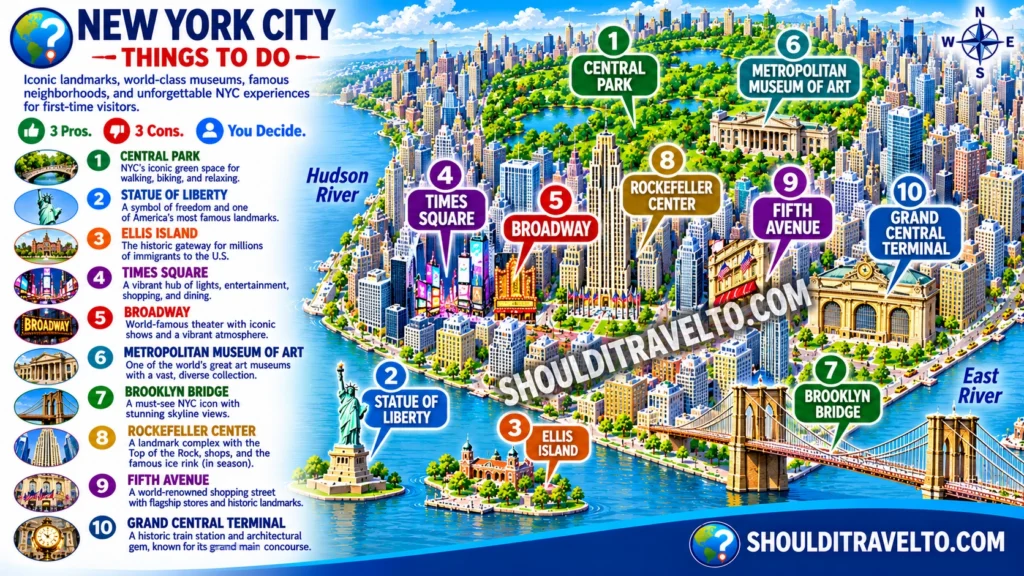
Central Park
Central Park provides an extraordinary green space in the middle of Manhattan.
Visitors can walk, relax, enjoy seasonal scenery, and explore familiar landmarks. It’s particularly attractive in spring and fall, but offers a different atmosphere in every season.
Statue of Liberty and Ellis Island
The Statue of Liberty is one of America’s most recognizable symbols.
Ellis Island adds an important connection to immigration history. Visitors interested in both landmarks should allow enough time for the ferry journey and exhibits.
Times Square and Broadway
Times Square represents the bright lights and commercial energy many visitors associate with New York.
Broadway offers a more substantial reason to spend time in the theater district. Even travelers who find Times Square overwhelming may enjoy attending a performance.
Metropolitan Museum of Art
The Metropolitan Museum of Art is one of the world’s leading art museums. Its collections span thousands of years and numerous cultures.
Art enthusiasts could spend an entire day here.
Brooklyn Bridge
Walking across the Brooklyn Bridge provides views of Manhattan, the East River, and the surrounding skyline.
It also connects visitors to Brooklyn’s waterfront neighborhoods.
The bridge can be crowded, so allow time to enjoy the experience rather than rushing across.
Rockefeller Center and Fifth Avenue
Rockefeller Center and Fifth Avenue are especially recognizable at Christmas, but they’re worth exploring year-round.
The surrounding area includes architecture, shopping, entertainment, and nearby landmarks.
Lower Manhattan and the 9/11 Memorial
Lower Manhattan combines financial history, colonial-era landmarks, waterfront attractions, and the World Trade Center site.
The 9/11 Memorial provides a place of remembrance and reflection. Visitors should approach the memorial respectfully and allow sufficient time if visiting the museum.
Grand Central Terminal
Grand Central Terminal is one of New York’s great architectural landmarks.
Its main concourse is worth visiting even if you’re not traveling by train. You can combine it with other Midtown attractions.
New York’s Neighborhoods
Some of New York’s best experiences come from exploring neighborhoods rather than major landmarks.
Greenwich Village, Chinatown, Harlem, Brooklyn neighborhoods, and food-focused areas of Queens offer opportunities to experience different sides of the city.
Choose neighborhoods based on your interests rather than trying to visit them all.
New York City for Holidays, Seasonal Travel, and Major Events
New York City isn’t just a year-round destination.
It’s also one of America’s leading cities for major holidays, seasonal celebrations, sporting events, and cultural gatherings.
For some travelers, the timing of the visit matters as much as the city itself.
A Christmas vacation offers a different experience from Thanksgiving, Valentine’s Day, or a fall foliage trip.
These are some of the strongest reasons to visit New York City during a particular season or event.
New York City for Valentine’s Day
Best for: Romantic city experiences, Broadway, fine dining, and winter walks
New York City offers couples a wide range of Valentine’s Day experiences, from a Broadway show and a special dinner to museums, observation decks, and walks through Central Park.
The city’s advantage is variety. Couples can build a romantic itinerary around their interests instead of relying on a single resort or attraction.
A winter evening with skyline views, theater, and a memorable meal can be a distinctive alternative to a beach or mountain getaway.
But February weather can be cold, and popular restaurants or romantic experiences may require advance reservations.
Why Visit: Broadway • Romantic Dining • Central Park • Skyline Views • Museums • Winter City Getaway
Explore More: Best Valentine’s Day Destinations
New York City for St. Patrick’s Day
Best for: A major Irish-American parade and historic Fifth Avenue traditions
New York City hosts one of the world’s best-known St. Patrick’s Day parades.
The annual procession along Fifth Avenue brings marching bands, Irish-American organizations, cultural groups, and spectators into Manhattan.
The parade passes St. Patrick’s Cathedral, adding a recognizable landmark to a celebration with roots reaching back to the colonial era.
For travelers interested in Irish-American heritage, the event offers another reason to visit New York.
But large crowds, street closures, and unpredictable March weather require planning.
Why Visit: Fifth Avenue Parade • Irish-American Heritage • St. Patrick’s Cathedral • Marching Bands • Cultural Traditions
Explore More: Best St. Patrick’s Day Destinations
New York City for Spring Break
Best for: Museums, Broadway, attractions, and an urban spring vacation
New York City is an appealing spring break destination for travelers who want something different from a beach or resort vacation.
Families can visit museums, parks, observation decks, and major landmarks. College students and adults may prefer restaurants, entertainment, shopping, and neighborhood exploration.
Spring temperatures can make walking more comfortable than during summer, although March and early April may still be chilly.
New York’s biggest advantage is that visitors can fill an entire vacation without relying on warm weather.
The biggest drawback is cost, particularly for families purchasing multiple attraction tickets.
Why Visit: Museums • Broadway • Central Park • Family Attractions • Shopping • Car-Free Vacation
Explore More: Best Spring Break Destinations
New York City for Summer Break
Best for: Outdoor entertainment, parks, waterfront activities, and extended city vacations
Summer brings outdoor concerts, cultural events, parks, sporting events, and waterfront experiences to New York City.
Visitors can explore Central Park, walk along the Hudson River, enjoy seasonal programming, and discover neighborhoods beyond Manhattan.
The city’s museums, restaurants, and theaters also provide indoor alternatives when the weather becomes uncomfortable.
Summer is especially appealing for travelers who want a busy, activity-filled vacation. But heat, humidity, and crowds can make sightseeing exhausting.
Why Visit: Central Park • Outdoor Events • Museums • Waterfronts • Broadway • Neighborhood Exploration
Explore More: Best Summer Destinations
New York City for Labor Day Weekend
Best for: A three-day city getaway with food, entertainment, and major attractions
Labor Day Weekend offers an opportunity to experience New York City without committing to a full week.
Visitors can spend three days exploring museums, neighborhoods, Central Park, restaurants, and Broadway.
The city’s public transportation makes it possible to enjoy a short trip without renting a car.
For travelers who prefer urban experiences over a final beach weekend, New York offers plenty of alternatives.
But late-summer heat, hotel demand, and holiday travel crowds can affect the experience.
Why Visit: Three-Day Getaway • Broadway • Museums • Restaurants • Central Park • Public Transportation
Explore More: Best Labor Day Weekend Destinations
New York City for Fall Foliage
Best for: Fall colors in urban parks combined with museums, dining, and city attractions
New York City isn’t a traditional mountain or forest fall foliage destination.
But it offers an appealing alternative for travelers who want autumn scenery without sacrificing a major city’s attractions.
Central Park, Prospect Park, and other green spaces develop seasonal color, often later than destinations farther north.
Visitors can enjoy fall walks, museums, restaurants, and neighborhood exploration during the same trip.
New York also offers access to the Hudson Valley for travelers who want a more traditional foliage excursion.
But visitors should know that peak foliage timing varies with weather, and the city’s urban scenery differs from New England’s sweeping mountain landscapes.
Why Visit: Central Park • Prospect Park • Autumn Walks • Hudson Valley Access • Museums • Fall City Atmosphere
Explore More: Best Fall Foliage Destinations
New York City for Columbus Day
Best for: The National Columbus Day Parade and Italian-American heritage
New York City hosts the National Columbus Day Parade along Fifth Avenue, one of America’s most prominent holiday celebrations.
Organized by the Columbus Citizens Foundation, the parade features marching bands, floats, cultural organizations, performers, and Italian-American community traditions.
For travelers interested in Columbus Day celebrations, New York offers a clear reason to plan a trip around the holiday.
You can also pair the parade with museums, restaurants, and neighborhood exploration during a fall city vacation.
But visitors should prepare for crowds and street closures along Fifth Avenue.
Why Visit: National Columbus Day Parade • Fifth Avenue • Italian-American Heritage • Marching Bands • Fall City Vacation
New York City for Halloween
Best for: The Village Halloween Parade, costumes, and a distinctive urban Halloween atmosphere
New York City offers a Halloween experience centered on creativity, costumes, nightlife, and neighborhood traditions.
The Village Halloween Parade in Manhattan is one of the city’s most recognizable seasonal events, bringing elaborate costumes, performers, and spectators into Greenwich Village.
Other neighborhoods offer decorations, family activities, and seasonal experiences.
New York’s Halloween identity differs from destinations such as Salem or Sleepy Hollow.
Rather than focusing primarily on witch-trial history or folklore, the city emphasizes a large, expressive urban celebration.
But crowds, late-night activity, and event logistics can make Halloween less appealing for travelers seeking a quiet or traditional small-town atmosphere.
Why Visit: Village Halloween Parade • Costumes • Greenwich Village • Nightlife • Seasonal Events
Explore More: Best Halloween Destinations
New York City for Thanksgiving
Best for: The Macy’s Thanksgiving Day Parade and a major holiday city vacation
Thanksgiving is one of New York City’s most recognizable annual celebrations.
The Macy’s Thanksgiving Day Parade brings giant balloons, floats, marching bands, performers, and enormous crowds to Manhattan.
For travelers who grew up watching the parade on television, seeing it in person can become the centerpiece of a memorable holiday trip.
Visitors can also enjoy museums, restaurants, Broadway, and the beginning of the Christmas season.
But Thanksgiving travel requires planning.
Hotels can be expensive, parade viewing areas fill early, streets close, and some attractions or restaurants operate on holiday schedules.
Why Visit: Macy’s Thanksgiving Day Parade • Giant Balloons • Marching Bands • Broadway • Holiday Atmosphere
Explore More: Best Thanksgiving Destinations
New York City for Christmas
Best for: Iconic holiday decorations, Christmas entertainment, and a big-city holiday experience
New York City is one of America’s most recognizable Christmas destinations.
The Rockefeller Center Christmas Tree, Fifth Avenue’s decorated storefronts, Bryant Park’s Winter Village, ice skating, and seasonal performances create a holiday atmosphere familiar from movies and television.
What makes Christmas in New York special is that the celebration extends beyond a single attraction.
Visitors can spend the morning exploring holiday markets, enjoy the afternoon at a museum, and finish the evening with a Broadway show or a walk through Midtown’s decorations.
But Christmas also brings some of New York’s biggest travel drawbacks.
Popular attractions become crowded, hotel prices can rise, and snow isn’t guaranteed.
Why Visit: Rockefeller Center Christmas Tree • Fifth Avenue Decorations • Bryant Park Winter Village • Radio City Christmas Spectacular • Dyker Heights Lights
Explore More: New York City for Christmas | Best Christmas Destinations
New York City for Christmas + New Year’s Eve
Best for: Travelers who want to experience both major holidays in one vacation
New York City offers an opportunity to combine two of America’s most recognizable holiday experiences.
A longer trip can include the Rockefeller Center Christmas Tree, seasonal markets, holiday performances, and the transition into New Year’s Eve.
For travelers with enough time, the city provides an unusually broad range of attractions between December 25 and January 1.
But this is also one of the most demanding periods to plan for.
Accommodation prices may be high, popular attractions can be crowded, and restaurants or performances may require advance reservations.
Visitors should also remember that some Christmas attractions close before New Year’s Day.
Why Visit: Christmas Decorations • Holiday Performances • Rockefeller Center • Times Square • Winter City Vacation
Explore More: Best Christmas + New Year’s Eve Destinations
New York City for New Year’s Eve
Best for: The Times Square Ball Drop and a globally recognized New Year’s celebration
New York City’s Times Square Ball Drop is one of the world’s most famous New Year’s Eve traditions.
The event attracts enormous crowds to Midtown Manhattan, while millions more watch the celebration on television.
For travelers who want to experience a globally recognizable New Year’s Eve spectacle, Times Square is a distinctive destination.
But watching the Ball Drop in person isn’t a casual evening activity.
Crowds arrive early, security restrictions apply, access to restrooms and food can be limited, and visitors may spend hours standing outdoors in cold weather.
New York also offers restaurants, performances, and other ways to celebrate the holiday without standing in Times Square.
Why Visit: Times Square Ball Drop • New Year’s Countdown • Midtown Manhattan • Holiday Entertainment • Iconic Celebration
Explore More: Best New Year’s Eve Destinations
New York City for Major Events
Best for: Travelers who want to build a city vacation around a major cultural or sporting event
New York City hosts major events year-round.
The US Open Tennis Championships, New York City Marathon, Tribeca Festival, major concerts, professional sports, and nationally recognized holiday parades all provide reasons to plan a visit around a particular date.
These events can add excitement to an ordinary city vacation.
They can also increase hotel demand, affect transportation, and create crowds around specific neighborhoods or venues.
For event-focused travelers, the best approach is to choose the event first, confirm its schedule, and build the city vacation around it.
Why Visit: US Open Tennis • NYC Marathon • Tribeca Festival • Professional Sports • Concerts • Major Parades
Explore More: Best Events Destinations
New York City for American Revolutionary War History
Best for: Revolutionary War history, British occupation, and the final chapter of American independence
New York City played a major role in the American Revolution.
British forces occupied the city for much of the war, and New York remained an important military and political center until the British evacuation in November 1783.
Visitors can explore sites associated with the Revolutionary era, including Fraunces Tavern, Federal Hall’s historical setting, and locations connected to the city’s colonial past.
New York is especially interesting for travelers who want to understand the Revolution beyond its most famous battlefields.
The city’s story connects the war’s military struggles with the transition to independence and the United States’ early years.
But many Revolutionary-era locations have changed considerably since the eighteenth century.
Visitors should approach New York as a historic city with surviving landmarks and interpretive sites, not as a single preserved battlefield.
Why Visit: British Occupation • Evacuation Day • Fraunces Tavern • Colonial New York • American Independence
Explore More: Best American Revolutionary War Sites
Who Should Visit New York City?
New York City appeals to a wide range of travelers, but it is especially rewarding for people who enjoy urban environments and cultural variety.
New York City Is Best For
First-time visitors to the United States: New York offers many of the landmarks and experiences people associate with American city life.
Food lovers: The variety of cuisines, restaurants, and neighborhood dining experiences is exceptional.
Museum enthusiasts: The city’s major museums can fill several days of a vacation.
Theater and entertainment fans: Broadway, concerts, comedy, and professional sports offer plenty of options.
Travelers who don’t want to rent a car: Public transportation and walkable neighborhoods make independent exploration relatively easy.
Couples and solo travelers: The city offers enough flexibility to create personalized itineraries around food, museums, neighborhoods, or entertainment.
Repeat visitors: New York rewards travelers who return to explore different neighborhoods, seasons, and events.
New York City May Not Be Ideal For
Travelers on strict budgets: Accommodation and attraction costs can make New York hard to visit on a tight budget.
Visitors who dislike crowds: The busiest areas can feel overwhelming, especially during major holidays.
Travelers seeking a quiet vacation: New York’s noise, density, and fast pace are part of everyday life.
Beach-focused travelers: Although New York has beaches, they aren’t the primary reason most tourists visit.
Visitors who prefer driving: New York is better suited to walking and public transportation.
Travelers with limited mobility: The city can be challenging because of walking distances, crowded sidewalks, and subway stations without step-free access. Careful planning can help, but accessibility varies by location.
New York City Compared to Other Cities
When choosing between New York City and other major American cities, the biggest question is what kind of vacation you want.
New York offers exceptional attractions, entertainment, food, and public transportation.
But other cities may provide better value, a more relaxed atmosphere, warmer weather, or a stronger focus on American history.
Here’s how New York City compares.
Chicago vs. New York City
Choose New York City over Chicago if:
- You want more iconic landmarks, Broadway shows, and world-famous attractions.
- You want an even wider selection of museums, neighborhoods, and international food.
- You want a city that can easily fill a week with different experiences.
Or choose Chicago over New York City if:
- You want better value for a major-city vacation.
- You prefer a more manageable pace and generally fewer crowds.
- You’re especially interested in architecture, Lake Michigan, and Chicago’s food scene.
Los Angeles vs. New York City
Choose New York City over Los Angeles if:
- You want to explore without renting a car.
- You prefer walkable neighborhoods, public transportation, and a dense urban environment.
- You want Broadway, iconic skyscrapers, and historic city attractions.
Or choose Los Angeles over New York City if:
- You want warmer, generally more comfortable weather.
- Beaches, hiking, and outdoor recreation are priorities.
- You prefer a more spread-out city experience and don’t mind driving.
Boston vs. New York City
Choose New York City over Boston if:
- You want more attractions, museums, and entertainment options.
- You prefer a larger, more energetic city with extensive nightlife.
- You want a destination that can fill a full week without running out of activities.
Or choose Boston over New York City if:
- Revolutionary War history is your primary interest.
- You prefer a smaller, more manageable city.
- You want New England character and access to regional day trips.
New York City vs. Philadelphia
Choose New York City over Philadelphia if:
- You want globally recognized landmarks, Broadway, and a famous skyline.
- You want more museums, nightlife, and entertainment choices.
- You want a longer city vacation with nearly endless possibilities.
Or choose Philadelphia over New York City if:
- American founding history is your priority.
- You want better value and a more relaxed pace.
- You prefer a compact historic core with fewer overwhelming crowds.
New York City vs. Washington, DC
Choose New York City over Washington, DC if:
- You want Broadway, nightlife, restaurants, and iconic skyline views.
- You prefer neighborhood exploration and a more energetic urban atmosphere.
- You want the widest possible variety of city attractions.
Or choose Washington, DC over New York City if:
- You want Smithsonian museums, monuments, and government landmarks.
- You prefer an educational vacation centered on American history.
- You’re traveling with family and want access to numerous free museums and attractions.
New York City isn’t automatically the best option.
Chicago may provide better value. Los Angeles offers better weather and beaches. Boston and Philadelphia emphasize American history, while Washington, DC excels in museums and monuments.
The right choice depends on your priorities.
Final Assessment
New York City is one of America’s most rewarding destinations for travelers who enjoy major cities.
Its combination of landmarks, museums, food, entertainment, neighborhoods, and public transportation makes it exceptionally versatile.
You can spend three days seeing famous attractions, five days exploring the city in greater depth, or a full week discovering neighborhoods and experiences beyond the usual tourist itinerary.
New York also offers something different year-round.
But New York isn’t an ideal vacation for everyone. Few other places offer so many different experiences in one city.
Visit New York City if you want an iconic, energetic, culturally rich urban vacation and are comfortable accepting the costs and crowds that come with it.
Consider another destination if you prioritize relaxation, lower expenses, or a slower pace.
The best city isn’t necessarily the one with the most attractions. It’s the one whose strengths match the vacation you want.
3 Pros. 3 Cons. You Decide.
New York City Frequently Asked Questions
Is New York City worth visiting for the first time?
Yes. New York City is one of America’s strongest destinations for first-time visitors who want iconic landmarks, museums, Broadway, food, and a classic urban experience. However, its costs, crowds, and fast pace may not suit travelers seeking a quiet vacation.
How many days should you spend in New York City?
Five days is a good starting point for first-time visitors. Three days lets you see the major highlights, while seven days gives you more time for museums, neighborhoods, entertainment, and exploring beyond Manhattan.
What is the best time of year to visit New York City?
September through November generally offers a strong balance of comfortable weather, fall scenery, and sightseeing opportunities. Spring is another excellent option. December is particularly appealing for Christmas activities, although holiday crowds and hotel prices can be high.
Is New York City expensive to visit?
Yes. Hotels, restaurants, Broadway shows, and major attractions can make New York an expensive vacation. However, visitors can reduce costs by using public transportation, enjoying free attractions, choosing affordable restaurants, and prioritizing paid experiences.
Do you need a car in New York City?
No. Most visitors are better off using the subway, buses, ferries, and walking. Renting a car usually adds parking costs, traffic complications, and unnecessary stress.
Is New York City safe for tourists?
Most tourists visit New York City without serious problems. As in any major city, conditions vary by neighborhood and time of day. Visitors should remain aware of their surroundings, research accommodation locations, and use normal urban precautions.
Is New York City better than Chicago, Boston, or Washington, DC?
It depends on your interests. Choose New York for iconic attractions, Broadway, food, nightlife, and a large-city experience. Chicago generally offers better value and architecture, Boston emphasizes Revolutionary history and New England character, and Washington, DC is especially strong for museums, monuments, and American history.