

Should You Visit Virginia’s Historic Triangle?
Quick Answer
Yes, you should visit the Historic Triangle in Virginia.
If you’re interested in American history, Virginia’s Historic Triangle offers one of the best historical road trips in the United States.
Within just a few miles, visitors can experience:
- Where permanent English America began at Jamestown
- How colonial Americans lived and governed at Williamsburg
- Where the American Revolution reached its decisive conclusion at Yorktown
Together, these three destinations tell nearly 175 years of American history in one remarkably compact region.
Rather than visiting one historic site and moving on, travelers can follow the story of early America from the first permanent English settlement through colonial society and ultimately to American independence.
For history lovers, few destinations in the United States offer a more complete historical journey.
What Is Virginia’s Historic Triangle?
Virginia’s Historic Triangle is the region formed by three historic destinations:
Jamestown → Williamsburg → Yorktown
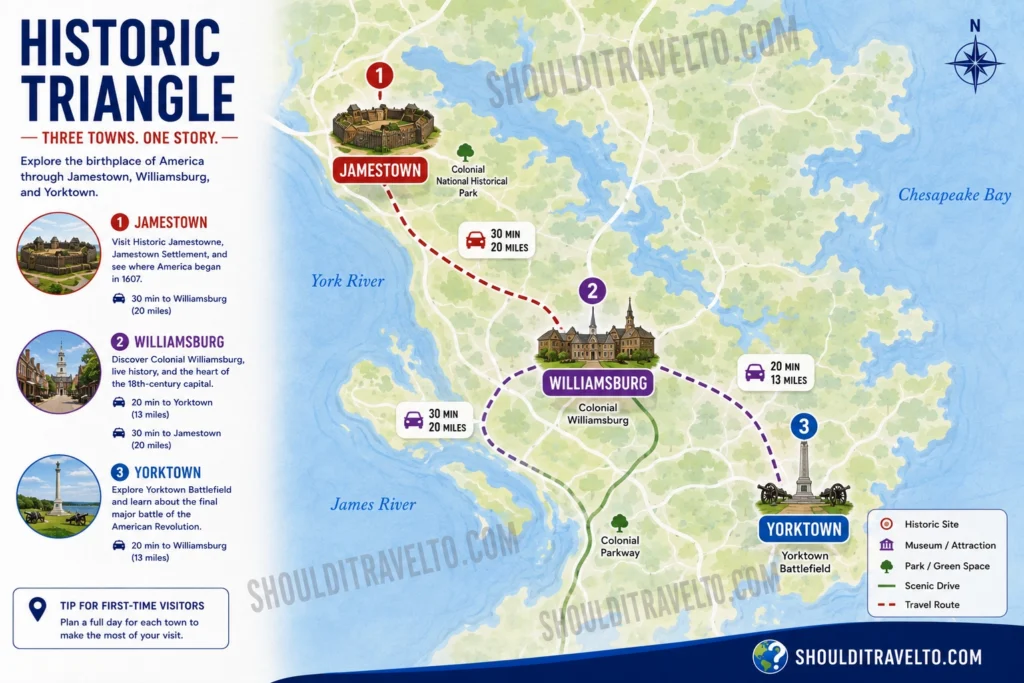
Each represents a different chapter in America’s early history.
Jamestown: The Beginning
Founded in 1607, Jamestown became England’s first permanent English settlement in North America.
Visitors can explore the archaeological remains of the original settlement at Historic Jamestowne and experience reconstructed ships, buildings, and living-history exhibits at Jamestown Settlement.
Williamsburg: Colonial Life
Williamsburg became Virginia’s colonial capital in 1699 and one of colonial America’s most important political and cultural centers..
Today, Colonial Williamsburg recreates the eighteenth-century city through restored and reconstructed buildings, historic trades, museums, gardens, and costumed interpreters.
Yorktown: Independence
In 1781, American and French forces defeated the British at Yorktown, forcing General Cornwallis to surrender.
The battlefield and American Revolution Museum at Yorktown allow visitors to explore the campaign that effectively ended major fighting in the American Revolution.
Together, They Tell the Story
Jamestown represents the beginning.
Williamsburg represents the development of colonial society.
Yorktown represents the struggle for independence.
Few American destinations connect these chapters of history so naturally.
The Biggest Difference
The biggest difference between visiting the Historic Triangle and visiting a traditional tourist destination is that the entire region is the attraction.
You aren’t traveling to one city with a list of unrelated things to do.
You’re following a historical story.
At Jamestown, you learn how permanent English settlement began.
Next, at Williamsburg, you see how colonial society developed.
At Yorktown, you learn how that society ultimately fought for independence.
The destinations become more meaningful when experienced together.
That is what makes the Historic Triangle different from simply visiting three historic attractions.
Let’s explore the top reasons to visit the Historic Triangle in Virginia.
The 3 Biggest Reasons to Visit Virginia’s Historic Triangle
The Historic Triangle combines some of America’s most important historic sites with a remarkably easy road-trip experience.
1. America’s Most Complete Colonial Experience
Few destinations provide such a continuous look at America’s early history.
Visitors can stand at the site of the first permanent English settlement, walk through a reconstructed colonial capital, and explore the battlefield where American independence was secured.
The experience covers:
- Early English settlement
- Native American history
- Colonial government
- Everyday colonial life
- Religious history
- The growth of Virginia
- The American Revolution
- The fight for independence
Instead of learning these events separately in a classroom, visitors can experience the places where they happened.
2. Three World-Class Historic Destinations Within Minutes
The Historic Triangle is unusually convenient.
Jamestown, Williamsburg, and Yorktown are connected by the Colonial Parkway, a scenic 23-mile road through forests, wetlands, and river landscapes.
That means visitors don’t have to spend hours driving between historic sites.
You can have breakfast in Williamsburg, explore Jamestown, and return to Williamsburg for dinner.
Or spend the morning at the Yorktown Battlefield and the afternoon exploring Colonial Williamsburg.
The compact geography makes the Historic Triangle particularly well suited to a three-day road trip.
3. An Easy Historical Road Trip
The Historic Triangle is also relatively easy to combine with larger Virginia or East Coast vacations.
Travelers can reach the region from:
- Washington, DC
- Richmond
- Norfolk
- Virginia Beach
Once you’re there, a car makes it easy to move between Jamestown, Williamsburg, Yorktown, and nearby attractions.
The region can therefore work as either a dedicated history vacation or a stop on a larger Virginia road trip.
Next, let’s explore the cons of visiting the Historic Triangle.
The Three Biggest Cons of Visiting the Historic Triangle
The Historic Triangle is an outstanding destination for the right traveler, but it isn’t designed for everyone.
1. You’ll Spend Several Days Visiting Historic Sites
The biggest advantage of the Historic Triangle can also be its biggest limitation.
Much of your vacation involves:
- Museums
- Historic buildings
- Battlefields
- Archaeological sites
- Walking tours
- Living-history demonstrations
- Historical exhibits
If you’re looking for nightlife, major shopping districts, beaches, or nonstop entertainment, the Historic Triangle may feel quiet.
2. You’ll Want a Car
Williamsburg itself is relatively easy to explore, but the three destinations are spread across the region.
A car makes it much easier to visit:
- Jamestown
- Historic Jamestowne
- Yorktown Battlefield
- Colonial Williamsburg
- Colonial Parkway
- Nearby plantations
- Busch Gardens Williamsburg
Public transportation and rideshare services are available, but a car offers considerably more flexibility for a Historic Triangle road trip.
3. Summer Is Hot and Humid
Virginia’s Historic Triangle is an outdoor-heavy destination, and summer can make exploring the historic sites more challenging.
Temperatures are often hot, while Virginia’s humidity can make walking around Colonial Williamsburg, Jamestown, and Yorktown feel even warmer.
That’s particularly noticeable when spending several hours outside at battlefields, archaeological sites, historic streets, and the Colonial Parkway.
If you’re sensitive to heat and humidity, spring and fall are generally more comfortable times to visit.
The upside is that summer also brings longer daylight hours, more programming, and a full schedule of living-history activities, making it a popular time for families.
For the most comfortable combination of weather and outdoor exploration, consider visiting in April–May or September–October.
Planning Your Historic Triangle Trip
The biggest advantage of the Historic Triangle is that you can experience the three destinations in a logical sequence.
Ideal 3-Day Historic Triangle Itinerary
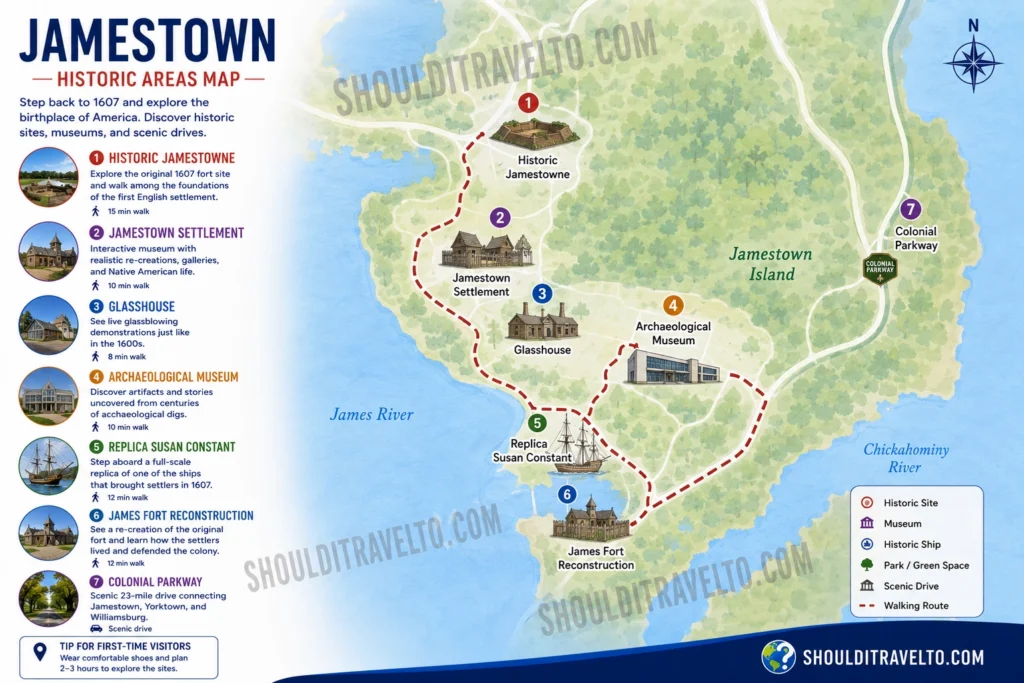
Day 1: Jamestown
Start with the beginning of the story.
Visit:
- Historic Jamestowne
- Jamestown Settlement
- Archaeological exhibits
- Reconstructed ships
- James Fort
- Colonial Parkway
Allow roughly half a day to a full day depending on how deeply you want to explore.
Jamestown is particularly valuable when visited first because it establishes the beginning of the story that continues throughout the rest of the trip.
Day 2: Williamsburg
Spend your second day experiencing colonial life.
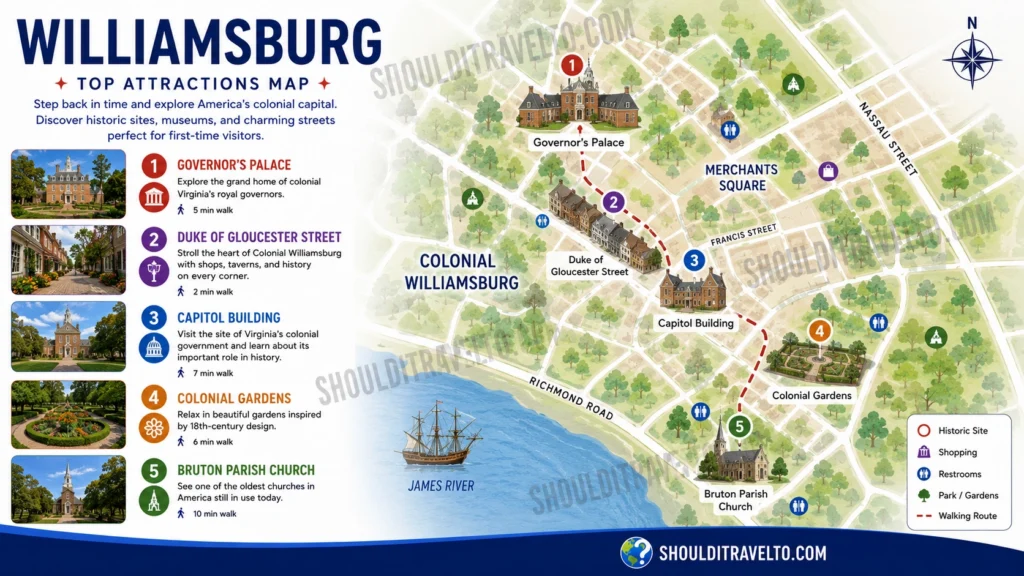
Visit:
- Colonial Williamsburg
- Governor’s Palace
- Duke of Gloucester Street
- Capitol Building
- Historic trades
- Bruton Parish Church
Williamsburg deserves the most time of the three destinations because Colonial Williamsburg is considerably larger than either Jamestown or Yorktown.
Stay overnight in Williamsburg to maximize your time in the historic area.
Day 3: Yorktown
Finish the journey with the American Revolution.
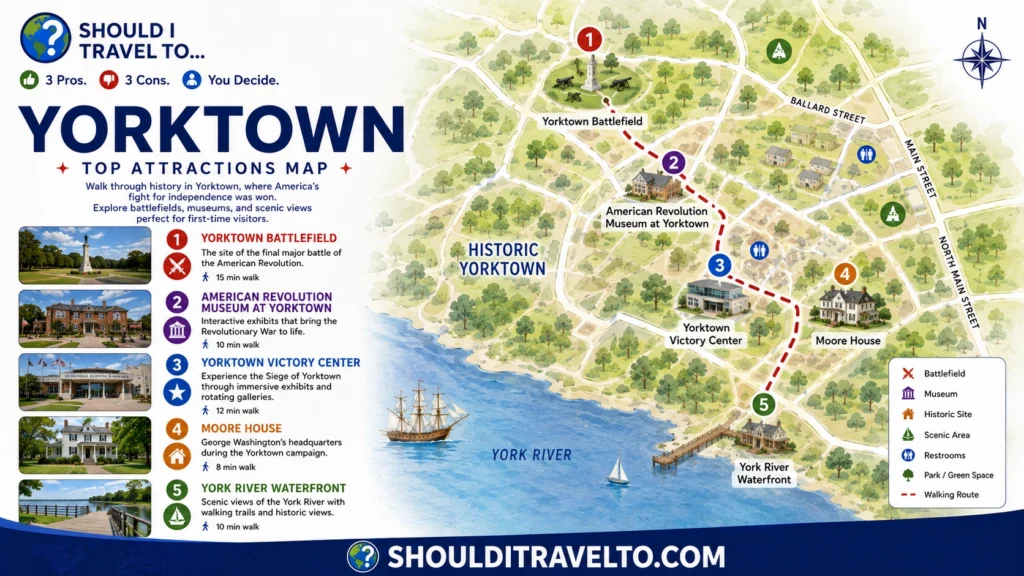
Visit:
- Yorktown Battlefield
- American Revolution Museum at Yorktown
- Surrender Field
- Moore House
- Yorktown Waterfront
The story that began at Jamestown more than 170 years earlier ends with the colonies fighting for independence at Yorktown.
Can You Visit the Historic Triangle in Two Days?
Yes, but three days is better.
A two-day trip can work if you’re primarily interested in the highlights.
Two-Day Itinerary
Day 1: Williamsburg + Jamestown
Day 2: Yorktown
The biggest drawback is that you’ll have to move quickly, particularly through Colonial Williamsburg.
Three days provides a much more comfortable pace.
How Many Days Do You Need?
1 Day
Possible, but not recommended.
You can visit one major destination or experience a very abbreviated version of two.
2 Days
Good for travelers who want the highlights.
- Williamsburg
- Jamestown
- Yorktown
3 Days
Best balance.
- Jamestown
- Colonial Williamsburg
- Yorktown
- Colonial Parkway
- Major museums and historic sites
4 Days
Best for history enthusiasts.
- Everything above
- More time in Colonial Williamsburg
- Additional museums
- Historic homes
- More battlefield exploration
- Slower pace
The Historic Triangle’s Three Signature Experiences
Rather than trying to visit every attraction, focus on one or two signature experiences at each destination.
Jamestown
Historic Jamestowne
Walk through the archaeological remains of the original settlement and see where England’s first permanent colony in North America was established.
Jamestown Settlement
Explore reconstructed ships, a fort, a Powhatan village, and living-history exhibits that depict life in the colony’s earliest years.
Williamsburg
Governor’s Palace
Tour the reconstructed residence of Virginia’s royal governors and learn about the political world that existed before independence.
Duke of Gloucester Street
Walk the heart of Colonial Williamsburg, where restored buildings, shops, taverns, gardens, and historic trades recreate the atmosphere of an eighteenth-century colonial capital.
Yorktown
Yorktown Battlefield
Explore the battlefield, defensive earthworks, redoubts, and Surrender Field where the decisive campaign of the American Revolution unfolded.
American Revolution Museum at Yorktown
Visit the museum before or after the battlefield to understand the broader military and civilian story of the Revolution.
Don’t Miss the Colonial Parkway
The Colonial Parkway isn’t simply a convenient way to get between the three destinations.
It’s part of the experience.
The 23-mile scenic road connects Jamestown, Williamsburg, and Yorktown through forests, wetlands, and river landscapes while avoiding the commercial development found along many modern highways.
For a Historic Triangle road trip, don’t rush through it.
The drive helps connect the three destinations into one journey.
Best Time to Visit the Historic Triangle
The Historic Triangle can be visited year-round, but spring and fall generally offer the most comfortable conditions for walking and exploring outdoor historic sites.
Spring
- Comfortable temperatures
- Gardens in bloom
- Excellent walking weather
- Smaller crowds than summer
Summer
- Longer operating hours
- Full programming
- Family-friendly activities
Downside: Hot, humid weather and larger crowds.
Fall
- Comfortable temperatures
- Beautiful foliage
- Excellent walking weather
- Seasonal historical events
Winter
- Smaller crowds
- Quieter historic sites
- Holiday programming in Williamsburg
Downside: Shorter days and fewer outdoor activities.
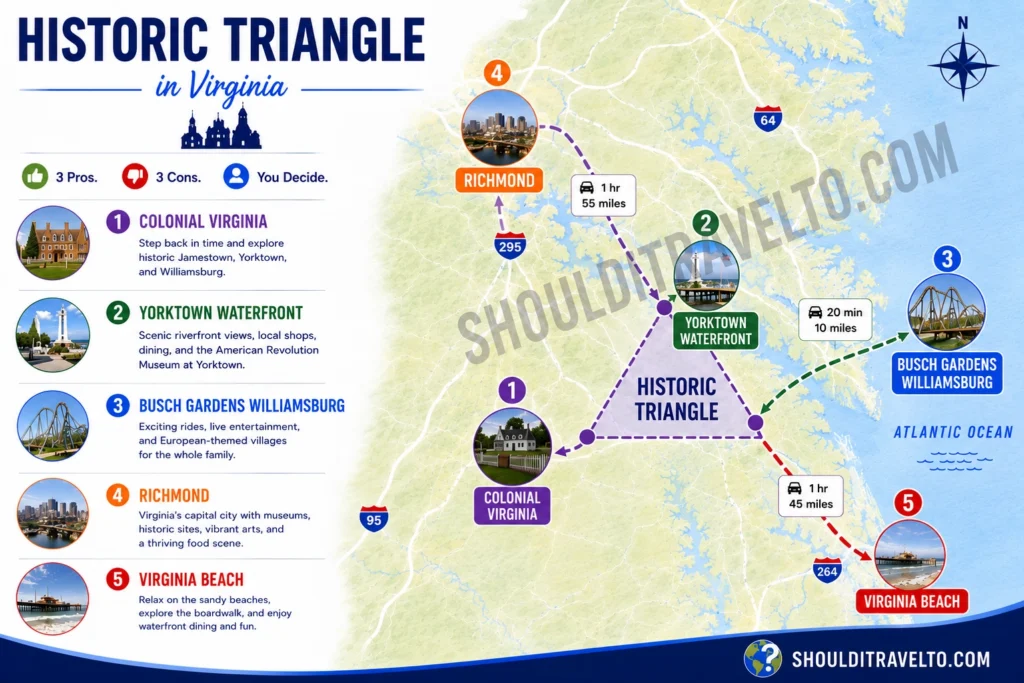
Nearby Destinations
The Historic Triangle can easily become part of a larger Virginia vacation.
Consider adding:
Richmond
Virginia’s capital offers additional attractions related to the Civil War, the Revolutionary War, and American history.
Virginia Beach
A completely different experience, with beaches and a coastal vacation atmosphere.
Busch Gardens Williamsburg
A useful addition for families who want to balance history with theme-park entertainment.
Yorktown Waterfront
Even after exploring the battlefield, visitors can relax along the York River with restaurants, shops, and waterfront scenery.
Colonial Virginia
Travelers with more time can explore additional historic homes, plantations, and communities throughout the region.
Who Should Visit the Historic Triangle?
Most people should visit the Historic Triangle in Virginia to experience American history firsthand.
The Historic Triangle is ideal for:
- American history enthusiasts
- Families
- Students
- History-focused road trips
- Revolutionary War enthusiasts
- Colonial history enthusiasts
- Educational vacations
- Travelers who enjoy museums
- Travelers who enjoy scenic road trips
You may want to skip the Historic Triangle if:
- You dislike museums
- You aren’t interested in history
- You want nightlife
- You want a beach vacation
- You only have one day
- You prefer large cities
The Historic Triangle rewards travelers who enjoy slowing down and understanding the places they visit.
Final Assessment
Virginia’s Historic Triangle isn’t simply three historic attractions placed near each other.
It’s a chronological journey through the early history of the United States.
At Jamestown, permanent English settlement begins.
Next, at Williamsburg, colonial society develops.
At Yorktown, the colonies fight for and secure independence.
That progression is what makes the region so special.
You could visit each destination separately, but experiencing all three together creates a much richer understanding of American history.
For travelers interested in the story of America’s beginnings, few road trips are more rewarding.
3 Pros. 3 Cons. You Decide.
Virginia’s Historic Triangle Frequently Asked Questions
What is Virginia’s Historic Triangle?
Virginia’s Historic Triangle consists of Jamestown, Williamsburg, and Yorktown. Together, the three destinations tell nearly 175 years of American history, from the first permanent English settlement in 1607 through the American Revolution and the British surrender at Yorktown.
How many days do you need for the Historic Triangle?
Three days is ideal for most travelers. A three-day itinerary allows one day each for Jamestown, Williamsburg, and Yorktown without rushing through the major attractions.
Can you visit Jamestown, Williamsburg, and Yorktown in one day?
Technically, yes, but it isn’t recommended. The three destinations are close together, but each has enough attractions to justify several hours of exploration. Trying to see all three in one day would mean rushing through some of America’s most important historic sites.
Do you need a car for the Historic Triangle?
A car is highly recommended. Williamsburg is relatively easy to explore on foot, but the major attractions in Jamestown and Yorktown are spread across larger areas. A car also makes it easier to travel along the Colonial Parkway and explore nearby destinations.
Which should you visit first: Jamestown, Williamsburg, or Yorktown?
If you have three days, visit them in historical order: Jamestown, Williamsburg, then Yorktown. This creates a natural chronological journey from the beginning of permanent English settlement through colonial life and ultimately to American independence.
Is the Historic Triangle good for kids?
Yes. Families can explore replica ships, reconstructed forts, living-history demonstrations, historic buildings, interactive museums, and battlefields. Younger children may enjoy the hands-on experiences at Jamestown and Williamsburg, while older children often appreciate the Revolutionary War history at Yorktown.
What is the difference between Historic Jamestowne and Jamestown Settlement?
Historic Jamestowne preserves the archaeological site of the original 1607 settlement. Jamestown Settlement is a nearby living-history museum with replica ships, a reconstructed fort, a Powhatan village, and interactive exhibits. Visiting both provides a more complete Jamestown experience.
Is Williamsburg or Jamestown better?
They offer very different experiences. Jamestown focuses on the earliest years of English settlement, archaeology, and living history, while Williamsburg recreates an entire eighteenth-century colonial capital. Travelers interested in American history should ideally visit both.
Is Yorktown part of Colonial Williamsburg?
No. Yorktown is a separate historic destination several miles from Williamsburg. It is part of Virginia’s Historic Triangle along with Jamestown and Williamsburg.
Is the Historic Triangle worth visiting?
Yes, particularly for travelers interested in American history. The combination of Jamestown, Colonial Williamsburg, and Yorktown creates one of the most complete historical journeys in the United States.
What is the best time to visit the Historic Triangle?
Spring and fall generally offer the most comfortable weather for walking and exploring historic sites outdoors. Summer offers longer hours and more programming but can be hot and humid, while winter brings smaller crowds and a quieter atmosphere.
Can you visit the Historic Triangle without staying in Williamsburg?
Yes. Travelers can stay in Yorktown, Jamestown-area accommodations, or elsewhere in the region. However, Williamsburg is a convenient base because it sits between Jamestown and Yorktown and offers the largest selection of accommodations and restaurants.
Is the Colonial Parkway worth driving?
Yes. The Colonial Parkway connects Jamestown, Williamsburg, and Yorktown through scenic forests, wetlands, and river landscapes. The drive is an important part of the Historic Triangle experience rather than simply a way to get from one attraction to another.