

Should You Visit Charleston, South Carolina, the “Holy City”?
Quick Answer
Yes, especially if you enjoy history, architecture, food, walkable neighborhoods, and Southern culture.
Charleston combines colonial history, beautifully preserved architecture, acclaimed Lowcountry cuisine, and waterfront scenery into one of America’s most distinctive city vacations.
The city feels distinct from almost every major destination in the United States, offering a slower pace than New York, a stronger historic atmosphere than Miami, and a more polished visitor experience than many Southern cities.
While Charleston can be expensive and summer weather is often hot and humid, it remains one of the most rewarding destinations in the American South.
The Biggest Mistake First-Time Charleston Visitors Make
Many first-time visitors treat Charleston as a beach destination.
While nearby beaches such as Folly Beach, Sullivan’s Island, and Isle of Palms are excellent additions to a trip, Charleston’s greatest strength is the historic city itself.
The best Charleston itineraries focus on:
- Walking the Historic District
- Touring historic homes
- Exploring waterfront parks
- Experiencing Southern cuisine
- Learning about Colonial and Revolutionary history
Visitors who spend most of their trip downtown often leave with a stronger impression than those who spend most of their time at the beach.
The Biggest Difference: Charleston Is America’s Best-Preserved Historic City
Many historic destinations preserve individual landmarks.
Charleston preserves entire neighborhoods, so much so that it’s a photogenic city. Few American cities are photographed as often as Charleston. From Rainbow Row and the Battery to hidden courtyards and church steeples, nearly every block feels postcard-worthy.
Walking through downtown Charleston feels like stepping into a different era.
Historic churches, cobblestone streets, gas lanterns, centuries-old homes, and hidden courtyards remain part of daily life.
Few American cities have preserved their architectural character as successfully as Charleston.
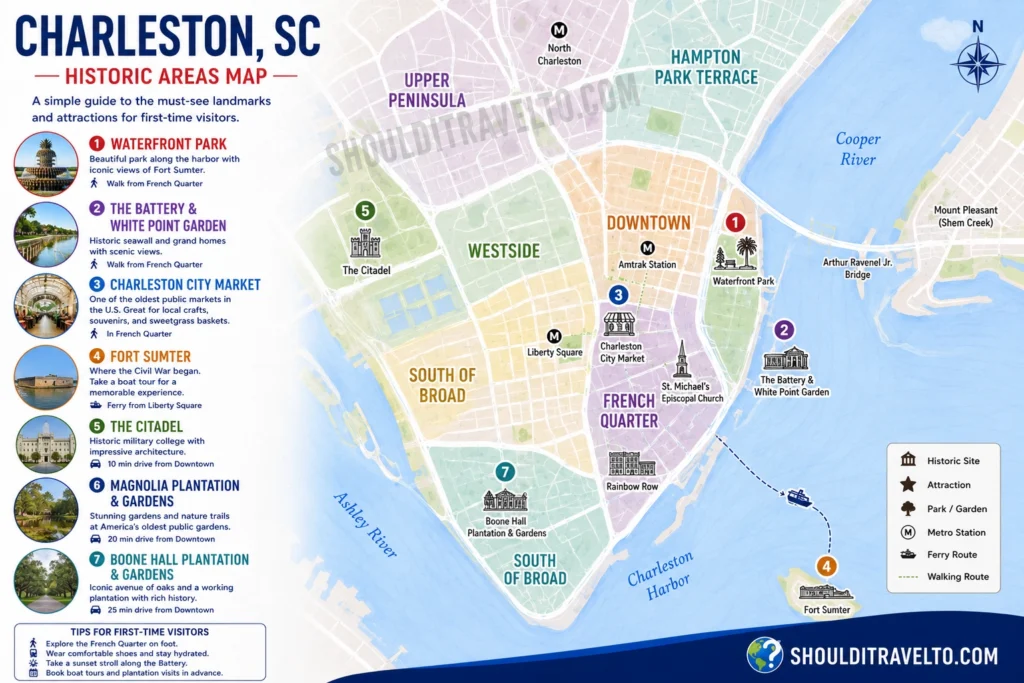
Let’s look at some reasons why people should visit Charleston, SC.
The 3 Biggest Pros of Visiting Charleston
Charleston is one of America’s most beautiful historic cities. Its beauty and outstanding food scene are two more reasons why so many people visit it.
1. America’s Best-Preserved Historic City
Charleston is often considered one of the most beautiful cities in the United States.
Visitors can explore must-see attractions, such as:
- Rainbow Row
- The Battery
- White Point Garden
- Broad Street
- King Street
- Historic churches
- Waterfront Park
- Charleston City Market
Unlike many historic cities, Charleston’s architecture extends far beyond a handful of landmarks.
Entire districts remain remarkably intact and tell the story of the city over 300 years. For example, the Charleston single house accommodates residents and keeps them comfortable in its subtropical climate.
Charleston architecture features influences from several eras, including Colonial & Georgian, Greek Revival, and Federal.
2. Outstanding Food Scene
Charleston has become one of America’s premier food destinations.
Popular local specialties include:
- Shrimp and grits
- She-crab soup
- Lowcountry boils
- Fresh seafood
- Southern barbecue
- Biscuits
- Fried green tomatoes
For many travelers, Charleston’s food scene rivals those of much larger cities because it offers a wide range of options and high quality.
3. America’s Most Important Southern History City
Charleston has preserved its history so well that the US Semiquincentennial Commission (America 250) for the 250th anniversary gave it one of four coveted spots. The others went to Boston, Philadelphia, and Washington, DC.
Charleston played important roles in:
- Colonial America
- The American Revolution
- Early American commerce
- The Civil War
Charleston played a key role in the American Revolution. In 1776, Patriot forces achieved an unlikely victory over the British during the Battle of Sullivan’s Island, helping defend the city in the early stages of the war.
During the colonial era, Charleston grew into one of America’s wealthiest and most important ports, rivaling Boston and Philadelphia in commerce and influence.
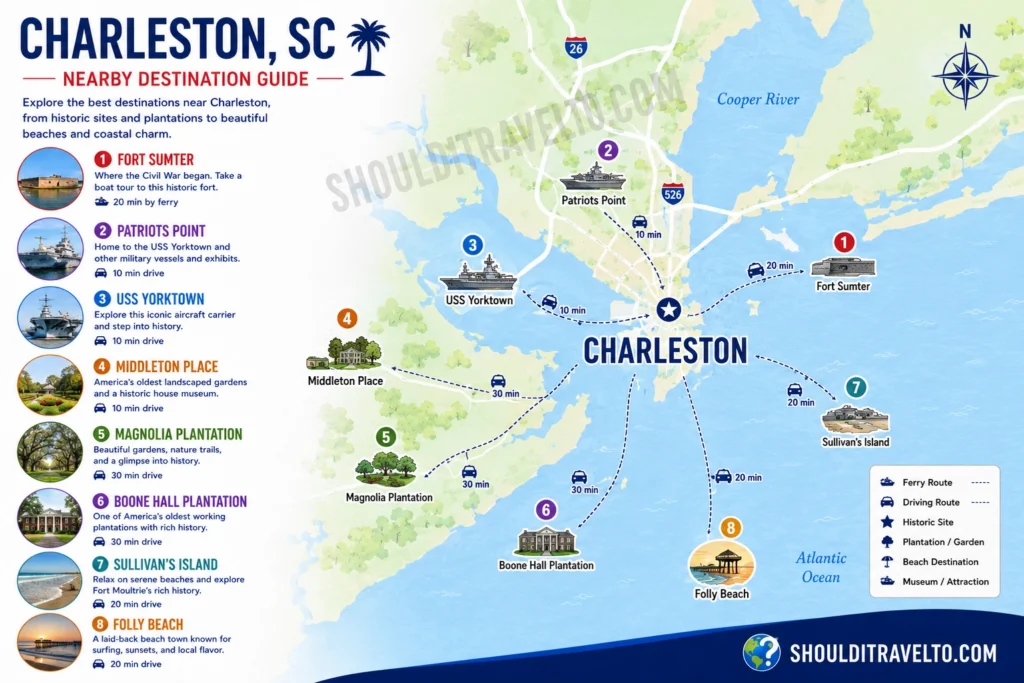
Nearby attractions include:
- Fort Sumter
- Patriots Point
- USS Yorktown
- Middleton Place
- Magnolia Plantation
- Boone Hall Plantation
- Sullivan’s Island
- Folly Beach
Boston tells the story of the Revolution.
Philadelphia tells the story of America’s founding.
Charleston tells the story of how the American South developed, from colonial settlement and Atlantic trade to the Civil War.

Now, let’s explore the tradeoffs of visiting Charleston.
The 3 Biggest Cons of Visiting Charleston
As an East Coast city, Charleston experiences hot and humid summers. Visitor demand means hotels charge higher prices despite Charleston offering a smaller portfolio of attractions than New York City or Washington, DC.
1. Summer Heat and Humidity
Charleston summers can be brutal.
Temperatures frequently reach the 90s, while humidity makes outdoor sightseeing uncomfortable.
Visitors planning summer trips should expect:
- High humidity
- Afternoon thunderstorms
- Heavy perspiration
- Crowded beaches
Therefore, visitors should pack accordingly.
2. Hotels Can Be Expensive
Charleston’s popularity has pushed hotel prices upward.
Historic downtown accommodations are particularly expensive.
Visitors seeking lower costs often stay outside the Historic District and drive into the city.
3. Smaller Attraction Portfolio Than America’s Largest Cities
Charleston offers tremendous quality but fewer attractions than major cities like:
- New York City
- Washington, DC
- Chicago
Most visitors find three to four days in Charleston, SC, ideal.
Travelers seeking a week of nonstop attractions may prefer larger destinations.
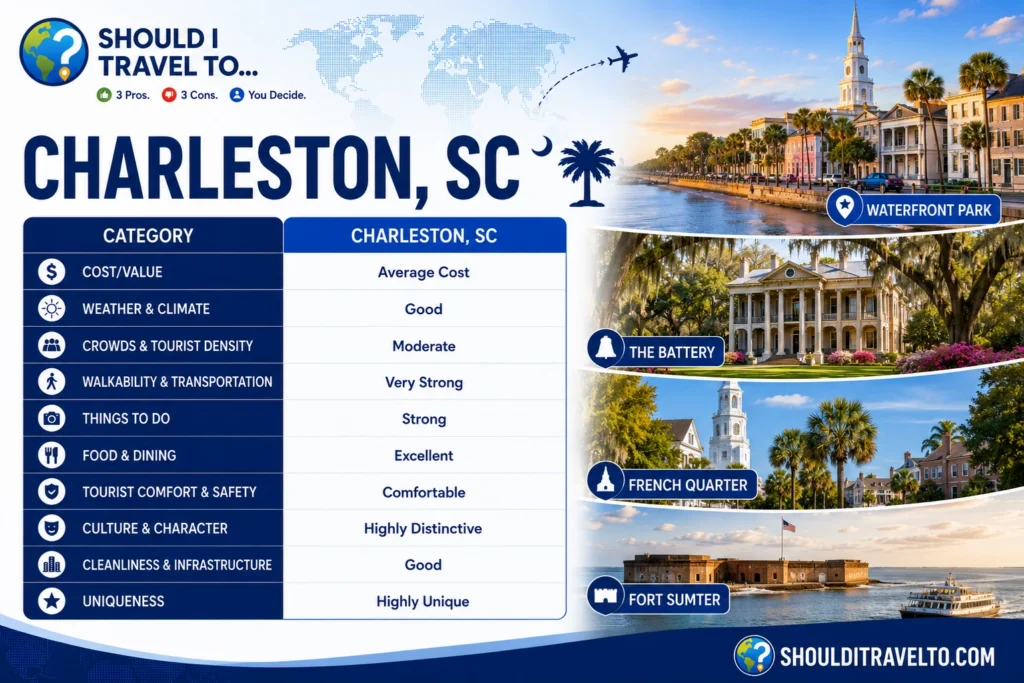
The Should I Travel To … Charleston Scorecard
Here’s how Charleston fares on the Should I Travel To … framework to help make your decision easier.
Cost / Value: Average Cost
Charleston is not a budget destination, but visitors receive a memorable experience. Hotels and dining can be expensive, especially during spring and fall.
Weather: Good
Best Time to Visit: March–May and October–November
Spring and fall offer comfortable temperatures and lower humidity.
Crowds & Tourist Density: Moderate
Popular areas become busy, but Charleston generally feels less crowded than New York City, Orlando, or Las Vegas.
Walkability & Transportation: Very Strong
Most visitors spend the majority of their time walking downtown.
While a car helps with plantations and beaches, Charleston’s historic core is highly walkable.
Things to Do: Strong
Unlike larger cities, Charleston’s attractions are concentrated within a relatively compact area, making it easy to see a great deal without constantly changing neighborhoods.
Highlights include:
- Historic District
- Fort Sumter
- Waterfront Park
- Charleston City Market
- Historic homes, such as the Nathaniel Russell House, Aiken-Rhett House, and Edmondston-Alston House
- Historic estates and gardens
- Harbor tours
- Beaches
In many ways, Charleston offers a relaxing trip full of sightseeing opportunities.
Food & Dining: Excellent
Charleston’s food scene consistently ranks among America’s best.
Few cities of its size compete with its restaurant quality.
Tourist Comfort & Safety: Comfortable
The main tourist districts are easy to navigate and welcoming to visitors.
Culture & Character: Highly Distinctive
Charleston possesses one of the strongest local identities in America.
The city feels unmistakably Southern.
Cleanliness & Infrastructure: Good
Historic areas are generally well maintained and attractive.
Uniqueness: Highly Unique
No major American city combines Southern culture, preserved architecture, waterfront scenery, and colonial history quite like Charleston.
Trip Length
Ideal: 3–5 Days
Many visitors spend:
- 1 day exploring the Historic District
- 1 day touring Fort Sumter and the harbor
- 1 day visiting plantations
- 1 day at nearby beaches
Winner: Excellent long-weekend destination.
Atmosphere / Vibe
Charleston feels:
- Historic
- Southern
- Elegant
- Relaxed
- Walkable
- Waterfront-oriented
- Food-focused
Many travelers describe Charleston as one of America’s most charming cities.
Charleston Compared to Nearby Cities
Choose Charleston over Savannah if:
- You want more attractions
- Food is important
- You want easier access to beaches
Charleston generally offers more museums, a larger restaurant scene, and easier access to beaches.
Savannah is more relaxed, offers more value, better squares, and an easier pace.
Read more: Charleston vs. Savannah
Choose Charleston over New Orleans if:
- You prefer a calmer atmosphere
- You enjoy architecture and history
- Nightlife is not your primary goal
Choose Charleston over Washington, DC if:
- You want Southern culture
- You prefer charm over museums
- Food is a higher priority
Who Should Travel To Charleston?
As a historic city, Charleston is a place most people should visit at least once. However, if you must pick between it and other travel destinations, consider the following.
Charleston Is Best For:
- History enthusiasts
- Food lovers
- Couples
- First-time Southern travelers
- Architecture lovers
- Long weekend travelers
You May Want to Skip Charleston If…
- Budget travelers
- Travelers seeking nonstop nightlife
- Visitors who dislike hot weather
- Travelers looking for a week of attractions
Boston tells the story of the American Revolution.
Philadelphia tells the story of America’s founding.
Charleston tells the story of how the American South developed, from colonial settlement and Atlantic trade to the Civil War and beyond.
Final Verdict
Charleston may not have the size of New York City or the museum collection of Washington, DC, but it delivers one of the most distinctive travel experiences in America.
Few destinations combine history, architecture, food, Southern culture, and waterfront scenery as successfully as Charleston.
For travelers looking to experience the American South, Charleston belongs near the top of the list.
The best destination isn’t the one with the highest score.
It’s the one whose strengths match what you’re looking for.
3 Pros. 3 Cons. You Decide.
Charleston, SC, Frequently Asked Questions
Is Charleston worth visiting?
Yes, Charleston is worth visiting. It is one of America’s most rewarding historic cities thanks to its architecture, food, waterfront, and Southern charm.
How many days do you need in Charleston?
Most visitors should plan to stay in Charleston for 3 to 5 days.
Three days cover the historic district and Fort Sumter, while five days allow time for exploring the plantations and nearby beaches.
What is the best time to visit Charleston?
The best time to visit Charleston is March through May and October through November, which generally offer the best combination of weather and manageable crowds.
Is Charleston expensive?
Charleston is moderately expensive.
Hotels in the Historic District can be costly, especially during spring and fall, but staying outside downtown can reduce costs.
Do you need a car in Charleston?
You do not need a car for getting around Downtown Charleston.
The Historic District is highly walkable.
In Charleston, a car becomes useful for:
- Fort Sumter ferry departures
- Boone Hall
- Magnolia Plantation
- Middleton Place
- Folly Beach
- Sullivan’s Island
- Isle of Palms
Renting a car for a Charleston trip largely depends on the intended itinerary.
What is Charleston known for?
Charleston is known for:
- Historic architecture
- Rainbow Row
- Southern food
- Fort Sumter
- Waterfront Park
- Plantations
- Lowcountry cuisine
Many visitors travel to the Southern city for its antebellum architecture and Lowcountry cuisine.
Is Charleston good for families?
Yes, Charleston is good for families.
Families enjoy:
- Fort Sumter
- Patriots Point
- USS Yorktown
- Harbor cruises
- Waterfront Park
- Beaches
- Horse-drawn carriage tours
Each one caters to groups and families with plenty to see and explore.
Is Charleston safe for tourists?
Charleston’s Historic District and primary tourist areas are generally comfortable for visitors. As with any city, remain aware of your surroundings, especially at night and outside the main tourist districts.
What food should I try in Charleston?
When visiting Charleston, don’t leave without trying:
- Shrimp and grits
- She-crab soup
- Lowcountry boil
- Fresh oysters (seasonal)
- Fried green tomatoes
- Hoppin’ John
- Biscuits
- Pimento cheese
- Oyster Roasts
These are all foods the city puts its own special twist on.
Is Fort Sumter worth visiting?
Yes, Fort Sumter is worth visiting.
Fort Sumter marks the site where the first shots of the Civil War were fired and is one of the most historically significant attractions in the Charleston area.
Are Charleston’s plantations worth visiting?
Many visitors consider Middleton Place, Magnolia Plantation, and Boone Hall Plantation among the region’s highlights. Each presents the history of the South from a different perspective, including both the beauty of the estates and the history of enslaved people who lived and worked there.
Why is Charleston called the Holy City?
Charleston earned the nickname “The Holy City” because of its historic skyline filled with church steeples and its long tradition of religious tolerance dating back to the colonial period.