Should You Visit Portland, Oregon, the City of Roses?
Quick Answer
Yes, Portland, Oregon, is worth visiting, especially if you like food, distinctive neighborhoods, parks, gardens, bookstores, local culture, and easy access to some of the Pacific Northwest’s most impressive scenery.
But Portland is more interesting than its modern reputation suggests.
Long before Portland became known for food carts, coffee, bicycles, independent businesses, and the phrase “Keep Portland Weird,” the Columbia and Willamette rivers shaped the region.
Lewis and Clark traveled through the broader area during their journey to the Pacific in 1805 and returned in 1806.
A few decades later, thousands of emigrants traveled west on the Oregon Trail toward the Willamette Valley. The migration helped transform the region, while the settlement that became Portland developed into an important river port and commercial center. Portland was incorporated in 1851.
Today, Portland combines those historical layers with something very different:
Food carts.
Independent bookstores.
Gardens.
Urban forests.
Walkable neighborhoods.
Coffee.
Breweries.
And remarkably easy access to waterfalls, mountains, rivers, and the Columbia River Gorge.
That’s Portland’s biggest advantage.
You don’t have to choose between a city trip and a Pacific Northwest nature trip.
Portland can give you both.
Things First-Time Visitors Misunderstand About Portland
Portland has such a strong image that first-time visitors may arrive expecting a caricature rather than the real city.
Portland Isn’t Just Downtown
To understand Portland, think beyond its central business district.
One of the biggest mistakes first-time visitors can make is judging Portland entirely by its downtown.
Portland is a city of neighborhoods.

The city officially recognizes more than 90, spread across the areas locals traditionally call Portland’s “quadrants,” even though it now has six major geographic sections.
The Pearl District feels different from Northwest Portland.
Hawthorne and Division feel different from downtown.
Alberta has its own personality.
Sellwood-Moreland feels different again.
And that’s important because some of Portland’s strongest experiences aren’t traditional attractions.
They’re neighborhoods.
Portland isn’t only a city you sightsee.
It’s a city you explore.
Portland Has More History Than Its Modern Reputation Suggests
Portland’s national reputation tends to emphasize its modern culture.
But the city’s location connects it to much larger stories in American history.
Lewis and Clark traveled along the Columbia through this region during the Corps of Discovery expedition.
The Oregon Trail helped bring large numbers of American emigrants into the Willamette Valley.
Portland then developed around river transportation and commerce at the confluence region of two enormously important Pacific Northwest rivers.
Its growth eventually produced a major West Coast port city.
That history remains visible through places such as the Oregon Historical Society, Pittock Mansion, Old Town, and nearby historic sites throughout the Portland-Vancouver region.
Portland Is Also a Gateway
Portland becomes a much more compelling destination when you stop treating the city limits as the boundaries of the vacation.
Don’t evaluate Portland only by what’s inside the city limits.
That’s one of the biggest differences between Portland and many traditional city destinations.
The Columbia River Gorge begins roughly 30 miles east.
Mount Hood is a day-trip option.
The Willamette Valley wine region is nearby.
And the Oregon Coast can become another extension of a longer vacation. Travel Portland describes mountains, coast, wine country, and waterfalls as all being within roughly two hours of the city.
So when evaluating Portland, ask two questions: What can I do in Portland?
And: What can Portland help me reach?
The Biggest Mistake First-Time Visitors Make
The biggest mistake is treating Portland like a traditional checklist city.
You can certainly make a list:
- Powell’s
- Washington Park
- Japanese Garden
- Rose Garden
- Pittock Mansion
- Food carts
But Portland works better when you leave room for neighborhoods.
- Walk
- Eat
- Browse
- Stop for coffee
- Explore a bookstore
- Visit a park
- Cross the river
Then spend the next day doing something completely different outside the city.
Portland rewards travelers who combine planned attractions with unplanned exploration.
What Makes Portland Different?
Portland’s biggest difference is the relationship between city life and nature.
Plenty of cities have parks.
Portland has a 410-acre Washington Park that includes the International Rose Test Garden, Hoyt Arboretum, the Oregon Zoo, the Portland Japanese Garden, and other attractions.
Then there’s Forest Park, an enormous forested area immediately beside the urban core.
Beyond Portland?
The landscape gets even bigger.
- Mountains
- Waterfalls
- The Columbia River
- The Columbia River Gorge
- Wine country
- And eventually the Pacific Coast.
So Portland’s strongest tourism proposition isn’t:
Come see America’s greatest collection of famous urban attractions.
It’s closer to: Come experience a distinctive Pacific Northwest city—and use it to explore the surrounding landscape.
3 Reasons to Visit Portland
Portland doesn’t compete with New York, Chicago, or Washington by having more famous attractions. Its strengths come from the combination of culture, food, neighborhoods, and nature.
1. Food Is Part of the Portland Experience
Food isn’t simply something you do between attractions here.
It’s one of the attractions.
Portland’s food-cart culture gives travelers an unusually informal way to sample cuisines from around the world, and Travel Portland currently lists more than 500 food carts across the city.
But don’t reduce Portland food to food carts.
- Restaurants
- Coffee
- Bakeries
- Breweries
- Farmers markets
- Local ingredients
- International cuisines
- Neighborhood restaurants
Portland’s relatively compact neighborhoods make eating your way through the city part of the exploration.
The Portland approach?
Don’t just decide what you want to see.
Decide what you want to eat along the way.
2. Portland Combines Urban Culture With Nature Exceptionally Well
Few cities make it this easy to move between urban neighborhoods and Pacific Northwest landscapes.
Spend the morning exploring a neighborhood.
Visit the Japanese Garden.
Walk through Washington Park.
Hike in Forest Park.
Then have dinner downtown or on the east side.
The following morning?
Drive east toward waterfalls in the Columbia River Gorge.
That’s a fundamentally different vacation from a city where the urban attractions are the entire reason to go.
Portland doesn’t force you to choose.
City today.
Waterfalls tomorrow.
That’s one of Portland’s strongest advantages.
3. Portland Has a Distinctive Sense of Place
Some cities are easy to compare. Portland has developed a personality that’s much harder to separate from the destination itself.
Independent businesses.
Bookstores.
Coffee shops.
Neighborhood commercial streets.
Food carts.
Bicycles.
Gardens.
Older homes.
Bridges.
The Willamette River.
The surrounding green landscape also contributes to the city’s personality.
Powell’s City of Books has become a signature attraction.
The Japanese Garden and International Rose Test Garden give Portland an entirely different identity.
Neighborhoods, rather than a single tourist district, help define the experience.
You may love Portland’s personality.
You may decide it isn’t for you.
But that’s actually a strength for this site.
Portland has character.
3 Downsides of Visiting Portland
Portland’s strengths come with trade-offs, particularly for travelers expecting a conventional bucket-list city vacation.
1. Portland Has Fewer Must-See Attractions Than America’s Biggest Tourism Cities
Portland has plenty to do.
But there’s an important distinction between things to do and world-famous attractions.
New York has the Statue of Liberty, Central Park, Broadway, Times Square, and major museums.
San Francisco has the Golden Gate Bridge, Alcatraz, cable cars, and Fisherman’s Wharf.
Portland’s appeal is more diffuse.
Powell’s.
Gardens.
Food.
Neighborhoods.
Parks.
Coffee.
Local culture.
That’s excellent for some travelers.
But someone who wants a vacation built around one famous attraction after another may find Portland less compelling.
2. Weather Can Affect the Experience
Portland’s greenery has a trade-off.
Rain and gray skies are part of the Pacific Northwest climate, particularly outside the drier summer season.
That matters more here than it might in a museum-heavy destination because so many of Portland’s strengths involve:
Walking.
Gardens.
Parks.
Neighborhoods.
Hiking.
And outdoor day trips.
Come prepared for variable weather rather than expecting sunshine every day.
3. The Best Portland Vacation May Require Leaving Portland
This is a strange downside because it’s also one of the city’s greatest strengths.
You can absolutely take a Portland-only trip.
But if you have several days, it becomes increasingly difficult to ignore what’s nearby.
The Columbia River Gorge.
Mount Hood.
Willamette Valley.
Oregon Coast.
Suddenly, a four-day Portland trip can become a two-day Portland trip plus two days of regional exploration.
That’s not necessarily bad.
But it means travelers should decide what they’re booking: A Portland city break?
Or: A Portland-based Pacific Northwest vacation?
Those aren’t quite the same trip.
The Should I Travel To … Portland Scorecard
Portland scores particularly well for food, character, and getting around without a car. Its biggest limitations are weather, a smaller collection of famous attractions, and the fact that some of the region’s best experiences sit outside the city itself.
| Category | Portland |
| Cost / Value | Average |
| Weather & Climate | Good |
| Crowds & Tourist Density | Moderate |
| Walkability & Transportation | Easy Without a Car |
| Things To Do | Strong |
| Food & Dining | Exceptional |
| Tourist Comfort & Safety | Generally Comfortable |
| Culture & Character | Highly Distinctive |
| Cleanliness & Infrastructure | Mixed |
| Uniqueness | Highly Distinctive |
Portland’s American History
Portland isn’t primarily an American history destination like Boston, Philadelphia, or Williamsburg. But understanding its history makes the modern city considerably more interesting. The Columbia and Willamette rivers connect Portland to exploration, westward migration, commerce, and the larger American expansion into the Pacific Northwest.
Lewis and Clark
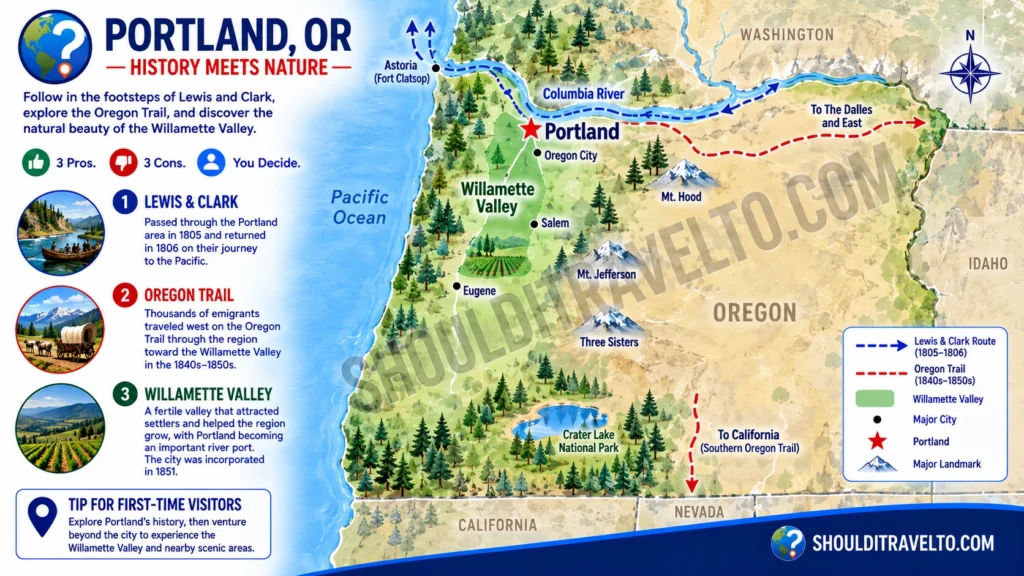
Portland didn’t exist when Lewis and Clark reached this part of the Pacific Northwest, but the expedition traveled through the river landscape that would eventually help shape the city.
In 1805, the Corps of Discovery traveled down the Columbia toward the Pacific Ocean.
They returned through the region in 1806.
The expedition wasn’t traveling through “Portland” as we understand it today. The city didn’t exist yet, but Lewis and Clark explored the river system and landscape that would later become central to Portland’s development.
Their expedition was also part of a much larger American interest in understanding, mapping, trading with, and ultimately expanding into the Pacific Northwest. The National Park Service connects the expedition directly with the subsequent American push into Oregon Country.
Lewis and Clark didn’t discover Portland.
They traveled through the river landscape that would eventually help create it.
The Oregon Trail and the Willamette Valley
If Lewis and Clark helped introduce many Americans to the Pacific Northwest, the Oregon Trail helped bring large-scale American migration into the region.
A few decades later, another movement transformed the region.
The Oregon Trail.
By the 1840s, more and more American emigrants were traveling thousands of miles west toward Oregon Country.
The 1843 “Great Migration” included nearly 1,000 people, and by 1846 thousands of emigrants had traveled west.
Many were ultimately seeking land and opportunity in the Willamette Valley.
The traditional Oregon Trail terminus is associated with Oregon City, not Portland.
That’s an important distinction.
But Portland grew within the larger region that migration transformed.
Its location near the Willamette and Columbia rivers helped it develop into an increasingly important transportation, trade, and commercial center.
The Oregon Trail brought settlers to the region.
The rivers helped Portland grow into a city.
That’s the historical connection I’d emphasize.
From Stumptown to Portland
By the mid-nineteenth century, the story shifts from regional migration to the creation of Portland itself.
Portland’s early development was anything but polished.
Forests were cleared.
Stumps remained throughout the growing settlement.
And “Stumptown” became one of Portland’s early nicknames.
The city also famously received its name after Asa Lovejoy of Massachusetts and Francis Pettygrove of Maine reportedly settled their naming dispute with a coin toss.
Pettygrove won.
Portland, Maine beat Boston, Massachusetts.
The famous “Portland Penny” is preserved by the Oregon Historical Society. Portland was incorporated in 1851.
It’s one of those small historical stories that tells you almost nothing about national history—but makes visiting the city more fun.
Portland could have been Boston.
Planning Your Portland Trip
Portland works best when you combine a few signature attractions with food, neighborhoods, parks, and time to explore without a rigid schedule. Here’s how I’d build a first trip.
Best Things to Do in Portland
For a first trip, combine Portland’s signature attractions with neighborhoods and at least one historical stop.
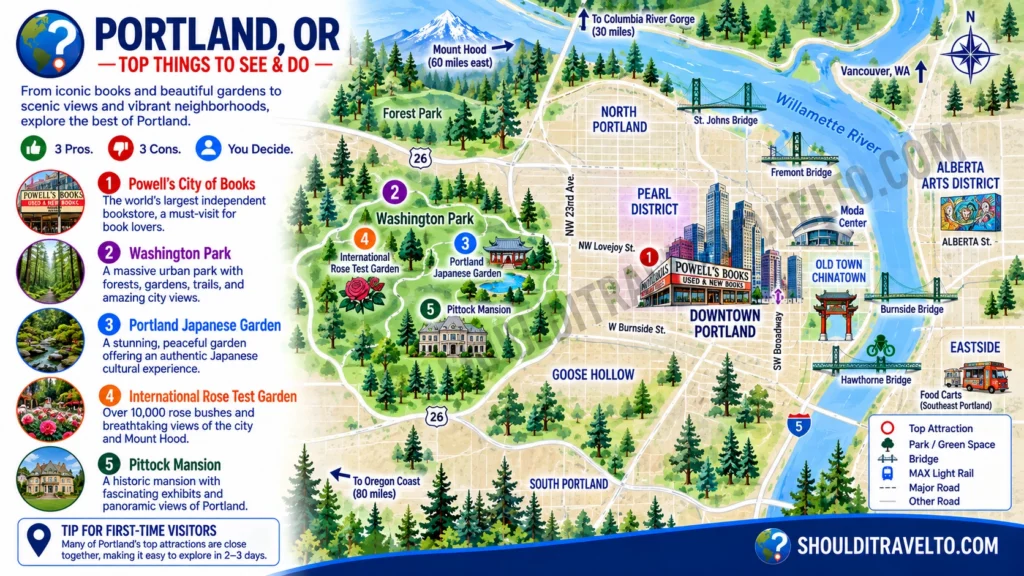
Powell’s City of Books
Even travelers who don’t normally treat bookstores as tourist attractions should consider Powell’s.
Its flagship store occupies an entire city block in the Pearl District and has become one of Portland’s most recognizable institutions.
Give yourself time.
This isn’t a five-minute photo stop.
Washington Park
Washington Park is one of the easiest ways to understand Portland’s relationship with green space.
The 410-acre park includes multiple major attractions and receives roughly 3.5 million visitors annually.
You could easily spend much of a day here.
Portland Japanese Garden
The Japanese Garden is one of Portland’s signature attractions.
Founded in 1963, it sits in a wooded setting in Washington Park and offers a dramatically different experience from downtown or Portland’s commercial neighborhoods.
Combine it with the International Rose Test Garden.
International Rose Test Garden
Portland isn’t called the Rose City accidentally.
The International Rose Test Garden dates to the early twentieth century and remains one of Washington Park’s signature attractions.
For garden lovers, combining it with the Japanese Garden makes Washington Park one of Portland’s strongest half-day experiences.
Pittock Mansion
Pittock Mansion gives you two things at once:
Portland history.
And one of the city’s signature viewpoints.
The historic estate sits high in the West Hills and provides context for Portland’s development and the people who helped shape the growing city.
For this particular guide, I’d elevate Pittock Mansion more than a generic Portland article might because it supports your history angle.
Oregon Historical Society
If you’re interested in the history we’ve just discussed, put the Oregon Historical Society on the itinerary.
It’s where the Lewis and Clark story, Oregon Trail migration, Portland’s development, and the state’s broader story can begin to fit together.
And yes, you can see the Portland Penny is associated with the city’s naming story.
Explore Portland’s Neighborhoods
Don’t spend the entire trip moving between attractions.
Pick one or two neighborhoods and explore.
- The Pearl District
- Northwest Portland
- Hawthorne
- Division
- Alberta
- Sellwood-Moreland
Which neighborhoods make sense will depend on what you want to eat, shop for, or experience.
This isn’t filler between the attractions.
The neighborhoods are part of the attraction.
Eat at a Food Cart Pod
You don’t need one universally agreed-upon “best” food cart.
That’s missing the point.
Choose a pod, walk around, see what looks interesting, and try something you wouldn’t normally order.
Portland’s hundreds of food carts make this one of the easiest signature experiences to incorporate into almost any itinerary.
Don’t Miss
If you have limited time, prioritize:
Washington Park + Japanese Garden + Powell’s + one neighborhood + one great Portland meal.
Then add Pittock Mansion or the Oregon Historical Society if you’re interested in the city’s history.
And if you have an extra day? That’s when Portland’s location becomes a major part of the decision.
The Portland Day Trip You Should Seriously Consider
If you have one extra day, Portland’s location becomes one of its biggest advantages.
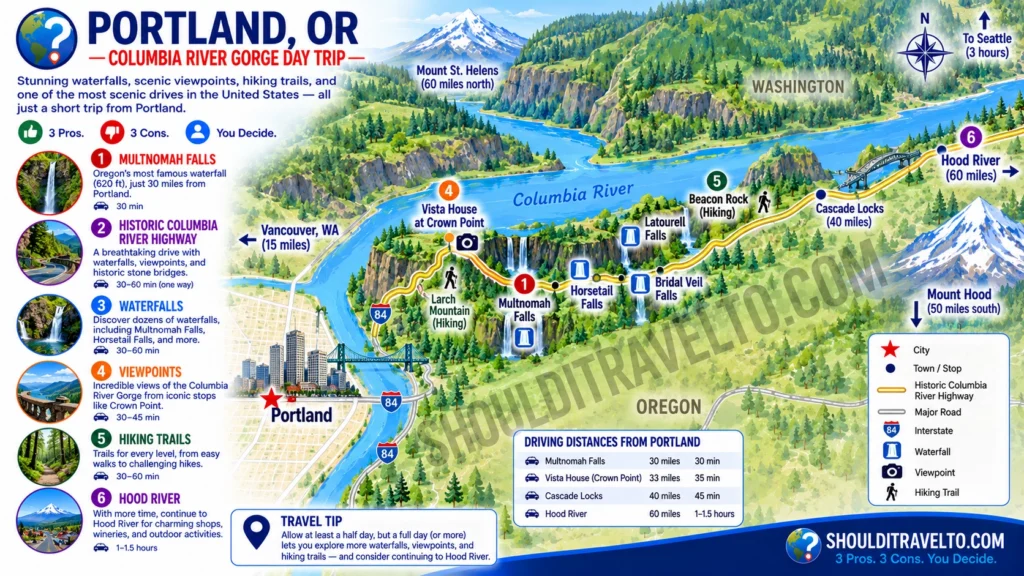
Columbia River Gorge
The Columbia River Gorge begins only about 30 miles east of Portland.
That means a first-time traveler can stay in Portland and spend an entire day exploring:
Multnomah Falls.
The Historic Columbia River Highway.
Waterfalls.
Viewpoints.
Hiking trails.
The Columbia River.
Cascade Locks.
And, with more time, Hood River.
This isn’t an obscure excursion requiring a major detour.
The Columbia River Gorge is one of Portland’s strongest tourism advantages.
Getting Around Portland
Portland is relatively visitor-friendly for those who don’t want to rent a car. Portland is easier to navigate without a car than many western US cities, but whether you should rent one depends heavily on how far beyond Portland you plan to explore.
TriMet operates buses and MAX light rail, while Portland Streetcar serves the central city. MAX also connects Portland International Airport with the city and broader metro area.
Walking works particularly well within individual neighborhoods.
Biking is another option.
So for a Portland-only vacation?
You can comfortably visit without a car.
But the calculation changes if you’re using Portland as a regional base.
Columbia River Gorge.
Mount Hood.
Willamette Valley.
Oregon Coast.
For those trips, a car generally offers much more flexibility, although regional transit options do serve parts of the Gorge.
How Many Days Do You Need in Portland?
Portland can work as a short city break, but adding even one extra day changes the trip considerably, giving you time to explore beyond the city.
1 Day: Enough for highlights.
Washington Park.
Powell’s.
Food.
One neighborhood.
You’ll understand Portland, but you won’t really settle into it.
2 Days: A good city break.
Day 1: Central Portland + Powell’s + neighborhoods + food.
Day 2: Washington Park + Japanese Garden + Pittock Mansion + another neighborhood.
3 Days: Best first Portland trip.
Two days in Portland.
One day in the Columbia River Gorge.
4–5 Days: Portland becomes a regional base.
Add another day for Mount Hood, Willamette Valley, additional Gorge exploration, or simply a slower Portland day.
Two days gives you Portland. Three days gives you Portland and the Gorge.
Best Time to Visit Portland
Portland changes noticeably with the seasons, and the best time to visit depends largely on how much of your trip you plan to spend outdoors.
Spring
Green landscapes, gardens, flowers, and milder temperatures make spring attractive, though rain is still possible.
Summer
For many first-time visitors, summer provides the easiest Portland experience.
Longer days and generally drier weather work especially well for neighborhoods, parks, outdoor dining, hiking, and Gorge day trips.
Fall
Fall is particularly interesting for your site.
The city cools down.
Autumn color appears.
Harvest season adds another dimension to regional travel.
And the Columbia River Gorge can become a fall foliage destination in its own right.
That makes Portland an excellent city-and-foliage combination.
Winter
Winter is quieter and wetter.
It can work well for food, bookstores, coffee, museums, and a lower-key city trip, but travelers prioritizing outdoor exploration may prefer another season.
Who Should Visit Portland?
Portland works particularly well for travelers who value experiences and atmosphere as much as famous attractions.
Best for:
- Food travelers
- Outdoor travelers
- Neighborhood explorers
- Coffee enthusiasts
- Beer enthusiasts
- Road trippers
- Pacific Northwest first-timers
- Travelers combining cities and nature
- Travelers interested in Oregon history
Skip Portland if:
- A huge collection of famous attractions
- Guaranteed sunny weather
- A resort vacation
- A traditional historic city
- A tightly packed bucket-list sightseeing itinerary
How Does Portland Compare With Other Cities?
Portland overlaps with several West Coast destinations, but the strongest alternatives depend on whether you’re prioritizing the Pacific Northwest, famous attractions, food, neighborhoods, or access to nature.
Portland vs. Seattle
In many cases, Portland and Seattle are natural alternatives for travelers planning their first Pacific Northwest city trip.
Seattle feels like the bigger Pacific Northwest city.
Portland feels more like an intimate Pacific Northwest lifestyle trip.
Seattle has the more recognizable skyline and famous attractions.
Moreover, Portland makes a particularly strong case for food, neighborhoods, gardens, independent culture, and easy integration with an Oregon road trip.
Portland vs. San Francisco
Portland and San Francisco both combine distinctive urban culture with easy access to natural scenery, but the vacations feel very different.
San Francisco wins for iconic attractions.
Golden Gate Bridge.
Alcatraz.
Cable cars.
Distinctive architecture.
Portland wins for a lower-key vacation centered on neighborhoods, food, greenery, and access to Oregon’s natural landscapes.
The question becomes: Do you want the more iconic city trip, or the more relaxed city-and-nature trip?
Final Assessment
Portland isn’t the Pacific Northwest’s answer to New York.
And it doesn’t need to be.
You don’t visit primarily to race between world-famous landmarks.
You visit to experience the city.
Eat from a food cart.
Browse Powell’s.
Walk through a neighborhood.
Visit a garden.
Learn how the Columbia and Willamette rivers shaped the region.
Understand how exploration, migration, trade, and the Oregon Trail helped transform the Pacific Northwest.
So, should you travel to Portland?
Yes, especially if you want a city vacation where food, neighborhoods, history, and nature all belong on the same itinerary.
3 Pros. 3 Cons. You Decide.
Portland, Oregon, Frequently Asked Questions
Is Portland, Oregon worth visiting?
Yes, especially for travelers interested in food, neighborhoods, gardens, bookstores, parks, local culture, and Pacific Northwest scenery. Portland becomes even more compelling when combined with the Columbia River Gorge.
What is Portland best known for?
Portland is particularly known for food carts, coffee, breweries, independent businesses, Powell’s City of Books, gardens, parks, cycling culture, distinctive neighborhoods, and easy access to outdoor recreation.
How many days do you need in Portland?
Two days work well for the city itself.
Three days is better for a first trip because it gives you two days in Portland and one day for the Columbia River Gorge.
Do you need a car in Portland?
Not necessarily. Portland has buses, MAX light rail, and streetcars, and many visitor areas are walkable. A car becomes more useful if you’re planning regional day trips.
How far is the Columbia River Gorge from Portland?
The western Columbia River Gorge begins roughly 30 miles east of Portland, making it one of the city’s easiest and most rewarding regional excursions.
Did Lewis and Clark visit Portland?
Lewis and Clark traveled through the broader Columbia River region in 1805 and again on their return in 1806, before Portland existed as a city. It’s more accurate to connect Portland with the river landscape the expedition traversed than to say Lewis and Clark visited the modern city.
Is Portland on the Oregon Trail?
Portland itself is not the traditional end of the Oregon Trail. Oregon City, south of Portland, is traditionally associated with the trail’s terminus. Portland developed within the broader Willamette Valley region transformed by Oregon Trail migration.
Is Portland good for history lovers?
Yes, although history probably shouldn’t be the sole reason for a first trip. The Oregon Historical Society, Pittock Mansion, Old Town, and nearby regional sites add meaningful historical context to a vacation primarily built around Portland’s food, culture, neighborhoods, and landscapes.
Is Portland a good base for the Columbia River Gorge?
Yes. In fact, this is one of Portland’s strongest advantages for first-time visitors. The western Gorge begins about 30 miles east of the city, making Portland a practical base for travelers who want to combine urban sightseeing with waterfalls, hiking, and Columbia River scenery.