

Should You Visit Shenandoah National Park for Fall Foliage?
Quick Answer
Yes, you should travel to Shenandoah National Park for fall foliage if you want Blue Ridge Mountain scenery, panoramic overlooks, hiking, waterfalls, wildlife, and one of the most accessible scenic fall drives in the eastern United States.
And for many travelers, one attraction defines the experience: Skyline Drive.
Running 105 miles along the crest of Virginia’s Blue Ridge Mountains, Skyline Drive is the only public road through Shenandoah National Park. Along the way, travelers encounter mountain overlooks, hiking trailheads, forests, waterfalls, lodging, and some of the park’s most recognizable scenery.
That makes Shenandoah particularly appealing to fall travelers who want dramatic mountain scenery without having to build their entire vacation around strenuous hiking.
You can hike to a summit.
Walk to a waterfall.
Spend the night inside the park.
Or simply drive Skyline Drive and stop at overlooks along the way.
And there’s another enormous advantage:
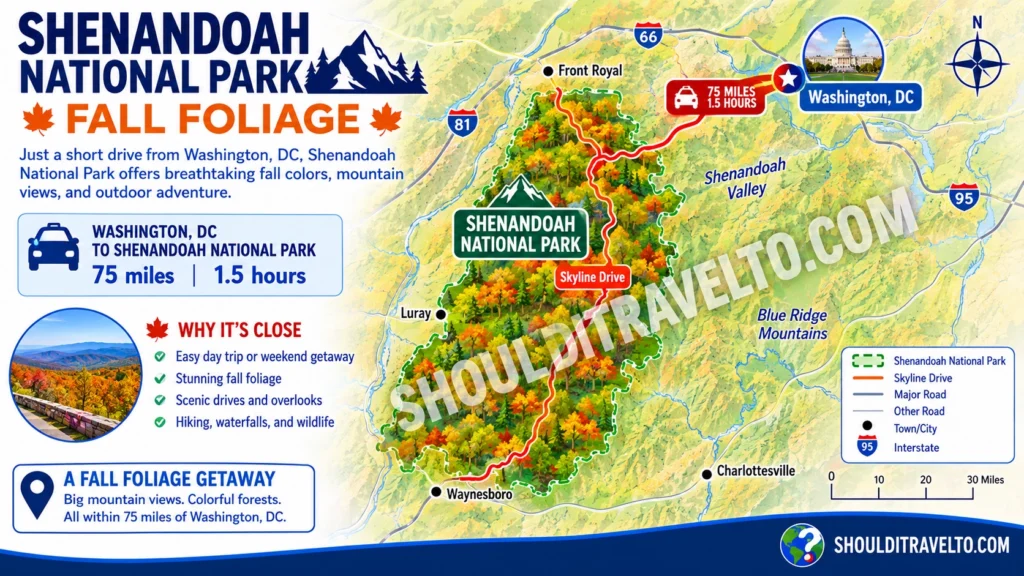
Washington, DC is only about 75 miles away.
That makes Shenandoah one of the easiest major fall foliage destinations to combine with a major US city.
For many travelers, the decision is simple:
Washington, DC gives you the city trip.
Shenandoah gives you the fall escape.
What Is Shenandoah National Park?
Shenandoah National Park protects nearly 200,000 acres along Virginia’s Blue Ridge Mountains.
The park is long and relatively narrow, stretching through the mountains from the Front Royal area in the north toward Waynesboro in the south.
And unlike the Adirondacks, which encompass an enormous mixture of communities, public land, private land, mountains, lakes, and roads, Shenandoah is much easier for a first-time visitor to understand.
There’s one road that ties almost everything together: Skyline Drive.
The 105-mile road runs north-south along the crest of the Blue Ridge Mountains and is the only public road through the park. Most campgrounds, lodging, dining, visitor facilities, and many hiking trailheads are directly accessible from it.
So for a first-time fall foliage trip, the geography is unusually straightforward.
Enter Shenandoah.
Get on Skyline Drive.
Then use the road to explore the park.
Why Is Shenandoah So Easy to Combine With a Washington, DC Visit?
This may be one of Shenandoah’s biggest advantages over other famous foliage destinations.
Shenandoah National Park is only about 75 miles from Washington, DC.
That means travelers don’t necessarily have to choose between a city vacation and a mountain foliage trip.
You can spend several days exploring Washington’s monuments, museums, neighborhoods, restaurants, and historic sites, and then head west toward the Blue Ridge Mountains.
For travelers flying into the region, that creates a particularly strong combination:
Washington, DC + Shenandoah National Park.
And in fall, the contrast is excellent.
Monuments and museums first.
Mountains and foliage next.
What Makes Shenandoah for Fall Foliage Different?
The answer is Skyline Drive.
Many fall foliage destinations have famous scenic roads.
Shenandoah is different because its primary scenic road essentially becomes the organizing structure for the entire national park.
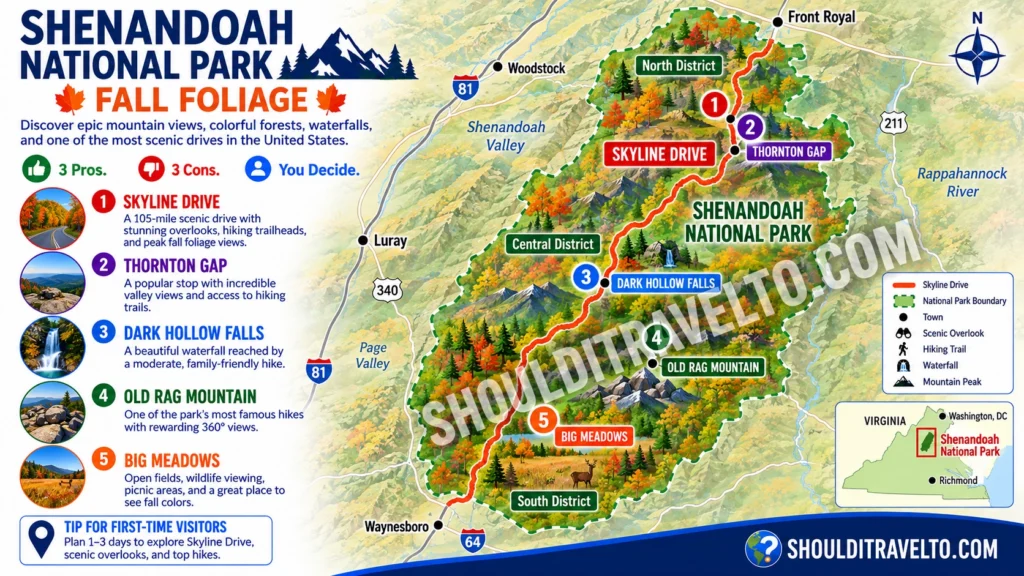
Skyline Drive follows the crest of the Blue Ridge Mountains for 105 miles.
Instead of simply driving beneath colorful trees, travelers repeatedly reach expansive overlooks across the Shenandoah Valley to the west and the Virginia Piedmont to the east. The road was specifically designed to provide scenic views from the mountain crest.
That creates a distinctive fall experience.
Drive.
Overlook.
Hike.
Waterfall.
Repeat.
And because so much of the scenery is accessible directly from the road, Shenandoah works particularly well for groups with varying activity levels.
You don’t have to hike all day to experience the mountains.
But if you want to hike?
There are about 500 miles of trails.
The Biggest Mistake First-Time Fall Visitors Make
The biggest mistake is assuming you need to drive all 105 miles of Skyline Drive.
You don’t.
The National Park Service estimates that driving the entire road takes approximately three hours on a clear day without substantial stops.
But that’s not really how you experience Shenandoah.
You’ll want to stop at overlooks.
Take photographs.
Go hiking.
Visit waterfalls.
Watch for wildlife.
Eat.
And occasionally do absolutely nothing except look across layers of the Blue Ridge Mountains.
Trying to drive the entire park while also experiencing everything along the way can turn a scenic fall trip into a race.
For a short visit: Choose a section of Skyline Drive and explore it properly.
The second mistake?
Assuming the entire park peaks at exactly the same time.
It doesn’t.
Shenandoah stretches for more than 100 miles and contains substantial elevation differences. NPS explicitly warns that fall color can vary dramatically from one area to another and that predicting one universal peak date is impossible.
So don’t chase one supposedly perfect date.
Follow current conditions.
The 3 Biggest Reasons to Visit Shenandoah During Fall
Shenandoah combines one of America’s most recognizable mountain drives with hiking, waterfalls, expansive overlooks, and unusually easy access from Washington, DC. But three advantages make it particularly compelling during fall.
1. Skyline Drive Is One of America’s Great Fall Drives
This is the biggest reason to come.
Skyline Drive isn’t simply transportation through Shenandoah.
It’s one of the attractions.
The road follows the crest of the Blue Ridge Mountains for 105 miles, repeatedly opening to expansive mountain and valley views.
During fall, those views become layered with autumn color.
You can stop at an overlook.
Drive through colorful forest.
Continue along the ridge.
Stop again.
And watch the landscape change throughout the day.
You don’t need one famous viewpoint.
The road gives you dozens of opportunities to find your own.
That’s what makes Shenandoah so approachable for first-time foliage travelers.
2. You Can Combine Scenic Driving With Hiking and Waterfalls
Shenandoah isn’t only a driving destination.
The park contains about 500 miles of hiking trails, including approximately 101 miles of the Appalachian Trail.
That creates an easy formula for a fall day:
Drive.
Stop.
Hike.
Return to the car.
Continue.
Some trails lead to mountain viewpoints.
Others lead through forest.
And others reach waterfalls.
Dark Hollow Falls, for example, is one of Shenandoah’s most popular hikes and offers a relatively short waterfall experience, though the trail includes steep sections.
So Skyline Drive doesn’t limit your experience to the car.
It gives you access to everything else.
3. Shenandoah Is Exceptionally Accessible From Washington, DC
Shenandoah offers a genuine Blue Ridge Mountains foliage experience, approximately 75 miles from Washington, DC.
That makes it unusually practical.
You can build a dedicated Shenandoah vacation.
But you don’t have to.
You can add Shenandoah to a trip to Washington, DC.
Turn a DC vacation into a city-and-mountains itinerary.
Or use Washington as the starting or ending point of a longer Virginia road trip.
For travelers who want spectacular fall scenery without flying into a remote mountain region, Shenandoah makes an unusually strong case.
The 3 Biggest Downsides of Visiting Shenandoah in Fall
Shenandoah’s accessibility and famous scenic drive also create several important trade-offs.
1. Fall Weekends Can Be Extremely Busy
There’s an obvious downside to being a spectacular foliage destination close to a major metropolitan region:
You’re probably not going to have it to yourself.
Fall brings heavy visitation, particularly on weekends.
That can mean traffic at entrance stations, busy overlooks, crowded trailheads, and congestion along popular parts of Skyline Drive.
If your schedule allows it, weekdays can make a major difference.
And regardless of the day, start early.
The experience is considerably better when you aren’t spending your fall foliage trip looking for parking.
2. There Is No Guaranteed Park-Wide Peak
NPS notes that Shenandoah’s fall color typically peaks around mid-October, but that’s a general pattern, not a guaranteed date.
The park stretches for more than 100 miles and spans a wide range of elevations.
That means one section can look very different from another.
Weather also affects how quickly conditions change.
The upside?
You may have options.
The downside?
You can’t simply circle one weekend on the calendar and assume the entire park will look perfect.
Monitor current fall-color conditions before your trip.
3. Skyline Drive Is Slow by Design
Skyline Drive is beautiful.
But it isn’t a highway.
And that’s the point.
If you enter Shenandoah expecting to quickly move between distant parts of the park, you may underestimate how much time the road requires.
NPS estimates roughly three hours just to drive the entire 105 miles on a clear day—and that’s before meaningful stops.
Add overlooks, hiking, photographs, wildlife, food, and fall traffic, and the drive can easily become the day.
Don’t fight that.
In Shenandoah, the slow road is the attraction.
Planning Your Shenandoah Fall Foliage Trip
A first-time Shenandoah foliage trip should prioritize a manageable portion of Skyline Drive, several overlooks, and one or two experiences away from the car.
Best Things To Do During Fall
The best Shenandoah fall itinerary combines time on Skyline Drive with a few carefully chosen experiences away from the car. You don’t need to see everything. The goal is to experience the mountains from several different perspectives.
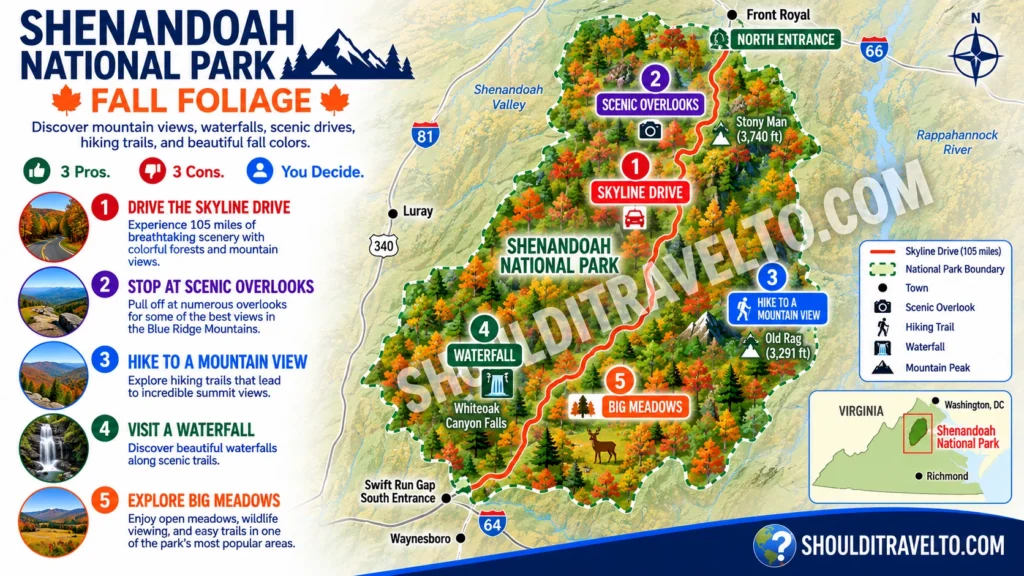
Drive Skyline Drive
This is the essential Shenandoah experience.
Skyline Drive runs 105 miles along the crest of the Blue Ridge Mountains and connects the park from north to south.
But don’t measure success by how many miles you drive.
Measure it by what you experience along the way.
Stop at overlooks.
Watch the mountain layers.
Walk a trail.
Take your time.
Skyline Drive isn’t the road to the attraction.
Skyline Drive is part of the attraction.
Stop at Scenic Overlooks
One of Shenandoah’s greatest advantages is how little effort some of its best views require.
Skyline Drive was designed with overlooks that open onto views of the Shenandoah Valley and the Piedmont.
That means even travelers who don’t want to hike extensively can experience expansive Blue Ridge scenery.
During fall, this becomes particularly valuable.
You can see entire mountain slopes and valleys changing color rather than viewing foliage only from inside the forest.
Hike to a Mountain View
For travelers willing to leave the car behind, Shenandoah offers hundreds of miles of hiking trails.
For more ambitious hikers, Old Rag is one of Shenandoah’s signature experiences. From March 1 through November 30, visitors using the relevant Old Rag trails need a day-use ticket in addition to the park entrance pass. Because access and parking conditions can change, check current NPS conditions before planning an Old Rag hike.
2026 Planning Note: The main Old Rag Trailhead parking lot is currently closed for infrastructure improvements, which are expected to continue through November 2026. Overflow parking remains available.
Visit a Waterfall
Mountain views may define Shenandoah, but waterfalls add another dimension to a fall trip.
Dark Hollow Falls is one of the park’s best-known waterfall hikes.
The route is relatively short, but don’t confuse short with effortless—the trail includes steep terrain.
A waterfall hike also gives travelers a different foliage perspective:
Instead of looking across the Blue Ridge Mountains…
you’re walking underneath the autumn canopy.
Explore Big Meadows
Big Meadows provides a completely different landscape from Shenandoah’s forested trails and mountain overlooks.
The high-elevation meadow is an important wildlife habitat and one of the park’s best-known places for wildlife viewing, walking, and simply slowing down. Its central location also makes it particularly useful when exploring the middle portion of Skyline Drive.
When Is Peak Fall Foliage in Shenandoah?
Fall leaf color typically peaks around mid-October, but that doesn’t mean the entire park reaches peak color at the same time.
That makes mid-October the most important period for many first-time visitors to watch, but the park’s length and elevation differences create a much broader progression of color.
| Period | General Expectation |
| Late September | Earliest color beginning, particularly in cooler/higher areas |
| Early October | Increasing color across the park |
| Mid-October | Historically one of the strongest periods to watch |
| Late October | Strong color may continue in parts of the park and at lower elevations |
| Early November | Increasingly late-season, with conditions highly variable |
For a first-time foliage trip, watch mid-October most closely, but monitor current conditions rather than treating one weekend as guaranteed peak.
Don’t chase one peak date. Follow the color through the park.
Ideal Trip Length
Shenandoah works unusually well for a short fall trip because Skyline Drive makes many of the park’s major experiences easy to connect. One day can provide a worthwhile introduction, but two days give first-time visitors a much better balance of scenic driving, overlooks, and hiking.
1 Day: Skyline Drive Highlights
A day trip can work particularly well for travelers coming from Washington, DC.
Choose one section of Skyline Drive, stop at several overlooks, and add a short hike.
Don’t attempt to see the entire park.
2 Days: Best Balance
For most first-time foliage travelers, I think two days is the sweet spot.
That gives you time for Skyline Drive, overlooks, hiking, a waterfall, and a much less rushed pace.
3 Days: More Complete Shenandoah Experience
Three days allows you to explore multiple sections of Skyline Drive, take longer hikes, spend more time at overlooks, and experience the park at sunrise or sunset without constantly moving.
Where Should You Stay?
Where you stay should depend primarily on which section of Skyline Drive you plan to explore and whether Shenandoah is a standalone trip or part of a larger Washington, DC, or Blue Ridge Mountains itinerary.
Inside Shenandoah National Park
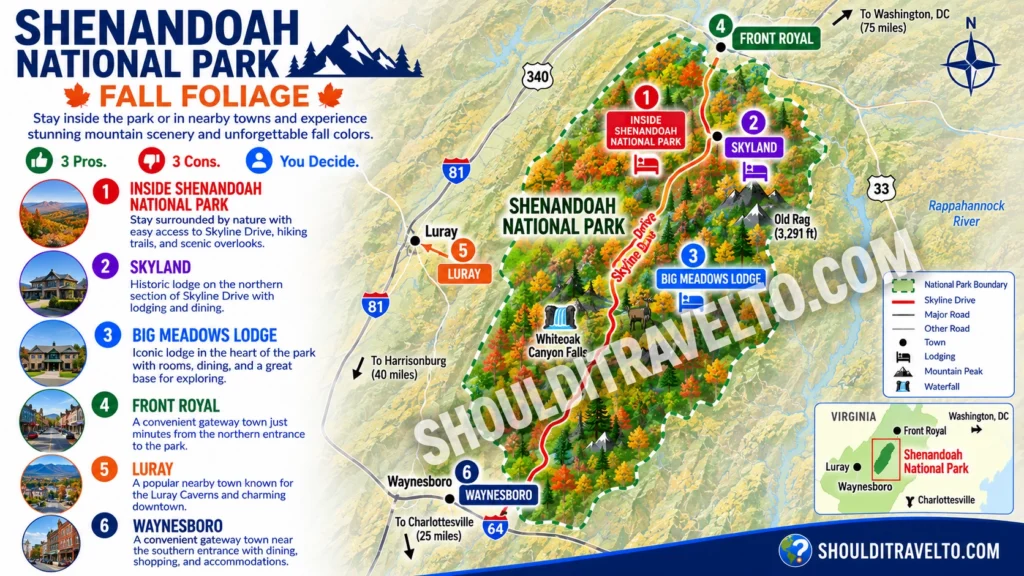
Staying inside the park gives you the biggest advantage because you’re already on Skyline Drive.
That makes early mornings, sunsets, hiking, and scenic driving considerably easier.
For a first visit, Skyland and Big Meadows Lodge are the two options I’d consider, as both put you directly on Skyline Drive in the central portion of the park.
Skyland sits around mile 41.7 and provides convenient access to the central/northern portion of the park.
Big Meadows Lodge sits around mile 51 and places you near Big Meadows, Byrd Visitor Center, Dark Hollow Falls, and other central-area attractions.
Front Royal: Best for the North Entrance and Washington, DC
Travelers coming from Washington can enter Shenandoah near Front Royal and begin Skyline Drive from the north.
For a DC-Shenandoah itinerary, Front Royal is an obvious gateway.
Luray: Best for Central/Northern Shenandoah + Caverns
Luray provides another practical base outside the park and adds Luray Caverns as an additional attraction.
Waynesboro: Best for the Southern End
Waynesboro makes sense for travelers entering or leaving the Rockfish Gap area near the southern end of Skyline Drive.
Do You Need a Car?
Yes, you do need a car to see the fall foliage in Shenandoah National Park.
For most travelers, a car is essential.
Skyline Drive is the park’s only public road, and most major visitor facilities, overlooks, lodging areas, and trailheads are organized around it.
And unlike Lake Placid, there isn’t really a walkable town functioning as your foliage base inside Shenandoah.
Here, the car isn’t merely transportation.
It’s part of how you experience the park.
Who Should Visit Shenandoah for Fall Foliage?
Shenandoah works best for travelers who want mountain scenery and outdoor experiences without needing to build an entire vacation around strenuous hiking or a remote wilderness trip. Its combination of scenic driving, accessible overlooks, trails, and proximity to Washington, DC gives it unusually broad appeal.
Shenandoah is especially good for travelers who want:
- Scenic driving
- Blue Ridge Mountain views
- Fall foliage
- Hiking
- Waterfalls
- Wildlife
- Easy overlooks
- National parks
- Washington, DC + nature combinations
- Virginia road trips
- Weekend foliage trips
- A foliage destination that doesn’t require serious hiking
Think twice if you:
- Hate slow scenic driving
- Want solitude on peak fall weekends
- Don’t want to use a car
- Want a compact mountain town as part of the experience
- Primarily want lakes
- Primarily want coastal scenery
- Need a guaranteed peak date
How Does Shenandoah Compare With Other Fall Foliage Destinations?
Shenandoah competes with several famous eastern mountain destinations for fall foliage trips, but each offers a different type of experience. Comparing Shenandoah with the Blue Ridge Parkway, Great Smoky Mountains, and the Adirondacks makes it easier to decide which landscape and trip style best match what you’re looking for.
Shenandoah vs. Blue Ridge Parkway for Fall Foliage
Shenandoah and the Blue Ridge Parkway are natural comparisons because both offer spectacular Blue Ridge Mountain scenery built around famous scenic roads. But they work best for different types of fall trips: Shenandoah is a concentrated national park experience, while the Blue Ridge Parkway is a much longer mountain road trip.
Choose Shenandoah for:
- Skyline Drive
- National park experience
- Hiking
- Waterfalls
- Wildlife
- Washington, DC access
- Easier short trip
- Concentrated park experience
Choose the Blue Ridge Parkway for:
- Longer road trip
- 469 miles of scenic driving
- Multiple mountain regions
- North Carolina mountain scenery
- Asheville, NC
- Boone and Blowing Rock
- Craggy Gardens
- Mount Mitchell
- Linville Falls
- Connecting multiple destinations
And geographically, they’re natural partners.
Skyline Drive reaches its southern end at Rockfish Gap, which also serves as the northern entrance to the Blue Ridge Parkway.
So travelers don’t necessarily have to choose.
They can turn the two into one enormous Blue Ridge fall road trip.
The Blue Ridge Parkway begins nearby and continues south through Virginia and North Carolina.
So travelers don’t necessarily have to choose.
They can turn the two into one enormous Blue Ridge fall road trip.
The simplest difference?
Shenandoah is the stronger fall foliage national park experience.
The Blue Ridge Parkway is the stronger fall foliage road trip.
Shenandoah vs. Great Smoky Mountains for Fall Foliage
Shenandoah and Great Smoky Mountains National Park both offer classic Appalachian fall scenery, scenic driving, hiking, waterfalls, and wildlife. The biggest difference is scale: Shenandoah is easier to experience during a short trip, while the Smokies reward travelers with more time to explore a much larger mountain landscape.
Choose Shenandoah for:
- Skyline Drive
- Washington, DC access
- Easier weekend trip
- Blue Ridge overlooks
- Simpler geography
- Shorter first-time trip
Choose the Smokies for:
- Larger-scale mountain experience
- Longer foliage progression
- Wildlife
- Historic valleys
- Waterfalls
- Tennessee + North Carolina
- More extensive national park vacation
The simplest difference?
Shenandoah is easier to experience quickly.
The Smokies reward a longer mountain vacation.
Shenandoah vs. Adirondacks for Fall Foliage
Shenandoah and the Adirondacks both deliver dramatic mountain foliage, but the landscapes create noticeably different fall experiences. It is organized around Skyline Drive and expansive Blue Ridge overlooks, while the Adirondacks combine the High Peaks with mountain lakes, reflections, and a much larger wilderness region.
Choose Shenandoah for:
- Skyline Drive
- Blue Ridge overlooks
- Washington, DC access
- Easier weekend trip
- More concentrated national park experience
Choose the Adirondacks for:
- Mountain lakes
- High Peaks
- Reflections
- Lake Placid
- Larger wilderness landscapes
- Paddling
- Earlier-season foliage potential
The clean distinction: Shenandoah gives you foliage across the Blue Ridge Mountains.
The Adirondacks give you foliage reflected in mountain lakes.
Final Assessment
Yes, you should travel to Shenandoah National Park to see the fall foliage, especially if you want a scenic mountain trip that’s easy to combine with a trip to Washington, DC.
The park is remarkably straightforward for a first-time visitor.
There’s one road tying the experience together.
Skyline Drive.
Drive along the crest of the Blue Ridge Mountains.
Stop at overlooks.
Hike to a viewpoint.
Walk to a waterfall.
Watch for wildlife.
Then get back in the car and continue down the ridge.
The three biggest reasons to visit are Skyline Drive, the combination of scenic driving, hiking, and waterfalls, and Shenandoah’s exceptional accessibility from Washington, DC.
The three biggest drawbacks are fall crowds, unpredictable peak timing, and the amount of time Skyline Drive requires.
But that last drawback is also part of the appeal.
You’re not supposed to rush through Shenandoah.
The slow road is the attraction.
And that’s what makes this park such an effective fall destination.
You don’t have to hike every mountain, or drive all 105 miles.
You don’t even need a week.
Choose a section.
Take your time.
And follow the color through the Blue Ridge Mountains.
3 Pros. 3 Cons. You Decide.
Shenandoah National Park Fall Foliage FAQs
When is peak fall foliage in Shenandoah National Park?
Fall color typically peaks around mid-October, but conditions vary considerably by elevation, location, and weather. Because Shenandoah stretches for more than 100 miles, don’t expect the entire park to reach peak color simultaneously. Monitor current NPS fall-color updates before traveling.
Is Skyline Drive worth visiting during fall?
Yes. Skyline Drive is the defining Shenandoah fall experience, running 105 miles along the Blue Ridge crest and providing repeated access to overlooks, trails, lodging, and other park attractions.
Do you have to drive the entire length of Skyline Drive?
No. For a short trip, it’s usually better to choose one section and combine scenic overlooks with hiking, waterfalls, or other stops. Driving the full 105 miles takes about three hours even before substantial stops.
How many days do you need in Shenandoah during fall?
Two days is the sweet spot for most first-time foliage visitors. One day works for a focused section of Skyline Drive, while three days allows more hiking and exploration of multiple areas.
Can you visit Shenandoah as a day trip from Washington, DC?
Yes. Shenandoah is close enough to Washington to make a day trip possible, particularly if you concentrate on the northern portion of the park. However, staying one or two nights provides a considerably less rushed experience.
Do you need to hike to see fall foliage in Shenandoah?
No. One of Shenandoah’s biggest advantages is that extensive mountain scenery is accessible directly from Skyline Drive and its overlooks. Hiking adds another dimension, but it isn’t required to have a worthwhile foliage trip.
Are fall weekends crowded in Shenandoah?
Yes. NPS specifically identifies fall as the park’s busiest season and warns that fall weekends bring large crowds, full parking areas, and waits at entrances. Weekdays are preferable when possible.
Can you combine Shenandoah with the Blue Ridge Parkway?
Absolutely. Skyline Drive reaches its southern end at Rockfish Gap, which is also the northern entrance to the Blue Ridge Parkway. That makes the two roads a natural combination for a longer Blue Ridge fall road trip.