

Should You Visit Acadia National Park for Fall Foliage?
Quick Answer
Yes, you should travel to Acadia National Park for fall foliage if you want something more than colorful forests.
Acadia combines brilliant autumn foliage with a rocky Atlantic coastline, mountain views, lakes, forests, and charming Bar Harbor.
It is one of the most unusual fall foliage destinations in New England.
Many destinations offer colorful forests.
Others offer dramatic mountains.
Others offer ocean views.
Acadia offers all three in the same trip.
The park’s forests generally reach peak fall color around mid-October, although exact timing varies each year.
For travelers who want to experience fall foliage beside the ocean, Acadia is difficult to beat.
What Is Acadia National Park?
Acadia National Park is located along the rugged coast of Maine and protects a landscape of mountains, forests, lakes, islands, and rocky Atlantic coastline.
But understanding Acadia’s geography can be confusing for first-time visitors.
Most of the park’s best-known attractions are located on Mount Desert Island, a large island along Maine’s coast.
This is where you’ll find many of the places visitors associate with Acadia, including:
- Cadillac Mountain
- Jordan Pond
- Sand Beach
- Thunder Hole
- Otter Point
- Park Loop Road
- Many of the park’s hiking trails and carriage roads
But Mount Desert Island and Acadia National Park aren’t the same thing.
Mount Desert Island is the geographic island. Acadia National Park protects portions of the island.
The island also contains several communities, including Bar Harbor, which sits beside the national park and serves as its best-known gateway.
Acadia itself extends beyond Mount Desert Island. Other sections of the national park include the Schoodic Peninsula on the mainland and areas on surrounding islands.
For most first-time visitors, however, the basic geography is simple:
Mount Desert Island = the island
Acadia National Park = the protected parkland
Bar Harbor = the primary tourist town and gateway
That means you can spend the day hiking, driving scenic roads, and viewing fall foliage inside Acadia before returning to Bar Harbor for restaurants, shops, and accommodations.
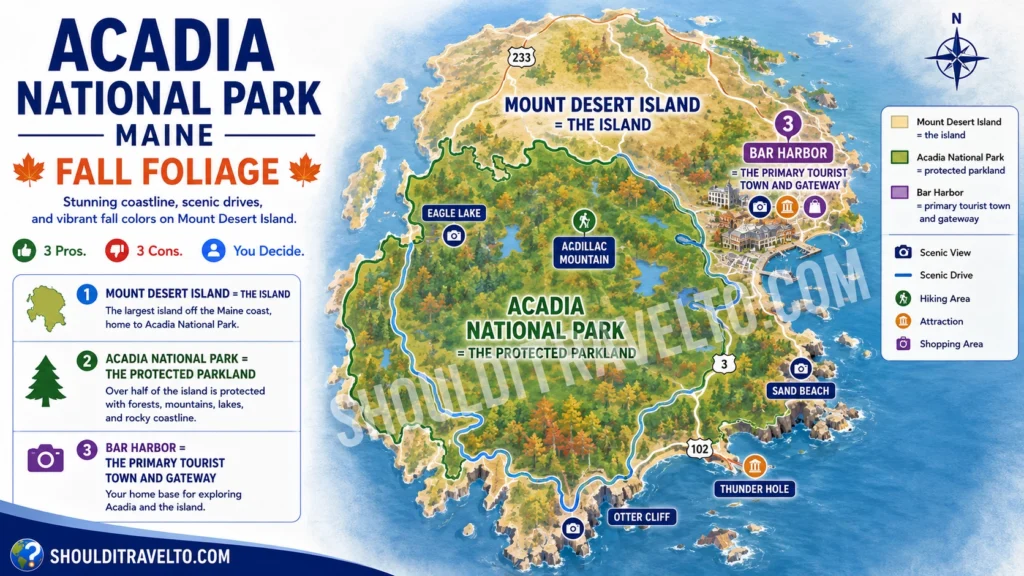
This combination of national park wilderness and a nearby coastal town is one of the reasons Acadia works particularly well for a fall foliage vacation.
Why Acadia Is One of America’s Most Unique Fall Foliage Destinations
Fall foliage usually brings to mind mountains, covered bridges, country roads, and small New England towns.
Acadia adds something unexpected:
The Atlantic Ocean.
Within the park, visitors can experience:
- Brilliant fall forests
- Rocky ocean coastline
- Mountain summits
- Freshwater lakes
- Scenic overlooks
- Historic carriage roads
- Coastal villages
- Hiking trails
- Lighthouses
- Dramatic sunrise and sunset views
The result is a landscape that changes constantly.
One moment you’re surrounded by red and orange forests.
A few minutes later, you’re looking across the Atlantic.
Then you’re standing above a mountain lake surrounded by autumn color.
Acadia protects some of the highest rocky headlands along the North Atlantic coast, and the park’s landscape includes mountains, forests, lakes, and coastline.
That combination is what makes Acadia special.
The Biggest Mistake First-Time Acadia Visitors Make
The biggest mistake first-time visitors make is treating Acadia as a destination that can be experienced from a single scenic overlook.
It can’t.
Acadia is a collection of different landscapes spread across Mount Desert Island and surrounding areas.
You can spend the morning:
- Driving Park Loop Road
- Exploring the coastline
- Hiking
- Visiting Jordan Pond
And still have completely different scenery waiting for you in the afternoon.
Another mistake is trying to see everything during peak foliage weekends.
Fall is one of Acadia’s busiest seasons, and popular areas can become congested.
A better strategy is to choose several experiences and give yourself time to enjoy them.
Acadia rewards exploration rather than rushing.
Let’s explore the three biggest reasons to visit Acadia during fall foliage season.
The 3 Biggest Reasons to Visit Acadia National Park During Fall
Traveling to Acadia to see the fall foliage means seeing it from a coastal perspective, making it one of the most unique fall combinations. Fall foliage travelers can also see the leaves from Cadillac Mountain.
1. Ocean + Fall Foliage
This is Acadia’s biggest advantage.
Most fall foliage destinations are inland.
Acadia isn’t.
The autumn colors appear alongside:
- The Atlantic Ocean
- Rocky cliffs
- Coastal islands
- Granite mountains
- Lakes
- Forests
The contrast between the warm colors of autumn and the deep blue of the ocean creates some of the most distinctive scenery in New England.
For photographers, this combination is especially appealing.
You’re not simply photographing trees.
You’re photographing fall foliage against the Maine coast.
2. Cadillac Mountain
Cadillac Mountain is one of Acadia’s signature experiences.
At 1,530 feet, Cadillac Mountain is the highest mountain along the eastern seaboard of the United States.
In autumn, the summit provides a completely different perspective on the foliage.
Instead of walking through the forest, you’re looking across a patchwork of colorful forests, blue water, granite peaks, and islands.
The summit is accessible by the Cadillac Summit Road, although vehicle reservations are required during the reservation season.
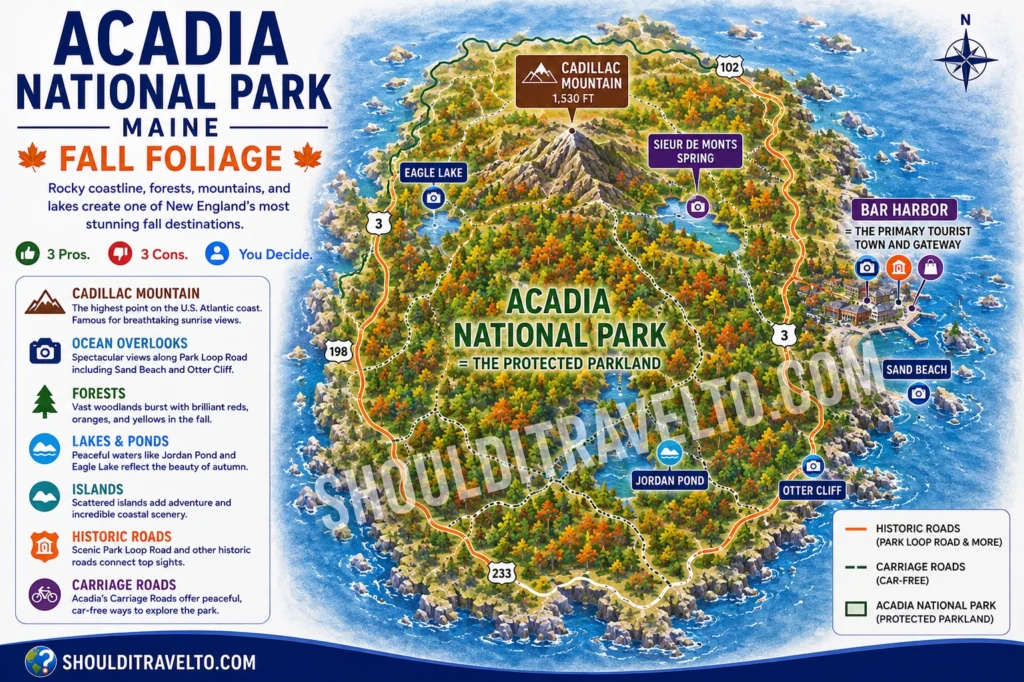
For a first visit to Acadia, Cadillac Mountain belongs near the top of the itinerary.
3. Scenic Driving, Hiking, and Foliage Viewing in One Destination
One of Acadia’s greatest advantages is the number of ways visitors can experience autumn.
Drive through colorful forests on Park Loop Road.
Walk or bike the historic carriage roads.
Hike to mountain viewpoints.
Stop beside Jordan Pond.
Explore the rocky coastline.
Or simply enjoy the changing leaves while traveling between destinations.
Next, let’s explore the downsides.
The 3 Biggest Downsides of Visiting Acadia National Park in Fall
Acadia is spectacular in autumn, but peak foliage comes with crowds, unpredictable weather, and the need for planning.
1. Peak Foliage Season Can Be Crowded
Fall is one of Acadia’s most popular seasons.
Popular areas such as Cadillac Mountain, Park Loop Road, Jordan Pond, and Bar Harbor can become busy during peak weekends.
Expect:
- Busy roads
- Crowded parking areas
- Higher hotel demand
- Busy restaurants
- Popular trails
If you can visit during the week, you’ll generally have a more relaxed experience.
2. Foliage Timing Isn’t Guaranteed
Like every fall foliage destination, Acadia’s peak color depends on nature.
The National Park Service says fall colors typically peak around mid-October, but the timing can vary from year to year.
Higher elevations can change at different times than lower areas.
That means you shouldn’t expect every tree to be at peak color on a specific date.
If peak foliage is the entire reason for your trip, monitor Maine’s foliage reports before traveling.
3. You Need to Plan Ahead
Acadia is not a destination where you should simply arrive during peak October weekends and figure everything out later.
Popular accommodations can fill quickly.
Parking can also become challenging at popular attractions.
And if you want to drive Cadillac Summit Road during the reservation season, you’ll need an advance vehicle reservation.
The good news is that planning doesn’t need to make the trip complicated.
Choose a place to stay, identify several priority attractions, and leave room for spontaneous scenic stops.
Planning Your Acadia National Park Fall Foliage Trip
The following factors can help you make the most of an autumn visit.
Best Things To Do in Acadia During Fall
Visitors can combine foliage viewing with:
- Drive Park Loop Road
- Visit Cadillac Mountain
- Explore Bar Harbor
- Visit Jordan Pond
- See Sand Beach
- Stop at Thunder Hole
- Explore Otter Cliff
- Hike through colorful forests
- Walk the carriage roads
- Visit Bass Harbor Head Lighthouse
- Watch the sunrise
- Photograph the coastline
- Enjoy Maine seafood
One of the best things about Acadia is that many of these experiences are scenic even when the leaves aren’t at absolute peak.
Park Loop Road
Park Loop Road is one of the best ways to experience Acadia in fall.
The park contains a 27-mile scenic Park Loop Road that connects many of its most popular destinations, including Sand Beach, Thunder Hole, Otter Point, Jordan Pond, and Cadillac Mountain.
The 27-mile loop winds through forests and along the coastline, connecting many of the park’s most popular destinations.
Along the way, visitors can stop at:
- Sand Beach
- Thunder Hole
- Otter Point
- Jordan Pond
- Cadillac Mountain
- Scenic overlooks
The road itself becomes part of the attraction during foliage season.
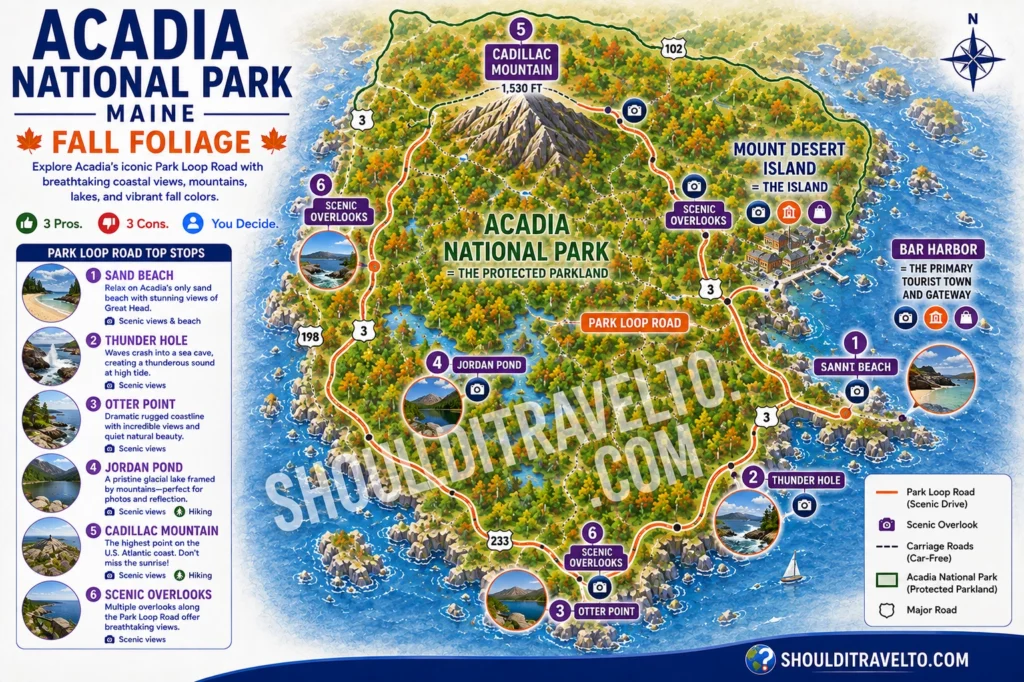
Instead of simply driving from one attraction to another, the journey becomes a continuous fall landscape.
Best Time to Visit
Acadia’s fall foliage generally peaks around mid-October, although the exact timing varies each year.
| Period | Experience | Rating |
| Late September | Early fall color, fewer crowds | ★★★★☆ |
| Early October | Increasing color, good balance | ★★★★★ |
| Mid-October | Peak foliage potential | ★★★★★ |
| Late October | Later color, fewer leaves | ★★★★☆ |
| November | Mostly post-foliage | ★★★☆☆ |
Mid-October is generally the best target for travelers specifically seeking peak foliage.
But if you value smaller crowds over absolute peak color, early October can be an excellent compromise.
Keep in mind that Acadia becomes increasingly seasonal later in October. The park remains accessible, but some campgrounds, visitor facilities, restaurants, transportation services, and other seasonal operations are beginning to close or reduce service. If you’re visiting in late October or November, check current operating dates before your trip.
Ideal Trip Length
A three-day trip is a good starting point for first-time visitors to Acadia National Park when specifically seeing the fall foliage.
Weekend:
- Bar Harbor
- Park Loop Road
- Cadillac Mountain
- Major coastal viewpoints
3 Days: Best balance
Acadia highlights:
- Fall foliage drives
- Hiking and scenic stops
5 Days:
- Explore Acadia more slowly
- Bar Harbor
- Additional hiking
- Schoodic Peninsula
- Nearby coastal communities
Five days allows you to slow down and explore more of Mount Desert Island and the surrounding Maine coast.
Where Should You Stay for an Acadia National Park Fall Foliage Trip?
Where you stay can make a significant difference during an Acadia fall foliage trip.
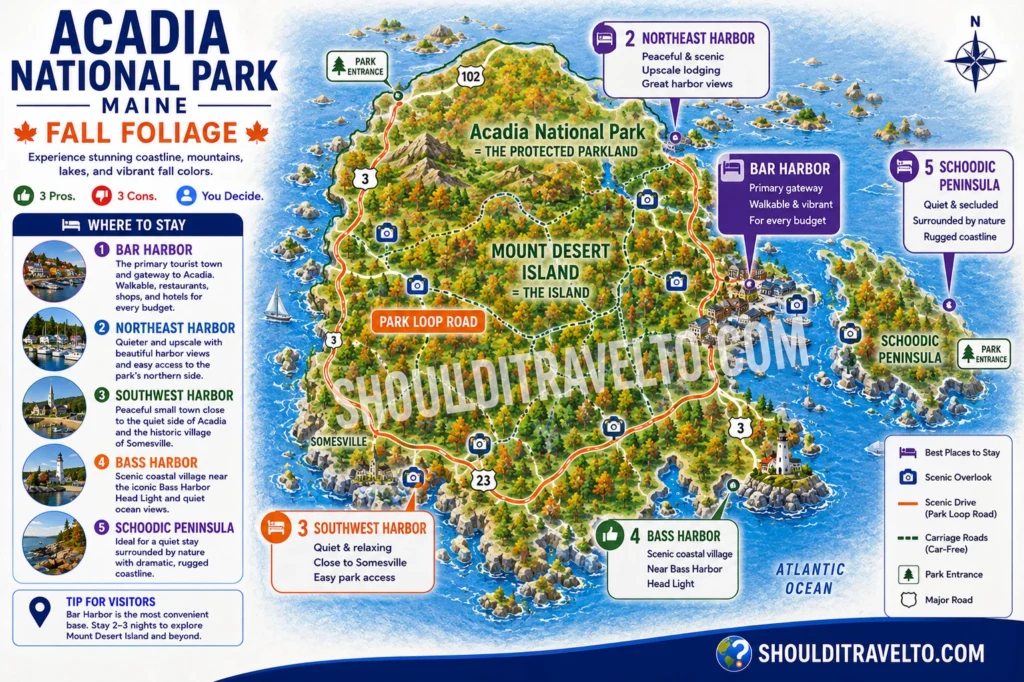
Most first-time visitors stay somewhere on Mount Desert Island, which provides convenient access to the park’s most popular attractions.
Bar Harbor: Best for First-Time Visitors
For most first-time visitors, Bar Harbor is the easiest base.
The town sits on Mount Desert Island beside Acadia National Park and provides the area’s largest concentration of:
- Hotels and inns
- Restaurants
- Shops
- Galleries
- Tour operators
- Harbor activities
- Visitor services
Bar Harbor works particularly well if you want to combine days exploring Acadia with evenings walking around town, eating at restaurants, and enjoying the Maine coast.
It’s also one of the better choices for travelers who want to reduce their dependence on a car when seasonal transportation is operating.
The downside?
Bar Harbor is extremely popular.
During peak foliage season, accommodations can be expensive, restaurants busy, and the town considerably more crowded than quieter communities elsewhere on Mount Desert Island.
Best for: First-time visitors, couples, restaurants, convenience, walkability, and travelers who want both Acadia and a coastal-town experience.
Northeast Harbor: Best for a Quieter, Upscale Stay
Northeast Harbor provides a quieter alternative to Bar Harbor while keeping you on Mount Desert Island.
The village has a more relaxed atmosphere and provides access to the southern and central portions of the island without putting you in the middle of Bar Harbor’s tourist activity.
It’s a particularly appealing option for travelers who value peaceful surroundings over nightlife and a large selection of restaurants.
Best for: Couples, quieter trips, upscale accommodations, and travelers who don’t need to stay in the center of the action.
Southwest Harbor: Best for a Quieter Side of Mount Desert Island
Southwest Harbor sits on what is commonly called the Quiet Side of Mount Desert Island.
It’s farther from many of Acadia’s most famous attractions along Park Loop Road, but it provides a much calmer base.
The location is especially useful for exploring the western side of Mount Desert Island and attractions such as Bass Harbor Head Light Station.
You’ll sacrifice some convenience for the major eastern-side attractions, but you’ll gain a more relaxed Maine-coast atmosphere.
Best for: Repeat visitors, quieter vacations, couples, and travelers who don’t mind additional driving.
Bass Harbor: Best for a Small Coastal Village Experience
Bass Harbor offers an even quieter experience near the southwestern end of Mount Desert Island.
This isn’t the choice for travelers looking for lots of restaurants, shopping, or evening activity.
Instead, it works for visitors who want a small coastal-community atmosphere and easy access to the quieter western side of the island.
Best for: Solitude, coastal atmosphere, photographers, and travelers who prefer small communities.
Schoodic Peninsula: Best for Escaping the Mount Desert Island Crowds
For something completely different, consider staying near the Schoodic Peninsula, the only portion of Acadia National Park located on the mainland.
Schoodic offers a rocky coastline, forests, scenic roads, and ocean views, with generally fewer visitors than on Mount Desert Island.
The trade-off is significant:
You’ll be far from Cadillac Mountain, Jordan Pond, Sand Beach, and the other famous Mount Desert Island attractions.
For a first trip to Acadia, I’d generally stay on Mount Desert Island.
For a return trip or for travelers who prioritize solitude, Schoodic can be an excellent alternative.
Best for: Smaller crowds, scenic driving, solitude, repeat Acadia visitors, and travelers willing to sacrifice convenience.
Which Area Should First-Time Visitors Choose?
For most first-time fall foliage visitors:
Choose Bar Harbor.
It offers the easiest combination of Acadia access, restaurants, accommodations, walkability, and coastal-town atmosphere.
Choose Northeast Harbor or Southwest Harbor if you’d rather trade some convenience for a quieter experience.
Choose the Schoodic Peninsula if escaping the crowds matters more than being close to Acadia’s most famous attractions.
For a first three-day Acadia foliage trip, Bar Harbor is difficult to beat as a base.
What Makes Acadia’s Fall Foliage Different?
Traditional New England foliage destinations often emphasize:
Mountains + forests + small towns.
Acadia adds:
Ocean + mountains + forests + islands.
That changes the experience completely.
Imagine driving through brilliant red and orange forests before emerging onto a granite coastline overlooking the Atlantic.
Or standing on Cadillac Mountain and looking down over colorful forests and blue water.
Or walking around Bar Harbor after spending the afternoon inside the national park.
This is why Acadia belongs in a different category from many traditional foliage destinations.
It isn’t simply one of the places to see fall colors.
It’s one of the places where fall changes the entire landscape.
Who Should Visit Acadia National Park for Fall Foliage?
Acadia National Park remains a popular destination for travelers who want to see the fall foliage, but some might enjoy it more than others.
Acadia is perfect for:
- Fall foliage lovers
- National park travelers
- Photographers
- Couples
- Scenic road-trip travelers
- Hikers
- Ocean lovers
- Mountain lovers
- First-time Maine visitors
- Travelers looking for unusual fall scenery
Skip Acadia If:
- You dislike crowds
- You want to avoid both driving and seasonal transportation planning
- You want a quiet small-town foliage experience
- You dislike unpredictable weather
- You aren’t interested in national parks
- You want guaranteed peak foliage
Acadia National Park vs. the White Mountains for Fall Foliage
If you’re deciding between Acadia and the White Mountains, the biggest question is what kind of scenery you want.
Choose Acadia if you want:
- Ocean views
- Rocky coastline
- Mountains and forests
- Islands
- Bar Harbor
- A national park experience
- One of America’s most unusual fall landscapes
Choose the White Mountains if you want:
- More dramatic mountain scenery
- Mountain passes
- Waterfalls
- Covered bridges
- Scenic mountain roads
- The Kancamagus Highway
- A classic mountain foliage experience
The White Mountains are more about mountains and forests.
Acadia is about mountains, forests, and the ocean.
Neither is objectively better.
They’re simply different versions of New England in the fall.
Final Verdict
Acadia National Park may be one of the most unique places in America to experience fall foliage.
The forests turn brilliant shades of red, orange, and gold.
The mountains provide sweeping views.
And beyond the trees is the Atlantic Ocean.
That combination is difficult to replicate anywhere else.
Cadillac Mountain provides one of the best panoramic perspectives, while Park Loop Road connects many of Acadia’s most memorable landscapes.
Bar Harbor adds restaurants, accommodations, shops, and a charming coastal-town experience to the trip.
Yes, peak October weekends can be crowded.
Yes, foliage timing depends on nature.
And yes, you’ll want to plan ahead.
But if you want a fall foliage trip that feels different from the traditional New England mountain experience, Acadia deserves serious consideration.
Sometimes the best fall foliage isn’t just about the leaves.
It’s about what you see beyond them.
3 Pros. 3 Cons. You Decide.
Acadia National Park for Fall Foliage Frequently Asked Questions
Is Acadia National Park worth visiting for fall foliage?
Yes. Acadia is particularly appealing because it combines colorful autumn forests with mountains, lakes, rocky coastline, and the Atlantic Ocean.
When is peak fall foliage in Acadia?
Peak foliage generally occurs around mid-October, although exact timing varies from year to year.
Is October a good time to visit Acadia?
Yes. October is one of the best times to visit Acadia for fall foliage, although popular weekends can be crowded.
How many days do you need in Acadia during fall?
Three days is a good starting point for first-time visitors. Five days allows more time for hiking, scenic drives, Bar Harbor, and less-visited areas.
Is Acadia crowded during fall foliage?
Yes. Peak foliage is a popular time to visit. Cadillac Mountain and other major attractions can become particularly busy.
Do you need a car in Acadia?
A car is useful, particularly for maximizing flexibility during a fall foliage trip, but it isn’t essential for every visitor. The fare-free Island Explorer connects Bar Harbor and surrounding communities with many destinations throughout Acadia during its operating season.
However, the Island Explorer does not serve Cadillac Mountain, and service becomes more limited later in fall.
Check the current Island Explorer schedule before planning a car-free trip.
Is Cadillac Mountain worth visiting during fall?
Absolutely. Cadillac Mountain provides panoramic views across Acadia’s mountains, forests, islands, and coastline.
Do you need a reservation for Cadillac Mountain?
Vehicle reservations are required for Cadillac Summit Road during the reservation season. Check current National Park Service requirements before your trip.
Is Bar Harbor worth visiting in the fall?
Yes. Bar Harbor provides convenient access to Acadia while also offering restaurants, shops, hotels, harbor views, and a walkable downtown.
Is Acadia better than the White Mountains for fall foliage?
It depends on what you want. Acadia is better for travelers who want ocean views combined with fall colors. The White Mountains are better for travelers who prioritize dramatic mountain scenery and scenic mountain drives.
Is Acadia good for couples?
Yes. Scenic drives, coastal views, hiking, restaurants, Bar Harbor, and colorful autumn scenery make Acadia particularly appealing for couples.
Is Acadia good for families?
Yes. Families can combine scenic drives, short walks, beaches, viewpoints, and outdoor activities. However, peak foliage crowds can make some areas more challenging.
Can you visit Acadia without hiking?
Absolutely. Some of Acadia’s best fall experiences can be enjoyed from scenic roads, overlooks, and accessible viewpoints. The 27-mile Park Loop Road is particularly useful for visitors who want to see the park without extensive hiking.
What makes Acadia different from other fall foliage destinations?
The combination of ocean, mountains, forests, lakes, islands, and autumn color. Few American destinations put all of those landscapes together in such a compact area.