
Should You Drive the Blue Ridge Parkway to See the Fall Foliage?
Quick Answer
Yes, you should drive the Blue Ridge Parkway if you’re looking for a classic American fall foliage road trip featuring colorful mountains, scenic overlooks, winding roads, and small Appalachian communities.
Stretching nearly 470 miles through Virginia and North Carolina, the Blue Ridge Parkway connects Shenandoah National Park with Great Smoky Mountains National Park and is one of America’s great scenic road trips.
In fact, the Parkway recorded more than 16.5 million recreation visits in 2025, making it the most visited site in the entire National Park System.
And in autumn, it’s easy to understand why.
The Parkway becomes one of the country’s great foliage experiences.
The scenery isn’t limited to one viewpoint.
You can spend an entire day driving through forests of red, orange, yellow, and gold, stopping at overlooks, hiking trails, waterfalls, historic sites, and mountain communities along the way.
The Blue Ridge Parkway offers something different from destinations such as the Berkshires or White Mountains.
The journey is the attraction.
For travelers who enjoy road trips, scenic driving, and mountain landscapes, the Blue Ridge Parkway belongs near the top of the American fall foliage list.
For travelers who want to stay in one walkable town and avoid spending hours in a car, it may not be the best choice.
What Is the Blue Ridge Parkway?
The Blue Ridge Parkway is a scenic road running through the Blue Ridge Mountains of Virginia and North Carolina.
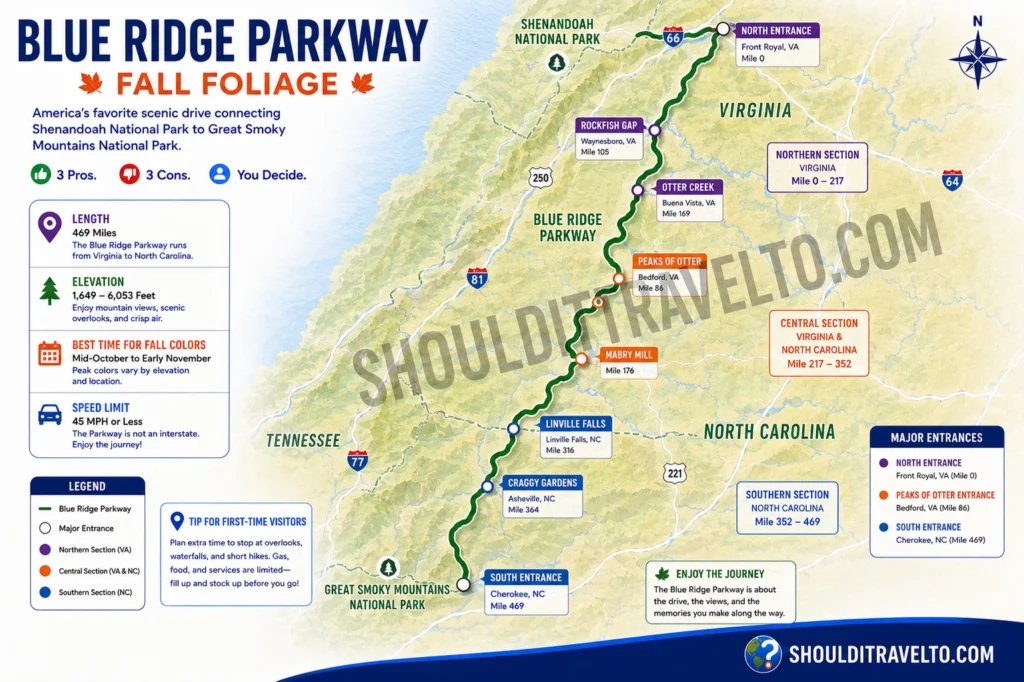
It connects Shenandoah National Park in Virginia with the North Carolina entrance to Great Smoky Mountains National Park near Cherokee, creating a massive scenic route through the Appalachian Mountains.
Unlike a typical highway, the Parkway was designed primarily for scenic travel.
There are overlooks, picnic areas, hiking trails, historic sites, visitor centers, and other places to stop throughout the route.
That makes the road itself one of America’s most famous travel experiences.
You aren’t simply using the Parkway to get somewhere.
You’re driving it because the drive is the destination.
Why the Blue Ridge Parkway Is One of America’s Best Fall Foliage Destinations
Some fall foliage destinations are built around a single town.
Others revolve around a famous mountain or scenic highway.
The Blue Ridge Parkway combines all three into one enormous road-trip experience.
The Parkway follows the Blue Ridge Mountains through Virginia and North Carolina, connecting mountain landscapes with overlooks, forests, hiking trails, waterfalls, historic sites, and small communities.
In autumn, the landscape changes dramatically as elevation and latitude create distinct stages of fall color along the route.
That means you don’t necessarily need to find one perfect location.
You can follow the foliage.
The experience can include:
- Mountain overlooks
- Colorful forests
- Winding mountain roads
- Waterfalls
- Hiking trails
- Historic sites
- Appalachian communities
- Scenic picnic areas
- Wildlife
- Sunrise and sunset views
And because the Parkway stretches for hundreds of miles, you can experience everything from quick scenic drives to multi-day road trips.
When Is Peak Fall Foliage on the Blue Ridge Parkway?
There is no single peak-foliage date for the entire Blue Ridge Parkway.
The route stretches 469 miles and varies by more than 5,000 feet in elevation, so autumn progresses differently depending on where you are.
A useful general pattern is:
| Period | What to Expect |
| Late September | Earliest color may begin at the highest elevations |
| Early October | High-elevation areas increasingly colorful |
| Mid-October | Excellent foliage across many elevations and sections |
| Late October | Strong color often shifts toward lower elevations |
| Early November | Later color may remain at lower elevations, depending on the year |
The National Park Service notes that most color typically develops during October, beginning at the highest elevations and moving down the mountainsides as the month progresses.
That creates one of the Parkway’s biggest advantages:
If one elevation isn’t at peak, another may be.
Don’t chase one peak date.
Follow fall down the Parkway.
The Biggest Mistake First-Time Blue Ridge Parkway Visitors Make
The biggest mistake first-time visitors make is trying to drive too much of the Parkway.
The route is nearly 470 miles long.
You could technically drive enormous portions of it in a single trip, but doing so would defeat much of the purpose.
The Parkway is best experienced slowly.
Choose a section.
Find a few overlooks.
Add a hike or waterfall.
Stop in a mountain town.
Have lunch.
Then continue.
Fall foliage makes this even more important because traffic can be heavier and some overlooks and attractions become crowded during peak weekends.
Don’t treat the Blue Ridge Parkway like a road you need to finish.
Treat it like a destination you need to experience.
What Makes Fall Foliage on the Blue Ridge Parkway Different?
The Blue Ridge Parkway is special because few roads in America combine scenery, accessibility, and scale quite like it does.
The route passes through two states and hundreds of miles of Appalachian landscape.
Along the way, travelers can experience:
- Dramatic mountain views
- Endless fall color
- High-elevation overlooks
- Forests and valleys
- Waterfalls
- Appalachian history
- Small mountain communities
- Hiking trails
- Historic structures
And unlike a traditional fall foliage destination, you can change your experience simply by driving another section of the road.
The Parkway also offers something particularly valuable during autumn:
You don’t have to choose between the mountains and the foliage.
The mountains provide the backdrop.
The forests provide the color.
And the road connects everything.
Which Section of the Blue Ridge Parkway Should You Drive?
You do not need to drive all 469 miles.
For most fall foliage trips, choosing one section is the better strategy.
Northern Virginia: Best for Combining With Shenandoah
The Parkway begins near Rockfish Gap, close to Shenandoah National Park and Skyline Drive.
This section works particularly well for travelers building a longer Virginia fall foliage road trip.
Roanoke and Central Virginia: Best for a Virginia-Based Parkway Trip
Roanoke provides convenient access to a substantial portion of the Virginia Parkway while offering hotels, restaurants, and city amenities.
Nearby Parkway experiences include mountain overlooks, hiking, and historic stops such as Mabry Mill farther south.
Boone and Blowing Rock: Best for Mountain Towns
This section combines classic Parkway scenery with some of North Carolina’s most popular mountain communities.
It works particularly well for travelers who want scenic driving during the day and a mountain-town base at night.
Asheville: Best for First-Time North Carolina Visitors
Asheville, NC, is one of the easiest bases for combining Blue Ridge Parkway scenery with restaurants, breweries, hotels, and a larger city experience.
Nearby destinations include Craggy Gardens and Mount Mitchell.
Southern Parkway: Best for Combining With the Great Smoky Mountains
The southern end of the Parkway approaches Cherokee and Great Smoky Mountains National Park.
This section works particularly well for travelers who want to combine the Parkway with the Smokies or build a longer western North Carolina fall foliage trip.
First trip? Choose one base and explore approximately one region of the Parkway rather than trying to conquer the entire road.
Let’s explore the three biggest reasons to visit the Blue Ridge Parkway during fall.
The 3 Biggest Reasons to Visit the Blue Ridge Parkway During Fall
Here are the three biggest reasons the Blue Ridge Parkway stands out during fall foliage season.
1. The Road Itself Is the Attraction
The Blue Ridge Parkway is one of America’s great road-trip destinations.
The route was designed to showcase the landscape rather than simply move travelers between cities.
During fall, nearly every mile can become part of the experience.
You’ll find:
- Scenic overlooks
- Mountain curves
- Forest tunnels
- Open ridgelines
- Valley views
- Colorful hillsides
You don’t need to find one famous viewpoint.
The entire road becomes the attraction.
2. You Can Follow Fall for Hundreds of Miles
The Parkway’s length and elevation create an advantage for fall foliage travelers.
Different areas can reach peak color at different times.
Higher elevations often change earlier, while lower elevations can retain color later.
That gives travelers a wider window to experience autumn than in a destination concentrated at a single elevation.
The scenery also changes as you move through Virginia and North Carolina.
One section might feature broad mountain vistas.
Another might take you through dense forest.
Another might open onto a valley filled with autumn color.
For foliage travelers, that variety is one of the Parkway’s greatest strengths.
3. There’s Much More Than Scenic Driving
The Blue Ridge Parkway isn’t just a scenic drive.
You can turn the trip into an active vacation.
Stop for:
- Hiking
- Waterfalls
- Picnics
- Photography
- Wildlife viewing
- Historic sites
- Scenic overlooks
- Small-town exploring
- Local restaurants
Popular areas include Mount Mitchell, Linville Falls, Craggy Gardens, and Mabry Mill.
That means two travelers can drive the same general section of the Parkway and have completely different vacations.
Next, let’s explore the biggest downsides.
The 3 Biggest Downsides of Visiting the Blue Ridge Parkway
But every destination comes with trade-offs, and the Blue Ridge Parkway is no exception.
1. You Need a Car
This may seem obvious, but it is one of the most important considerations.
The Blue Ridge Parkway is a road-trip destination.
There is no practical way to experience its major scenic overlooks, trails, waterfalls, and remote areas without your own vehicle or a planned tour.
For travelers who enjoy driving, that’s part of the fun.
For travelers who prefer trains, public transportation, or walkable destinations, the Parkway can be frustrating.
2. Fall Weekends Can Be Very Busy
The Blue Ridge Parkway is extremely popular during peak foliage.
Expect:
- Heavy traffic
- Crowded overlooks
- Busy parking areas
- Full restaurants
- Slow-moving traffic on popular sections
The road itself can be narrow and winding, so traffic can make the experience considerably slower than expected.
If your schedule allows, weekday trips are generally preferable.
3. Weather and Road Conditions Can Change Quickly
Never assume the entire Parkway is open simply because the weather looks good at your hotel.
Construction, storm damage, maintenance, fog, ice, and other conditions can close individual sections.
Check the National Park Service road-status page each morning before committing to your route.
For fall foliage travelers, flexibility is important.
Planning Your Blue Ridge Parkway Fall Foliage Trip
The following factors can help you plan your trip.
Best Things To Do Along the Blue Ridge Parkway
Visitors can combine scenic driving with:
- Scenic overlooks
- Hiking
- Waterfalls
- Photography
- Wildlife viewing
- Historic sites
- Picnic areas
- Mountain towns
- Local restaurants
- Sunrise and sunset viewing
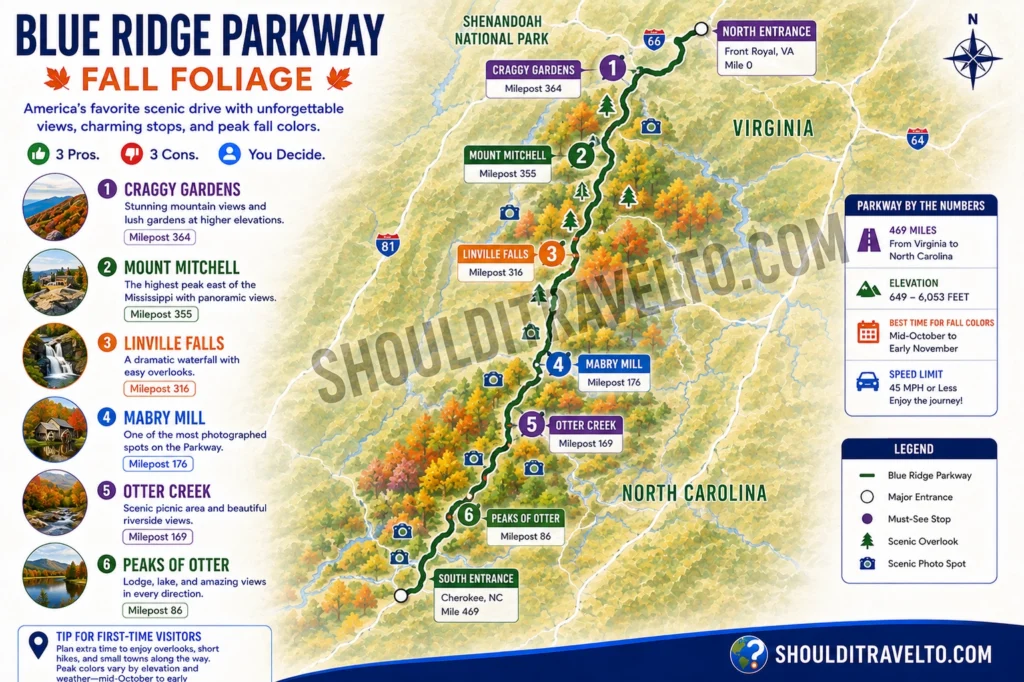
Some of the most popular stops include:
Craggy Gardens
Known for high-elevation scenery, mountain views, and colorful landscapes.
Mount Mitchell
Accessible from the Parkway, Mount Mitchell contains the highest summit east of the Mississippi River and offers expansive mountain views from the surrounding high country.
Linville Falls
One of the Parkway’s most famous waterfall areas, with hiking trails and multiple viewpoints.
Mabry Mill
One of the Parkway’s most recognizable historic attractions and a particularly photogenic fall stop.
Ideal Trip Length
You don’t need a week to experience the Parkway.
A weekend can be excellent if you concentrate on one section.
Weekend
- One section of the Parkway
- Several overlooks
- One hike or waterfall
3 Days
- More scenic driving
- Multiple attractions
- Mountain towns
5–7 Days
- Multi-section road trip
- Virginia + North Carolina
- More hiking and attractions
Longer trips make more sense if you want to travel through multiple regions.
Where to Stay Along the Blue Ridge Parkway
Because the Blue Ridge Parkway isn’t a single town or resort destination, where you stay depends heavily on which section you want to explore.
Popular bases include:
Asheville, North Carolina: Best for City Amenities
One of the best choices for travelers who want a combination of Parkway access, restaurants, hotels, breweries, and a lively city atmosphere.
Boone, North Carolina: Best for Northern North Carolina
A good base for exploring the northern North Carolina mountains and nearby Parkway attractions.
Blowing Rock, North Carolina: Best for a Mountain-Town Getaway
A charming mountain town particularly well suited to travelers who want a small-town fall getaway.
Roanoke, Virginia: Best Virginia City Base
A useful base for exploring the Virginia section of the Parkway while still having access to a larger city’s restaurants and accommodations.
Waynesboro, Virginia: Best for Combining With Shenandoah
A convenient option near the northern end of the Parkway and Shenandoah National Park.
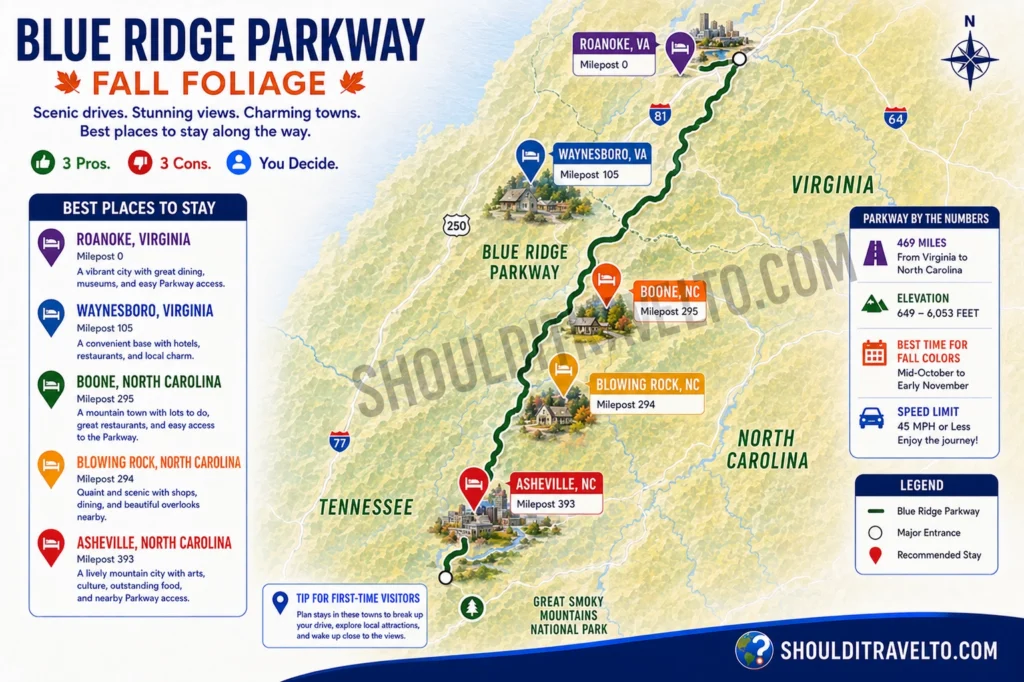
The best place to stay depends on whether you want mountain scenery, small-town atmosphere, restaurants and nightlife, or convenient access to a particular section of the Parkway.
What Is the Blue Ridge Parkway Like Outside Fall?
The Parkway can be visited throughout the year, but access varies considerably by season.
Spring: Wildflowers & Waterfalls
Spring brings wildflowers, fresh greenery, waterfalls, and generally quieter roads.
Summer: Hiking & Mountain Escape
Summer is popular for hiking and escaping the heat at higher elevations.
Fall: Foliage
Autumn is the Parkway’s signature season, combining colorful forests with mountain views.
Winter: Quiet Mountain Scenery
Winter can provide a much quieter experience, although weather and temporary road closures become more important considerations.
If your primary goal is fall foliage, autumn is the clear winner.
Who Should Visit the Blue Ridge Parkway?
The Blue Ridge Parkway is perfect for:
- Fall foliage lovers
- Road-trip travelers
- Photographers
- Couples
- Outdoor enthusiasts
- Hikers
- Scenic-drive enthusiasts
- Mountain lovers
- Families
- Travelers exploring Virginia and North Carolina
Skip the Blue Ridge Parkway if:
- You dislike long drives.
- You don’t want to rent a car.
- You prefer one walkable destination.
- You dislike winding mountain roads.
- You want guaranteed weather.
- You want dramatic alpine peaks rather than Appalachian mountains.
Blue Ridge Parkway vs. Great Smoky Mountains for Fall Foliage
Choose the Blue Ridge Parkway for:
- Scenic driving
- A true road-trip format
- Hundreds of miles of changing scenery
- Multiple mountain communities
- Virginia + North Carolina
- A trip where the road itself is the attraction
Choose the Great Smoky Mountains for:
- A national park-centered experience
- Wildlife
- Historic valleys
- Waterfalls
- More concentrated hiking areas
- Cades Cove
- A Tennessee + North Carolina park vacation
The Blue Ridge Parkway is the stronger fall road trip.
The Great Smoky Mountains are the stronger fall national park experience.
Final Verdict
If you want to experience fall foliage from behind the wheel, few destinations in America make a stronger case than the Blue Ridge Parkway.
But don’t make the mistake of treating 469 miles as a checklist.
Pick a region.
Drive slowly.
Stop often.
Follow the color.
Because the Parkway’s greatest attraction isn’t waiting at the end of the road.
It’s the road itself.
3 Pros. 3 Cons. You Decide.
Blue Ridge Parkway Frequently Asked Questions
Is the Blue Ridge Parkway worth visiting for fall foliage?
Yes. The Parkway is one of America’s best fall foliage destinations, particularly for travelers who enjoy scenic driving, mountain views, hiking, and road trips.
When is peak fall foliage on the Blue Ridge Parkway?
Peak foliage varies considerably along the route because of differences in elevation and latitude. Higher elevations can change earlier, while lower elevations often peak later. Check current foliage conditions for the specific section you plan to visit.
How long does it take to drive the Blue Ridge Parkway?
Driving the entire Parkway would take considerably longer than simply following the road from one end to the other because travelers will want to stop at overlooks, trails, waterfalls, and attractions. A weekend is better spent exploring one section rather than attempting the entire route.
How many days do you need for the Blue Ridge Parkway?
Three days is a good starting point for a fall foliage trip. A five- to seven-day trip allows you to explore a larger portion of the Parkway and combine multiple mountain towns and attractions.
Is the Blue Ridge Parkway crowded in October?
Yes, particularly during peak foliage weekends. Popular overlooks and sections can become congested. Weekdays generally offer a more relaxed experience.
Do you need a car for the Blue Ridge Parkway?
Yes. A personal vehicle is the most practical way to experience the Parkway and its many overlooks, hiking areas, waterfalls, and attractions.
What states does the Blue Ridge Parkway go through?
The Blue Ridge Parkway runs through Virginia and North Carolina.
What are the best stops on the Blue Ridge Parkway?
Popular stops include Mount Mitchell, Linville Falls, Craggy Gardens, Mabry Mill, and numerous scenic overlooks and hiking trails.
Is Asheville on the Blue Ridge Parkway?
Asheville is not on the Parkway itself, but the road passes directly through the mountains near Asheville, making the city one of the most popular bases for exploring the Parkway.
Is the Blue Ridge Parkway good for families?
Yes. Families can enjoy scenic overlooks, short hikes, waterfalls, picnic areas, historic sites, and mountain towns without needing to undertake difficult hikes.
Is the Blue Ridge Parkway good for couples?
Yes. Scenic drives, mountain views, small towns, restaurants, hiking, and fall colors make the Parkway particularly appealing for couples.
Can you visit the Blue Ridge Parkway without hiking?
Absolutely. Many of the Parkway’s best experiences involve scenic overlooks and driving. Hiking simply provides another way to experience the landscape.
What is the difference between the Blue Ridge Parkway and the Blue Ridge Mountains?
The Blue Ridge Mountains are the broader mountain range extending through multiple states.
The Blue Ridge Parkway is a 469-mile scenic road that travels through part of that mountain landscape in Virginia and North Carolina.
Is the Blue Ridge Parkway better than the White Mountains for fall foliage?
It depends on what you want.
Choose the Blue Ridge Parkway for a longer Appalachian road trip with hundreds of miles of changing scenery and multiple possible bases.
Choose the White Mountains for a more concentrated New England mountain experience with dramatic scenery, the Kancamagus Highway, mountain passes, waterfalls, and classic New England fall atmosphere.
The Blue Ridge Parkway is the bigger road trip.
The White Mountains are the more concentrated mountain-foliage destination.
Is the Blue Ridge Parkway the same as Skyline Drive?
No.
Skyline Drive runs for approximately 105 miles through Shenandoah National Park in Virginia.
The Blue Ridge Parkway begins near Rockfish Gap, just south of Shenandoah National Park.
Together, they can form one enormous Appalachian scenic road trip.
Is the Blue Ridge Parkway the most visited National Park Service site?
Yes. The Blue Ridge Parkway recorded approximately 16.5 million recreation visits in 2025, making it the most visited site managed by the National Park Service that year.
That’s different from saying it is America’s most visited national park. Great Smoky Mountains National Park holds that distinction among sites officially designated as national parks.
Can you drive the Blue Ridge Parkway in one day?
You can drive a portion of it in one day, but trying to cover the entire Parkway would leave little time for overlooks, hikes, waterfalls, and other attractions. Choose one section instead.
What is the biggest mistake visitors make on the Blue Ridge Parkway?
Trying to see too much. The Parkway is almost 470 miles long, and the best experience comes from slowing down, choosing a manageable section, and enjoying the journey rather than trying to complete the entire route.