
Should You Visit Roanoke Island, Home of America’s Lost Colony?
Quick Answer
Yes, you should visit Roanoke Island, especially if you’re interested in early American history, unsolved mysteries, Native American history, or the story of England’s first attempts to establish a permanent colony in North America.
More than two decades before Jamestown was founded, English colonists arrived on Roanoke Island along what is now the Outer Banks of North Carolina.
The first settlement attempt failed.
Then, in 1587, another group of men, women, and children established a colony on the island.
When Governor John White returned three years later, the colonists had disappeared.
The word CROATOAN was carved into a post.
The fate of the colonists became one of the most enduring mysteries in American history.
Today, visitors can explore Fort Raleigh National Historic Site, learn about the English colonization attempts and the Carolina Algonquian peoples already living in the region, and discover a broader history that extends through the Civil War and beyond.
Roanoke isn’t a destination filled with surviving colonial buildings.
That’s important to understand before you go.
Instead, it’s a place where the landscape, archaeology, interpretation, and mystery tell the story.
For travelers building an American history trip, Roanoke represents one of the earliest chapters.
Why Visit Roanoke Island?
Before Jamestown. Before Plymouth. And before the thirteen colonies. There was Roanoke.
In 1584, an English reconnaissance expedition sponsored by Sir Walter Raleigh reached the region.
The following year, England attempted to establish a colony on Roanoke Island.
That settlement was abandoned.
In 1587, another group arrived under Governor John White.
This time, the colonists included women and children, demonstrating an intention to establish a permanent community. Among them was Virginia Dare, born on Roanoke Island on August 18, 1587, and remembered as the first English child born in North America.
Then the colony disappeared.
That mystery has overshadowed Roanoke for centuries.
But there’s much more to the story.
Visitors can also learn about the Carolina Algonquian peoples who lived here before the English arrived, the complicated interactions between Indigenous communities and the colonists, and the Freedmen’s Colony established on Roanoke Island during the Civil War.
Roanoke isn’t simply the story of a missing colony.
It’s one of the places where the long story of English America began.
Roanoke Island, North Carolina vs. Roanoke, Virginia
Before planning your trip, there’s an important distinction to keep in mind.
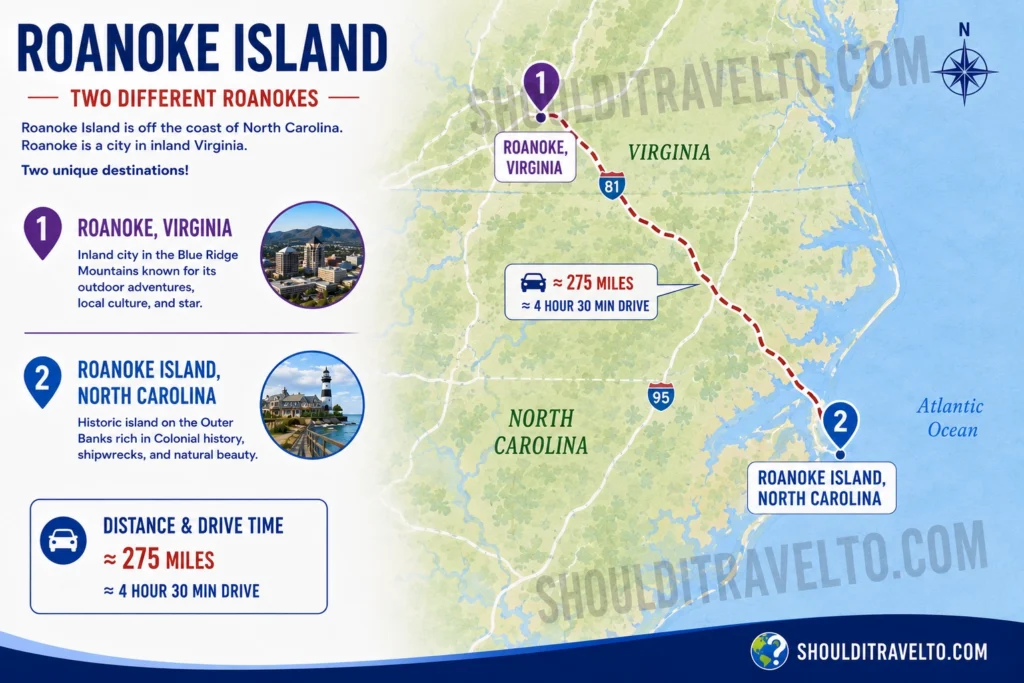
Roanoke Island, North Carolina, and Roanoke, Virginia, are two completely different destinations.
Roanoke Island is located along North Carolina’s Outer Banks and is associated with England’s sixteenth-century colonization attempts and the famous Lost Colony.
This is the Roanoke you’ll want to visit if you’re interested in Fort Raleigh, Virginia Dare, John White, CROATOAN, and the mystery of what happened to the colonists.
Roanoke, Virginia, meanwhile, is a modern city in western Virginia’s Blue Ridge Mountains. It is hundreds of miles from Roanoke Island and has no geographic connection to the Lost Colony.
The shared name can be particularly confusing because the English territory associated with the Roanoke expeditions was called Virginia, even though the colony itself was located on what is now Roanoke Island, North Carolina.
Today, the two destinations offer completely different vacations.
Visit Roanoke Island, North Carolina, for:
- The Lost Colony
- Fort Raleigh National Historic Site
- Early American history
- The Outer Banks
- Beaches and coastal scenery
Visit Roanoke, Virginia, for:
- The Blue Ridge Mountains
- Blue Ridge Parkway access
- Hiking and outdoor recreation
- Fall foliage
- A small-city base for exploring western Virginia
For the Lost Colony and the beginning of England’s colonial story in America, Roanoke Island, North Carolina, is the destination you’re looking for.
Here are the biggest reasons to visit Roanoke Island.
Three Reasons to Visit Roanoke Island
Roanoke Island combines one of America’s greatest historical mysteries with early colonial history and a beautiful Outer Banks setting.
1. Explore the Mystery of the Lost Colony
The Lost Colony remains one of the most fascinating mysteries in American history.
In 1587, more than 100 colonists arrived on Roanoke Island.
Governor John White eventually returned to England for supplies.
War between England and Spain delayed his return.
When White finally reached Roanoke again in 1590, the settlement was deserted.
He found CRO carved into a tree and CROATOAN carved into a palisade.
There were no obvious signs that the colonists had left suddenly.
White attempted to travel to Croatoan but was prevented by weather and ultimately returned to England without discovering what happened to the colonists.
Their ultimate fate remains uncertain.
For history travelers, standing in the landscape where the mystery unfolded provides a very different experience from simply reading about it.
2. Visit Fort Raleigh National Historic Site
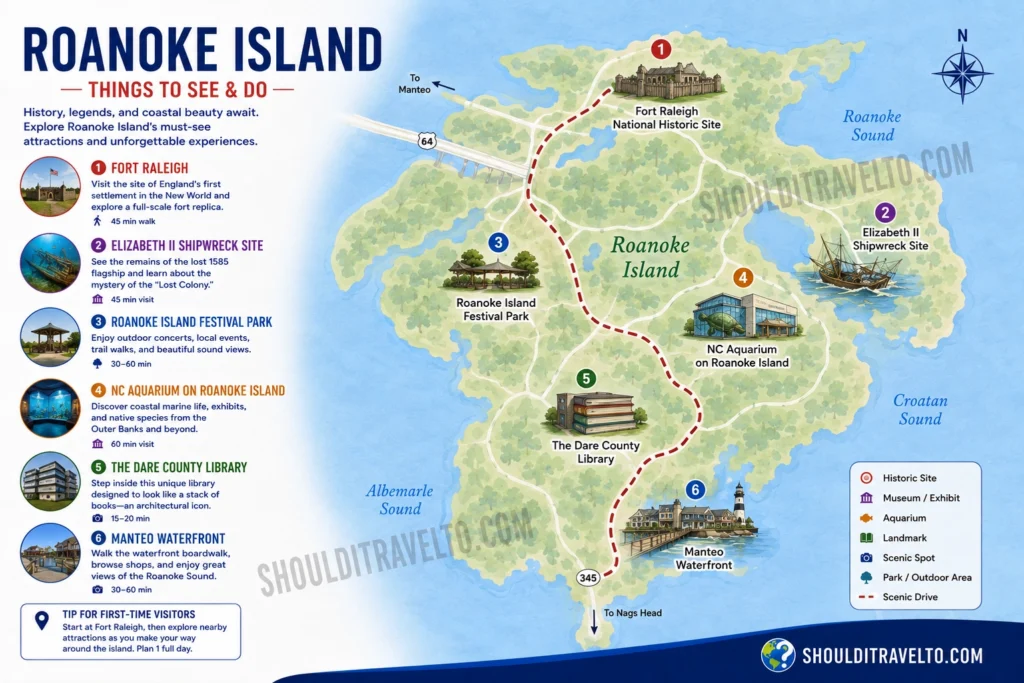
Fort Raleigh National Historic Site preserves and interprets the history associated with England’s colonization attempts on Roanoke Island.
Visitors can explore:
- The Visitor Center
- Reconstructed earthen earthwork
- Historical exhibits
- Thomas Hariot Trail
- Freedom Trail
- Freedmen’s Colony Monument
- Archaeological interpretation
- Waterside Theatre
The site isn’t filled with surviving sixteenth-century structures.
Instead, archaeology, exhibits, reconstructed features, trails, and the surrounding landscape help visitors understand what happened here.
That makes Fort Raleigh considerably different from Williamsburg or Mount Vernon.
You aren’t primarily visiting preserved buildings.
You’re visiting the location where the history happened.
3. Understand the Story Before Jamestown
Roanoke becomes considerably more interesting when you connect it to Jamestown.
The English colonization attempts at Roanoke occurred more than twenty years before the establishment of Jamestown in 1607.
And those failures mattered.
England’s experience at Roanoke became part of the much larger story of its attempts to establish a permanent presence in North America. The National Park Service notes that England successfully established Jamestown seventeen years after John White’s unsuccessful 1590 return to Roanoke.
For history travelers, that creates a fascinating progression:
Roanoke: The Attempt
Jamestown: The Permanent Settlement
Williamsburg: The Colonial Capital
Yorktown: The Revolution Won
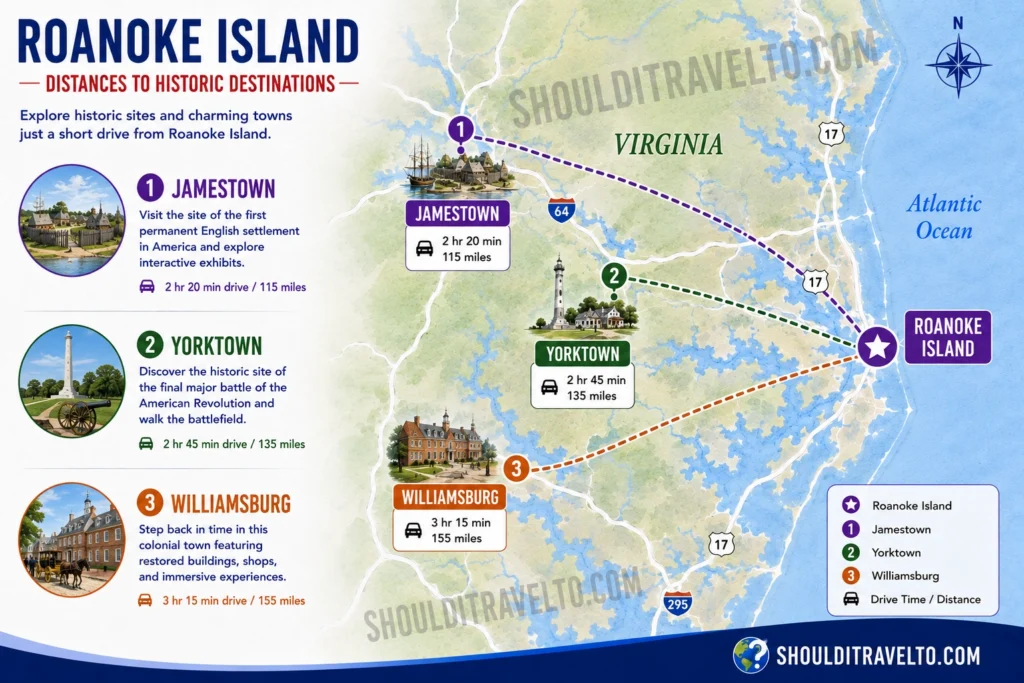
Seeing these places together transforms them from isolated attractions into chapters of the same story.
Next, let’s explore the downsides of traveling to Roanoke Island.
Three Downsides of Visiting Roanoke Island
Roanoke is historically fascinating, but visitors should understand what the experience actually involves.
1. Very Little of the Original Colony Survives
Don’t arrive expecting Williamsburg.
There aren’t streets filled with reconstructed colonial buildings or a preserved colonial settlement.
Much of the experience depends on:
- Interpretation
- Archaeology
- Exhibits
- Trails
- Monuments
- Imagination
The earthwork visitors see today was reconstructed in 1950 following archaeological investigation that confirmed its sixteenth-century age. Its exact purpose remains a subject of archaeological interpretation.
Travelers who need substantial physical remains to connect with history may find Roanoke less visually impressive than Jamestown or Mount Vernon.
2. The Historical Attractions Don’t Require Several Days
Roanoke Island’s historical sites can take up a substantial portion of a day, but the colonial history experience alone probably doesn’t justify a long vacation for most travelers.
Roanoke works much better as part of a broader Outer Banks trip.
That allows travelers to combine history with beaches, coastal scenery, lighthouses, nature, and other regional attractions.
3. The Mystery Doesn’t Have a Definitive Ending
If you’re expecting to visit Roanoke and discover exactly what happened to the Lost Colony, you won’t.
Historians and archaeologists have developed theories and continue studying evidence, but the colony’s ultimate fate remains uncertain. The National Park Service continues to describe it as one of history’s enduring mysteries.
For some travelers, that’s precisely what makes Roanoke fascinating.
Others may find the lack of a definitive conclusion frustrating.
Planning Your Roanoke Island Trip
When planning your visit, keep these factors in mind.
Best Things To Do on Roanoke Island
Don’t miss:
Fort Raleigh National Historic Site
The essential stop for understanding the Roanoke colonies, Indigenous history, archaeology, and the later Freedmen’s Colony.
Fort Raleigh Visitor Center
Start here before exploring the grounds. The exhibits provide context that makes the relatively subtle archaeological landscape much easier to understand.
Reconstructed Earthwork
See the reconstructed sixteenth-century earthwork and learn how archaeology has helped researchers understand English activity at the site.
Thomas Hariot Trail
A short trail through maritime forest provides another way to experience the natural environment surrounding the historic site.
Freedom Trail
The 1.25-mile trail leads through maritime forest toward Croatan Sound and the area associated with the Civil War-era Freedmen’s Colony.
The Lost Colony
During its performance season, the long-running outdoor drama at Waterside Theatre interprets the story of the Roanoke colonists in the landscape where the events occurred.
Manteo
Combine Fort Raleigh with a visit to nearby Manteo for restaurants, waterfront scenery, and additional Roanoke Island attractions.
Best Time to Visit Roanoke Island
Spring ★★★★★
- Comfortable temperatures
- Lower crowds than peak summer
- Good conditions for exploring outdoors
- Excellent for combining history with an Outer Banks trip
Summer ★★★★☆
- Warm beach weather
- Longer days
- Seasonal attractions and programming
- The Lost Colony performance season
- Larger Outer Banks crowds
Fall ★★★★★
- Comfortable sightseeing weather
- Smaller crowds after peak summer
- Excellent for history and outdoor exploration
- Strong choice for an Outer Banks road trip
Winter ★★★☆☆
- Quiet
- Fewer visitors
- Cooler weather
- Some seasonal experiences unavailable
For travelers primarily interested in history rather than beaches, spring and fall offer the strongest balance.
Ideal Trip Length
For most history travelers, one full day is sufficient to experience Roanoke Island’s major historical sites.
Half Day: Fort Raleigh highlights
Full Day: Fort Raleigh + Manteo + additional Roanoke Island attractions
2–3 Days: Roanoke Island + broader Outer Banks
A longer stay makes much more sense when you combine Roanoke with the Outer Banks.
Roanoke vs. Jamestown: What’s the Difference?
Roanoke and Jamestown represent two different stages in the development of English America. Let’s take a look.
Roanoke
Roanoke represents England’s early attempts to establish a permanent colony in North America.
The 1585 settlement was abandoned.
The 1587 colony disappeared.
Its fate remains one of America’s great historical mysteries.
Jamestown
Jamestown was established in 1607 and became England’s first permanent settlement in North America.
Unlike Roanoke, the colony survived and eventually became the foundation for permanent English colonization in Virginia.
Which Should You Visit?
Choose Roanoke if you’re more interested in:
- The Lost Colony
- Exploration
- Archaeology
- Historical mysteries
- The earliest English colonization attempts
- Combining history with an Outer Banks vacation
Choose Jamestown if you’re more interested in:
- The first permanent English settlement
- Archaeological remains
- Reconstructed colonial experiences
- Seventeenth-century life
- Combining history with Williamsburg and Yorktown
For serious American history travelers, however, the best answer is:
Visit both.
Roanoke tells you how the English colonial story almost failed before it really began.
Jamestown tells you what happened when England finally established a settlement that survived.
Nearby Destinations
Roanoke Island works particularly well as part of a broader Outer Banks vacation.
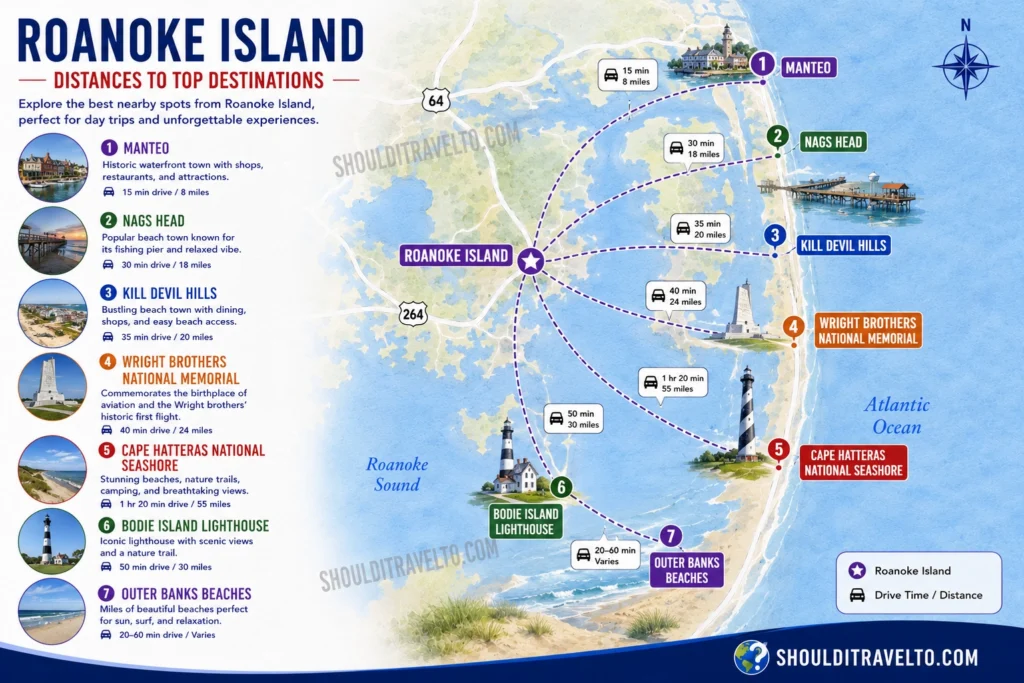
Nearby options include:
- Manteo
- Nags Head
- Kill Devil Hills
- Wright Brothers National Memorial
- Cape Hatteras National Seashore
- Bodie Island Lighthouse
- Outer Banks beaches
For travelers continuing the story of early English America, consider the Historic Triangle destinations:
- Jamestown
- Williamsburg
- Yorktown
Who Should Visit Roanoke Island?
Like other historic American destinations, Roanoke is a worthwhile trip for many travelers. Here’s what to consider.
Roanoke Island is ideal for:
- American history enthusiasts
- Colonial history travelers
- Families
- Students
- Archaeology enthusiasts
- Travelers fascinated by historical mysteries
- Outer Banks visitors
- Road-trip travelers
You may want to skip Roanoke if:
- You expect extensive surviving colonial buildings
- You aren’t interested in history
- You want a large living-history attraction
- You have very limited time on an Outer Banks beach vacation
- Historical mysteries without definitive answers frustrate you
Final Thoughts
Roanoke Island doesn’t have the surviving colonial buildings of Williamsburg.
It doesn’t have the archaeological scale of Jamestown.
And it doesn’t have the battlefield significance of Yorktown.
What it has is something completely different.
A mystery.
More than twenty years before Jamestown, English colonists attempted to establish themselves on this small island along the North Carolina coast.
The first settlement failed.
The next disappeared.
And when John White returned in 1590, one word became the most famous clue in the story:
CROATOAN.
But Roanoke’s significance extends beyond the mystery.
Its history includes the Carolina Algonquian peoples who lived here before the English arrived, England’s earliest colonization attempts, ongoing archaeological investigations of those events, and a Freedmen’s Colony established centuries later during the Civil War.
For travelers interested in American history, Roanoke represents something important:
The story before Jamestown.
If you want to understand how English America began, Roanoke Island belongs near the beginning of the journey.
3 Pros. 3 Cons. You Decide.
Roanoke Island Frequently Asked Questions
Is Roanoke Island worth visiting?
Yes, particularly for travelers interested in early American history, the Lost Colony, archaeology, Native American history, or the Outer Banks.
Where was the Roanoke Colony?
The Roanoke Colony was established on Roanoke Island in present-day North Carolina, not in the modern city of Roanoke, Virginia. The English called the broader territory Virginia during the sixteenth century.
What happened to the Lost Colony of Roanoke?
No definitive answer has been established. When John White returned in 1590, the colonists had disappeared. Among the clues were the carvings CRO and CROATOAN, suggesting the colonists may have relocated, but White was unable to investigate Croatoan before returning to England.
What does CROATOAN mean?
Croatoan referred to an Indigenous community and an island in the region. The word carved at the abandoned settlement led John White to believe the colonists may have relocated there.
Who was Virginia Dare?
Virginia Dare was born on Roanoke Island on August 18, 1587, and is remembered as the first English child born in North America. She was among the colonists whose ultimate fate remains unknown.
Is Fort Raleigh the original fort?
The earthwork visitors see today is reconstructed. Archaeological investigation confirmed the sixteenth-century age of the earthwork, and it was reconstructed in 1950.
How long should you spend at Roanoke Island?
History-focused visitors can see the major Fort Raleigh experiences in roughly half a day, while a full day allows time to explore additional Roanoke Island attractions and Manteo. Two or three days work well if you’re combining the island with the broader Outer Banks.
Is Roanoke older than Jamestown?
Yes. English colonization attempts at Roanoke occurred during the 1580s. Jamestown was established in 1607 and became England’s first permanent settlement in North America.
Is Roanoke Island good for families?
Yes. The mystery of the Lost Colony can make early colonial history particularly engaging for children, while trails, outdoor attractions, and nearby Outer Banks destinations provide variety beyond museums and historical interpretation.
Can you visit Roanoke and Jamestown on the same trip?
Yes, although they’re not nearby attractions. They work better as stops on a longer Virginia–North Carolina American history road trip.
What is the biggest mistake visitors make at Roanoke?
Expecting to see a preserved colonial town.
Roanoke is primarily an archaeological and interpretive historical destination. Understanding the story before exploring Fort Raleigh makes the physical site considerably more meaningful.