

Should You Visit the Adirondacks for Fall Foliage?
Quick Answer
Yes, you should travel to the Adirondacks for fall foliage if you want colorful mountains, reflective lakes, scenic drives, hiking, small mountain towns, and one of the most dramatic autumn landscapes in the Northeast.
And for a first-time foliage trip, Lake Placid is one of the best places to start.
Located in New York’s Adirondack Mountains, Lake Placid combines several ingredients that make an exceptional fall destination:
- The Adirondack High Peaks
- Mirror Lake and surrounding mountain lakes
- Scenic roads
- Hiking trails
- Whiteface Mountain
- A walkable mountain town with Olympic history
The result is a fall foliage experience that feels distinctly different from New England.
The Adirondacks aren’t primarily about covered bridges and quintessential Vermont villages.
They’re about wilderness, mountains, lakes, and enormous stretches of forest.
And around Lake Placid, those landscapes come together particularly well.
The strongest foliage around Lake Placid often arrives from late September into early October, although exact timing varies significantly from year to year.
That means one of the biggest planning lessons is simple:
Don’t wait too long.
Lake Placid can peak earlier than travelers expecting a traditional mid-October New England foliage trip might realize.
What Are the Adirondacks?
The Adirondacks are a vast mountain region in northern New York centered around the Adirondack Mountains and largely encompassed by Adirondack Park.
The terminology can be confusing for first-time visitors.
The Adirondack Mountains are the mountains.
Adirondack Park is the approximately six-million-acre region containing mountains, forests, lakes, communities, and a mixture of public and private land.
And “the Adirondacks” is the common name used for the broader region.
Unlike a traditional national park, the Adirondack Park doesn’t have a single entrance gate or a central visitor corridor. It contains public Forest Preserve lands alongside privately owned towns, homes, farms, businesses, and other properties.
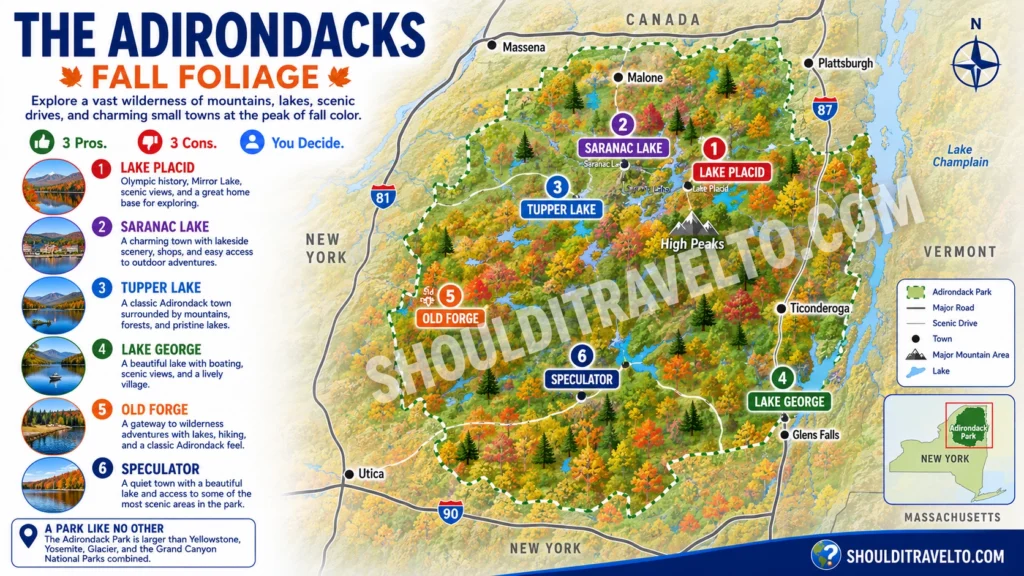
The Adirondack Park Agency describes it as the largest publicly protected area in the contiguous United States, larger than Yellowstone, Everglades, Glacier, and Grand Canyon national parks combined. The region also contains more than 3,000 lakes and ponds and approximately 30,000 miles of rivers and streams.
For travelers, the most important lesson is simple:
The Adirondacks aren’t one compact destination.
They’re an enormous region filled with mountains, lakes, wilderness areas, scenic roads, villages, recreational areas, and communities.
And that brings us to Lake Placid.
Why Use Lake Placid as Your Fall Foliage Base?
Lake Placid gives first-time visitors something especially valuable:
A practical base for exploring an enormous mountain region.
You can spend the day exploring mountain roads, hiking trails, lakes, waterfalls, and scenic overlooks…
then return to a town with hotels, restaurants, shops, and other visitor services.
Lake Placid also sits near some of the Adirondacks’ most recognizable fall scenery.
Nearby experiences include:
- Mirror Lake
- Whiteface Mountain
- Cascade Lakes
- Route 73
- Wilmington Notch
- Adirondack Loj Road
- Heart Lake
- High Peaks hiking
- High Falls Gorge
- Olympic attractions
Official Lake Placid tourism specifically highlights Route 73 through the Cascade Lakes, Mirror Lake Drive, Route 86 through Wilmington Notch, Adirondack Loj Road, and Whiteface Veterans’ Memorial Highway as scenic fall drives.
So for this guide, I’d use a simple distinction:
The Adirondacks are the destination.
Lake Placid is the base.
What Makes Adirondack Fall Foliage Different?
The answer is the combination of mountains and water.
You aren’t simply looking across forests filled with red, orange, yellow, and gold.
You’re often seeing those colors reflected in lakes beneath mountain peaks.
That creates a very different visual experience.
Around Lake Placid, a single fall trip can combine mountains, lakes, forests, scenic roads, hiking, and a mountain-town base.
And unlike some foliage destinations where the best scenery requires substantial hiking, many classic Adirondack fall views are accessible by road.
You can hike to a summit.
But you can also drive through a mountain pass.
Circle Mirror Lake.
Stop beside Cascade Lakes.
Drive toward Adirondack Loj.
Or climb Whiteface Mountain by road.
The Adirondacks can be adventurous when you want them to be—and scenic when you don’t.
The Biggest Mistake First-Time Fall Visitors Make
The biggest mistake is assuming that mid-October is automatically peak foliage.
That’s a reasonable assumption in some Northeast destinations.
But Lake Placid is farther north and surrounded by higher elevations.
Fall often moves quickly here.
Local Lake Placid guidance says the typical peak-color period runs from the last week of September into the first week of October.
Exact timing varies every year.
Temperature, rainfall, elevation, wind, and other conditions affect when leaves change and how long they remain.
That’s why travelers should follow current foliage reports rather than book around a supposedly guaranteed peak date.
Lake Placid publishes seasonal foliage reports beginning in September.
The second mistake?
Trying to experience the Adirondacks as if they were a compact destination.
They’re not.
Choose a region.
Choose a base.
Then explore it properly.
For a first trip, Lake Placid makes that decision considerably easier.
Let’s explore the pros and cons of traveling to the Adirondacks to see the fall foliage.
The 3 Biggest Reasons to Visit the Adirondacks During Fall
1. Mountains and Lakes Create Extraordinary Fall Scenery
This is the biggest reason to come.
The Adirondacks combine rugged mountain landscapes with an extraordinary concentration of lakes, ponds, rivers, and streams.
During autumn, those landscapes become layered.
Colorful forests cover mountain slopes.
Lakes reflect the changing leaves.
Mountain peaks rise behind the water.
And scenic roads move between all of them.
Around Lake Placid, places such as Mirror Lake and Cascade Lakes give visitors the classic combination.
Mountains above.
Fall foliage around you.
Reflections below.
That’s what separates the Adirondacks from many other famous foliage destinations.
2. The High Peaks Create a Dramatic Backdrop
Lake Placid provides convenient access to the Adirondack High Peaks, home to some of the region’s most dramatic mountain scenery and extensive hiking opportunities.
That matters.
Instead of rolling hills covered in autumn color, many views are framed by substantial mountain terrain.
Serious hikers can turn fall foliage into a mountain adventure.
But you don’t have to climb a High Peak to appreciate the scenery.
Roads, lakes, overlooks, and shorter trails still provide views of the surrounding mountains.
This makes Lake Placid particularly good for groups with different activity levels.
One traveler can hike.
Another can take a scenic drive.
Both can experience the same spectacular autumn landscape.
3. Lake Placid Gives You a Complete Fall Getaway
This may be the advantage that separates Lake Placid from more remote Adirondack destinations.
You’re not only traveling somewhere to look at leaves.
You can build a complete vacation around them.
Spend the morning driving through mountain scenery.
Take an afternoon walk around Mirror Lake.
Explore an Olympic attraction.
Go hiking.
Paddle if conditions allow.
Visit nearby waterfalls.
Explore downtown Lake Placid.
Then have dinner and return to your hotel.
The town adds comfort and convenience to a region otherwise defined by wilderness.
For travelers who want nature without giving up restaurants, accommodations, and a recognizable vacation base, Lake Placid works extremely well.
The 3 Biggest Downsides of Visiting the Adirondacks in Fall
The Adirondacks’ enormous geography, northern location, and popularity during peak foliage also create several important trade-offs.
1. Peak Foliage Can Be Easy to Miss
This is the biggest drawback.
The same northern location and mountain environment that create spectacular color can make timing difficult.
Lake Placid may reach peak before travelers expecting an October foliage vacation realize.
A trip during the second or third week of October might coincide with excellent foliage somewhere else in the Northeast, while Lake Placid could already be beyond its strongest color.
That doesn’t mean late-season trips aren’t worthwhile.
But if foliage is your primary reason for traveling, timing matters.
Don’t plan Lake Placid around the calendar alone.
Monitor actual foliage conditions.
And because elevation and local conditions vary across the Adirondacks, being past peak in one area doesn’t necessarily mean the entire region is past peak.
2. The Region Is Enormous
Adirondack Park encompasses approximately six million acres.
That’s an advantage if you want wilderness.
It’s a disadvantage if you try to see everything.
Lake Placid.
Whiteface.
Saranac Lake.
Tupper Lake.
High Peaks.
Lake George.
Keene Valley.
And countless other Adirondack destinations are not part of a single compact sightseeing district.
Trying to cover enormous portions of the Adirondacks in a weekend defeats the purpose.
For a first trip, build around Lake Placid and the surrounding High Peaks region rather than trying to “see the Adirondacks.”
3. Peak Season Can Be Busy and Expensive
Beautiful fall foliage attracts plenty of other travelers.
Lake Placid is already one of the Adirondacks’ best-known vacation destinations.
During peak foliage, popular hotels, restaurants, trailheads, scenic roads, and viewpoints can become busy.
Accommodation prices can also reflect demand.
This isn’t necessarily the place to plan a spontaneous peak-foliage weekend and assume you’ll find your preferred hotel at a bargain.
Book important accommodations in advance.
But remain flexible about exactly where you’ll look for foliage once you arrive.
Planning Your Adirondacks Fall Foliage Trip
When planning your Adirondacks fall foliage trip, consider the following.
Best Things To Do During Fall
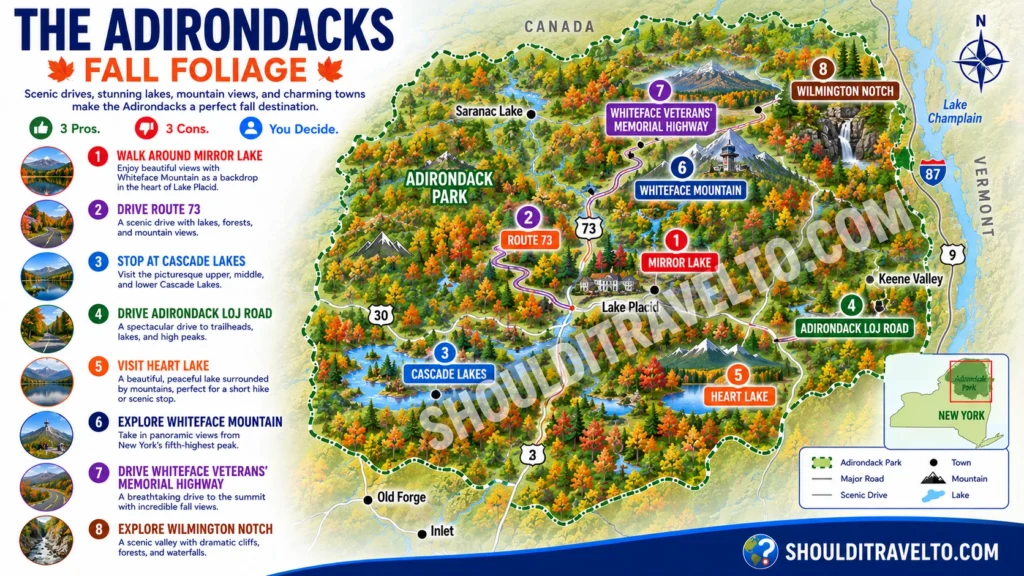
A first-time Lake Placid foliage itinerary can include:
- Walk around Mirror Lake
- Drive Route 73
- Stop at Cascade Lakes
- Drive Adirondack Loj Road
- Visit Heart Lake
- Explore Whiteface Mountain
- Drive Whiteface Veterans’ Memorial Highway
- Explore Wilmington Notch
Mirror Lake
Mirror Lake may be the easiest introduction to fall in Lake Placid.
It’s directly beside downtown and surrounded by mountain scenery.
Visitors can walk around the lake, photograph reflections, explore Main Street, and enjoy the foliage without getting in a car.
Mirror Lake Drive circles the lake and offers foliage, mountain views, and views toward Whiteface Mountain.
This is what makes Lake Placid such an effective base.
The fall scenery doesn’t begin when you leave town.
It’s already there.
Route 73 and Cascade Lakes
For a classic Adirondack fall drive, Route 73 is one of the strongest options.
Approaching Lake Placid from the east takes travelers through mountain terrain and past the Cascade Lakes.
The lakes sit beneath steep surrounding terrain and can reflect the autumn foliage.
The route also passes through places such as Keene and Keene Valley before reaching Lake Placid.
For first-time visitors, this drive provides exactly what they probably came to the Adirondacks to see mountains, lakes, forests, and fall color.
Adirondack Loj Road and Heart Lake
Adirondack Loj Road is another excellent fall drive near Lake Placid.
The road travels through a valley surrounded by High Peaks and ends near Adirondack Loj and Heart Lake.
It’s approximately 9.6 miles round trip from Route 73.
For hikers, this is a gateway to major High Peaks trails.
For everyone else?
The road and Heart Lake still make the trip worthwhile.
This is a good example of why Lake Placid works for both serious outdoor travelers and casual foliage visitors.
Whiteface Mountain
Whiteface Mountain offers one of the most dramatic views of Adirondack foliage.
The Whiteface Veterans’ Memorial Highway climbs for roughly 8 miles toward the summit area, offering visitors increasingly broad views of the surrounding mountains and valleys.
During peak foliage, the elevation can create enormous panoramas of autumn color.
And unlike a mountain summit that requires hours of hiking, much of the elevation gain happens by car.
That makes Whiteface particularly valuable for families, photographers, and travelers who want a major mountain view without a major hike.
The highway operates seasonally, so travelers should confirm current operating dates and conditions before building a fall itinerary around it.
When Is Peak Fall Foliage in Lake Placid?
| Period | What to Expect | Foliage Potential |
| Mid-September | Early color developing | ★★★☆☆ |
| Late September | Strong color developing; peak possible | ★★★★★ |
| First Week of October | Peak or near-peak often possible | ★★★★★ |
| Second Week of October | Later-stage color; past-peak conditions increasingly possible | ★★★☆☆ |
| Mid-October | Often past peak around Lake Placid; conditions vary elsewhere | ★★☆☆☆ |
| Late October | Mostly post-peak across many northern/high-elevation areas | ★☆☆☆☆ |
These are planning guidelines, not guarantees.
For a first-time foliage trip, target late September through approximately the first week of October, and monitor the current foliage report as your trip approaches.
Ideal Trip Length
For most first-time foliage travelers: Three days is the sweet spot.
2 Days: Highlights
Enough for Lake Placid, Mirror Lake, one major scenic drive, and Whiteface or a short hike.
3 Days: Best Balance
Enough time for Lake Placid, multiple scenic drives, Whiteface, lakes, hiking or waterfalls, and a less rushed pace.
4–5 Days: More Complete Adirondack Experience
Better for combining Lake Placid with Saranac Lake, additional hiking, longer scenic drives, Olympic attractions, and more of the surrounding Adirondacks.
Where Should You Stay?
Where you stay matters in the Adirondacks because the region is enormous. For a foliage trip centered around the High Peaks, these are some of the most practical bases.
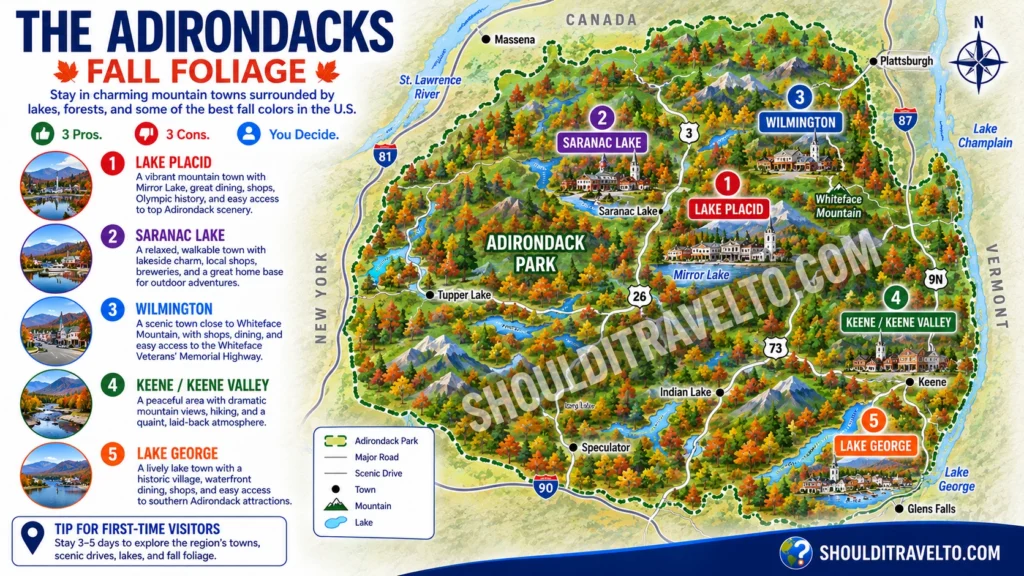
Lake Placid: Best for First-Time Visitors
Lake Placid combines accommodations, restaurants, shops, lake scenery, Olympic attractions, and excellent access to the High Peaks.
You can enjoy wilderness during the day without staying somewhere isolated at night.
Saranac Lake: Best Alternative Base
Saranac Lake provides another mountain-town option and works particularly well for travelers who want to explore more of the surrounding lake country.
It can also help turn the trip from a Lake Placid vacation into a broader Adirondack experience.
Wilmington: Best for Whiteface Mountain
Wilmington makes sense if Whiteface Mountain and the surrounding outdoor recreation are central to your trip.
It’s less of a complete visitor town than Lake Placid but geographically useful.
Keene or Keene Valley: Best for Hikers
For travelers who prioritize the High Peaks, hiking, and mountain scenery over traditional tourist amenities, this area may make more sense.
For most first-time visitors:
Stay in Lake Placid.
Do You Need a Car?
Yes, you’ll need a car when visiting the Adirondacks to see the fall foliage.
Lake Placid itself offers plenty of walking opportunities, particularly around Main Street and Mirror Lake.
But the broader Adirondack foliage experience requires mobility.
Cascade Lakes.
Whiteface Mountain.
Wilmington Notch.
Adirondack Loj.
Trailheads.
Waterfalls.
Other towns.
These experiences are geographically dispersed.
A car also gives you something especially valuable during foliage season:
flexibility.
If one area isn’t displaying the color you expected, you can explore somewhere else.
Who Should Visit the Adirondacks for Fall Foliage?
The Adirondacks are especially good for:
- Fall foliage travelers
- Photographers
- Couples
- Hikers
- Scenic road trippers
- Lake lovers
- Mountain lovers
- Paddlers
- Families
- Outdoor travelers
- New York road trips
- Travelers seeking an alternative to New England
- Travelers who can visit in late September or early October
Think twice if:
- You can’t travel until later October.
- You don’t want to drive.
- You want a compact destination.
- Hiking and outdoor scenery don’t interest you.
- You prefer coastal scenery.
- You primarily want quaint New England villages.
- You need guaranteed peak foliage.
Adirondacks vs. White Mountains for Fall Foliage
The Adirondacks and White Mountains are both outstanding mountain foliage destinations, but they emphasize different types of fall scenery.
Choose the Adirondacks for:
- Lakes
- High Peaks
- Mountain reflections
- Lake Placid
- Large wilderness landscapes
- Hiking
- Paddling
- Olympic history
- New York mountain-town experience
Choose the White Mountains for:
- Dramatic mountain roads
- Kancamagus Highway
- Mountain passes
- Waterfalls
- Covered bridges
- Classic New England foliage
- A more concentrated scenic-driving experience
The simplest difference?
The White Mountains are the stronger classic foliage road trip.
The Adirondacks are the stronger mountains-and-lakes foliage experience.
Adirondacks vs. Acadia for Fall Foliage
Both destinations feature mountains, water, and fall foliage, but the types of landscapes are completely different.
Choose the Adirondacks for:
- High Peaks
- Mountain lakes
- Wilderness
- Lake reflections
- Hiking
- Scenic mountain roads
- Lake Placid
Choose Acadia for:
- Atlantic Ocean
- Rocky coastline
- Islands
- Cadillac Mountain
- Park Loop Road
- Bar Harbor
- Coastal New England
Both combine mountains and water.
But it’s completely different water.
The Adirondacks reflect fall foliage in mountain lakes.
Acadia places fall foliage beside the Atlantic Ocean.
Adirondacks vs. Great Smoky Mountains for Fall Foliage
The Adirondacks and Great Smoky Mountains are especially useful to compare because their foliage seasons often favor different parts of the fall calendar.
Choose the Adirondacks for:
- Earlier foliage
- Mountain lakes
- High Peaks
- Northern forest scenery
- Lake Placid
- A Northeast fall getaway
Choose the Great Smoky Mountains for:
- A longer foliage season
- Later color
- Southern Appalachian scenery
- Wildlife
- Historic valleys
- Waterfalls
- Tennessee and North Carolina
The seasonal difference is particularly useful.
Lake Placid can be an excellent late-September foliage destination.
The Smokies can offer strong foliage well into October, with lower elevations sometimes carrying color into early November.
Final Assessment
Yes, you should travel to the Adirondacks to see the fall foliage, especially if your idea of a perfect fall landscape includes mountains reflected in lakes surrounded by brilliant autumn forests.
The Adirondacks are enormous.
Wild.
Mountainous.
Filled with lakes.
And Lake Placid gives first-time visitors an unusually convenient way to experience them.
You can watch autumn color reflect across Mirror Lake.
Drive through the mountains toward Cascade Lakes.
Explore roads surrounded by the High Peaks.
Drive toward Whiteface Mountain.
Hike.
Visit waterfalls.
Or simply watch the mountains change color from town.
And timing is especially important.
Don’t automatically wait until mid-October because that’s when you associate the Northeast with peak foliage.
The Adirondacks can get there first.
For Lake Placid, late September into early October is usually the window to watch most closely.
And when you catch it at the right time?
You don’t just see the fall foliage once.
You see it across the mountains.
And then you see it again in the lakes.
3 Pros. 3 Cons. You Decide.
Adirondacks Fall Foliage Frequently Asked Questions
Are the Adirondacks worth visiting for fall foliage?
Yes. The combination of extensive forests, High Peaks, lakes, scenic roads, hiking, and mountain towns makes the Adirondacks one of the Northeast’s strongest fall foliage destinations.
Are the Adirondacks and Adirondack Mountains the Same Thing?
Not exactly. The Adirondack Mountains are the mountain range, while “the Adirondacks” commonly refers to the broader region surrounding them. Adirondack Park encompasses approximately six million acres and includes mountains, forests, lakes, communities, and both public and private land.
Is Lake Placid in the Adirondacks?
Yes. Lake Placid is located within Adirondack Park in northern New York and is one of the region’s best-known mountain communities. Its location near the High Peaks, Whiteface Mountain, Mirror Lake, and major scenic roads makes it a particularly convenient base for a first-time Adirondack fall foliage trip.
Is Lake Placid a good base for Adirondack fall foliage?
Yes. For first-time visitors, it’s arguably one of the easiest bases because it combines accommodations and restaurants with immediate access to lakes, scenic drives, High Peaks recreation, Whiteface Mountain, and other foliage experiences.
When is peak foliage in Lake Placid?
Peak varies each year, but current Lake Placid tourism guidance indicates the strongest period is typically from the last week of September through the first week of October. Travelers should check current foliage reports before arriving.
Is late September too early?
No.
Late September may actually be one of the best times to target Lake Placid for fall foliage.
Is mid-October too late?
Potentially.
Some years may still have color, particularly at lower elevations or elsewhere in the Adirondacks, but Lake Placid can already be past peak by mid-October.
If foliage is the primary reason for your trip, I’d target earlier.
Why does Lake Placid peak earlier than many other foliage destinations?
Its northern location and mountain elevations generally produce cooler autumn conditions earlier than destinations farther south or at lower elevations.
How many days do you need in Lake Placid?
Three days is a good starting point for a first fall trip.
Two days can cover highlights, while four or five days allow more hiking and exploration of the surrounding Adirondacks.
Do you need a car?
For the broader Adirondacks, yes.
Lake Placid itself is partially walkable, but most scenic drives, trailheads, lakes, waterfalls, and surrounding communities require driving.
What are the best scenic drives near Lake Placid?
Route 73 through the Cascade Lakes, Mirror Lake Drive, Route 86 through Wilmington Notch, Adirondack Loj Road, and Whiteface Veterans’ Memorial Highway are among the routes highlighted by Lake Placid tourism for fall scenery.
Do you have to hike to see great foliage?
No.
That’s one of Lake Placid’s strengths.
Scenic roads, Mirror Lake, Cascade Lakes, Whiteface Mountain, and roadside viewpoints provide impressive scenery without requiring a major hike.
Is Whiteface Mountain worth visiting in fall?
Yes. The Veterans’ Memorial Highway provides access to high-elevation panoramic views without requiring a full summit hike, making it particularly appealing during foliage season.
Are the Adirondacks a national park?
No.
Adirondack Park is a unique mix of public and private land covering approximately six million acres. Nearly half is publicly owned and constitutionally protected Forest Preserve, while the remainder includes communities and privately owned lands.
Is Adirondack Park bigger than Yellowstone?
Yes, considerably.
At approximately six million acres, the Adirondack Park Agency says the park is larger than Yellowstone, Everglades, Glacier, and Grand Canyon national parks combined.
Lake Placid or Stowe for fall foliage?
Choose Lake Placid for mountains, lakes, wilderness, High Peaks, and outdoor recreation.
Choose Stowe for the quintessential Vermont fall-town experience, New England scenery, covered bridges, farms, and classic Vermont atmosphere.
Adirondacks or White Mountains for fall foliage?
Choose the Adirondacks for mountains + lakes.
Choose the White Mountains for mountain roads + classic New England foliage.
Adirondacks or Acadia for fall foliage?
Choose the Adirondacks for mountain lakes, High Peaks, and wilderness.
Choose Acadia for Atlantic coastline, granite mountains, and ocean-and-foliage scenery.
What’s the biggest mistake when planning an Adirondacks fall foliage trip?
Waiting until mid-October because you assume that is automatically peak foliage everywhere in the Northeast.
Around Lake Placid, late September through early October deserves much closer attention.