

Should You Visit Minneapolis, Minnesota, the Mill City?
Quick Answer
Yes, you should visit Minneapolis, Minnesota, especially if you’re interested in American history, Mississippi River scenery, parks and lakes, arts and culture, food, music, and a city whose natural geography played an unusually important role in its development.
The key to understanding Minneapolis is St. Anthony Falls.
The waterfall provided the power that helped turn Minneapolis into a major lumber and flour-milling center during the 19th century. From 1888 to 1930, Minneapolis was the largest flour center in the United States.
Today, visitors can still explore that history around St. Anthony Falls, Mill City Museum, Mill Ruins Park, the Stone Arch Bridge, and the historic Mississippi Riverfront.
But Minneapolis isn’t only the Mill City.
It’s also a city of lakes and parks.
A major arts and music city.
The hometown of Prince.
A destination with museums, theaters, restaurants, sports, neighborhoods, trails, and an extensive urban park system.
That’s what makes Minneapolis interesting.
The Mississippi River explains how Minneapolis grew.
The lakes and parks help explain how Minneapolis became the city it is today.
What First-Time Visitors Often Get Wrong About Minneapolis
The biggest mistake first-time visitors make is thinking of Minneapolis as simply another modern Midwestern city.
Its skyline may look modern.
But the story underneath it is much older and more interesting.
Minneapolis developed where it did largely because of one extraordinary natural feature: St. Anthony Falls.
The falls provided waterpower for sawmills and later flour mills.
As the milling industry expanded, grain arrived by railroad, flour left for markets across the country and around the world, and Minneapolis became known as the Mill City.
The City of Minneapolis says as many as 16 sawmills once operated near the falls before flour mills increasingly replaced them. Minneapolis and the separate community of St. Anthony merged in 1873.
Eventually, the industrial riverfront declined.
But it didn’t disappear completely.
Today, visitors can walk through the same riverfront landscape and see mill ruins, historic buildings, bridges, the waterfall, and the Mississippi River.
So don’t think of Minneapolis as a modern city without much visible history.
Some of the most important history is sitting directly beside the downtown skyline.
What Makes Minneapolis Different?
Minneapolis offers an unusual combination of urban history and outdoor recreation.
In one part of the city, you can explore the ruins of the flour mills that helped transform Minneapolis into an industrial powerhouse.
In another, you can walk or bike around lakes surrounded by parkland.
You can see St. Anthony Falls.
Cross the Mississippi River.
Visit an art museum.
See where Prince performed.
Explore neighborhoods.
Attend a professional sporting event.
Walk along a lake.
Or follow miles of urban trails and parkways.
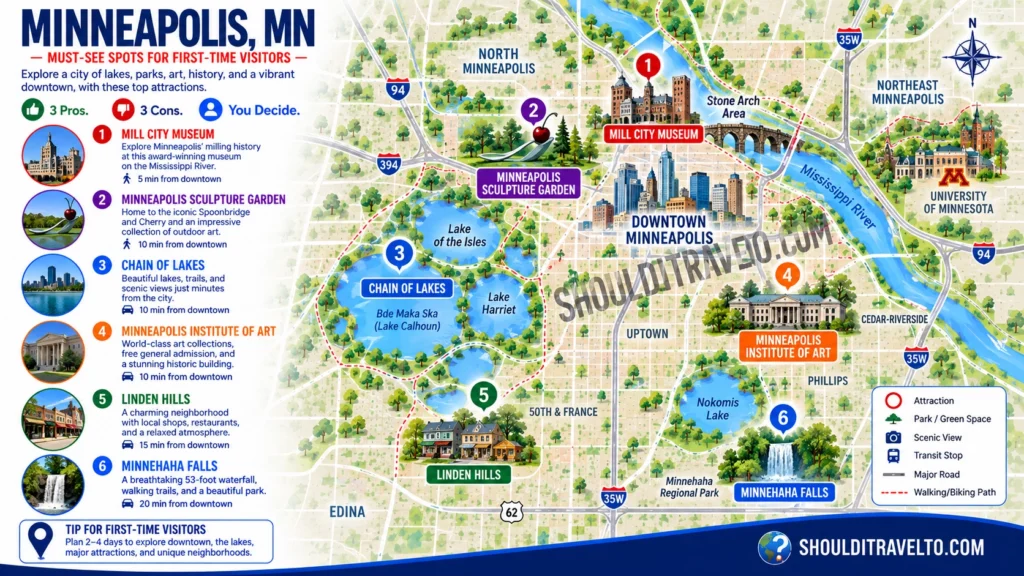
The Minneapolis Park and Recreation Board oversees more than 7,000 acres of parkland and water, including 22 lakes, approximately 55 miles of parkways, and 102 miles of Grand Rounds walking and biking paths.
That’s an important part of the city’s identity.
Minneapolis isn’t simply an urban destination with some parks added around it.
Water helped create the city.
And water still shapes the experience of visiting it.
How Did St. Anthony Falls Create Minneapolis?
Understanding Minneapolis begins with the Mississippi River.
And more specifically, St. Anthony Falls.
The area around the falls has been important to people for thousands of years. The falls hold deep significance for Dakota people, who had names for the waterfall long before European settlement.
During the 19th century, settlers increasingly harnessed the waterfall’s enormous waterpower.
First came lumber.
Sawmills processed timber arriving from forests farther north.
Then flour milling became increasingly important.
Wheat arrived from farms throughout the region.
Waterpower from St. Anthony Falls drove milling machinery.
Railroads carried flour to distant markets.
And Minneapolis grew.
From 1888 through 1930, Minneapolis was the country’s largest flour center.
One of the most important mills was the Washburn A Mill.
Today, Mill City Museum occupies the ruins of the later mill complex and tells the story of flour production, workers, wheat, waterpower, and the industry that made Minneapolis famous.
Nearby, the Stone Arch Bridge reveals another layer of the story.
James J. Hill completed the bridge in 1883 as part of the expanding transportation network serving the city.
What makes this history especially compelling for travelers is that the geography is still there.
The river.
The falls.
The mill ruins.
The bridge.
The historic district.
And the modern skyline rising behind them.
You don’t have to imagine why Minneapolis developed here.
You can stand beside the waterfall that helped make it happen.
The 3 Biggest Pros of Visiting Minneapolis
Minneapolis’s strongest advantages are its distinctive history, exceptional parks and lakes, and a cultural scene that extends well beyond the city’s industrial past.
1. St. Anthony Falls and the Mill District Tell an Outstanding American Industrial Story
This is where I’d start a first visit.
The St. Anthony Falls area explains Minneapolis better than almost anywhere else in the city.
Visit Mill City Museum, which occupies the ruins of what was once the world’s largest flour mill.
Explore Mill Ruins Park.
See St. Anthony Falls.
Walk the historic riverfront.
See the Stone Arch Bridge.
Explore the St. Anthony Falls Historic District.
And look at the modern downtown skyline from the river.
These aren’t disconnected attractions.
They’re chapters in the same story.
The waterfall provided power.
The mills created industry.
The railroads moved products.
The population grew.
And a major American city emerged beside the Mississippi.
For history travelers, that’s an unusually coherent urban story.
Minneapolis exists where it does largely because of a waterfall.
2. Minneapolis Has an Exceptional System of Lakes, Parks, and Trails
The second reason to visit has little to do with mills.
Minneapolis is famous for its parks, lakes, trails, and urban outdoor recreation.
The Minneapolis Park and Recreation Board was established in 1883, and landscape architect Horace Cleveland helped establish the vision of a connected park and parkway system focused on the city’s natural features.
Today, the system includes the Grand Rounds Scenic Byway, one of the country’s longest continuous systems of public urban parkways.
Visitors can explore places such as:
- Bde Maka Ska
- Lake Harriet
- Lake of the Isles
- Minnehaha Falls
- Theodore Wirth Regional Park
- Mississippi River parkways
- Chain of Lakes
That creates an unusual city vacation.
Spend the morning in a museum.
Have lunch in a neighborhood.
Walk around a lake.
Bike a parkway.
See a waterfall.
Then return downtown for dinner or entertainment.
The outdoor environment isn’t separate from Minneapolis.
It’s one of the defining features of the city.
3. Minneapolis Has a Strong Arts, Music, and Cultural Identity
Minneapolis’s history didn’t stop when the flour mills declined.
The city developed a major arts, theater, and music culture.
And no individual is more closely associated with Minneapolis music than Prince.
Prince grew up in Minneapolis, maintained deep connections to the city throughout his career, and helped make the Minneapolis music scene internationally recognizable. Visitors can still explore locations associated with him, including First Avenue and other sites on the city’s Prince-related “Purple Path.”
But the cultural scene extends beyond Prince.
Minneapolis offers art museums, theaters, live music, public art, sports, restaurants, breweries, and culturally diverse neighborhoods.
That matters because it keeps the city from feeling like a historical destination whose most interesting era ended a century ago.
The riverfront tells you where Minneapolis came from.
The arts and neighborhoods show you what the city became.
The 3 Biggest Cons of Visiting Minneapolis
Minneapolis offers an unusually varied city experience, but several drawbacks can make it less appealing for certain travelers.
1. Winter Can Be Difficult
As with St. Paul, Minnesota’s climate is a serious consideration.
Winters can bring very cold temperatures, snow, ice, and short daylight hours.
That’s especially relevant in Minneapolis because many of its strongest attractions involve being outdoors.
Walking the riverfront.
Exploring the lakes.
Using the trails.
Visiting parks.
Seeing Minnehaha Falls.
Walking between attractions around St. Anthony Falls.
Minneapolis can absolutely be visited in winter, and some travelers may specifically enjoy the winter atmosphere.
But for a first-time visitor who wants to experience the full range of the city?
Late spring through fall is considerably easier.
2. The Attractions Are Spread Across Different Parts of the City
Minneapolis isn’t a destination where every major attraction sits within one compact downtown tourist district.
The historic riverfront is in one area.
The Chain of Lakes is elsewhere.
Minnehaha Falls is farther south.
Museums, neighborhoods, music venues, restaurants, parks, and other attractions are scattered throughout the city.
That means a visitor needs to think about geography.
You can explore individual areas very effectively on foot or by bike, and transit can connect many parts of the city.
But if you try to bounce constantly between distant attractions, you’ll spend more time moving around than expected.
Minneapolis rewards travelers who explore it by area rather than attraction by attraction.
3. Minneapolis Has Fewer Nationally Famous Tourist Attractions Than America’s Biggest Cities
Minneapolis has plenty to do.
But like St. Paul, it isn’t built around a huge collection of universally recognized bucket-list landmarks.
- St. Anthony Falls
- Mill City Museum
- The lakes
- Minnehaha Falls
- Museums
- Prince connections
- Sports
- Neighborhoods
These can produce an excellent city vacation.
But travelers comparing Minneapolis with New York, Chicago, Washington, or other major tourist cities may find fewer attractions they’ve long dreamed of visiting.
Minneapolis’s strength is the combination.
- History
- Parks
- Lakes
- Culture
- Food
- Music
- Neighborhoods
The city becomes more interesting as those pieces come together.
The Should I Travel To … Minneapolis Scorecard
The following ratings help show where Minneapolis fits within the Should I Travel To decision framework.
Cost / Value: Good
Minneapolis can offer relatively good value compared with many larger American city destinations, although hotel rates and other costs vary by season and major events.
Weather & Climate: Fair
For most first-time visitors, late spring through early fall provides the easiest introduction to Minneapolis, with summer offering the fullest version of the city’s lakes, parks, trails, and outdoor character.
Crowds & Tourist Density: Light to Moderate
Minneapolis generally avoids the overwhelming tourist density found in America’s largest visitor destinations, although festivals, sporting events, concerts, and other major events can create localized crowds.
Walkability & Transportation: Good in Key Areas
Individual districts, including downtown and the historic riverfront, can be explored effectively on foot, while bikes and transit expand the practical sightseeing area. Transportation becomes more important when combining the riverfront, lakes, Minnehaha Falls, and attractions spread throughout the city.
Things To Do: Strong
History, museums, parks, lakes, arts, music, sports, food, neighborhoods, and outdoor recreation provide considerably more variety than many first-time visitors expect.
Food & Dining: Strong
Minneapolis offers a diverse restaurant scene ranging from neighborhood dining and international cuisines to breweries, markets, and higher-end restaurants.
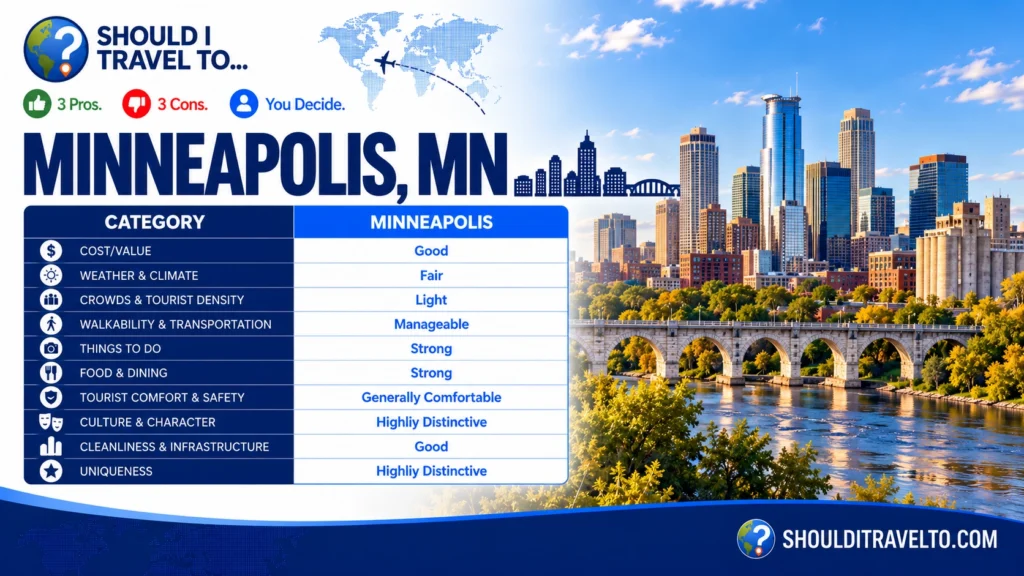
Tourist Comfort & Safety: Generally Comfortable
Major visitor areas can generally be explored with normal city precautions, while conditions and comfort can vary by neighborhood and time of day.
Culture & Character: Highly Distinctive
The Mississippi River, milling history, lakes, park system, music culture, neighborhoods, and arts scene give Minneapolis a strong identity.
Cleanliness & Infrastructure: Good
Minneapolis has substantial visitor infrastructure, parks, trails, transit, major venues, and established tourism districts.
Uniqueness: Highly Distinctive
The combination of an industrial Mississippi River history, St. Anthony Falls, an extensive urban lake and park system, and a major music and arts legacy makes Minneapolis difficult to replicate elsewhere.
Planning Your Minneapolis Vacation
Minneapolis works well as a standalone city break, but it becomes an even more complete trip when combined with St. Paul.
Atmosphere
Minneapolis feels:
- Urban
- Outdoorsy
- Energetic
- Cultural
- Creative
- Water-oriented
- Neighborhood-driven
- Midwestern
It’s a city where an industrial riverfront, modern skyline, lakes, parks, neighborhoods, and cultural attractions coexist surprisingly well.
Best Time to Visit
Spring ★★★★☆
- Warmer weather returns
- Parks and trails become easier to explore
- Good museum and cultural sightseeing
Summer ★★★★★: Recommended
- Warm weather
- Long daylight hours
- Excellent lake and park conditions
- Festivals and outdoor activities
- Best opportunity to experience the city’s outdoor character
Fall ★★★★★
- Comfortable sightseeing weather
- Fall color
- Excellent parks and riverfront conditions
- Easy time of year for a broader Twin Cities trip
Winter ★★★☆☆
- Very cold temperatures
- Snow and ice
- Shorter daylight
- Greater emphasis on museums, restaurants, sports, arts, and indoor attractions
For most first-time visitors, summer through early fall provides the easiest introduction to Minneapolis.
Ideal Trip Length
Minneapolis deserves two or three days. The Twin Cities deserve the longer vacation.
1 Day: Minneapolis Highlights
Focus on St. Anthony Falls and the historic riverfront, then choose either a major museum, neighborhood, or one of the city’s lakes.
2 Days: Best Minneapolis Introduction
Use one day for downtown, the Mississippi River, St. Anthony Falls, and milling history.
Use the second for parks, lakes, museums, neighborhoods, food, or music.
3 Days: Complete Minneapolis City Break
Three days gives you enough time to experience the historical riverfront, lakes and parks, cultural attractions, neighborhoods, and food without rushing.
4–5 Days: Minneapolis + St. Paul
For most travelers coming from farther away, this is where I’d turn the trip into a Twin Cities vacation.
Don’t Miss These Minneapolis Attractions
Minneapolis’s most important visitor attractions reveal both the city’s history and the natural landscape that distinguishes it from many other American cities.
St. Anthony Falls
Start where Minneapolis started.
The falls help explain the city’s industrial development and remain the geographic centerpiece of the historic Mississippi Riverfront.
Mill City Museum
Built within the ruins of the Washburn A Mill, this is probably the single best attraction for understanding how flour milling helped transform Minneapolis.
Stone Arch Bridge and Historic Riverfront
The former railroad bridge, mill district, river, falls, and skyline come together here to create one of Minneapolis’s defining urban landscapes.
Chain of Lakes
Explore the Minneapolis identity that has nothing to do with flour mills: lakes, parks, trails, beaches, and outdoor recreation.
Minnehaha Falls
Minneapolis has another significant waterfall beyond St. Anthony Falls, which is surrounded by parkland and connected to the city’s historic park system.
Minneapolis Institute of Art
Give the trip a major indoor cultural attraction and another dimension beyond history and outdoor recreation.
Hidden Gems and Experiences
Some of Minneapolis’s best experiences come from connecting the major attractions rather than simply checking them off individually.
Follow the St. Anthony Falls Heritage Trail
The self-guided historic loop connects important sites around the falls and Mississippi riverfront.
Explore St. Anthony Main
Spend time on the east side of the river, where some of the city’s earliest surviving urban fabric can still be found around the historic St. Anthony area.
Follow Prince’s Minneapolis
Visit First Avenue and other locations associated with Prince and the music culture that helped give Minneapolis an international identity.
Experience the Grand Rounds
The Grand Rounds ties together lakes, creeks, woodlands, riverbanks, parks, trails, and parkways and helps explain why outdoor recreation feels so integrated into Minneapolis.
Explore Minneapolis by Bike
With extensive trails around the lakes, river, parks, and Grand Rounds, cycling can be part of the sightseeing experience rather than simply transportation.
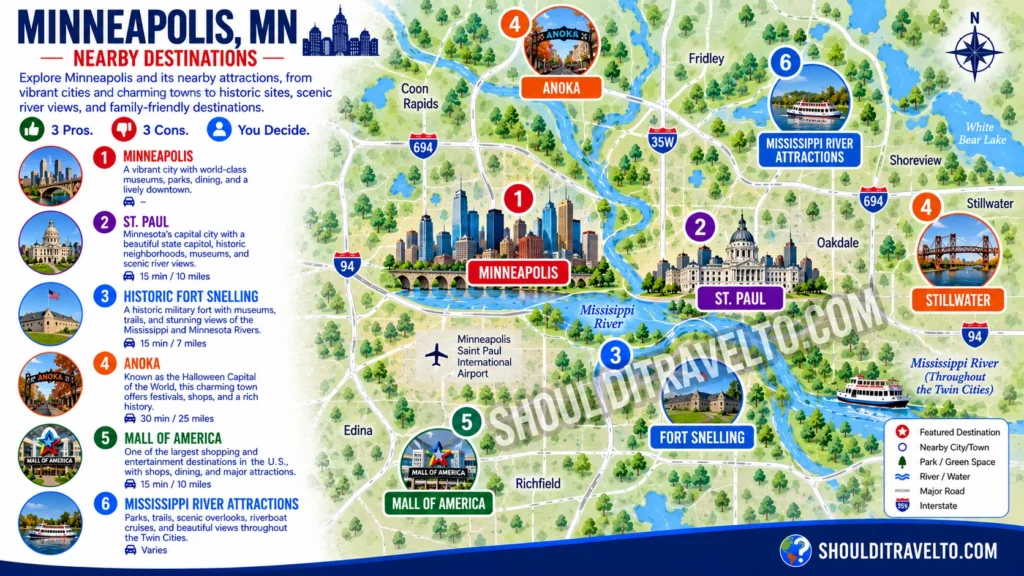
Nearby Attractions and Trips
Minneapolis works particularly well as the center of a broader Twin Cities and Minnesota trip.
- St. Paul
- Historic Fort Snelling
- Anoka
- Mall of America
- Stillwater
- Mississippi River attractions throughout the Twin Cities
For an October trip, Minneapolis can also work as part of a larger Halloween itinerary.
Make Minneapolis and St. Paul the vacation.
Make Anoka the Halloween centerpiece.
Who Should Travel to Minneapolis?
Minneapolis is particularly good for travelers interested in:
- American industrial history
- Mississippi River history
- Architecture and historic districts
- Parks and lakes
- Walking and biking
- Arts and museums
- Live music
- Prince
- Food
- Sports
- Outdoor recreation
- Midwest city trips
- Twin Cities vacations
However, Minneapolis may not be ideal for travelers who primarily want:
- Warm winter weather
- A compact tourist district
- Huge collections of internationally famous landmarks
- A city that can be fully explored on foot
- A destination where outdoor recreation isn’t important to the experience
Minneapolis vs. St. Paul
Minneapolis and St. Paul are close enough to visit together, but their different histories created noticeably different cities.
Choose Minneapolis If You Want:
- St. Anthony Falls
- Flour-milling and industrial history
- Mississippi riverfront
- Lakes and parks
- More arts and entertainment
- Prince and music history
- A larger urban experience
- A more energetic atmosphere
- Outdoor recreation
Choose St. Paul If You Want:
- Historic architecture
- Summit Avenue
- Minnesota State Capitol
- James J. Hill House
- Gilded Age history
- F. Scott Fitzgerald
- Historic neighborhoods
- A quieter atmosphere
- A more traditional historic-city experience
The simplest distinction?
Minneapolis feels like the more energetic Twin City.
St. Paul feels like the more historic Twin City.
But there’s another historical distinction that I think is even more interesting:
Minneapolis tells the story of industry.
St. Paul tells the story of government, transportation, and railroad wealth.
One city grew around the power of a waterfall.
The other grew as a river port, transportation center, and state capital.
Visit Minneapolis to understand how industry helped build the Twin Cities.
Visit St. Paul to experience their political, architectural, and railroad history.
And visit both to understand the Twin Cities.
Final Verdict
Yes, you should travel to Minneapolis.
Especially if you like cities where history, nature, and modern urban life overlap.
Minneapolis doesn’t make its strongest case with a single world-famous landmark.
Its case is the combination.
The Mississippi River.
St. Anthony Falls.
Flour mills.
The Stone Arch Bridge.
Lakes.
Parks.
Trails.
Museums.
Music.
Prince.
Food.
Neighborhoods.
And a modern city that still makes its origin story surprisingly easy to see.
The three biggest reasons to visit are its outstanding industrial and Mississippi River history, exceptional parks and lakes, and strong arts and cultural identity.
The biggest drawbacks are difficult winters, attractions spread throughout the city, and fewer nationally famous bucket-list sights than America’s biggest tourism cities.
But Minneapolis becomes much more interesting when you understand why it’s there.
3 Pros. 3 Cons. You Decide.
Minneapolis Frequently Asked Questions
Is Minneapolis worth visiting?
Yes. Minneapolis is particularly worthwhile for travelers interested in the Mississippi River and industrial history, parks and lakes, museums, arts, music, food, outdoor recreation, and exploring the broader Twin Cities.
What is Minneapolis best known for?
Minneapolis is known for its lakes and parks, Mississippi River setting, St. Anthony Falls, historic flour-milling industry, arts and music scene, Prince connections, sports, and the broader Twin Cities metropolitan area.
Why was Minneapolis built at St. Anthony Falls?
St. Anthony Falls provided enormous water power that could be harnessed by sawmills and later flour mills. Those industries helped drive Minneapolis’s population growth and economic development during the 19th and early 20th centuries.
Why was Minneapolis called the Mill City?
Minneapolis became one of the world’s most important flour-milling centers. The City of Minneapolis says it was the largest flour center in the United States from 1888 to 1930.
What is St. Anthony Falls?
St. Anthony Falls is a waterfall on the Mississippi River in Minneapolis. Its water power was fundamental to the development of the city’s lumber and flour-milling industries.
Is Minneapolis good for history lovers?
Yes, particularly for travelers interested in industrial history, flour milling, railroads, Mississippi River history, urban development, and American park history. The St. Anthony Falls Historic District provides one of the clearest concentrations of that history.
How many days do you need in Minneapolis?
Two days provide a good introduction, while three days allow a more complete experience of the historic riverfront, parks, lakes, museums, neighborhoods, food, and cultural attractions. With four or more days, consider adding St. Paul.
What is the best time to visit Minneapolis?
Summer through early fall generally provides the easiest conditions for a first-time visit. Summer is particularly good for lakes, parks, trails, and outdoor events, while early fall combines comfortable sightseeing conditions with autumn color.
Is Minneapolis walkable?
Individual areas such as downtown and the historic Mississippi Riverfront can be explored effectively on foot, but Minneapolis’s major attractions are spread across multiple areas. Biking, transit, or other modes of transportation can make it easier to connect the riverfront, lakes, parks, and neighborhoods.
Does Minneapolis have a lot of lakes?
Yes. The Minneapolis Park and Recreation Board says its system contains 22 lakes, along with more than 7,000 acres of parkland and water.
Is Minneapolis good for outdoor activities?
Yes. The city’s extensive parks, lakes, riverfront, trails, and Grand Rounds system make walking, biking, paddling, and other outdoor activities an unusually important part of the Minneapolis city experience.
What does Prince have to do with Minneapolis?
Prince grew up in Minneapolis and remained strongly associated with the city and its music scene throughout his career. Visitors can explore Minneapolis-area sites associated with him, including First Avenue and locations highlighted along the city’s Prince-focused Purple Path.
Is Minneapolis or St. Paul better for tourists?
Minneapolis generally offers a larger and more energetic city experience, with lakes, parks, arts, entertainment, music, and industrial history. St. Paul offers stronger historic architecture, state-capital history, Gilded Age landmarks, and a quieter atmosphere. Most first-time visitors with enough time should experience both.
Can you visit Minneapolis and St. Paul on the same trip?
Yes. That’s how I’d recommend experiencing the Twin Cities for most visitors coming from outside Minnesota. Minneapolis deserves roughly two or three days, while St. Paul deserves at least one dedicated day.
Can you combine Minneapolis with Anoka for Halloween?
Yes. Minneapolis and St. Paul can form the main city vacation while Anoka serves as the seasonal Halloween centerpiece. This is especially useful for travelers coming from outside Minnesota who may not want to build an entire trip around Anoka alone.