
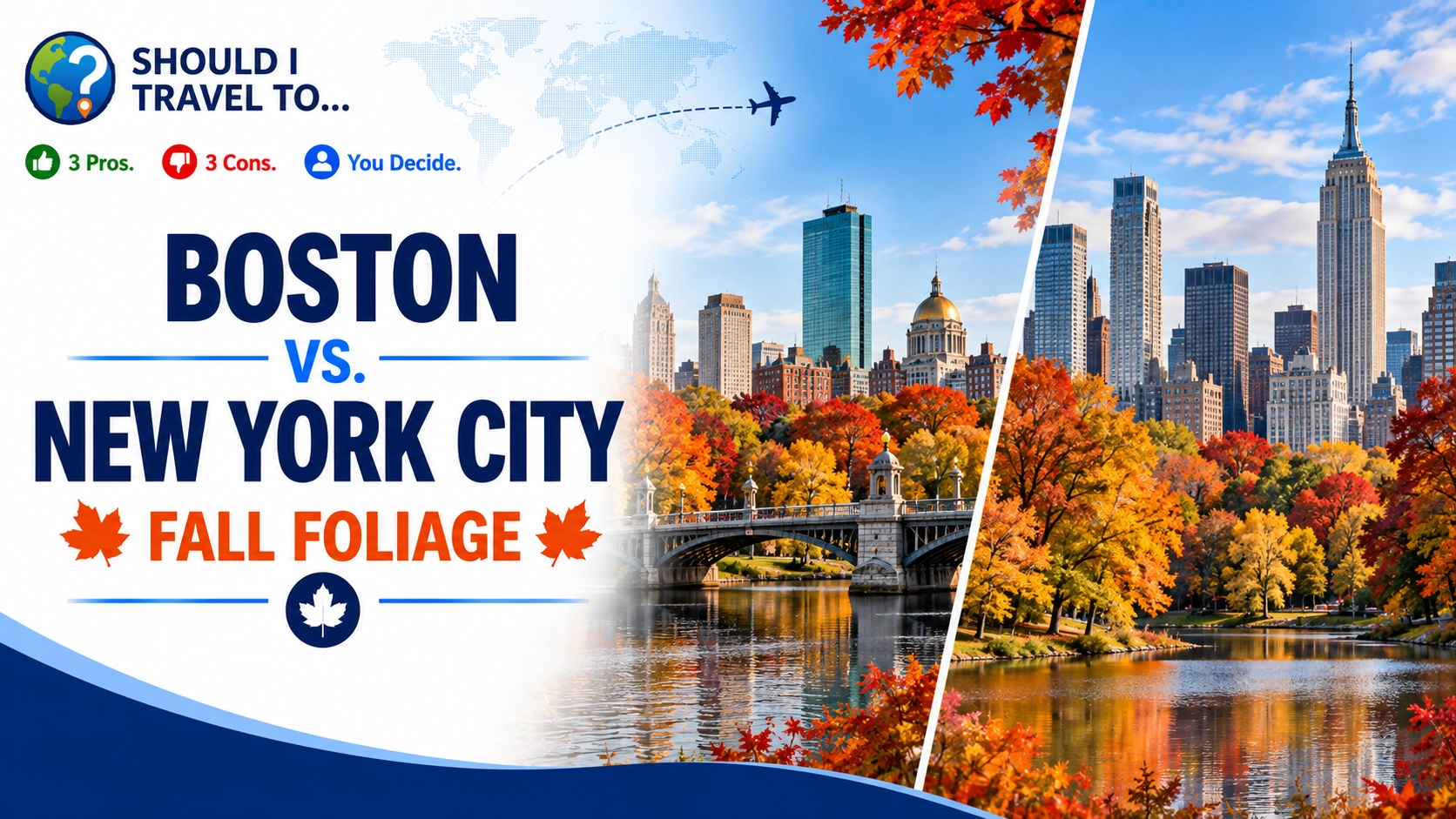
Should You Visit Boston or New York City for Fall Foliage?
Quick Answer
When comparing Boston vs. New York City for fall foliage, choose Boston if seeing fall color is one of the main reasons for your trip and you want to combine a major city vacation with the classic New England fall experience.
Choose New York City if you primarily want a big-city vacation but also want beautiful fall foliage, comfortable autumn weather, and one of the world’s great urban park experiences.
Both cities are excellent fall destinations.
But they offer fall in very different ways.
Boston gives you fall foliage throughout the city, historic neighborhoods surrounded by autumn color, and easy access to some of New England’s most famous foliage regions.
New York City gives you something harder to replicate anywhere else: Fall foliage in the middle of one of the world’s great cities.
You can walk beneath autumn color in Central Park in the morning and spend the afternoon at the Metropolitan Museum of Art, Rockefeller Center, Broadway, or another major New York attraction.
So the simplest difference is this:
Boston is the better choice if fall is helping you decide where to travel.
New York City is the better choice if you want New York and fall makes the trip even better.
Boston vs. New York City for Fall Foliage at a Glance
Boston and New York City both provide legitimate fall foliage experiences, but Boston has the advantage when foliage itself becomes an important part of the travel decision.
| Category | Boston | New York City |
| Overall Fall Foliage | Winner | Excellent |
| Urban Fall Foliage | Excellent | Winner |
| Classic Fall Atmosphere | Winner | Excellent |
| Historic Fall Setting | Winner | Very Good |
| Major Attractions | Excellent | Winner |
| Walkability & Transportation | Excellent | Winner |
| Fall Day Trips | Winner | Excellent |
| New England Experience | Winner | — |
| Big-City Experience | Excellent | Winner |
| Best For | Classic New England fall trip | Big-city vacation + fall foliage |
Overall Fall Foliage Winner: Boston
Big-City Fall Experience Winner: New York City
Boston has the stronger overall foliage case because the city itself is only the beginning.
New York City has the stronger case if you want fall foliage without sacrificing the scale, attractions, food, entertainment, and energy of America’s largest city.
Biggest Difference: Boston vs. New York City for Fall Foliage
The biggest difference isn’t whether you can see fall foliage in Boston or New York City.
You can.
The difference is how important you want fall foliage to be to the vacation.
In Boston, fall can become the trip’s organizing theme.
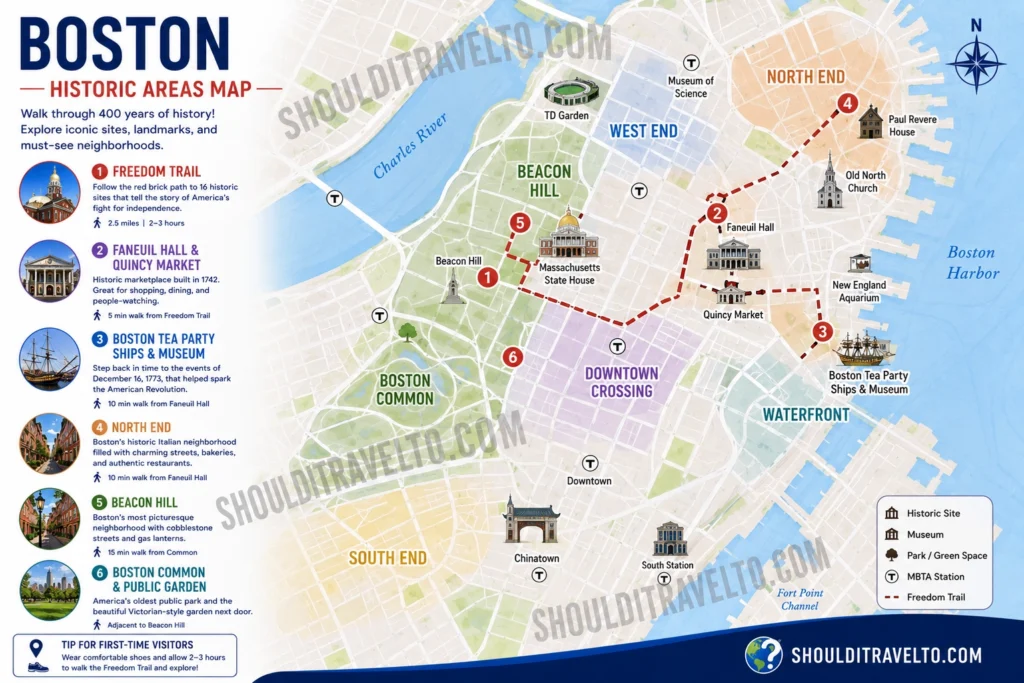
Walk through Boston Common and the Public Garden.
Explore Beacon Hill and Back Bay.
Walk beneath the trees along Commonwealth Avenue.
Visit the Arnold Arboretum.
Then leave the city.
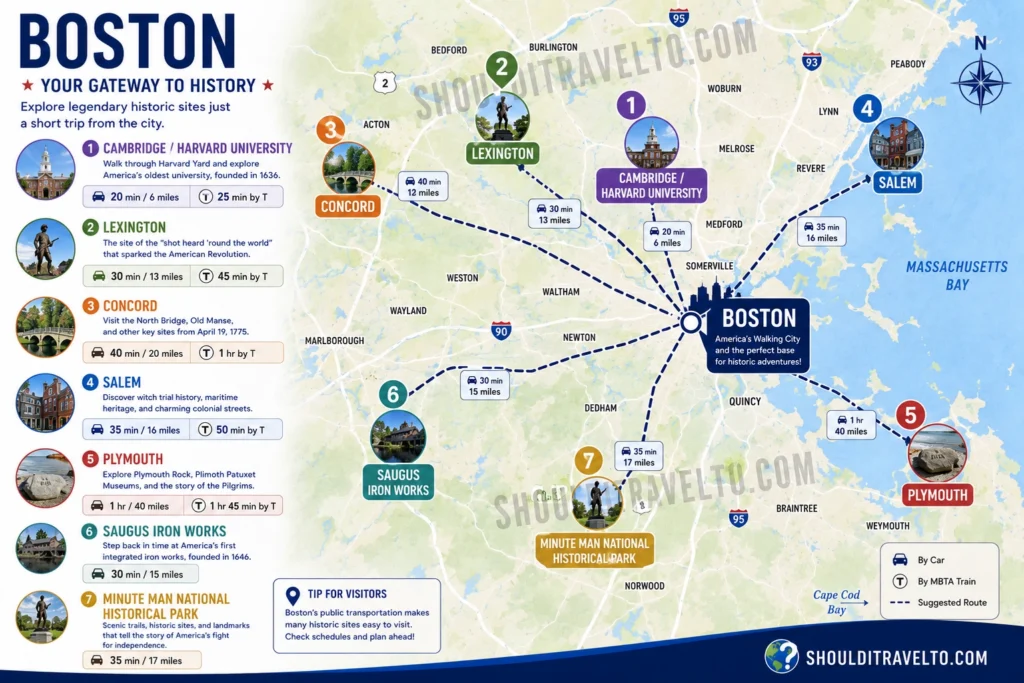
Spend a day exploring Lexington and Concord, where American Revolutionary history combines naturally with a New England fall landscape.
Head north toward Salem for another historic Massachusetts day trip.
Travel south toward Plymouth and combine fall scenery with early American history.
Or use Boston as the starting or ending point of a much larger New England foliage trip.
That opens the door to the Berkshires in western Massachusetts, the White Mountains in New Hampshire, Stowe in Vermont, and even Maine and Acadia National Park on a longer itinerary.
Boston therefore gives travelers two levels of fall foliage:
Stay in the city: experience urban New England foliage.
Leave the city: use Boston as the gateway to a much larger New England fall trip.
New York City works differently.
How New York City’s Fall Foliage Experience Is Different
The foliage experience is more urban in New York City.
And that’s exactly what makes it special.
Central Park becomes the obvious centerpiece.
Each fall, the park’s thousands of trees transform portions of Manhattan with yellow, orange, and red foliage. The Ramble, North Woods, Reservoir, Mall, Conservatory Garden, and other areas offer distinct autumn settings.
But Central Park isn’t the only option.
Travelers can also find fall color in Prospect Park, Riverside Park, Fort Tryon Park, and other green spaces throughout the city.
The defining experience is the juxtaposition: Fall foliage + New York City.
Trees changing color against Manhattan buildings.
A morning walk through Central Park followed by a museum.
Autumn scenery followed by Broadway.
A park in the morning and a rooftop view that evening.
You’re not choosing New York City because its foliage competes with Vermont or New Hampshire.
You’re choosing it because very few destinations allow you to combine a world-class city vacation with an urban fall experience on this scale.
And if you want to leave the city?
New York can also serve as a gateway to the Hudson Valley and Catskills for a larger foliage trip.
Boston makes fall part of the destination.
New York City makes fall part of the atmosphere.
Boston and New York City Fall Similarities
Despite their differences, Boston and New York City have a surprising amount in common as fall destinations.
Both let travelers enjoy fall foliage without giving up the benefits of a major-city vacation.
Both offer:
- Large urban parks and green spaces
- Walkable neighborhoods
- Historic architecture
- Excellent museums
- Outstanding food
- Extensive public transportation
- Autumn events and seasonal atmosphere
- Easy car-free city vacations
- Nearby destinations for larger foliage trips
- Enough attractions to fill several days even if the foliage isn’t at peak
That last point is especially important.
A dedicated fall foliage trip can be vulnerable to timing.
Arrive too early, and the leaves may still be mostly green.
Arrive too late, and peak color may have passed.
Boston and New York City reduce that risk.
If the foliage isn’t perfect, you still have Boston.
Or New York City.
Advantages of a City Fall Foliage Trip
Museums don’t stop being interesting because the leaves are late.
Historic neighborhoods don’t disappear because peak foliage arrived a week earlier than expected.
Restaurants, theaters, landmarks, architecture, and cultural attractions remain.
That makes both cities particularly forgiving choices for travelers who want to experience fall without their entire vacation hinging on a single perfect foliage weekend.
Both can also become starting points for something bigger.
From Boston, travelers can combine their city trip with historic Massachusetts destinations such as Lexington and Concord, Salem, and Plymouth, or continue farther into New England.
From New York City, travelers can extend the trip into the Hudson Valley and Catskills.
The major difference is what happens once you leave the city.
Boston puts you directly into the broader New England fall experience.
New York puts you within reach of excellent foliage destinations while keeping the larger city experience as the centerpiece of the vacation.
That leads to the central decision:
Do you want to build a city vacation around fall?
Or:
Do you want to build a fall vacation around one of America’s great cities?
For the first, Boston has the advantage.
For the second, New York City makes an extremely strong case.
Next, let’s start with the three biggest reasons to choose Boston.
The 3 Biggest Reasons to Choose Boston for Fall Foliage
Boston makes a stronger case for travelers who want fall foliage to be an important part of the vacation, not just something they see along the way.
1. Boston Gives You the More Complete Fall Foliage Trip
Boston’s biggest advantage is that the foliage experience doesn’t stop at the city limits.
Start in Boston itself.
Walk through Boston Common and the Public Garden.
Explore Beacon Hill and Back Bay.
Walk beneath the trees along Commonwealth Avenue.
Follow the Charles River Esplanade.
Or spend time at the Arnold Arboretum, where 281 acres and an enormous variety of plant life create another opportunity to experience autumn within the city.
But then expand the trip.
Lexington and Concord combine fall scenery with some of the most important sites of the American Revolution.
Salem adds historic New England architecture, maritime history, and an entirely different October atmosphere.
Plymouth provides another opportunity to combine early American history with a broader Massachusetts road trip.
And if you have more time?
Boston becomes a gateway to some of America’s most famous fall foliage regions.
And on a longer trip, Maine and Acadia National Park.
That’s Boston’s fundamental advantage over New York City.
Boston isn’t simply a city where you can see fall foliage.
It’s a city that can be the starting point for an entire New England fall foliage vacation.
2. Fall Foliage Fits Naturally With Boston’s Historic Character
Boston doesn’t need a mountain backdrop to feel like a fall destination.
Its historic neighborhoods already create much of the atmosphere.
- Brick sidewalks
- Brownstones
- Historic homes
- Churches
- Old streets
- Public parks
Then fall color layers on top of them.
Walk through the Public Garden and Boston Common.
Continue toward Beacon Hill.
Explore Back Bay and Commonwealth Avenue.
Then follow the Freedom Trail through one of America’s most historic cities.
The result isn’t simply colorful trees.
It’s New England history surrounded by fall.
And that combination becomes even stronger outside Boston.
Massachusetts specifically recommends fall foliage travel from Boston through Lexington and Concord, allowing travelers to combine autumn scenery with Revolutionary history.
For history travelers in particular, that gives Boston an advantage few major American cities can match.
You aren’t choosing between a history trip and a foliage trip.
You can build them into the same vacation.
3. Boston Is the Better Gateway to a Larger Fall Foliage Vacation
If you want to stay entirely within the city, Boston works.
But Boston becomes considerably more compelling when you have a car and several extra days.
Head west, and Massachusetts eventually gives way to the Berkshires.
Head north, and you can build a trip toward New Hampshire’s White Mountains.
Continue farther, and Vermont becomes possible.
Go northeast, and Maine can become part of a longer New England itinerary.
That creates enormous flexibility.
You can spend two or three days in Boston and then leave the city for a dedicated foliage trip.
Or do the reverse.
Spend several days traveling through New England and finish with museums, restaurants, history, and city attractions in Boston.
New York City can also serve as a gateway to excellent foliage in the Hudson Valley and Catskills.
But if the question is specifically: Which major city makes the stronger starting point for a classic New England foliage vacation?
Boston wins.
The 3 Biggest Downsides of Choosing Boston for Fall Foliage
Boston has the stronger overall foliage case, but that doesn’t automatically make it the better choice for every fall traveler.
1. Boston Can’t Match New York City’s Scale of Attractions
This is Boston’s biggest disadvantage.
If the leaves don’t cooperate?
New York City has an extraordinary backup plan.
- Broadway
- The Metropolitan Museum of Art
- The Museum of Modern Art
- Rockefeller Center
- The Empire State Building
- World-famous restaurants
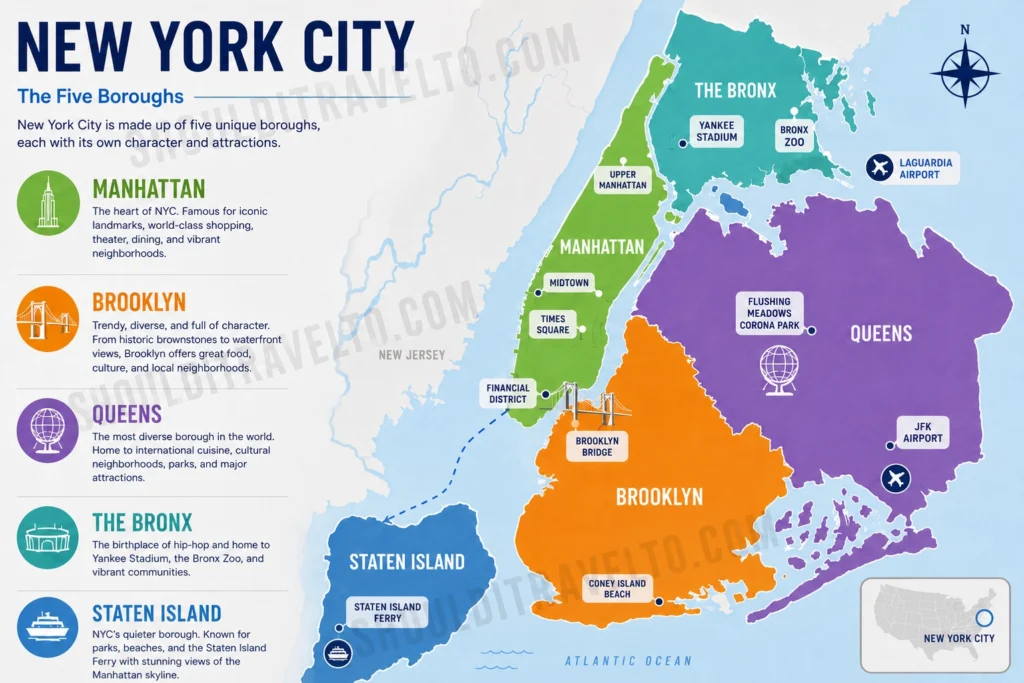
- Distinct neighborhoods across five boroughs
- And an almost endless supply of things to do
Boston has excellent museums, historic sites, restaurants, neighborhoods, and attractions.
But it doesn’t offer the same scale.
That’s important on a foliage trip because fall color is unpredictable.
If you arrive before or after the strongest foliage, New York City gives you more ways to completely forget that the leaves weren’t perfect.
2. The Best Version of the Boston Foliage Trip May Require a Car
Boston itself is easy to experience without a car.
And that’s important.
You can explore the central city, parks, historic neighborhoods, museums, restaurants, and many attractions by public transportation and on foot.
But the more ambitious your foliage plans become, the more useful a car becomes. particularly for scenic Massachusetts drives, the Berkshires, New Hampshire, Vermont, Maine, and other destinations where flexibility is part of the experience.
The broader New England advantage that makes Boston such a strong foliage base also introduces more transportation planning.
New York City offers a simpler proposition if your goal is:
Fly in. Don’t rent a car. See fall color. Enjoy the city. Fly home.
3. Boston’s City Foliage Isn’t the Same as a Dedicated New England Foliage Destination
Boston may be the strongest core city for a classic New England fall trip.
But it’s still a city.
If your mental picture of New England foliage is mountain slopes covered in red, orange, and yellow, scenic mountain roads, small Vermont towns, covered bridges, or enormous wilderness landscapes, you’ll eventually need to leave Boston.
Boston Common, the Public Garden, the Esplanade, and Arnold Arboretum can be beautiful in fall.
But they aren’t the White Mountains.
They aren’t the Berkshires.
And they aren’t Vermont.
That’s why Boston works best when you understand its real advantage:
Boston gives you the city and access to the larger fall experience.
It doesn’t replace the larger fall experience.
The 3 Biggest Reasons to Choose New York City for Fall Foliage
New York City makes a different argument. Choose it when the city vacation comes first—but you still want fall foliage to meaningfully improve the experience.
1. Central Park Is One of the World’s Great Urban Fall Experiences
This is New York City’s strongest argument.
Central Park contains roughly 18,000 trees across 843 acres, creating an enormous expanse of foliage in the middle of Manhattan.
And the setting is what makes it extraordinary.
- The Ramble
- The Mall
- The Reservoir
- North Woods
- Conservatory Garden
- The Pool
Different parts of the park provide different foliage experiences.
But you’re still in Manhattan.
That’s the magic.
Look through autumn leaves and see the skyline.
Walk beneath colorful trees and emerge onto Fifth Avenue.
Spend the morning leaf-peeping and the afternoon at a museum.
Very few places can reproduce that juxtaposition: Fall foliage + Manhattan skyline.
If Boston gives you the classic New England fall experience, New York gives you one of the world’s most distinctive urban fall experiences.
2. You Don’t Have to Sacrifice a Major-City Vacation for Fall Foliage
This is where New York becomes extremely difficult to beat.
You can build an entire trip around New York City’s normal attractions and still experience fall.
Central Park in the morning.
The Met in the afternoon.
Broadway at night.
Then another day exploring neighborhoods, restaurants, observation decks, museums, or landmarks.
Fall enhances the trip without dictating it.
And Central Park isn’t your only option.
Prospect Park, Riverside Park, Fort Tryon Park, and green spaces throughout the five boroughs provide additional opportunities to see autumn color. New York City’s tourism organization highlights more than 29,000 acres of parks and open space across the five boroughs as part of the city’s autumn appeal.
So you don’t have to choose between a New York City vacation and a fall trip.
You can have both.
3. New York City Gives You More Protection Against Bad Foliage Timing
No one can guarantee peak fall foliage.
Weather matters.
Temperature matters.
Rain matters.
Wind matters.
And the timing varies from year to year.
That’s where New York’s enormous portfolio of attractions comes in.
If Central Park isn’t at its peak? You’re still in New York City.
Some travelers may also have another timing advantage.
Central Park’s foliage often develops later than many foliage destinations farther north in New York.
That can make NYC particularly interesting for travelers planning a somewhat later fall trip.
But the bigger point is simple: New York doesn’t need perfect foliage to justify the vacation.
The leaves can be spectacular.
But they’re a bonus on top of a destination that already has enough attractions to fill almost any itinerary.
The 3 Biggest Downsides of Choosing New York City for Fall Foliage
New York offers an exceptional fall city experience, but travelers specifically chasing foliage should understand what they’re giving up by choosing it over Boston.
1. Fall Foliage Isn’t the Main Event
This is the fundamental trade-off.
You can see beautiful fall foliage in New York City.
But New York isn’t primarily a foliage destination.
It’s New York.
Central Park can be spectacular.
Prospect Park can be beautiful.
Fort Tryon Park can provide another autumn experience.
But the city itself remains the main attraction.
For some travelers, that’s exactly the point.
For others, it means the trip may not feel enough like a dedicated fall foliage vacation.
If your first question is: Where should I go to experience a classic northeastern fall?
Boston makes the stronger argument.
If your first question is: Where should I take a major city vacation in fall?
New York becomes much harder to beat.
2. New York Doesn’t Feel as Quintessentially New England
New York has tremendous historic character.
But it doesn’t give you the same New England identity.
Boston’s brick streets, historic neighborhoods, Revolutionary sites, nearby colonial towns, and access to Massachusetts and the rest of New England create a different atmosphere.
In Boston, fall feels connected to the destination’s regional identity.
In New York, fall creates a seasonal layer over an enormous global city.
Neither is inherently better.
But they’re different experiences.
Boston feels like New England in fall.
New York feels like New York in fall.
Your preference between those two ideas may determine the entire decision.
3. The Bigger Foliage Experience Requires Leaving the City
Central Park is excellent.
But if you want mountain landscapes, scenic drives, and much larger expanses of foliage, you’ll eventually need to leave New York City.
The Hudson Valley and Catskills can provide that larger experience.
But now the trip becomes more complicated.
You’re no longer simply taking the subway to Central Park.
You’re building a city-and-regional foliage itinerary.
And once you’re willing to do that?
Boston’s proximity to the broader New England foliage experience becomes a much stronger competitive advantage.
Boston vs. New York City Fall Foliage Scorecard
Boston and New York City both score exceptionally well as fall city destinations, but they win for different reasons. For example, Boston has the advantage when fall foliage itself drives the trip, while New York dominates when the goal is to combine foliage with the biggest possible city vacation.
| Category | Boston | New York City | Winner |
| Fall Foliage | Excellent | Excellent | Boston |
| Urban Foliage | Excellent | Exceptional | New York City |
| Classic Fall Atmosphere | Exceptional | Excellent | Boston |
| Historic Fall Setting | Exceptional | Excellent | Boston |
| Parks & Green Space | Excellent | Exceptional | New York City |
| Fall Day Trips | Exceptional | Excellent | Boston |
| Major Attractions | Excellent | Endless | New York City |
| Food & Dining | Exceptional | World-Class | New York City |
| Car-Free Fall Trip | Excellent | Exceptional | New York City |
| Larger Foliage Road Trip | Exceptional | Very Strong | Boston |
| Fall Trip Flexibility | Exceptional | Exceptional | Tie |
| Overall Fall Foliage City | Exceptional | Excellent | Boston |
Boston wins the foliage trip.
New York City wins the city trip.
The decision depends on which one matters more.
Planning Your Boston or New York City Fall Trip
Once you’ve decided what kind of fall experience you want, timing and trip length matter most. Both cities work well for short vacations, but foliage timing and the possibility of regional day trips can change the ideal itinerary.
Atmosphere: Which City Feels More Like Fall?
Boston wins for classic fall atmosphere.
Boston feels particularly natural in autumn.
- Historic neighborhoods
- Brick architecture
- Tree-lined streets
- College campuses
- Parks
- The Charles River
- Nearby colonial towns
- And the broader New England setting
Fall doesn’t feel added to Boston.
It feels like part of the destination.
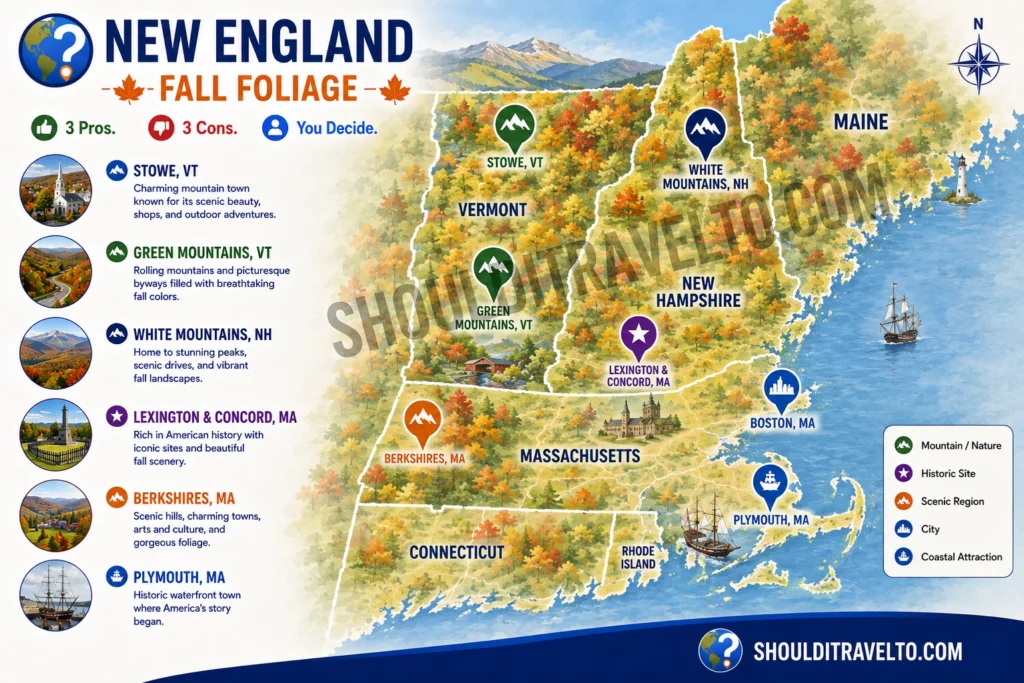
New York City’s fall atmosphere is completely different.
It’s more cinematic.
- Central Park foliage surrounded by Manhattan
- Cooler weather on city streets
- Autumn walks between museums, restaurants, neighborhoods, and landmarks
The contrast between nature and the built environment is part of the appeal.
So choose based on the atmosphere you want.
Boston: Classic New England fall.
New York City: Iconic big-city autumn.
Atmosphere Winner: Boston
Ideal Trip Length
Both cities work well for long weekends, but Boston deserves additional time if you’re using it as the gateway to a larger foliage trip.
Boston: 3–5 Days
Three days gives you enough time to explore Boston itself while experiencing places such as Boston Common, the Public Garden, Beacon Hill, Back Bay, the Esplanade, and the city’s major historic attractions.
Four or five days become considerably more interesting in the fall.
Now you can add Lexington and Concord.
Salem.
Plymouth.
Or use one or more days to begin exploring farther into Massachusetts or New England.
If you’re building a dedicated Boston + New England foliage road trip, a week or more can easily make sense.
New York City: 4–5 Days
New York benefits from additional time simply because there is so much to do.
Four or five days allow Central Park to become part of the vacation rather than consume your limited sightseeing time.
You can explore the park when conditions and weather are best while still leaving plenty of time for museums, neighborhoods, food, Broadway, landmarks, and other attractions.
If you’re adding the Hudson Valley or Catskills, extend the trip.
Ideal Trip Length Winner: Tie
Boston lets you do more of the core city experience in less time.
New York rewards the extra days with a much larger array of attractions.
Best Time to Visit for Fall Foliage
Boston and New York City don’t necessarily peak at exactly the same time.
Massachusetts’ fall foliage season generally begins well before Boston itself reaches its strongest color. Massachusetts tourism notes that foliage progresses across the state through the season, while Boston’s urban foliage can occur relatively late compared with higher and inland areas.
That creates an important advantage for a Boston-based trip: You may be able to follow the foliage.
Earlier in the season, travel farther into New England or toward higher elevations.
Later, foliage can become stronger closer to Boston itself.
For Boston city foliage, watch mid-to-late October most closely, while always checking current conditions before traveling.
New York City can run later.
For travelers specifically hoping to see Central Park foliage, late October into early November is an important period to watch, although exact timing varies every year.
For travelers specifically hoping to see Central Park foliage, late October through early November is particularly important to watch, although exact timing varies every year.
That means the calendar may help you decide.
Early to mid-October: Boston becomes particularly compelling when paired with the broader New England region.
Mid-to-late October: Boston remains strong, especially as city foliage develops.
Late October into early November: New York City becomes increasingly interesting for urban foliage.
But don’t choose either city based on a supposedly guaranteed peak date.
Monitor current foliage conditions as your trip approaches.
Who Should Choose Boston or New York City for Fall Foliage?
Boston is the stronger choice for travelers who want fall foliage to influence the entire vacation.
Choose Boston if you want:
- A classic New England fall experience
- Foliage within the city
- Historic neighborhoods surrounded by fall color
- Boston Common and the Public Garden
- The Charles River Esplanade
- Arnold Arboretum
- American history
- Lexington and Concord
- Salem or Plymouth
- Easy access to a larger New England foliage trip
- The Berkshires, White Mountains, Vermont, or Maine as possible extensions
- A city + road trip combination
Boston is especially compelling for travelers who think: “If I’m traveling in fall, I want the destination to actually feel like fall.”
New York City is the stronger choice when the city itself matters more than having the most complete foliage vacation.
Choose New York City if you want:
- Central Park in fall
- Fall foliage + Manhattan skyline
- A larger city vacation
- World-class museums
- Broadway
- More restaurants and entertainment
- An entirely car-free fall city trip
- Multiple urban parks
- A later-season foliage possibility
- Hudson Valley or Catskills as optional extensions
- A trip that remains exceptional even if foliage timing isn’t perfect
New York City is especially compelling for travelers who think: “I want to visit New York, and seeing it in fall would make the trip even better.”
Who Wins: Boston or New York City for Fall Foliage?
For a trip specifically built around fall foliage, Boston wins.
Not because Boston necessarily has more impressive foliage than every place you can find in New York.
And not because Central Park isn’t spectacular.
It is.
Boston wins because it offers the more complete fall foliage vacation.
You can experience autumn color without leaving the city.
Walk through historic neighborhoods.
Explore Boston Common and the Public Garden.
Visit the Arnold Arboretum.
Then use Boston as the gateway to Lexington and Concord, other historic Massachusetts destinations, and eventually some of New England’s premier foliage regions.
New York City makes a different, and extremely compelling, argument.
Central Park in fall is one of America’s great urban seasonal experiences.
And New York allows you to experience fall foliage without sacrificing a world-class city vacation.
So the final decision is remarkably simple:
Choose Boston if fall foliage is one of the main reasons you’re traveling.
Choose New York City if New York is the main reason you’re traveling—and fall foliage makes the trip even better.
Or put another way:
Boston makes fall part of the destination.
New York City makes fall part of the atmosphere.
Overall Fall Foliage Winner: Boston
Honorable City Fall Foliage Mentions: Washington, DC and Philadelphia
Boston and New York City aren’t the only major East Coast cities that work well for a fall foliage trip.
If neither city quite fits what you’re looking for, Washington, DC and Philadelphia offer two compelling alternatives.
Neither replaces Boston for a classic New England fall experience, and neither can match New York City for the combination of Central Park and a massive big-city vacation.
But both offer something distinctive.
Washington, DC combines fall foliage with America’s most famous monuments.
Philadelphia combines fall foliage with some of America’s most important historic sites.
Washington, DC: Best for Monuments Surrounded by Fall Color
Washington, DC is a stronger fall foliage destination than many first-time visitors might expect.
The reason isn’t that Washington competes with New England’s mountains or forests.
It’s the setting.
Monuments + fall foliage.
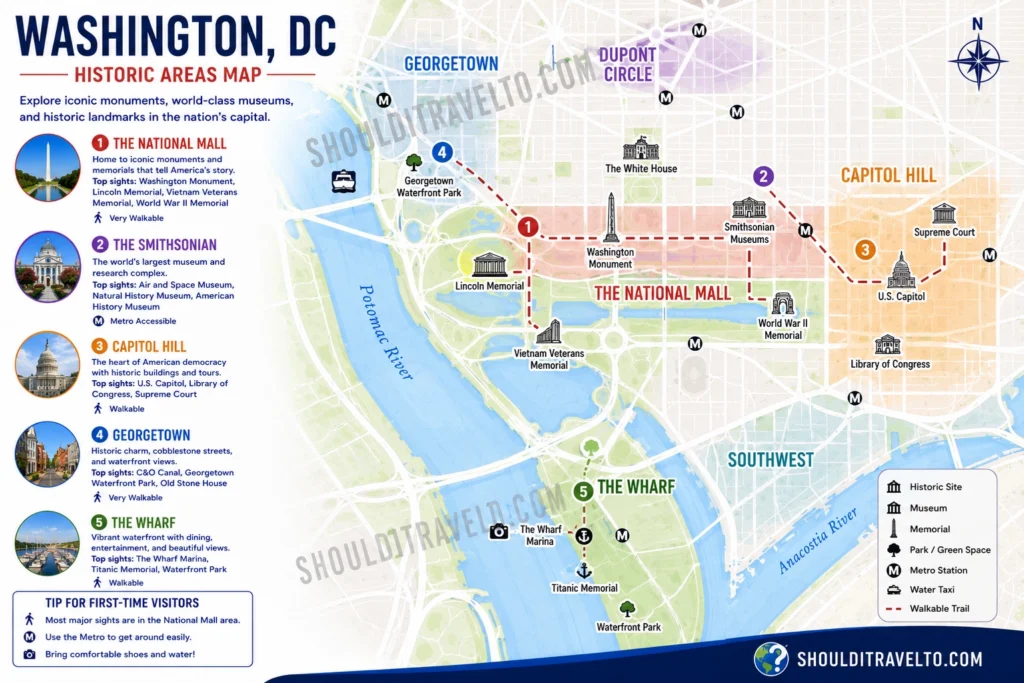
The National Mall and surrounding monumental core provide an autumn experience that looks completely different from Boston or New York City.
Instead of New England neighborhoods or a Manhattan skyline, Washington gives you famous monuments, memorials, museums, and government buildings surrounded by seasonal color.
That makes fall particularly appealing for travelers who already want to experience the capital.
But Washington also has a much more natural side.
Rock Creek Park provides wooded trails, streams, valleys, and substantial tree cover without requiring travelers to leave the city.
The US National Arboretum offers another chance to enjoy autumn among extensive plant collections and landscaped grounds.
Like Boston and New York City, Washington offers more than one way to experience fall.
Stay near the monumental core: combine fall color with the National Mall, monuments, museums, and historic sites.
Explore Washington’s greener side: spend time in Rock Creek Park or the National Arboretum.
And Washington has one additional advantage.
Travel beyond the city, and you can combine Washington with Skyline Drive, Blue Ridge Mountain overlooks, hiking, waterfalls, and a much larger fall foliage experience.
That creates a particularly compelling vacation: Washington, DC gives you the city trip. Shenandoah gives you the fall escape.
Choose Washington, DC over Boston or New York City if: you want monuments, museums, American history, urban fall color, and the possibility of adding a Blue Ridge Mountain foliage trip.
Fall Foliage Rating: ★★★★
Best For: Monuments + Fall Color
Philadelphia: Best for American History + Fall Foliage
Philadelphia makes a surprisingly strong case for travelers who want to combine fall foliage with American history.
Start with the history.
Independence Hall.
The Liberty Bell.
Old City.
Historic streets and buildings connected to the founding of the United States.
Then add a side of Philadelphia that first-time visitors can easily underestimate: its parks.
Fairmount Park gives travelers substantial green space within the city, while Wissahickon Valley Park offers a much woodier environment than many visitors expect in a major East Coast city.
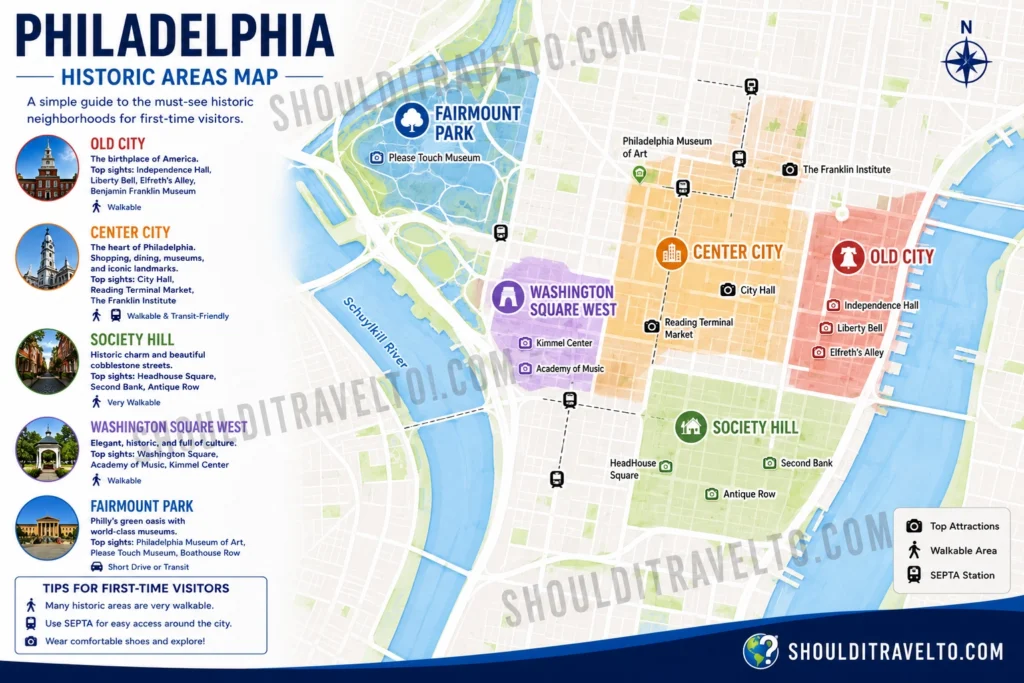
That creates Philadelphia’s distinctive fall combination: American history + fall foliage.
Spend part of the trip exploring Independence National Historical Park and Old City.
Then trade historic streets for trails, trees, and fall color.
And the foliage possibilities don’t end at Philadelphia’s city limits.
Greater Philadelphia contains additional fall destinations, including Longwood Gardens, about an hour outside the city in Kennett Square. Visit Philadelphia identifies Longwood as one of the region’s notable foliage locations, while Longwood itself celebrates autumn with seasonal displays and programming. Fall foliage typically becomes one of the gardens’ highlights in October.
That makes Philadelphia particularly interesting for travelers who don’t need fall foliage to dominate every day of the vacation.
You can build the trip around history.
Add foliage within Philadelphia.
Then use a day outside the city for an even larger fall experience.
Choose Philadelphia over Boston or New York City if: American history is one of your biggest travel priorities and you want fall foliage to complement the historic trip.
Fall Foliage Rating: ★★★★
Best For: American History + Fall Foliage
How the Four Cities Compare
These four cities ultimately represent four different ways to build an East Coast fall vacation.
| City | Fall Foliage Case | Best For |
| Boston | ★★★★★ | Classic New England fall trip |
| New York City | ★★★★½ | Big-city vacation + urban fall foliage |
| Washington, DC | ★★★★ | Monuments + fall color |
| Philadelphia | ★★★★ | American history + fall foliage |
The easiest way to decide is to ask what you want besides the leaves.
Choose Boston if you want the strongest overall combination of a major city and a classic New England fall experience.
Choose New York City if you want Central Park and autumn atmosphere without giving up one of the world’s great city vacations.
Or choose Washington, DC if you want monuments and museums surrounded by fall color, with Shenandoah National Park available for a larger foliage experience.
Choose Philadelphia if you want American history combined with substantial urban parks and nearby fall destinations.
For a trip specifically focused on fall foliage, Boston remains our first choice.
But if Boston isn’t the right fit, you don’t necessarily have to give up the city vacation to experience fall.
Final Assessment
Yes, you should travel to either Boston or New York City for fall foliage, but the better choice depends on how important fall itself is to your vacation.
For a trip specifically built around fall foliage, Boston wins.
Boston gives you two different levels of fall.
Stay in the city, and you can experience autumn color in Boston Common, the Public Garden, along Commonwealth Avenue, on the Esplanade, in Beacon Hill, and at the Arnold Arboretum.
Leave the city and the possibilities expand considerably.
Lexington and Concord combine Revolutionary history with a classic New England fall setting.
Salem and Plymouth provide additional historic destinations for a larger Massachusetts trip.
And with more time, Boston becomes a gateway to the Berkshires, White Mountains, Vermont, Maine, and some of New England’s most famous foliage landscapes.
That’s why Boston is more than a city with colorful trees.
Boston can become the starting point for an entire New England fall vacation.
Boston wins because it makes fall part of the destination.
New York City makes fall part of the atmosphere.
Overall Fall Foliage Winner: Boston
3 Pros. 3 Cons. You Decide.
Boston vs. New York City Fall Foliage Frequently Asked Questions
Choosing between Boston and New York City for a fall trip usually comes down to foliage timing, how much of the vacation you want to spend outdoors, and whether you’re willing to leave the city for a larger foliage experience. Here are the most important questions for first-time visitors.
Is Boston or New York City better for fall foliage?
Boston is the better overall choice if fall foliage is a primary reason for your trip.
You can experience foliage within Boston and then use the city as a gateway to historic Massachusetts destinations and larger New England foliage regions.
New York City is the better choice if you primarily want a major-city vacation with fall foliage as an important part of the atmosphere.
Is Central Park worth visiting for fall foliage?
Yes.
Central Park is one of the strongest reasons to visit New York City in the fall. Its trees, paths, lakes, rocky landscapes, and surrounding Manhattan skyline create an urban foliage experience that’s difficult to replicate elsewhere.
And you don’t have to build your entire day around foliage.
You can walk through Central Park in the morning and continue to museums, restaurants, shopping, observation decks, Broadway, or other New York attractions afterward.
Can you see good fall foliage without leaving Boston?
Yes.
Boston Common, the Public Garden, Commonwealth Avenue, the Charles River Esplanade, Beacon Hill, and the Arnold Arboretum all offer opportunities to experience fall color in Boston.
However, Boston’s biggest foliage advantage emerges when you combine the city with destinations beyond its center.
If you’re willing to take day trips or build a larger road trip, the foliage possibilities become considerably greater.
When is the best time to visit Boston for fall foliage?
For foliage within Boston itself, mid-to-late October is generally the period to watch most closely, although exact timing varies every year.
One advantage of using Boston as a foliage base is that fall color varies across New England.
Depending on when you’re traveling, you may find stronger color outside Boston in other parts of Massachusetts or farther into New England.
Always monitor current foliage conditions as your trip approaches rather than relying on one supposedly guaranteed peak weekend.
When is the best time to visit New York City for fall foliage?
For New York City, late October into early November is generally an important period to watch, particularly for Central Park.
Urban foliage can develop later than color in cooler areas farther north or at higher elevations.
But timing varies each year, so check current conditions shortly before traveling rather than booking around a single historical peak date.
Which City Is Better for Fall Foliage in October?
The answer depends partly on when in October you’re traveling.
Boston is particularly appealing when you can combine the city with foliage elsewhere in New England, where timing varies considerably by latitude and elevation.
Washington, DC and Philadelphia generally make stronger foliage cases later in the fall than the classic northern New England destinations.
New York City can also be a late-season option, with Central Park’s foliage often developing later than farther north.
Rather than choosing a city based on one historical “peak foliage” date, check current conditions as your trip approaches.
Do you need a car for a fall foliage trip to Boston or New York City?
You don’t need a car to experience fall foliage within either city.
Boston and New York City are both excellent choices for car-free city vacations.
However, a car becomes considerably more useful if you want to take advantage of Boston’s biggest foliage strength: access to the broader New England fall experience.
For New York City, staying car-free makes particular sense if Central Park and other urban parks are your primary foliage destinations.
If you’re adding the Hudson Valley or the Catskills, transportation will require additional planning.
What are the best fall day trips from Boston?
For travelers who want to combine fall scenery with American history, Lexington and Concord are particularly strong choices.
Salem can add historic architecture, maritime history, and its famous October atmosphere.
Plymouth can also fit into a larger Massachusetts history trip.
Travelers willing to go farther can begin building a larger foliage itinerary toward the Berkshires, New Hampshire, Vermont, or Maine.
The farther you travel, however, the more the trip begins to function as a New England road trip rather than a simple Boston day trip.
Can you combine New York City with the Hudson Valley or Catskills for fall foliage?
Yes.
New York City can serve as the city portion of a larger New York fall trip, with the Hudson Valley and Catskills providing more expansive foliage landscapes beyond the five boroughs.
That’s the closest New York equivalent to Boston’s city-plus-region advantage.
The difference is that Boston is in New England, giving travelers access to a particularly large concentration of famous fall foliage destinations across several states.
Which East Coast City Is Best for a Fall Foliage Trip?
It depends partly on when in October you’re traveling.
Boston is particularly appealing earlier in the month when you can combine the city with foliage elsewhere in New England, where timing varies considerably by latitude and elevation.
By mid-to-late October, foliage within Boston itself becomes increasingly important to watch.
New York City can be a stronger late-season option, with Central Park’s foliage often developing later than many destinations farther north.
Rather than choosing either city based on one historical “peak foliage” date, check current conditions as your trip approaches.
Is Washington, DC or Philadelphia Better for Fall Foliage?
Washington, DC and Philadelphia both offer surprisingly good fall foliage for major East Coast cities, but they provide different experiences.
Choose Washington, DC if you want fall color surrounding monuments, memorials, and museums. The National Mall provides an iconic city setting, while Rock Creek Park and the US
National Arboretum offer greener, more wooded experiences.
Washington also has an important advantage for travelers willing to leave the city: Shenandoah National Park can turn a Washington vacation into a much larger Blue Ridge Mountains foliage trip.
Choose Philadelphia if you want to combine fall foliage with American history. Explore Independence Hall and Old City, then experience a very different side of Philadelphia in Fairmount Park or Wissahickon Valley Park. Longwood Gardens also provides another fall destination outside the city.
Washington, DC is better for monuments + fall color.
Philadelphia is better for American history + fall foliage.
For the strongest foliage experience beyond the city itself, Washington has the advantage thanks to its proximity to Shenandoah National Park.