

Should You Visit the White Mountains, New Hampshire, to See the Fall Foliage?
Quick Answer
Yes, you should travel to the White Mountains of New Hampshire if you want dramatic mountain scenery, colorful forests, and some of the best fall foliage drives in New England.
The White Mountains offer a different kind of fall foliage experience than destinations such as Stowe, Vermont.
Here, the mountains are the star.
The Kancamagus Highway, Franconia Notch, Mount Washington, winding mountain roads, waterfalls, covered bridges, and expansive overlooks combine to create one of America’s most spectacular autumn road-trip destinations.
If you enjoy scenic drives and want to see fall foliage from behind the wheel, few destinations compare.
The biggest challenge?
The most popular roads can become extremely crowded during peak foliage weekends.
Why the White Mountains Are One of America’s Best Fall Destinations
Some fall foliage destinations are built around charming towns.
The White Mountains are built around the mountains themselves.
During autumn, the forests covering New Hampshire’s mountainsides explode with shades of red, orange, gold, and yellow.
The changing leaves become even more dramatic when viewed against the region’s rugged peaks, mountain passes, waterfalls, rivers, and valleys.
And unlike destinations where you need to hike to experience the best scenery, many of the White Mountains’ highlights can be experienced from the road.
That makes the region particularly appealing to travelers who want a classic New England fall road trip.
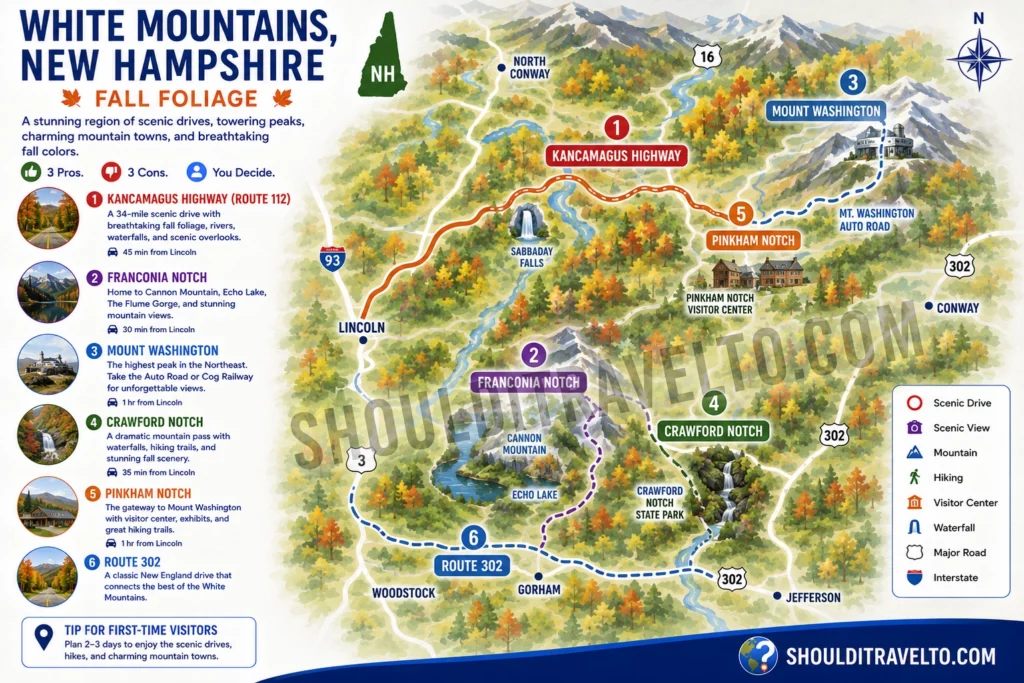
What Are the White Mountains, New Hampshire?
The White Mountains aren’t a single town or destination.
They are a large mountain region in northern New Hampshire that includes the White Mountain National Forest, state parks, scenic byways, mountain passes, waterfalls, hiking trails, and numerous small towns and villages.
For fall foliage travelers, the White Mountains are best understood as a road-trip destination rather than a place you visit from a single downtown.
The region’s mountains and forests create some of New England’s most spectacular autumn scenery, with foliage changing at different times depending on elevation and location.
Some of the area’s most famous fall experiences include:
- Kancamagus Highway: a 34.5-mile scenic drive between Lincoln and Conway
- Franconia Notch: dramatic mountain scenery, hiking, and viewpoints
- Mount Washington: the highest peak in the Northeast
- Crawford Notch: another spectacular mountain pass and scenic driving route
- Pinkham Notch: access to Mount Washington and the Presidential Range
- Route 302: a major scenic route through the region
- Covered bridges, waterfalls, farms, and small mountain towns
The Kancamagus Highway is particularly famous, but it shouldn’t be the only road on your itinerary. New Hampshire tourism officials specifically recommend exploring the region’s broader network of scenic routes because beautiful foliage can be found throughout the White Mountains.
Where Do You Stay When Visiting the White Mountains to See Fall Foliage?
Because the White Mountains are a region, travelers typically stay in one of the surrounding towns and use it as a base for exploring.
North Conway is one of the most popular bases in the eastern White Mountains, offering easy access to the Kancamagus Highway, Mount Washington Valley, scenic drives, restaurants, and attractions.
Lincoln is particularly convenient for travelers focusing on the western White Mountains, including the Kancamagus Highway and Franconia Notch.
Other popular places to stay include:
- Jackson
- Franconia
- Gorham
- Littleton
- Bethlehem
- Bartlett
- Woodstock
The best choice depends on which part of the White Mountains you want to explore.
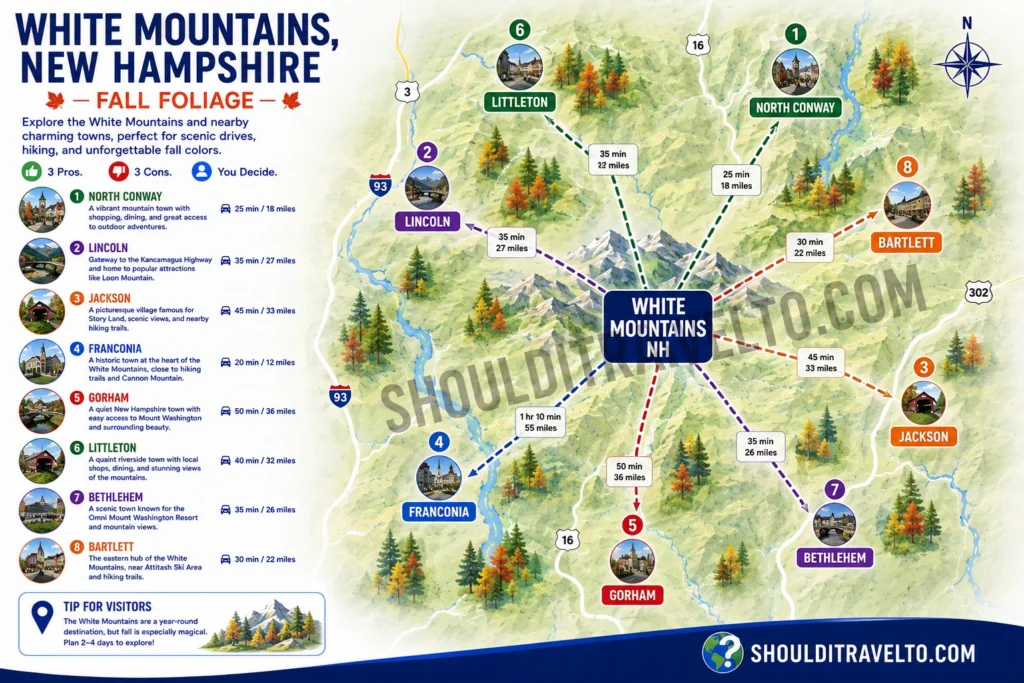
For a first-time fall foliage trip, North Conway or Lincoln is a particularly convenient base because it puts travelers close to several of the region’s major scenic drives and attractions.
The Bottom Line
Think of the White Mountains as New Hampshire’s fall foliage playground rather than a single destination.
You don’t come here to spend three days in one town.
You come here to drive the mountain roads, stop at overlooks, explore small towns, hike to viewpoints, photograph waterfalls and covered bridges, and chase the best foliage conditions across the region.
That distinction is important because the journey is part of the destination.
The Biggest Mistake First-Time White Mountains Visitors Make
Many first-time visitors underestimate how much there is to see.
The White Mountains cover a large area, and the most famous attractions are spread throughout the region.
Trying to drive the Kancamagus Highway, explore Franconia Notch, visit Mount Washington, and see multiple scenic viewpoints in a single day can leave you spending more time in the car than enjoying the scenery.
Another mistake is assuming that peak foliage occurs at exactly the same time throughout the region.
Elevation and location affect when the leaves change.
The higher elevations can reach peak color before lower areas, while different valleys and mountain passes can peak at different times.
Planning a route around the foliage conditions can make a major difference.
What Makes the White Mountains Different?
The White Mountains combine fall foliage with some of the most dramatic mountain scenery in New England.
Visitors can experience:
- Mountain passes
- Scenic highways
- Waterfalls
- Covered bridges
- Mountain peaks
- Forests
- Historic villages
- Scenic overlooks
The result is less of a traditional “fall town” vacation and more of an autumn mountain road trip.
And that’s exactly what makes the White Mountains special.
Let’s explore the three biggest reasons to visit the White Mountains during fall foliage season.
The 3 Biggest Reasons to Visit the White Mountains During Fall
The White Mountains offer spectacular mountain scenery, legendary scenic drives, and some of New England’s most memorable fall foliage.
1. The Kancamagus Highway
The Kancamagus Highway is one of the biggest reasons travelers visit the White Mountains in autumn.
The approximately 34-mile route crosses the White Mountain National Forest between Lincoln and Conway, with numerous scenic overlooks, waterfalls, hiking opportunities, and colorful mountain views along the way.
During peak foliage, the highway becomes a spectacular corridor of red, orange, and gold.
The important thing to remember is that the drive itself is the attraction.
Don’t rush from one end to the other.
Leave time for:
- Scenic overlooks
- Waterfalls
- Short hikes
- Photography
- Covered bridges
- Mountain viewpoints
The Kancamagus can become extremely busy during peak foliage, so travelers should plan for slower driving times and arrive early when possible.
2. Franconia Notch
Franconia Notch State Park provides another spectacular way to experience fall in the White Mountains.
The mountain pass is surrounded by dramatic peaks and colorful forests, with attractions and scenic viewpoints throughout the area.
Visitors can explore:
- Mountain scenery
- Hiking trails
- Waterfalls
- Scenic overlooks
- Cannon Mountain
- The Flume Gorge
Franconia Notch is particularly impressive because the foliage isn’t simply surrounding you.
It’s climbing the mountainsides around you.
3. Mount Washington
For travelers who want to take their fall foliage experience to the next level, Mount Washington offers some of the region’s most dramatic views.
The Mount Washington Auto Road allows visitors to drive toward the summit, where the scenery changes dramatically with elevation. The summit can be significantly colder and windier than the valleys below, so check conditions before going.
The summit can also provide views across the surrounding Presidential Range and beyond.
Weather conditions can be very different at the summit than they are in the valleys, so travelers should check conditions before making the trip.
Next, let’s explore the downsides of visiting the White Mountains during fall foliage season.
The 3 Biggest Downsides of Visiting the White Mountains
The White Mountains are spectacular in autumn, but peak foliage brings crowds, unpredictable timing, and a heavy reliance on driving.
1. Peak Foliage Can Be Crowded
The White Mountains are one of New England’s most popular fall destinations.
The most famous roads and attractions can become extremely busy during peak weekends.
Expect:
- Heavy traffic
- Crowded overlooks
- Busy parking areas
- Longer waits
- Higher hotel demand
The Kancamagus Highway is particularly popular during foliage season.
If you dislike crowds, consider visiting during the week or exploring some of the region’s less-famous roads and towns.
2. Foliage Timing Isn’t Guaranteed
Fall foliage is beautiful precisely because it is temporary.
Peak color can shift from year to year depending on weather, elevation, and location.
The White Mountains typically experience some of their strongest foliage from late September through the first half of October, but conditions vary.
Travelers planning specifically around peak color should monitor foliage reports before their trip.
3. You Need a Car
The White Mountains are best explored by car.
The region’s biggest attractions are spread across a large area, and many of the best experiences involve driving scenic roads.
That is a major advantage for travelers who enjoy road trips.
It can be a disadvantage for visitors who prefer to stay in one walkable town.
Planning Your White Mountains Fall Foliage Trip
The following factors can help you make the most of an autumn visit.
Best Things To Do in the White Mountains
Visitors can combine foliage viewing with:
- Drive the Kancamagus Highway
- Explore Franconia Notch
- Visit Mount Washington
- Drive through Crawford Notch
- Stop at scenic overlooks
- Visit waterfalls
- Explore covered bridges
- Hike through colorful forests
- Explore North Conway
- Photograph mountain scenery
- Take a scenic train ride
You don’t need to hike to enjoy the White Mountains.
Many of the region’s most impressive views can be experienced from scenic roads and easily accessible viewpoints.
Best Time to Visit
Although fall is the most spectacular season for foliage, the White Mountains are a year-round outdoor destination.
| Season | Why Visit? | Rating |
| Fall | Peak foliage & scenic drives | ★★★★★ |
| Winter | Skiing & snow-covered mountains | ★★★★☆ |
| Summer | Hiking & outdoor activities | ★★★★★ |
| Spring | Waterfalls & quiet exploring | ★★★☆☆ |
Fall is the clear choice for foliage.
Summer is the strongest alternative for travelers who want hiking and outdoor adventures without the focus on fall colors.
Ideal Trip Length
Weekend
✓ Kancamagus Highway and major highlights
3 Days
✓ Best balance
5 Days
✓ Explore multiple mountain regions and scenic drives
A three-day trip gives most visitors enough time to experience the region’s major highlights without spending the entire vacation behind the wheel.
Nearby Destinations
The White Mountains also work well as part of a larger New England road trip.
Visitors can combine the region with:
- Stowe, Vermont
- Burlington, Vermont
- Lake Winnipesaukee
- North Conway
- Lincoln
- Woodstock, Vermont
- Maine’s western mountains
- Boston
This makes the White Mountains particularly useful as a centerpiece for a longer New England foliage itinerary.
What Are the Best Scenic Drives in the White Mountains?
Scenic drives are one of the biggest reasons to visit the region.
The Kancamagus Highway is the obvious starting point, but travelers shouldn’t stop there.
Other scenic routes include:
- Franconia Notch
- Crawford Notch
- Route 302
- Mount Washington Auto Road
- White Mountain Trail
- Smaller backroads through mountain towns
New Hampshire has an extensive network of scenic roads and cultural byways, giving travelers plenty of alternatives when the most famous routes become crowded.
The best strategy is often to combine one famous drive with less-traveled backroads.
Who Should Visit the White Mountains?
The White Mountains are perfect for:
- Fall foliage lovers
- Scenic road-trip travelers
- Photographers
- Outdoor enthusiasts
- Hikers
- Couples
- Families
- Travelers who enjoy mountain scenery
- New England first-time visitors
Skip the White Mountains If:
- You dislike driving.
- You dislike mountain roads.
- You want a highly walkable destination.
- You want guaranteed foliage dates.
- You dislike crowds.
- You prefer a beach or warm-weather vacation.
Final Verdict
If you’re looking for a spectacular fall foliage road trip, the White Mountains belong near the top of your list.
The Kancamagus Highway, Franconia Notch, Mount Washington, and the region’s countless scenic roads create an autumn experience that is difficult to match.
The White Mountains aren’t simply a place to see colorful trees.
They’re a place to drive through the foliage, climb above it, hike among it, and experience it from almost every angle.
Yes, peak weekends can be crowded.
Yes, foliage timing is unpredictable.
And yes, you’ll want a car.
But if you’re willing to embrace the road-trip experience, the White Mountains offer one of America’s great fall vacations.
3 Pros. 3 Cons. You Decide.
White Mountains Fall Foliage Frequently Asked Questions
What are the White Mountains in New Hampshire?
The White Mountains are a mountain region in northern New Hampshire, not a single town. The area includes numerous communities, scenic roads, state parks, hiking areas, and attractions, with the White Mountain National Forest forming a major part of the region.
Where should you stay to see fall foliage in the White Mountains?
North Conway and Lincoln are two of the most popular bases. North Conway is particularly convenient for exploring the Mount Washington Valley and eastern White Mountains, while Lincoln is well positioned for the Kancamagus Highway and Franconia Notch. Smaller communities such as Franconia and Bethlehem offer quieter alternatives.
Is North Conway or Lincoln better for fall foliage?
It depends on your itinerary. North Conway is better for travelers who want easy access to restaurants, shopping, and the eastern White Mountains. Lincoln is better for travelers focusing on the Kancamagus Highway, Franconia Notch, and the western White Mountains.
Is the Kancamagus Highway worth visiting in the fall?
Absolutely. The 34-mile Kancamagus Highway between Lincoln and Conway is one of New England’s most famous fall foliage drives, with mountain views, forests, waterfalls, and numerous scenic pull-offs.
How long does it take to drive the Kancamagus Highway?
The Kancamagus Highway can be driven in roughly an hour without stops, but travelers should allow at least half a day during fall foliage season. Scenic overlooks, waterfalls, short hikes, photography stops, and traffic can significantly extend the trip.
Is the Kancamagus Highway crowded during fall foliage?
Yes. The Kancamagus can become particularly busy during peak foliage weekends. Travelers should expect traffic and crowded pull-offs, especially during peak periods. The regional tourism organization recommends exploring other scenic roads as well rather than concentrating exclusively on the Kanc.
Is Franconia Notch worth visiting in the fall?
Yes. Franconia Notch combines colorful forests with dramatic mountain scenery, waterfalls, hiking trails, and attractions. It is one of the strongest alternatives to the Kancamagus Highway for experiencing White Mountains foliage.
Is Mount Washington worth visiting during fall foliage?
Yes, particularly for travelers who want dramatic mountain views alongside colorful forests. Visitors can drive the Mount Washington Auto Road or use other methods of reaching the summit, although conditions at higher elevations can differ significantly from those in the valleys.
When is peak fall foliage in the White Mountains?
Peak foliage varies by location and elevation, but the White Mountains generally experience their strongest color from late September through the first half of October. Higher elevations and northern areas can change earlier than lower elevations farther south and east.
Can you visit the White Mountains before peak foliage?
Yes. Early-season visitors can often find color at higher elevations before lower areas reach peak. The changing foliage also means different parts of the region can offer good scenery at different times.
Can you visit the White Mountains after peak foliage?
Yes. The mountains remain scenic after peak foliage, although some trees may have lost their leaves. The benefit is that roads, trails, and attractions can become considerably quieter.
Do you need a car to see fall foliage in the White Mountains?
Yes. A car is highly recommended. The region’s biggest attractions include scenic highways, mountain roads, overlooks, waterfalls, and communities spread across a large geographic area. The White Mountains are particularly well suited to a road trip.
How many days do you need in the White Mountains for fall foliage?
Three days is a good starting point for seeing the major highlights. Five days gives travelers more time to combine the Kancamagus Highway, Franconia Notch, Mount Washington, and additional scenic drives without rushing.
Are the White Mountains a good fall destination for families?
Yes. The region offers hiking, scenic drives, train rides, waterfalls, and numerous family attractions. North Conway is particularly convenient for families because of its concentration of lodging, restaurants, and attractions.
Are the White Mountains good for couples?
Yes. Scenic drives, mountain views, cozy inns, covered bridges, and small towns make the region particularly appealing for couples during fall.
Are the White Mountains better than Stowe for fall foliage?
It depends on what you want. Stowe offers a concentrated Vermont village-and-mountain experience. The White Mountains offer more dramatic mountain scenery, major scenic drives, and a larger road-trip experience.
Are the White Mountains better than the Berkshires for fall foliage?
The White Mountains are better for travelers seeking dramatic mountains, notches and major scenic drives. The Berkshires are better for travelers who prefer small towns, rolling hills, art, history, and leisurely country roads.
What is the biggest mistake visitors make when visiting the White Mountains in fall?
Trying to see everything in one day. The White Mountains are a large region, and the most famous attractions are spread out. Trying to combine the Kancamagus Highway, Franconia Notch, and Mount Washington into one day can leave visitors spending more time driving than enjoying the scenery.
Can you see fall foliage without hiking in the White Mountains?
Absolutely. This is actually one of the region’s strengths. Scenic drives such as the Kancamagus Highway, Franconia Notch, and the Mount Washington Auto Road allow visitors to experience spectacular scenery without committing to long hikes.