

Should You Visit St. Paul, Minnesota, the Saintly City?
Quick Answer
Yes, you should visit St. Paul, Minnesota, especially if you’re interested in American history, historic architecture, museums, walkable neighborhoods, Mississippi River scenery, and a city that feels considerably more intimate than many major metropolitan destinations.
St. Paul is Minnesota’s capital and one of the Twin Cities.
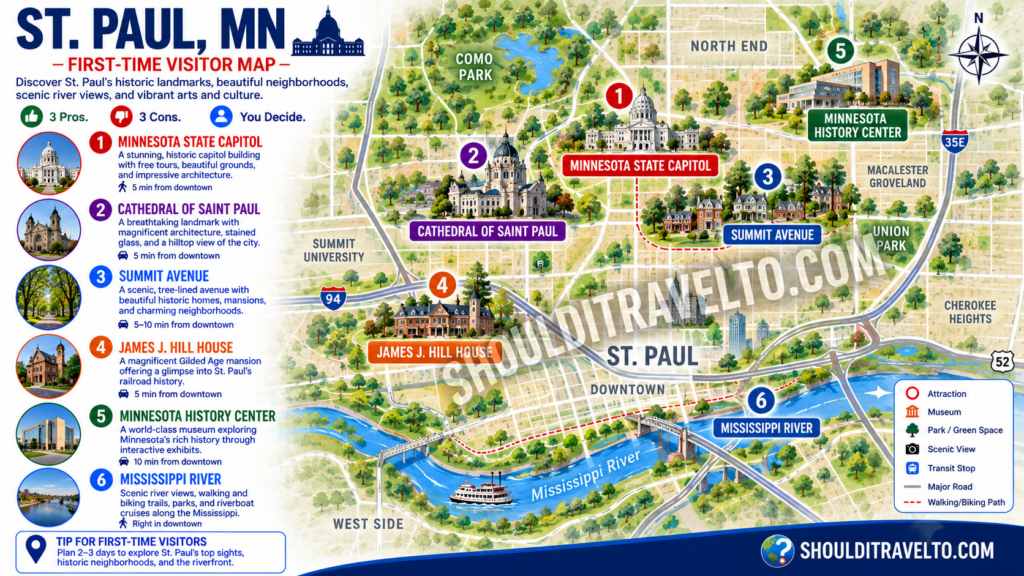
Here, visitors can tour the Minnesota State Capitol, walk past Victorian-era mansions along Summit Avenue, explore the home of railroad magnate James J. Hill, see the Cathedral of Saint Paul, learn about Minnesota history, explore neighborhoods filled with historic architecture, and spend time along the Mississippi River.
St. Paul probably won’t overwhelm you with famous bucket-list attractions.
That’s not really its strength.
Its appeal comes from something subtler:
History, architecture, neighborhoods, and character.
For travelers willing to slow down and explore it, St. Paul may be one of the more underrated city trips in the Midwest.
What First-Time Visitors Often Get Wrong About St. Paul
The biggest mistake first-time visitors make is assuming St. Paul and Minneapolis are essentially the same destination.
They’re not.
Yes, they form the Twin Cities and can easily be visited during the same vacation.
But they developed differently and still offer noticeably different experiences.
Minneapolis grew dramatically around St. Anthony Falls, milling, industry, and commerce.
St. Paul’s development was closely connected to the Mississippi River, transportation, government, railroads, and its role as Minnesota’s capital.
St. Paul became the capital of the Minnesota Territory in 1849 and developed as an important trading and transportation center along the Mississippi.
Those differences still influence what travelers see today.
St. Paul rewards visitors who are interested in:
- Historic neighborhoods
- Architecture
- Minnesota history
- The Mississippi River
- Gilded Age mansions
- Railroads
- Literature
- Museums
- Local neighborhoods
Don’t visit St. Paul expecting a smaller version of Minneapolis.
Visit St. Paul because it’s different from Minneapolis.
What Makes St. Paul Different?
The biggest difference between St. Paul and many American cities is how much of its appeal comes from its historic character.
This isn’t a city built around one famous attraction.
Instead, the experience comes from exploring places like Summit Avenue, Cathedral Hill, downtown, historic homes, museums, government buildings, and the Mississippi River.
In some places, St. Paul feels more like an established Eastern or Great Lakes city than what travelers may picture when they imagine Minnesota.
Grand homes line tree-covered streets.
A monumental cathedral overlooks downtown.
The State Capitol anchors Minnesota’s political history.
Historic buildings reveal the wealth created during the railroad era.
And the Mississippi River explains why the city developed here in the first place.
St. Paul isn’t a city you rush through collecting landmarks.
It’s a city you understand by exploring its history.
How Did St. Paul Become an Important Mississippi River City?
Understanding St. Paul begins with the Mississippi River.
During the 19th century, St. Paul’s location along the river helped it develop into a trading and transportation center.
The settlement grew rapidly, and in 1849 St. Paul became the capital of the newly created Minnesota Territory. It remained the capital when Minnesota became a state in 1858.
Transportation continued shaping the city.
One of the most important figures was James J. Hill.
Hill arrived in St. Paul by riverboat in 1856 and began working as a shipping clerk. After years in transportation, he and several investors purchased the struggling St. Paul & Pacific Railroad in 1878. The railroad eventually developed into the Great Northern Railway, which reached the Pacific Coast in 1893.
The wealth generated during this era transformed St. Paul.
And visitors can still see it.
Hill’s enormous Summit Avenue mansion remains one of the city’s major historic sites.
The Minnesota Historical Society describes the 36,000-square-foot James J. Hill House as once being the largest private residence in Minnesota.
But Hill’s mansion is only part of the story.
St. Paul’s history can also be explored through the Minnesota State Capitol, Summit Avenue, Cathedral Hill, Landmark Center, historic neighborhoods, museums, and the Mississippi River itself.
The city’s past isn’t hidden.
It’s part of the sightseeing.
The 3 Biggest Pros of Visiting St. Paul
St. Paul’s strongest advantages are its history, architecture, and its ability to offer a quieter, more manageable city experience than many larger destinations.
1. St. Paul Has Outstanding History and Architecture
This is St. Paul’s biggest strength.
For travelers interested in architecture and American history, there’s an impressive amount to explore.
Start with Summit Avenue.
The 4.5-mile avenue contains 373 of its original 440 homes and is described by Visit Saint Paul as the longest preserved stretch of Victorian-era homes in the United States.
Among its landmarks is the James J. Hill House.
Completed in 1891, the massive sandstone mansion reflects the wealth and ambition of the railroad era.
But Summit Avenue also connects visitors with another famous St. Paul resident: Scott Fitzgerald.
Fitzgerald grew up in St. Paul, and his former residence at 599 Summit Avenue is where he completed This Side of Paradise.
Elsewhere, visitors can see the Minnesota State Capitol, Cathedral of Saint Paul, Landmark Center, and historic neighborhoods.
Even St. Paul’s gangster era adds another unusual layer. Landmark Center, once a federal courthouse, was connected with major gangster trials during the 1920s and 1930s.
Together, these sites give St. Paul an unusual combination of political, railroad, architectural, literary, and Prohibition-era history.
2. The Mississippi River Gives St. Paul a Strong Sense of Place
St. Paul exists where it does largely because of the Mississippi River.
And the river remains one of the city’s defining geographic features.
St. Paul sits within the Mississippi National River and Recreation Area, a 72-mile National Park Service corridor through the Twin Cities metropolitan area. The river changes dramatically along this stretch, moving from prairie river through St. Anthony Falls and the Mississippi gorge before becoming part of the country’s enormous inland navigation system.
For visitors, the Mississippi provides more than scenery.
It connects the modern city with the reason St. Paul developed as a transportation and commercial center.
You can explore riverfront parks, trails, overlooks, bridges, and historic areas while experiencing a completely different side of the city from Summit Avenue or downtown.
St. Paul isn’t simply a state capital that happens to have a river.
The river is part of the reason the city exists.
3. St. Paul Offers a More Relaxed City Experience
Not every city vacation needs to be overwhelming.
St. Paul offers museums, historic sites, restaurants, neighborhoods, parks, architecture, and cultural attractions without the constant intensity of America’s largest cities.
Walk Summit Avenue.
Explore Cathedral Hill.
Visit a museum.
Tour the Capitol.
See the Mississippi.
Have dinner in a neighborhood rather than rushing to another attraction.
For travelers who enjoy cities but don’t necessarily enjoy frantic sightseeing, St. Paul’s pace can be one of its greatest advantages.
The 3 Biggest Cons of Visiting St. Paul
St. Paul’s quieter character and historical appeal also create several limitations, particularly for travelers comparing it with America’s major sightseeing destinations.
1. St. Paul Has Fewer Major Bucket-List Attractions
This is probably the biggest drawback.
St. Paul has plenty worth seeing.
But it doesn’t have the enormous portfolio of nationally famous attractions found in cities like New York City, Chicago, and Washington, DC.
The appeal is more subtle.
Summit Avenue.
The Capitol.
Historic homes.
Museums.
Neighborhoods.
Architecture.
The Mississippi.
If those things interest you, St. Paul can be fascinating.
If you want a trip built around one famous attraction after another, you may find the city comparatively quiet.
2. Winter Can Be Difficult
Minnesota winters are a genuine consideration.
Cold temperatures, snow, ice, and shorter daylight hours can make outdoor sightseeing considerably less appealing.
That’s particularly important in St. Paul because some of its best experiences involve walking historic neighborhoods, exploring Summit Avenue, and spending time along the Mississippi.
Winter can still work for museums, restaurants, indoor attractions, and travelers comfortable with cold weather.
But for most first-time visitors, I’d favor late spring through fall.
3. St. Paul Can Feel Too Quiet for Some Travelers
The relaxed atmosphere that appeals to some travelers may disappoint others.
St. Paul isn’t the obvious choice for travelers prioritizing:
- Major nightlife
- Nonstop entertainment
- Huge shopping districts
- Constant tourist activity
- A packed schedule from morning until midnight
This doesn’t mean St. Paul lacks restaurants, bars, events, or entertainment.
It means the city’s appeal tends to be more understated.
For many travelers, that’s refreshing.
The Should I Travel To … St. Paul Scorecard
The following ratings help show where St. Paul fits within the Should I Travel To decision framework.
Cost / Value: Good
St. Paul can provide relatively good value compared with many larger American city destinations, although prices vary considerably by accommodation, season, and events.
Weather & Climate: Fair/Mixed
Summer and early fall can be excellent for sightseeing, but Minnesota winters are long and cold.
Crowds & Tourist Density: Light
St. Paul generally doesn’t experience the overwhelming tourist density associated with America’s biggest visitor destinations, although festivals, sporting events, and other major events can create localized crowds.
Walkability & Transportation: Manageable
Downtown, Cathedral Hill, Summit Avenue, and individual neighborhoods can be enjoyable to explore on foot, but transportation is useful for moving between different parts of the city or for combining St. Paul with Minneapolis.
Things To Do: Strong
St. Paul offers enough museums, historic sites, architecture, parks, neighborhoods, cultural attractions, and Mississippi River experiences to comfortably fill several days when combined thoughtfully.
Food & Dining: Strong
St. Paul’s food scene reflects the Twin Cities’ broader cultural diversity and offers plenty of neighborhood restaurants and local dining.
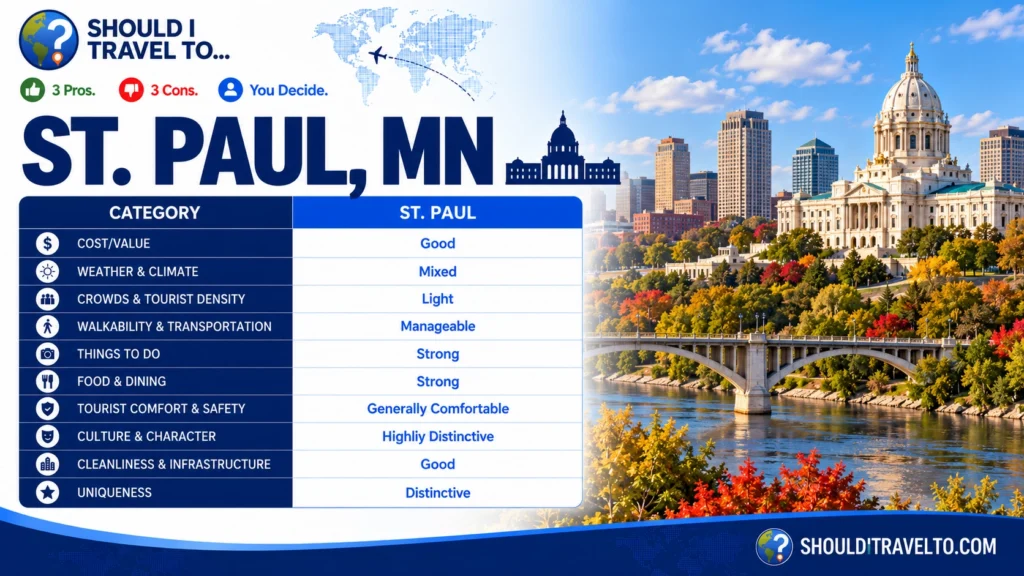
Tourist Comfort & Safety: Generally Comfortable
Most major visitor areas are straightforward to explore with normal city precautions.
Culture & Character: Highly Distinctive
Historic architecture, the state-capital identity, railroad history, neighborhoods, and Mississippi River setting give St. Paul a strong sense of place.
Cleanliness & Infrastructure: Good
Major visitor areas are generally well established and relatively easy to navigate.
Uniqueness: Distinctive
Few American cities combine a state capital, Mississippi River history, Victorian architecture, railroad history, literary connections, and a quieter neighborhood-oriented atmosphere quite like St. Paul.
Planning Your St. Paul Vacation
St. Paul works particularly well as either a short standalone city break or as one half of a broader Twin Cities vacation.
Atmosphere
St. Paul feels:
- Historic
- Architectural
- Relaxed
- Neighborhood-oriented
- Cultured
- Understated
- Midwestern
Best Time to Visit
Spring ★★★★☆
- Warmer weather returns
- Parks and neighborhoods become easier to explore
- Good museum and sightseeing conditions
Summer ★★★★★
- Warm weather
- Long daylight hours
- Excellent riverfront conditions
- Festivals and outdoor activities
Fall ★★★★★: Recommended
- Comfortable sightseeing weather
- Fall color
- Excellent conditions for Summit Avenue and historic neighborhoods
- Easy combination with seasonal trips such as Anoka for Halloween
Winter ★★★☆☆
- Cold temperatures
- Snow and ice
- Shorter daylight
- Stronger emphasis on museums, restaurants, and indoor attractions
For most first-time visitors, summer through early fall provides the easiest introduction to St. Paul, with early fall offering an especially appealing combination of comfortable sightseeing weather and autumn color.
Ideal Trip Length
St. Paul deserves its own day or two. The Twin Cities deserve the longer vacation.
1 Day: Major St. Paul highlights
Visit the Capitol, Cathedral, Summit Avenue, and one major museum or historic site.
2 Days: Best St. Paul experience
Two days allow enough time to explore the city’s history, neighborhoods, museums, architecture, and Mississippi River without rushing.
3–4 Days: Minneapolis + St. Paul
For most travelers coming from farther away, I’d use the additional time to experience both Twin Cities rather than spending four days exclusively in St. Paul.
Don’t Miss These St. Paul Attractions
St. Paul’s best attractions reinforce its strongest themes: Minnesota history, architecture, the Mississippi River, and distinctive neighborhoods.
Minnesota State Capitol
The natural place to understand St. Paul’s role as Minnesota’s capital and the state’s political history.
Cathedral of Saint Paul
One of the city’s defining architectural landmarks and a major part of the Cathedral Hill skyline.
Summit Avenue
Walk or drive part of the 4.5-mile corridor to see one of America’s most remarkable concentrations of Victorian-era homes.
James J. Hill House
Tour the enormous Gilded Age mansion built for railroad magnate James J. Hill and connect St. Paul’s architecture with the railroad wealth that helped shape the region.
Minnesota History Center
One of the most logical attractions for anyone interested in understanding Minnesota beyond St. Paul itself.
Mississippi River
Spend time along the river to understand the geography and transportation history that helped create the city.
Hidden Gems and Experiences
St. Paul’s less-famous attractions can reveal some of the city’s most interesting history and character.
Landmark Center
The historic former federal courthouse provides another window into the city’s architecture and its colorful Prohibition-era history.
Follow F. Scott Fitzgerald’s St. Paul
Fitzgerald was born in St. Paul and spent important years here. His Summit Avenue connections add a literary layer to a neighborhood already rich in architecture.
Cathedral Hill
Spend time exploring the neighborhood surrounding the Cathedral rather than simply photographing the landmark and leaving.
Grand Avenue
Pair Summit Avenue’s architecture with restaurants, shops, and neighborhood life along nearby Grand Avenue.
Explore St. Paul’s Gangster History
St. Paul’s Prohibition-era history adds an unexpected dimension to the city. Historic sites and tours explore stories involving bootleggers, gangsters, law enforcement, and the city’s unusual criminal past.
Nearby Attractions and Trips
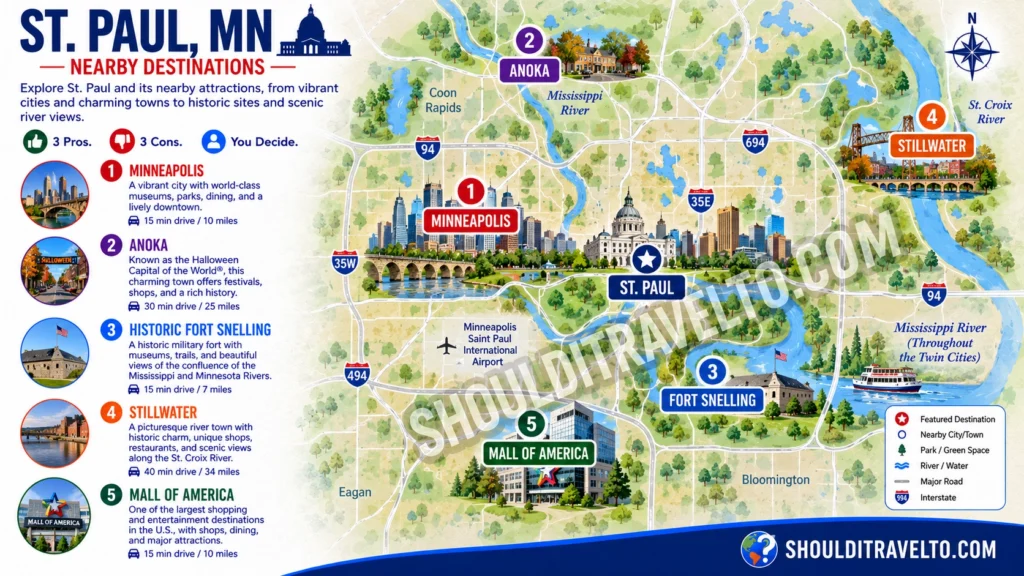
St. Paul’s location makes it easy to build a larger Minnesota vacation.
- Minneapolis
- Anoka
- Historic Fort Snelling
- Mississippi River attractions throughout the Twin Cities
- Stillwater
- Mall of America
This also makes St. Paul particularly useful for travelers planning a Halloween trip to Anoka.
They can make St. Paul and Minneapolis the vacation, and Anoka the Halloween centerpiece.
Who Should Travel to St. Paul?
St. Paul is particularly good for travelers interested in:
- American history
- Architecture
- Historic neighborhoods
- Museums
- State capitals
- Mississippi River history
- Railroad history
- Literature
- Couples trips
- Relaxed city vacations
- Midwest road trips
- Minneapolis–St. Paul vacations
However, St. Paul may not be ideal for travelers who primarily want:
- Major nightlife
- Huge collections of famous attractions
- Warm winter weather
- A high-energy city vacation
- A destination that requires a full week on its own
St. Paul vs. Minneapolis
For most first-time visitors, this isn’t really an either/or decision.
The cities are close enough and different enough that experiencing both makes sense.
Choose St. Paul If You Want:
- Historic architecture
- Summit Avenue
- Minnesota State Capitol
- Gilded Age history
- James J. Hill
- F. Scott Fitzgerald
- Historic neighborhoods
- A quieter atmosphere
- A more traditional historic-city experience
Choose Minneapolis If You Want:
- A larger urban experience
- St. Anthony Falls and milling history
- Lakes and parks
- More arts and entertainment
- A stronger nightlife scene
- A more energetic atmosphere
- A larger modern downtown experience
The simplest distinction?
Minneapolis feels like the more energetic Twin City.
St. Paul feels like the more historic Twin City.
Visit Minneapolis for a larger-city experience, and visit St. Paul for history and character.
Visit both to understand the Twin Cities.
Final Verdict
St. Paul probably isn’t the first city most travelers think of when planning an American city vacation.
That’s part of what makes it interesting.
This isn’t a destination built around beaches, theme parks, famous skyscrapers, or nonstop entertainment.
Its strengths are quieter.
History.
Architecture.
Neighborhoods.
The Mississippi River.
The State Capitol.
Summit Avenue.
Railroad fortunes.
Scott Fitzgerald.
And layers of Minnesota history that remain surprisingly visible throughout the city.
The three biggest reasons to visit are its outstanding historic character and architecture, its connection to the Mississippi River, and its relaxed city experience.
The biggest drawbacks are a smaller collection of bucket-list attractions, difficult winters, and an atmosphere that may feel too quiet for travelers seeking nonstop entertainment.
But St. Paul becomes considerably more compelling when you stop asking whether it can compete with America’s largest tourist cities.
It doesn’t need to.
And it becomes an even stronger trip when paired with Minneapolis.
Minneapolis gives you the energy.
St. Paul gives you the history and character.
Together, they give you the Twin Cities.
3 Pros. 3 Cons. You Decide.
St. Paul Frequently Asked Questions
Is St. Paul worth visiting?
Yes, particularly for travelers interested in American history, architecture, museums, historic neighborhoods, and the Mississippi River. It becomes an even stronger destination when combined with the neighboring city of Minneapolis.
What is St. Paul best known for?
St. Paul is Minnesota’s capital and is known for historic architecture, Summit Avenue, the Cathedral of Saint Paul, the Minnesota State Capitol, the Mississippi River, the James J. Hill House, and its historic neighborhoods.
Is St. Paul or Minneapolis better for tourists?
Minneapolis generally offers a larger, more energetic city experience, while St. Paul provides stronger historic character and architecture. Most first-time visitors should experience both.
How many days do you need in St. Paul?
One day covers major highlights, while two days allow a more relaxed exploration of St. Paul’s museums, historic sites, neighborhoods, architecture, and riverfront. Travelers with three or more days should consider combining St. Paul with Minneapolis.
Is St. Paul walkable?
Individual areas such as downtown, Cathedral Hill, Summit Avenue, and Grand Avenue can be explored on foot, but transportation is helpful for traveling between different parts of the city and throughout the broader Twin Cities.
What is Summit Avenue?
Summit Avenue is a 4.5-mile historic St. Paul corridor containing 373 of its original 440 homes. It’s particularly famous for its concentration of Victorian-era architecture and landmarks such as the James J. Hill House and F. Scott Fitzgerald’s former residence.
Is St. Paul good for history lovers?
Yes. St. Paul combines Minnesota political history, Mississippi River history, railroad history, Gilded Age architecture, literary history, and even Prohibition-era gangster stories.
Was F. Scott Fitzgerald from St. Paul?
Yes. Fitzgerald was born in St. Paul and spent part of his youth and early adulthood there. His former residence at 599 Summit Avenue is associated with the completion of his first novel, This Side of Paradise.
Is St. Paul on the Mississippi River?
Yes. The Mississippi River was fundamental to St. Paul’s development as a transportation and commercial center, and the city lies within the 72-mile Mississippi National River and Recreation Area.
Can you visit Minneapolis and St. Paul on the same trip?
Absolutely. In fact, that’s how I’d recommend approaching the destination for most travelers coming from outside Minnesota. Give St. Paul at least one dedicated day rather than treating it as a quick Minneapolis side trip.
Can you combine St. Paul with Anoka for Halloween?
Yes. Anoka can serve as the Halloween centerpiece of a broader Twin Cities vacation. Travelers can spend part of the trip exploring St. Paul’s history and architecture, visit Minneapolis, and schedule Anoka around the Halloween event they most want to experience.
What is the best time to visit St. Paul?
For most first-time visitors, summer through early fall offers the easiest sightseeing conditions. Summer offers long daylight hours and ideal conditions for exploring the Mississippi River and neighborhoods, while early fall brings autumn color and comfortable walking weather. Winter can still work for museums and indoor attractions, but cold temperatures make outdoor sightseeing more challenging.
Is St. Paul good for a weekend trip?
Yes. A weekend is enough time to experience St. Paul’s major historic sites, neighborhoods, architecture, museums, and Mississippi River setting without rushing. Two days is the sweet spot for St. Paul itself, while travelers with three or four days should consider exploring Minneapolis as well.