
Should You Visit the Catskills & Hudson Valley for a Fall Foliage Road Trip?
Quick Answer
Yes, you should travel to the Catskills and Hudson Valley for fall foliage if you want colorful mountains, scenic drives, historic towns, hiking, Hudson River views, restaurants, historic sites, and an easy fall escape from New York City.
What makes this region particularly appealing is its variety.
You can spend the morning hiking in the Catskill Mountains.
Drive through colorful forests in the afternoon.
Explore a historic Hudson Valley town.
Visit an estate or historic site.
Have dinner overlooking or near the Hudson River.
Then wake up the next morning and do something completely different.
The Catskills provide the mountains.
The Hudson Valley offers the river, towns, history, and culture.
And together, they create one of New York’s most complete fall road trips.
For travelers coming from New York City, there’s another major advantage:
You don’t have to travel far to feel like you’ve left the city completely behind.
What Are the Catskills and Hudson Valley?
The first thing to understand is that the Catskills and Hudson Valley aren’t the same thing.
But they overlap geographically and work extremely well together as a single trip.
The Hudson Valley follows the Hudson River north from the New York City region toward Albany. Hudson Valley Tourism describes the region as stretching roughly 150 miles and divides it into Lower, Mid, and Upper Hudson Valley sections.
The Catskill Mountains rise primarily west of the Hudson River.
The Catskills contain a mixture of public and private land, including approximately 287,500 acres of state Forest Preserve.
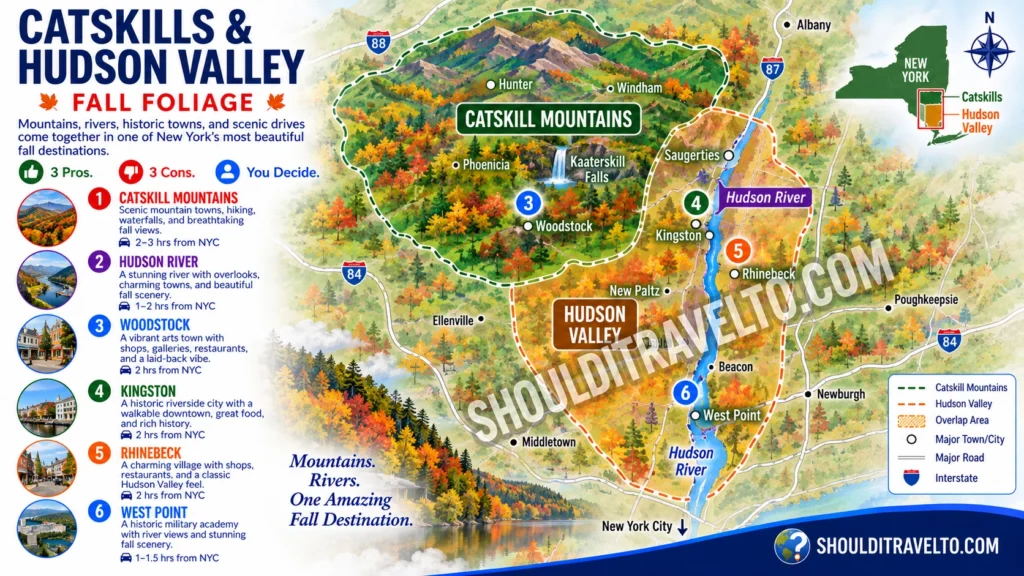
For a fall traveler, however, the easiest distinction is:
The Hudson Valley follows the river.
The Catskills take you into the mountains.
And you can experience both on the same trip.
Why Combine the Catskills and Hudson Valley?
Because each region solves the other’s biggest limitation.
A dedicated Catskills trip can give you mountains, forests, hiking, waterfalls, and scenic drives.
But the Hudson Valley adds historic towns, restaurants, estates, museums, art, river scenery, and considerably more cultural variety.
A Hudson Valley trip can give you towns, history, food, and river views.
But the Catskills add the dramatic mountain scenery many travelers want from a dedicated foliage vacation.
Together, you don’t have to choose.
Mountains in the morning.
Historic towns in the afternoon.
The Hudson River by evening.
That’s the appeal.
What Makes Catskills & Hudson Valley Fall Foliage Different?
Some fall foliage destinations are defined primarily by one landscape.
The Adirondacks give you mountains and lakes.
Acadia gives you mountains and ocean.
Shenandoah gives you the Blue Ridge Mountains and Skyline Drive.
The Catskills and Hudson Valley give you something different: Mountains + river + towns + history.
And the history isn’t a minor addition.
The Hudson River Valley National Heritage Area contains more than 100 designated heritage sites, covering themes including the Revolutionary War, landscapes and gardens, architecture, environmental history, and the Hudson River School of art.
The broader region includes places associated with Franklin D. Roosevelt, Vanderbilt, Washington Irving, Thomas Cole, Frederic Church, Revolutionary War history, West Point, and more.
That means a rainy fall day doesn’t necessarily ruin the trip.
You aren’t relying entirely on overlooks and hiking trails.
There’s considerably more to do.
The Biggest Mistake First-Time Fall Visitors Make
The biggest mistake is trying to see too much.
Just like the Adirondacks, this region looks more manageable on a map than it feels once you’re actually exploring it.
The Hudson Valley alone stretches roughly 150 miles.
Then add the Catskills to the west.
You could easily start listing:
- Sleepy Hollow
- Bear Mountain
- Beacon
- Cold Spring
- Hyde Park
- New Paltz
- Kingston
- Woodstock
- Phoenicia
- Catskill
- Hudson
And suddenly your relaxing fall weekend becomes an enormous driving itinerary.
Don’t do that.
Choose a section.
Choose a base.
Then explore the surrounding region.
The 3 Biggest Reasons to Visit the Catskills & Hudson Valley to See Fall Foliage
The Catskills and Hudson Valley make their strongest case in fall because they combine several different types of foliage experiences within one road trip. Here are the three biggest reasons to visit.
1. You Get Mountains, River Scenery, and Fall Color
This is the biggest reason to come.
The Catskills give you forested mountain slopes, hiking trails, waterfalls, scenic roads, and expansive views.
The Hudson Valley gives you the Hudson River cutting through an enormous historic landscape.
And in places such as the Hudson Highlands, those two visual ideas begin to come together.
Instead of experiencing fall foliage in only one setting, you can see it:
- Across mountains
- Along the river
- Around historic estates
- Beside small towns
- Along country roads
- And from hiking trails
The scenery keeps changing.
That’s what makes a road trip here particularly rewarding.
2. Historic Towns and Cultural Attractions Make This More Than a Foliage Trip
This is where the Hudson Valley gives the region a major advantage.
You aren’t traveling somewhere only to see leaves.
The Hudson River Valley has played an important role in American history, art, architecture, and culture.
You can explore presidential history around Hyde Park.
Visit Revolutionary War sites.
Explore Historic Huguenot Street in New Paltz.
See the landscape that helped inspire the Hudson River School.
Visit art museums and sculpture parks.
Or simply spend time exploring historic towns and Main Streets.
This creates an unusually complete fall vacation.
If the weather is beautiful? Go hiking.
If it rains? Visit a historic site or museum.
If you’ve had enough foliage? Go eat.
That’s a major advantage.
3. It’s an Exceptionally Easy Fall Escape From New York City
The Hudson Valley begins at the northern edge of New York City and becomes progressively more rural as you travel north.
Hudson Valley Tourism describes the Lower Hudson Valley as roughly 30–60 minutes from NYC and specifically highlights the broader region’s proximity to New York City as one of its accessibility advantages.
That creates enormous flexibility.
You can take a day trip.
Plan a weekend.
Spend three or four days exploring.
Or add the Hudson Valley and Catskills to a longer New York City vacation.
And unlike the Adirondacks, you don’t necessarily have to travel several hours north before the scenery begins changing dramatically.
New York City gives you the city vacation.
The Hudson Valley and Catskills give you the fall escape.
The 3 Biggest Downsides of Visiting the Catskills & Hudson Valley in Fall
The region’s accessibility and enormous variety also create some important trade-offs.
1. The Region Can Be Confusing to Plan
This is probably the biggest drawback for a first-time visitor.
There isn’t one entrance.
One scenic road.
One obvious base.
Or even one clearly defined tourist center.
The Catskills and Hudson Valley contain numerous towns, parks, historic sites, hiking areas, scenic roads, and attractions spread across a large region.
That flexibility is wonderful once you understand the geography.
It’s overwhelming before you do.
For a first trip, don’t start by asking:
“How do I see the Catskills and Hudson Valley?”
Ask:
“Which part should I see?”
That’s a much easier trip to plan.
2. Fall Weekends Can Be Very Busy
Easy access from New York City works both ways.
You can get here easily.
So can everyone else.
Popular towns, hiking areas, restaurants, orchards, scenic roads, and viewpoints can become crowded during beautiful fall weekends.
Traffic can also undermine the spontaneous road-trip feeling you’re probably trying to create.
If possible, visit during the week.
If you’re coming on a weekend, make important restaurant and accommodation reservations in advance
3. You Probably Need a Car for the Complete Experience
One unusual thing about the Hudson Valley is that parts of it are accessible from New York City by train.
That can make destinations such as Beacon, Cold Spring, and other river communities appealing without a car.
But that’s not the same thing as experiencing the Catskills and Hudson Valley as a foliage road trip.
The mountains, scenic roads, trailheads, waterfalls, rural communities, and many historic sites are geographically dispersed.
Although several Hudson Valley communities can be reached by train, many mountain areas, trailheads, scenic roads, rural communities, and historic attractions are much easier to explore by car.
For the full experience: Bring a car.
Planning Your Catskills & Hudson Valley Fall Foliage Trip
For a first trip, resist creating a massive checklist.
Instead, build the itinerary around four ingredients: 1 Scenic Drive + 1 Natural Attraction + 1 Historic Town + 1 Historic/Cultural Site.
Best Things To Do During Fall
The best fall trips here aren’t built around seeing as many attractions as possible. Instead, combine mountain scenery, outdoor recreation, a Hudson Valley town, and at least one historic or cultural experience.
Drive Through the Catskill Mountains
A Catskills road trip should be one of the anchors of the trip.
The goal isn’t simply getting from one attraction to another.
It’s about driving through forested mountain landscapes, stopping in small communities, and letting the scenery itself become part of the day.
For a first trip, consider a loop through the eastern or central Catskills that combines mountain roads, one or two towns, and a natural stop rather than trying to cross the entire region.
Explore the Hudson Highlands
For travelers coming from New York City, the Hudson Highlands provide one of the most dramatic transitions from urban New York to mountain-and-river scenery.
Places such as Bear Mountain and the surrounding Highlands combine hiking, Hudson River views, and fall foliage relatively close to the city.
Bear Mountain State Park also offers outdoor recreation and access to the Appalachian Trail.
This can work particularly well for a shorter trip when you don’t have enough time to travel deeper into the Catskills.
Visit a Historic Hudson Valley Site
Depending on where you stay, possibilities include presidential sites around Hyde Park, Historic Huguenot Street, Revolutionary War sites, Hudson River School locations, historic estates, or other National Heritage Area sites.
The point isn’t that everyone needs to visit the same historic site. The point is to add history to the foliage trip.
That’s one of this region’s greatest advantages.
Explore a Hudson Valley or Catskills Town
The towns are part of the experience.
Depending on the itinerary, places such as Beacon, Cold Spring, New Paltz, Kingston, Woodstock, or Hudson can add restaurants, shops, galleries, historic architecture, and a place to slow down between outdoor experiences.
When Is Peak Fall Foliage in the Catskills & Hudson Valley?
The region stretches north to south and features significant elevation differences between mountain areas and the Hudson Valley.
Generally, higher, more northern Catskills locations can begin turning earlier, while lower, more southern Hudson Valley areas can remain colorful later.
That means fall color can effectively move through the region.
| Period | General Expectation |
| Late September | Earliest color developing, especially higher/northern areas |
| Early October | Increasing Catskills color |
| Mid-October | Strong period to watch across much of the region |
| Late October | Strong potential farther south/lower in the Hudson Valley |
| Early November | Later-season possibilities, especially southern/lower areas |
These are general seasonal patterns, not guaranteed peak dates. Weather, elevation, latitude, and yearly conditions can shift the timing considerably. Check current New York foliage reports before traveling.
Don’t chase one supposedly perfect date. Use the region’s differences in elevation and latitude to your advantage.
Ideal Trip Length
You can get a taste of the region in a day, but combining the Catskills and Hudson Valley becomes considerably easier once you have at least two or three days.
1 Day: Hudson Highlands or One Town
A day trip from New York City is absolutely possible.
But choose one target.
Don’t attempt a giant Catskills-Hudson Valley loop.
2 Days: Weekend Highlights
Two days gives you enough time for a scenic drive, hiking or nature, one or two towns, and perhaps a historic site.
3 Days: Best Balance
For most first-time foliage travelers, three days is the sweet spot.
That allows you to combine the Hudson Valley and Catskills without turning every day into a race.
4–5 Days: Complete Regional Road Trip
Four or five days gives you enough time to explore several towns, go deeper into the Catskills, visit historic sites, hike, and follow foliage conditions as they change.
Where Should You Stay?
There isn’t one perfect base for the Catskills and Hudson Valley because the region is too large and varied. Where you should stay depends on whether you prioritize mountain scenery, Hudson Valley towns, outdoor recreation, or easy access from New York City.
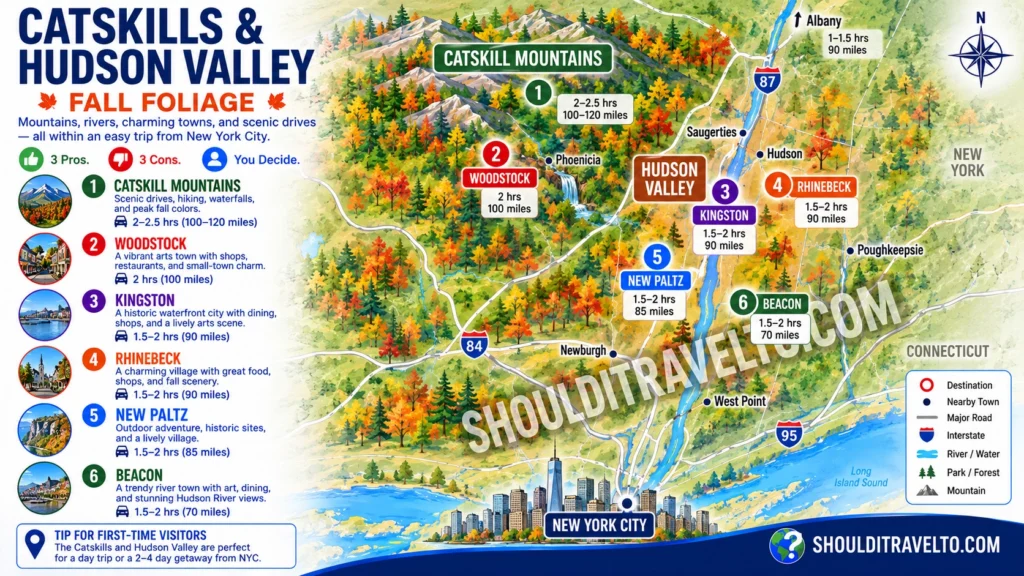
New Paltz: Best for a First-Time Hudson Valley Outdoor Trip
New Paltz gives travelers access to the Mid-Hudson Valley and nearby outdoor areas while still providing restaurants and a recognizable town base.
It also adds Historic Huguenot Street and access to Minnewaska and the Shawangunks. The National Heritage Area specifically highlights both Historic Huguenot Street and nearby outdoor preserves.
Kingston: Best Central Base
Kingston’s location makes it particularly useful for travelers trying to combine the Hudson Valley with the eastern Catskills.
It also brings significant history of its own.
Woodstock: Best for a Catskills-Focused Trip
Choose Woodstock if the mountain-town atmosphere and Catskills side of the trip matter more than convenient access to the entire Hudson Valley.
Beacon or Cold Spring: Best for a Short NYC Escape
For a shorter trip from New York City, the lower/mid-Hudson communities make considerably more sense than driving deep into the Catskills.
Do You Need a Car?
For the full Catskills and Hudson Valley foliage experience:
Yes.
Train service makes parts of the Hudson Valley unusually accessible from New York City.
But a car gives you access to the Catskills, scenic roads, trailheads, rural attractions, historic sites, and smaller communities.
It’s also especially valuable during foliage season.
If one area isn’t displaying the color you expected?
Go somewhere else.
That’s one of the advantages of choosing such a large and varied region.
Who Should Visit the Catskills & Hudson Valley for Fall Foliage?
The Catskills and Hudson Valley are particularly well-suited to travelers who want fall foliage to be part of a broader road trip rather than the only reason to travel.
This destination is especially good for travelers who want:
- Fall foliage
- Scenic road trips
- Mountains
- Hudson River views
- Historic towns
- Hiking
- American history
- Art and culture
- Restaurants and local food
- Couples trips
- Weekend getaways
- New York City add-ons
- A foliage trip with more than outdoor scenery
Think twice if you:
- Want one compact destination
- Don’t want to drive
- Want one obvious scenic route
- Primarily want high mountain scenery
- Want a traditional national park experience
- Need a guaranteed peak weekend
Catskills & Hudson Valley vs. Adirondacks for Fall Foliage
Both offer outstanding New York fall foliage, but they create very different vacations. The Adirondacks emphasize mountains, lakes, and wilderness, while the Catskills and Hudson Valley combine mountain scenery with river towns, history, food, and culture.
Choose the Catskills & Hudson Valley for:
- Easier access from New York City
- Historic towns
- Hudson River scenery
- History and culture
- Restaurants
- Mountain + river combinations
- More varied sightseeing
- Easier weekend trips
Choose the Adirondacks for:
- High Peaks
- Mountain lakes
- Reflections
- Lake Placid
- Larger wilderness landscapes
- Paddling
- More dramatic mountain setting
- Earlier-season foliage potential
The simplest difference?
The Adirondacks are the stronger mountains-and-lakes foliage trip.
The Catskills and Hudson Valley are the stronger foliage road trip with towns, history, and culture.
Catskills & Hudson Valley vs. Stowe for Fall Foliage
This comparison comes down largely to variety versus concentration. The Catskills and Hudson Valley give you a large region to road-trip through, while Stowe provides a more concentrated version of the classic Vermont fall experience.
Choose the Catskills & Hudson Valley for:
- Greater variety
- Hudson River
- Multiple towns
- History
- Art and culture
- New York City access
- A larger road trip
Choose Stowe, VT for:
- Quintessential Vermont atmosphere
- One recognizable fall town
- Covered bridges
- Farms
- Mountain scenery
- A more concentrated New England experience
Stowe gives you the quintessential fall town.
The Catskills and Hudson Valley give you an entire fall region to explore.
Catskills & Hudson Valley vs. Shenandoah for Fall Foliage
Both destinations work particularly well for foliage road trips, but Shenandoah provides a much more structured experience. The Catskills and Hudson Valley require you to build the route yourself.
Choose the Catskills & Hudson Valley for:
- Historic towns
- Hudson River
- Catskill Mountains
- Restaurants
- Art and culture
- New York City access
- More varied sightseeing
Choose Shenandoah National Park for:
- Skyline Drive
- Blue Ridge Mountain overlooks
- National park experience
- More concentrated scenic driving
- Hiking and waterfalls
- Washington, DC access
The simplest difference?
Shenandoah organizes the trip around one great mountain road.
The Catskills and Hudson Valley invite you to build your own fall road trip.
Final Assessment
Yes, you should travel to the Catskills and Hudson Valley to see the fall foliage, especially if you want more than mountains and colorful trees.
This is a fall trip built around variety.
Drive through the Catskill Mountains.
Hike.
See a waterfall.
Follow the Hudson River.
Explore a historic town.
Visit an estate or museum.
Eat well.
Then get back in the car and watch the landscape change again.
The three biggest reasons to visit are the combination of mountain and river scenery, the extraordinary amount of history and culture, and the region’s accessibility from New York City.
The three biggest drawbacks are the complex geography, busy fall weekends, and the need for a car to get the full experience.
But that complicated geography is also what makes the region so interesting.
There isn’t one attraction you’re supposed to see.
One road you’re supposed to drive.
Or one town where everyone needs to stay.
You build the fall trip you want.
Mountains.
River.
History.
Towns.
Food.
Foliage.
And all of it within reach of New York City.
3 Pros. 3 Cons. You Decide.
Catskills & Hudson Valley Fall Foliage Frequently Asked Questions
The Catskills and Hudson Valley cover a large and varied region, so first-time visitors often have questions about timing, transportation, where to stay, and how to plan the trip. Here are the most important things to know.
Are the Catskills and Hudson Valley the Same Place?
No. The Catskills and Hudson Valley are distinct yet overlapping regions that pair particularly well on a road trip.
The Hudson Valley follows the Hudson River north from the New York City region toward Albany and includes river communities, historic sites, estates, restaurants, museums, and outdoor attractions.
The Catskills are a mountainous region primarily west of the Hudson River, known for forests, hiking, waterfalls, scenic roads, and mountain communities.
For travelers, the easiest distinction is:
The Hudson Valley follows the river. The Catskills take you into the mountains.
Are the Catskills or Hudson Valley Better for Fall Foliage?
Choose the Catskills if your priorities are mountain scenery, hiking, forests, waterfalls, and scenic drives.
Choose the Hudson Valley if you want fall foliage combined with Hudson River scenery, historic towns, estates, restaurants, art, and American history.
For a longer trip, don’t necessarily choose between them. Combining the Catskills and Hudson Valley gives you a more varied fall foliage road trip.
When Is Peak Fall Foliage in the Catskills?
The Catskills generally begin changing earlier than lower and more southern portions of the Hudson Valley, with higher elevations often developing color first.
Early to mid-October is an important period to watch, but peak foliage varies by elevation, location, weather, and year.
Rather than planning around one supposedly perfect date, check current New York foliage reports before traveling and be prepared to adjust your route.
When Is Peak Fall Foliage in the Hudson Valley?
Fall color in the Hudson Valley generally develops from north to south and can continue later than higher-elevation areas of the Catskills.
Mid-to-late October is an important period to watch across much of the region, while some lower and more southern areas may retain color into late October or early November.
These are general seasonal patterns rather than guaranteed peak dates, so check current foliage conditions before your trip.
How Many Days Do You Need for the Catskills and Hudson Valley?
Three days is a good target for most first-time visitors.
One day is enough for a focused Hudson Valley or Hudson Highlands excursion from New York City.
Two days work for a weekend concentrating on one portion of the region.
Three days gives you enough time to combine mountain scenery, a scenic drive, hiking or another outdoor activity, a historic town, and a cultural or historic site without constantly rushing.
With four or five days, you can create a much more complete regional road trip.
Do You Need a Car to Visit the Catskills and Hudson Valley?
You don’t necessarily need a car for every Hudson Valley trip. Some river communities can be reached from New York City by train.
But for a Catskills and Hudson Valley fall foliage road trip, a car is strongly recommended.
A car gives you much greater access to mountain roads, trailheads, waterfalls, rural communities, historic attractions, and scenic areas. It also gives you the flexibility to change locations if foliage conditions are better somewhere else.
Can You Take a Fall Foliage Day Trip From New York City?
Yes. The lower Hudson Valley and Hudson Highlands make a fall foliage day trip from New York City possible.
The key is to choose one destination or small area rather than trying to see the entire Catskills and Hudson Valley in a single day.
For a true Catskills-and-Hudson-Valley road trip, plan at least two or three days.
Where Should You Stay for a Catskills and Hudson Valley Fall Trip?
There isn’t one perfect base because the region is too large for a single town to provide convenient access to everything.
New Paltz works particularly well for outdoor recreation and the Mid-Hudson Valley.
Kingston provides a useful central location for combining Hudson Valley attractions with the eastern Catskills.
Woodstock makes more sense for a Catskills-focused trip.
Beacon or Cold Spring can work particularly well for a shorter escape from New York City.
Choose where to stay based on the portion of the region you actually intend to explore rather than trying to find one base for everything.
What Is the Best Way to Plan a First Catskills and Hudson Valley Fall Trip?
Don’t begin with a giant list of towns and attractions.
Instead, build each trip around a simple framework:
One scenic drive + one hike or natural attraction + one historic town + one cultural or historic site.
Then choose a base that puts those experiences reasonably close together.
The region rewards slower exploration much more than trying to cover as much territory as possible.
Catskills & Hudson Valley or Adirondacks: Which Is Better for Fall Foliage?
Choose the Adirondacks if your priorities are larger mountain landscapes, mountain lakes, reflections, wilderness, paddling, and destinations such as Lake Placid.
Choose the Catskills and Hudson Valley if you want fall foliage combined with the Hudson River, historic towns, American history, art, restaurants, cultural attractions, and easier access from New York City.
The simplest difference?
The Adirondacks are the stronger mountains-and-lakes foliage trip. The Catskills and Hudson Valley are the stronger foliage road trip with towns, history, and culture.
Is the Catskills & Hudson Valley Worth Visiting if the Fall Foliage Isn’t at Peak?
Yes, and that’s one of the region’s biggest advantages.
Missing peak foliage is disappointing anywhere, but a Catskills and Hudson Valley vacation doesn’t depend entirely on colorful leaves.
You can still hike, explore the Hudson River, visit historic towns, tour estates and historic sites, visit museums and galleries, eat well, and explore the region’s scenic roads and communities.
And because the region covers different elevations and a considerable north-to-south distance, foliage conditions can vary substantially from one area to another.
If the color isn’t ideal where you are, you may be able to look for better conditions elsewhere.
That flexibility makes the Catskills and Hudson Valley one of the more forgiving choices for a fall foliage road trip.