
Should You Visit Jamestown, America’s First Permanent English Settlement?
Quick Answer
Yes, you should visit Jamestown.
If you want to stand where English America began, Jamestown is one of the most important historic destinations in the United States.
Founded in 1607, Jamestown became England’s first permanent settlement in North America, thirteen years before the Pilgrims arrived in Plymouth.
Visitors can explore archaeological sites, reconstructed forts, replica ships, and museums that tell the story of America’s earliest English colony.
While Jamestown doesn’t have the name recognition of Plymouth or Independence Hall, it marks the beginning of permanent English America, making it one of the most important historic sites in the United States.
For history lovers, it’s one of the country’s most significant destinations.
Why Jamestown Matters
Many Americans learn about Plymouth Rock before they learn about Jamestown.
However, historically, Jamestown came first.
Established in 1607, Jamestown became England’s first successful permanent settlement in North America.
The colony survived famine, disease, conflict, and near collapse before eventually becoming the foundation for the Colony of Virginia.
Jamestown also introduced events that shaped American history for centuries, including:
- Representative government through the House of Burgesses
- The story of Pocahontas and John Smith
- The expansion of English settlement throughout Virginia
Without Jamestown, the history of the United States would have unfolded very differently.
Jamestown marks the beginning of continuous English settlement that eventually grew into the thirteen colonies and, later, the United States.
It also became the colony where tobacco transformed Virginia into England’s most successful North American settlement, shaping the economy of colonial America for generations.
The Biggest Mistake First-Time Visitors Make
Many visitors try to see Jamestown in only a few hours.
While the archaeological site itself can be explored fairly quickly, Jamestown is best experienced alongside nearby Williamsburg and Yorktown.
Together, they form Virginia’s Historic Triangle.
Visiting all three destinations provides one of the most complete journeys through early American history anywhere in the country.
Jamestown and Virginia’s Historic Triangle
One of Jamestown’s greatest strengths is its location.
Jamestown sits at the heart of Virginia’s Historic Triangle, which includes:
- Jamestown: The beginning of permanent English settlement.
- Williamsburg: Colonial America’s political and cultural capital.
- Yorktown: Where the American Revolution effectively ended with Britain’s surrender in 1781.
Together, these three destinations tell nearly two centuries of American history, from the first English colony to the birth of an independent nation.
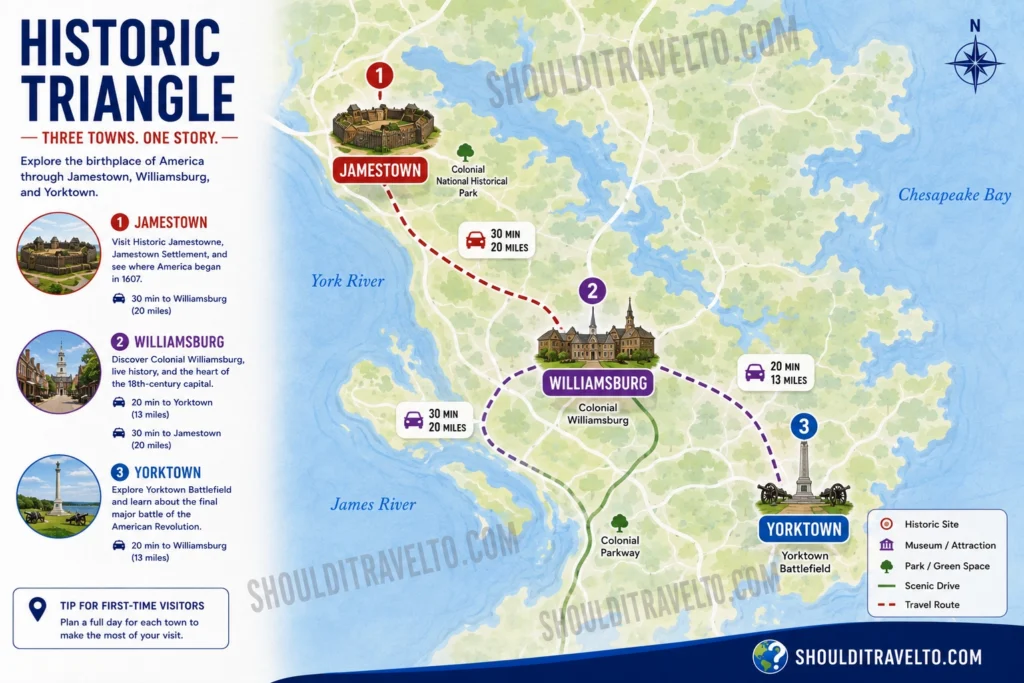
Few places in America offer such a complete historical journey within such a short distance.
Many visitors spend three to four days exploring all three.
Let’s take a look at the three biggest reasons to visit Jamestown.
The 3 Biggest Reasons to Visit Jamestown
Jamestown is the birthplace of English America. It features living history at the Jamestown Settlement, and travelers can easily combine the trip with a visit to Williamsburg and Yorktown.
1. The Birthplace of English America
Jamestown represents the beginning of permanent English settlement in North America.
Visitors can explore:
- Historic Jamestowne archaeological site
- Original settlement location
- Foundations of early buildings
- Artifacts uncovered by archaeologists
It’s one of the few places where visitors can stand where American colonial history truly began.
2. Living History at Jamestown Settlement
Just a short drive away, Jamestown Settlement recreates life in the early colony.
Visitors can experience:
- Replica ships
- Reconstructed fort
- Powhatan Indian village
- Living history demonstrations
- Interactive exhibits
The combination of archaeology and living history helps visitors understand what life was actually like during the colony’s earliest years.
3. Easy to Combine with Williamsburg and Yorktown
Few American historical destinations work together as well as Virginia’s Historic Triangle.
Visitors can easily experience:
- Jamestown
- Colonial Williamsburg
- Yorktown Battlefield
- American Revolution Museum at Yorktown
Together, they tell one continuous story spanning nearly 175 years.
Here are the three biggest downsides of visiting Jamestown.
The 3 Biggest Downsides of Traveling to Jamestown
Although many school kids study Jamestown in their history classes, it is less famous as a tourist destination than other historic sites. Visitors need a car to get to Jamestown, which has hot, humid summers.
1. Often Overlooked
Many travelers recognize Plymouth or Independence Hall before they recognize Jamestown, even though it came first.
As a town, Jamestown receives less attention than the cities on the East Coast.
When planning East Coast vacations, many travelers automatically think of:
Jamestown often receives less attention despite its enormous historical importance.
2. Requires a Car to Visit
Unlike Boston or Philadelphia, Jamestown isn’t designed as a walkable city destination.
A car makes exploring Jamestown much easier. Travelers who plan to add on Williamsburg and Yorktown to their trips should rent a car.
3. Summer Can Be Hot and Humid
Like much of coastal Virginia, summers are warm and humid in Jamestown.
Spring and fall generally offer the most comfortable weather.
Best Things To Do at Jamestown
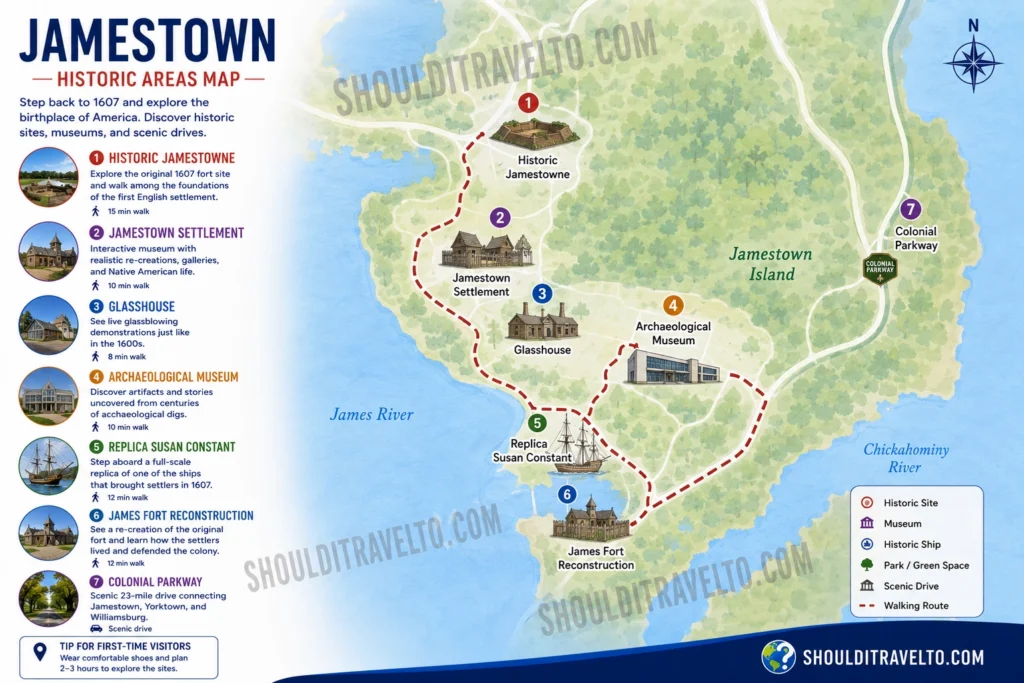
When visiting Jamestown, travelers often enjoy:
Historic Jamestowne
The original site of England’s first permanent settlement in North America remains one of the most important historic locations in the United States. Visitors can walk among active archaeological excavations, view original foundations, and see artifacts that continue to reshape historians’ understanding of early colonial life.
Historic Jamestowne remains one of the country’s most active archaeological sites, with new discoveries continuing to reshape what historians know about the colony.
Jamestown Settlement
Jamestown Settlement is a living history museum that recreates life for the first English settlers, the Powhatan people, and the early years of the Virginia colony. Costumed interpreters, recreated buildings, and interactive exhibits make it one of the best places to understand how Jamestown looked and functioned in the early 1600s.
One of the best parts of visiting Jamestown is experiencing both sites. Historic Jamestowne preserves the original location where the colony stood, while Jamestown Settlement recreates what life looked like through living-history exhibits and full-scale replicas.
Glasshouse
The Glasshouse showcases one of America’s oldest surviving industries, where English settlers attempted to manufacture glass shortly after arriving in Virginia. Today, skilled artisans demonstrate traditional glassblowing techniques, giving visitors a chance to watch handcrafted pieces being created using methods similar to those employed more than 400 years ago.
Archaearium (Jamestown Archaeological Museum)
The Archaearium displays thousands of artifacts uncovered during ongoing excavations at Historic Jamestowne. Exhibits include weapons, tools, personal belongings, and human remains that provide an extraordinary glimpse into daily life during the colony’s earliest years.
Replica Susan Constant
The Susan Constant replica allows visitors to step aboard a full-size recreation of the flagship that carried the first English colonists to Virginia in 1607. Walking its decks helps visitors appreciate the cramped conditions and difficult Atlantic crossing that shaped the beginning of English America.
James Fort Reconstruction
The reconstructed James Fort demonstrates how the settlers defended themselves during Jamestown’s earliest and most difficult years. Visitors can explore defensive walls, period buildings, and military displays while learning about the challenges the colonists faced in establishing the settlement.
Colonial Parkway
The Colonial Parkway is a scenic 23-mile drive connecting Jamestown, Williamsburg, and Yorktown through forests, marshes, and riverfront landscapes. Free of commercial traffic and billboards, the drive offers beautiful scenery while linking the three major sites of Virginia’s Historic Triangle into a single historical journey.
Many visitors consider the drive itself part of the experience.
Best Time to Visit Jamestown
Spring 🌸
March–May
★★★★★
Fall 🍂
September–November
★★★★★
Summer ☀️
Hot but full programming
★★★★☆
Winter ❄️
Quiet with smaller crowds
★★★☆☆
Ideal Trip Length
Half Day:
✓ Jamestown highlights
2 Days:
✓ Jamestown + Williamsburg
3–4 Days:
✓ Complete Historic Triangle (Recommended)
Nearby Destinations
Since Jamestown is a half-day trip, many visitors combine it with nearby destinations. For example, travelers can also visit:
- Williamsburg
- Yorktown
- Colonial Parkway
- Busch Gardens Williamsburg
- Richmond
- Virginia Beach
Combining Jamestown with nearby destinations turns the visit into an educational road trip.
Who Should Visit Jamestown?
Jamestown, a historic American destination, deserves a spot on most people’s itineraries.
Jamestown is perfect for:
- American history lovers
- Families
- Students
- Colonial history enthusiasts
- Road trip travelers
- Visitors exploring Virginia
Skip Jamestown If:
- You’re looking primarily for nightlife
- You want beaches
- You dislike museums or historical sites
- You only have a few hours in the region
Jamestown, like other historic town destinations, is more of an education stop than an entertainment one.
Final Verdict
As a tourist destination, Jamestown doesn’t have the instant recognition of Plymouth or Independence Hall.
Yet few destinations have had a greater impact on American history.
This is where permanent English America began.
Combined with Williamsburg and Yorktown, it becomes part of one of the finest historical trips in the United States.
Visitors can trace America’s story from its earliest English settlement through the growth of colonial society and finally to independence, all within a few miles.
For travelers interested in American history, few destinations are more rewarding.
If you’re already visiting Williamsburg or Yorktown, there’s almost no reason to skip Jamestown. Together, the Historic Triangle tells one of the greatest stories in American history.
3 Pros. 3 Cons. You Decide.
Jamestown Frequently Asked Questions
Is Jamestown worth visiting?
Yes. Jamestown is one of the most historically important destinations in the United States.
How long should I spend in Jamestown?
Most visitors spend half a day to a full day in Jamestown, although many combine it with Williamsburg and Yorktown over several days.
What is the Historic Triangle?
Virginia’s Historic Triangle consists of:
- Jamestown
- Williamsburg
- Yorktown
Together they tell the story of early America from 1607 through the American Revolution.
Is Jamestown better than Plymouth?
Jamestown and Plymouth tell different parts of America’s story.
Jamestown marks the beginning of permanent English settlement.
Plymouth represents the arrival of the Pilgrims and religious freedom.
Do I need a car?
Yes. A car is the easiest way to visit Jamestown and the other two destinations in the Historic Triangle.
What is Jamestown known for?
Jamestown is famous for:
- America’s first permanent English settlement
- Pocahontas
- John Smith
- Historic Jamestowne
- Jamestown Settlement
- Virginia’s Historic Triangle
What is the difference between Historic Jamestowne and Jamestown Settlement?
Historic Jamestowne preserves the original archaeological site where the colony stood in 1607. Jamestown Settlement is a nearby living-history museum featuring replica ships, reconstructed buildings, and interactive exhibits. Most visitors should see both to fully experience Jamestown.
Was Jamestown the first settlement in America?
Jamestown was England’s first permanent settlement in what would become the United States. Earlier European settlements existed, including St. Augustine, Florida (1565), established by Spain, and Santa Fe, New Mexico (1610).