

When Visiting California, Where Should You Start?
Quick Answer
Traveling to California means deciding what kind of California vacation you want.
California isn’t one travel experience. Los Angeles, Disneyland, Palm Springs, Joshua Tree, Big Sur, Napa Valley, Yosemite, Lake Tahoe, and Catalina Island could each anchor completely different trips.
So don’t start by asking, “What is the best place to visit in California?”
Start with the experience you want, such as city, coast, theme parks, desert, mountains, wine country, or an island getaway, and then choose the destination that fits it.
What California Destination Should You Visit?
California’s best-known destinations aren’t interchangeable, so choosing where to go starts with understanding what each one offers.
California is difficult to summarize as a single vacation destination.
You could spend a week exploring Los Angeles without leaving Southern California. Or you could:
- Build an entire trip around Disneyland.
- Relax beside a pool in Palm Springs.
- Hike through the desert in Joshua Tree.
- Drive one of America’s most famous coastlines through Big Sur.
- Spend a weekend tasting wine in Napa Valley.
- Explore Yosemite.
- Visit Monterey and Carmel.
- Escape to Lake Tahoe.
- Take a boat to Catalina Island.
Those aren’t variations of the same California vacation.
They’re completely different trips.
The best California destination gives you the California experience you’re actually looking for.
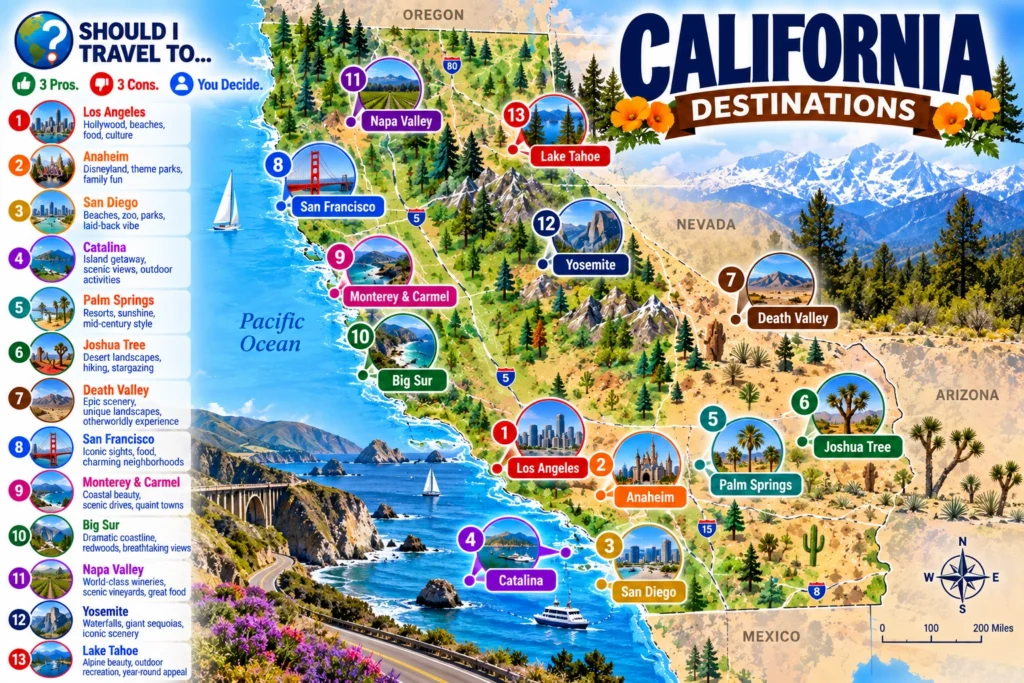
Why Travel to California?
Few states can offer major cities, beaches, deserts, mountains, theme parks, wine regions, national parks, scenic highways, forests, islands, and small coastal towns within the same state.
That variety is California’s biggest travel advantage.
You can build an entire vacation around one experience, or combine compatible destinations into a larger trip. Spend several days in Los Angeles before heading to Palm Springs. Pair San Francisco with Napa Valley. Combine Monterey and Carmel with Big Sur. Or make Yosemite the centerpiece of an outdoor vacation.
California doesn’t require one massive itinerary. Its strength is giving travelers enough variety to build very different trips around their interests.
3 Pros and 3 Cons of Traveling to California
California offers extraordinary variety, but its size and popularity create some significant trade-offs.
The 3 Biggest Pros
California’s biggest advantages come from the range of experiences travelers can fit into one state.
1. California Offers Almost Every Kind of Vacation
Few destinations give travelers this much flexibility within one state.
California can support city breaks, beach vacations, theme-park trips, desert escapes, mountain adventures, wine-country weekends, national-park vacations, and coastal road trips.
That means California can work for dramatically different travelers—and for the same traveler at different stages of life.
You don’t have to experience everything on one trip.
In fact, California becomes more appealing when you realize you don’t have to.
2. Cities and Nature Can Be Combined
California’s geography lets you combine major cities with dramatically different landscapes in the same regional trip.
You don’t always have to choose between a city vacation and an outdoor vacation.
Los Angeles can lead to Palm Springs and Joshua Tree.
San Francisco can lead to Napa Valley, Monterey, or Yosemite.
San Diego can become part of a larger Southern California road trip.
Anaheim can be paired with Los Angeles or the coast.
Palm Springs can become the base for a Joshua Tree excursion.
That creates one of California’s strongest travel formulas: city + outdoor escape.
3. California Rewards Repeat Trips
California isn’t a state you need to “finish.” Travelers can spend several years exploring the Golden State one trip at a time.
One trip could be:
- Los Angeles + Anaheim
- Palm Springs + Joshua Tree
- San Francisco + Napa Valley
- Monterey + Carmel + Big Sur
Each trip would reveal a completely different side of California. You could return repeatedly without taking the same vacation twice.
The 3 Biggest Cons
California’s variety comes with complications.
1. California Is Much Larger Than Visitors Expect
It’s easy to look at a map and start building a trip around:
- Los Angeles
- San Diego
- Palm Springs
- Yosemite
- San Francisco
- Napa Valley
Can you connect several of them? Yes.
Should you try to fit all of them into one normal vacation? Probably not.
Long driving distances can turn a California vacation into a transportation itinerary rather than an actual trip.
California rewards regional travel more than destination collecting.
2. A Car Is Helpful, or Essential, for Many Trips
You can do San Francisco without a car.
You can explore some parts of Los Angeles without driving if you plan your itinerary carefully.
Disneyland Resort is unusually compact.
But once you start connecting beaches, deserts, national parks, wine regions, mountain destinations, and smaller towns, a car becomes much more useful.
Some California vacations are essentially road trips.
3. California Can Be Expensive
California can be expensive to travel in, especially in major cities, coastal communities, resort destinations, wine country, and theme parks.
Costs may include:
- Hotels
- Parking
- Rental cars
- Gas
- Restaurants
- Theme parks
- Resorts
A luxury Napa weekend and a hiking-focused Joshua Tree trip aren’t the same financial proposition.
Price the California trip you’re actually considering.
Which California Destination Fits Your Trip?
Once you know the kind of trip you want, narrowing down California becomes much easier.
| If you want… | Start with… |
| Maximum city variety | Los Angeles |
| Iconic scenery + urban character | San Francisco |
| Beaches + family attractions | San Diego |
| Disneyland | Anaheim |
| Desert relaxation | Palm Springs |
| Desert adventure | Joshua Tree |
| Dramatic coastal scenery | Big Sur |
| Wine country | Napa Valley |
| Classic national-park scenery | Yosemite |
| Coast + charming towns | Monterey & Carmel |
| Mountains + lake | Lake Tahoe |
| Extreme desert landscapes | Death Valley |
| Island getaway | Catalina Island |
Don’t start by trying to see California. Start by choosing your California.
Best California Cities
California’s major cities can anchor an entire vacation or serve as a starting point for exploring a larger region.
Los Angeles: The Everything-in-One California Vacation
Los Angeles is the choice for travelers who want maximum variety.
The City of Angels offers:
- Hollywood
- Beaches
- Museums
- Food
- Entertainment
- Sports
- Theme parks
- Neighborhoods
- Hiking
- Shopping
And day-trip possibilities.
Its greatest strength is also its biggest challenge.
Everything is spread out.
Los Angeles rewards travelers who decide what matters before they arrive and group activities geographically.
Best for: First-time visitors who want variety, entertainment, food, beaches, and attractions.
Biggest trade-off: Traffic, distances, and planning.
Choose Los Angeles if: You don’t want your California vacation defined by only one experience.
San Francisco: The Iconic Northern California City
San Francisco offers a dramatically different California experience.
The Golden City offers:
- Golden Gate Bridge
- Cable cars
- Neighborhoods
- Waterfront
- Architecture
- Food
- Hills
- Bay views
And easy access to a much larger Northern California trip.
San Francisco also provides a natural starting point for Napa Valley, Monterey, Carmel, Big Sur, redwood country, and other Northern California destinations.
Best for: Walkable city exploration, architecture, food, scenery, and Northern California itineraries.
Biggest trade-off: Cost, hills, and highly variable microclimates.
Choose San Francisco if: You want the city itself to feel like one of the attractions.
San Diego: The Beach-and-Family California Vacation
San Diego fills a gap that neither Los Angeles nor Anaheim completely fills.
America’s Finest City offers:
- Beaches
- Balboa Park
- San Diego Zoo
- La Jolla
- Museums
- Outdoor activities
- Family attractions
- Neighborhoods
And a generally relaxed coastal identity.
Best for: Families, beach lovers, outdoor adventurers, and travelers who want an easier-going Southern California vacation.
Biggest trade-off: A car helps you explore the broader city and region.
Choose San Diego if: You want beaches and attractions without the scale and intensity of Los Angeles.
Best California Theme-Park Destination
California also offers one of America’s defining theme-park vacations.
Anaheim: The Disneyland Vacation
Most people don’t vacation in Anaheim because it’s Anaheim.
Anaheim has a very clear travel identity:
- Disneyland
- Disney California Adventure
- Hotels
- Restaurants
And an unusually compact tourism district.
That’s what differentiates Anaheim from Orlando.
Orlando offers enormous scale. Anaheim offers simplicity.
You can build a shorter, more concentrated Disney vacation and potentially combine it with Los Angeles, San Diego, or Southern California beaches.
Best for: Families, Disney fans, shorter theme-park trips.
Biggest trade-off: Anaheim itself is rarely the primary attraction beyond its major entertainment venues.
Choose Anaheim if: Disneyland is the reason you’re going to California.
Best California Desert Destinations
California’s deserts offer very different vacations, from resort relaxation in Palm Springs to outdoor adventure in Joshua Tree and extreme landscapes in Death Valley.
Palm Springs: The Desert Escape
Palm Springs is where California slows down.
The Golf Capital of the World offers:
- Pools
- Resorts
- Midcentury architecture
- Restaurants
- Mountain views
- Desert landscapes
And the Palm Springs Aerial Tramway.
You don’t need to fill every hour. In fact, that’s part of the appeal.
Best for: Couples, relaxation, design, resorts, pools, and desert scenery.
Biggest trade-off: Extreme summer heat substantially affects what you can comfortably do.
Choose Palm Springs if: You want to relax in the desert.
Joshua Tree National Park: The Desert Adventure
Joshua Tree answers a completely different question.
Instead of: Where can I relax in the desert?
Ask: Where can I explore it?
Joshua Tree offers:
- Joshua trees
- Rock formations
- Hiking
- Stargazing
- Desert landscapes
- Sunrise
- Sunset
Some travelers will choose between Palm Springs and Joshua Tree. The decision comes down to a simple question: Do you want to relax in the desert or explore it?
Best for: Hiking, photography, stargazing, nature, desert landscapes.
Biggest trade-off: Limited services inside the park and weather extremes.
Choose Joshua Tree if: The landscape is the attraction.
Death Valley National Park: The Extreme California Desert
Death Valley isn’t simply another version of Joshua Tree.
Its appeal is scale and extremity.
Death Valley offers:
- Salt flats
- Mountains
- Canyons
- Sand dunes
- Vast desert landscapes
And some of the lowest elevations in North America.
But season matters enormously. This isn’t a destination to treat casually in extreme heat.
Best for: Scenic driving, geology, photography, desert landscapes, national parks.
Biggest trade-off: Extreme temperatures and substantial driving distances.
Choose Death Valley if: You want California at its most dramatic and severe.
Best California Coastal Destinations
California’s coast offers more than a beach vacation, with dramatic road-trip scenery in Big Sur, classic coastal towns around Monterey and Carmel, and an island escape on Catalina.
Big Sur: The Scenic Coast
Big Sur isn’t about checking off dozens of attractions.
The landscape is the attraction.
Big Sur offers:
- Cliffs
- Ocean
- Bridges
- Beaches
- Redwoods
- Scenic overlooks
And Highway 1.
This is the California road-trip image many travelers have in their heads before they ever arrive.
But road conditions matter, and Highway 1 closures can substantially affect itineraries. Travelers should verify current road conditions before leaving.
Best for: Road trips, scenery, photography, couples, outdoor travel.
Biggest trade-off: Road access, limited lodging, and potentially expensive accommodations.
Choose Big Sur if: The drive itself is part of the vacation.
Monterey & Carmel: The Classic Coastal Getaway
Monterey gives you the aquarium, Cannery Row, history, and waterfront.
Carmel gives you a smaller, more romantic coastal-town experience.
The surrounding area gives you scenic drives and access to Big Sur.
Best for: Couples, families, coast, wildlife, aquariums, scenic drives.
Biggest trade-off: Popular weekends can be expensive.
Choose Monterey and Carmel if: You want the California coast without making the entire trip a road trip.
Catalina Island: The Island Escape
Catalina gives travelers something unique. You leave the mainland behind.
The Island of Romance offers:
- Avalon
- Harbor views
- Boats
- Hiking
- Water activities
- Golf carts
And an island atmosphere surprisingly close to Southern California’s major population centers.
Best for: Couples, weekend trips, island atmosphere, water activities.
Biggest trade-off: Ferry logistics and a more limited range of attractions than a major city.
Choose Catalina if: You want your California trip to feel farther away than it actually is.
Best California Mountain Destinations
California doesn’t end at the coast and desert.
Some of its most famous landscapes are inland and at elevation.
Yosemite National Park: The Iconic National-Park Trip
Yosemite is the California destination to choose when world-famous scenery, hiking, and the national-park experience, not a city or coastline, are the reason for the trip.
The Incomparable Valley offers:
- Granite cliffs
- Waterfalls
- Giant sequoias
- Hiking
- Valleys
- Mountain scenery
It’s a destination that can justify an entire California vacation on its own. And that distinction matters.
Don’t treat Yosemite as something you casually squeeze between Los Angeles and San Francisco.
Best for: National parks, hiking, photography, scenery, outdoor travelers.
Biggest trade-off: Crowds, seasonal access considerations, and logistics.
Choose Yosemite if: Nature, not a California city, is the reason for the trip.
Lake Tahoe: The Mountain-and-Lake Vacation
Lake Tahoe gives California another completely different identity.
In warmer months, Lake Tahoe offers:
- Lake
- Beaches
- Hiking
- Boating
- Mountain scenery
In winter, it offers:
- Snow
- Skiing
- Snowboarding
- Mountain resorts
That makes Tahoe unusually seasonal.
The same destination can support two completely different vacations depending on when you visit.
Best for: Mountains, lake activities, skiing, outdoor trips, families.
Biggest trade-off: Seasonal crowds and driving conditions.
Choose Lake Tahoe if: You want the California mountains to define the trip.
Best California Wine Destination
For travelers who want to build a California vacation around wine, food, resorts, and a slower pace, Napa Valley offers one of the state’s most distinctive getaways.
Napa Valley: The Wine-Country Vacation
Napa gives California yet another travel identity. It offers:
- Vineyards
- Wine tasting
- Restaurants
- Resorts
- Scenic countryside
- Slower travel
This isn’t a trip where the goal should be seeing as many attractions as possible.
The experience is the destination.
Best for: Couples, wine, food, resorts, slower itineraries.
Biggest trade-off: Cost and limited appeal for travelers not interested in wine- or food-focused travel.
Choose Napa Valley if: You want California to feel indulgent rather than busy.
Which California Region Fits the Trip?
Many first-time travelers start by asking which city they should visit.
The bigger decision may actually be: Which California region fits the trip?
Southern California
Think:
- Los Angeles
- Anaheim
- San Diego
- Palm Springs
- Joshua Tree
- Catalina
- Beaches
- Theme parks
- Desert
- Entertainment
Choose Southern California for: beaches, entertainment, theme parks, and desert escapes.
Northern California
Think:
- San Francisco
- Napa Valley
- Monterey
- Carmel
- Big Sur
- Lake Tahoe
Choose Northern California for: scenery, food, wine country, mountains, and road trips.
Neither is the “better California.” They’re different vacations.
City vs. Coast vs. Desert vs. Mountains
If you’re still unsure, simplify the decision.
Choose a city if attractions, food, museums, neighborhoods, and entertainment matter most. Start with Los Angeles, San Francisco, or San Diego.
Choose the coast if scenery, beaches, and road trips matter most. Start with Big Sur, Monterey & Carmel, or Catalina.
Choose the desert if open landscapes, resorts, hiking, or winter sunshine appeal to you. Start with Palm Springs, Joshua Tree, or Death Valley.
Choose the mountains if hiking, national parks, lakes, or skiing are the priority. Start with Yosemite or Lake Tahoe.
Can’t decide? Combine two compatible experiences instead of trying to do everything.
Best California Destination Combinations
Some of California’s best trips combine two or three nearby destinations that offer different experiences without turning the vacation into a race across the state.
Los Angeles + Anaheim: City + Disneyland: One of the easiest first-time Southern California combinations.
Los Angeles + Palm Springs: City + desert relaxation: Experience LA’s intensity and then deliberately slow down.
Palm Springs + Joshua Tree: Desert relaxation + desert adventure: One of California’s most natural desert combinations.
Los Angeles + San Diego: Big-city variety + easier-going coastal city: A natural Southern California road trip.
San Francisco + Napa Valley: City + wine country: Two completely different experiences within one Northern California vacation.
San Francisco + Monterey & Carmel: City + coast: A strong introduction to Northern California.
Monterey & Carmel + Big Sur: Coastal towns + scenic road trip, a natural pairing.
San Francisco + Yosemite: City + national park: A much more ambitious combination, but one that gives travelers dramatically different California experiences.
Planning Your California Trip
Once you’ve chosen the California experience you want, the next step is deciding how long to stay, when to visit, and how much of the state you can realistically fit into one trip.
How Many Days Do You Need in California?
The number of days you need in California depends less on the size of the state than on how many regions you try to combine. Three days can work for one compact destination. A week can support a regional trip. Ten to fourteen days makes a larger road trip more realistic.
3 Days
Three days are enough to see and enjoy destinations, such as:
- Palm Springs
- San Diego
- Anaheim
- San Francisco
- Monterey/Carmel
5 Days
Five days let travelers explore one major destination in depth or combine two nearby destinations.
Examples:
- Los Angeles
- San Francisco + Napa
- Palm Springs + Joshua Tree
- Monterey + Carmel + Big Sur
7 Days
A week gives you enough time for a real regional vacation.
For example, travelers can visit:
- Los Angeles + Anaheim
- Los Angeles + San Diego
- San Francisco + Napa + Monterey
- Yosemite + another Northern California destination
10–14 Days
Two weeks makes a California road trip much more realistic.
But even with two weeks, don’t assume you need to cover the entire state.
A deeper Southern California or Northern California trip may be more enjoyable than racing between both.
California rewards depth more than distance.
When Is the Best Time to Visit California?
California doesn’t have one travel season. That’s another consequence of the state’s size and geography.
The best time for Palm Springs isn’t necessarily the best time for Lake Tahoe.
The best season for Death Valley isn’t necessarily the best season for Yosemite.
Coastal weather differs from inland weather.
Mountains introduce snow. Deserts introduce extreme heat.
So rather than choosing a month and then asking where to go: Choose the destination first. Then choose the season.
California With Kids vs. Couples
California works particularly well for families traveling with kids and couples, but the destinations change.
With Kids
With kids, start with destinations where attractions are easy to build a trip around. For couples, start with the experience: relaxation, food and wine, scenery, or city exploration.
Start with:
- Anaheim
- San Diego
Travelers with kids may also consider:
- Los Angeles
- Yosemite
- Lake Tahoe
For Couples
For couples, start with the experience you want to share rather than looking for one destination that is universally “romantic.”
Start with:
- Palm Springs
- Napa Valley
- Carmel
- Big Sur
- Catalina
- San Francisco
But don’t make these rigid categories.
A family can love Yosemite.
A couple can love Disneyland.
Traveler fit matters more than labels.
California Road Trip or Single Destination?
Whether you should take a California road trip or stay in one destination depends on how much time you have, how much driving you want to do, and whether the journey itself is part of the vacation.
Choose a single destination when:
- You have three or four days
- You’re visiting Disneyland
- You’re taking a resort trip
- You’re primarily visiting a national park
- You want a slower vacation.
Choose a road trip when:
- You have at least a week
- The journey itself matters
- You’re connecting compatible regions
- You’re comfortable spending part of the vacation driving.
The mistake isn’t taking a California road trip.
The mistake is assuming that more California automatically creates a better California vacation.
Don’t Miss
Don’t miss the opportunity to make the journey itself part of the California experience. A coastal drive, desert transition, mountain approach, ferry to Catalina, or drive into wine country can be as memorable as the destination.
But don’t add stops simply because they’re on the map. The best California itineraries connect places that belong together.
And remember: You don’t need to see Northern and Southern California on the same trip.
California will still be there next time.
The Decision Is Yours
There isn’t one California vacation. The Golden State offers major cities, small towns, beaches, deserts, mountains, theme parks, wine country, islands, and national parks—and trying to fit all of them into one trip misses the point.
Choose the city, coast, desert, mountains, theme parks, or wine country. Or combine two experiences that naturally belong together.
Don’t start by trying to see California. Start by choosing your California.
Then build the trip around it.
3 Pros. 3 Cons. You Decide.
California Travel Frequently Asked Questions
What is the best destination in California for first-time visitors?
It depends on the trip. Los Angeles offers enormous variety, San Francisco provides a distinctive urban experience, San Diego combines beaches and family attractions, and Yosemite offers an entirely nature-focused vacation.
How many days do you need in California?
Five to seven days is enough for one region or a few compatible destinations. Ten to fourteen days offers more flexibility for a road trip, but California is too large to experience fully on a typical vacation.
Do you need a car in California?
Often, yes. You can explore some destinations without one, particularly San Francisco and compact tourist areas such as the Disneyland Resort area, but a car becomes increasingly useful when combining destinations.
Should you visit Northern or Southern California?
Choose Southern California for beaches, entertainment, theme parks, and desert destinations. Choose Northern California for San Francisco, wine country, coastal scenery, mountains, and road-trip experiences. Both regions contain exceptions, so the individual destinations matter more than the labels.
What is the best California destination for families?
Anaheim is particularly strong for Disneyland-focused trips, while San Diego combines beaches with major family attractions. Los Angeles offers greater variety, while Yosemite and Lake Tahoe work well for outdoor-oriented families.
What is the best California destination for couples?
Palm Springs, Napa Valley, Carmel, Big Sur, Catalina Island, and San Francisco all offer very different trips for couples. The better choice depends on whether you want relaxation, wine, scenery, an island, or a city.
What is the best California destination for beaches?
San Diego is one of the strongest choices for a vacation that combines beaches with major attractions. Los Angeles offers numerous famous beaches as part of a much larger city vacation.
What is the best California destination for nature?
Yosemite is the obvious starting point for iconic mountain scenery, while Joshua Tree offers desert landscapes, Big Sur offers dramatic coastline, Death Valley provides extreme desert scenery, and Lake Tahoe combines mountains with a major alpine lake.
Can you visit Los Angeles and San Francisco on the same trip?
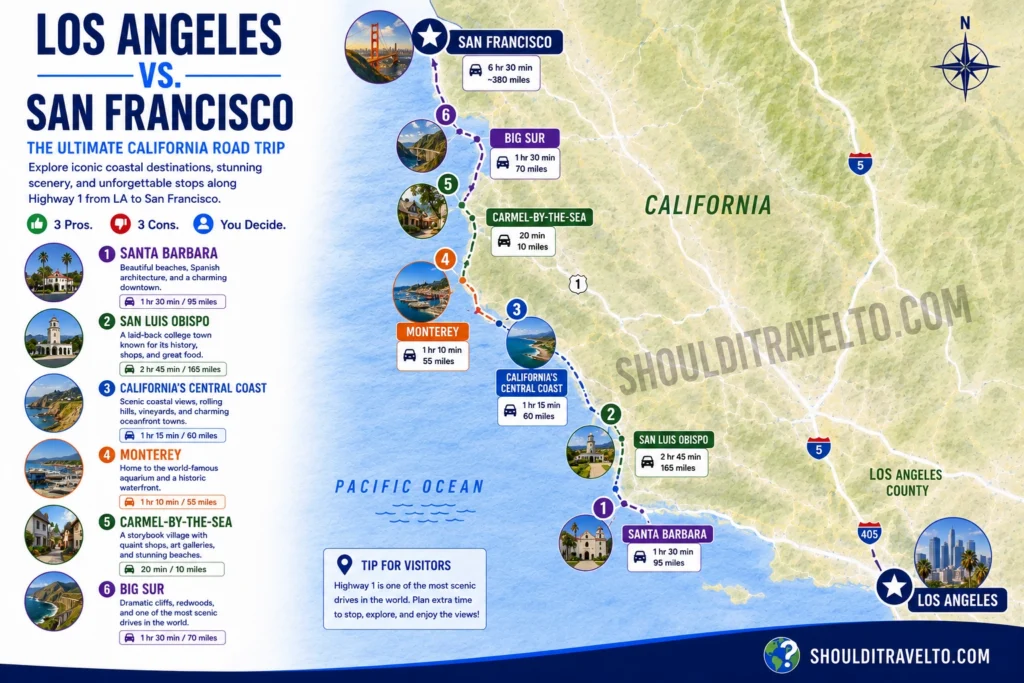
Yes, but don’t treat them as neighboring destinations. The journey between them can become part of the vacation, especially if you include California’s coast, or travelers can fly between the two metropolitan areas when time is limited.
Is California expensive to visit?
It can be, particularly in major cities, coastal communities, wine regions, resorts, and theme parks. Costs vary substantially by destination, season, accommodation style, and itinerary.