

Should I Travel To Palm Springs, California, the Golf Capital of the World?
Quick Answer
Yes, Palm Springs, California, is worth visiting if you want sunshine, desert scenery, resorts, pools, midcentury modern architecture, restaurants, and a vacation built around relaxation rather than nonstop sightseeing.
Palm Springs is especially appealing for couples, weekend getaways, architecture enthusiasts, outdoor travelers, and anyone looking for an easy Southern California escape that feels dramatically different from Los Angeles.
But Palm Springs isn’t for everyone.
Summer heat can be extreme. You’ll probably want a car if you plan to explore beyond downtown. And travelers looking for a huge collection of famous attractions may find the destination quieter than expected.
The biggest thing to understand is this: Palm Springs isn’t a vacation where you need to fill every hour.
Leaving part of the itinerary empty is part of the appeal.
Things First-Time Visitors Misunderstand About Palm Springs, California
Palm Springs is both a destination in its own right and a gateway to a much larger desert vacation region.
The city sits on the western side of the Coachella Valley, surrounded by the San Jacinto and Santa Rosa Mountains. Nearby communities include Palm Desert, Rancho Mirage, Indian Wells, La Quinta, Desert Hot Springs, and Coachella.
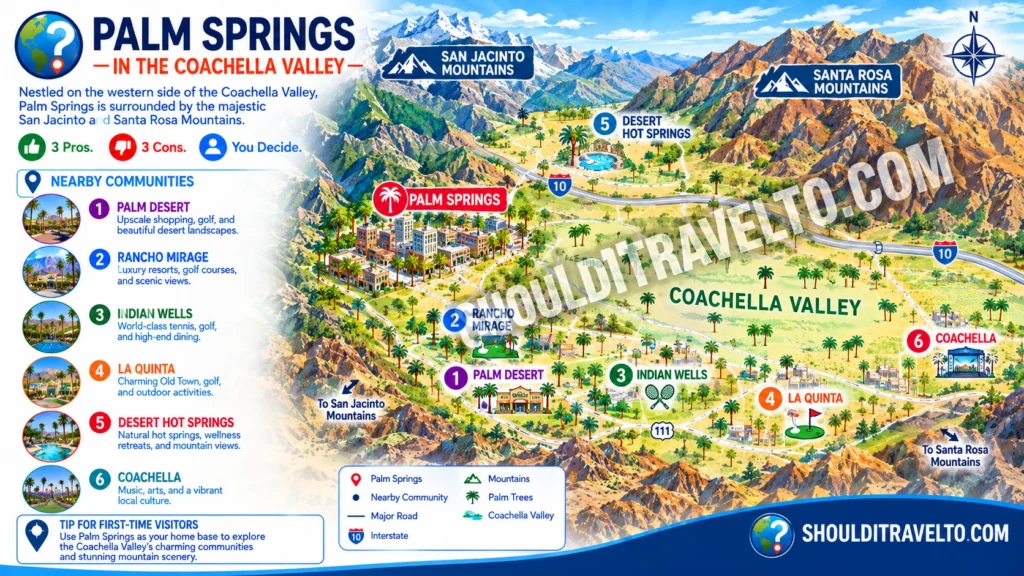
That means travelers sometimes use “Palm Springs” to describe a vacation that actually takes place throughout the broader valley.
There’s another misconception.
Palm Springs isn’t simply a collection of pools, golf courses, and resorts.
The area combines culture, desert landscapes, hiking, mountain recreation, modernist architecture, art, restaurants, shopping, and a long history as a Southern California retreat.
Understanding that makes Palm Springs a much more interesting destination.
The Biggest Mistake First-Time Visitors Make
The biggest mistake first-time visitors make in Palm Springs, California, is trying to turn it into a checklist vacation.
Yes, there are things you should see and do, such as:
- Ride the Palm Springs Aerial Tramway
- Explore the architecture
- Visit the Palm Springs Art Museum
- Walk downtown
- Explore Indian Canyons or Tahquitz Canyon
But Palm Springs works best when you leave room for the resort itself.
For example, you can have a long breakfast, spend two hours at the pool, go to a spa, sit outside for dinner, and take an architecture drive without worrying about how many stops you make.
Palm Springs isn’t Los Angeles in the desert.
The slower pace is part of the product.
What’s the Biggest Difference Between Palm Springs and Other California Destinations?
Palm Springs gives you something many California destinations don’t: A resort vacation surrounded by dramatic desert scenery.
Los Angeles is about variety.
San Diego combines beaches with attractions.
Big Sur is about the coast.
Big Bear is about the mountains.
Palm Springs is about desert, design, and relaxation.
That combination gives the destination its identity.
3 Pros and 3 Cons of Visiting Palm Springs
Palm Springs can be an excellent short getaway, but its strengths are unusually specific. Whether you’ll enjoy it depends heavily on what you want your vacation to feel like.
The 3 Biggest Pros
1. Palm Springs Is Excellent for Relaxation
Palm Springs is a destination where doing less, instead of having an ambitious itinerary, can make the vacation better.
It offers:
- Pools
- Resorts
- Spas
- Golf
- Restaurants
- Warm sunshine
- Mountain views
Palm Springs has attracted travelers seeking rest and escape for generations. It grew from early health tourism before Hollywood helped turn it into a fashionable desert retreat.
That history still makes sense today.
2. The Desert and Mountains Create a Remarkable Setting
Palm Springs doesn’t just give you desert.
It gives you dramatic elevation.
The Palm Springs Aerial Tramway climbs nearly 6,000 feet from the desert floor to the Mountain Station at 8,516 feet, carrying visitors into the alpine environment of Mount San Jacinto State Park. Indian Canyons and Tahquitz Canyon offer palm oases, trails, rock formations, and landscapes closely connected to the Agua Caliente Band of Cahuilla Indians.
That creates one of Palm Springs’ most interesting contrasts:
- Pool in the desert below
- Alpine wilderness above
You can experience both during the same trip.
3. Palm Springs Has an Identity You Won’t Confuse With Anywhere Else
Palm Springs isn’t generic. When you explore it, you’ll find:
- Midcentury modern homes
- Low-slung buildings
- Palm trees
- Mountains
- Pools.
- Desert colors
- Old Hollywood associations
- Modern resort culture
Some describe Palm Springs as a major center of midcentury modern design, shaped by architects including Richard Neutra, Albert Frey, E. Stewart Williams, and Donald Wexler.
The architecture isn’t simply another attraction. It’s part of what Palm Springs looks and feels like.
The 3 Biggest Cons
Those strengths come with some significant trade-offs.
1. The Weather Can Dictate the Entire Vacation
Palm Springs is a desert destination. That matters.
The warm, dry conditions that make it so attractive during cooler months can become intense during summer.
Your experience can therefore change dramatically depending on when you visit.
Every month is not interchangeable. Season matters here more than it does in many major cities.
2. You May Run Out of Traditional Sightseeing Faster Than Expected
Palm Springs has attractions. But it doesn’t have the enormous sightseeing portfolio of Los Angeles, San Diego, New York City, or Chicago.
That’s partly the point.
If you need a major museum, landmark, neighborhood, or attraction every few hours to feel like you’re getting value from a vacation, Palm Springs may feel limited.
If you’re happy spending half the afternoon at the pool? The same characteristic becomes an advantage.
3. A Car Makes the Larger Destination Much Easier
Central Palm Springs is pleasant to explore on foot, especially downtown.
But the broader vacation spans the Coachella Valley and surrounding desert, such as:
- Indian Canyons
- The tramway
- Palm Desert
- Rancho Mirage
- La Quinta
- Nearby desert attractions
Once you begin treating Palm Springs as a regional California destination rather than simply a downtown getaway, a car becomes much more useful.
The Should I Travel To … Palm Springs Scorecard
| Category | Palm Springs |
| Cost / Value | Expensive |
| Weather & Climate | Good |
| Crowds & Tourist Density | Moderate |
| Walkability & Transportation | Car Helpful |
| Things To Do | Good |
| Food & Dining | Very Good |
| Tourist Comfort & Safety | Generally Comfortable |
| Culture & Character | Highly Distinctive |
| Cleanliness & Infrastructure | Good |
| Uniqueness | Highly Distinctive |
Cost / Value: Expensive
Palm Springs can be expensive, especially for hotels, resorts, dining, golf, and popular weekends. The value depends heavily on how you use the destination: a resort-focused getaway can cost considerably more than a hiking-oriented desert trip.
Weather & Climate: Good
Palm Springs has excellent weather during the cooler months, with abundant sunshine and dry conditions, but extreme summer heat is a significant drawback. The destination’s weather is highly seasonal, so when you visit matters almost as much as where you stay.
Crowds & Tourist Density: Moderate
Palm Springs is popular without feeling like a major tourist city. Crowds can increase around major events, holidays, winter weekends, and peak travel periods, but the city generally doesn’t have the constant tourist density of destinations such as Disneyland or Los Angeles.
Walkability & Transportation: Car Helpful
Downtown Palm Springs is relatively easy to explore on foot, but the broader destination spans the Coachella Valley. A car makes it much easier to reach Indian Canyons, the Aerial Tramway, Palm Desert, surrounding communities, and other desert attractions.
Things To Do: Good
Palm Springs offers enough attractions for a satisfying short trip, including the Aerial Tramway, Indian Canyons, architecture, museums, hiking, golf, shopping, and downtown. It doesn’t have the enormous sightseeing inventory of a major city, but that’s part of its appeal.
Food & Dining: Very Good
Palm Springs has a strong restaurant scene ranging from casual restaurants and cafés to upscale dining. The surrounding Coachella Valley adds even more options, making food an important part of the destination rather than simply an amenity.
Tourist Comfort & Safety: Generally Comfortable
Palm Springs is an established resort destination with extensive tourism infrastructure, hotels, restaurants, and visitor services. Travelers should use normal precautions, particularly around vehicles and valuables, but most visitors will find the destination comfortable to navigate.
Culture & Character: Highly Distinctive
Palm Springs has a recognizable identity built around desert landscapes, midcentury modern architecture, resort culture, Indigenous history, Hollywood connections, and its long history as a Southern California retreat. Few California destinations combine those elements in quite the same way.
Cleanliness & Infrastructure: Good
Palm Springs has well-developed tourism infrastructure and a polished resort-oriented core. Conditions can vary across the larger Coachella Valley, but the primary visitor areas generally provide the services and infrastructure travelers expect from an established resort destination.
Uniqueness: Highly Distinctive
Palm Springs combines desert scenery, dramatic mountains, midcentury modern architecture, resort culture, pools, and easy access to outdoor recreation in a way that is difficult to replicate. The ability to go from a desert pool to an alpine environment on the Aerial Tramway is particularly unusual.
Palm Springs Has More History Than You Might Expect
Palm Springs is often associated with Hollywood celebrities and midcentury architecture.
But that’s only one part of its story.
From Desert Retreat to Hollywood Escape
As transportation improved, Palm Springs developed as a health and resort destination.
Then Hollywood changed its image.
Actors, entertainers, and other celebrities were attracted by the combination of privacy, sunshine, resorts, and relative proximity to Los Angeles.
Palm Springs increasingly became associated with a glamorous desert escape.
And that helped create another chapter of its identity.
Palm Springs Helped Define Desert Modernism
The architecture followed the lifestyle.
From the mid-20th century, architects experimented with buildings designed around the desert environment, including:
- Glass
- Clean lines
- Indoor-outdoor living
- Mountain views
- Pools
- Shade
Palm Springs became so closely associated with the movement that Visit California calls it America’s midcentury modern mecca.
Today, you don’t need to enter a museum to experience that history.
You can drive through it.
Planning Your Palm Springs Trip
Palm Springs is easy to over-plan, so choose a few experiences you don’t want to miss and leave enough time to enjoy the destination itself.
Best Things to Do in Palm Springs
Palm Springs works best when you combine a few major attractions with enough unscheduled time to enjoy the destination itself.
Ride the Palm Springs Aerial Tramway
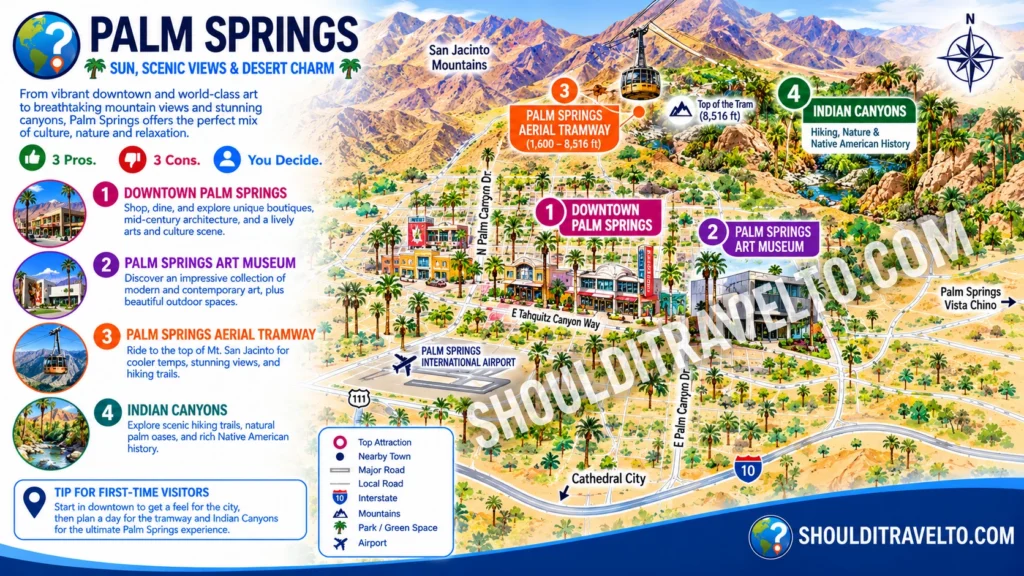
The rotating tram car climbs from the desert environment into Mount San Jacinto State Park, gaining nearly 6,000 feet in elevation and opening access to viewpoints, trails, and dramatically cooler mountain conditions.
The tramway illustrates what makes Palm Springs unusual: you can begin the day surrounded by desert heat and end it in a dramatically cooler mountain environment.
Explore Indian Canyons
Indian Canyons offers hiking through palm oases, streams, desert terrain, and landscapes connected to the Agua Caliente Band of Cahuilla Indians.
This isn’t simply a scenic side trip. It’s one of the places where Palm Springs’ natural and cultural histories come together.
Explore the Midcentury Modern Architecture
You don’t need to know anything about architecture before visiting.
That’s part of the fun.
Drive through Palm Springs, and you’ll encounter homes, commercial buildings, hotels, and civic architecture that helped make desert modernism one of the city’s defining characteristics.
Architecture tours can add context, but even a self-guided drive can completely change how you see the city.
Visit the Palm Springs Art Museum
The Palm Springs Art Museum adds an indoor cultural component and complements the city’s strong relationship with art, architecture, and design. Visit California highlights its modern and contemporary collections as a major cultural attraction.
Explore Downtown Palm Springs
Downtown gives you restaurants, shopping, galleries, public art, bars, and an easy place to spend part of an afternoon or evening.
This is also where Palm Springs feels most like a conventional small city rather than a sprawling resort region.
Do Absolutely Nothing
Seriously. Instead, you can enjoy:
- Pool
- Book
- Drink
- Spa
- Nap
- Long lunch
- Sunset
- Dinner
Not every hour needs an attraction.
Worth the Detour: Joshua Tree National Park
Palm Springs also works as a base for exploring more of the Southern California desert.
Joshua Tree National Park is the obvious extension.
Rather than turning a short Palm Springs weekend into an enormous desert road trip, add Joshua Tree if you have enough time to experience both destinations without rushing.
That gives you a particularly strong combination:
- Palm Springs = resort + architecture + relaxation
- Joshua Tree = desert wilderness + rock formations + hiking
Together, they create a much broader Southern California desert vacation.
Should You Combine Palm Springs and Los Angeles?
Yes, especially if you’re already traveling through Southern California.
Palm Springs sits roughly 110 miles southeast of Los Angeles, making the two destinations natural partners, although driving time can vary substantially with traffic.
And they complement each other unusually well.
Los Angeles gives you entertainment, museums, neighborhoods, beaches, restaurants, sports, and enormous variety.
Palm Springs gives you desert scenery, resorts, architecture, pools, and a slower pace.
Los Angeles gives you the city. Palm Springs gives you the escape.
If Palm Springs is part of a larger California trip, pair it with destinations that complement its identity rather than simply adding more stops. Los Angeles + Palm Springs gives you city + desert, while Palm Springs + Joshua Tree gives you resort + wilderness.
How Many Days Do You Need in Palm Springs?
Two to three days is enough for most first-time visitors. It lets visitors see major attractions, restaurants, shopping, and outdoor experiences.
| Stay | What it allows |
| 1 day | Tramway + downtown + architecture highlights |
| 2 days | Add Indian Canyons, museum, and pool/resort time |
| 3 days | Best balance for a first visit |
| 4–5 days | Add Joshua Tree, more hiking, golf, spa time, or broader Coachella Valley exploration |
The key is not filling the extra days simply because they’re available.
Palm Springs gets better when the itinerary gets slower.
Best Time to Visit Palm Springs
Palm Springs is a strongly seasonal destination.
The cooler months are generally the most comfortable time for outdoor sightseeing, hiking, architecture tours, golf, and spending time around the desert.
Summer is a very different proposition because of the extreme heat.
That doesn’t automatically make summer a bad trip. The resorts and pools can still be appealing, but it changes how you should structure your days.
For most first-time visitors who want to explore beyond the resort, I’d favor the cooler part of the year.
Who Should Visit Palm Springs?
Palm Springs makes the most sense for travelers who want:
- A relaxing long weekend
- Sunshine
- Pools and resorts
- Desert scenery
- Midcentury modern architecture
- Spas and wellness
- Golf
- Hiking
- Restaurants
- A couples getaway
- A Southern California escape
- A trip that doesn’t require constant sightseeing
It’s especially strong when you want the vacation to feel like a break, not a project.
Who Might Skip Palm Springs?
Palm Springs may be less appealing if you want:
- A huge collection of famous attractions
- A dense major-city experience
- A completely car-free regional vacation
- Beaches
- Mild outdoor temperatures during the hottest part of summer
- A vacation where every day is packed with sightseeing
In those cases, another California destination may fit you better.
Palm Springs vs. Los Angeles
The biggest difference between Palm Springs and Los Angeles is pace.
Choose Los Angeles for attractions, food, entertainment, museums, beaches, sports, neighborhoods, and variety.
Choose Palm Springs for resorts, pools, architecture, desert scenery, mountains, and relaxation.
Los Angeles asks: What should we do next?
Palm Springs asks: Do we need to do anything next?
Is Palm Springs Good for Thanksgiving?
Yes, especially if you want Thanksgiving to be a warm-weather, relaxing getaway rather than a traditional holiday trip.
The destination’s resorts, pools, spas, restaurants, golf, desert scenery, and cooler late-fall conditions make it possible to build a Thanksgiving weekend around slowing down.
That gives Palm Springs a very different role from Orlando.
Orlando turns Thanksgiving into a family vacation.
Palm Springs turns Thanksgiving into an escape.
The Decision Is Yours
Palm Springs is worth visiting if you want a Southern California vacation built around desert scenery, sunshine, resorts, architecture, and slowing down.
Its biggest strength isn’t an enormous collection of attractions.
It’s the combination.
The best Palm Springs itinerary may be the one with a little less itinerary.
3 Pros. 3 Cons. You Decide.
Palm Springs, California, Frequently Asked Questions
Is Palm Springs worth visiting?
Yes, if you enjoy desert scenery, resorts, pools, architecture, restaurants, outdoor activities, and a slower vacation pace. It is less compelling for travelers primarily interested in a large number of famous attractions.
How many days do you need in Palm Springs?
Two to three days works well for a first visit. Three days gives you enough time for the tramway, architecture, downtown, desert hiking, restaurants, and relaxation without rushing.
Do you need a car in Palm Springs?
Not necessarily if you’re staying centrally and planning a resort-focused getaway, but a car becomes much more useful if you want to visit the tramway, canyons, surrounding Coachella Valley communities, or nearby desert destinations.
What is Palm Springs famous for?
Palm Springs is particularly known for its desert resort culture, midcentury modern architecture, pools, golf, Hollywood history, mountain setting, and connections to the Agua Caliente Band of Cahuilla Indians.
Is Palm Springs close to Los Angeles?
Palm Springs is about 110 miles southeast of Los Angeles. Actual driving time varies considerably depending on traffic.
Is Palm Springs just for relaxing?
No. Hiking, architecture, museums, Indigenous cultural sites, the Aerial Tramway, golf, shopping, restaurants, and nearby desert landscapes can create an active itinerary. But relaxation is one of Palm Springs’ greatest strengths.