

Should You Visit Boston, the Birthplace of the American Revolution, or Chicago, the Birthplace of the Skyscraper?
Quick Answer
When deciding between Boston vs. Chicago, the biggest question is what kind of city vacation you want.
Choose Boston if you want American history, New England character, and a compact, highly walkable city. Choose Chicago if you want world-class architecture, Lake Michigan, and a larger-city experience
Boston feels smaller, older, more historic, and distinctly New England. Chicago feels larger, more architectural, more urban, and distinctly Midwestern.
Both are relatively easy to explore without a car. They can fill several days, and have excellent food, museums, sports, waterfronts, and neighborhoods.
The difference isn’t whether either city has enough to do. It’s what you want the city to be during your vacation.
Boston makes the city feel like part of American history.
Chicago makes the city itself the attraction.
Boston vs. Chicago at a Glance
| Category | Boston | Chicago |
| Cost / Value | Average Cost | Average Cost |
| Weather | Good | Good |
| Crowds & Tourist Density | Moderate | Moderate |
| Walkability & Transportation | Car-Free Paradise | Car-Free Paradise |
| Things To Do | Very Strong | Extensive |
| Food & Dining | Strong | Exceptional |
| Tourist Comfort & Safety | Comfortable | Comfortable |
| Culture & Character | Highly Distinctive | Distinctive |
| Cleanliness & Infrastructure | Good | Good |
| Uniqueness | Highly Unique | Distinctive |
| Ideal Trip Length | 3–5 days | 4–5 days |
Boston’s strongest characteristics are its history, walkability, New England identity, and proximity to the broader region, while Chicago’s strongest characteristics are architecture, food, value, and the breadth of the urban experience.
The Biggest Difference Between Boston and Chicago
The biggest difference is what gives each city its identity.
Boston’s identity comes from its history and its relationship with New England.
Boston played a central role in the events that led to and began the American Revolution. The Freedom Trail connects historic sites throughout the city. Harvard and MIT add an academic dimension. The waterfront and historic neighborhoods reinforce the city’s New England character.
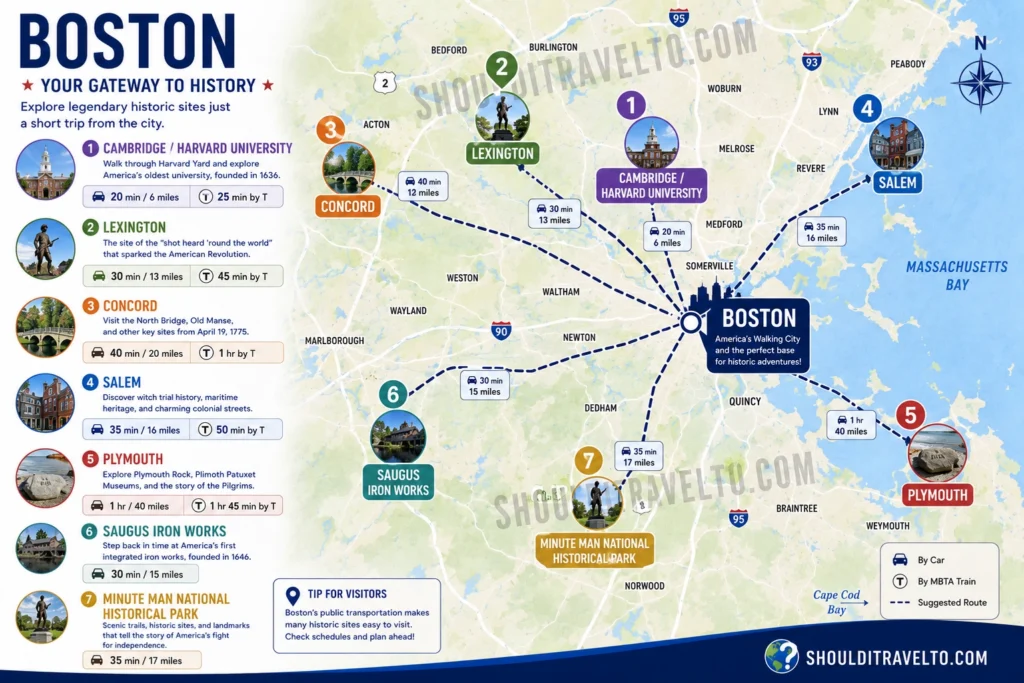
And Boston’s location makes the destination larger than the city itself.
You can use Boston as a base for:
- Cambridge
- Harvard
- MIT
- Salem
- Lexington
- Concord
- Plymouth
- Cape Cod
- Newport
That regional accessibility is one of Boston’s biggest advantages.
Chicago’s identity comes more from the city itself.
Chicago is the birthplace of the skyscraper and has one of America’s most recognizable architectural landscapes. Its lakefront, museums, neighborhoods, restaurants, sports culture, and skyline are all major parts of the experience.
Chicago’s biggest strength is that it feels like a true major American metropolis without New York City’s scale. Its city guide emphasizes architecture, food, museums, sports, transportation, and value as central parts of the experience.
So the simplest distinction is: Boston is a historic city that opens the door to New England. Chicago is a major city that rewards you for exploring it.
Boston and Chicago Similarities
Despite their different identities, Boston and Chicago share a surprising amount.
Both offer:
- Walkable neighborhoods
- Excellent public transportation
- Major museums
- Professional sports
- Strong food scenes
- Waterfront attractions
- Historic architecture
- Distinctive neighborhoods
- Major universities
- Excellent urban parks
- Four distinct seasons
- Car-free vacations
- Strong local identities
Neither city requires a rental car for most traditional tourist itineraries.
Boston’s compact historic core makes it particularly easy to explore on foot, while Chicago’s CTA system and walkable central neighborhoods make it one of America’s easier large cities to visit without a car.
The difference is what you’ll see as you walk.
In Boston, you might be following the Freedom Trail. In Chicago, you might be looking up at a skyscraper.
Three Pros of Traveling to Boston
Boston’s biggest advantages come from the combination of history, walkability, and access to New England. For travelers who want a city that feels distinctly American and distinctly regional, Boston has a lot to offer.
1. American History Is Everywhere
Boston is one of the best American cities for travelers who want history integrated directly into the urban environment.
The Freedom Trail connects 16 historic sites tied to the American Revolution, and the city also includes Paul Revere’s House, Old North Church, the Boston Massacre site, the Boston Tea Party sites, and other historic landmarks.
The important difference is that Boston doesn’t feel like an open-air historical museum.
People actually live and work among these places.
You can spend the morning walking Revolutionary-era streets and the afternoon eating in the North End or watching a baseball game.
That combination gives Boston its character.
Boston is particularly suited to you if:
- American history is a major reason you travel
- You enjoy historic architecture
- You want to walk between attractions
- You like smaller cities
- New England interests you
- You want to combine a city trip with regional day trips
2. Boston Is Easier to Absorb
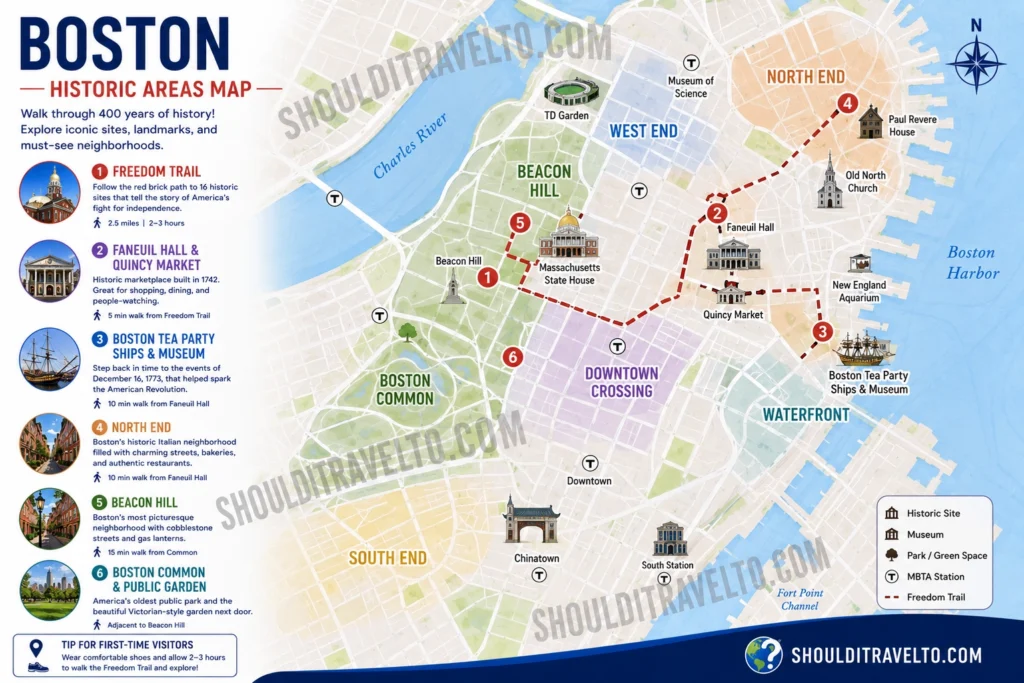
Boston is a major American city, but its core tourist experience is relatively compact.
Downtown Boston, Beacon Hill, Back Bay, the North End, the Waterfront, and nearby Cambridge connect by walking and public transportation.
That means a first-time visitor can see a lot without spending all their time crossing a massive metropolitan area.
Chicago is also very manageable by big-city standards.
But Chicago feels bigger.
Boston gives you more of a city you can get to know over several days.
Chicago gives you more of a city you can keep exploring.
3. Boston Gives You New England Beyond the City
This may be Boston’s most important advantage in this comparison.
Your Boston vacation doesn’t have to remain in Boston.
You can add:
- Salem
- Lexington
- Concord
- Plymouth
- Cape Cod
- Newport
- Cambridge
- Harvard
- MIT
That makes Boston particularly useful for travelers who want a combination of city + regional exploration.
A four- or five-day Boston trip can therefore become much more than a Boston-only vacation.
Three Cons of Visiting Boston
Boston’s compact size and historic character are major strengths, but they also create some trade-offs. Compared with Chicago, Boston offers a smaller attraction portfolio, can become expensive, and has a winter climate that can make outdoor sightseeing difficult.
1. Boston Has a Smaller Attraction Portfolio
Boston has plenty to do.
But Chicago’s scale gives it a broader selection of museums, neighborhoods, architecture, entertainment, and city experiences.
Boston’s own guide describes its attraction portfolio as smaller than those of destinations such as New York, Chicago, and Los Angeles.
That’s not necessarily a disadvantage.
It means Boston’s appeal comes more from quality, character, and history than from sheer quantity.
2. Boston Can Be Expensive
Boston falls into the Average Cost category on your framework, but that doesn’t mean it’s inexpensive.
Hotels can become particularly expensive during peak travel periods and major events.
Chicago also isn’t a cheap destination, but its larger hotel market and broad range of neighborhoods give travelers more options.
So neither city is a budget destination by default.
3. Boston Winters Can Be Tough
Boston’s winter isn’t necessarily a reason to avoid the city, but it is an important consideration when deciding when to visit. Cold, snow, ice, and wind can change the experience of a city that is particularly enjoyable on foot.
Winter can bring:
- Cold temperatures
- Snow
- Ice
- Wind
- Difficult walking conditions
For travelers who want to spend most of their vacation outdoors, Boston’s spring through fall seasons are generally easier.
Chicago has the same basic problem, although Chicago’s winter reputation can be even more extreme.
Three Pros of Traveling to Chicago
Chicago’s biggest strengths are its architecture, food, and the sheer depth of the urban experience. For travelers who want a major American city without New York City’s scale, Chicago offers a particularly compelling combination.
1. Architecture Is a Major Attraction
Boston has beautiful historic architecture.
Chicago made modern architecture a defining feature of the city.
Chicago is widely associated with the development of the skyscraper and offers an unusually broad architectural experience, from early skyscrapers and Art Deco buildings to Frank Lloyd Wright and modern architecture.
The Chicago River Architecture Cruise is one of the clearest ways to experience this.
And you don’t need to be an architecture enthusiast to appreciate it.
Chicago’s skyline is simply part of the vacation.
2. Chicago Has the Broader Food Experience
Boston has an excellent food scene, particularly for seafood, Italian food, historic taverns, and New England specialties.
Chicago takes the food experience considerably further.
You can build an entire trip around:
- Deep-dish pizza
- Italian beef
- Steakhouses
- International cuisine
- Neighborhood restaurants
- Fine dining
- Bakeries
- Breweries
- Casual food
- Food markets
Chicago’s individual city guide rates its food and dining Exceptional, compared with Boston’s Strong.
The difference isn’t that Boston has bad food.
It’s that Chicago’s food scene is a bigger part of the destination itself.
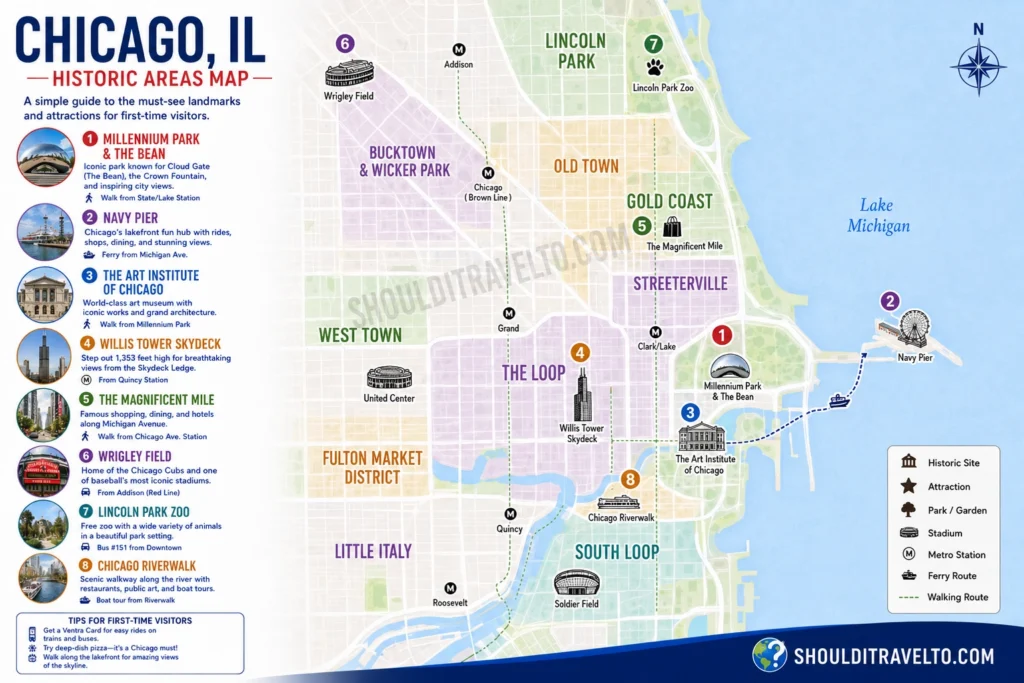
3. Chicago Gives You More Big-City Experience
Chicago provides many of the experiences people seek in New York City without quite the same scale or intensity.
You get:
- A major skyline
- World-class museums
- Professional sports
- Extensive public transportation
- Large neighborhoods
- Major restaurants
- Shopping
- Lakefront attractions
- Architecture
- Cultural institutions
The city guide specifically positions Chicago as offering a major-city experience while remaining relatively approachable and valuable.
That makes Chicago especially appealing for travelers who want a substantial urban vacation without the scale of New York City.
Three Cons of Visiting Chicago
Chicago’s scale is one of its greatest advantages, but it can also make the trip more demanding. Winter weather, a less immediately accessible historical story, and the city’s size are the biggest factors to consider.
1. Chicago Winters Can Be Brutal
Chicago winters are one of the biggest factors to consider.
Cold temperatures, snow, wind, and rapidly changing weather can make sightseeing considerably harder.
Lake Michigan shapes the city’s weather patterns, and the lakefront can make cold, windy conditions especially noticeable.
If you’re primarily interested in outdoor sightseeing, Chicago is much easier to enjoy from late spring through early fall.
2. Chicago’s Historic Story Is Less Central to the Tourist Experience
Chicago certainly has history.
But it isn’t the same type of history as Boston.
Boston lets you walk directly through the American Revolution.
Chicago’s history is more closely connected to:
- Architecture
- Industry
- Immigration
- Railroads
- Commerce
- Labor
- Urban development
- The growth of modern America
That history is fascinating, but it produces a different type of vacation.
If you want Paul Revere and the American Revolution, Boston is the obvious fit.
If you want to understand how the modern American city developed, Chicago offers a different story.
3. Chicago Is a Larger Experience
Chicago is approachable for a major city.
But it’s still a major city.
The number of neighborhoods, museums, attractions, restaurants, sports venues, and lakefront destinations means that you can spend significantly more time exploring without exhausting the city’s possibilities.
That’s a strength for some travelers.
For others, Boston’s smaller scale may make for a more relaxed vacation.
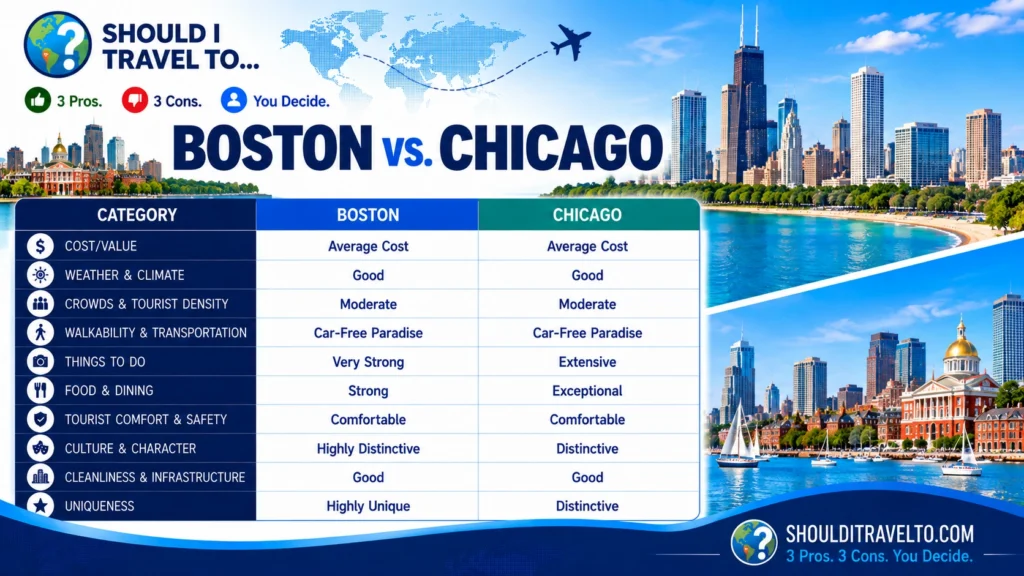
The Should I Travel To … Boston vs. Chicago Scorecard
Boston and Chicago both score well across the Should I Travel To framework, but they excel in different areas. The scorecard shows where each city has an advantage and why the choice ultimately depends on the kind of trip you want.
Cost & Value
Boston
Boston isn’t as expensive as New York City in every category, but hotels and other visitor expenses can become costly during peak periods.
Chicago
Chicago is also Average Cost, but value is one of the city’s defining strengths.
It offers a large-city experience, major museums, architecture, sports, restaurants, and public transportation without necessarily requiring the same budget as the largest global cities.
The difference
Boston: Pay for history, location, and New England access.
Chicago: Get a large-city experience with relatively strong value.
Weather
Boston
Boston’s strongest travel seasons are generally spring and fall, with September and October particularly attractive for comfortable walking weather.
Winter can be cold and snowy.
Chicago
Chicago’s strongest season is generally summer, when the lakefront, outdoor festivals, architecture cruises, parks, and neighborhoods are particularly enjoyable.
Winter can be extremely cold and windy.
The difference
Neither is a year-round warm-weather destination.
If you are choosing strictly around weather, the season you travel may matter more than the city you choose.
Crowds
Boston
Boston generally has moderate tourist density.
Popular historic attractions can get busy, especially in summer and fall, but the city usually doesn’t feel as continuously crowded as New York City.
Chicago
Chicago also falls into the moderate category.
Its major attractions can be busy, but the city’s size distributes visitors across a much larger area.
The difference
Both offer a relatively manageable major-city experience.
Boston can feel busier because its historic core is compact.
Chicago can spread visitors across a much larger urban area.
Walkability & Transportation
Boston
Boston is one of America’s easiest cities to explore on foot.
The historic core, Back Bay, Beacon Hill, the North End, the Waterfront, and other visitor areas connect by walking and public transportation.
Chicago
Chicago is also exceptionally easy to explore without a car.
The CTA connects major neighborhoods and attractions, while the Loop, River North, Millennium Park, the lakefront, and surrounding areas offer plenty of walking opportunities.
The difference
Boston: Walking is part of the attraction.
Chicago: Public transportation makes the larger city easy to reach.
Both work very well for travelers who don’t want to rent a car.
Things To Do
Boston
Boston’s attractions revolve around:
- American history
- Museums
- Universities
- Sports
- Historic neighborhoods
- Waterfront
- Nearby New England destinations
The city itself can comfortably fill three to five days, especially with nearby destinations.
Chicago
Chicago offers:
- Architecture
- Museums
- Sports
- Food
- Lakefront activities
- Neighborhoods
- Shopping
- River cruises
- Cultural institutions
- Parks
The city can comfortably support four to five days, with even longer trips possible for travelers who want to explore deeply.
The difference
Boston: More concentrated.
Chicago: More expansive.
Food & Dining
Boston
Boston’s food identity is strongly connected to:
- Seafood
- Lobster rolls
- Clam chowder
- Italian food
- Historic taverns
- New England cuisine
Chicago
Chicago offers:
- Deep-dish pizza
- Italian beef
- Steakhouses
- International cuisine
- Neighborhood restaurants
- Fine dining
- Breweries
- Contemporary food culture
The difference
Boston gives you New England food culture.
Chicago gives you a broader big-city food experience.
History & Culture
Boston
Boston’s history is deeply tied to the founding of the United States.
The city lets visitors walk through major events associated with the American Revolution.
Chicago
Chicago’s historical identity is tied more closely to the growth of modern America.
Its story includes immigration, industry, transportation, architecture, commerce, and urban development.
The difference
If you’re asking: Where did the American Revolution happen? Boston.
If you’re asking: Where can I experience the development of the modern American city? Chicago.
Sports
Both cities have serious sports cultures.
Boston’s sports identity includes:
- Baseball
- Basketball
- Football
- Hockey
Chicago offers:
- Baseball
- Basketball
- Football
- Hockey
The difference is less about whether either city is a sports destination and more about which teams and sporting traditions you’re personally interested in.
For sports fans, either city can feel very different depending on the season.
Waterfront Experience
Boston has the Atlantic Ocean and Boston Harbor. Chicago has Lake Michigan.
The difference is substantial.
Boston’s waterfront connects the city to its maritime and New England identity.
Chicago’s lakefront is integrated directly into the urban experience, with beaches, parks, trails, skyline views, and recreational areas.
The Chicago lakefront is one of the city’s defining visual characteristics.
Planning Your Boston vs. Chicago Trip
Boston and Chicago are both relatively easy cities to visit, but they reward different approaches. Your trip length, travel season, and priorities can determine which city makes more sense and how much time you should allow.
Ideal Trip Length
Both cities work well for a long weekend, but Chicago’s larger scale can reward a little more time. The right trip length also depends on whether you’re staying in the city or using Boston as a base to explore New England.
Boston: 3–5 Days
Three days can cover:
- Freedom Trail
- Historic Boston
- North End
- Waterfront
- Back Bay
- One major museum
Four or five days allow you to add:
Boston’s compact core is one reason it works particularly well as a long-weekend destination.
Chicago: 4–5 Days
Three days can cover the major highlights.
Four or five days allow you to explore:
- Architecture
- Museums
- Lakefront
- Neighborhoods
- Food
- Sports
- Downtown
- River North
- Additional attractions
Chicago rewards a little more time because its attractions are distributed across a much larger urban area.
Boston vs. Chicago: What Kind of Traveler Are You?
The easiest way to choose between Boston and Chicago is to think about what you want the destination to do for you. Boston favors travelers drawn to history, New England, and compact city exploration, while Chicago favors travelers looking for architecture, food, and a larger urban experience.
Boston may fit you better if you:
- Love American history
- Want to walk through historic neighborhoods
- Prefer a smaller city
- Want New England character
- Enjoy seafood
- Want to visit Harvard or MIT
- Want easy access to Salem, Plymouth, Lexington, or Concord
- Prefer a slower urban pace
- Want a three- to five-day city trip
Chicago may fit you better if you:
- Love architecture
- Love food
- Want major museums
- Enjoy professional sports
- Want a larger city
- Want an impressive skyline
- Enjoy neighborhoods
- Want a strong urban experience
- Want to explore without a car
- Want strong value from a major American city
Boston vs. Chicago for Families
Both cities can work well for families, but they offer different experiences.
Boston
Boston works particularly well for families interested in:
- American history
- Museums
- Walking
- Aquariums
- Historic sites
- Universities
- Sports
The compact layout can make a family itinerary relatively easy to manage.
Chicago
Chicago offers a broader selection of major attractions for families, including:
- Museums
- Lake Michigan beaches
- Parks
- Architecture cruises
- Zoos
- Sports
- Navy Pier
- Neighborhood restaurants
Therefore, Chicago can provide more variety for families staying four or five days.
Boston vs. Chicago for Couples
Both cities can make excellent couples’ getaways, but the atmosphere is different. Boston feels more intimate and historic. Chicago offers a more metropolitan experience built around architecture, food, neighborhoods, and the lakefront.
Boston
Boston works particularly well for couples who want:
- Historic neighborhoods
- Walkable streets
- Restaurants
- Waterfront scenery
- New England charm
- Fall travel
- A relatively compact city
Chicago
Chicago works well for couples who want:
- Architecture
- Food
- Rooftop experiences
- Museums
- Neighborhood exploration
- Lakefront walks
- Sports
- A larger-city atmosphere
Boston can feel more intimate.
Chicago can feel more metropolitan.
Boston vs. Chicago for a First Visit
A first visit to either city can provide a strong introduction to urban America, but the experiences are very different. Boston introduces you to America’s revolutionary past and New England character. Chicago showcases the architecture, energy, and scale of the modern American city.
Boston
Boston is particularly useful if your idea of an American city includes:
- Revolutionary history
- Historic architecture
- Walkability
- Universities
- New England
- Seafood
- Compact neighborhoods
Chicago
Chicago is particularly useful if your idea of an American city includes:
- Skyscrapers
- Architecture
- Museums
- Sports
- Food
- Public transportation
- Neighborhood diversity
- A major urban skyline
Neither is simply a “better first city.” They’re introductions to different versions of America.
Boston vs. Chicago: Which One Should You Choose?
There isn’t a universal winner because Boston and Chicago solve different travel problems. Choose based on whether your ideal trip is more about history and New England character or architecture, food, and the experience of a major American city.
Choose Boston if your priority is: History + Walkability + New England
Boston is particularly compelling if you want a city where historic sites are integrated into a compact, highly walkable urban environment.
It’s also a strong choice if the city is only the beginning of your trip and you want to explore the broader New England region.
Choose Chicago if your priority is: Architecture + Food + Big-City Experience
Chicago is particularly compelling if you want a substantial urban vacation built around architecture, museums, food, sports, neighborhoods, and the lakefront.
It’s also a strong choice if you want a major American city without New York City’s scale.
The Decision Is Yours
Boston and Chicago are both major American cities, but they offer very different vacations.
The city comparison shows that Boston is smaller, more compact, more historic, and more distinctly New England. Chicago is larger, more architectural, more expansive, and more distinctly Midwestern.
Chicago is larger, more architectural, more expansive, and more closely tied to the modern American metropolis.
Boston gives you:
- Revolutionary history
- New England character
- Walkable neighborhoods
- Seafood
- Harvard and MIT
- Easy access to the broader region
Chicago gives you:
- Architecture
- Exceptional food
- Major museums
- Professional sports
- Lake Michigan
- A larger urban experience
- Strong value
If your ideal vacation is walking through history and experiencing New England, Boston makes sense.
If your ideal vacation is exploring architecture, food, neighborhoods, and a major American city, Chicago makes sense.
And there’s an important reason I wouldn’t frame this as one city simply being “better.”
They’re answering different travel questions.
Boston asks you to step into America’s past.
Chicago asks you to experience the American city.
3 Pros. 3 Cons. You Decide.
Boston vs. Chicago Frequently Asked Questions
Is Boston or Chicago better for a first-time visitor?
It depends on the experience you want. Boston suits travelers interested in American history, walkability, and New England. Chicago suits travelers interested in architecture, food, museums, sports, and a larger urban experience.
Which is cheaper, Boston or Chicago?
Both fall into the Average Cost category in the Should I Travel To… framework. Boston can get expensive during peak travel periods, while Chicago offers strong value for a major American city.
Is Boston or Chicago more walkable?
Both are excellent choices for car-free travel. Boston’s compact historic core makes walking a major part of the experience, while Chicago’s extensive CTA system makes it easy to move around a much larger city without a car.
Which city has more things to do?
Chicago has the larger overall attraction portfolio, particularly for museums, architecture, neighborhoods, sports, and urban attractions. Boston has a more concentrated collection of attractions, but nearby destinations such as Salem, Lexington, Concord, and Plymouth significantly expand the potential itinerary.
Is Boston or Chicago better for history?
Boston is particularly strong for travelers interested in America’s founding and the American Revolution. Chicago offers a different type of history centered on architecture, immigration, industry, transportation, and urban development.
Is Boston or Chicago better for food?
Both have strong food cultures. Boston is particularly known for seafood, Italian food, and New England specialties. Chicago offers a broader large-city food scene, including deep-dish pizza, Italian beef, steakhouses, international cuisine, and fine dining. Chicago’s city guide rates its food scene Exceptional, while Boston’s is rated Strong.
Is Chicago or Boston better without a car?
Both work very well without a car. Boston’s compact core is particularly easy to walk, while Chicago’s CTA makes it practical to travel between many more neighborhoods and attractions.
Which city is better for architecture?
Chicago is particularly well suited to architecture enthusiasts. Its history as the birthplace of the skyscraper, combined with its early skyscrapers, Art Deco buildings, Frank Lloyd Wright sites, modern architecture, and architecture cruises, makes architecture central to the visitor experience.
Which city is better for a three-day trip?
Boston’s compact layout makes it particularly well suited to a three-day visit. Chicago can also work in three days, but four or five days gives you more time to experience its neighborhoods, museums, architecture, food, and lakefront.
Which city has better weather?
Neither city is consistently warm. Boston’s spring and fall can be excellent for walking, while Chicago’s summer is particularly attractive for lakefront activities and outdoor events. Both have challenging winters.
Can you visit both Boston and Chicago on the same trip?
Yes, although they’re far enough apart that they work better as separate city stops than as a casual side trip. If you’re planning a broader US itinerary, combining them can provide a useful contrast between New England and the Midwest.