

Should You Visit Asheville, NC, The Land of the Sky?
Quick Answer
Yes, Asheville, NC, is worth visiting, especially if you like historic architecture, food, art, mountain scenery, outdoor recreation, and distinctive smaller cities.
Asheville is one of those destinations where the city and its surroundings are difficult to separate.
Its most famous attraction is the Biltmore Estate, George Vanderbilt’s enormous Gilded Age country estate.
But Biltmore is only part of the experience.
Downtown Asheville offers historic architecture, restaurants, breweries, galleries, shops, music, and an unusually strong personality for a relatively small city.
Then there are the mountains.
Asheville sits in the Blue Ridge Mountains and provides direct access to the Blue Ridge Parkway, one of America’s great scenic roads. The 469-mile Parkway connects Shenandoah National Park in Virginia with Great Smoky Mountains National Park in North Carolina.
That gives Asheville an unusual combination:
- Historic estate
- Distinctive mountain city
- Blue Ridge scenery
You don’t have to choose between a city trip and a mountain trip.
Asheville can give you both.
Things First-Time Visitors Misunderstand About Asheville
Asheville is often described as a mountain town. That’s true.
But it can also undersell the destination.
Asheville Isn’t Just a Base for the Mountains
You could stay in Asheville simply because you want somewhere convenient for exploring western North Carolina.
But you’d be missing much of the point.
Downtown Asheville has restaurants, galleries, historic buildings, breweries, shops, live music, and cultural attractions that can fill much of a trip. The official tourism organization describes a walkable downtown with more than 30 art galleries alongside a substantial culinary and music scene.
The mountains strengthen Asheville. They don’t replace it.
Asheville Isn’t Just Biltmore
Biltmore dominates Asheville tourism.
George Vanderbilt’s estate encompasses approximately 8,000 acres today, with Biltmore House, gardens, grounds, dining, shopping, a winery, and other experiences.
You could spend most of a day there.
Biltmore may be Asheville’s most famous attraction, but it isn’t the destination’s entire identity.
Asheville also offers:
- Downtown architecture
- Thomas Wolfe
- Historic neighborhoods
- Arts and crafts
- The French Broad River
- The Blue Ridge Mountains
All of these help explain the destination.
Asheville Is More Than a Weekend Downtown
You can absolutely take a two-night Asheville city break.
But Asheville becomes considerably more interesting when you have enough time to leave downtown.
- Blue Ridge Parkway
- Hiking
- Waterfalls
- Mountain overlooks
- Nearby communities
Suddenly, what looked like a small-city weekend can become a four- or five-day western North Carolina vacation.
The Biggest Mistake First-Time Visitors Make
The biggest mistake is trying to decide whether Asheville is a city trip or a mountain trip.
It’s both.
If you spend the entire trip downtown, you’re missing the landscape. If you spend the entire trip driving through the mountains, you’re missing much of what makes Asheville itself distinctive.
Instead:
- Spend time downtown
- Visit Biltmore
- Eat well
- Explore the city’s history
- Get in the car and head toward the Blue Ridge Parkway.
The strongest itinerary doesn’t force you to choose between them.
City today. Mountains tomorrow.
What Makes Asheville Different?
Many American cities offer access to nature. Plenty of mountain towns have restaurants and shops.
Very few combine those things with an attraction on the scale of Biltmore.
That’s Asheville’s biggest difference.
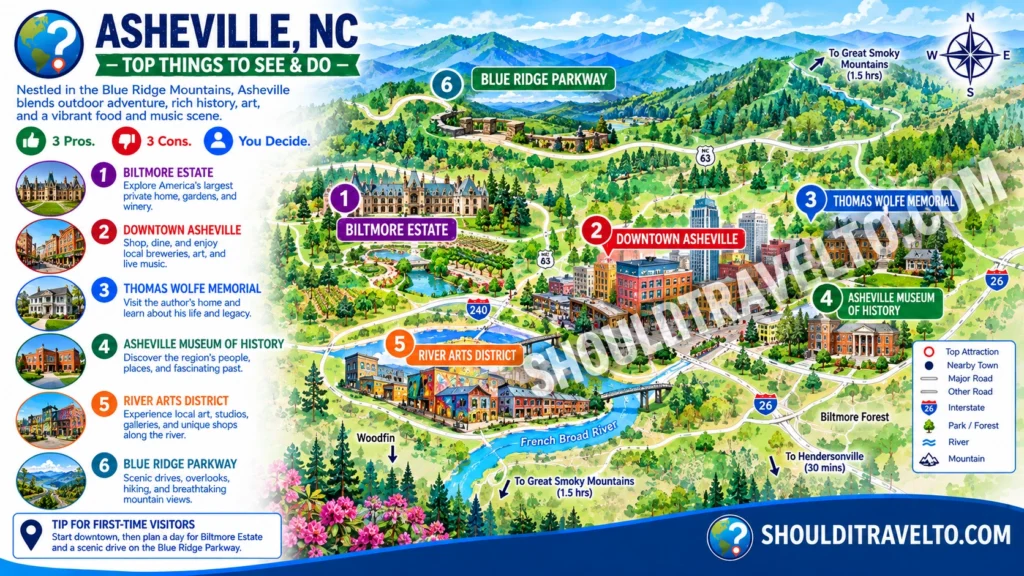
You can spend the morning inside a 19th-century Vanderbilt estate. Have lunch in the city. Explore downtown architecture in the afternoon.
Then spend the next day driving through the Blue Ridge Mountains.
You don’t need to travel far to make that transition.
Biltmore gives you the history.
Asheville gives you the culture.
The Blue Ridge gives you the scenery.
3 Pros of Visiting Asheville, North Carolina
Asheville’s appeal comes from the mix of experiences it packs into a single trip. These three strengths explain why Asheville can work as more than a mountain getaway.
1. Biltmore Is One of America’s Great Historic Estates
Biltmore is reason enough for many travelers to put Asheville on their list.
George Washington Vanderbilt began creating his western North Carolina estate in the late 19th century, working with architect Richard Morris Hunt and landscape architect Frederick Law Olmsted.
Biltmore House opened to family and friends in 1895. And it wasn’t intended to be modest.
The 250-room French Renaissance-inspired château became the centerpiece of an enormous country estate.
Today, visiting Biltmore isn’t simply about walking through a giant house.
The experience can include:
- Biltmore House
- Historic rooms
- Gardens
- Landscaped grounds
- Views of the Blue Ridge Mountains
- Antler Hill Village
- Winery
- Restaurants
And miles of estate property.
Biltmore opens the door to the Gilded Age, American architecture, landscape design, wealth, labor, agriculture, forestry, tourism, and the transformation of western North Carolina.
2. Asheville Gives You Exceptional Access to the Blue Ridge Mountains
Asheville’s second major advantage is its access to the Blue Ridge Mountains.
The Blue Ridge Parkway runs directly through the Asheville area.
The National Park Service designed the Parkway around slow travel, generally at 45 mph or less, with overlooks, trails, mountain landscapes, and cultural sites along the route.
Near Asheville, you can reach places such as:
- Folk Art Center
- Craggy Gardens
- Blue Ridge Parkway Visitor Center
- North Carolina Arboretum
And, depending on current road conditions and how far you’re willing to drive, Mount Mitchell and additional mountain destinations.
That’s especially important in fall.
As foliage changes across different elevations, Asheville becomes a natural base for exploring the Blue Ridge.
But don’t think of the Parkway as only a fall attraction.
Spring brings wildflowers.
Summer brings hiking and long daylight hours.
Fall brings foliage.
And the mountain landscape remains one of Asheville’s defining features year-round.
Asheville doesn’t just have mountain views. It gives you access to the mountains themselves.
3. Asheville Has a Strong Personality of Its Own
Take away Biltmore. Take away the Parkway.
Would Asheville still be worth exploring?
For many travelers, yes.
That’s important.
Asheville has developed a reputation around:
- Food
- Craft beer
- Art
- Music
- Historic architecture
- Independent businesses
- Local shops
And an eclectic downtown culture.
But the character isn’t entirely modern.
Historic buildings remain a major part of downtown’s appearance.
Older neighborhoods add architectural variety.
And Asheville’s mountain setting means you rarely feel completely disconnected from the surrounding landscape.
It’s difficult to confuse downtown Asheville with downtown Orlando.
Or Minneapolis.
Or Philadelphia.
Asheville has a sense of place.
For a smaller city, that’s a significant advantage.
3 Downsides of Visiting Asheville
Asheville’s combination of city, mountains, and major attractions is unusual, but it also creates some trade-offs. The same geography and scale that make the destination distinctive can make certain parts of the trip less convenient.
1. A Car Makes Asheville Much Easier
You can walk around downtown Asheville. But the complete Asheville vacation is much harder without a car.
Biltmore is separate from downtown.
The Blue Ridge Parkway requires transportation.
Trailheads and waterfalls are spread throughout the surrounding region.
Nearby mountain towns require driving.
And some of Asheville’s greatest advantages involve leaving the compact downtown core.
That doesn’t mean you’ll spend the entire vacation driving. It means a car dramatically expands what Asheville can offer.
Downtown Asheville can be a walking trip. The Asheville region is a driving trip.
2. Asheville Has Fewer Major Attractions Than Larger Cities
Asheville has plenty to do.
But there’s a difference between having things to do and having a long list of nationally famous attractions.
Biltmore is the obvious exception.
Asheville isn’t New York City, Chicago, Washington, DC, or Philadelphia.
But Asheville works extremely well for travelers who enjoy atmosphere, food, outdoor experiences, architecture, and exploration. But if your ideal vacation means moving from one world-famous attraction to another, a larger city may give you more of what you’re looking for.
3. The Best Seasons Can Also Be the Busiest
Some of Asheville’s strongest reasons to visit are tied to particular times of year: fall foliage, Christmas at Biltmore, and summer mountain recreation. That can make the destination especially busy when one of those experiences peaks.
So if your trip depends on a particular seasonal experience, plan earlier than you might for an ordinary Asheville weekend.
The Should I Travel To … Asheville Scorecard
| Category | Asheville |
| Cost / Value | Average |
| Weather & Climate | Good |
| Crowds & Tourist Density | Moderate |
| Walkability & Transportation | Car Helpful |
| Things To Do | Strong |
| Food & Dining | Excellent |
| Tourist Comfort & Safety | Generally Comfortable |
| Culture & Character | Highly Distinctive |
| Cleanliness & Infrastructure | Good |
| Uniqueness | Highly Distinctive |
Asheville scores particularly well for Food & Dining, Culture & Character, and Uniqueness. The combination of a distinctive mountain city, Biltmore Estate, Blue Ridge scenery, strong food scene, arts, and historic architecture gives Asheville an identity that’s difficult to replicate elsewhere.
Things To Do: Strong
Asheville offers plenty to fill a trip, though its attractions differ from those of a major city. Much of the experience comes from exploring rather than checking off a long list of famous attractions.
Cost / Value: Average
Asheville isn’t among America’s most expensive destinations, but during popular periods, Biltmore admission, accommodations, and exploring the surrounding mountains can add up.
Weather & Climate: Good
With four distinct seasons and generally comfortable conditions for exploring the city and mountains. Fall is particularly appealing for foliage, while summer offers good conditions for outdoor recreation.
Crowds & Tourist Density: Moderate
The crowd levels in Asheville can change significantly during fall foliage, Christmas at Biltmore, and other popular periods.
Walkability & Transportation: Car Helpful
Downtown Asheville is quite walkable, but Biltmore, the Blue Ridge Parkway, hiking areas, waterfalls, and surrounding communities are much easier to reach by car.
Tourist Comfort & Safety: Generally Comfortable
Asheville is an established tourist destination with strong visitor infrastructure, though normal urban and outdoor travel precautions still apply.
Finally, Cleanliness & Infrastructure: Good
Asheville has a well-developed tourism infrastructure, but the experience becomes more dependent on roads and driving once you leave the downtown core.
Overall, Asheville’s scorecard reflects a destination that isn’t trying to compete with America’s largest cities. Its strength is combining city, history, food, and mountains in one trip.
Asheville’s History
Asheville’s history helps explain why the city looks and feels the way it does today. The railroad, Biltmore, tourism, architecture, literature, and the surrounding mountains all shaped the Asheville visitor experience today.
Asheville’s modern reputation revolves around mountains, food, art, breweries, and Biltmore.
But the historical story is considerably deeper.
A Mountain Crossroads Becomes Asheville
European-American settlement increased in western North Carolina during the late 18th century.
Buncombe County was created in 1792, and Asheville developed as its county seat.
Its mountain location initially made access difficult. But its geography also made the settlement an important regional center for trade and transportation.
For much of its early history, Asheville was relatively isolated from the larger urban centers of the East.
Then transportation changed everything.
The Railroad Changes Asheville
The arrival of railroad service in 1880 was a pivotal moment in Asheville’s history.
The mountains no longer isolated the community.
People could arrive more easily. Goods could move more efficiently. Tourism expanded.
And wealthy visitors increasingly discovered western North Carolina as a mountain retreat.
George Vanderbilt and Biltmore
George Washington Vanderbilt first visited Asheville in the late 1880s.
He eventually began acquiring land for an enormous country estate.
The project brought together two giants of American design. Architect Richard Morris Hunt designed Biltmore House.
Landscape architect Frederick Law Olmsted, best known as one of the designers of New York’s Central Park, shaped the landscape.
The house was completed in 1895.
But Biltmore’s influence didn’t stop at the estate gates.
The Vanderbilt presence influenced architecture, employment, forestry, agriculture, tourism, and development in the surrounding Asheville region.
Nearby Biltmore Village developed in connection with the estate.
Asheville’s Boom, and the Architecture It Left Behind
Asheville continued growing during the early 20th century.
- Tourism expanded
- Hotels appeared
- Businesses grew
And ambitious construction reshaped downtown.
That period left Asheville with an unusually interesting collection of historic commercial architecture, including prominent Art Deco buildings.
Then came the Great Depression. Asheville suffered severe financial consequences and spent decades dealing with its municipal debt.
Thomas Wolfe and Literary Asheville
Asheville also contributed to American literature.
Writer Thomas Wolfe was born here in 1900.
His mother’s boardinghouse inspired “Dixieland” in his autobiographical novel Look Homeward, Angel.
Today, the Thomas Wolfe Memorial preserves the historic boardinghouse and helps connect visitors with Wolfe’s life, family, and complicated relationship with his hometown.
For travelers interested in literature, it adds another historical layer beyond Vanderbilt and architecture.
Planning Your Asheville, NC, Trip
The best Asheville itinerary isn’t simply a checklist of attractions. Because the destination combines downtown, Biltmore, and the surrounding mountains, planning around those three elements can help you get much more out of the trip.
Best Things to Do in Asheville
For a first visit, focus on the experiences that best show what makes Asheville different from other mountain destinations. Start with Biltmore, downtown Asheville, and the Blue Ridge Parkway, then add attractions based on your interests and available time.
Biltmore Estate
If you’ve never been to Asheville, start here.
Biltmore is the city’s signature attraction and deserves enough time to experience properly.
- Tour the house
- Explore the gardens
- Walk the grounds
- Learn about the Vanderbilt family
- Take in the mountain setting
Biltmore wouldn’t be Biltmore without the Blue Ridge landscape surrounding it.
The estate offers the historic house, gardens, winery, Antler Hill Village, dining, and other activities across its roughly 8,000 acres.
Downtown Asheville
Give downtown time rather than treating it as somewhere to eat dinner after Biltmore.
Walk around, look at the architecture, explore shops, visit galleries, stop for food, listen for live music, and let the city itself become part of the itinerary.
Blue Ridge Parkway
The Blue Ridge Parkway is one of Asheville’s strongest tourism advantages.
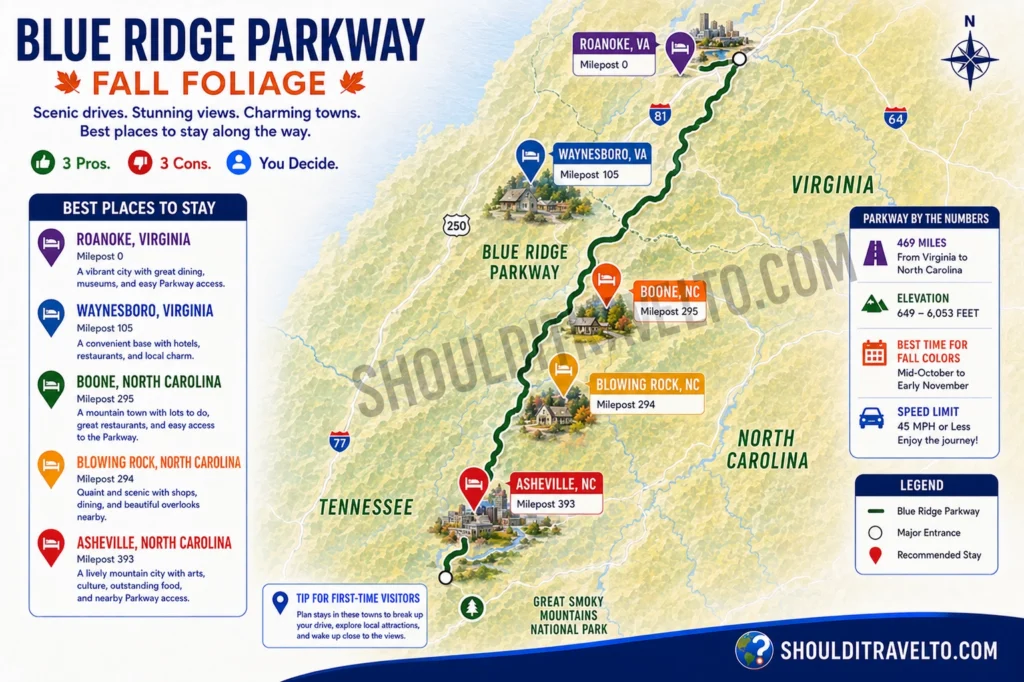
You don’t need to drive hundreds of miles.
Even a relatively short section can provide:
- Mountain overlooks
- Hiking
- Forests
- Scenic drives
- Picnic areas
- Access to additional attractions
The Parkway was conceived during the Great Depression and ultimately became both a scenic road and an elongated national park protecting landscapes and cultural resources through Virginia and North Carolina.
Asheville is particularly well positioned to access it, with four primary entrances around the city.
Folk Art Center
Located directly on the Blue Ridge Parkway, the Folk Art Center showcases work associated with the Southern Highland Craft Guild.
It can easily become part of a Parkway drive rather than requiring a separate excursion.
Thomas Wolfe Memorial
History and literature travelers should consider the Thomas Wolfe Memorial.
It adds something Biltmore can’t: Asheville’s story through a writer who actually grew up in the city.
And because it’s downtown, it integrates easily into a city sightseeing day.
Asheville Museum of History
The museum operates from the historic Smith-McDowell House and interprets Asheville and western North Carolina history.
River Arts District
For Asheville’s contemporary creative side, spend some time in the River Arts District.
Studios, galleries, working artists, and the French Broad River create an experience very different from Biltmore or downtown.
It helps connect Asheville’s historical artistic reputation with the creative city visitors experience today.
Explore Asheville’s Food Scene
Make food part of the itinerary, not something you squeeze between attractions.
Asheville’s restaurant scene is disproportionately strong for the city’s size, incorporating Southern and Appalachian influences alongside a wide range of other cuisines. Its official tourism organization still emphasizes food as one of Asheville’s defining visitor experiences.
And yes, Asheville’s breweries remain part of its modern tourism identity.
But you don’t have to drink beer to make food and drink a major part of the trip.
Don’t Miss
If you’re short on time, don’t try to see everything. These three experiences provide the clearest introduction to what makes Asheville different.
For a first Asheville trip, prioritize:
- Biltmore Estate
- Downtown Asheville
- Blue Ridge Parkway
Those three experiences explain the destination better than any long attraction checklist.
If you have more time, add:
- Folk Art Center
- Thomas Wolfe Memorial
- River Arts District
- Asheville Museum of History
And additional mountain exploration.
Have One More Day?
Once you’ve experienced Biltmore and downtown Asheville, the best use of an extra day is to leave the city and explore the surrounding landscape.
Drive the Blue Ridge Parkway
If you’ve spent one day at Biltmore and one day exploring Asheville, head into the mountains the next one.
Asheville has four primary Parkway access points, including an entrance on U.S. 25 only about three miles south of Biltmore.
You can tailor the drive to your available time.
Want a short outing? Drive to overlooks and the Folk Art Center.
Have half a day? Add hiking.
Have an entire day? Explore farther into the Blue Ridge.
The Parkway is deliberately designed for slower travel, with a maximum speed of generally 45 mph and frequent opportunities to stop.
That’s important.
Don’t treat the Blue Ridge Parkway as the road to the attraction. The road is the attraction.
And in fall? It becomes one of America’s great foliage trips.
Best Time to Visit Asheville
No single season works for every Asheville traveler. The Spring, summer, fall, and Christmas seasons each emphasize a different side of the destination.
Spring: Excellent
Spring brings warming temperatures, flowers, gardens, and increasingly comfortable mountain exploration.
It’s a great time to pair Biltmore’s gardens with the Blue Ridge Parkway.
Summer: Very Good
Summer works well for hiking, waterfalls, mountain drives, outdoor dining, and escaping some of the heat found at lower elevations.
It’s also one of the easiest seasons for exploring the surrounding region.
Fall: Excellent
Fall is arguably Asheville’s signature outdoor season due to the fall foliage.
The city’s elevation combined with surrounding mountains at different elevations can create an extended foliage experience across western North Carolina.
Christmas Season
Excellent for a completely different reason: Christmas at Biltmore.
The estate has a genuine historical Christmas connection: George Vanderbilt welcomed family and friends to the newly completed Biltmore House on Christmas Eve 1895.
Today, Biltmore transforms for the holiday season with decorated trees, lights, ornaments, fireplaces, and special evening experiences.
That gives Asheville one of the most distinctive Christmas experiences among your developing seasonal destinations.
How Many Days Do You Need in Asheville?
The ideal length of an Asheville trip depends largely on whether you’re staying downtown or using the city as a base for exploring the mountains. For most first-time visitors, three days provide enough time to experience all three sides of the destination.
1 Day: Choose one.
Biltmore or Asheville + a short mountain experience.
2 Days: A good weekend
Day 1: Biltmore Estate.
Day 2: Downtown Asheville + food + arts/history.
3 Days: Best first trip.
For most first-time visitors, three days is the sweet spot: one day for Biltmore, one for Asheville itself, and one for the mountains.
Day 1: Biltmore House, gardens, estate.
Next, Day 2: Asheville Downtown, history, food, River Arts District.
Day 3: Blue Ridge Parkway. Scenic drive, overlooks, Folk Art Center, hiking or another mountain experience.
4–5 Days: Regional vacation
Add:
Longer Parkway exploration
- Waterfalls
- Additional hiking
- Nearby mountain towns
- Great Smoky Mountains region
Or simply slow the trip down.
The simplest summary:
Two days gives you Asheville and Biltmore.
Three days gives you Asheville, Biltmore, and the Blue Ridge.
Getting Around Asheville
Getting around Asheville is relatively simple if you’re staying downtown, but the logistics change once you start exploring the region. The farther you venture into the mountains, the more useful a car becomes.
You can walk much of downtown Asheville.
But for the complete trip? A car is extremely helpful.
Biltmore is separate from downtown.
The Parkway is a driving experience.
Trailheads, waterfalls, and surrounding communities are spread across western North Carolina.
That makes Asheville very different from Boston or Washington, DC.
You don’t necessarily need the car every hour.
But having one dramatically increases your options.
Who Should Visit Asheville, NC?
Asheville is not trying to be a smaller version of a major American city. It appeals most to travelers who enjoy combining culture, history, food, and outdoor exploration rather than concentrating on one type of attraction.
Best for:
- Couples
- History travelers
- Food travelers
- Fall foliage travelers
- Road trippers
- Outdoor travelers
- Art lovers
- Architecture enthusiasts
- Christmas travelers
- Gilded Age history enthusiasts
- Travelers who like smaller cities with distinctive personalities
- Travelers who don’t want to choose between a city and the mountains
Asheville may be less compelling if your ideal vacation revolves around:
- Major-city museums
- Huge collections of famous attractions
- Beaches
- Nightlife on the scale of Miami or New Orleans
- A completely car-free vacation
- A resort where you never need to plan anything beyond the property
Asheville rewards exploration.
If you want every attraction packaged together, another destination may be a better fit.
Final Assessment
Asheville isn’t a destination you visit for one reason.
Travelers can discover the city, explore the Biltmore, and experience the mountains.
The history adds another dimension. At the same time, Asheville has developed a modern identity around many of the things travelers associate with the city today, including food, art, music, and outdoor recreation.
So, should you travel to Asheville?
Yes, especially if you want a smaller-city vacation where history, food, culture, and mountain scenery all fit into the same trip.
3 Pros. 3 Cons. You Decide.
Frequently Asked Questions
Is Asheville, North Carolina worth visiting?
Yes. Asheville is particularly worthwhile for travelers interested in Biltmore Estate, food, art, historic architecture, Blue Ridge Mountain scenery, outdoor recreation, and distinctive smaller cities.
What is Asheville best known for?
Asheville is best known for Biltmore Estate, its Blue Ridge Mountain setting, food and craft beer scene, arts culture, historic downtown, and access to the Blue Ridge Parkway.
How many days do you need in Asheville?
Three days is ideal for a first trip to Asheville, NC.
Spend one day at Biltmore, one exploring Asheville, and one on the Blue Ridge Parkway.
Is Biltmore worth visiting?
For most first-time Asheville visitors, yes.
Biltmore isn’t simply a mansion tour. The roughly 8,000-acre estate includes the historic house, gardens, grounds, winery, dining, and other experiences.
Can you visit Asheville without going to Biltmore?
Absolutely, but first-time travelers should consider seeing it.
Downtown, restaurants, arts, music, historic architecture, the River Arts District, and access to the Blue Ridge Mountains can support a trip without Biltmore.
Is Asheville a good base for the Blue Ridge Parkway?
Yes, Asheville is a good base for the Blue Ridge Parkway.
Four primary Parkway entrances are around Asheville, and the Blue Ridge Parkway Visitor Center is also nearby.
Is Asheville good for fall foliage?
Yes, Asheville, NC, is good for fall foliage.
Asheville’s location in the Blue Ridge Mountains makes it an excellent base for a fall trip, particularly when combined with the Blue Ridge Parkway.
However, foliage timing changes each year and varies by elevation.
Is Asheville worth visiting at Christmas?
Yes, especially if you want to experience Christmas at Biltmore.
The combination of Biltmore’s Gilded Age history, elaborate holiday presentation, downtown Asheville, restaurants, and Blue Ridge setting gives Asheville a Christmas identity very different from NYC, Williamsburg, Orlando, or other major Christmas destinations.
Do you need a car in Asheville?
Not necessarily for downtown alone.
But a car is highly recommended if you plan to visit Biltmore, drive the Blue Ridge Parkway, hike, see waterfalls, or explore the surrounding mountains.
Can you combine Asheville and Great Smoky Mountains National Park?
Yes, but treat this as a longer regional vacation rather than trying to squeeze both into a two-day Asheville weekend.
The Blue Ridge Parkway itself ultimately connects the Shenandoah region with Great Smoky Mountains National Park, with Asheville positioned along the North Carolina portion of the route.