
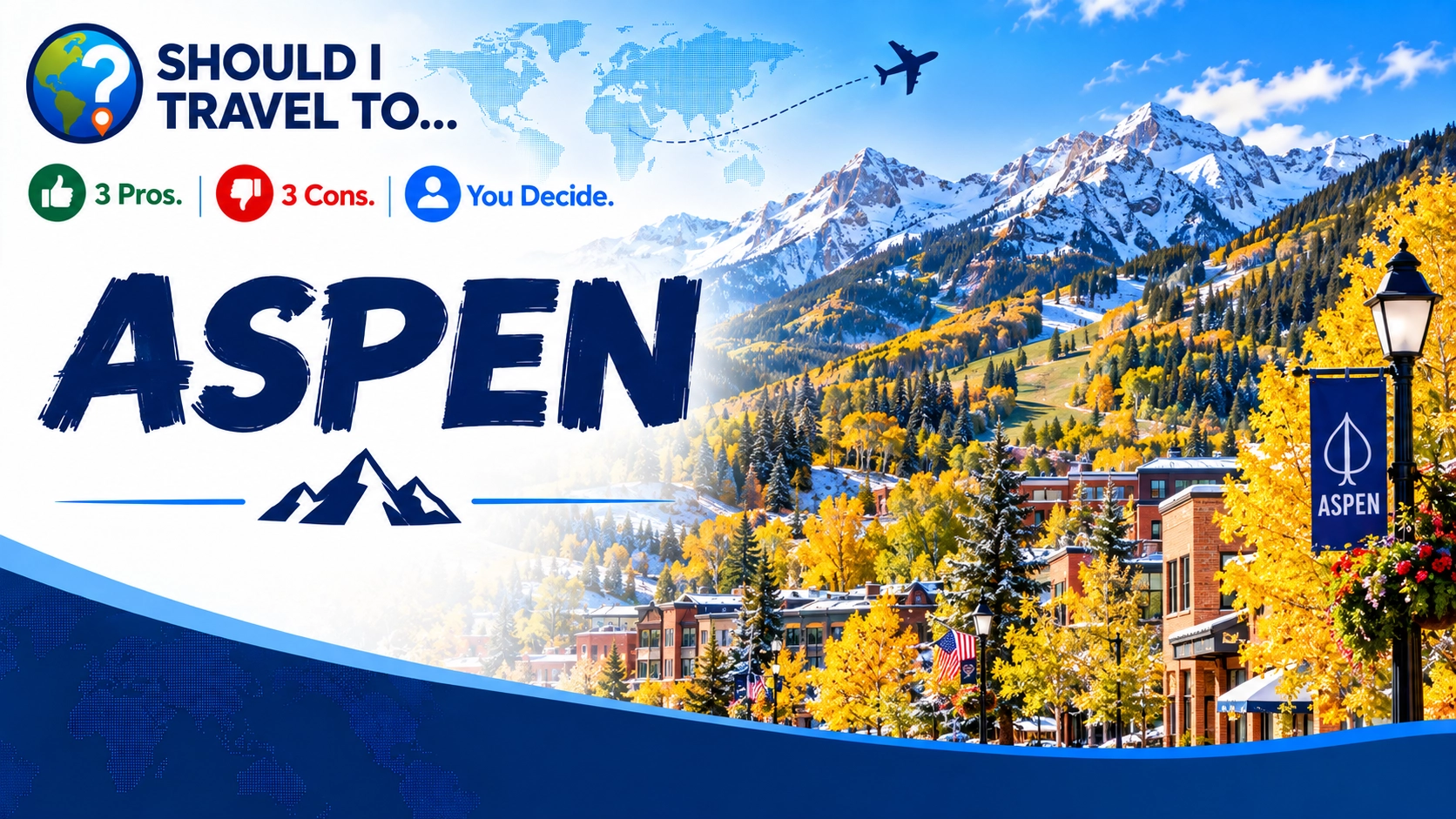
Should You Visit Aspen, Colorado, America’s Luxury Mountain Town?
Quick Answer
Yes, Aspen, Colorado, is worth visiting if you enjoy skiing, dramatic mountain scenery, excellent food, arts and culture, outdoor recreation, and a destination where luxury is part of the experience.
Aspen is best known as one of America’s premier ski destinations.
But skiing is only part of the story.
The town combines four things that don’t often exist together:
- World-class mountain recreation
- A historic Western town
- High-end dining, shopping, and accommodations
- An unusually strong arts and culture scene
That combination is what makes Aspen different from a typical ski resort.
In winter, Aspen becomes a snowy mountain destination built around skiing, snowboarding, après-ski, restaurants, shopping, and holiday experiences.
Christmas adds another layer, with snow-covered mountains, decorated streets, seasonal events, and an alpine-village atmosphere.
But Aspen isn’t only a winter destination.
Spring brings quieter mountain days and spring skiing.
Summer transforms the region into a hiking, biking, rafting, fishing, and arts destination.
And fall brings golden aspen groves, crisp weather, and a quieter mountain experience before winter returns.
The simplest way to think about Aspen? Come for the mountains. Stay for everything else.
The Biggest Mistake First-Time Aspen Visitors Make
The biggest mistake is assuming Aspen is simply a ski resort.
Skiing is obviously one of Aspen’s defining attractions.
But the town has become much more than that.
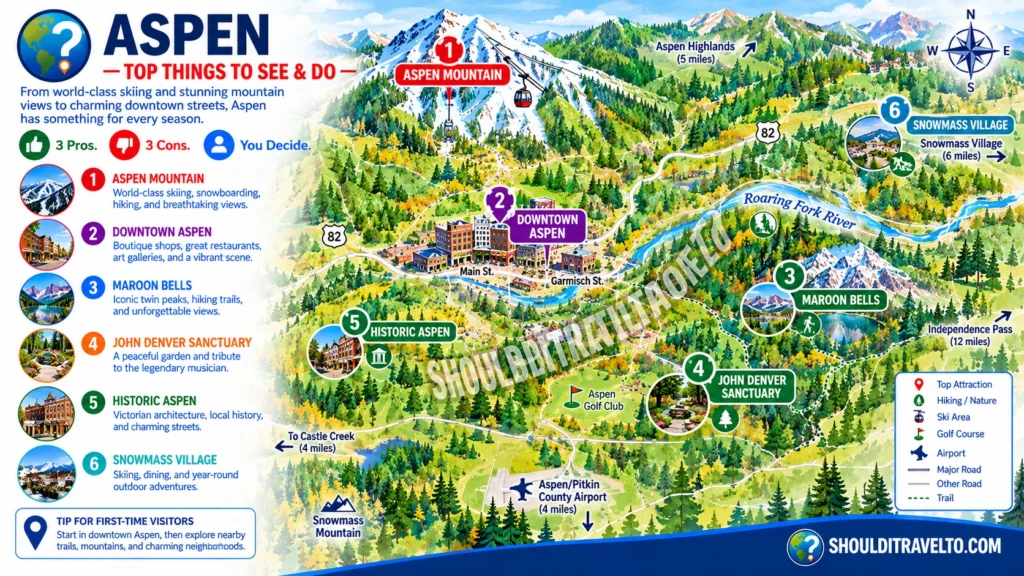
A first-time visitor can spend the morning skiing or snowboarding, have lunch downtown, explore galleries and boutiques in the afternoon, and finish the evening at a restaurant or performance.
And you don’t have to ski at all.
Aspen offers winter activities beyond downhill skiing, including snowshoeing, cross-country skiing, ice skating, snowmobiling, and other mountain experiences.
Outside winter, the mountains remain the attraction. Visitors can go:
- Hiking
- Biking
- Fishing
- Rafting
- Golfing
- Enjoy arts and culture
- Explore Aspen’s food scene
- Attend events
The challenge isn’t finding something to do. It’s deciding which version of Aspen you want.
What Makes Aspen Different?
Aspen is unusual because it doesn’t force travelers to choose between a mountain vacation and a luxury getaway.
You can have both.
The town sits at approximately 7,908 feet in the Rocky Mountains, surrounded by dramatic peaks and outdoor recreation.
At the same time, Aspen has an unusually sophisticated visitor experience for a mountain town.
Downtown offers:
- Restaurants
- Boutiques
- Art galleries
- Museums
- Historic buildings
- Performing arts
- Après-ski
- Luxury accommodations
And the mountains are never far away.
Aspen’s four ski mountains, Aspen Mountain, Aspen Highlands, Buttermilk, and Snowmass, offer more than 5,700 acres of skiable terrain accessible through Aspen Snowmass.
That combination creates Aspen’s identity: Mountain adventure outside. Sophisticated town inside.
The 3 Biggest Reasons to Visit Aspen, Colorado
Aspen’s appeal goes beyond skiing. Three things make the destination particularly distinctive.
1. The Mountains Are Exceptional
The obvious reason to visit Aspen is the Rocky Mountains.
In winter, those mountains become a massive playground for skiing and snowboarding.
Aspen Snowmass consists of four distinct mountains:
- Aspen Mountain
- Aspen Highlands
- Buttermilk
- Snowmass
Together, they offer more than 5,700 acres of terrain.
The four mountains don’t offer the same experience.
Aspen Mountain sits directly above downtown and is closely connected to the classic Aspen ski experience.
Aspen Highlands is known for more challenging terrain.
Buttermilk is especially known for beginner-friendly terrain and freestyle skiing.
Snowmass is the largest of the four and offers terrain for a wide range of abilities.
The important point isn’t simply the size of the ski area. It’s the combination of skiing and town.
You don’t have to spend the entire day at the resort.
You can ski in the morning, return to town, explore downtown, and make the evening part of the experience.
And when the snow disappears, the mountains don’t stop being useful.
Summer brings hiking, biking, rafting, fishing, golf, and other outdoor activities.
2. Aspen Has a Personality Beyond Skiing
Aspen’s skiing would make it a major destination on its own, but its cultural identity helps the town feel different from other mountain resorts.
Walter and Elizabeth Paepcke shaped its modern identity, in part, by developing the idea of a community centered on “mind, body, and spirit” after World War II.
That philosophy helped Aspen evolve from a ski destination into a cultural center.
Today, visitors can explore:
- Aspen Art Museum
- Art galleries
- Performing arts
- Live music
- Historic sites
- Museums
- Literary and intellectual events
- Food and wine events
The result is a mountain destination where you can spend an afternoon doing something completely unrelated to skiing.
That’s important because Aspen’s identity doesn’t disappear when you leave the slopes.
3. Aspen Makes a Mountain Vacation Feel Special
Aspen isn’t simply about having access to mountains.
It’s about the overall experience surrounding them.
The town has approximately 80 restaurants and roughly 150 shops and boutiques, according to the Aspen Chamber’s current fact sheet.
That creates a very different vacation from a destination where the main activity is simply getting to the ski lift.
In Aspen, the experience can continue after the outdoor activity ends.
- Ski
- Après-ski
- Dinner
- Shopping
- Art
- Music
- Cocktails
- A performance
Then do it again tomorrow.
That seamless transition between outdoor recreation and sophisticated town life is one of Aspen’s defining characteristics.
3 Downsides of Visiting Aspen
Aspen’s combination of mountains, luxury, and culture is unusual. It also creates some very real trade-offs.
1. Aspen Is Expensive
Aspen is not an inexpensive mountain getaway.
Accommodation, dining, ski passes, equipment rentals, transportation, and activities can all add up quickly.
The most desirable periods, especially around holidays and peak winter conditions, can command especially high prices.
Travelers should enter the planning process understanding that Aspen operates at a different price point from many American mountain destinations.
If your primary goal is simply to ski Colorado, there are less expensive alternatives.
Aspen’s appeal is the entire experience.
2. Winter Can Be Extremely Popular
Aspen’s most famous season is also one of its busiest.
Winter brings skiers, snowboarders, holiday travelers, families, and visitors looking for the classic Aspen experience.
Christmas and New Year’s can be particularly desirable periods.
That means:
- Higher accommodation demand
- Busy restaurants
- Popular ski terrain
- More expensive travel
- Greater need for advance planning
The solution isn’t necessarily to avoid winter.
It’s to understand that Aspen’s most famous experiences come with corresponding demand.
3. Altitude Can Affect the Experience
Aspen sits at approximately 7,908 feet above sea level.
For travelers arriving from lower elevations, that altitude can make the first day feel different.
Visitors may notice that they tire more easily during physical activity.
That makes pacing important.
Don’t necessarily arrive and immediately plan the most demanding hike or ski day of the trip.
Give yourself time to adjust, stay hydrated, and understand how your body responds to the elevation.
The Should I Travel To … Aspen Scorecard
| Category | Aspen |
| Cost / Value | Very Expensive |
| Weather & Climate | Good |
| Crowds & Tourist Density | Moderate |
| Walkability & Transportation | Easy Without a Car |
| Things To Do | Strong |
| Food & Dining | Excellent |
| Tourist Comfort & Safety | Very Comfortable |
| Culture & Character | Highly Distinctive |
| Cleanliness & Infrastructure | Excellent |
| Uniqueness | One-of-a-Kind |
Cost / Value: Very Expensive
Aspen is a destination where price shapes the decision.
Hotels, restaurants, skiing, shopping, and activities can make a trip considerably more expensive than a typical mountain vacation.
You’re paying not only for access to the mountains, but also for the town, dining, culture, service, and overall resort experience.
Weather & Climate: Good
Aspen has a true four-season climate, with snowy winters, warm and generally dry summers, and crisp fall weather. The climate is excellent for skiing and summer mountain recreation, but winter temperatures and high elevation make it less comfortable year-round than destinations with milder weather.
Crowds & Tourist Density: Moderate
Aspen can become very busy during peak winter periods, holidays, and major events.
But the experience varies considerably by season.
Summer and fall offer a different pace than the busiest winter periods.
Walkability & Transportation: Easy Without a Car
Aspen’s downtown is compact and easy to walk.
Local bus service connects Aspen with surrounding communities and mountain areas.
That means you don’t necessarily need to spend your entire vacation driving.
A car can be useful for exploring the broader Roaring Fork Valley, but staying in Aspen itself can be relatively easy without one.
Things To Do: Strong
Aspen’s activity list is unusually diverse for a mountain destination.
Skiing and snowboarding dominate winter.
Summer adds hiking, biking, rafting, fishing, golf, and other outdoor activities.
Arts, culture, shopping, dining, museums, and events fill the spaces between outdoor adventures.
Food & Dining: Excellent
Food is part of the Aspen experience.
The town offers a broad range of restaurants, from casual mountain meals to sophisticated dining.
That matters particularly in winter, when après-ski and dinner become major parts of the day.
Tourist Comfort & Safety: Very Comfortable
Aspen is highly accustomed to visitors, with polished infrastructure, extensive tourism services, and an easy-to-navigate downtown. For most travelers, cost matters more than basic tourist comfort.
Culture & Character: Highly Distinctive
Aspen combines mining-town history, ski culture, arts, intellectual life, luxury tourism, and Rocky Mountain recreation.
Few mountain destinations have quite the same combination.
Cleanliness & Infrastructure: Excellent
Aspen has a highly developed visitor infrastructure, with extensive lodging, restaurants, transportation, shops, cultural institutions, and mountain facilities.
Uniqueness: One-of-a-Kind
There are many luxury ski destinations.
Many beautiful Rocky Mountain towns exist.
There are also many cultural destinations.
Aspen combines all three in a way that is difficult to replicate.
Aspen’s History
Aspen’s modern identity can make it easy to forget that the town began with silver rather than skiing.
Its history helps explain why Aspen feels more substantial than a purpose-built ski resort.
From Ute Country to Silver-Mining Town
The Aspen area has a much longer human history than its modern resort identity suggests.
The Ute people lived in the region long before European-American settlers arrived.
By the 1880s, the town had become a major silver-mining community with a population in the thousands.
Aspen grew rapidly during the mining boom.
By the 1880s, the town had become a major silver-mining community with a population in the thousands.
The boom eventually ended.
The collapse of the silver industry left Aspen struggling economically, and for decades the town was far removed from the international resort destination it would eventually become.
Skiing Changes Aspen
Aspen’s transformation into a ski destination began taking shape in the 1930s, when interest grew in developing the surrounding mountains for skiing. The transformation accelerated after World War II.
Interest in developing the mountains for recreational skiing grew before World War II, but the transformation accelerated after the war.
Walter Paepcke and other investors helped establish the modern ski industry.
Aspen Mountain opened for skiing in 1947, beginning the next major chapter in the town’s history.
But Paepcke envisioned something larger than a ski resort. He wanted Aspen to become a cultural and intellectual community, too.
That vision helped create the Aspen that exists today.
The Aspen Idea
The concept became known as the Aspen Idea: Mind. Body. Spirit.
The philosophy helped shape Aspen’s cultural institutions and distinguish the town from a destination focused exclusively on skiing.
That legacy remains visible today through the town’s arts organizations, festivals, educational institutions, galleries, performances, and cultural events.
Aspen’s evolution is therefore unusual.
It went from: Mining town → ski destination → cultural and luxury mountain destination.
And all three identities remain visible.
Planning Your Aspen Trip
Aspen rewards travelers who plan around the season.
A winter trip and a summer trip can feel like entirely different vacations.
Best Things to Do in Aspen
For a first visit, focus on the experiences that best explain Aspen’s identity.
Ski or Snowboard
If you’re visiting in winter and you ski or snowboard, this is the obvious starting point.
Aspen Snowmass consists of four distinct mountains, Aspen Mountain, Aspen Highlands, Buttermilk, and Snowmass, with more than 5,700 acres of skiable terrain.
The four mountains offer different experiences, so you don’t necessarily need to spend every day on the same slopes.
Explore Downtown Aspen
Downtown Aspen is part of the destination, not just where you sleep after skiing.
You can:
- Walk the streets
- Explore boutiques
- Visit galleries
- Look at historic buildings
- Stop for coffee
- Have lunch
- Return for après-ski
Then explore the restaurants and nightlife.
This is one of the biggest differences between Aspen and a mountain destination where everything revolves around the slopes.
Explore Aspen’s Arts and Culture
The Aspen Art Museum and the town’s galleries, performances, festivals, and cultural institutions add another dimension to the destination.
Aspen’s arts scene matters because it runs year-round, not just in winter.
Maroon Bells
The Maroon Bells are among Colorado’s most recognizable landscapes.
The peaks provide one of the classic visual experiences associated with the Aspen area.
Because access can be subject to seasonal restrictions, reservations, and transportation requirements, check current conditions and reservation rules before planning a visit.
Food and Après-Ski
Food is not an afterthought in Aspen.
Build time into the itinerary for restaurants, cafés, après-ski, and the town’s broader food scene.
The town has a surprisingly extensive collection of restaurants, shops, boutiques, and galleries for a mountain destination.
Don’t Miss
For a first Aspen trip, prioritize:
- Aspen Mountain
- Downtown Aspen
- Maroon Bells
- Aspen’s restaurants and après-ski
- Aspen’s arts and cultural institutions
If you’re visiting in winter, include skiing or snowboarding in the itinerary if that’s the experience you’re seeking.
If you’re visiting outside winter, replace the ski day with hiking, biking, rafting, fishing, or another mountain activity.
Have One More Day?
Use the extra day to explore beyond the core Aspen experience.
In winter, consider:
- Another ski mountain
- Snowshoeing
- Cross-country skiing
- Snowmobiling
- Ice skating
- A longer après-ski experience
Outside winter, consider:
- A longer hike
- Mountain biking
- Rafting
- Fly-fishing
- Scenic drives
- Exploring the Roaring Fork Valley
Aspen is one of those destinations where an extra day doesn’t necessarily mean adding another attraction.
It can simply mean slowing down.
Best Time to Visit Aspen
Aspen is genuinely a four-season destination, but each season creates a different vacation.
Winter: Excellent
Winter is Aspen’s signature season.
Skiing and snowboarding dominate, but non-skiers can also enjoy snowshoeing, cross-country skiing, ice skating, snowmobiling, arts and culture, dining, shopping, and winter events.
For travelers who want the classic Aspen experience, winter is the obvious choice.
Christmas: Excellent
Christmas may be one of the most atmospheric times to visit Aspen.
- Snow-covered mountains
- Decorated streets
- Skiing during the day
- Après-ski in the afternoon
- Restaurants and shopping in the evening
And a mountain-town setting that naturally lends itself to the holidays.
Aspen also has longstanding winter traditions, including Wintersköl, an annual celebration of winter that dates to 1951. The 2026 celebration is scheduled for December 10–13.
Christmas is particularly appealing if you want a luxury winter vacation rather than a Christmas destination built around a single major attraction.
Spring: Very Good
Spring brings a different Aspen.
Skiing can continue into March and April, while the town gradually becomes quieter as winter winds down.
This can be appealing if you want mountain recreation without making the trip entirely about peak winter.
Summer: Excellent
Summer may be Aspen’s biggest surprise.
The snow disappears, but the mountains become an outdoor playground.
Visitors can:
- Hike
- Mountain bike
- Road bike
- Raft
- Kayak
- Fish
- Golf
- Attend concerts
- Explore galleries
- Enjoy outdoor dining
If you like mountains but don’t ski, summer may actually be your Aspen.
Fall: Excellent
Fall is one of Aspen’s most visually distinctive seasons.
The area’s namesake aspens turn brilliant gold against the mountains.
Fall also brings crisp temperatures and a quieter atmosphere before winter begins.
If your idea of Aspen is skiing and snow, fall provides a completely different version of the destination.
How Many Days Do You Need in Aspen?
Your ideal trip length depends heavily on the season and whether you’re skiing.
2 Days: Quick Aspen Escape
Good for travelers who want:
- Downtown Aspen
- One major mountain experience
- Restaurants
- A taste of the Aspen atmosphere
3 Days: Good First Trip
A three-day trip gives you enough time to combine:
Day 1: Aspen Mountain or another major activity
Day 2: Downtown, food, shopping, and culture
Day 3: Maroon Bells or another mountain experience
4–5 Days: Best Balance
Four or five days gives you enough time to enjoy the mountains without turning the trip into a checklist.
Winter travelers can ski multiple mountains.
Summer travelers can combine hiking, biking, rafting, and cultural activities.
And everyone gets more time to actually enjoy Aspen.
6+ Days: Slow Down
A longer trip makes sense if you’re building a true mountain vacation.
Ski multiple mountains.
Take a rest day.
Explore the valley.
Spend more time dining and exploring downtown.
Aspen rewards travelers who don’t feel compelled to fill every hour.
Getting Around Aspen
Aspen is considerably easier to navigate than many mountain destinations.
Downtown is compact and walkable, and local bus service connects Aspen with surrounding communities and mountain areas.
That means you don’t necessarily need a rental car for a trip centered on Aspen itself.
A car becomes more useful if you’re planning to explore the broader Roaring Fork Valley or make independent excursions.
In winter, however, mountain weather and road conditions can make driving complicated.
For many visitors, staying in Aspen and using local transportation can be simpler than dealing with parking and winter roads.
Who Should Visit Aspen, Colorado?
The mountain town is particularly well suited to travelers who want mountains without giving up comfort, food, culture, or a sophisticated town experience.
Aspen is ideal for:
- Skiers
- Snowboarders
- Luxury travelers
- Couples
- Outdoor enthusiasts
- Food travelers
- Arts and culture travelers
- Fall foliage travelers
- Christmas travelers
- Travelers who enjoy boutique shopping
- Travelers who want a sophisticated mountain vacation
- Travelers who want a four-season destination
Aspen may be less compelling if you prioritize:
- Low-cost travel
- Budget skiing
- Large-city attractions
- A completely casual mountain town
- Beaches
- A destination where nightlife is the primary attraction
- A vacation where the scenery matters less than the attractions
Aspen’s biggest question isn’t whether there is enough to do.
It’s whether the overall experience justifies the price for you.
Final Assessment
Aspen is famous for skiing. But skiing doesn’t fully explain Aspen.
The town combines Rocky Mountain scenery, a historic Western identity, world-class mountain recreation, sophisticated dining and shopping, and an arts and cultural scene that continues beyond ski season.
Winter is the signature experience.
Christmas adds an especially atmospheric twist.
But Aspen is not only a winter destination.
Summer turns the mountains into a playground for hiking, biking, rafting, fishing, and other outdoor activities.
Fall brings golden aspens and crisp mountain weather.
Spring offers skiing and a quieter transition between seasons.
So, should you travel to Aspen?
Yes, if you want the Aspen experience, not simply a place to ski.
3 Pros. 3 Cons. You Decide.
Aspen, Colorado Frequently Asked Questions
Is Aspen, Colorado worth visiting?
Yes, particularly for travelers who enjoy skiing, mountain scenery, outdoor recreation, excellent food, arts and culture, and sophisticated resort destinations.
Is Aspen only worth visiting in winter?
No. Aspen is a four-season destination. Winter is the signature season for skiing and snowboarding, but summer offers hiking, biking, rafting, fishing, golf, and cultural events; fall brings golden foliage, and spring combines skiing with a quieter atmosphere.
Is Aspen worth visiting at Christmas?
Yes, especially if you want a snowy mountain Christmas with skiing, restaurants, shopping, après-ski, and a holiday atmosphere rather than a destination centered on one Christmas attraction.
Is Aspen good for Christmas if you don’t ski?
Yes. Non-skiers can enjoy Aspen’s restaurants, shopping, arts and culture, snowshoeing, ice skating, snowmobiling, winter scenery, and seasonal events.
Is Aspen expensive?
Yes. Aspen is an expensive destination, particularly during peak winter and holiday periods. Travelers should budget more for accommodation, dining, skiing, transportation, and activities than they would for many other mountain destinations.
Is Aspen good for a luxury vacation?
Aspen is particularly well suited to travelers who want a high-end mountain vacation. Luxury accommodations, restaurants, shopping, skiing, outdoor recreation, and arts and culture all exist within a relatively compact destination.
How many days do you need in Aspen?
Three to five days is a good starting point for a first trip. Three days allows travelers to experience downtown, the mountains, and a major attraction or outdoor activity. Four to five days provides more time to ski, explore the valley, and slow down.
Do you need a car in Aspen?
Not necessarily. Downtown Aspen is walkable, and local transportation connects the town with surrounding areas and mountain destinations. A car becomes more useful if you want to explore independently beyond Aspen.
Is Aspen good for non-skiers?
Yes. Aspen offers restaurants, shopping, art galleries, museums, live music, performances, snowshoeing, cross-country skiing, ice skating, snowmobiling, and other activities that don’t require downhill skiing.
Is Aspen good in summer?
Yes. Summer is one of Aspen’s strongest seasons for travelers who enjoy outdoor recreation without skiing. Hiking, biking, rafting, fishing, golf, outdoor dining, and arts and culture all become major parts of the experience.
Is Aspen good in fall?
Yes. Fall is particularly attractive for travelers who want golden aspen foliage, crisp mountain weather, hiking, scenic drives, and a quieter mountain experience. The peak foliage period is generally late September through early October, though conditions vary each year.
Is Aspen good for families?
Yes, but it depends on what your family wants. Snowmass, one of the four Aspen Snowmass mountains, is particularly family-oriented, while Aspen itself offers skiing, outdoor activities, restaurants, cultural attractions, and a walkable downtown.
What is Aspen best known for?
Aspen is best known for skiing and snowboarding, Rocky Mountain scenery, luxury travel, dining, shopping, arts and culture, and its historic transformation from a silver-mining town into an international mountain resort.
What are the four Aspen Snowmass mountains?
The four mountains are Aspen Mountain, Aspen Highlands, Buttermilk, and Snowmass. Together they offer more than 5,700 acres of terrain and are accessible through Aspen Snowmass’s lift-ticket system.
What is the Aspen Idea?
The Aspen Idea is a philosophy centered around mind, body, and spirit that became influential in Aspen’s postwar development. It helped shape the town’s identity as not only a ski destination but also a center for arts, culture, education, and intellectual life.
Is Aspen a good alternative to a traditional ski resort?
Aspen is still fundamentally a ski destination in winter, but the town offers considerably more than skiing. Its restaurants, shopping, arts, culture, history, and walkable downtown make it possible to build a trip around the overall Aspen experience rather than spending every hour on the mountain.
What is the biggest reason not to visit Aspen?
The biggest consideration is cost. Travelers who primarily want access to Colorado skiing can find less expensive alternatives. Aspen makes the most sense when you value the combination of skiing, scenery, dining, culture, shopping, and the overall mountain-town experience.
Should you visit Aspen in winter or summer?
A year-round destination, choose winter if skiing, snowboarding, Christmas, après-ski, and snow-covered mountain scenery are your main reasons for visiting.
Choose summer if you prefer hiking, biking, rafting, fishing, outdoor dining, and arts and culture.
Then, choose fall if you prefer golden foliage and cooler mountain weather.
Choose spring if you want a combination of skiing and a quieter transition between seasons.