

Should You Visit the Hudson Valley for American History?
Quick Answer
Yes, you should visit the Hudson Valley, New York, especially if you’re interested in the American Revolution, presidential history, the Gilded Age, American art, historic estates, architecture, or the development of New York and the United States.
But the Hudson Valley is different from destinations such as Williamsburg, Gettysburg, or Roanoke Island.
No single defining historical event exists.
No single central historic district exists. And no single attraction explains the entire destination.
Instead, history stretches for miles along both sides of the Hudson River.
You can:
- Visit George Washington’s final headquarters of the Continental Army during the Revolutionary War in Newburgh
- Explore the strategic Hudson Highlands and West Point
- Visit Franklin D. Roosevelt’s home and presidential library in Hyde Park
- Explore Eleanor Roosevelt’s Val-Kill
- Tour a Vanderbilt mansion
- Stand in the landscapes that inspired Thomas Cole and Frederic Church and helped launch the Hudson River School of American landscape painting
- Visit Washington Irving’s Hudson Valley
- Explore communities shaped by Dutch and English settlement
And follow the Hudson River itself, a transportation corridor, strategic military objective, source of artistic inspiration, and economic artery that helped shape New York.
The congressionally designated Maurice D. Hinchey Hudson River Valley National Heritage Area encompasses more than four million acres, stretching from the Capital Region to the northern edge of New York City and containing hundreds of nationally significant historic resources.
For American history travelers, that’s the Hudson Valley’s greatest advantage.
The Hudson Valley isn’t one chapter of American history. It’s a road trip through several.
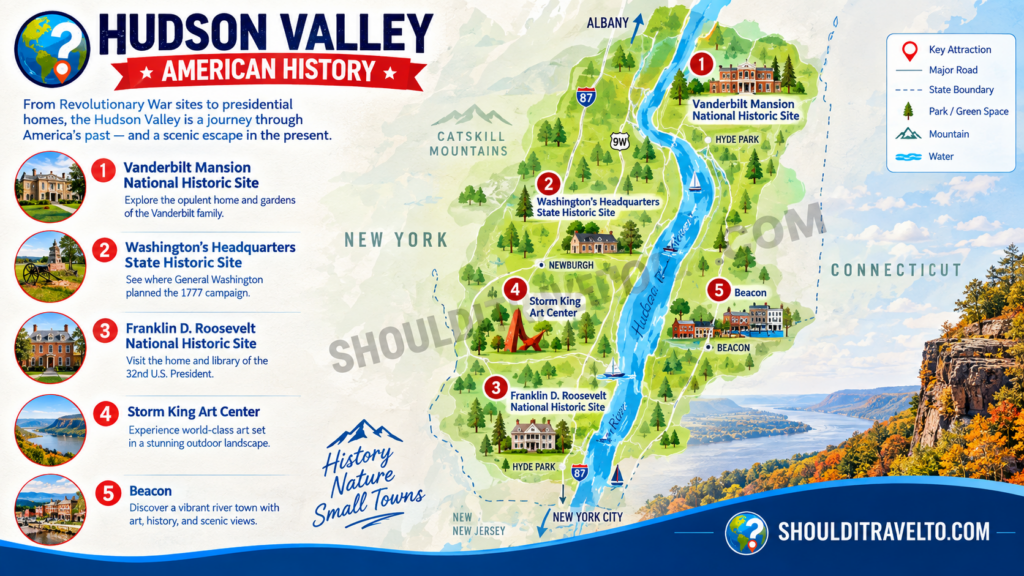
Why Visit the Hudson Valley for American History?
Few American history destinations cover as much historical ground as the Hudson Valley, New York.
Henry Hudson explored the river in 1609.
Dutch and later English settlement transformed the valley.
During the American Revolution, control of the Hudson became strategically important because British control of the river could help separate New England from the other states.
West Point became one of the Revolution’s most important defensive positions.
George Washington spent more than 16 months headquartered in Newburgh near the end of the war.
New York’s first state government took shape in Kingston.
In the nineteenth century, the valley became an important transportation and commercial corridor while its landscapes inspired writers, architects, and artists.
Thomas Cole helped launch the Hudson River School, the first major American school of landscape painting, and his student Frederic Church later created Olana across the river.
Wealthy families constructed enormous estates along the Hudson.
Then, in the twentieth century, Hyde Park became inseparable from Franklin and Eleanor Roosevelt and some of the defining political events of modern American history.
The river connects all of it.
- Revolution
- Presidents
- Art
- Architecture
- Industry
- Great estates
- Environmental history
Few regions allow you to explore so many different versions of American history in one trip.
Three Reasons to Visit the Hudson Valley, New York, for American History
The Hudson Valley’s greatest strength isn’t one famous attraction. It’s the variety and depth of the historical experience.
1. Follow the American Revolution Along the Hudson
If you’re interested in the American Revolution, the Hudson Valley deserves considerably more attention than it often receives.
The river was strategically critical.
British control of the Hudson could have threatened communications between New England and the other American states, making the valley an important military objective throughout the war. The National Heritage Area identifies Revolutionary sites including Washington’s Headquarters, Stony Point, Kingston, Fort Montgomery, Fort Clinton, and West Point.
West Point provides perhaps the clearest example.
George Washington considered its position on the Hudson extraordinarily important. American forces constructed fortifications, batteries, redoubts, and an enormous iron chain across the river to obstruct British movement.
The fortress was never captured.
It later became the target of Benedict Arnold’s attempted betrayal.
West Point remains the oldest continuously occupied military post in the United States.
Then continue to Newburgh.
Washington used the Hasbrouck House as his headquarters for more than 16 months near the end of the war.
During that period, he confronted the Newburgh Conspiracy, helped prevent a potential military challenge to the new republic, established the Badge of Military Merit, the predecessor of today’s Purple Heart, and announced the cessation of hostilities.
The site later made history again: in 1850, Washington’s Headquarters became the nation’s first publicly owned historic site.
That’s an extraordinary combination.
The Hudson Valley wasn’t simply near the Revolution. Control of the Hudson was part of the Revolution’s strategy.
2. Explore Presidential History in Hyde Park
The Hudson Valley isn’t only a Revolutionary War destination.
It also contains one of America’s strongest concentrations of twentieth-century presidential history.
Franklin D. Roosevelt was born at Springwood in Hyde Park and returned there throughout his life.
Today, the Home of Franklin D. Roosevelt National Historic Site allows visitors to explore the house and landscape associated with the nation’s 32nd president, who led the United States through the Great Depression and most of World War II.
Nearby is the Franklin D. Roosevelt Presidential Library and Museum.
And then there’s Val-Kill.
Eleanor Roosevelt used Val-Kill first as a retreat and later as her primary home after FDR’s death. It became associated with her political activism, human rights work, guests, discussions, and independent public life.
The Eleanor Roosevelt National Historic Site preserves that story. Val-Kill was the first National Historic Site dedicated to a first lady.
That makes Hyde Park particularly powerful for history travelers.
You aren’t visiting one presidential house.
You’re exploring the landscapes associated with Franklin Roosevelt, Eleanor Roosevelt, the New Deal era, World War II, presidential politics, social reform, and human rights.
For twentieth-century American history, Hyde Park can justify an entire day.
3. Experience American Art, Architecture, and the Great Hudson River Estates
This is where the Hudson Valley becomes unlike almost any other destination in your American History collection.
History here isn’t limited to wars and presidents.
It’s also about the development of an American cultural identity.
In Catskill, Thomas Cole helped establish the Hudson River School, America’s first major art movement.
The National Park Service describes Cole’s work as helping launch an art movement Americans could call their own.
Across the Hudson sits Olana, the home, studio, and designed landscape of Frederic Edwin Church, one of Cole’s students and one of the Hudson River School’s most important painters.
Remarkably, you can connect the two via the Hudson River Skywalk, which crosses the river between the Thomas Cole Site and Olana and offers views of the landscapes associated with the movement.
Then there are the estates.
In Hyde Park, Vanderbilt Mansion National Historic Site preserves Frederick and Louise Vanderbilt’s country estate and offers a window into the wealth, architecture, social hierarchy, and lifestyle of America’s Gilded Age elite. The National Park Service describes it as the only Gilded Age mansion in the National Park System.
Elsewhere in the valley, historic estates, designed landscapes, architecture, and gardens help tell the story of the people who transformed the Hudson River into one of America’s great residential and cultural landscapes.
So if your definition of American history includes more than battlefields and founding documents? The Hudson Valley becomes much more compelling.
Here, the American landscape itself became part of American history.
Three Downsides of Visiting the Hudson Valley for American History
The same scale and variety that make the Hudson Valley historically impressive also make it more complicated to visit.
1. The Historical Sites Are Spread Across a Huge Region
Don’t think of the Hudson Valley as Williamsburg.
Think of it as a historical road trip.
West Point, Newburgh, Hyde Park, Kingston, Sleepy Hollow, Catskill, Hudson, and other historic communities aren’t all clustered around one central visitor district.
The National Heritage Area itself extends through a roughly 150-mile valley.
Trying to see everything is a mistake. You can easily spend more time driving than experiencing history.
The better approach? Choose a section of the valley. Choose a historical theme. Then build the trip around it.
2. A Car Makes the Historical Experience Much Easier
Some Hudson Valley communities are reachable by train from New York City.
But a comprehensive American history trip becomes considerably easier with a car.
Historic estates, Revolutionary War sites, artist homes, smaller communities, scenic roads, and attractions on opposite sides of the river aren’t always conveniently connected by public transportation.
That makes the Hudson Valley less straightforward for a car-free traveler than Boston, Philadelphia, or Washington, DC.
If you’re primarily visiting one or two towns, you may be able to build a transit-oriented trip.
If you want to understand the region? A road trip makes much more sense.
3. There Is Almost Too Much History
This sounds like an advantage. And it is. But it creates a planning problem.
Do you focus on:
- The Revolution
- The Roosevelts
- The Gilded Age
- Dutch settlement
- Washington Irving
- The Hudson River School
- Military history
- Architecture
- Environmental history
Trying to combine all of them into one weekend can make the trip feel like a checklist.
The Hudson Valley works better when you accept you won’t see everything.
Don’t try to visit the Hudson Valley.
Visit a chapter of the Hudson Valley. Then come back for another one.
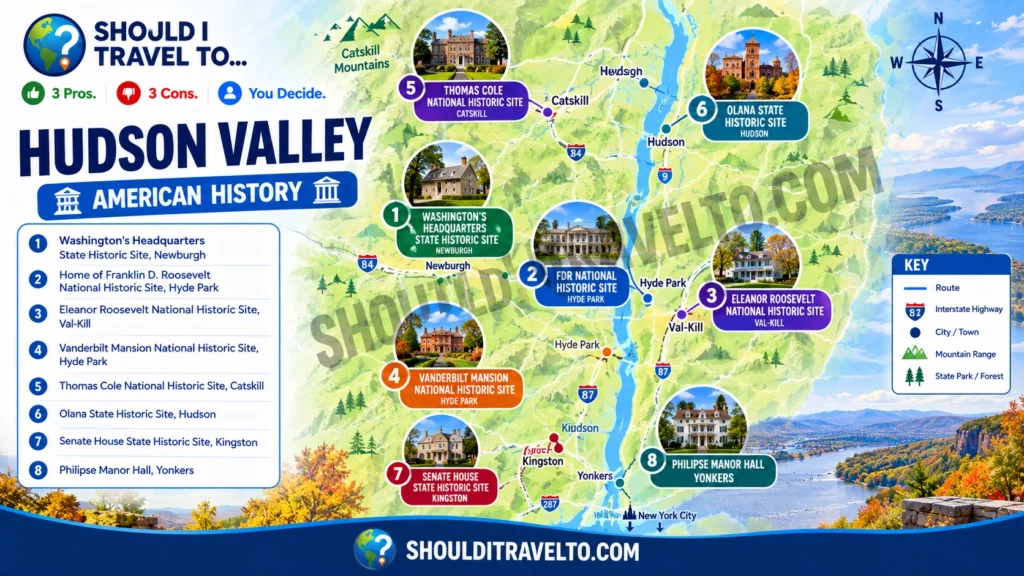
Planning Your Hudson Valley, New York, American History Trip
Because the region is so large, planning by historical theme is often more useful than simply collecting attractions.
Best American History Sites in the Hudson Valley
Washington’s Headquarters State Historic Site, Newburgh
Start here for Revolutionary War history.
George Washington headquartered at the Hasbrouck House for more than 16 months near the end of the Revolution. Key events from his time in Newburgh include the Newburgh Conspiracy, the end of hostilities, and the creation of the Badge of Military Merit.
The site is historically important for another reason too.
It opened to the public in 1850 as the nation’s first publicly owned historic site.
Best for: George Washington + the end of the American Revolution
West Point
West Point’s position above a bend in the Hudson made it strategically critical during the Revolution.
American fortifications protected the river, and the famous Great Chain formed part of the defenses designed to stop British ships from moving upriver.
Benedict Arnold’s attempt to surrender West Point to the British added another chapter to the story.
The United States Military Academy was established here in 1802, and West Point remains the country’s oldest continuously occupied military post.
Best for: Revolutionary War + military history
Home of Franklin D. Roosevelt National Historic Site, Hyde Park
Springwood was FDR’s lifelong home.
The property provides an unusually personal perspective on a president whose administration transformed the federal government and whose presidency encompassed the Great Depression and World War II.
Combine the house with the nearby Franklin D. Roosevelt Presidential Library and Museum.
Best for: Presidential history + twentieth-century America
Eleanor Roosevelt National Historic Site, Val-Kill
Val-Kill tells a different Roosevelt story.
It became central to Eleanor Roosevelt’s development as an activist and public figure and later became her primary home.
Visitors can connect the property with women’s history, political activism, civil rights, human rights, and Eleanor Roosevelt’s unusually influential post-White House career.
Best for: Eleanor Roosevelt + human rights + women’s history
Vanderbilt Mansion National Historic Site, Hyde Park
If the Roosevelt sites explain politics and public life, Vanderbilt Mansion explains another side of the same era.
The mansion and estate interpret Gilded Age wealth, architecture, estate life, social hierarchy, and the world of America’s millionaire class.
Frederick and Louise Vanderbilt built the mansion in the late 1890s, with construction completed in 1898.
Best for: Gilded Age + architecture + wealth
Thomas Cole National Historic Site, Catskill
Thomas Cole helped create the Hudson River School of American landscape painting.
His home and studios provide a direct connection to the landscape that inspired him and to an artistic movement that helped Americans develop their own visual identity.
This isn’t merely art history.
It’s part of the story of how Americans began interpreting America itself through art.
Best for: American art + Hudson River School
Olana State Historic Site, Hudson
Olana sits across the river from Thomas Cole’s home.
Frederic Edwin Church studied under Cole and became one of America’s leading nineteenth-century landscape painters.
His home, studio, and designed landscape became a work of art in their own right.
Visiting Thomas Cole and Olana together creates one of the strongest art-history days in the Hudson Valley.
Best for: Frederic Church + art + architecture + landscape design
Senate House State Historic Site, Kingston
Kingston played an important role during the Revolution and became New York’s first capital.
The Senate House was the meeting place of the state’s first Senate in 1777, connecting the site directly with the formation of New York’s state government during the Revolution.
Best for: Revolutionary politics + New York State history
Philipse Manor Hall, Yonkers
For travelers starting in the lower Hudson Valley, Philipse Manor Hall tells an earlier, more complicated story.
The property dates to the seventeenth century and today interprets Indigenous, European, and African experiences, Dutch colonial history, slavery, tenant farming, Loyalism, and the American Revolution.
Best for: Colonial New York + slavery + Loyalists
Washington Irving’s Hudson Valley
The Hudson Valley’s cultural history isn’t limited to painting.
Washington Irving helped turn the region’s landscapes, legends, and Dutch heritage into some of the earliest internationally recognized American literature.
Rip Van Winkle and The Legend of Sleepy Hollow became inseparable from the Hudson Valley landscape. Congress specifically recognized these literary traditions when establishing the National Heritage Area.
For travelers interested in literature, folklore, and early American cultural identity, the lower Hudson Valley adds another layer to the trip.
Best for: American literature + folklore + Hudson Valley identity
The Best Way to Explore Hudson Valley History
Unlike Roanoke, where one full day can cover the primary historical story, the Hudson Valley needs a different strategy.
Lower Hudson Valley: Revolution + Literature
Focus on:
- West Point
- Hudson Highlands
- Revolutionary War sites
- Sleepy Hollow
- Washington Irving
- Philipse Manor Hall
Best for: Revolutionary history + military history + early American culture
Central Hudson Valley: Washington + Roosevelt + Gilded Age
Focus on:
- Washington’s Headquarters
- Hyde Park
- FDR Home
- FDR Presidential Library
- Val-Kill
- Vanderbilt Mansion
- Kingston
Best for: Revolution + presidents + Gilded Age
Upper Hudson Valley: Art + Architecture + Landscapes
Focus on:
- Thomas Cole National Historic Site
- Olana
- Hudson
- Historic estates
- Hudson River School landscapes
Best for: American art + architecture + cultural landscapes
That solves one of the biggest planning problems.
Instead of asking: “How do I see the Hudson Valley?”
Ask: “Which Hudson Valley story do I want to follow?”
Ideal Trip Length
The Hudson Valley rewards considerably more time than most individual historic destinations.
1 Day: One historical theme or geographic cluster
2 Days: Two major clusters
3 Days: Best first American history trip
4–5 Days: Revolution + Roosevelts + estates + art + historic towns
1 Week: Broader Hudson Valley road trip incorporating history, scenery, food, hiking, and additional communities
A First-Time Hudson Valley American History Itinerary
For a dedicated history trip, three days is the sweet spot, but I’d give readers multiple options.
One Day: Hyde Park
If you only have one day, make it focused.
Visit: Home of Franklin D. Roosevelt → FDR Presidential Library → Val-Kill
If time allows, add Vanderbilt Mansion.
This creates an unusually concentrated day of presidential, political, social, and Gilded Age history.
Two Days: Revolution + Presidents
Day 1: West Point + Washington’s Headquarters
Day 2: Hyde Park, FDR + Eleanor Roosevelt + Vanderbilt
Three Days: The Hudson Valley Through American History
Day 1: Revolution, West Point → Washington’s Headquarters
Next, Day 2: Presidents & Gilded Age, FDR Home → Presidential Library → Val-Kill → Vanderbilt Mansion
Day 3: American Art, Thomas Cole → Hudson River Skywalk area → Olana
Nearby American History Destinations
The Hudson Valley becomes even more valuable because it connects to several larger history trips.
To the south: New York City
or To the north: Albany and Saratoga
To the east: New England
And for travelers building a broader Revolutionary War trip: Boston → Hudson Valley → Philadelphia → Washington, DC
That’s a much larger trip, but it illustrates something important.
The Hudson Valley doesn’t sit outside the familiar American history story. It connects several parts of it.
Best Time to Visit the Hudson Valley for American History
The Hudson Valley changes significantly by season, and historical sightseeing pairs well with the region’s scenery.
Spring ★★★★★
Comfortable sightseeing weather, spring landscapes, and a strong time for combining historic sites with outdoor exploration.
Summer ★★★★☆
Long daylight hours make road trips easier, but warmer weather and peak tourism can make some destinations busier.
Fall ★★★★★
Historic estates, Revolutionary War landscapes, river views, towns, and Hudson River School scenery become part of a larger fall foliage vacation.
For travelers interested in both history and autumn scenery, this is one of the strongest combinations in the Northeast.
Winter ★★★☆☆
The valley becomes quieter, but seasonal hours and closures can limit the experience at some attractions.
For a first American history trip, spring and fall offer the strongest overall balance.
Who Should Visit the Hudson Valley, New York, for American History?
The Hudson Valley can appeal to a much wider range of history travelers than its reputation as a scenic getaway might suggest.
The Hudson Valley is ideal for:
- American history enthusiasts
- Revolutionary War travelers
- Presidential history enthusiasts
- Military history travelers
- Art history enthusiasts
- Architecture enthusiasts
- Gilded Age enthusiasts
- Road-trip travelers
- Couples
- Families with older children
- New York City visitors looking for a history-focused side trip
- Travelers who enjoy combining history with scenery
You may want to skip it if:
- You want all the major attractions within walking distance
- You don’t want to drive
- You only have a few hours
- You prefer one clearly defined historical story
- You aren’t interested in planning a multi-stop itinerary
Hudson Valley vs. Philadelphia for American History
These destinations demonstrate two very different ways to experience American history.
Philadelphia concentrates some of America’s most important founding history into a relatively compact urban area.
Choose Philadelphia for:
- Declaration of Independence
- Constitution
- Independence Hall
- Founding Fathers
- Museums
- Walkability
- A concentrated history trip
The Hudson Valley spreads its history across a large landscape.
Choose the Hudson Valley for:
- Revolutionary War strategy
- George Washington
- West Point
- Franklin and Eleanor Roosevelt
- Gilded Age estates
- Hudson River School art
- Historic landscapes
- A history road trip
The simplest difference? Philadelphia concentrates American history.
The Hudson Valley connects American history across a landscape.
For serious history travelers? Visit both.
Hudson Valley vs. Boston for American History
Boston’s historical identity is much easier to define.
Boston is primarily one of America’s great Revolutionary history cities.
The Hudson Valley is broader.
Choose Boston for:
- The events leading to the Revolution
- Freedom Trail
- Paul Revere
- Boston Massacre
- Boston Tea Party
- Walkable history
- A city-centered experience
Choose the Hudson Valley for:
- Revolutionary military strategy
- George Washington
- West Point
- Presidential history
- Great estates
- American art
- A regional road trip
You could summarize the distinction this way: Boston shows you how the Revolution began.
The Hudson Valley shows you how America defended the Revolution—and what the country became afterward.
Final Thoughts
The Hudson Valley isn’t Williamsburg, Gettysburg, or Philadelphia.
And that’s precisely why it belongs in an American history collection. No single event defines it.
Instead, the Hudson River connects centuries of American history, including the American Revolution, George Washington, West Point, the arts, and literature.
And through all of those periods, the Hudson remained the connecting thread.
That’s what makes the destination different.
The Hudson Valley isn’t one chapter of American history. It’s a road trip through several of them.
For travelers who want American history to be more than a museum visit and want the landscape itself to connect the stories, the Hudson Valley deserves a place on the itinerary.
3 Pros. 3 Cons. You Decide.
Hudson Valley, New York, American History Frequently Asked Questions
Is the Hudson Valley worth visiting for American history?
Yes. The Hudson Valley combines Revolutionary War history, presidential history, military history, Gilded Age estates, American art, architecture, literature, and historic landscapes across one region. Congress designated the Hudson River Valley a National Heritage Area in 1996 to recognize its nationally significant historical and cultural resources.
What is the Hudson Valley most famous for historically?
There isn’t one answer. Historically, the valley is particularly important for its strategic role during the American Revolution, West Point, George Washington’s Newburgh headquarters, Franklin and Eleanor Roosevelt, the Hudson River School of landscape painting, historic estates, and its role as a major transportation and commercial corridor.
What are the best American history sites in the Hudson Valley?
For a first trip, prioritize Washington’s Headquarters, West Point, the Home of Franklin D. Roosevelt, the FDR Presidential Library and Museum, Val-Kill, Vanderbilt Mansion, Thomas Cole National Historic Site, and Olana.
You don’t need to see all of them on one trip.
How many days do you need for a Hudson Valley history trip?
Three days is an excellent first trip.
Use one day for Revolutionary War history, one for Hyde Park and the Roosevelts, and one for Thomas Cole, Olana, and the Hudson River School.
If you have only one day, choose one historical theme rather than trying to cover the entire region.
Do you need a car to explore Hudson Valley history?
A car is strongly recommended for a comprehensive trip. Historic attractions are spread across a large region and on both sides of the Hudson River.
Is West Point part of Hudson Valley history?
Absolutely. West Point occupied one of the most strategically important positions on the Hudson during the American Revolution. The British never captured the fortress, and West Point remains America’s oldest continuously occupied military post.
Can you visit FDR’s home in the Hudson Valley?
Yes. Springwood in Hyde Park is preserved as the Home of Franklin D. Roosevelt National Historic Site. The Franklin D. Roosevelt Presidential Library and Museum is nearby, making Hyde Park one of America’s strongest presidential-history destinations.
What does the Hudson Valley have to do with American art?
The Hudson Valley helped give rise to the Hudson River School of landscape painting. Thomas Cole is regarded as the movement’s founder, while his student Frederic Church became one of its most prominent artists. You can visit both their historic homes: the Thomas Cole National Historic Site and Olana.
Can you combine American history and fall foliage in the Hudson Valley?
Yes, and that’s one of the region’s strongest advantages. Learn more about traveling to the Catskills and Hudson Valley for fall foliage.