

Should You Visit Saratoga, New York, the Turning Point of the American Revolution?
Quick Answer
Yes, you should visit Saratoga, New York, if you’re interested in the American Revolution, George Washington, military history, American independence, or the events that brought France into the Revolutionary War.
The Revolutionary War sites associated with Saratoga are spread across the communities around Saratoga Springs. The main battlefield is in Stillwater, while other park sites are in Schuylerville and Victory.
Saratoga is best known for the Battles of Saratoga in 1777, a major American victory that resulted in the surrender of British General John Burgoyne’s army.
But Saratoga’s importance goes beyond the battle itself.
Today, Saratoga National Historical Park preserves the battlefield, historic sites, trails, monuments, and landscapes associated with the campaign.
You aren’t simply visiting a Revolutionary War battlefield.
You’re visiting the place where an American victory helped turn a colonial rebellion into an international conflict.
The simplest way to think about Saratoga? The Revolution began in 1775.
America didn’t win the Revolutionary War at Saratoga. It proved victory was possible.
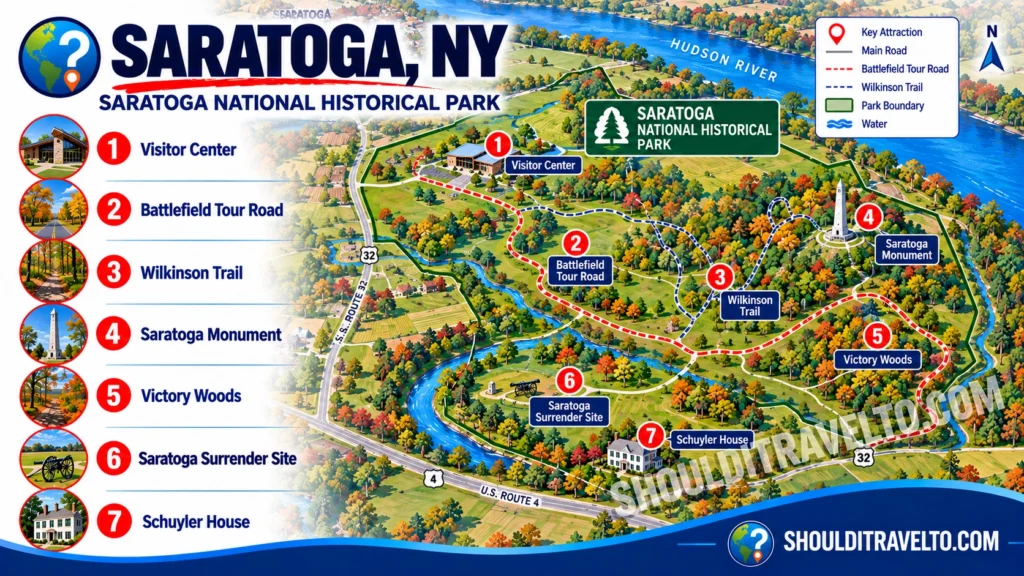
Why Visit Saratoga, New York?
Saratoga is one of the most important Revolutionary War destinations in the United States.
It wasn’t important because of one dramatic moment.
It was important because of what happened after the fighting.
In 1777, Britain attempted to isolate New England from the rest of the colonies by sending General John Burgoyne’s army south from Canada.
Burgoyne’s army captured Fort Ticonderoga and advanced toward Albany. But the campaign began to unravel.
- American forces resisted the invasion
- Burgoyne became increasingly short of supplies
- His army suffered losses
And the Americans gathered more troops around the Hudson River.
The first major Battle of Saratoga took place on September 19, 1777. The second took place on October 7.
The British were eventually forced to retreat.
Burgoyne’s army became trapped near present-day Schuylerville.
On October 17, more than 6,000 British and German soldiers surrendered.
That surrender was extraordinary. It demonstrated that an American army could defeat and force the surrender of a major British army.
And the consequences were enormous.
The American victory helped persuade France to formally ally with the United States in 1778. French military assistance would later play a decisive role at Yorktown.
For American history travelers, Saratoga therefore represents a crucial chapter:
- Lexington & Concord → The Revolution Begins
- Philadelphia → Independence Is Declared
- Valley Forge → Washington’s Army Is Transformed
- Saratoga → America Proves It Can Win
- Yorktown → Britain Is Defeated
That’s why Saratoga is worth visiting.
The Battles of Saratoga
Saratoga wasn’t actually one battle. It was a campaign involving two major battles and a series of movements, skirmishes, strategic decisions, and retreats.
The British Plan
British General John Burgoyne believed he could split the American colonies by advancing south from Canada toward Albany.
The basic strategy was to sever New England from the other colonies.
Burgoyne launched his invasion in June 1777. His army moved south through the Lake Champlain corridor.
The campaign initially went well.
British forces captured Fort Ticonderoga and continued south. But the Americans didn’t simply disappear. They regrouped.
The farther Burgoyne advanced, the harder it became to supply his army.
The First Battle of Saratoga
The first major battle took place on September 19, 1777.
American forces and Burgoyne’s army clashed near Freeman Farm.
The fighting was intense. Neither side achieved a decisive victory.
But the Americans had demonstrated that Burgoyne’s army could be challenged.
Burgoyne dug in. And the situation began to change.
The Second Battle of Saratoga
The second major battle occurred on October 7.
Burgoyne’s position had become increasingly difficult. American forces were growing. British supplies were shrinking.
Burgoyne attempted another offensive.
Instead, American forces pushed the British back.
American troops captured the strategically important Breymann Redoubt. Benedict Arnold played a major role in the fighting and was wounded in the leg.
The British position became increasingly desperate. Burgoyne began retreating north.
The British Surrender
Burgoyne’s army retreated toward Saratoga, now called Schuylerville. But there was nowhere to go.
American forces surrounded the British.
Burgoyne’s army was outnumbered and running out of food and supplies.
On October 17, 1777, more than 6,000 British and German troops surrendered.
It was the first time a British army had surrendered to another country.
And the consequences would be enormous.
The 3 Biggest Reasons to Visit Saratoga
Saratoga, New York, combines Revolutionary War history, military history, American independence, and some of the Revolution’s most important strategic events.
1. This Is Where the American Revolution Changed
The American victory demonstrated that the Continental forces could defeat a major British army. That changed how foreign governments viewed the Revolution.
France had already been providing covert assistance to the American cause.
After Saratoga, French support became much more direct. The alliance formally took shape in 1778.
France provided military assistance, financial support, naval power, and troops.
Eventually, French forces would fight alongside Americans at Yorktown.
So when you stand on the Saratoga battlefield, you’re looking at a place that helped change the international balance of the Revolutionary War.
2. You Can Walk the Actual Battlefield
Saratoga is different from a traditional museum experience. The battlefield remains a landscape.
You can follow roads and trails through the terrain where American and British forces fought.
When open, the park offers a self-guided battlefield experience via the Tour Road, along with the Wilkinson Trail, exhibits, interpretive stations, and optional audio resources.
You can see:
- Freeman Farm
- Bemus Heights
- British defensive positions
- American positions
- Redoubts
- Historic roads
- Battlefield landscapes
And begin to understand why the terrain mattered.
The battlefield is not simply a place where something happened. The geography helped determine what could happen.
3. Saratoga Connects the Entire Revolutionary War
Saratoga makes more sense when you place it within the larger American Revolution.
You can connect Saratoga to:
- Fort Ticonderoga
- Lake Champlain
- Albany
- Valley Forge
- Philadelphia
- Yorktown
- France
Saratoga is therefore particularly rewarding for travelers building an American Revolution road trip. It sits between the Revolution’s early years and its eventual conclusion.
The war wasn’t over in 1777. But after Saratoga, the Americans had something they didn’t have before:
A major victory and a powerful international ally.
The 3 Biggest Downsides of Visiting Saratoga
Saratoga, New York, is historically important, but travelers should understand what the experience actually involves.
1. The Battlefield Is Spread Out
The Saratoga Revolutionary War sites span several communities north of Albany, with Saratoga Springs serving as the area’s best-known visitor base.
Saratoga National Historical Park consists of multiple separate sites, including the:
- Main battlefield is in Stillwater
- Schuyler House is in Schuylerville
- Saratoga Monument is in Victory
The sites don’t physically connect. That means you’ll need transportation between some of them.
For travelers expecting to park once and walk through an entire Revolutionary War town, Saratoga can feel surprisingly spread out.
2. The Battlefield Requires Some Imagination
Colonial streets aren’t filled with original buildings. No intact Revolutionary War town exists.
Much of the experience is:
- Fields
- Forest
- Roads
- Earthworks
- Trails
- Monuments
- Interpretive signs
That’s part of what makes Saratoga valuable.
But it also becomes much more meaningful when you understand what happened there.
- Start at the visitor center
- Watch the orientation film
- Study the maps
- Explore the battlefield
Once you understand the campaign, the landscape begins to make sense.
3. Saratoga Is More of a History Destination Than a General Tourist Destination
Saratoga Springs is a major tourist destination in its own right. But the Revolutionary War sites are different.
You’re not coming to Saratoga National Historical Park for rides, entertainment, or a highly interactive theme-park experience.
You’re coming to understand:
- Military strategy
- The American Revolution
- George Washington’s era
- Burgoyne’s campaign
- American military history
- The French alliance
If that’s what you’re looking for, Saratoga is exceptional.
If you want a destination where historical attractions are only one small part of a larger vacation, you’ll probably want to combine it with Saratoga Springs or other regional destinations.
Why Was Saratoga So Important?
Before Saratoga, France had already been assisting the American cause. But a formal alliance was different.
France needed to know whether the Americans had a realistic chance of defeating Britain. The American victory at Saratoga helped answer that question.
The British sent a major army to New York, and the Americans defeated it and forced a surrender.
The Americans demonstrated that the Revolution was not simply a doomed rebellion.
France formally allied with the United States in 1778, transforming the war.
French troops and naval forces would eventually become critical to the American victory at Yorktown.
That’s why Saratoga is often described as a turning point.
The Story of Benedict Arnold at Saratoga
Saratoga also tells one of the most fascinating stories of the American Revolution: Benedict Arnold.
Today, Arnold is remembered primarily as a traitor. But in 1777, he was a hero to the Americans.
Arnold played an important role in the fighting at Saratoga.
During the second battle on October 7, he helped lead American forces against the British position at Breymann Redoubt.
He was wounded in the leg. His military reputation was already complicated by disagreements with other American commanders.
But at Saratoga, his battlefield performance was significant.
The irony is impossible to miss.
The Saratoga Monument itself commemorates Arnold’s role by leaving the southern niche for his statue empty, reflecting his later betrayal.
That makes Saratoga an especially interesting place to explore Arnold’s story.
The same man remembered as America’s most famous traitor was also one of the American Revolution’s most talented battlefield commanders.
General Philip Schuyler and Saratoga
Schuyler commanded the American Northern Department early in Burgoyne’s campaign.
After the loss of Fort Ticonderoga, critics replaced him with Horatio Gates. But Schuyler remained an important figure in the campaign.
Burgoyne’s retreating army burned his country estate at Saratoga.
During the retreat, Burgoyne’s forces burned Schuyler’s original country home. The present Schuyler House was built later in 1777 and is now preserved as part of Saratoga National Historical Park.
Visiting it provides another perspective on the Revolution.
The war wasn’t experienced only by soldiers. It disrupted families, homes, farms, communities, and entire regions.
Saratoga was a battlefield. But it was also a place where ordinary people experienced the consequences of war.
Planning Your Saratoga Trip
Saratoga works particularly well as part of a larger American Revolution itinerary.
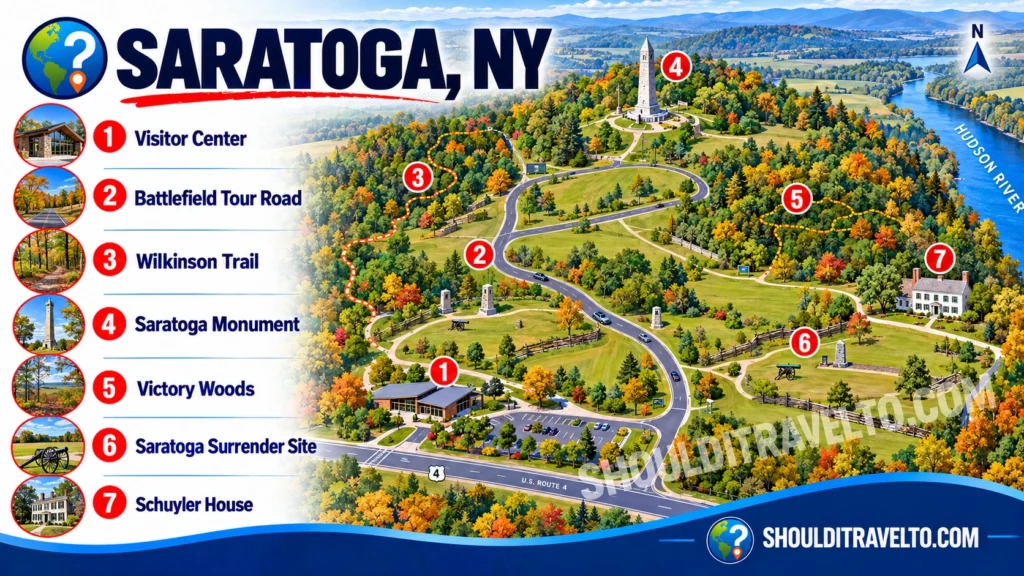
Best Things to Do at Saratoga National Historical Park
The Visitor Center
Start here. The visitor center offers maps, exhibits, artifacts, an orientation film, and a campaign timeline.
That context is especially helpful before you explore the battlefield.
The National Park Service recommends beginning at the visitor center before following the self-guided battlefield experience.
Drive the Battlefield Tour Road
The battlefield’s Tour Road lets visitors move between key sites without hiking the entire battlefield.
When the road is open, it’s one of the easiest ways to understand the campaign’s geography.
- Stop at the major interpretive areas
- Read the maps
- Look across the landscape
And imagine the movement of the two armies.
Walk the Wilkinson Trail
For travelers who want a more immersive experience, the Wilkinson Trail follows the route soldiers used during the campaign.
It’s a chance to experience the battlefield on foot rather than simply drive between monuments.
Visit the Saratoga Monument
The Saratoga Monument is one of the park’s most recognizable landmarks.
The granite monument commemorates the American victory and stands near Burgoyne’s final camp. It contains 188 steps and five levels.
However, check current operating conditions before planning to climb it, because access to the interior has not always been available.
Walk Victory Woods
Victory Woods preserves the landscape associated with Burgoyne’s final encampment.
This is where the British army made its last stand before surrendering.
The British were surrounded, outnumbered, exhausted, and running out of food.
On October 17, Burgoyne surrendered.
Victory Woods therefore connects battlefield victories to the actual surrender.
Visit the Saratoga Surrender Site
The surrender site in Schuylerville marks the location associated with the October 17 surrender.
More than 6,000 British and German troops surrendered their arms.
It’s a relatively simple site. But historically, it’s enormous.
This is where the British army formally surrendered.
Visit the Schuyler House
The Schuyler House was General Philip Schuyler’s country home.
The property helps tell the story of the Revolutionary War from a civilian and political perspective.
It’s particularly useful when paired with the battlefield.
The Saratoga Battlefield Is Not in Saratoga Springs
Saratoga Springs is the region’s best-known city.
But Saratoga National Historical Park’s main battlefield is in Stillwater, New York.
The park’s other historic sites are in the surrounding communities of Schuylerville and Victory.
So don’t simply type “Saratoga” into your GPS and assume you’ve arrived at the battlefield.
For the battlefield visitor center, the National Park Service lists: 648 Route 32, Stillwater, NY 12170
The battlefield is approximately 15 miles southeast of Saratoga Springs and about 40 miles north of Albany.
Best Time to Visit Saratoga
You can visit Saratoga year-round, but the experience changes with the seasons.
Spring
Spring brings comfortable conditions for exploring the battlefield.
The landscape becomes green, and longer daylight makes it easier to spend time outdoors.
Summer
Summer offers long days and good conditions for exploring the park.
The trade-off is heat and potentially higher regional tourism demand.
Fall
Fall may be the best overall season for a Saratoga history trip.
The weather is generally comfortable for walking, the landscape becomes colorful, and the Revolutionary War campaign itself took place during the fall.
October is particularly meaningful because Burgoyne surrendered on October 17, 1777.
Winter
Winter provides a quieter battlefield experience.
But snow, ice, and shorter daylight can make outdoor exploration more difficult.
For most travelers, spring through fall is the easiest time to explore the park.
How Long Do You Need at Saratoga?
The answer depends on how deeply you want to explore the campaign.
2–3 Hours: Battlefield Highlights
Enough for:
- Visitor Center
- Orientation film
- Major battlefield stops
- A few interpretive areas
Half Day: Best for Most Visitors
A half day gives you time to:
- Understand the campaign
- Drive the battlefield
- Walk portions of the park
- Visit important historic sites
Full Day: Complete Saratoga Experience
A full day allows you to combine:
- Battlefield
- Victory Woods
- Saratoga Monument
- Surrender Site
- Schuyler House
- Longer walks
For serious Revolutionary War travelers, a full day is worthwhile.
For everyone else, a half day is a good starting point.
Saratoga and Saratoga Springs
Don’t confuse Saratoga National Historical Park with Saratoga Springs. They are close, but they’re different travel experiences.
Saratoga National Historical Park
Visit for:
- Revolutionary War history
- Battlefield landscapes
- Burgoyne’s surrender
- American military history
- Saratoga Monument
- Schuyler House
- Victory Woods
Saratoga Springs
Visit for:
- Historic architecture
- Saratoga Race Course
- Restaurants
- Hotels
- Spas
- Downtown shopping
- Performing arts
- Mineral springs
The easiest strategy is to use Saratoga Springs as your base and take a day trip to the Revolutionary War sites.
That gives you both the historical experience and a broader destination experience.
Nearby American History Destinations
Saratoga is particularly useful as part of a larger Revolutionary War itinerary of American history destinations.
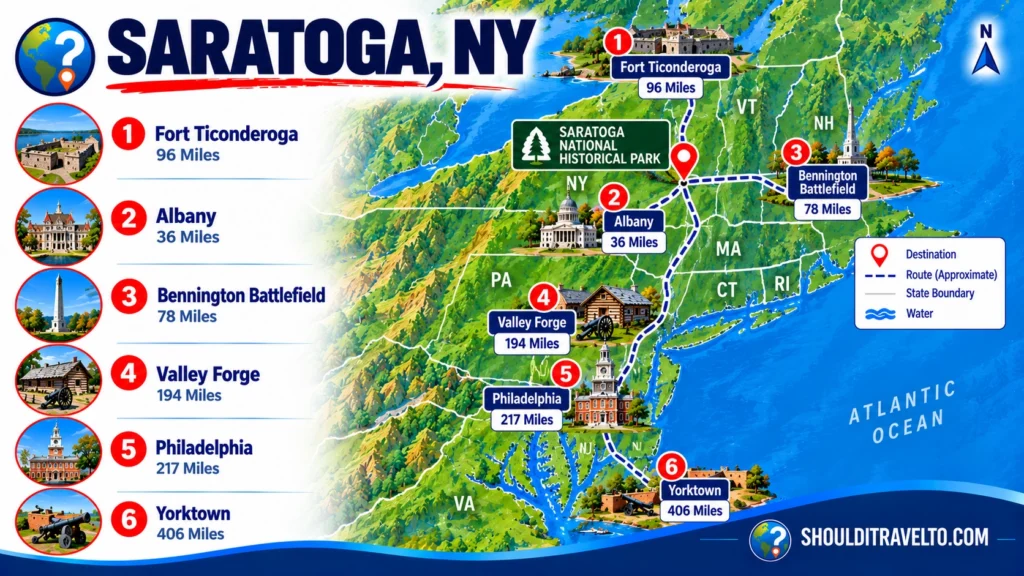
Fort Ticonderoga
Fort Ticonderoga helps explain how Burgoyne’s 1777 invasion began.
British forces captured the American-held fort in July 1777 and then continued south.
Albany
Albany was Burgoyne’s intended objective.
The British plan was to reach Albany and connect with other British forces.
That never happened.
Bennington Battlefield
The Battle of Bennington in August 1777 weakened Burgoyne’s army before the Battles of Saratoga.
The battlefield is in New York, despite the name.
Valley Forge
Valley Forge tells a different story.
- Saratoga = The Turning Point
- Valley Forge = The Army Endures
Together, they show two very different moments in the Revolution.
Philadelphia
Philadelphia tells the political story of independence.
Saratoga tells the military and international story.
Yorktown
Yorktown represents the Revolution’s final major American victory.
Saratoga helped make Yorktown possible by bringing France into the war.
Saratoga vs. Valley Forge
These two destinations are natural companions for travelers on the American Revolution trail.
Saratoga: The Turning Point
Visit Saratoga for:
- Major battlefield history
- Burgoyne’s surrender
- Benedict Arnold
- Horatio Gates
- The French alliance
- The 1777 Northern Campaign
Valley Forge: The Army Endures
Visit Valley Forge for:
- George Washington
- The Continental Army
- The winter encampment
- Military training
- Baron von Steuben
- Army organization
The simplest distinction: Valley Forge shows you how the American army survived.
Saratoga shows what happened when that army and the American cause began to win.
For travelers interested in the Revolutionary War, both are worth visiting.
Saratoga vs. Yorktown
Both Saratoga and Yorktown are also closely connected.
Saratoga
The Americans defeat Burgoyne’s army in 1777. France enters the war as an ally of the Americans.
Yorktown
American and French forces surround Cornwallis’s army in 1781.
The British surrender, bringing the war to a close.
The connection is simple: Saratoga helped bring France into the war.
French support helped make Yorktown possible.
That’s why Saratoga deserves to be considered one of the most important destinations in the entire American Revolution.
Who Should Visit Saratoga?
Saratoga is particularly well suited to:
- American history enthusiasts
- Revolutionary War travelers
- Military history travelers
- Families
- Travelers following the Revolutionary War campaign
- Benedict Arnold enthusiasts
- History-focused road trippers
- Travelers visiting Saratoga Springs
- Students
- American Revolution road trippers
- Travelers interested in the French alliance
- Visitors who enjoy historic landscapes
You may want to skip Saratoga National Historical Park if:
- You aren’t particularly interested in history
- You dislike outdoor historical sites
- You expect a preserved colonial town
- You want highly interactive attractions
- You have very limited time in the region
- You don’t want to drive between separate historic sites
The question isn’t whether Saratoga is historically important. It absolutely is.
The question is whether you want to spend time understanding why one Revolutionary War victory changed the course of the war.
Is Saratoga Good for Families?
Yes.
Saratoga can be especially interesting for families with children studying the American Revolution.
The battlefield gives children room to explore instead of spending the entire visit inside a museum.
You can:
- Watch the orientation film
- Follow the battlefield
- See historic structures
- Walk trails
- Explore the landscape
- Visit monuments
- Learn about soldiers and military strategy
The experience works best when parents or teachers explain the basic story before you arrive.
Otherwise, a battlefield can simply look like a field.
With context, it becomes the site of one of America’s most important victories.
Saratoga and the 250th Anniversary of the American Revolution
Saratoga will become increasingly relevant as the United States approaches the 250th anniversary of the American Revolution in 2026.
The anniversary provides a strong reason to explore Revolutionary War destinations as a connected travel story.
Saratoga belongs near the center of that story.
The 1777 victory occurred less than a year after the Declaration of Independence.
The war remained uncertain, and the American government struggled.
Washington’s army was under enormous pressure.
And yet an American army had just forced a major British army to surrender.
That makes Saratoga especially valuable for travelers who want to understand the Revolution beyond the famous names and dates.
The Decision Is Yours
So, should you travel to Saratoga?
If you’re looking for a Revolutionary War destination where you can see a dramatic colonial town preserved exactly as it was, Saratoga probably isn’t the best choice.
But if you want to understand the battle that helped change the Revolutionary War, Saratoga deserves a place on your itinerary.
Today, Saratoga National Historical Park lets you explore the battlefield, Victory Woods, the surrender site, the Schuyler House, and the Saratoga Monument.
It isn’t one attraction. It’s an entire campaign spread across a landscape.
America didn’t win the Revolutionary War at Saratoga.
It was where America proved that victory was possible.
3 Pros. 3 Cons. You Decide.
Saratoga Frequently Asked Questions
Is Saratoga worth visiting?
Yes, particularly for travelers interested in the American Revolution, military history, American independence, and the events that led to the French alliance.
What happened at Saratoga?
The Battles of Saratoga took place in September and October 1777. American forces defeated British General John Burgoyne’s army, which surrendered on October 17, 1777.
Why was Saratoga important?
The American victory demonstrated that the Continental forces could defeat a major British army and helped convince France to formally ally with the United States.
Was Saratoga a turning point in the Revolutionary War?
Yes. Saratoga is widely regarded as a turning point because the American victory helped bring France openly into the war as an American ally.
Who won the Battles of Saratoga?
The American forces won the Battles of Saratoga and forced British General John Burgoyne to surrender his army.
When did the British surrender at Saratoga?
Burgoyne surrendered on October 17, 1777.
How many British soldiers surrendered at Saratoga?
More than 6,000 British and German troops surrendered at Saratoga.
Was Benedict Arnold at Saratoga?
Yes. Benedict Arnold played an important role in the fighting and was wounded during the second Battle of Saratoga.
Why is Benedict Arnold’s statue missing from the Saratoga Monument?
The Saratoga Monument includes representations of several important American leaders, but the niche associated with Benedict Arnold is empty because he later betrayed the American cause.
Is Saratoga National Historical Park in Saratoga Springs?
No. The main battlefield is in Stillwater, New York. The park also includes the Schuyler House in Schuylerville and the Saratoga Monument in Victory.
How far is Saratoga National Historical Park from Saratoga Springs?
The battlefield is approximately 15 miles southeast of Saratoga Springs.
How long do you need at Saratoga National Historical Park?
A few hours is enough for the major highlights. A half day works well for most first-time visitors, while a full day lets you explore the battlefield and other historic sites more thoroughly.
What should you see at Saratoga National Historical Park?
The major sites include the battlefield, Visitor Center, Wilkinson Trail, Victory Woods, Saratoga Monument, Saratoga Surrender Site, and Schuyler House.
Can you walk the Saratoga battlefield?
Yes. The park offers walking opportunities, including the Wilkinson Trail, which follows historic routes associated with the 1777 campaign.
Is Saratoga good for kids?
Yes, particularly for families interested in American history. The battlefield, trails, monuments, historic sites, and interpretive programs can make the Revolutionary War easier to visualize.
Should you visit Saratoga or Valley Forge?
Visit Saratoga to understand the American victory that helped bring France into the Revolutionary War. Visit Valley Forge to learn about Washington’s army during its difficult winter encampment and its subsequent transformation.
Should you visit Saratoga or Yorktown?
Saratoga represents a major turning point in the Revolution and the beginning of a formal French alliance. Yorktown represents the decisive American victory that effectively ended major combat.
Can you visit Saratoga as a day trip from Albany?
Yes. Saratoga National Historical Park is about 40 miles north of Albany, making it a practical day trip.
Is Saratoga worth visiting in the fall?
Yes. Fall provides comfortable conditions for exploring the battlefield and is particularly meaningful because the Battles of Saratoga and Burgoyne’s surrender occurred in September and October 1777.
Why should you visit Saratoga during the 250th anniversary of the American Revolution?
Saratoga is one of the most important Revolutionary War sites in the United States. The 250th anniversary offers a great opportunity to visit the battlefield and understand how the 1777 American victory helped change the course of the war.