

Should You Visit Las Vegas, Nevada, Sin City?
Quick Answer
Yes, you should consider visiting Las Vegas, Nevada, if you want spectacular resorts, major entertainment, restaurants, nightlife, casinos, shopping, sports, shows, or a city vacation unlike almost anywhere else in the United States.
Las Vegas is difficult to compare with a conventional American city.
The city’s most famous experience is the Strip, where enormous resorts, casinos, restaurants, theaters, shopping, nightlife, and attractions line Las Vegas Boulevard.
But Las Vegas isn’t just casinos.
You can see major touring shows, eat at restaurants from internationally recognized chefs, visit museums, explore Downtown Las Vegas, watch professional sports, relax at a resort pool, take a day trip into the desert, or use Vegas as a base for exploring southern Nevada.
And then there is the spectacle.
Las Vegas has built an entire destination around being bigger, brighter, louder, and more theatrical than normal.
That’s either exactly what you want, or one reason you may want to go somewhere else.
There are also some important trade-offs.
If you want:
- Major entertainment
- Casinos and gaming
- World-class shows
- Restaurants
- Nightlife
- Resort experiences
- Shopping
- Sports
- Spectacle
- A distinctive American destination
- Easy access to desert landscapes
Las Vegas offers an unusually broad range of experiences.
The bigger question isn’t whether there is enough to do. It’s what kind of Las Vegas you want to experience.
The Biggest Mistake First-Time Las Vegas, Nevada, Visitors Make
The biggest mistake is thinking Las Vegas, Nevada, is simply the Strip.
The Strip is the center of the classic Las Vegas experience, but it isn’t the entire destination.
The Las Vegas Strip is a roughly 4-mile resort corridor filled with enormous hotels, casinos, restaurants, entertainment venues, shopping, attractions, and nightlife.
But Downtown Las Vegas offers a different experience, particularly around Fremont Street.
The Arts District offers another.
And outside the urban core, the desert landscape becomes part of the experience.
That means two travelers can visit Las Vegas for four days and have completely different vacations.
One might spend the entire trip inside resorts. Another might see shows and restaurants. One might spend half the trip exploring Red Rock Canyon and the surrounding desert. Another might barely gamble at all.
Las Vegas works precisely because you don’t have to experience it one particular way.

The Las Vegas Strip vs. Downtown
The Strip: The Classic Las Vegas Experience
The Strip is where you’ll find:
- Mega-resorts
- Casinos
- Major shows
- Nightclubs
- Restaurants
- Shopping
- Pools
- Attractions
- Resort entertainment
- Iconic Las Vegas architecture
It’s what most visitors picture before arriving. It is also enormous.
Don’t underestimate the distance between resorts simply because they look close together on a map.
Downtown Las Vegas: Old Vegas
Downtown offers a different atmosphere.
The Fremont Street area combines historic casinos, neon signs, live entertainment, bars, restaurants, and the Fremont Street Experience.
It’s more compact than the Strip and has a stronger connection to Las Vegas’s earlier identity.
If the Strip feels like modern Las Vegas, Downtown can feel like a concentrated version of old Vegas.
Beyond the Resort Corridor
Las Vegas also provides access to the desert landscapes of southern Nevada.
That makes it possible to combine a resort vacation with:
- Hiking
- Scenic drives
- Desert landscapes
- Rock formations
- Outdoor recreation
- Day trips
You can spend one day surrounded by neon and another surrounded by desert.
That’s part of what makes Las Vegas more versatile than its reputation suggests.
What Makes Las Vegas Special?
Las Vegas, Nevada, is special because it doesn’t simply provide entertainment.
Entertainment is the destination.
Most cities have casinos, restaurants, shopping, nightlife, concerts, sports, and hotels.
Las Vegas combines them all into an enormous tourism ecosystem designed almost entirely around visitors.
You can:
- Walk through a resort designed to resemble another city
- See a major production show
- Eat at a restaurant operated by a celebrity chef
- Watch a sporting event
- Gamble
- Shop
- Spend the afternoon at a resort pool
- Finish the night surrounded by millions of lights
Then you can wake up the next morning and drive into the desert.
Las Vegas is not subtle. That’s the point.
The 3 Biggest Pros of Visiting Las Vegas
Las Vegas combines an extraordinary concentration of entertainment, dining, and resort experiences with a destination identity that is hard to replicate.
1. There Is an Extraordinary Amount to Do
This is probably Las Vegas’s biggest strength.
You can spend several days in Vegas without repeating the same type of experience.
You can:
- See a show
- Visit a casino
- Eat at a major restaurant
- Go shopping
- Visit a museum
- See a sporting event
- Relax at a resort
- Visit Downtown
- Explore the Arts District
- Take a desert excursion
- Go hiking
- Visit an observation deck
- Experience nightlife
The official Las Vegas tourism site lists everything from Strip attractions and shows to outdoor adventures and family activities.
For travelers who like having choices, that’s a major advantage.
2. Las Vegas Has Some of America’s Best Entertainment
Few American destinations concentrate so much professional entertainment into one place.
Las Vegas offers:
- Concerts
- Residencies
- Comedy
- Magic
- Cirque-style productions
- Theater
- Nightclubs
- Sports
- Live music
- Special events
And the entertainment calendar is constantly changing.
That means repeat visitors can return to Las Vegas and have an entirely different trip.
3. It Doesn’t Have to Be a Gambling Vacation
This is an important misconception.
You can visit Las Vegas without gambling at all.
The city offers enough:
- Food
- Shows
- Shopping
- Resorts
- Attractions
- Sports
- Museums
- Nightlife
- Outdoor activities
to build an entire vacation without making gambling the centerpiece.
That makes Vegas much more versatile than its traditional reputation suggests.
The 3 Biggest Cons of Visiting Las Vegas
Las Vegas offers enormous variety, but the same characteristics that make it exciting can also make the destination tiring, expensive, and overwhelming.
1. Las Vegas Can Be Expensive
Las Vegas can look inexpensive at first because hotel room rates sometimes appear surprisingly low.
But a trip’s total cost can rise quickly.
Consider:
- Resort fees
- Parking
- Restaurant prices
- Show tickets
- Nightlife
- Drinks
- Attractions
- Transportation
- Gaming
- Shopping
A traveler who books a cheap-looking hotel room can still end up spending far more than expected once they add the rest of the trip.
You can absolutely visit Vegas on a budget.
But you’ll need to plan for the total trip cost, not just the advertised room rate.
2. The Strip Can Be Exhausting
The Strip looks walkable. It is.
But that doesn’t mean it is easy to walk.
Distances between resorts can be considerable, and getting from one end of the Strip to another can take much longer than a first-time visitor expects.
Add:
- Heat
- Crowds
- Pedestrian traffic
- Crosswalks
- Resort interiors
- Escalators
- Casino floors
and a simple walk can become a significant part of your day.
Las Vegas rewards travelers who plan their itinerary geographically instead of constantly crossing the Strip.
3. Summer Can Be Extremely Hot
Las Vegas is in the Mojave Desert.
Summer temperatures can become extreme.
That matters because the destination relies heavily on walking outdoors, especially around the Strip.
You can escape the heat inside resorts, restaurants, casinos, shopping centers, and attractions, but outdoor sightseeing becomes much less comfortable during the hottest part of the day.
If outdoor activities are important to you, spring, fall, and winter can offer much more comfortable conditions.
The Should I Travel To … Las Vegas Scorecard
The following is an overview of how Las Vegas fits the Should I Travel To … framework.
| Category | Rating |
| Cost / Value | Expensive |
| Weather & Climate | Good |
| Crowds & Tourist Density | Very Crowded |
| Walkability & Transportation | Car Helpful |
| Things To Do | Endless |
| Food & Dining | Exceptional |
| Tourist Comfort & Safety | Comfortable |
| Culture & Character | One-of-a-Kind |
| Cleanliness & Infrastructure | Excellent |
| Uniqueness | One-of-a-Kind |
Cost / Value: Expensive
Las Vegas offers an enormous range of prices.
You can find relatively inexpensive food, free attractions, and budget accommodations.
But a typical resort vacation can become expensive quickly.
Hotels, resort fees, restaurants, entertainment, nightlife, attractions, and transportation can all add up.
The value depends heavily on how you use the destination.
Weather & Climate: Good
Las Vegas has a desert climate with very hot summers and relatively mild winters.
Spring and fall are particularly appealing for travelers who want comfortable outdoor conditions.
Winter can be cool, especially at night, but generally provides comfortable conditions for sightseeing.
Summer is the major trade-off.
If your vacation depends heavily on outdoor activities, extreme heat can limit what you want to do during the day.
Crowds & Tourist Density: Very Crowded
Las Vegas is an intensely tourist-oriented destination.
The Strip can be crowded throughout the year, with especially heavy demand during:
- Holidays
- Major sporting events
- Conventions
- New Year’s Eve
- Major concerts
- Large festivals
The upside is that Vegas has enormous visitor infrastructure designed to accommodate those crowds.
The downside is that you should not expect a quiet urban vacation.
Walkability & Transportation: Car Helpful
The Strip is walkable in sections, but Las Vegas as a whole is not a city you should expect to explore entirely on foot.
The resort corridor is long, and attractions outside the Strip require transportation.
You can use:
- Walking
- Rideshare
- Taxis
- Buses
- The Las Vegas Monorail
- Hotel shuttles
- Rental cars
A car becomes particularly useful if you want to explore beyond the resort corridor.
Things To Do: Endless
Las Vegas is one of the easiest cities in America to fill with activities.
There are:
- Casinos
- Shows
- Restaurants
- Nightclubs
- Shopping
- Museums
- Sports
- Attractions
- Pools
- Spas
- Concerts
- Outdoor activities
- Day trips
The challenge isn’t finding something to do.
It’s deciding what to skip.
Food & Dining: Exceptional
Food has become one of the major reasons to visit Las Vegas.
The city offers everything from inexpensive casual meals to highly elaborate tasting menus.
You’ll find:
- Celebrity chefs
- Steakhouses
- Italian
- Asian cuisines
- Mexican
- Buffets
- Seafood
- Bakeries
- Food halls
- Fast casual
- Fine dining
Las Vegas is no longer just a place to eat between casino sessions.
For many travelers, the restaurants are part of the reason to visit.
Tourist Comfort & Safety: Comfortable
Las Vegas is extremely accustomed to tourists.
Major visitor areas have extensive hotels, restaurants, transportation, attractions, and tourism infrastructure.
The biggest challenges are generally practical:
- Crowds
- Heat
- Long walks
- Alcohol consumption
- Traffic
- Pickpocketing and theft risks in crowded areas
- Navigating unfamiliar areas late at night
Normal urban precautions remain important.
Culture & Character: One-of-a-Kind
Las Vegas has a cultural identity unlike almost any other American city.
Its character comes from:
- Gambling
- Entertainment
- Neon
- Resort culture
- Desert geography
- Tourism
- Spectacle
- Reinvention
It isn’t an old historic city or primarily a cultural capital. It is something else.
Las Vegas turned tourism itself into a city.
Cleanliness & Infrastructure: Excellent
Las Vegas has built enormous infrastructure around tourism.
Major resorts are designed to handle huge numbers of visitors, while the Strip provides concentrated access to hotels, restaurants, entertainment, shopping, and transportation.
The trade-off is that the infrastructure can feel overwhelming.
Uniqueness: One-of-a-Kind
There are casinos, resorts, and entertainment districts elsewhere.
But very few places combine all of those things at Las Vegas’s scale.
The Strip itself is difficult to replicate.
Planning Your Las Vegas Vacation
Las Vegas is easier to enjoy when you decide what kind of trip you’re planning before you arrive.
Atmosphere
Las Vegas can feel:
- Energetic
- Loud
- Spectacular
- Theatrical
- Adult-oriented
- Tourist-focused
- Fast-paced
- Excessive
- Exciting
- Overwhelming
And it can change dramatically depending on where you are.
The Strip feels different from Downtown.
A luxury resort feels different from Fremont Street.
A quiet morning feels different from midnight on New Year’s Eve.
That’s part of the experience.
Best Time to Visit Las Vegas
No single time is perfect.
The best season depends heavily on whether you care more about weather, nightlife, outdoor activities, pool season, or major events.
Spring: Excellent
Spring can offer some of the year’s most comfortable weather.
- Mild temperatures
- Comfortable outdoor sightseeing
- Pool season beginning
- Good conditions for hiking
- Major entertainment calendar
However, spring can also be busy because of conventions and major events.
Summer: Hot
Summer is Las Vegas’s biggest weather challenge.
Temperatures can become extremely high.
The good news is that virtually everything around the resort corridor is designed around air-conditioned indoor spaces.
But outdoor activities, walking, hiking, and daytime sightseeing can become uncomfortable.
If you visit in summer, plan outdoor activities for early morning or evening.
Fall: Excellent
Fall brings more comfortable temperatures and remains a strong season for both city sightseeing and outdoor activities.
It can also be a busy period because of conventions, sporting events, and other major events.
Winter: Excellent for a City Getaway
Winter is generally much cooler than summer but can be a very comfortable time to explore Las Vegas.
You may not get the classic pool vacation.
But you’ll have:
- Comfortable daytime sightseeing
- Shows
- Restaurants
- Casinos
- Shopping
- Entertainment
- Desert excursions
Winter can also be an excellent time to combine Las Vegas with nearby outdoor destinations.
Ideal Trip Length
2 Days: Quick Vegas Weekend
Two days is enough for a taste of the Strip.
You can:
- Explore several resorts
- See one show
- Have a major dinner
- Experience nightlife
- Visit one major attraction
But you’ll have to be selective.
3 Days: Good First Trip
Three days provide a much better introduction.
You can divide your time between:
- The Strip
- A show
- Restaurants
- Downtown
- One additional attraction
This is a good length for a first-time visitor who wants the classic experience.
4–5 Days: Best Balance
Four or five days gives you enough time to slow down.
You can experience the Strip without rushing, add Downtown, see multiple shows or attractions, and potentially include an outdoor excursion.
For many first-time visitors, this is the most flexible length.
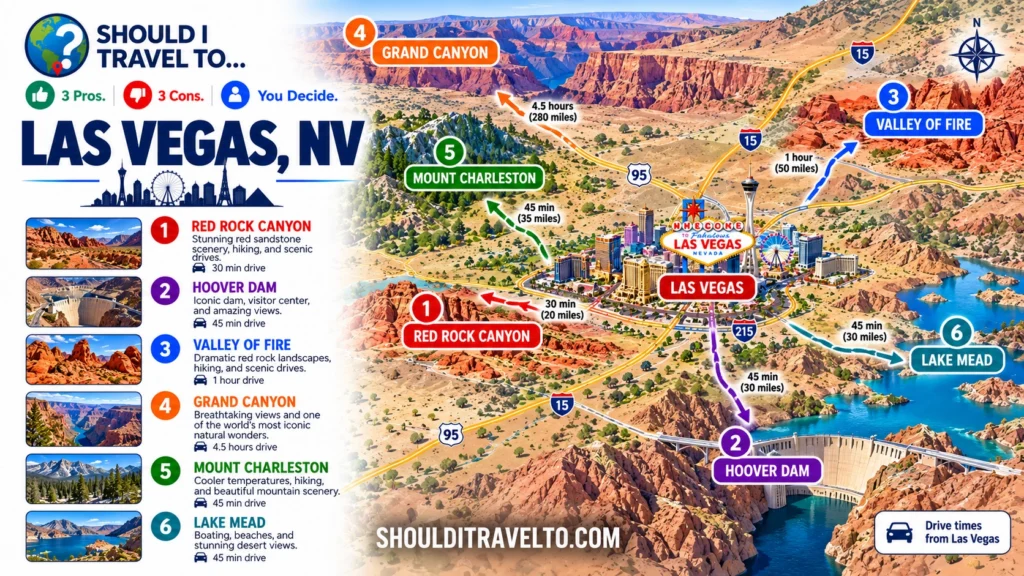
6+ Days: Add Beyond Vegas
A longer trip makes the most sense if you want to combine Las Vegas with:
- Red Rock Canyon
- Hoover Dam
- Valley of Fire
- Grand Canyon
- Lake Mead
- Mount Charleston
- Other southern Nevada destinations
Las Vegas becomes particularly useful as part of a larger Southwest road trip.
Don’t Miss
The Las Vegas Strip
The Strip is the obvious starting point.
Explore several resorts instead of spending your entire trip in one.
The architecture, interiors, fountains, attractions, restaurants, shops, and nighttime lights are part of the experience.
Fremont Street Experience
Downtown provides a very different version of Las Vegas.
Fremont Street combines neon, casinos, entertainment, bars, restaurants, and the enormous Viva Vision canopy.
It’s particularly useful if you want to understand the contrast between modern Strip Vegas and older Downtown Vegas.
The Welcome to Fabulous Las Vegas Sign
Welcome to Fabulous Las Vegas Sign is one of the city’s classic photo stops.
It’s a quick visit rather than a half-day attraction, but first-time visitors will probably want the photograph.
See a Show
Las Vegas is one of the easiest destinations in America to build an entire evening around entertainment.
Depending on the current calendar, you can find:
- Concerts
- Comedy
- Magic
- Theater
- Dance
- Residencies
- Production shows
Book major performances in advance when possible.
Experience Las Vegas From Above
An observation experience can give you a useful sense of the Strip’s scale.
High Roller is one option, while Stratosphere Tower offers another perspective from the north end of the Strip.
Eat Somewhere Memorable
Don’t make every meal an afterthought.
Las Vegas has enough restaurants that food can become a defining part of your trip.
Plan at least one meal around a restaurant you specifically want to experience.
What Makes Las Vegas’s Food Scene Different?
Las Vegas isn’t historically known as a food city.
That has changed.
The resort industry created an enormous market for restaurants, and major chefs have increasingly treated Las Vegas as a destination for ambitious restaurants.
Today you can build an entire itinerary around food.
You can have:
- Breakfast at a casual restaurant
- Lunch at a food hall
- Drinks at a cocktail bar
- A celebrity-chef dinner
- Late-night food
The important distinction is that Las Vegas food is often part of the entertainment experience.
You’re not simply going to dinner.
You may be dining inside an enormous resort, watching a performance, overlooking the Strip, or turning dinner into part of a larger night out.
Las Vegas Beyond the Strip
One of the best ways to improve a Las Vegas trip is to leave the resort corridor for at least part of the vacation.
The desert surrounding Las Vegas is a major attraction in its own right.
Depending on the season and conditions, you can explore:
- Red Rock Canyon
- Valley of Fire
- Hoover Dam
- Lake Mead
- Mount Charleston
- Mojave Desert landscapes
You can even use Las Vegas as a base for longer excursions into the Southwest.
The contrast is striking.
You can spend one evening surrounded by neon and the next morning surrounded by red rock and desert.
Las Vegas for New Year’s Eve
The Strip becomes the centerpiece on New Year’s Eve in Las Vegas.
Major resorts participate in the fireworks display, while parties, concerts, nightclubs, restaurants, and special events operate throughout the destination.
That makes Las Vegas particularly distinctive for travelers who want:
- Fireworks
- Nightlife
- Major parties
- Concerts
- Casinos
- Resort entertainment
- A massive countdown atmosphere
But New Year’s Eve also magnifies Vegas’s normal trade-offs.
Expect:
- Very large crowds
- Higher hotel demand
- Higher prices
- Transportation challenges
- Packed sidewalks
- Reservations filling early
If you’re using Las Vegas for New Year’s Eve, plan significantly earlier than you would for an ordinary weekend.
This is one destination where the event can become the entire vacation.
What Else Should You Know Before Visiting Las Vegas?
The Strip Isn’t Actually the City of Las Vegas
Much of the Las Vegas Strip is located outside the formal city limits of Las Vegas, primarily in the unincorporated communities of Paradise and Winchester.
Visitors generally don’t need to worry about the distinction when planning a vacation.
That’s why “Las Vegas” can refer to both the city and the much larger tourism area surrounding it.
Distances Are Bigger Than They Look
Don’t assume two resorts are close because they appear close on a map.
The Strip is long, and resort properties themselves can be enormous.
Build your itinerary geographically.
Resort Fees Matter
When comparing hotels, look beyond the advertised nightly rate.
Check:
- Resort fees
- Taxes
- Parking
- Deposits
- Cancellation policies
The headline room price isn’t necessarily the final price.
Vegas Can Be Loud
If you want a quiet vacation, choose your hotel and neighborhood carefully.
The Strip and Downtown can remain energetic well into the night.
You Don’t Have to Gamble
You can have a complete Las Vegas vacation without placing a single bet.
The Desert Is Not the Strip
If you want hiking or outdoor activities, plan them separately from your Strip itinerary.
Desert conditions can differ greatly from the climate inside an air-conditioned resort.
Who Should Travel to Las Vegas, Nevada?
Las Vegas Is Best For:
- First-time visitors
- Couples
- Groups of friends
- Entertainment travelers
- Food travelers
- Nightlife travelers
- Casino visitors
- Sports fans
- Concert fans
- Luxury travelers
- People who enjoy resorts
- New Year’s Eve travelers
- Weekend travelers
- Southwest road trips
Las Vegas May Not Be Ideal For:
- Travelers seeking quiet
- Travelers who dislike crowds
- Travelers who dislike nightlife
- Travelers uncomfortable around gambling
- Travelers looking for historic architecture
- Travelers who want a highly walkable traditional city
- Travelers who dislike heat
- Travelers seeking a low-cost vacation
- Travelers who want a slow-paced destination
The biggest question is whether you enjoy spectacle.
Las Vegas is designed to entertain you.
If that sounds exhausting rather than exciting, another destination may fit better.
Las Vegas for Families
Las Vegas is not traditionally thought of as a family destination, but there is much more for families than casinos.
You can find:
- Shows
- Attractions
- Pools
- Observation experiences
- Interactive attractions
- Museums
- Outdoor excursions
- Family-friendly restaurants
The important caveat is that the environment remains heavily oriented toward adults, gambling, nightlife, and alcohol.
Families should choose their resort and itinerary carefully.
For families, Las Vegas works better when you treat it as an entertainment destination rather than a casino vacation.
Las Vegas for Couples
Las Vegas can be an excellent destination for couples.
You can combine:
- Fine dining
- Shows
- Spas
- Resort pools
- Nightlife
- Shopping
- Scenic views
- Desert excursions
- Romantic dinners
The city also makes it easy to build a trip around a special occasion.
- Birthday
- Anniversary
- Proposal
- Wedding
- New Year’s Eve
Or simply a weekend away.
The downside is that Vegas isn’t particularly peaceful.
If your idea of romance is quiet beaches and secluded resorts, another destination may be a better fit.
If your idea of romance is dinner, a show, cocktails, and staying out until midnight, Vegas is a natural fit.
The Best Las Vegas Trip Depends on What You Want
Las Vegas is one of those destinations where two travelers can visit the same city and have completely different vacations.
One traveler might spend the weekend gambling. Another might see three shows.
One might eat at five restaurants. Another might spend the entire trip at a luxury resort.
Another might use Vegas as a base for exploring the desert.
That’s why the question isn’t simply: Should I Travel To Las Vegas?
It’s: What do I want Las Vegas to be?
A party destination?
A food destination?
An entertainment destination?
A resort vacation?
A New Year’s Eve destination?
Once you answer that question, planning the trip becomes much easier.
The Decision Is Yours
Las Vegas is one of the easiest destinations in America to oversimplify.
Yes, there are casinos.
But there are also restaurants, shows, resorts, sports, shopping, museums, nightlife, desert landscapes, and endless entertainment.
The Strip is the center of the experience, but Downtown and the surrounding desert add entirely different dimensions.
The trade-offs are just as real.
But if you want a city where entertainment is the destination, few places offer the same combination.
Come for the spectacle.
Stay for the food.
See a show.
Explore beyond the Strip.
And decide for yourself how much Vegas you actually want.
3 Pros. 3 Cons. You Decide.
Las Vegas, Nevada, Frequently Asked Questions
Is Las Vegas worth visiting?
Yes, particularly if you enjoy entertainment, restaurants, resorts, nightlife, shows, sports, shopping, or unusual travel experiences. Las Vegas offers considerably more than gambling.
How many days do you need in Las Vegas?
Three days is a good starting point for a first visit. Four to five days gives you more time for shows, restaurants, Downtown, attractions, and an excursion outside the resort corridor.
Is Las Vegas expensive?
It can be. Hotel rates, resort fees, restaurants, entertainment, attractions, transportation, and nightlife can add up quickly. Budget travelers can cut costs by using free attractions and choosing accommodations and dining carefully.
Do you need a car in Las Vegas?
Not necessarily if you plan to stay primarily on the Strip. Rideshare, taxis, buses, walking, and the Monorail can cover many visitor needs. A car becomes more useful for exploring outside the resort corridor.
Is Las Vegas walkable?
Parts of it are. The Strip is walkable, but its size can be deceptive. Distances between resorts can be considerable, and walking can become uncomfortable during very hot weather.
Is Las Vegas good for couples?
Yes. Restaurants, shows, resorts, spas, nightlife, shopping, and nearby desert scenery give couples many ways to structure a trip.
Is Las Vegas good for families?
It can be. Families can find shows, attractions, pools, museums, outdoor activities, and other entertainment. However, Las Vegas remains heavily oriented toward adult entertainment, gambling, nightlife, and alcohol.
Is Las Vegas good if you don’t gamble?
Absolutely. You can build an entire trip around restaurants, shows, attractions, shopping, resorts, sports, museums, and outdoor activities without gambling.
What is the Las Vegas Strip?
The Las Vegas Strip is the famous resort and entertainment corridor along Las Vegas Boulevard South. Although commonly associated with Las Vegas, much of the Strip is actually outside the city’s formal boundaries.
Is Downtown Las Vegas worth visiting?
Yes, particularly if you want a different atmosphere from the Strip. Downtown provides access to Fremont Street, historic casinos, neon, live entertainment, and a more concentrated version of old Las Vegas.
What is the best time to visit Las Vegas?
Spring and fall generally provide comfortable conditions for outdoor activities and sightseeing. Winter is also pleasant for a city vacation. Summer is the hottest period and can make outdoor activities difficult during the day.
Is Las Vegas good for New Year’s Eve?
Yes, particularly if you want a huge party atmosphere, fireworks, entertainment, nightlife, and a major countdown experience. New Year’s Eve is also one of the busiest and most expensive times to visit, so plan ahead.
Can you visit Las Vegas and the Grand Canyon on the same trip?
Yes. Las Vegas is commonly used as a base for excursions into the surrounding Southwest. The appropriate itinerary depends on which part of the Grand Canyon you want to visit and how much time you have.
Is Las Vegas a good weekend destination?
Yes. Las Vegas is especially well suited to two- or three-day trips because the concentration of hotels, restaurants, entertainment, and attractions lets you do a lot without needing a long vacation.
Is Las Vegas only for adults?
No. There are family-oriented attractions and activities, although the destination’s overall atmosphere remains strongly associated with adult entertainment, gambling, nightlife, and alcohol.