
If I’m Traveling for Winter, Where Should I Go?
Quick Answer
Yes, you should consider traveling specifically for winter if you enjoy snow, mountain scenery, skiing, snowboarding, winter activities, cozy mountain towns, après-ski, restaurants, resorts, or simply the experience of being somewhere that feels completely transformed by the season.
Some people travel for winter specifically to ski and spend the day on the slopes.
During winter travel, you can also snowshoe through a forest, explore a historic mountain town, sit by a fireplace after a long day outside, enjoy a resort, spa, or great restaurant, or travel simply to experience a snow-covered landscape.
That’s what makes winter travel different from simply traveling during winter.
Some destinations are cold places that happen to have snow.
Others make winter part of the reason to go. This guide focuses on the second group.
You’ll find destinations known for:
- Skiing and snowboarding
- Mountain scenery
- Winter activities
- Après-ski
- Food and dining
- Resorts
- Historic mountain towns
- Snow-covered landscapes
- Outdoor recreation
- Non-ski winter experiences
And the destinations aren’t all the same.
Aspen offers glamour, skiing, dining, shopping, and a sophisticated mountain-town experience.
Park City combines major skiing with a historic Main Street and a broader town experience.
Vail emphasizes a classic alpine resort atmosphere.
Jackson Hole feels more rugged and adventure-oriented.
Lake Tahoe breaks the traditional ski-town formula entirely by combining skiing with a huge alpine lake, multiple communities, and Nevada resort experiences.
Stowe offers a distinctly New England winter.
Breckenridge combines a historic mountain town with a major ski resort.
Mammoth Lakes offers a very different California winter built around the Sierra Nevada.
So there isn’t one “best” winter destination.
The better question is: What kind of winter do you want?
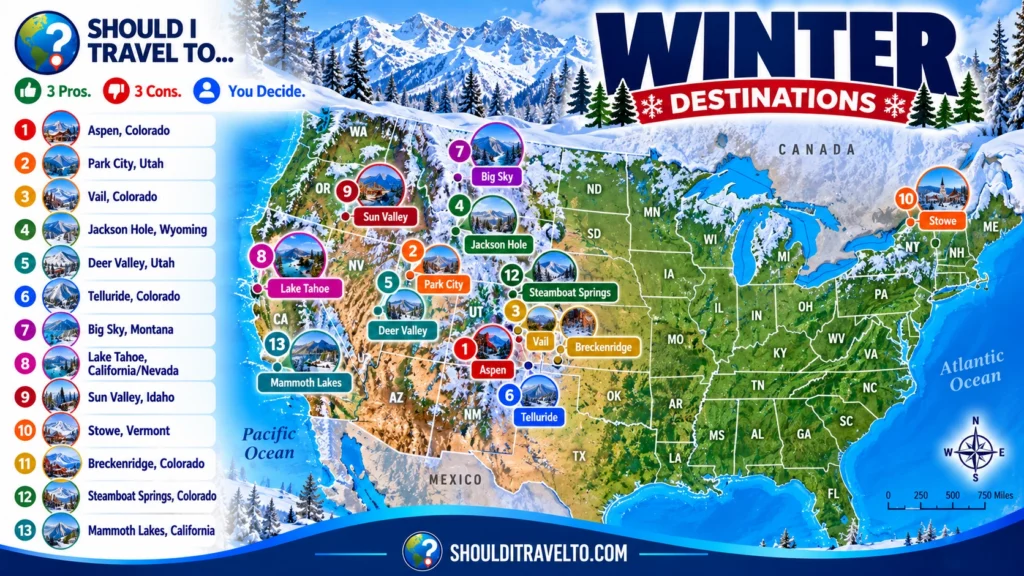
The Best Winter Destinations at a Glance
Winter means something different at each destination. Some focus on skiing, some on the town, and some on the landscape beyond the slopes.
| Destination | Best For | Winter Identity |
| Aspen, Colorado | Luxury & glamour | Skiing + dining + shopping + mountain town |
| Park City, Utah | All-around winter trip | Skiing + historic Main Street + activities |
| Vail, Colorado | Classic ski resort | Skiing + alpine village + luxury |
| Jackson Hole, Wyoming | Adventure | Skiing + Tetons + wilderness |
| Deer Valley, Utah | Premium resort experience | Upscale skiing + dining + service |
| Telluride, Colorado | Remote mountain escape | Skiing + historic town + scenery |
| Big Sky, Montana | Wilderness + skiing | Huge mountain + winter adventure |
| Lake Tahoe, California/Nevada | Winter variety | Skiing + lake + casinos + scenery |
| Sun Valley, Idaho | Sophisticated mountain town | Skiing + town charm + quieter atmosphere |
| Stowe, Vermont | New England winter | Skiing + village + classic winter setting |
| Breckenridge, Colorado | Historic ski town | Skiing + historic Main Street |
| Steamboat Springs, Colorado | Western winter | Skiing + hot springs + Western character |
| Mammoth Lakes, California | California winter | Skiing + snow + Sierra Nevada |
These destinations offer several answers to the same question: Where should I go when I want winter itself to be part of the vacation?
What Makes a Great Winter Destination?
For many travelers, a great winter destination is more than a place with a ski mountain.
The best destinations give you reasons to visit even when you’re not attached to skis or a snowboard.
You might want:
- Excellent skiing
- A memorable mountain landscape
- A walkable or distinctive town
- Restaurants worth traveling for
- Après-ski
- Snowshoeing or Nordic skiing
- Sledding and tubing
- Winter sightseeing
- Spa and resort experiences
- Activities for families
- Things to do when the weather isn’t cooperating
Winter vacations are weather-dependent.
A strong winter destination gives you options when temperatures drop, snow gets heavy, or you simply don’t want to spend another six hours outside.
And that’s why this guide isn’t simply ranking ski resorts. It’s looking at the entire winter vacation.
The 3 Biggest Reasons to Travel for Winter
Winter travel comes with a unique advantage: the season itself becomes part of the destination. You’re not simply tolerating the cold to get somewhere else. You’re traveling because you want to experience what that destination becomes in winter.
1. Winter Can Transform the Destination
A familiar mountain town can feel completely different once snow arrives.
The landscape changes. The pace changes.
Outdoor activities change.
Restaurants and lodges take on a different atmosphere.
And places that might be pleasant in summer can become extraordinary in winter.
That’s especially true in destinations like Aspen, Stowe, Telluride, and Breckenridge, where the town and surrounding mountains work together to create a distinctly seasonal experience.
2. You Can Build a Vacation Around More Than Skiing
Skiing is obviously a major reason people travel in winter. But it doesn’t have to be the reason everyone travels.
You can:
- Snowshoe
- Go cross-country skiing
- Take a sleigh ride
- Relax at a spa
- Explore a mountain town
- Enjoy après-ski
- Go shopping
- Eat at destination restaurants
Or simply take in the scenery.
Many of the strongest winter destinations offer plenty of activities beyond downhill skiing. Park City, Big Sky, Jackson Hole, and Mammoth Lakes, for example, all provide a range of winter activities beyond the main ski slopes.
That makes winter travel much more accessible to mixed groups.
3. Winter Can Create a Vacation You Can’t Reproduce in Another Season
Some destinations have strong seasonal identities.
Lake Tahoe in July and Lake Tahoe in January feel like two different vacations.
Mammoth Lakes in summer and winter offer completely different recreational environments.
Stowe’s winter landscape creates an entirely different atmosphere from its fall foliage season.
A ski town like Aspen becomes a destination built around snow, not just a mountain town.
That’s part of the appeal.
You’re traveling for a version of the destination that only exists for part of the year.
The 3 Biggest Downsides of Traveling for Winter
Winter travel can be spectacular, but the season creates practical trade-offs that you don’t face during warmer-weather vacations.
1. Winter Weather Can Disrupt Your Plans
Snow is part of why you’re traveling. It can also change your travel plans.
- Flights can be delayed
- Mountain roads can become difficult
- Ski areas can close temporarily
- Outdoor activities can be canceled
A beautiful winter storm can make a destination much harder to reach.
That’s not necessarily a reason to avoid winter travel. It simply means flexibility matters more.
Leave some room in the itinerary. Check road conditions. Allow extra travel time.
And don’t build your entire vacation around one activity that depends on perfect weather.
2. Winter Vacations Can Be Expensive
Many of the country’s best winter destinations are also premium tourism destinations.
Hotels, ski passes, equipment rentals, dining, and transportation can become expensive.
Aspen and Deer Valley are the obvious premium examples, but even destinations with broader price ranges can become expensive during Christmas, New Year’s, holiday weekends, and peak ski periods.
Winter travel doesn’t have to be luxurious.
But the most desirable dates often come at a premium.
3. You Don’t Have to Be a Skier, But Winter Still Requires More Planning
You may not ski at all, but snow still affects your vacation.
You need to think about:
- Clothing
- Transportation
- Road conditions
- Parking
- Weather
- Activity reservations
And what you’ll do if outdoor conditions change.
The best winter destinations solve some of this problem by offering plenty of alternatives.
But don’t plan a snow destination like a summer vacation. Winter requires a little more preparation.
What Kind of Winter Vacation Do You Want?
The right destination depends less on how much snow you want and more on what you want to do with the snow.
The Luxury Winter Vacation
Choose Aspen or Deer Valley if you want skiing combined with upscale lodging, restaurants, après-ski, service, and resort amenities.
You’re not simply booking a mountain. You’re booking an entire winter experience.
The trade-off is cost.
These destinations make sense when the resort and town experience matters as much as the skiing.
The Classic Ski-Resort Vacation
Choose Vail if you want the classic American ski-resort vacation.
You get major ski terrain, an alpine-style pedestrian village, restaurants, shopping, lodging, and a highly developed resort environment.
Vail is especially appealing if you want skiing as the centerpiece but don’t want the trip to feel isolated from a traditional resort town.
The Historic Mountain Town
Choose Breckenridge, Stowe, or Sun Valley if the town itself matters almost as much as the mountain.
These destinations have distinctive communities that give winter travel a stronger sense of place.
You can ski during the day and still have somewhere interesting to walk, eat, shop, and explore afterward.
The Adventure and Wilderness Vacation
Choose Jackson Hole, Telluride, or Big Sky for a stronger connection to dramatic landscapes and outdoor adventure.
These destinations can feel more rugged and wilderness-oriented than the polished resort experience associated with some of the larger luxury destinations.
The scenery becomes part of the attraction.
The Winter Destination That Breaks the Ski-Town Formula
Choose Lake Tahoe if you don’t want your winter vacation to be defined entirely by skiing.
Tahoe combines mountains, snow, skiing, a huge alpine lake, multiple communities, restaurants, resorts, and Nevada casinos.
You can ski, snowboard, explore the lake, visit a casino, or simply enjoy the mountain landscape.
Tahoe is a great choice for travelers who want winter without fully committing to ski culture.
The California Winter
Choose Mammoth Lakes if you want a major winter destination without leaving California.
Mammoth combines substantial snowfall and mountain recreation with the Eastern Sierra’s distinct identity.
It’s especially useful for travelers who want skiing and snow without traveling to Colorado, Utah, Wyoming, or Montana.
Winter Destinations
Aspen, Colorado: Best for Luxury and Glamour
Aspen best shows that a winter vacation doesn’t have to be only about skiing.
The mountains are obviously central.
But Aspen is also a town with restaurants, shopping, lodging, nightlife, cultural attractions, and a sophisticated atmosphere.
You can ski during the day and explore downtown at night. And if you’re traveling with someone who doesn’t ski, Aspen offers plenty of alternatives.
That’s what makes Aspen different.
The destination remains interesting even when you’re not on the mountain.
Choose Aspen if you want: Luxury, dining, skiing, shopping, après-ski, and a famous mountain-town atmosphere.
Think twice if you want: A budget winter vacation or don’t care about upscale resort amenities.
Park City, Utah: Best All-Around Winter Destination
Park City offers major skiing. Deer Valley is nearby.
It has a historic Main Street and offers restaurants and après-ski options.
Winter activities extend beyond skiing, giving Park City particularly broad appeal.
You can build a trip around skiing and still enjoy a substantial off-mountain town experience.
It’s also one of the easier destinations to combine into a larger Utah trip.
Choose Park City if you want: Skiing + historic town + dining + winter activities.
Think twice if you want: The most remote or wilderness-oriented winter experience.
Vail, Colorado: Best for the Classic Alpine Resort
Vail represents the traditional upscale American ski-resort vacation.
The mountain is enormous.
The village is deliberately alpine.
Much of the experience is designed to make the resort itself part of the vacation.
You can spend the morning skiing, the afternoon walking through Vail Village, and the evening at a restaurant or après-ski spot.
That’s a very different proposition from a destination where the mountain is the only reason to visit.
Choose Vail if you want: Major skiing, an alpine village, convenience, dining, and a polished resort experience.
Think twice if you want: A small-town or rugged mountain atmosphere.
Jackson Hole, Wyoming: Best for Adventure
Jackson Hole offers a different personality.
The mountains feel bigger.
The scenery feels more dramatic.
The overall experience leans more toward adventure and wilderness.
You can ski, but the broader appeal also includes the Tetons and the surrounding outdoor environment.
Winter activities extend beyond the slopes.
That gives Jackson Hole a strong identity for travelers who want a winter vacation that feels like an adventure rather than a resort stay.
Choose Jackson Hole if you want: Challenging outdoor experiences, dramatic scenery, skiing, and a Western atmosphere.
Think twice if you want: A compact, easygoing resort vacation.
Deer Valley, Utah: Best for a Premium Resort Experience
Deer Valley is useful on this list because it represents a particularly refined version of the winter ski vacation.
The emphasis is not simply on getting down the mountain.
The resort experience matters.
Skiing, grooming, dining, lodging, service, and après-ski all matter.
For travelers who care about the quality of the entire experience around the skiing, that distinction matters.
Choose Deer Valley if you want: Upscale skiing, service, dining, and a refined resort atmosphere.
Think twice if you: Prefer a casual or budget-oriented mountain vacation.
Telluride, Colorado: Best for a Distinctive Mountain Town
Telluride has one of the strongest senses of place on this list.
The mountains are dramatic.
The town is historic.
The destination feels more removed from the mainstream resort corridor than places like Vail.
That remoteness is part of the appeal.
Telluride can feel like you’re traveling specifically to experience the town and mountains, not just to visit a large ski resort.
Choose Telluride if you want: Historic character, dramatic scenery, skiing, and a more remote getaway.
Think twice if you want: Easy access, a large urban-style tourism infrastructure, or the widest range of transportation options.
Big Sky, Montana: Best for Wilderness and Scale
Big Sky combines a huge mountain environment with a distinctly Montana setting.
The winter experience is about more than downhill skiing.
Depending on conditions, visitors can also snowshoe, Nordic ski, snowmobile, dog-sled, skate, or simply enjoy the snowy landscape.
That variety makes Big Sky especially appealing to travelers who want winter adventure without spending every day on a ski lift.
The setting also provides a strong sense of wilderness.
Choose Big Sky if you want: Large-scale skiing, outdoor adventure, Montana scenery, and a more wilderness-oriented vacation.
Think twice if you: Prefer a historic downtown or highly urbanized destination.
Lake Tahoe, California/Nevada: Best for Winter Variety
Lake Tahoe is perhaps the most important destination on this list for preventing the page from becoming a list of ski resorts.
Tahoe has skiing. But it also has:
- An enormous alpine lake
- Multiple mountain communities
- Resorts
- Restaurants
- Casinos
- Winter scenery
- Outdoor recreation
That means you can build several different kinds of vacations around the same destination.
A skier can spend the day on the mountain.
A non-skier can explore the lake or relax at a resort.
And the Nevada side adds an entirely different entertainment experience.
Choose Lake Tahoe if you want: Skiing + lake scenery + resorts + casinos + winter variety.
Think twice if you want: A compact ski-town experience or dislike driving between different parts of the region.
Sun Valley, Idaho: Best for a Sophisticated but Quieter Winter
Sun Valley offers a different version of the upscale winter vacation.
It’s sophisticated without being as overtly flashy as Aspen.
The town has charm.
The mountain has history.
And the destination can feel more relaxed.
That makes Sun Valley particularly appealing to travelers who want excellent skiing and dining without necessarily wanting the most intense luxury-resort atmosphere.
It’s a classic winter destination with a strong sense of place.
Choose Sun Valley if you want: Skiing, dining, mountain-town charm, and a more understated winter experience.
Think twice if you want: The most concentrated nightlife and entertainment.
Stowe, Vermont: Best for New England Winter
Stowe brings something essential to the pillar: a distinctly New England version of winter.
The landscape, architecture, village atmosphere, inns, restaurants, and mountain setting create a very different experience from Colorado, Utah, Wyoming, or Montana.
And you don’t need to ski for Stowe to make sense.
You can explore the village, enjoy restaurants and local shops, take in the scenery, and experience the winter atmosphere.
For travelers who picture winter as snow-covered New England rather than a giant Western ski resort, Stowe is one of the strongest choices.
Choose Stowe if you want: New England character, skiing, village atmosphere, and a classic winter setting.
Think twice if you want: Enormous Western ski terrain or a sprawling resort destination.
Breckenridge, Colorado: Best for a Historic Ski Town
Breckenridge combines two things that don’t always come together easily:
A major ski resort.
And a genuine historic mountain town.
The result is a destination that can satisfy serious winter travelers without feeling entirely built around the ski resort.
The historic downtown gives you somewhere to walk after skiing, with restaurants, shops, lodging, and a distinctive mountain-town atmosphere.
That makes Breckenridge particularly strong for travelers who want a balance between skiing and town life.
Choose Breckenridge if you want: Skiing + historic downtown + restaurants + a lively mountain town.
Think twice if you want: The exclusivity of a smaller premium resort or the remoteness of a wilderness destination.
Steamboat Springs, Colorado: Best for Western Character and Hot Springs
Steamboat Springs offers another distinctly different Colorado winter experience.
Instead of feeling like a polished international ski resort, it retains more of a Western identity.
And there’s another major attraction: Hot springs.
That gives the destination a useful combination of snow and relaxation.
You can spend the day skiing or enjoying other winter activities, then switch to a completely different experience afterward.
For travelers who want winter with some personality beyond the ski mountain, Steamboat is particularly compelling.
Choose Steamboat if you want: Skiing, hot springs, Western character, and a less conventional Colorado experience.
Think twice if you want: The most glamorous resort atmosphere.
Mammoth Lakes, California: Best California Winter Destination
Mammoth Lakes provides one of the strongest reasons for California travelers to think beyond the usual winter destinations.
The Eastern Sierra becomes a major winter snow destination, with skiing, snowboarding, snowshoeing, cross-country skiing, tubing, sledding, snowmobiling, and more.
The landscape is distinctly Californian, even when it’s covered in snow.
That makes Mammoth a great choice for travelers who want a serious winter vacation without leaving the state.
Choose Mammoth Lakes if you want: Major California skiing, snow, outdoor recreation, and Sierra Nevada scenery.
Think twice if you want: A traditional village-centered ski vacation.
Planning Your Winter Destination Trip
Winter Without Skiing
You don’t have to ski to enjoy winter.
In fact, some travelers may prefer a destination where skiing is simply one of many options.
At Park City, you can explore Main Street, snowshoe, take a sleigh ride, or enjoy restaurants and après-ski without spending the entire day on the mountain.
At Jackson Hole, winter sightseeing, snowmobiling, sleigh rides, and other activities provide alternatives to skiing.
Big Sky adds Nordic skiing, snowshoeing, dog sledding, snowmobiling, and ice skating.
Mammoth Lakes offers snowshoeing, Nordic skiing, tubing, sledding, snowmobiling, and other winter activities.
And Lake Tahoe is especially flexible because the lake, resorts, restaurants, casinos, scenic landscapes, and multiple communities create a vacation that doesn’t have to revolve around a ski lift.
Before booking a winter destination, ask: What will I do if I don’t ski today?
The answer says a lot about the destination’s quality for your trip.
The Best Winter Destination for Families
Families need more than a great mountain.
They need activities for different ages, alternatives for when children don’t want to ski, restaurants that work for groups, and plenty to do beyond the main attraction.
Park City stands out because skiing, Main Street, winter activities, dining, and family attractions overlap.
Breckenridge works well because the historic downtown gives families somewhere to explore beyond the mountain.
Big Sky offers a wide range of winter activities beyond skiing.
Lake Tahoe offers unusual flexibility because families can combine skiing with other winter recreation, resorts, and the lake environment.
Mammoth Lakes is another strong option for families who want a California winter.
The Best Winter Destination for Couples
For couples, the decision may be more about atmosphere than skiing.
Aspen is ideal for couples who want luxury, restaurants, shopping, après-ski, and a sophisticated mountain-town experience.
Telluride suits couples who want dramatic scenery and a more secluded feel.
Stowe offers New England charm and a more intimate winter atmosphere.
Sun Valley is especially appealing if you want sophistication without Aspen’s intensity.
Steamboat Springs adds hot springs and Western character.
Lake Tahoe can work for couples who want skiing, scenery, resorts, and a large lake.
The best couples destination isn’t necessarily the most luxurious. It’s the one that matches the kind of winter atmosphere you both enjoy.
The Best Winter Destination for Food
Winter vacations and food pair especially well. After a day outdoors, a great dinner suddenly matters more.
Aspen and Vail are especially strong for travelers who want upscale dining as part of the resort experience.
Park City combines skiing with a substantial restaurant scene.
Telluride and Sun Valley offer a more intimate mountain-town dining experience.
And Lake Tahoe provides unusual variety because you’re choosing among several communities and resort areas.
Don’t let food be an afterthought on a winter trip. You’ll spend more time indoors than you might on a summer vacation.
Make some of that time delicious.
The Best Winter Destination for a Short Trip
For a two- or three-day winter escape, proximity and convenience matter more.
Park City works especially well for a relatively straightforward mountain getaway.
Vail is designed around a concentrated resort experience.
Breckenridge can deliver skiing and a town experience without requiring an enormous itinerary.
Stowe works particularly well for Northeast travelers who want a classic New England winter.
And Mammoth Lakes can be especially useful for California travelers looking for a winter escape.
The farther you have to travel, the more important it becomes to stay long enough to justify the trip.
Premium Winter Destinations vs. Broader Winter Destinations
Not every winter destination on this list costs the same.
Aspen, Deer Valley, and Vail suit travelers who want premium resort experiences.
Telluride, Jackson Hole, and Big Sky also offer high-end winter vacations that emphasize scenery and adventure.
Meanwhile, Breckenridge, Steamboat Springs, Stowe, Sun Valley, Lake Tahoe, and Mammoth Lakes provide different ways to experience winter without making luxury the entire editorial premise.
A great winter vacation doesn’t have to mean the most expensive hotel or the most prestigious ski resort.
Sometimes the best trip is simply the one that gives you the winter experience you actually want.
When Is the Best Time to Travel for Winter?
There isn’t one universal “best” winter travel period.
The season varies significantly by destination, and the best time depends on whether you’re prioritizing snow conditions, lower prices, a holiday atmosphere, or quieter travel.
Early Winter
Early winter offers a strong mix of fresh snow and holiday atmosphere.
Christmas markets, decorations, seasonal events, and the anticipation of ski season can all make December particularly appealing.
The trade-off is that snow conditions can vary early in the season.
Christmas and New Year’s
This is one of the most atmospheric periods to visit.
- Mountain towns are decorated
- Resorts are active
- Après-ski is lively
And the entire destination can feel like a winter postcard.
It’s also one of the busiest and most expensive times to visit.
January
January can be an excellent month for travelers focused primarily on winter recreation.
The holiday rush has passed, while winter conditions remain central to the destination experience.
Depending on the year and destination, this can provide a useful balance between winter atmosphere and post-holiday travel.
February
February remains firmly within the heart of ski season across much of the country.
It can also appeal especially to couples and travelers seeking a romantic winter getaway.
Holiday weekends, however, can create significant demand.
March and Early Spring
March can provide a completely different winter experience.
- Longer days
- More sunshine
- Warmer afternoons
And, in many destinations, continued snow activities.
The season begins to transition toward spring, but many mountain destinations remain firmly in winter mode.
For travelers who want skiing combined with more comfortable outdoor conditions, late winter and early spring can be particularly attractive.
How Many Days Do You Need?
The ideal length depends on how far you’re traveling and how central winter activities are to the trip.
2 Days: Quick Winter Escape
Two days can work if you live relatively close to your destination and want a simple mountain getaway.
Focus on one area.
Don’t try to ski every resort or see everything.
3–4 Days: Best for Most Winter Weekends
Three or four days gives you enough time to ski or do another major winter activity while still leaving time for restaurants, après-ski, town exploration, and relaxation.
This is probably the sweet spot for a short winter trip.
5–7 Days: Full Winter Vacation
A longer stay makes sense when you’re traveling farther, skiing multiple days, or intentionally building a broader winter vacation.
You’ll have enough time to fit in non-ski activities and recover between longer outdoor days.
7+ Days: Slow Winter Travel
A week or longer is particularly appealing at destinations such as Aspen, Park City, Lake Tahoe, Jackson Hole, or Big Sky, where there is enough variety to avoid repeating the same experience every day.
A longer winter vacation should not mean scheduling more activities.
It can simply mean having more time to enjoy the destination.
How to Plan a Winter Trip
Winter travel requires a little more logistical planning than a typical summer vacation.
Book lodging early if you’re traveling during Christmas, New Year’s, holiday weekends, or other peak periods.
Then think about transportation.
- Will you need a rental car?
- Can you use a shuttle?
- Will you be driving through mountain passes?
- Are parking reservations necessary?
Then consider your winter activities.
If skiing is your priority, look at lift tickets, equipment rentals, lessons, and transportation before you arrive.
If you don’t ski, identify your alternatives in advance.
And finally, leave some flexibility.
Winter weather can change your itinerary. A good winter vacation isn’t one where every minute is scheduled.
It’s one where you have enough options to adapt.
Winter Driving: What Should You Know?
A winter destination can look close on a map and still be surprisingly difficult to reach.
- Mountain roads can be covered in snow and ice
- Road closures can occur
- Chains or traction devices may be required
- And conditions can change quickly
Before a winter road trip, check official road conditions and weather forecasts rather than relying solely on a standard navigation app.
And don’t underestimate how much longer a mountain drive can take in snow.
The safest itinerary gives you enough time and flexibility to travel based on conditions rather than a rigid schedule.
Which Winter Destination Should You Choose?
The easiest way to choose is to match the destination to the vacation you actually want.
Choose:
- Aspen if you want luxury, dining, shopping, skiing, nightlife, and a famous mountain-town atmosphere
- Park City if you want one of the best balances of skiing, town life, restaurants, and winter activities.
- Vail if you want a classic, polished alpine-resort experience
- Jackson Hole if you want dramatic scenery, adventure, and a stronger wilderness feeling
- Deer Valley if you want premium skiing, service, dining, and resort amenities
- Telluride if you want a distinctive historic town surrounded by dramatic mountains
- Big Sky if you want scale, outdoor adventure, and Montana wilderness
- Lake Tahoe if you want skiing plus a huge lake, multiple communities, resorts, and more variety beyond the slopes
- Sun Valley if you want sophisticated skiing and a quieter, classic mountain-town atmosphere
- Stowe if you want a New England winter experience with skiing and village character
- Breckenridge if you want a major ski resort combined with a historic mountain town
- Steamboat Springs if you want skiing, hot springs, and Western character
- Mammoth Lakes if you want a serious California winter vacation surrounded by Sierra Nevada scenery
Can You Combine Winter Destinations?
You can, but winter vacations aren’t automatically better just because you visit more than one mountain.
Moving between destinations adds transportation time, weather risk, hotel changes, and logistical complexity.
A combined trip works best when the destinations are close enough to make the move worthwhile or when the contrast between them is part of the attraction.
For example, Park City + Deer Valley naturally combine because they’re part of the same broader winter destination area.
A Colorado itinerary could potentially combine Breckenridge + Vail, although travelers should consider whether the additional travel time actually improves the trip.
A broader California winter trip could connect Mammoth Lakes with other Sierra destinations, depending on road and seasonal conditions.
For most travelers, one great winter destination beats two mediocre ones.
Winter vs. Summer Mountain Travel
One reason to choose a winter destination is that you’re experiencing the mountains in their most dramatically transformed state.
Summer mountain travel gives you:
- Hiking
- Mountain biking
- Lakes
- Wildflowers
- Longer days
- Warmer temperatures
Winter gives you:
- Snow
- Skiing
- Snowboarding
- Snowshoeing
- Winter landscapes
- Après-ski
- Cozy restaurants
- Snow-covered mountain town
Neither season is inherently better. They’re simply different versions of the same destination.
Some travelers will discover they prefer the winter version.
The Best Winter Trip Isn’t Necessarily the Best Ski Trip
A ski resort can have incredible terrain and still be a poor vacation choice.
Maybe you’re traveling with someone who doesn’t ski, or you care more about food.
Maybe you want a historic town or a spa.
Some travelers want a romantic getaway, or simply want to see snow-covered mountains.
That’s why the right question isn’t: “Where is the best skiing?”
It’s: “Where can I have the best winter vacation?”
Those aren’t necessarily the same thing.
The Decision Is Yours
Winter travel is unusual because what makes the trip harder is also why you’re going.
Snow can delay your flight, and cold can make walking difficult.
But winter can also transform a destination.
A mountain town becomes a snow-covered escape, and a ski resort becomes a complete vacation.
Choose Aspen if you want glamour.
Park City if you want balance.
Vail if you want a classic resort.
Jackson Hole if you want adventure.
Telluride if you want character.
Big Sky if you want wilderness.
Lake Tahoe if you want variety.
Stowe if you want New England.
Breckenridge if you want history and skiing.
Steamboat Springs if you want Western character and hot springs.
Mammoth Lakes if you want snow or to visit a California destination.
And choose Deer Valley or Sun Valley if the quality of the mountain-town experience matters as much as the skiing itself.
You don’t have to be a skier. You don’t have to spend every day outside.
And you don’t have to choose the most expensive destination.
You simply need to choose the version of winter you actually want.
Come for the snow. Stay for the mountains.
3 Pros. 3 Cons. You Decide.
Winter Destinations Frequently Asked Questions
What are the best winter destinations in the United States?
The best winter destination depends on what you want from the trip. Aspen, Park City, Vail, Jackson Hole, Deer Valley, Telluride, Big Sky, Lake Tahoe, Sun Valley, Stowe, Breckenridge, Steamboat Springs, and Mammoth Lakes each offer a different kind of winter vacation.
What is the best winter destination if you don’t ski?
Lake Tahoe, Park City, Aspen, Big Sky, Jackson Hole, and Mammoth Lakes are especially good because they offer plenty of winter activities and experiences beyond downhill skiing. The right choice depends on whether you prefer a resort, a mountain town, a wilderness setting, or a broader outdoor destination.
What is the best winter destination for skiing?
There isn’t one universal answer. Vail, Aspen, Park City, Deer Valley, Jackson Hole, Big Sky, Telluride, Breckenridge, and Mammoth Lakes are all strong choices, but each offers a different mix of terrain, town atmosphere, price, and resort experience.
What is the best winter destination for families?
Park City, Breckenridge, Big Sky, Lake Tahoe, and Mammoth Lakes offer broad options for travelers who don’t ski every day. Family preferences, children’s ages, lodging, and budget should determine the final choice.
What is the best winter destination for couples?
Aspen, Telluride, Stowe, Sun Valley, Lake Tahoe, and Steamboat Springs appeal to couples, but each offers a different atmosphere. Aspen emphasizes luxury, Telluride emphasizes scenery and character, Stowe emphasizes New England charm, and Lake Tahoe combines winter recreation with a much broader landscape.
What is the best winter destination for a romantic getaway?
That depends on the style of romance you want. Choose Aspen for luxury and dining, Stowe for a New England atmosphere, Telluride for dramatic scenery, Sun Valley for an understated mountain-town experience, or Lake Tahoe for mountains, resorts, and lake scenery.
Where is the best place to go for winter if you don’t want to ski?
Look for destinations where the town and surrounding landscape are attractions in their own right. Park City, Aspen, Stowe, Lake Tahoe, Big Sky, and Jackson Hole all offer plenty of alternatives to downhill skiing.
Is winter travel expensive?
It can be. Many popular winter destinations charge premium prices for lodging, ski passes, equipment rentals, restaurants, and transportation. Prices are generally highest around Christmas, New Year’s, holiday weekends, and other peak periods.
When is the best time to travel for winter?
December through early spring can all offer strong winter experiences, but the best period depends on your priorities. December offers a holiday atmosphere, January can provide a post-holiday winter experience, February remains firmly in ski season, and March can bring longer days and a transition toward spring.
Do you need a car for a winter vacation?
Not always. Some resort destinations offer shuttles and other transportation, while others are easier to get around without a vehicle. Whether you need a car depends on where you’re staying, whether you’re exploring multiple areas, and the winter road conditions at your destination.
Is winter driving difficult?
It can be. Snow, ice, mountain passes, road closures, and changing conditions can make winter driving much harder than summer driving. Check official road conditions and weather forecasts before traveling and allow extra time.
What should I pack for a winter destination?
Pack for the actual conditions rather than simply assuming every winter destination requires the same clothing. Layers, waterproof outerwear, warm footwear, gloves, and appropriate cold-weather accessories are useful for many destinations. Skiers and other outdoor travelers will also need gear specific to their activities.
Which winter destination has the best mountain-town atmosphere?
That depends on the style you prefer. Aspen is sophisticated, Breckenridge is historic and lively, Stowe feels distinctly New England, Sun Valley is more understated, Telluride is remote and dramatic, and Steamboat Springs has a stronger Western identity.
Which winter destination is best for luxury?
Aspen and Deer Valley are particularly strong choices for travelers who want premium lodging, dining, service, and resort experiences. Vail and Telluride also offer high-end winter vacations.
Which winter destination is best for a California traveler?
Lake Tahoe and Mammoth Lakes are the most obvious choices. Tahoe offers skiing, the lake, multiple communities, resorts, and entertainment in Nevada. Mammoth offers a more focused Sierra Nevada winter experience.
Can you enjoy a winter destination without skiing or snowboarding?
Absolutely. Depending on the destination, you can snowshoe, cross-country ski, take scenic excursions, go tubing or sledding, explore the town, visit restaurants and shops, relax at a spa, enjoy après-ski, or simply experience the snowy landscape.
Should I choose a winter destination based on skiing or the overall trip?
The overall trip. Skiing can be the main reason to choose a destination, but your vacation also includes where you stay, what you do after skiing, what non-skiers can do, how easy the destination is to navigate, what the restaurants are like, and whether you actually enjoy the atmosphere.
What is the most important question to ask before booking a winter destination?
Ask yourself: “What will I do here if I don’t ski today?”
The answer can tell you whether you’re choosing a great ski mountain or a great winter destination.