
Should You Visit the Great Smoky Mountains in Tennessee and North Carolina for Fall Foliage?
Quick Answer
Yes, you should travel to Great Smoky Mountains National Park for fall foliage if you want colorful mountain scenery, scenic drives, hiking, waterfalls, wildlife, historic valleys, and one of the longest autumn color seasons of any major American fall destination.
Straddling the border between Tennessee and North Carolina, Great Smoky Mountains National Park protects a vast landscape of forested mountains, deep valleys, streams, waterfalls, historic structures, and scenic overlooks.
And in autumn, that landscape changes dramatically.
Unlike destinations where fall color peaks within a relatively narrow window, the Smokies experience a gradual progression of fall color from the highest elevations down into the valleys.
Color can begin appearing at the highest elevations as early as mid-September. From early to mid-October, fall colors typically develop above 4,000 feet. The most brilliant color at middle and lower elevations commonly occurs from mid-October into early November.
That creates one of the Smokies’ greatest advantages:
Fall foliage doesn’t happen everywhere at once.
It moves down the mountains.
For travelers who want dramatic Appalachian scenery and multiple ways to experience autumn, from scenic drives and mountain overlooks to hiking, waterfalls, wildlife, and historic valleys, the Great Smoky Mountains are one of America’s strongest fall foliage destinations.
What Is Great Smoky Mountains National Park?
Understanding the geography makes a Great Smoky Mountains vacation much easier to plan, especially because several similar names are commonly used to describe the region.
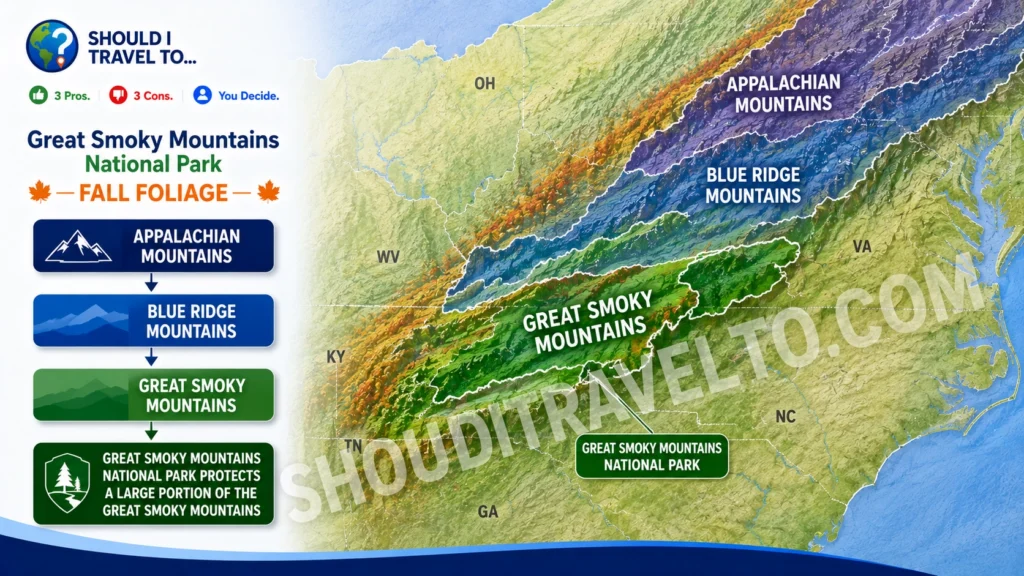
The Great Smoky Mountains are a mountain range along the Tennessee–North Carolina border. They’re part of the southern Appalachian Mountains and are associated with the broader Blue Ridge mountain region.
Great Smoky Mountains National Park protects a large portion of this mountain landscape, encompassing more than 800 square miles across Tennessee and North Carolina.
The simplest distinction is:
The Great Smoky Mountains are the mountains.
Great Smoky Mountains National Park is the national park protecting much of them.
The Smokies
And when travelers refer simply to “the Smokies,” they may be talking about the mountains, the national park, or the surrounding tourism region more generally.
That surrounding region extends beyond the national park itself. Popular gateway communities such as Gatlinburg, Townsend, Cherokee, and Bryson City are outside the park, even though they’re commonly included when travelers talk about taking a vacation to the Smokies.
The park itself isn’t built around one mountain, viewpoint, or central attraction. Instead, visitors explore a vast mountain landscape through roads, valleys, trails, overlooks, streams, waterfalls, historic areas, and dramatically different elevations.
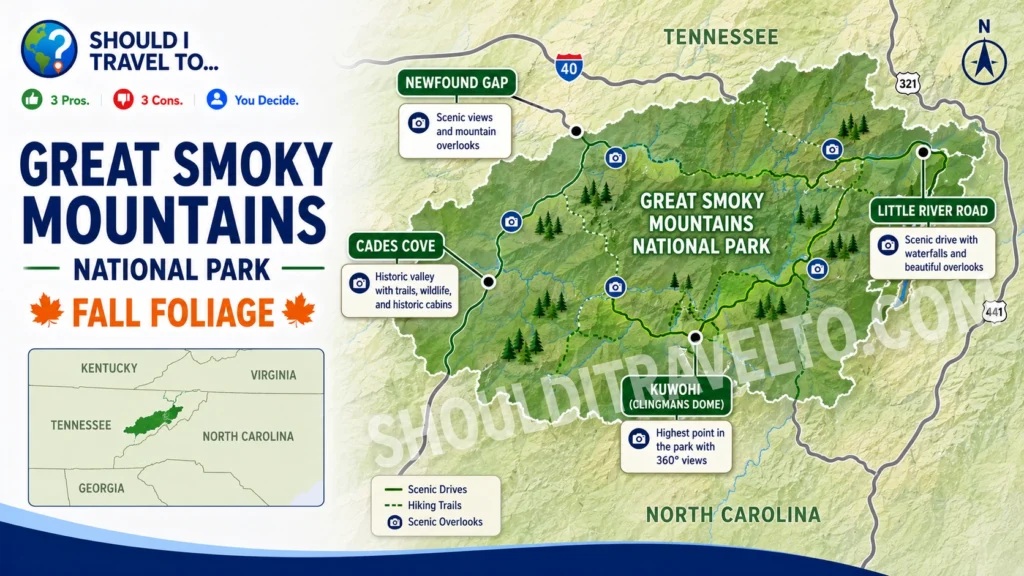
Some of the best-known areas include:
- Cades Cove
- Newfound Gap
- Kuwohi
- Little River Road
- Roaring Fork
- Cataloochee
- Deep Creek
- Elkmont
- Oconaluftee
- Sugarlands
Where you stay can therefore shape your trip.
Gatlinburg provides convenient access to many of the park’s most popular areas. Townsend offers a quieter Tennessee base with convenient access to Cades Cove. Cherokee is a major gateway to the North Carolina side, while Bryson City works particularly well for travelers exploring Deep Creek or combining the park with a broader western North Carolina trip.
The Smokies are also connected to another famous Southern Appalachian fall destination: the Blue Ridge Parkway.
But they’re not the same thing.
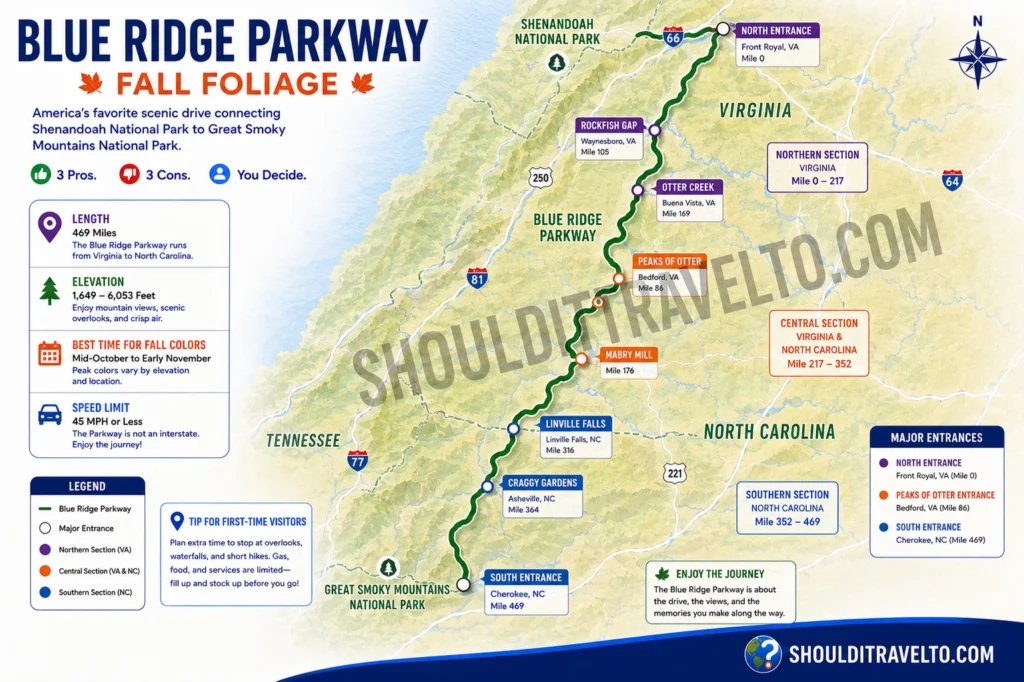
The Blue Ridge Parkway is a 469-mile scenic road through Virginia and North Carolina. The Great Smoky Mountains are a mountain range, and Great Smoky Mountains National Park protects much of that mountain landscape.
The Blue Ridge Parkway reaches its southern end near Cherokee at the entrance to Great Smoky Mountains National Park, so travelers can easily combine the two into a longer Southern Appalachian fall road trip.
And during fall, understanding all of this geography becomes especially important for one reason:
Elevation largely determines where you’ll find the best fall color.
Why the Great Smoky Mountains Are One of America’s Best Fall Foliage Destinations
The Great Smoky Mountains offer something unusually valuable to foliage travelers:
An enormous range of elevations.
The park’s dramatic elevation changes mean autumn doesn’t arrive everywhere at the same time.
At higher elevations, color changes can begin as early as mid-September.
By early to mid-October, fall color typically develops above 4,000 feet.
Then the strongest displays at middle and lower elevations often arrive between mid-October and early November.
That creates a foliage season that can stretch across several weeks.
And the scenery isn’t limited to colorful forests.
Visitors can experience fall foliage alongside:
- Mountain ridges
- Deep valleys
- Streams
- Waterfalls
- Historic cabins
- Scenic roads
- Hiking trails
- Wildlife
- Open meadows
- Misty mountain views
The Smokies also contain an extraordinary variety of deciduous trees.
At higher elevations, early color includes species such as yellow birch, American beech, mountain maple, hobblebush, and pin cherry.
Later in the season, lower and middle elevations can display sugar maple, scarlet oak, sweetgum, red maple, yellow poplar, and hickories.
The result isn’t simply one mountain turning orange.
Entire valleys and ridgelines change at different times.
Why Is Fall Foliage Season So Long in the Smokies?
When fall foliage peaks in the Great Smoky Mountains depends on the elevation.
Think of fall color as moving down the mountains.
Mid-September to Early October
Color begins developing at the highest elevations.
This is the time to concentrate more attention on higher mountain areas.
Early to Mid-October
Color becomes increasingly noticeable above approximately 4,000 feet.
High-elevation drives and overlooks can become particularly attractive.
Mid-October to Early November
This is often the strongest period for middle and lower elevations.
Valleys and lower mountain roads can display some of the park’s most brilliant color during this period.
This means someone visiting in early October and someone visiting in late October can both see beautiful fall foliage.
They may simply need to look in different parts of the park.
In the Smokies, don’t just chase a date.
Chase the elevation.
The Biggest Mistake First-Time Fall Visitors Make
The biggest mistake is trying to find one perfect peak-foliage weekend.
The Smokies don’t work that way.
Color varies with elevation, weather, temperature, rainfall, and other environmental conditions.
Instead of asking:
“Will the entire park be at peak on October 20?”
ask:
“Where in the park is the best color during my visit?”
The second major mistake is underestimating the crowds.
Great Smoky Mountains National Park is America’s most visited national park, recording approximately 11.5 million recreation visits in 2025. And the National Park Service says October is the park’s busiest month of the year.
Popular roads and parking areas can become extremely congested.
So fall in the Smokies rewards two things:
Flexibility and an early start.
Here are the three biggest reasons to visit.
The 3 Biggest Reasons to Visit the Great Smoky Mountains During Fall
The Great Smoky Mountains combine a long, elevation-driven foliage season with spectacular Appalachian scenery and enough scenic drives, trails, valleys, and overlooks to experience fall in completely different ways.
1. The Foliage Season Lasts for Weeks
This is the Smokies’ biggest fall advantage.
Many foliage vacations involve trying to hit a narrow peak-color window.
The Smokies give you more possibilities.
Because elevations vary so dramatically, fall color gradually moves from higher elevations toward the valleys.
That means different areas can look completely different during the same week.
Early October might favor higher elevations.
Late October might produce spectacular scenery in valleys and lower elevations.
And depending on the year, color can continue into early November.
That doesn’t eliminate the uncertainty of fall foliage.
Nature still determines the schedule.
But the Smokies give travelers a broader window in which some part of the park may be producing impressive color.
2. The Mountain Scenery Is Spectacular
Fall foliage is only part of the experience.
The Great Smoky Mountains provide layers of forested ridges extending toward the horizon.
Add autumn color, mountain mist, valleys, streams, waterfalls, historic structures, and scenic overlooks, and the landscape becomes distinctly Appalachian.
This is different from Acadia.
Acadia combines fall foliage with the Atlantic Ocean.
The White Mountains combine foliage with dramatic New England mountain roads.
The Great Smoky Mountains offer something else:
Vast layers of forested Appalachian mountains covered in autumn color.
And because the park contains high mountain overlooks, forested valleys, open meadows, streams, waterfalls, and scenic roads, visitors can experience that landscape from dramatically different perspectives.
3. You Can Experience Fall in Many Different Ways
Travelers don’t need to be a serious hiker to enjoy fall foliage in the Smokies.
You can experience autumn by:
- Driving scenic mountain roads
- Stopping at overlooks
- Exploring Cades Cove
- Hiking
- Visiting waterfalls
- Walking through historic areas
- Photographing wildlife
- Exploring mountain streams
- Visiting higher elevations
- Exploring quieter valleys
Some visitors may spend most of the trip hiking.
Others may barely hike at all.
That’s a major advantage.
The Smokies can work for photographers, road trippers, families, hikers, couples, wildlife watchers, and travelers who simply want to drive through beautiful fall scenery.
The 3 Biggest Downsides of Visiting the Great Smoky Mountains in Fall
The same enormous popularity and mountain geography that make the Smokies such an impressive fall destination also create some significant challenges, particularly during the busiest weeks of October.
1. October Can Be Extremely Crowded
This is the biggest drawback.
Great Smoky Mountains National Park isn’t merely popular.
It is America’s most visited national park, and October is its busiest month.
That means peak foliage can bring:
- Heavy traffic
- Full parking areas
- Crowded trails
- Busy overlooks
- Longer travel times
- Congested scenic roads
- High lodging demand in gateway communities
The National Park Service warns that fall congestion can make trips to some destinations take hours longer than usual.
And that’s particularly important in a destination where scenic driving is part of the attraction.
You don’t want your fall foliage drive to become a fall foliage traffic jam.
An early start can make a major difference. NPS recommends entering by about 8 a.m. during busy periods, or considering a later-afternoon visit.
2. There Isn’t One Guaranteed Peak Date
The long foliage season is both an advantage and a disadvantage.
You have more opportunities to see color.
But predicting exactly where peak color will occur on a particular day is difficult.
Higher elevations can be past peak while lower elevations are just beginning.
One side of the park may look different from another.
Weather can accelerate or delay color.
That means you should avoid planning your entire vacation around one promised “peak foliage date.”
Use forecasts as guidance.
Then remain flexible once you arrive.
The best foliage may be higher or lower than you expected.
3. Traffic Can Change Your Itinerary
This deserves to be treated separately from general crowds because transportation is fundamental to a Smokies vacation.
You may plan to drive several scenic roads and visit multiple areas in one day.
Then traffic changes everything.
Cades Cove is a good example.
The National Park Service recommends allowing at least two to four hours just to tour Cades Cove, and notes that traffic is heavy during the tourist season in summer and fall.
So don’t build an itinerary assuming every mile will move at normal highway speed.
During peak fall weekends, fewer destinations enjoyed properly can be much better than racing around the park.
Planning Your Great Smoky Mountains Fall Foliage Trip
When planning your trip to the Great Smoky Mountains to see the fall foliage, consider the following.
Best Things To Do in the Great Smoky Mountains During Fall
Visitors can combine foliage viewing with:
- Drive Newfound Gap Road
- Explore Cades Cove
- Visit Kuwohi
- Drive Little River Road
- Explore Roaring Fork
- Visit Oconaluftee
- Explore Cataloochee
- Hike to waterfalls
- Walk forest trails
- Photograph mountain overlooks
- Look for wildlife
- Explore historic structures
- Visit Gatlinburg
- Visit Cherokee
- Explore quieter sections of the park
Newfound Gap Road
Newfound Gap Road is one of the most important drives for a first-time fall visit.
The road crosses the park between Tennessee and North Carolina and climbs through dramatically changing elevations.
That makes it particularly interesting during foliage season.
As you climb, the landscape, and potentially the stage of fall color, changes.
This is one of the best places to understand what makes Smokies foliage different.
You aren’t simply driving through autumn.
You’re driving through different stages of autumn.
The road is one of the park’s primary routes and remains open year-round, weather permitting.
Cades Cove
Cades Cove provides a completely different fall experience.
Instead of concentrating primarily on high mountain overlooks, visitors explore a broad valley surrounded by mountains.
The area combines:
- Fall foliage
- Mountain scenery
- Wildlife
- Historic churches
- Cabins
- Other historic structures
- Open landscapes
Cades Cove Loop Road is one of the park’s most famous drives.
But don’t underestimate the time required.
NPS recommends at least two to four hours for the loop, with more time if you’re hiking.
During peak fall weekends, expect traffic.
Kuwohi
Kuwohi, formerly known as Clingmans Dome, is one of the park’s signature high-elevation destinations.
Because of its elevation, this area can experience fall conditions earlier than lower valleys.
The road to Kuwohi is seasonal rather than year-round and can close because of winter weather, so check current National Park Service road conditions before your trip.
This is an important place to consider for earlier-season foliage trips.
Little River Road
Little River Road provides another classic Smokies driving experience.
Forests, mountain streams, pullouts, trail access, and changing foliage make it particularly attractive in autumn.
It also connects important areas on the Tennessee side of the park.
When Is the Best Time to See Fall Foliage in the Great Smoky Mountains?
| Period | What to Expect | Fall Foliage Potential |
| Mid–Late September | Earliest color at highest elevations | ★★★☆☆ |
| Early October | Increasing high-elevation color | ★★★★☆ |
| Mid-October | Strong color across parts of the park, shifting toward middle elevations | ★★★★★ |
| Late October | Often spectacular middle/lower-elevation color | ★★★★★ |
| Early November | Later color in lower elevations | ★★★★☆ |
| Mid-November | Increasingly post-peak | ★★☆☆☆ |
The important caveat is that these aren’t guarantees.
NPS specifically says predicting exact peak dates is difficult because the timing depends on environmental factors.
For most first-time foliage travelers, target: mid- to late October.
That doesn’t guarantee peak color everywhere. Instead, it gives you a strong chance of finding impressive foliage somewhere across the park’s enormous elevation range.
If higher elevations are past peak, look lower.
If lower valleys are still green, look higher.
Don’t just chase the date. Chase the elevation.
Ideal Trip Length
2 Days: Highlights
Enough time for a scenic drive, overlooks, and one major park area.
3 Days: Best Balance
This gives you time to explore different elevations and different sections of the park without turning the trip into a race.
4–5 Days: More Complete Fall Experience
Better for travelers who want to combine scenic drives, hiking, Cades Cove, multiple park areas, wildlife, and gateway communities.
For most first-time fall foliage travelers, three days is the sweet spot.
The extra flexibility also matters if weather, traffic, or foliage conditions change your plans.
Where Should You Stay?
Visitors have several options of places to stay during their trips.
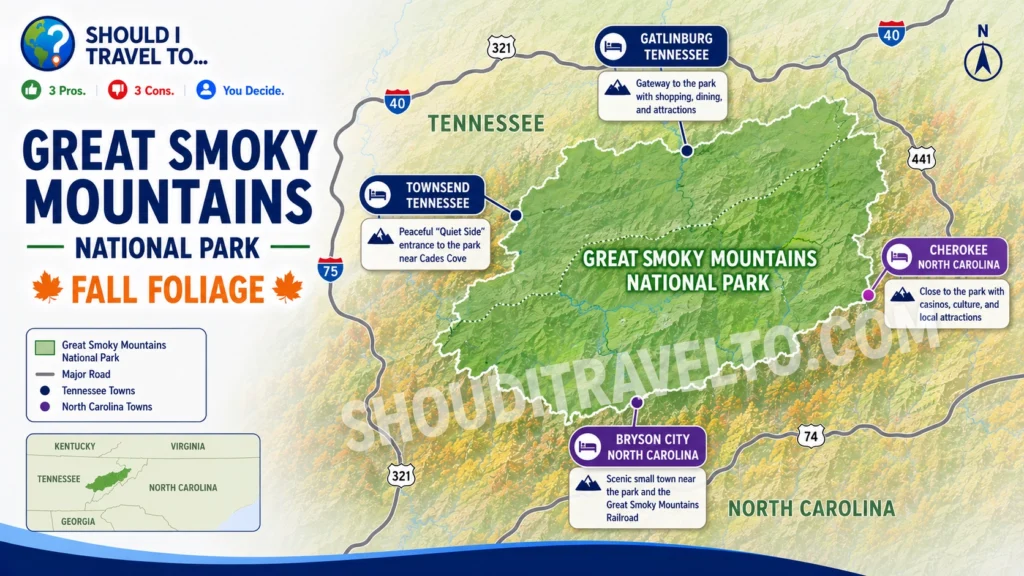
Gatlinburg, Tennessee: Best for First-Time Visitors
Gatlinburg provides convenient access to the park along with extensive accommodations, restaurants, attractions, and tourist services.
It’s the easiest choice for travelers who want a full-service base.
The downside?
It’s extremely popular and can feel busy and tourist-oriented.
Townsend, Tennessee: Best for a Quieter Smokies Experience
Townsend is a strong choice for travelers who prioritize Cades Cove, scenery, and a quieter atmosphere.
It doesn’t provide the same concentration of entertainment as Gatlinburg.
For some fall travelers, that’s exactly the point.
Cherokee, North Carolina: Best for the North Carolina Side
Cherokee provides convenient access to the park’s North Carolina side, including Oconaluftee and Newfound Gap Road.
It’s particularly useful for travelers continuing toward the Blue Ridge Parkway.
Bryson City, North Carolina: Best for a Broader Western North Carolina Trip
Bryson City can work particularly well for travelers combining the Smokies with additional western North Carolina experiences.
It gives the trip more of a mountain-town feel and can work as part of a longer fall road trip.
For a first visit focused primarily on the park, Gatlinburg is the easiest base.
For travelers who want quieter surroundings, Townsend deserves serious consideration.
And for a North Carolina-focused itinerary, Cherokee makes the most geographic sense.
Do You Need a Car to See the Fall Foliage in the Great Smoky Mountains?
For most visitors: Yes.
This is fundamentally different from Acadia, where seasonal transit can reduce your dependence on a car.
The Smokies are enormous, and many of the experiences visitors want are spread across different roads and sections of the park.
A vehicle gives you the flexibility to follow changing foliage conditions and explore different elevations.
But there’s a trade-off.
The more visitors driving during October, the more congestion becomes part of the experience.
For popular trailheads, shuttle services from surrounding communities can sometimes help reduce parking stress; NPS specifically suggests considering shuttles for popular hikes during busy fall periods.
Who Should Visit the Great Smoky Mountains for Fall Foliage?
The Smokies are especially good for:
- Fall foliage travelers
- Scenic road trippers
- Hikers
- Photographers
- Couples
- Families
- Wildlife enthusiasts
- National park travelers
- Waterfall lovers
- Mountain lovers
- Travelers looking for a potentially later fall foliage trip
- Tennessee road trips
- North Carolina road trips
- Southern Appalachian vacations
You might want to choose somewhere else if:
- You strongly dislike crowds.
- You don’t want to drive.
- Traffic ruins scenic destinations for you.
- You want a compact fall foliage trip.
- You need a guaranteed peak date.
- You prefer small New England towns to national parks.
- You want ocean scenery with your foliage.
Great Smoky Mountains vs. White Mountains for Fall Foliage
Choose the Great Smoky Mountains for:
- Longer foliage progression
- Southern Appalachian scenery
- Wildlife
- Historic valleys
- Waterfalls
- Tennessee and North Carolina
- A potentially later foliage trip
Choose the White Mountains for:
- Classic New England foliage
- Dramatic mountain passes
- Kancamagus Highway
- Covered bridges
- Waterfalls
- More concentrated scenic-road experience
- New Hampshire fall atmosphere
The White Mountains offer the quintessential New England foliage road trip.
The Smokies provide the broader Southern Appalachian mountain experience.
Great Smoky Mountains vs. Acadia for Fall Foliage
Choose Great Smoky Mountains National Park for:
- Appalachian mountain scenery
- A longer foliage progression
- Dramatic elevation changes
- Scenic mountain drives
- Waterfalls
- Wildlife
- Historic valleys
- Tennessee and North Carolina
- A Southern Appalachian road trip
Choose Acadia National Park for:
- Atlantic Ocean scenery
- Rocky coastline
- Granite mountains
- Islands
- Cadillac Mountain
- Bar Harbor
- Coastal New England
- A more unusual ocean-and-foliage combination
The biggest difference is the landscape.
Acadia offers fall foliage by the ocean.
The Smokies give you fall foliage across layers of Appalachian mountains.
Neither is objectively better.
They’re two completely different ways to experience autumn.
Great Smoky Mountains vs. Blue Ridge Parkway for Fall Foliage
The Great Smoky Mountains and Blue Ridge Parkway can easily be combined into one fall road trip, but they offer different experiences.
Choose Great Smoky Mountains National Park for:
- Hiking
- Wildlife
- Waterfalls
- Historic valleys
- Mountain trails
- Cades Cove
- A national park experience
Choose the Blue Ridge Parkway for:
- Scenic driving
- Frequent overlooks
- A longer road trip
- Following foliage across different sections
- Connecting mountain towns and destinations
- Making the road itself the attraction
The simplest distinction:
The Blue Ridge Parkway is the stronger fall foliage road trip.
The Great Smoky Mountains are the stronger fall foliage national park experience.
And travelers with enough time don’t necessarily have to choose. The southern end of the Blue Ridge Parkway connects with the Great Smoky Mountains region, making the two natural partners for a longer Southern Appalachian fall trip.
Final Assessment
Yes, you should travel to the Great Smoky Mountains to see the fall foliage, especially if you want fall foliage on a massive scale.
The Great Smoky Mountains aren’t about one famous tree-lined road.
They aren’t about one overlook.
And they aren’t about one perfect peak weekend.
That’s precisely what makes them different.
Autumn begins in the highest mountains.
Then it moves downward.
Across ridges.
Through forests.
Into valleys.
Until enormous portions of the landscape have changed.
The biggest advantages are the long foliage season, spectacular Appalachian scenery, and variety of ways to experience fall.
The biggest drawbacks are the October crowds, unpredictable timing, and traffic.
And those trade-offs matter.
This is America’s most visited national park.
October is its busiest month.
So don’t expect solitude at every overlook.
But don’t assume you need to arrive on a single magical weekend, either.
The park’s enormous elevation range gives fall travelers something unusually valuable:
Options.
If the high elevations are past peak, look lower.
If the valleys aren’t ready, go higher.
In the Smokies, don’t just chase a date.
Chase the elevation.
3 Pros. 3 Cons. You Decide.
Great Smoky Mountains Fall Foliage Frequently Asked Questions
Is Great Smoky Mountains National Park worth visiting for fall foliage?
Yes. The park combines extensive deciduous forests, mountain scenery, scenic roads, hiking, waterfalls, wildlife, and an unusually long progression of fall color.
When does fall foliage peak in the Great Smoky Mountains?
There isn’t one park-wide peak date.
High-elevation color can begin in mid-September, color commonly develops above 4,000 feet in early to mid-October, and middle and lower elevations often produce their strongest displays from mid-October into early November.
Should I stay in Tennessee or North Carolina?
Choose Tennessee, particularly Gatlinburg or Townsend, for convenient access to many of the park’s most popular areas.
Choose North Carolina, particularly Cherokee or Bryson City, if you want to emphasize the park’s North Carolina side or continue into western North Carolina and the Blue Ridge Parkway.
What is the biggest mistake when visiting the Smokies in fall?
Trying to chase one exact peak date and trying to see too much during a busy October weekend.
Fall color develops at different times depending heavily on elevation.
Are the Smoky Mountains and Great Smoky Mountains National Park the Same Thing?
Not exactly.
The Great Smoky Mountains are a mountain range along the Tennessee–North Carolina border within the southern Appalachian Mountains.
Great Smoky Mountains National Park protects a large portion of that mountain range.
“The Smokies” is the common nickname for the mountains and, depending on context, for the national park and the surrounding region.
Are the Great Smoky Mountains Part of the Appalachian Mountains?
Yes. The Great Smoky Mountains are part of the southern Appalachian Mountains and are associated with the broader Blue Ridge mountain region.
That’s why the Smokies share many characteristics with other Southern Appalachian destinations while still having their own distinct geography and identity.
Do I Need to Hike to See Fall Foliage in the Great Smoky Mountains?
No. Hiking can provide outstanding foliage views, but it isn’t required. Scenic roads such as Newfound Gap Road and Little River Road, overlooks, Cades Cove, and other accessible areas allow visitors to experience fall color without undertaking major hikes.
Is Great Smoky Mountains National Park in Tennessee or North Carolina?
Both. Great Smoky Mountains National Park straddles the Tennessee–North Carolina border.
Many first-time visitors stay on the Tennessee side near Gatlinburg or Townsend, while Cherokee is a major gateway on the North Carolina side.
Newfound Gap Road crosses through the park between Tennessee and North Carolina, allowing visitors to experience both sides during the same trip.