

When Visiting New England, Where Should You Start?
Quick Answer
Traveling to New England means deciding what kind of New England vacation you want.
New England isn’t one type of trip. Boston is a historic city break filled with Revolutionary War landmarks, museums, walkable neighborhoods, and restaurants. Coastal Maine is about rugged shorelines, lighthouses, lobster, and Acadia National Park. Vermont offers mountain towns, covered bridges, maple syrup, and classic fall foliage. New Hampshire brings the White Mountains, scenic drives, lakes, and outdoor adventure.
Rhode Island combines Newport’s Gilded Age mansions with coastal scenery and the city of Providence. Connecticut offers maritime history, colonial landmarks, college-town culture, and smaller coastal communities.
And those are only the state and regional experiences.
You can also travel to New England specifically for fall foliage, the American Revolution, colonial history, beaches, Christmas, winter sports, or a road trip connecting several states.
These aren’t variations of the same vacation. They’re completely different trips.
The best New England destination is the one that gives you the experience you’re actually looking for.
What Is New England?
New England is a region in the northeastern United States made up of six states: Connecticut, Maine, Massachusetts, New Hampshire, Rhode Island, and Vermont.
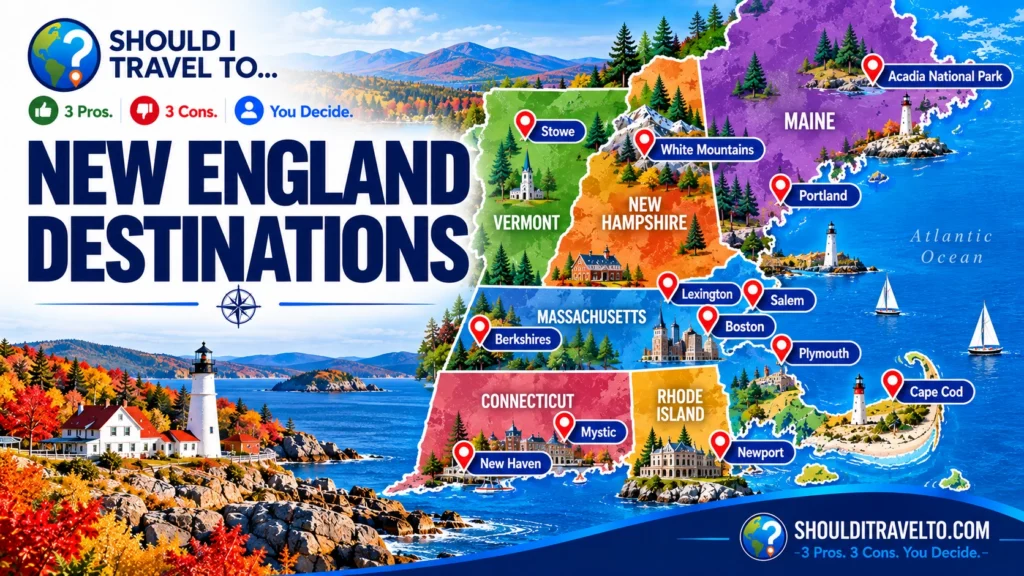
Although these states share a regional identity, their landscapes and travel experiences vary considerably. Coastal Maine isn’t interchangeable with Vermont’s mountain towns, and a weekend exploring Boston feels very different from a road trip through the White Mountains.
That variety is New England’s biggest travel advantage, but it also creates a planning challenge. First-time visitors can easily look at a map, see six neighboring states, and underestimate how much ground they are trying to cover.
The better approach is to start with the experience you want, choose a practical base, and then decide whether you need one state, one region, or a multi-state road trip.
Six States, Six Different Starting Points
Each state provides a different entry point into New England. Some are best known for a particular landscape, while others offer a mix of experiences.
Connecticut: Maritime history, Mystic, New Haven, the Litchfield Hills, and coastal towns.
Maine: Rocky coastlines, lighthouses, seafood, Acadia National Park, and vast stretches of forest.
Massachusetts: Boston’s Revolutionary history, Plymouth, Salem, Cape Cod, and the Berkshires.
New Hampshire: The White Mountains, Mount Washington, the Kancamagus Highway, lakes, and outdoor recreation.
Rhode Island: Newport’s mansions, coastal drives, sailing, beaches, Providence, and island escapes.
Vermont: Mountain towns, covered bridges, maple syrup, fall foliage, skiing, and rural landscapes.
You don’t need to visit all six states to experience New England. In fact, choosing one or two that fit your interests often makes for a better vacation than trying to cover all six in a single trip.
Why Travel to New England?
New England offers a unique mix of American history, distinctive small towns, dramatic landscapes, and recognizable seasonal experiences. Few regions in the country can support such different vacations across neighboring states.
New England Offers More Than One Kind of Vacation
A history enthusiast might spend several days in Boston and Lexington and Concord. A traveler looking for coastal scenery might choose Maine and Acadia National Park. Someone dreaming of a classic autumn road trip might focus on Vermont and New Hampshire.
Summer creates a different set of possibilities, including Cape Cod, Rhode Island’s beaches, and Maine’s coastal communities. Winter brings skiing, snow-covered villages, and seasonal celebrations, while spring introduces another opportunity to explore historic cities and rural landscapes.
This variety lets New England appeal to different travelers and offer something new to those returning in another season.
History Is Part of the Landscape
New England’s historical significance extends beyond museums and individual monuments.
In Massachusetts, visitors can explore sites tied to the Pilgrims, the Salem Witch Trials, and the opening battles of the American Revolution. Boston connects colonial resistance to the development of the independence movement, while other towns preserve maritime traditions, historic architecture, and different parts of the region’s past.
For travelers interested in the American Revolution, New England is especially valuable because several key events occurred close to one another. Boston, Lexington, and Concord can form part of the same history-focused trip.
The region also has Indigenous histories that predate European settlement by thousands of years. To fully understand New England, recognize that the colonial story is only one part of its past.
The Seasons Change the Entire Experience
New England is a distinctly seasonal destination, and when you travel can matter as much as where you go.
Autumn is famous for colorful foliage, covered bridges, mountain roads, and small towns. Summer brings beach vacations, coastal exploration, hiking, and outdoor dining. Winter offers skiing, snowshoeing, and Christmas getaways. Spring offers a different pace for exploring cities, historic sites, and the countryside.
These seasonal shifts are part of the region’s appeal, but they also affect accommodation prices, crowds, weather, and which attractions are operating.
Choose the season based on what you want to experience, rather than assuming every part of New England looks the same throughout the year.
New England at a Glance
New England’s strengths are its variety, historical character, and changing landscapes. Its main challenges are seasonal demand and the transportation planning required to connect rural, coastal, and mountain destinations.
| Category | Regional assessment |
| Cost | Moderate to Expensive |
| Weather | Highly Seasonal |
| Crowds | Moderate overall; Very High during peak foliage and popular summer periods |
| Transportation | Car Helpful; not necessary for every city trip |
| Things to Do | Exceptional |
| Food & Dining | Excellent |
| Tourist Comfort & Safety | Generally Comfortable; outdoor and winter travel require preparation |
| Culture & Character | Highly Distinctive |
| Cleanliness & Infrastructure | Good overall, with variation between cities and rural areas |
| Uniqueness | Highly Unique |
These are broad regional descriptions, not guarantees for every destination. Boston without a rental car, a remote Maine road trip, and a winter visit to the White Mountains have very different transportation needs and practical considerations.
The 3 Biggest Pros and 3 Biggest Cons of Traveling to New England
New England’s greatest strength is its variety, but that variety also requires travelers to think carefully about timing, geography, and priorities.
The 3 Biggest Pros
1. Extraordinary Variety Within One Region
Few regions offer such a broad mix of historic cities, rugged coastlines, mountain landscapes, beaches, rural villages, and winter recreation.
You can build an entire trip around Boston without leaving the city. Or you can combine Maine’s coastline with Acadia National Park, explore Vermont’s mountain towns, or create a New England road trip that links historic landmarks and scenic landscapes.
The variety also makes repeat trips worthwhile. You don’t need to experience every state at once, and you can return several times without repeating the same vacation.
2. Exceptional American History and Historic Towns
New England offers some of the country’s most important destinations for understanding early American history.
Boston, Lexington and Concord, Plymouth, and Salem each tell a different story. Beyond the major landmarks, historic towns and maritime communities add architectural character and local history to the experience.
The region rewards travelers who want to learn about a destination rather than just see its scenery.
3. Four Distinct Seasons Create Different Reasons to Visit
New England isn’t limited to autumn foliage.
Summer is attractive for coastal vacations, beaches, and outdoor recreation. Fall brings the region’s best-known seasonal scenery. Winter introduces skiing, Christmas towns, and snow-covered landscapes when conditions cooperate. Spring offers another opportunity to explore cities and historic sites.
That seasonal variety creates flexibility, although it also means the best destination depends heavily on when you travel.
The 3 Biggest Cons
1. Peak Season Can Be Crowded and Expensive
New England’s popularity during fall foliage season is one of its biggest trade-offs. Visitors compete for accommodation, scenic viewpoints, restaurants, and space on popular driving routes, particularly during peak-color weekends.
Summer can also be busy along the coast, especially in popular beach communities and on popular islands.
If your dates are flexible, consider weekdays or less popular travel periods. If you’re traveling for peak foliage or a specific summer destination, book key accommodations early and stay flexible about where you explore.
2. A Car Becomes Helpful Outside Major Cities
Boston is a strong destination for travelers who prefer walking and public transportation. Other cities and towns also have walkable areas.
But once you start connecting rural villages, scenic drives, beaches, hiking trails, and national park landscapes, a car becomes much more useful.
A multi-state trip may require a rental car, and islands, ferries, seasonal shuttles, and mountain roads can add additional planning. You don’t need a car for every New England vacation, but decide based on the destinations you plan to visit.
3. Distances Look Deceptively Short on a Map
New England is compact compared with much of the United States, but that doesn’t mean every destination is close in practical travel terms.
Coastal routes, mountain roads, seasonal traffic, ferries, and stops along the way can extend travel time. A plan that looks reasonable when you simply connect locations on a map may leave too little time to enjoy any of them.
The solution is to choose a region or a manageable route rather than treating all six states as one sightseeing district.
A broad six-state itinerary can be rewarding, but it needs enough days to allow travel time and meaningful stops.
Which New England Destination Fits Your Trip?
The easiest way to choose New England is to begin with your primary interest. Decide whether you’re looking for city life, history, coastlines, mountains, seasonal scenery, or a road trip before choosing the states and towns to include.
| If you want… | Start with… |
| American history and a walkable city | Boston |
| Lighthouses and rugged coastlines | Coastal Maine |
| Lobster, seafood, and harbor towns | Maine |
| Fall foliage and classic mountain villages | Vermont |
| Mountains, scenic drives, and outdoor adventure | New Hampshire |
| Gilded Age mansions and coastal luxury | Newport, Rhode Island |
| Maritime history and smaller coastal towns | Connecticut |
| The quintessential New England fall road trip | Vermont + New Hampshire |
| The opening battles of the American Revolution | Boston + Lexington and Concord |
| Colonial history and early settlements | Plymouth + Boston + Salem |
| Beaches and summer coastal towns | Cape Cod + Rhode Island |
| Christmas atmosphere and winter scenery | Vermont + New Hampshire |
| Hiking, lakes, and mountain landscapes | White Mountains + Green Mountains |
| A broad multi-state vacation | A 10–14 day New England road trip |
These are starting points rather than rigid itineraries. Many destinations overlap, so the best choice depends on your priorities.
New England Destinations and Experiences to Consider
New England becomes much easier to plan when you treat it as a collection of distinct vacations. These options pair the region’s most recognizable places with seasonal and historical trips worth exploring.
New England Cities and Regions
Boston, Massachusetts: American History and Big-City New England
Boston is the natural starting point for many first-time visitors because it combines Revolutionary history, walkable neighborhoods, museums, food, waterfront attractions, and a recognizable big-city atmosphere.
The Freedom Trail connects many of the city’s historic landmarks, including sites tied to the Revolutionary movement. Boston Common, Beacon Hill, the USS Constitution, the Black Heritage Trail, and Boston Harbor add further dimensions to the visit.
But Boston isn’t only a history destination. You can also explore museums, restaurants, neighborhoods, sports, and the city’s contemporary culture. The North End adds Italian-American food and historic streets, while Fenway Park connects the city to its sporting identity.
One of Boston’s biggest advantages is that you can enjoy a substantial city vacation without a rental car. Public transportation and walking let you explore much of the central visitor area.
Best for: American history, museums, food, neighborhoods, and a car-free city break.
Biggest trade-off: Accommodation can be expensive, and a Boston-only visit won’t offer the rural scenery or coastal landscapes associated with other parts of New England.
Coastal Maine: Lighthouses, Lobster, and Rugged Coastlines
Coastal Maine offers one of New England’s most distinctive landscapes, combining rocky shorelines, working harbors, lighthouses, seafood, small coastal towns, and access to Acadia National Park.
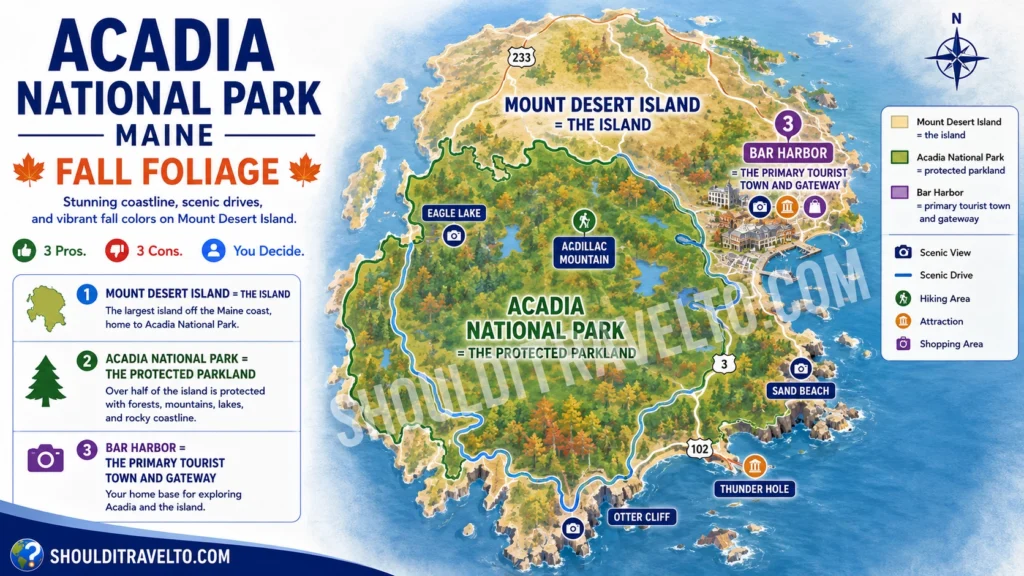
Portland offers a convenient urban starting point, with restaurants, a historic waterfront, and a strong food scene. Farther along the coast, communities such as Boothbay Harbor, Rockland, and Camden offer different versions of the Maine coastal experience.
For visitors seeking dramatic natural scenery, Acadia National Park and nearby Bar Harbor are top choices. Here, forests, mountains, lakes, and rocky Atlantic coastline come together in one destination.
Kennebunkport offers another coastal-town atmosphere, while the coast farther north becomes more rugged and remote in places. You don’t need to experience all of Maine’s coast in one trip; choose the section that best matches your interests.
Coastal Maine appeals to travelers who want scenery and small-town character rather than a major-city vacation.
Best for: Lighthouses, seafood, rocky coastlines, coastal road trips, and nature.
Biggest trade-off: Distances along the coast add up, and many seasonal businesses and activities operate for shorter periods than in major cities.
Vermont: Fall Foliage and Mountain Towns
Vermont is a strong starting point if your image of New England includes covered bridges, maple trees, white-steepled villages, mountain roads, and small towns surrounded by countryside.
Stowe is one of the state’s best-known mountain destinations, offering a mix of village character, outdoor recreation, and access to the Green Mountains. Woodstock has a classic small-town setting, while Manchester offers another base for exploring southern Vermont.
The scenery changes with the seasons. Autumn brings foliage drives and colorful mountain landscapes. Winter introduces skiing and snowboarding, while spring and summer offer hiking, farm visits, covered bridges, and scenic drives.
Maple syrup is another part of Vermont’s identity, and visiting during sugaring season offers a different experience than the popular fall trip.
Vermont isn’t primarily about large cities or an extensive list of urban attractions. Its appeal comes from the landscapes, villages, and time spent moving between them.
Best for: Fall foliage, mountain towns, covered bridges, maple syrup, skiing, and rural scenery.
Biggest trade-off: A car helps you explore beyond the main towns, and popular foliage weekends can bring crowds and higher accommodation prices.
New Hampshire: White Mountains and Outdoor Adventure
Start in New Hampshire for dramatic mountain scenery, scenic drives, hiking, lakes, and outdoor recreation.
The White Mountains are the state’s signature landscape. The Kancamagus Highway is especially well known for scenic driving, while Franconia Notch offers mountain views and outdoor attractions. Mount Washington adds another dimension for travelers seeking high-elevation scenery.
The Lakes Region provides a different experience. Lake Winnipesaukee, North Conway, and nearby communities combine outdoor activities with towns offering restaurants, accommodations, and visitor services.
Fall foliage makes New Hampshire especially attractive, but it isn’t limited to autumn. Summer hiking and lake activities, winter skiing, and scenic mountain trips during other seasons all have their own appeal.
New Hampshire is well suited to vacations where the landscape is the main attraction, whether you’re hiking, driving scenic roads, or simply seeking mountain views.
Best for: Hiking, scenic drives, mountain scenery, lakes, skiing, and outdoor adventure.
Biggest trade-off: Many of the best experiences require a car, and winter weather can affect road access and outdoor plans.
Newport and Rhode Island: Gilded Age Mansions and the Coast
Rhode Island may be New England’s smallest state, but its coastal destinations offer a distinctive combination of history, sailing, beaches, and city culture.
Newport is the best-known starting point. The city is known for Gilded Age mansions built by America’s wealthiest families, and visitors can explore them along the Cliff Walk and Ocean Drive.
The result is a coastal destination with a different kind of historic character from Boston’s Revolutionary landmarks or Plymouth’s colonial history.
Rhode Island also offers Providence, a city with its own cultural and food scene, along with coastal communities such as Narragansett and the offshore appeal of Block Island.
If you want a New England trip that combines seaside scenery with historic architecture and upscale dining, Newport makes an excellent anchor. Providence adds an urban experience, while the beaches offer a different reason to visit in warmer months.
Best for: Gilded Age mansions, sailing, coastal scenery, beaches, Providence, and historic architecture.
Biggest trade-off: Popular summer weekends can be busy, and the most convenient or upscale accommodations may be expensive.
Connecticut: Maritime History, College Towns, and Historic Communities
Connecticut often gets overlooked by travelers planning their first New England vacation, but it offers a useful mix of maritime history, historic towns, college-town culture, and coastal scenery.
Mystic is one of the state’s best-known visitor destinations. Mystic Seaport offers a maritime-history experience, while Mystic Aquarium adds a different attraction for families. The town itself also provides shops, dining, and a recognizable coastal atmosphere.
New Haven introduces another side of Connecticut, with Yale University, cultural attractions, and a well-known food identity. Farther inland, the Litchfield Hills and Connecticut River Valley offer rural scenery, historic architecture, and smaller communities.
Connecticut can work particularly well for travelers combining New England with New York City or Boston. It offers historic and coastal experiences without requiring a trip into the northern mountain regions.
Best for: Maritime history, Mystic, Yale and New Haven, rural towns, and coastal exploration.
Biggest trade-off: Connecticut’s attractions are spread across the state, so transportation planning still matters if you want to combine the coast, cities, and inland communities.
Experience-Based New England Destinations
The following destinations aren’t single towns or states. They represent reasons to travel to New England and help you decide where to go and when to visit.
Fall Foliage: The Classic New England Road Trip
If the image you have in your head when you hear “New England” is red and orange leaves, covered bridges, mountain roads, and small towns, you’re thinking of autumn New England.
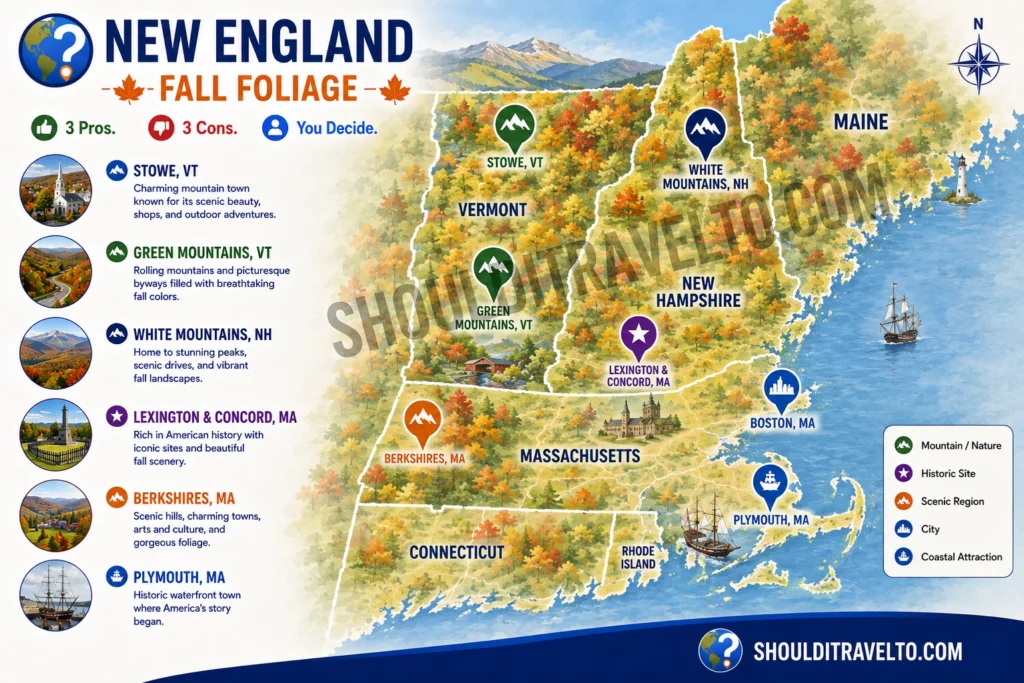
Vermont and New Hampshire are among the region’s best-known choices for mountain scenery and foliage drives. Maine adds forests, coastal communities, and Acadia National Park, while western Massachusetts offers colorful hills, historic towns, and the Berkshires.
The key is timing. Fall color generally develops earlier in northern and higher-elevation areas, then moves south and toward the coast. Exact timing varies from year to year, so travelers should monitor current foliage reports rather than assume a particular weekend will deliver peak color.
Fall is also one of the region’s busiest travel seasons. The most desirable mountain towns and coastal communities can be crowded, and you may need to book accommodation well in advance.
A successful foliage trip isn’t about driving through all six states. It’s about choosing a region, planning around likely color conditions, and leaving enough time to enjoy the scenery.
Best for: Scenic drives, covered bridges, photography, small towns, and seasonal landscapes.
Best starting points: Vermont, the White Mountains, Acadia National Park, and the Berkshires.
American Revolution: Where the Road to Independence Began
New England is an essential region for travelers who want to understand the origins of the American Revolution.
Boston provides the political and cultural background to the revolutionary movement. Lexington and Concord mark the opening military engagements of April 19, 1775, when colonial militia and British troops clashed and the war began.
You can also explore other places connected to the region’s Revolutionary history, including sites related to the Siege of Boston and the broader conflict that developed around Massachusetts and Rhode Island.
This itinerary works because the destinations complement one another. Boston explains the broader revolutionary movement, while Lexington and Concord put visitors in the landscapes where the fighting began.
For many history enthusiasts, this is one of the most rewarding ways to experience New England. The trade-off is that several important sites are spread across different communities, and a car may be useful outside central Boston.
Best for: Revolutionary War history, battlefields, historic buildings, museums, and American independence.
Best starting points: Boston and Lexington and Concord.
Colonial New England: Plymouth, Salem, and Historic Towns
Colonial New England is a broader historical experience than the American Revolution alone. It explores early English settlement, colonial communities, maritime trade, religious history, and the Indigenous peoples whose histories long predate European settlement.
Plymouth is associated with the Mayflower voyage, Plymouth Colony, and the complicated history of early contact between English settlers and Indigenous communities. Salem offers a different perspective through the 1692 witch trials and its maritime heritage.
Historic Boston, Portsmouth, New Hampshire, Mystic, Connecticut, and other towns offer additional ways to explore architecture, trade, and everyday life across different periods.
This trip style is especially useful for travelers who enjoy museums, historic buildings, walking tours, and places where local streets provide context for the past.
It’s also important to recognize that everyone didn’t experience colonial history the same way. Indigenous communities, European settlers, enslaved people, and other groups had different experiences that shaped the region.
Best for: Colonial architecture, early settlement history, maritime heritage, museums, and historic towns.
Best starting points: Plymouth, Salem, Boston, Portsmouth, and Mystic.
New England Beaches: Cape Cod, Islands, and Coastal Towns
New England’s beaches may not be the first thing travelers imagine when they think about the region, but summer beach vacations are an important part of its identity.
Cape Cod offers long stretches of coastline, beach communities, seafood, and access to outdoor recreation. Nantucket and Martha’s Vineyard bring island scenery, historic towns, and a more distinct getaway atmosphere. Rhode Island offers popular beaches and coastal drives, while Connecticut’s shoreline offers another summer escape.
Maine and New Hampshire also have beaches, though the region’s Atlantic water can stay cold even in summer. The atmosphere often centers on coastal towns, walking, sailing, and seafood as much as on swimming.
Timing matters. Summer is the main season for many beach destinations, and popular communities can become busy and expensive. Islands add ferry schedules and transportation planning, and some seasonal businesses close or reduce services outside the warm-weather season.
Best for: Summer vacations, seaside towns, coastal scenery, seafood, islands, and beach walks.
Best starting points: Cape Cod, Nantucket, Martha’s Vineyard, Newport, Narragansett, and Maine’s coast.
Christmas and Winter New England: Snowy Towns and Seasonal Getaways
Winter gives New England a different travel identity, with skiing, mountain towns, historic districts, seasonal decorations, and the possibility of snow-covered villages.
Vermont and New Hampshire are natural starting points for mountain scenery, winter sports, and small towns. Stowe, Woodstock, North Conway, and Manchester offer different combinations of outdoor recreation, dining, historic character, and seasonal atmosphere.
Boston remains an option for visitors who prefer a city vacation, with museums, restaurants, historic attractions, and cultural activities that aren’t entirely dependent on winter weather. Newport offers a different combination of coastal history and seasonal events.
Choose your winter destination based on what matters most. A ski trip, a Christmas destination getaway, and a winter city break are different vacations, even when all three involve cold weather.
Snow isn’t guaranteed on any given date, and winter conditions can affect mountain roads and outdoor activities. Plan around attractions and experiences you can enjoy even if the weather changes.
Best for: Christmas atmosphere, skiing, mountain towns, winter scenery, and cozy seasonal getaways.
Best starting points: Stowe, Woodstock, North Conway, Manchester, Boston, and Newport.
Outdoor Adventures and Lakes: A More Active New England
If your idea of New England includes hiking, lakes, mountain scenery, and time outdoors, the region offers plenty beyond autumn driving and winter skiing.
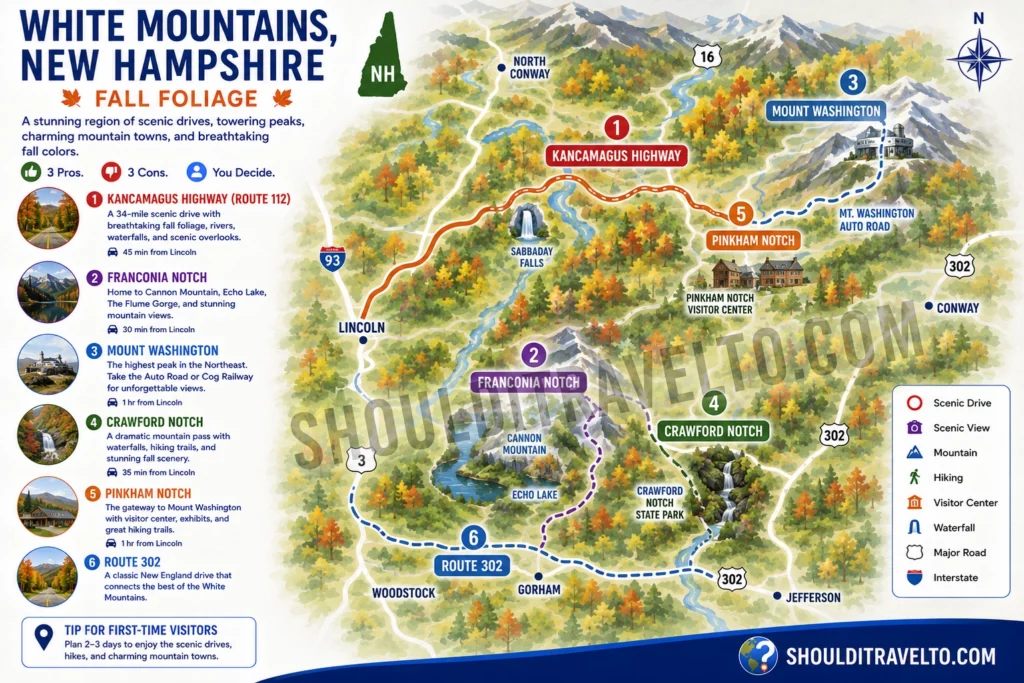
New Hampshire’s White Mountains offer mountain trails, scenic roads, and access to lakes. Vermont’s Green Mountains offer hiking, forests, and outdoor recreation in mountain towns. Maine adds Acadia National Park, coastal trails, and long stretches of forest, while New Hampshire’s Lakes Region offers time on and around the water.
These destinations suit travelers who want outdoor activity to shape the vacation, whether through hiking, cycling, paddling, skiing, or simply enjoying scenic drives and overlooks.
But nature-focused trips require more planning than a city break. Weather, trail conditions, seasonal road access, and service availability can affect the experience. Some activities also require appropriate equipment or experience.
Choose a practical base, research conditions before you go, and avoid trying to cover several distant mountain regions on a short visit.
Best for: Hiking, lakes, mountain scenery, outdoor recreation, and national parks.
Best starting points: The White Mountains, Green Mountains, Acadia National Park, and New Hampshire’s Lakes Region.
New England Road Trip: How Much of the Region Should You See?
A New England road trip can connect coastal scenery, historic cities, mountain towns, and rural landscapes in one vacation. But the most important decision is how much of the region you can realistically explore without spending the entire trip driving.
A weekend in Boston moves at a very different pace than a multi-state road trip. A week focused on coastal Maine and Acadia offers a different experience again. A broad tour of all six states takes more time and planning.
The ideal road trip connects destinations that belong together, rather than collecting state names simply to say you’ve visited them.
The Weekend: Boston and One Nearby Destination
A weekend is best spent concentrating on one city or a compact area.
You could explore Boston or use the city as a base for a day trip to Lexington and Concord, Salem, or another nearby destination. This works especially well for travelers who want history, restaurants, museums, and walkable sightseeing without needing a full road trip.
The advantage is simplicity. You can experience a meaningful part of New England without renting a car for the whole trip.
The Classic New England Road Trip: Coast, Mountains, and Villages
For a longer vacation, combine a few distinct regional experiences.
One possible route runs from Boston to coastal Maine, then through New Hampshire’s White Mountains, into Vermont, and south to western Massachusetts. Depending on your available time and priorities, you could extend the trip toward Newport or Connecticut before returning to your starting point.
This style of itinerary combines historic cities, rugged coastlines, mountain scenery, rural towns, and seasonal landscapes. It works particularly well in late summer or autumn, though each season offers different advantages and trade-offs.
The key is to allow enough time at each stop. A scenic drive can become a rushed transfer if the itinerary contains too many destinations.
The Deep Dive: 10–14 Days Across New England
A 10–14-day trip gives travelers more flexibility to explore several states.
You might combine Boston, Portland, Acadia National Park, the White Mountains, Vermont’s mountain towns, western Massachusetts, and coastal Rhode Island or Connecticut. You don’t need to include every stop; use your interests to decide which experiences deserve the most time.
This is also the kind of trip where a rental car becomes particularly useful. You’ll be connecting cities, coastal communities, scenic routes, and rural destinations that don’t always have convenient public transportation between them.
Even with two weeks, you won’t experience every corner of New England. That’s not a problem. The objective is to build a rewarding route, not to complete a checklist.
Best New England Destination Combinations
Some of New England’s best trips pair a major city with a nearby historic, coastal, or outdoor destination. Combining complementary experiences can create a more satisfying vacation without making the itinerary too ambitious.
| Combination | Why it works | Best for |
| Boston + Lexington and Concord | Combines city attractions with the landscapes of the opening Revolutionary War battles | American history |
| Boston + Salem | Pairs Revolutionary-era Boston with the history of the Salem Witch Trials and maritime heritage | History and architecture |
| Portland + Acadia National Park | Combines a food-focused coastal city with dramatic national park scenery | Coastal Maine |
| Vermont + White Mountains | Connects mountain towns and rural scenery with dramatic mountain landscapes | Fall foliage and outdoor recreation |
| Plymouth + Cape Cod | Combines early colonial history with a classic coastal vacation | Families, history, and summer travel |
| Providence + Newport | Pairs a city with a strong food and arts identity with Gilded Age mansions and coastal scenery | Couples and coastal getaways |
| Boston + Newport | Combines a major historic city with a distinctive coastal destination | First-time regional visitors |
These combinations are starting points, not fixed itineraries. Check travel times and seasonal conditions before adding too many stops.
How to Plan Your New England Trip
The right plan depends on your travel dates, interests, and comfort with driving between destinations. These considerations can help you decide which parts of the region to include in your itinerary.
Choose Your Season Before Your Route
New England’s seasons offer very different experiences, so start by deciding what you want to see.
If fall foliage is your priority, research current foliage reports and focus on a specific region. If summer beaches are the goal, compare Cape Cod, Rhode Island, and coastal Maine. A winter trip could focus on skiing, Christmas towns, or an indoor-friendly city break.
Don’t plan around a particular photograph or a supposedly guaranteed peak date. Weather, foliage, snow, and seasonal operating schedules vary.
Decide Whether You Need a Car
You can enjoy Boston without renting a car, and some compact towns are also easy to explore on foot.
However, a car becomes more valuable when you want to connect mountain towns, coastal viewpoints, hiking trails, and rural attractions. If you’re planning a multi-state itinerary, compare the convenience of driving with public transportation for the city portion of your trip.
A useful strategy is to arrive in Boston, explore the city without a car, then rent one when you’re ready to travel into the countryside.
Avoid Overloading the Itinerary
New England’s compact geography can make it tempting to add one more state or town to every day. But frequent hotel changes and long drives can leave little time for the places you came to see.
Choose one or two primary experiences, then add nearby destinations that complement them. A Boston, Lexington, and Concord trip is easier to organize than trying to combine Boston, Acadia, Vermont, Newport, and several beach towns into a short vacation.
You can always return for another season or region.
The Decision Is Yours
There isn’t one New England vacation.
The region offers major cities, Revolutionary landmarks, colonial communities, rugged coastlines, beaches, historic mansions, mountain towns, lakes, ski resorts, and some of America’s most recognizable fall scenery.
Trying to fit everything into one trip misses the point.
Chose:
- Boston for city life and history
- Maine for dramatic coastlines
- Vermont, such as Stowe, for mountain towns and fall foliage
- New Hampshire for outdoor adventure
- Newport for Gilded Age history and coastal scenery
- Connecticut for maritime history, historic communities, and smaller-scale regional exploration
Or combine two experiences that naturally belong together.
New England’s greatest advantage is its variety, but the best trip comes from choosing a focus.
Don’t start by trying to see New England. Start by choosing your New England.
Then build the trip around it.
3 Pros. 3 Cons. You Decide.
New England Travel Frequently Asked Questions
New England’s variety creates practical questions about timing, transportation, and how much ground you can cover. These answers can help narrow down your options before you book.
Which New England state is best to visit?
No single state is best for every traveler. Massachusetts is an excellent starting point for Boston and Revolutionary history. Maine is strong for rocky coastline and Acadia National Park. Vermont and New Hampshire offer mountain scenery and fall foliage, Rhode Island combines historic mansions with coastal destinations, and Connecticut offers maritime history and historic communities.
How many days do you need to visit New England?
A weekend can work well for Boston or another focused destination. Four to seven days is more practical for one subregion, such as coastal Maine or Vermont and New Hampshire. A broad six-state road trip is better suited to approximately 10–14 days, depending on your pace and chosen stops.
Do you need a car to travel around New England?
Not for every trip. You can easily explore Boston without a car, and some towns have walkable centers. A car becomes much more useful when you want to connect rural towns, beaches, scenic drives, mountain destinations, and national park landscapes.
When is the best time to visit New England?
It depends on the experience you want. Fall is famous for foliage, summer is ideal for many beach destinations, winter offers skiing and seasonal town experiences, and spring can be comfortable for exploring cities and historic sites. Each season has different costs, crowds, and weather considerations.
Where should you go in New England for fall foliage?
Vermont and New Hampshire are strong choices for mountain scenery and classic foliage drives. Maine offers forested landscapes and coastal views, while western Massachusetts pairs fall color with historic towns and the Berkshires. Peak color varies by location and year, so monitor current foliage reports.
Is New England expensive to visit?
It can be, particularly during peak fall foliage weekends, summer beach season, and popular winter holidays. Costs depend on accommodation, transportation, location, and activities. Smaller or less busy destinations may offer different price options, but a road trip also adds costs like rental cars and fuel.
Is New England a good destination for families?
Yes. Families can combine museums and historic sites with beaches, outdoor recreation, seasonal attractions, and walkable town centers. The best destination depends on your children’s ages, the season, and how much driving you want to do.
Can you visit Boston and Maine on the same trip?
Yes, particularly if you have several days. You can combine Boston with Portland and other coastal Maine destinations, but Acadia National Park is farther north and requires extra travel time. Plan around the places you most want to experience rather than trying to see the entire Maine coast in a short visit.
Is the Hudson Valley part of New England?
No. The Hudson Valley is in New York, outside the six New England states. However, it can complement a broader northeastern American history or fall foliage itinerary if you have enough time to travel beyond New England.
What is the best way to explore New England for the first time?
Choose one anchor destination and one complementary experience. Boston plus Lexington and Concord works for history, while Portland plus Acadia offers a coastal city and national park combination. For a broader trip, plan a regional road trip with enough time to enjoy each stop rather than trying to visit all six states in a few days.