
Should You Visit Park City, Utah?
Quick Answer
Yes, you should visit Park City, Utah, especially if you’re interested in skiing, snowboarding, mountain scenery, historic mining towns, upscale resorts, outdoor recreation, Olympic history, restaurants, galleries, and a year-round mountain destination.
Park City can look very different depending on when you visit.
In winter, the Wasatch Mountains take center stage.
Park City Mountain and Deer Valley Resort make the area a major ski destination, while Historic Main Street offers restaurants, galleries, shopping, nightlife, and the feel of an old Western mining town.
In summer, the snow disappears, and the mountains become a playground for:
- Hiking
- Mountain biking
- Fishing
- Golf
- Scenic drives
- Concerts
- Festivals
- Outdoor recreation
And throughout the year, Park City’s historic mining heritage remains visible.
Park City’s Historic Sites Inventory includes more than 400 historic sites, and Historic Main Street and the Mining Boom Era Residences Thematic District are listed on the National Register of Historic Places.
Then there’s the Olympic legacy.
Park City hosted events during the 2002 Winter Olympics, and Utah Olympic Park continues that connection through year-round activities and Olympic-related attractions.
But you need to understand something important about Park City.
It isn’t simply a ski resort with a town attached.
It’s a historic mountain community that evolved from silver mining into one of America’s best-known mountain destinations.
That combination is what makes Park City different.
What First-Time Visitors Often Get Wrong About Park City
The biggest misconception about Park City is that it’s essentially a winter destination.
Winter certainly gets Park City the most attention.
But the mountains don’t disappear when the snow does.
Summer and fall bring hiking, mountain biking, fishing, golf, concerts, festivals, and scenic mountain recreation. Historic Main Street remains active, restaurants stay busy, and the town’s mining-era architecture provides an experience that doesn’t depend on skiing.
There’s another misconception, too.
Park City isn’t just one giant ski resort.
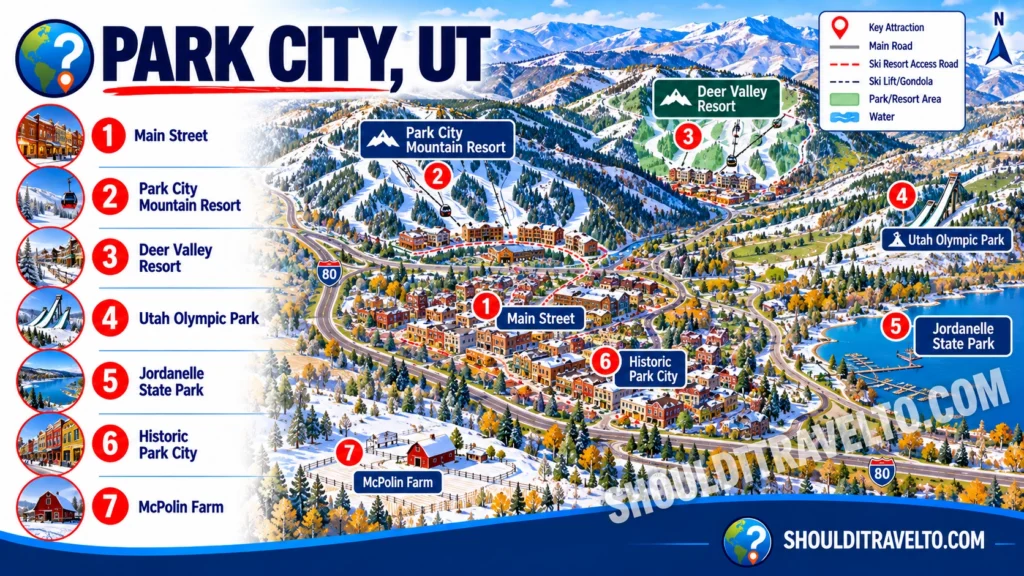
The destination is made up of several distinct experiences:
- Historic Main Street
- Old Town
- Park City Mountain
- Deer Valley
- Canyons Village
- Utah Olympic Park
- Kimball Junction
- The surrounding Wasatch Mountains
That matters when planning a trip.
A skier staying near a resort base will have a different experience from someone staying near Main Street.
A summer mountain biker will use Park City differently from a visitor coming for restaurants and history.
And a first-time winter visitor shouldn’t assume that everything revolves around the slopes.
Park City is a mountain destination first. Skiing is one of its biggest expressions.
What Makes Park City Different?
Park City’s biggest distinction is the combination of a historic mining town, major ski destination, and year-round mountain recreation.
Many ski destinations were built primarily around skiing.
Park City’s story began much earlier.
Silver mining brought prospectors and workers to the area in the nineteenth century, and the town developed into a genuine mining community. Mining continued into the twentieth century before skiing became an increasingly important part of Park City’s future.
Today, you can still walk along Historic Main Street and see the architecture left behind by that mining era.
Then look uphill.
The historic buildings give way to enormous mountain resorts and thousands of acres of ski terrain.
Park City Mountain alone encompasses 7,300 acres of skiable terrain.
Deer Valley provides a different resort experience, emphasizing service, dining and a ski-only environment while undergoing a major terrain expansion. For the 2025–26 season, Deer Valley reached more than 4,300 skiable acres.
And then there’s the Olympic legacy.
The Utah Olympic Park hosted events during the 2002 Winter Olympics and remains part of Park City’s year-round recreation landscape.
So Park City isn’t simply: ski resort + restaurants.
It’s: mining town + ski destination + Olympic legacy + mountain recreation + resort culture.
That’s the experience.
Park City: Historic Mining Town
Park City’s history begins long before it became synonymous with skiing.
Indigenous peoples, including Ute and Shoshone communities, traveled through the region before European-American settlement.
Then came the mining boom.
Prospectors arrived in the late 1860s, and silver became the foundation of Park City’s economy.
By the late nineteenth century, Park City had become a functioning mining town with a railroad station, post office, fire department, and a growing school system.
Mining remained central to the community for decades.
Then the town’s future changed again.
Skiing began emerging as an alternative to the declining mining economy, and in 1963 the Park City Consolidated Mines company entered the ski business by building lifts on what was then called Treasure Mountain.
That decision helped transform Park City.
The former mining town gradually became a major ski destination.
Today, the transition is part of the attraction.
You can walk past nineteenth-century mining-era buildings in the morning and spend the afternoon skiing terrain that helped make Park City internationally famous.
The town didn’t abandon its history. It built a new economy around the mountains.
The 3 Biggest Pros of Visiting Park City
Park City’s biggest strengths are its mix of mountain recreation, historic character, and deep year-round visitor appeal.
1. Park City Gives You a Real Town and a Major Ski Destination
Some mountain destinations can feel like resort developments.
Park City has an actual historic downtown.
Historic Main Street is lined with preserved mining-era buildings that now contain:
- Restaurants
- Bars
- Galleries
- Boutiques
- Hotels
- Shops
- Entertainment
The result is a destination where you can ski all day and walk into town afterward without feeling like you’ve left the vacation behind.
You can access Park City Mountain’s terrain directly from historic Park City, creating an unusually close relationship between the mountain and the town.
2. The Mountains Work in Every Season
Park City’s biggest physical asset doesn’t disappear when ski season ends.
Summer and fall bring:
- Hiking
- Mountain biking
- Fishing
- Golf
- Scenic drives
- Outdoor concerts
- Festivals
- Trail running
- Mountain recreation
The destination has more than 400 miles of trails, and Park City’s mountain environment supports a broad range of outdoor activities.
That makes Park City much more versatile than a destination designed primarily around winter skiing.
3. The Historic Character Makes Park City More Interesting Than a Typical Resort Town
Park City’s mining history isn’t just something you’ll find in a museum.
It’s built into the town.
Historic Main Street is a National Register historic district, and Park City maintains more than 400 historic sites.
That means the historic experience is part of simply walking around.
- Look at the buildings
- Walk the side streets
- Notice the old mining-era homes climbing the hillsides
Then compare that historic landscape with the modern resorts surrounding it.
Park City has preserved enough of its past to give the resort destination a genuine sense of place.
The 3 Biggest Cons of Visiting Park City
The same popularity and upscale resort infrastructure that make Park City attractive also create some important trade-offs.
1. Park City Can Be Expensive
This isn’t a destination where travelers should expect bargain pricing.
Winter ski vacations can involve substantial costs for:
- Lodging
- Lift tickets
- Equipment
- Ski lessons
- Restaurants
- Parking
- Transportation
- Après-ski activities
And accommodations near the most desirable areas can command premium prices.
Summer and shoulder seasons offer different pricing opportunities, but Park City remains a high-demand mountain destination.
If you’re looking for an inexpensive mountain getaway, Park City may not be the obvious choice.
2. Peak Periods Can Be Extremely Busy
Park City is popular.
Winter ski weekends bring large crowds, and major events and holidays can increase demand for accommodations, restaurants, transportation, and access to the mountains.
The town’s free public transportation helps visitors move around without a car, but busy periods can still create congestion and longer waits.
The important distinction is that Park City’s popularity isn’t necessarily a reason not to visit.
It’s a reason to plan ahead.
- Book lodging early
- Reserve activities
- Plan transportation
And know where you want to spend your time before you arrive.
3. Park City Can Feel More Like a Resort Destination Than a Traditional Small Town
Park City’s historic character is genuine. But so is its modern resort identity.
Luxury accommodations, high-end restaurants, ski infrastructure, and high-end shopping are significant parts of the visitor experience.
Travelers looking for a quiet, inexpensive mountain town may find Park City more developed and commercialized than expected.
The question isn’t whether Park City is a traditional small town. It’s whether you want a mountain destination where historic character and resort infrastructure exist side by side.
The Should I Travel To … Park City Scorecard
The following ratings show where Park City fits within the Should I Travel To decision framework.
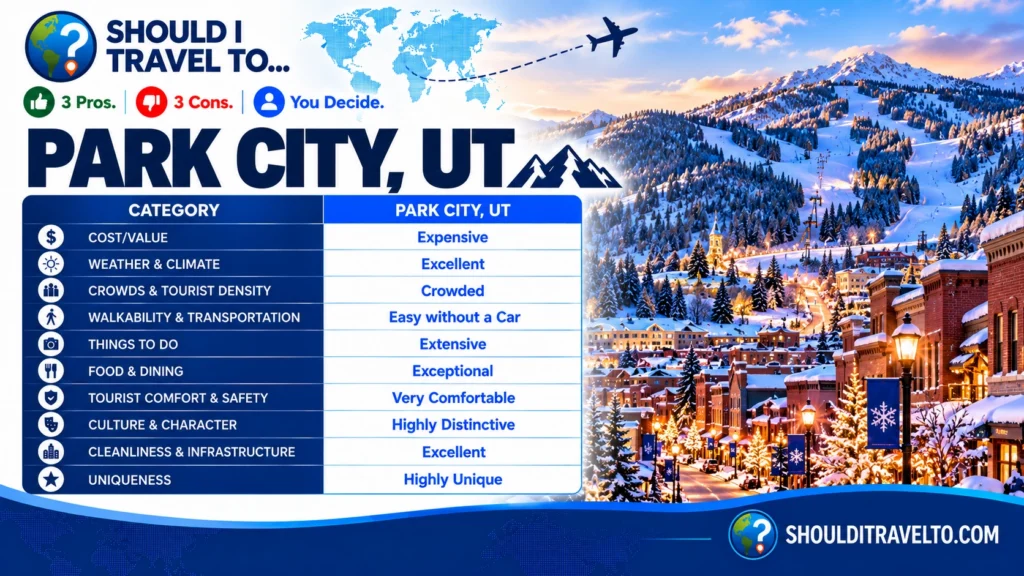
Cost / Value: Expensive
Park City offers a substantial range of experiences, but lodging, skiing, dining and resort activities can make it an expensive destination, particularly during peak winter periods.
Weather & Climate: Excellent
Park City’s four-season mountain climate supports winter skiing and snow sports and summer and fall hiking, biking, and outdoor recreation.
Crowds & Tourist Density: Crowded During Peak Periods
Winter weekends, holidays, and major events can be busy, although the experience varies considerably by season and location.
Walkability & Transportation: Easy Without a Car
Historic Main Street and central Park City are highly walkable, while the city’s free public transit connects major areas and resort destinations. A car can still help you explore beyond the core.
Things To Do: Extensive
Skiing, hiking, mountain biking, Olympic attractions, festivals, galleries, shopping, dining and outdoor recreation give Park City an unusually deep activity portfolio for a mountain town.
Food & Dining: Exceptional
Park City’s restaurant scene ranges from casual mountain dining to upscale restaurants, with Historic Main Street offering a particularly concentrated selection.
Tourist Comfort & Safety: Very Comfortable
Park City is highly developed for tourism, with extensive lodging, transportation, and visitor infrastructure. Winter weather, altitude, and mountain activities require appropriate preparation.
Culture & Character: Highly Distinctive
Park City’s mining history, mountain culture, Olympic legacy, arts scene, and resort identity combine to create a distinctive character.
Cleanliness & Infrastructure: Excellent
Park City has extensive visitor infrastructure and transportation, though traffic, parking, and capacity can strain during peak periods.
Uniqueness: Highly Unique
A preserved silver-mining town that evolved into a major ski destination and Olympic venue is a distinctive combination.
Planning Your Park City Vacation
Park City, Utah, works very differently by season. A ski trip requires a different strategy from a summer mountain getaway.
Atmosphere
Park City feels:
- Alpine
- Historic
- Upscale
- Outdoorsy
- Energetic
- Tourist-oriented
- Sophisticated
- Seasonal
- Mountain-focused
Historic Main Street provides the strongest sense of place, while the surrounding resorts create a much larger mountain destination.
Park City Through the Seasons
Winter ★★★★★
Winter is what most travelers picture when they think of Park City.
- Snow covers the Wasatch Mountains
- Skiers and snowboarders fill the resorts
- Historic Main Street becomes an après-ski destination
And the entire community revolves around mountain recreation.
Park City Mountain offers 7,300 acres of skiable terrain, while Deer Valley’s expanded 2025–26 footprint exceeds 4,300 acres.
Winter can also make Park City especially expensive and crowded.
Best for: Skiing, snowboarding, après-ski, snow, winter vacations.
Spring ★★★★☆
Spring can be a transitional season.
Skiing may continue while lower elevations begin to thaw. The crowds can change considerably as winter gives way to warmer weather.
Late spring is particularly useful for travelers who want mountain scenery without building the entire trip around skiing.
Best for: Late-season skiing, quieter mountain trips, transitional scenery.
Summer ★★★★★
Summer reveals a completely different Park City.
- The trails open
- Mountain biking becomes a major attraction
- Hiking, fishing, golf, concerts and festivals fill the calendar
Historic Main Street remains busy, but the focus shifts from snow to outdoor recreation.
Best for: Hiking, mountain biking, festivals, outdoor recreation and mountain scenery.
Fall ★★★★★
Fall may be one of Park City’s most underrated seasons.
The mountains become quieter than during peak summer, temperatures cool, and changing foliage adds another layer to the landscape.
It’s an excellent time to hike, bike, take scenic drives, and explore Historic Main Street.
Best for: Fall foliage, hiking, mountain biking, photography, and a quieter mountain experience.
When Is the Best Time to Visit Park City
| If You Want… | Consider Visiting… |
| Skiing and snowboarding | December–March |
| Peak winter atmosphere | January–February |
| Late-season skiing | March–April |
| Hiking and mountain biking | June–September |
| Summer festivals and concerts | June–August |
| Fall foliage | September–October |
| Quieter mountain experience | Spring or fall |
| Historic Main Street + restaurants | Year-round |
One important 2026 update: The Sundance Film Festival moves to Boulder, Colorado, beginning in 2027.
That makes 2026 historically significant for Park City film travelers, but Sundance should not be treated as a permanent Park City event going forward.
Ideal Trip Length
1 Day: Main Street + Mountain Experience
A day can give you a taste of Park City.
- Walk Historic Main Street
- Explore the shops and galleries
- Have lunch
Then head into the mountains if time allows.
This works particularly well as a quick visit from Salt Lake City.
2 Days: Best First Visit
Two days give you enough time to experience both sides of Park City.
Day 1: Historic Main Street + restaurants + galleries
Day 2: Skiing, hiking, biking, or another mountain activity
3 Days: Best for a Full Mountain Getaway
Three days provide room for:
- Mountain recreation
- Historic Main Street
- Restaurants
- Olympic attractions
- A slower pace
4–5 Days: Full Park City Vacation
A longer trip works particularly well for skiing, families, outdoor recreation, or travelers who want to combine Park City with nearby Utah destinations.
Don’t Miss These Park City Experiences
Historic Main Street
Historic Main Street combines Park City’s mining-era architecture with the restaurants, galleries, bars, and shops that define the modern town.
Don’t simply drive through it. Walk.
The historic district is one of the things that separates Park City from a conventional resort village.
Park City Mountain
If you’re visiting during winter, this is likely to be one of the primary reasons you’re here.
With 7,300 acres of skiable terrain, Park City Mountain is enormous.
But the mountain also operates as a summer recreation destination.
Deer Valley Resort
Deer Valley provides a distinctly different mountain experience.
The resort is known for its ski-only model, service, dining, and groomed terrain, and its major expansion has more than doubled its skiable acreage compared with its pre-expansion footprint.
Utah Olympic Park
The Olympic legacy remains one of Park City’s defining stories.
The park hosted events during the 2002 Winter Olympics and still offers opportunities to experience Olympic-related sports and activities.
Park City Museum
To understand why Park City exists, explore its mining history.
The modern ski resort makes much more sense once you understand the nineteenth-century mining town underneath it.
Park City Trails
The trail system is one of the main reasons Park City works year-round.
Hiking and mountain biking provide a completely different way to experience the same landscape that attracts skiers.
Hidden Gems and Experiences
Look for Mining History on the Mountain
Park City’s mining past isn’t confined to downtown.
You can still find remnants of mining operations across the mountain landscape.
It’s an unusual contrast: ski resort above a former mining landscape.
Visit Outside Ski Season
One of the easiest ways to see a different Park City is to visit when there’s no snow.
Summer and fall reveal a destination built around trails, mountain biking, concerts, festivals, and outdoor recreation.
Use the Public Transit
You don’t necessarily need to rent a car.
Park City’s transit system connects Historic Main Street, resort areas, and other major destinations.
That makes staying near downtown especially convenient.
Nearby Attractions and Trips
Park City is well positioned for a larger Utah vacation.
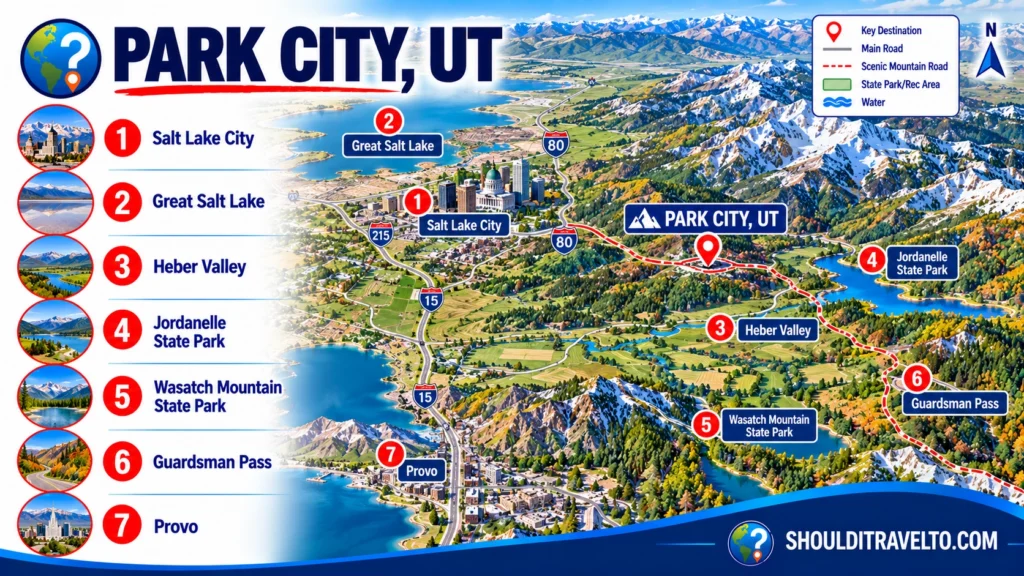
Consider combining it with:
- Salt Lake City
- Great Salt Lake
- Heber Valley
- Jordanelle State Park
- Wasatch Mountain State Park
- Guardsman Pass
- Provo
- Other Utah ski destinations
- A larger Utah national parks road trip
Park City can be the destination itself or one part of a much larger Utah itinerary.
Who Should Travel to Park City, Utah?
Park City is particularly good for travelers interested in:
- Skiing
- Snowboarding
- Mountain scenery
- Historic mining towns
- Hiking
- Mountain biking
- Luxury resorts
- Outdoor recreation
- Olympic history
- Restaurants
- Shopping
- Galleries
- Couples’ getaways
- Families
- Weekend trips
- Four-season mountain vacations
However, Park City may not be ideal for travelers who primarily want:
- A budget vacation
- A quiet, inexpensive mountain town
- Major urban museums
- A completely non-touristy experience
- Flat terrain
- A destination where everything is inexpensive
- A weeklong vacation without outdoor activities
Park City vs. Aspen
Park City and Aspen occupy similar territory in the American mountain-destination landscape, but the experience isn’t identical.
Choose Park City if you want:
- Historic mining-town character
- Major ski resorts
- Olympic history
- A walkable Main Street
- Easier access from Salt Lake City
- Year-round mountain recreation
- A larger ski area experience
Choose Aspen if you want:
- A luxury-oriented mountain destination
- Distinctive historic architecture
- High-end shopping
- A particularly polished resort atmosphere
- A strong arts and cultural scene
The simplest distinction? Aspen feels like a luxury mountain resort with historic roots.
Park City feels like a historic mining town that became a major mountain resort.
Park City vs. Jackson Hole
These destinations also provide very different versions of the Mountain West.
Choose Park City if you want:
- Ski resorts
- Historic Main Street
- Mining history
- Olympic history
- Restaurants and nightlife
- Easier access from a major airport
Choose Jackson Hole if you want:
- Dramatic wilderness
- Grand Teton access
- A stronger cowboy-Western identity
- Wildlife
- National park scenery
Park City is more developed around resort recreation.
Jackson Hole emphasizes the surrounding wilderness.
Final Verdict
Park City is easy to reduce to one word: Skiing.
That’s understandable.
The mountains are enormous, the resorts are major, and as a winter destination, it is a spectacular time to visit.
You can also walk Historic Main Street, visit Utah Olympic Park, and return in summer, when the ski slopes become hiking and mountain-biking terrain.
Park City is a historic mountain town that became a major ski destination without losing the character it had before the ski lifts arrived.
So, should you travel to Park City?
Yes, if you want a mountain destination that combines skiing, history, outdoor recreation, and resort culture in one place.
3 Pros. 3 Cons. You Decide.
Park City, Utah, Frequently Asked Questions
Is Park City worth visiting?
Yes, particularly for travelers interested in skiing, mountain scenery, outdoor recreation, historic towns, restaurants, and four-season mountain vacations.
Is Park City only a winter destination?
No. Summer and fall offer hiking, mountain biking, fishing, golf, concerts, festivals, and other outdoor activities.
Is Park City expensive?
Park City can be expensive, particularly during peak ski season and major events. Travelers should budget for premium lodging, skiing, dining, and resort activities.
How many days do you need in Park City?
Two to three days works well for a first visit. Ski trips and outdoor-focused vacations can easily justify four or more days.
Do you need a car in Park City?
Not necessarily. Park City’s free public transit connects many major areas, and Historic Main Street is highly walkable. A car becomes more useful for exploring farther beyond the central visitor areas.
Is Park City good for families?
Yes. Families can combine skiing, outdoor recreation, Olympic attractions, restaurants, and year-round mountain activities.
Is Park City good for couples?
Yes. Historic Main Street, restaurants, mountain scenery, skiing, and resort accommodations make Park City particularly well suited to couples’ trips.
Is Park City good in summer?
Yes. Summer turns the destination into a hiking, mountain-biking, and outdoor-recreation destination.
What is Park City best known for?
Park City is best known for skiing, Historic Main Street, its silver-mining history, mountain recreation, Olympic history, and major ski resorts including Park City Mountain and Deer Valley.
What happened to Sundance in Park City?
The 2026 Sundance Film Festival is the final edition held in Park City. Beginning in 2027, the Sundance Film Festival will be held in Boulder, Colorado.
Is Park City a historic town?
Yes. Park City developed as a nineteenth-century silver-mining town, and much of its historic character remains preserved. The city has more than 400 historic sites and two National Register historic districts.
What is the best time to visit Park City?
It depends on the trip. Winter is best for skiing and snowboarding, summer is excellent for hiking and mountain biking, and fall offers cooler weather and mountain scenery without the full intensity of ski season.