

Should You Visit the American Revolutionary War Sites?
Quick Answer
Yes, you should visit American Revolutionary War sites if you want to experience US history where it happened. You can walk the battlefields where the war began, explore where George Washington’s army struggled to survive, and visit Yorktown, where the British surrendered in 1781.
But no single destination tells the entire story.
Massachusetts is the strongest starting point for the opening battles. New York and New Jersey reveal how the Continental Army survived its early setbacks. Pennsylvania connects the fight for Philadelphia with the winter encampment at Valley Forge. The Carolinas tell the story of the southern campaign, while Yorktown offers one of the clearest connections to the war’s decisive conclusion.
Visiting these sites lets you connect American history to real places and landscapes.
If you’re interested in the founding of the United States, these destinations can make history tangible. The best trip depends on which part of the Revolution interests you most—and how much time you have.
Why Travel to American Revolutionary War Sites Now?
The 250th anniversary of American independence occurred in 2026 and marked a major milestone, but the Revolutionary War’s anniversary period extends beyond the Declaration of Independence.
The fighting began in April 1775 and continued after the Declaration of Independence in July 1776. The British surrender at Yorktown in 1781 was a decisive military turning point, while the Treaty of Paris formally ended the war in 1783.
That leaves several years to explore the Revolution through its battlefields, military campaigns, and historic landmarks.
The preserved landscapes and historic sites offer reasons to visit on their own. However, if you’re interested in reenactments, commemorations, or special programming, check official site calendars before booking.
The Best American Revolutionary War Sites at a Glance
| Region or destination | Best for | Historical Identity |
| Lexington and Concord, Massachusetts | The opening battles | Where the fighting began |
| Boston, Massachusetts | Causes of the Revolution | Colonial resistance and Bunker Hill |
| Fort Ticonderoga and Saratoga, New York | Early campaigns and turning points | Military strategy and the American victory at Saratoga |
| Washington Crossing and Princeton, New Jersey | Washington’s winter campaign | Trenton, Princeton, and renewed Patriot momentum |
| Brandywine and Valley Forge, Pennsylvania | The Philadelphia campaign | British occupation and the Continental Army’s winter encampment |
| Kings Mountain, Cowpens, and Guilford Courthouse | The southern campaign | Patriot victories and the weakening of British strategy |
| Ninety Six, South Carolina | Frontier conflict | Patriot-Loyalist divisions and a prolonged siege |
| Yorktown, Virginia | The decisive campaign | The British surrender in 1781 |
The best itinerary depends on whether you prefer battlefield landscapes, military strategy, founding-era history, or a broader American history vacation.
What Makes a Great American Revolutionary War Destination?
A strong Revolutionary War destination offers historical markers and monuments. It also lets you see the landscape where an engagement occurred, understand why the location mattered, and explore enough preserved features or interpretation to make the story meaningful.
Look for destinations that offer:
- A clear connection to a major event: The opening battles at Lexington and Concord, the victory at Saratoga, and the surrender at Yorktown are examples of important turning points.
- Preserved landscapes and historic features: Earthworks, battlefield trails, historic buildings, monuments, and military structures can help you visualize the events.
- Interpretation that explains the bigger picture: Visitor centers, exhibits, guided tours, and historical markers can explain why a battle mattered beyond its immediate outcome.
- Enough to do beyond one site: Nearby historic towns, museums, restaurants, and other attractions can make a multi-day trip more rewarding.
- A manageable travel plan: Sites within the same region are generally easier to combine than battlefields separated by several states.
Not every destination meets all these criteria. A short visit to one important battlefield can be worthwhile, while a longer trip may benefit from combining several sites that explain different stages of the war.
The 3 Biggest Reasons to Travel to American Revolutionary War Sites
1. You Can Experience American History Beyond the Textbook
Reading about the Revolution explains what happened. Visiting the places where it happened can help you understand the geography, distance, terrain, and circumstances that shaped the conflict.
At Minute Man National Historical Park, you can explore sites tied to the opening engagements of April 1775, and at Saratoga, you can see the landscape connected to a pivotal American victory. At Yorktown, you can explore the terrain where American and French forces surrounded the British army.
These visits can make the Revolution feel less like a sequence of dates and names and more like a series of difficult decisions made by people operating under uncertain conditions.
This is especially appealing to history enthusiasts, families introducing children to American history, and travelers who prefer experiences that combine education with exploration.
2. You Can Follow the Revolution as a Story
The sites become more meaningful when you understand how one campaign influenced the next.
Start in Massachusetts, where the fighting began, then follow Washington’s struggles in New Jersey. From there, you can explore the campaign for Philadelphia, the American victory at Saratoga, or the battles that shifted the war toward the South.
Yorktown offers a natural endpoint for the military story, although the formal peace settlement came later.
The timeline also shows that the Revolution was not a straightforward march toward victory. The Continental Army experienced defeats, supply shortages, retreats, and difficult winters. Patriot and Loyalist communities fought one another, and foreign assistance played a major role in the outcome.
3. You Can Combine Historic Sites With a Broader Vacation
A Revolutionary War trip doesn’t have to be all battlefields.
In Boston, you can combine Revolutionary history with restaurants, museums, and historic neighborhoods. A Philadelphia-area trip can include Brandywine, Valley Forge, and the city’s founding-era landmarks. A Virginia itinerary can pair Yorktown with Colonial Williamsburg and Jamestown.
The same approach works in the Carolinas, where you can pair battlefield visits with regional food, historic towns, and other cultural attractions.
This flexibility is one of the biggest advantages of choosing a historical destination. You can make the Revolution the main focus of your trip without devoting every hour to military history.
The 3 Biggest Downsides of Traveling to American Revolutionary War Sites
1. The Sites Are Spread Across a Large Area
The Revolution unfolded across a broad geographic area, and its associated sites aren’t concentrated in one city or national park.
Massachusetts, New York, New Jersey, Pennsylvania, the Carolinas, and Virginia each preserve important parts of the story. Visiting all of them in one vacation would require substantial driving or multiple flights.
The solution is to organize your trip regionally. Choose one campaign or historical period and build your itinerary around nearby sites rather than attempting to cover the entire war.
If you have only a long weekend, Massachusetts or the Philadelphia region may provide a more manageable introduction than a multi-state itinerary.
2. Some Battlefields Require More Imagination Than Others
Not every historic battlefield looks as it did in the eighteenth century.
Some sites preserve substantial landscapes and earthworks. Others have changed through development, agriculture, road construction, or the passage of time. A battlefield may have relatively few surviving structures, and some visits involve walking trails or reading interpretive signs rather than touring a reconstructed fort.
That doesn’t make the site unimportant, but it can affect how engaging the experience feels.
If you prefer highly immersive attractions, look for destinations with visitor centers, guided tours, historic buildings, or living-history programming. If you enjoy interpreting landscapes and understanding military strategy, a more open battlefield may be exactly what you want.
3. Weather, Access, and Operating Schedules Can Affect Your Trip
Many battlefields are outdoor destinations. Heat, rain, cold, mud, and seasonal conditions can make walking less comfortable, while visitor centers, historic buildings, tours, and special programs may operate on different schedules.
Some locations are also easier to explore by car, especially when the battlefield and its associated landmarks are spread across a large area.
Before you go, check official information for opening hours, trail conditions, accessibility, parking, tours, and any temporary closures. If your trip centers on a reenactment or anniversary event, confirm its dates separately rather than assuming it will occur every year.
Planning ahead can make the difference between a rewarding historical trip and a frustrating one.
American Revolution Battlefields You Can Visit Today: A Timeline of the War for Independence
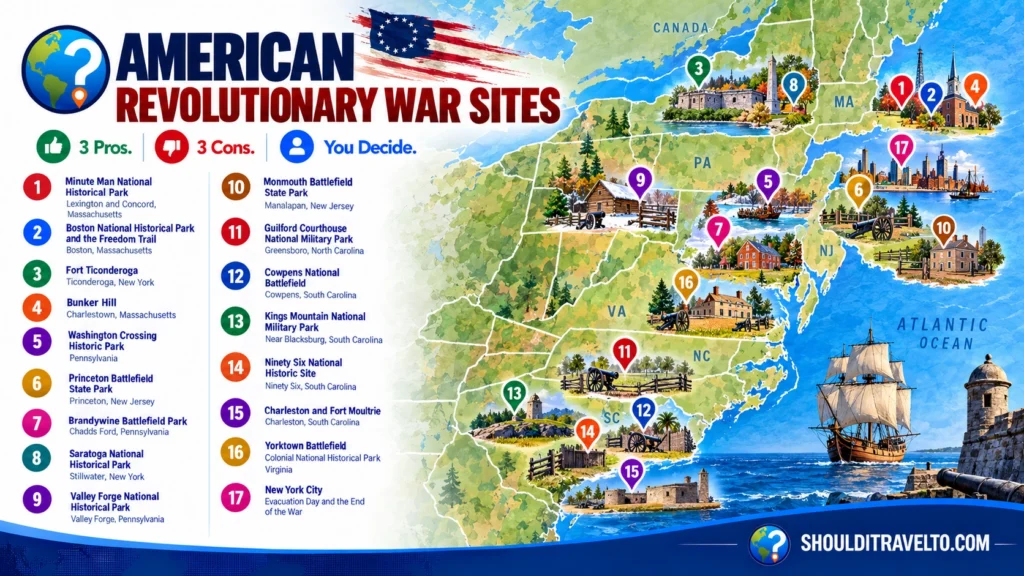
The United States celebrated the 250th anniversary of the Declaration of Independence in 2026. But the story of the American Revolution did not end with the signing of the Declaration on July 4, 1776, or even with the decisive American victory at Yorktown in 1781.
The Revolutionary War began in Massachusetts in April 1775, spread across the colonies, and continued until the Treaty of Paris formally ended the war in 1783. Its 250th-anniversary milestones therefore extend beyond 2026, creating opportunities to explore the battlefields, military sites, and historic places that shaped the country’s founding.
Many of these places are preserved as national historical parks, national military parks, state parks, and historic landmarks. You can walk the roads where militia confronted British soldiers, explore Revolutionary War fortifications, stand on battlefields where the war’s balance shifted, and visit the site where a British army surrendered.
Follows the Revolution chronologically, from the opening engagements in Massachusetts to the final struggle for independence. You can visit these sites.
April 1775: Opening Engagements in Massachusetts
Minute Man National Historical Park: Lexington and Concord, Massachusetts
What happened: On April 19, 1775, British troops marched from Boston toward Concord to seize colonial military supplies. Fighting broke out at Lexington Green, continued at Concord’s North Bridge, and spread along the road as British soldiers retreated toward Boston. These engagements marked the beginning of the Revolutionary War.
What visitors can see: Minute Man National Historical Park preserves sections of the Battle Road, historic homes, and the landscape associated with the opening day’s fighting. Visitors can explore Concord’s North Bridge area and learn about the colonial militia and British regulars who fought there. Lexington Battle Green, another central site associated with the opening engagements, is nearby.
Why visit: This is the natural starting point for a Revolutionary War road trip. Rather than viewing the Revolution only through documents and monuments, visitors can experience the geography of the opening battles and see how a confrontation in Massachusetts became a war for independence.
Boston National Historical Park and the Freedom Trail: Boston, Massachusetts
What happened: Before the fighting began, Boston was a center of colonial resistance. The Boston Massacre in 1770, the Boston Tea Party in 1773, and growing tensions between British authorities and colonists helped set the stage for war. In June 1775, the Battle of Bunker Hill demonstrated that colonial forces could inflict substantial losses on British troops.
What visitors can see: Boston’s Freedom Trail connects historic sites associated with the Revolution, including the Old State House and other landmarks. Across the harbor and in nearby Charlestown, visitors can explore the Bunker Hill Monument and learn about the battle fought on Breed’s Hill.
Why visit: Boston provides the political and social context for the war. It’s particularly useful for travelers who want to understand how protests over taxation and colonial government escalated into armed conflict. Unlike Minute Man, which focuses on the opening battles, Boston offers a broader look at the events that led to revolution.
May–June 1775: Early American Military Victories
Fort Ticonderoga: Ticonderoga, New York
What happened: On May 10, 1775, American forces led by Ethan Allen and Benedict Arnold captured Fort Ticonderoga from a small British garrison. The fort’s artillery later helped the Continental Army strengthen its position around Boston.
What visitors can see: The historic fort overlooks Lake Champlain and preserves military structures and exhibits, with views of the surrounding landscape. The site helps visitors understand the strategic importance of waterways, mountain passes, and fortified positions during the war.
Why visit: Fort Ticonderoga shows how the Patriots began acquiring the weapons and strategic positions needed to challenge the British military. It’s also a compelling stop for travelers interested in early American military history and the region’s broader colonial past.
Bunker Hill: Charlestown, Massachusetts
What happened: On June 17, 1775, British forces attacked colonial positions on Breed’s Hill during the Battle of Bunker Hill. Although the British ultimately took the position, they suffered heavy casualties. The battle demonstrated that the inexperienced colonial army could stand up to British regulars.
What visitors can see: The Bunker Hill Monument commemorates the battle, and the surrounding historic area helps explain the fighting and its significance. Visitors can combine the site with Boston’s Freedom Trail and other Revolutionary War landmarks.
Why visit: Bunker Hill offers a powerful early example of the Patriots’ determination and the high cost of the war for both sides.
November 1775: War Reaches the Southern Frontier
Ninety Six National Historic Site: Ninety Six, South Carolina
What happened: In November 1775, Patriots and Loyalists clashed at Ninety Six in one of the early Revolutionary War engagements in the South. The settlement later became strategically important again during the British southern campaign. In 1781, Patriot forces besieged a Loyalist-held fort there.
What visitors can see: The site preserves historic earthworks, walking trails, and the remains of the distinctive Star Fort. Visitors can explore the landscape where the two conflicts took place and learn how the Revolution divided communities and colonies.
Why visit: Ninety Six illustrates that the Revolution was not simply a unified American population fighting the British. Patriots and Loyalists also fought one another, and the struggle for control of the southern backcountry became increasingly important as the war progressed.
December 1776–January 1777: Washington’s Counterattack in New Jersey
Washington Crossing Historic Park: Pennsylvania
What happened: On the night of December 25–26, 1776, George Washington’s army crossed the Delaware River from Pennsylvania into New Jersey before attacking the Hessian garrison at Trenton. The victory helped restore morale after a difficult series of defeats and retreats.
What visitors can see: Washington Crossing Historic Park interprets the crossing and its surrounding history. Visitors can explore historic structures, exhibits, and the landscape associated with the operation. The New Jersey side of the river also has sites connected to the campaign.
Why visit: The Delaware crossing is one of the most recognizable episodes of the Revolution. The site helps travelers understand the risks Washington took when the Patriot cause was in serious danger.
Princeton Battlefield State Park: Princeton, New Jersey
What happened: On January 3, 1777, Washington’s army defeated British forces at Princeton. Coming shortly after the victories at Trenton, the battle helped revive the Patriot cause and demonstrated that Washington’s army could challenge British troops in the field.
What visitors can see: Princeton Battlefield State Park preserves part of the battlefield and interprets the fighting. Visitors can walk the grounds and learn about troop movements and the battle’s place in the campaign.
Why visit: Princeton makes an excellent companion to Washington Crossing and Trenton for travelers interested in the winter campaign that changed the Revolution’s momentum.
September–October 1777: The Fight for Philadelphia and the Turning Point at Saratoga
Brandywine Battlefield Park: Chadds Ford, Pennsylvania
What happened: On September 11, 1777, British forces defeated Washington’s army at the Battle of Brandywine as they advanced toward Philadelphia. The battle did not end American resistance, but it opened the way for the British occupation of the nation’s revolutionary capital.
What visitors can see: Brandywine Battlefield Park interprets the battle and preserves portions of the historic landscape. Visitors can learn about the opposing armies’ movements and the challenges of defending a broad front against a larger, experienced force.
Why visit: Brandywine helps explain why Philadelphia fell to the British in 1777 and why the Revolution continued despite serious setbacks for Washington’s army.
Saratoga National Historical Park: Stillwater, New York
What happened: In the fall of 1777, American forces confronted British General John Burgoyne’s army in a series of engagements around Saratoga. Burgoyne surrendered his army in October. The victory helped convince France to enter a formal alliance with the United States and provide crucial military and naval support.
What visitors can see: Saratoga National Historical Park preserves key battlefield areas, including Freeman’s Farm and Bemis Heights, as well as the site of Burgoyne’s surrender. The landscape and interpretive exhibits explain how the campaign unfolded.
Why visit: Saratoga is one of the most consequential Revolutionary War destinations. Its importance extends beyond the battlefield: the American victory changed the war’s international dimensions.
Valley Forge National Historical Park: Valley Forge, Pennsylvania
What happened: Valley Forge was not a major battlefield. It was the Continental Army’s winter encampment from December 1777 to June 1778, after the British occupied Philadelphia. The army endured shortages and harsh conditions as it trained and reorganized.
What visitors can see: The park preserves the encampment landscape, reconstructed huts, historic structures, and memorials. Visitors can explore by car, on foot, or by bicycle, depending on their interests and the time available.
Why visit: Valley Forge offers a different perspective on the Revolution: the struggle to keep an army supplied, organized, and able to continue the war. It pairs naturally with Brandywine for a broader Philadelphia-area Revolutionary War itinerary.
June 1778: The Continental Army Returns to the Field
Monmouth Battlefield State Park: Manalapan, New Jersey
What happened: On June 28, 1778, American forces engaged British troops near Monmouth Court House as the British withdrew from Philadelphia toward New York. The battle took place in intense summer heat and ended without a decisive victory for either side, but it demonstrated the growing competence of Washington’s army.
What visitors can see: Monmouth Battlefield State Park preserves a substantial portion of the battlefield, with trails, interpretive displays, and historic landscape features that help visitors understand the engagement.
Why visit: Monmouth illustrates how the Continental Army evolved during the war. After Valley Forge, the army returned to combat better trained and increasingly capable of confronting British regulars.
1780: The War Intensifies in the South
Charleston and Fort Moultrie: Charleston, South Carolina
What happened: In May 1780, British forces captured Charleston after a prolonged siege, taking a major Patriot army prisoner. The victory gave Britain an important foothold in the South and helped shift the war’s center of gravity toward the southern colonies.
What visitors can see: Charleston offers historic sites associated with the Revolution and the city’s role in the struggle for independence. Fort Moultrie on Sullivan’s Island is especially relevant to the earlier Battle of Sullivan’s Island in June 1776, when American defenders successfully resisted a British naval attack. The fort’s history spans multiple periods, so visitors should distinguish the 1776 defense from the later 1780 fall of Charleston.
Why visit: Charleston shows how the war affected an important port city and why control of the South became central to Britain’s strategy. It also lets you combine Revolutionary War history with the city’s architecture, food, and broader cultural heritage.
Kings Mountain National Military Park: Near Blacksburg, South Carolina
What happened: On October 7, 1780, Patriot militia defeated a Loyalist force at Kings Mountain. The battle weakened British efforts to secure the southern backcountry and helped change the course of the southern campaign.
What visitors can see: Kings Mountain National Military Park preserves the rugged battlefield and offers trails, interpretive exhibits, and a visitor center when open. The terrain helps explain how the Patriot forces surrounded and overwhelmed their opponents.
Why visit: Kings Mountain is an important stop for understanding the civil-war-like divisions within the Revolution. It also demonstrates how local militia forces could affect the larger military campaign.
January–March 1781: Patriot Victories Weaken the British Southern Campaign
Cowpens National Battlefield: Cowpens, South Carolina
What happened: On January 17, 1781, American forces under Daniel Morgan defeated British troops led by Banastre Tarleton at Cowpens. Morgan’s use of militia and regular soldiers in coordinated lines helped produce a decisive Patriot victory.
What visitors can see: Cowpens National Battlefield preserves the battlefield, with walking routes and interpretive materials that explain the tactics and troop movements.
Why visit: Cowpens appeals especially to travelers interested in military strategy. The battle helped undermine Britain’s southern campaign and set the stage for further clashes in the Carolinas.
Guilford Courthouse National Military Park: Greensboro, North Carolina
What happened: On March 15, 1781, American forces under Nathanael Greene fought British troops under Charles Cornwallis at Guilford Courthouse. The British technically won the battlefield, but their losses were so severe that the victory weakened their ability to continue operations in the region.
What visitors can see: Guilford Courthouse National Military Park preserves much of the battlefield, with walking trails, monuments, and interpretive exhibits. The park helps visitors understand how the fighting unfolded across the terrain.
Why visit: Guilford Courthouse demonstrates that a battlefield victory did not always translate into strategic success. Heavy British losses pushed Cornwallis toward Virginia, where the campaign would eventually culminate at Yorktown.
May–June 1781: The Siege of Ninety Six
Ninety Six National Historic Site: Ninety Six, South Carolina
What happened: In 1781, Patriot forces under Nathanael Greene besieged the Loyalist-held Star Fort at Ninety Six. The Patriots ultimately withdrew when a British relief force approached, making the siege a failure rather than an American victory.
What visitors can see: Visitors can explore the Star Fort earthworks, walking trails, and other historic features associated with both the 1775 engagement and the 1781 siege.
Why visit: Returning to Ninety Six in the timeline highlights the prolonged struggle for control of the southern interior. The site is especially useful for travelers who want to understand the war’s local dimensions beyond its most famous battles.
September–October 1781: Yorktown and the Decisive Surrender
Yorktown Battlefield: Colonial National Historical Park, Virginia
What happened: In the fall of 1781, American and French forces surrounded British General Cornwallis’s army at Yorktown. French naval power helped prevent the British from providing effective relief, and the siege ended with Cornwallis’s surrender on October 19, 1781.
What visitors can see: Yorktown Battlefield preserves siege lines, earthworks, historic structures, and the landscape associated with the campaign. Visitors can explore the battlefield and learn how American and French forces coordinated their operations. Nearby Colonial Williamsburg and Jamestown offer additional context for a longer history-focused trip.
Why visit: Yorktown is the essential destination for understanding the war’s decisive military turning point. The surrender effectively ended major British offensive operations in North America, although the war and peace negotiations continued.
1782–1783: From Military Victory to Independence
New York City: Evacuation Day and the End of the War
What happened: Even after Yorktown, British forces remained in New York City and other locations. The parties agreed to preliminary peace terms in 1782, and the Treaty of Paris was signed on September 3, 1783, formally ending the war and recognizing American independence. British forces evacuated New York City on November 25, 1783.
What visitors can see: New York City isn’t a single preserved battlefield marking the war’s end, but visitors can explore Revolutionary-era sites tied to British occupation, Patriot resistance, and the city’s role in the conflict’s final stages. The Fraunces Tavern area and other historic sites connect to the period, while broader Revolutionary War tours put the city’s role in context.
Why visit: New York brings the timeline full circle. The war’s final chapter was not a single surrender or battlefield moment, but a transition from military conflict to internationally recognized independence.
Planning Your American Revolutionary War Trip
The best way to plan a Revolutionary War vacation is to start with the part of the story you most want to experience. Then choose a region, allow enough time to explore, and add nearby attractions that make the trip more than a series of stops.
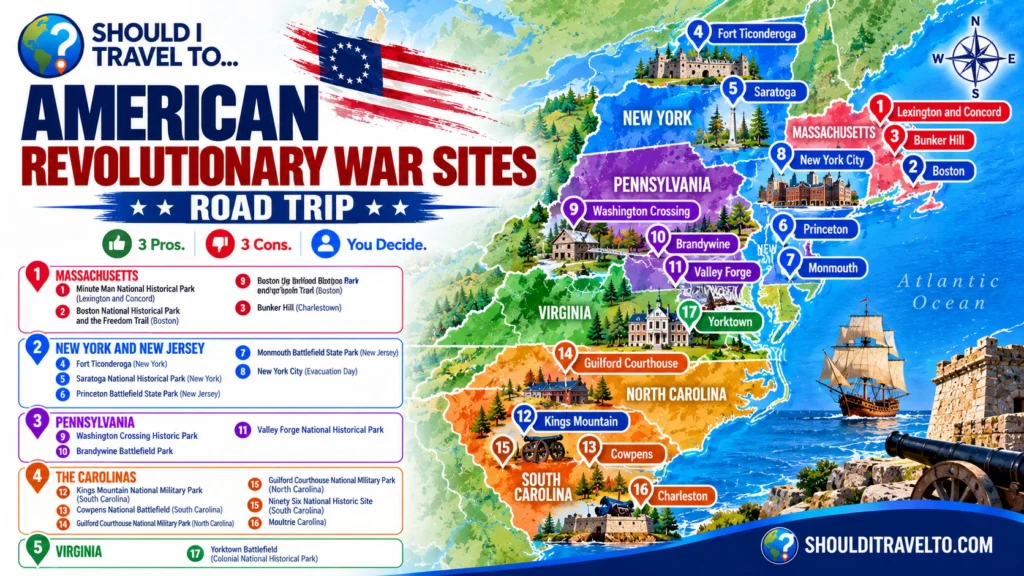
Choose Your Historical Focus
Beginning of the Revolution: Start with Lexington and Concord, then explore Boston’s Revolutionary landmarks and Bunker Hill.
George Washington’s early campaigns: Combine Washington Crossing with Princeton and other nearby sites associated with the New Jersey campaign.
The struggle over Philadelphia: Visit Brandywine and Valley Forge, with time to explore Philadelphia’s history in its founding era.
For the turning point at Saratoga: Focus on Saratoga National Historical Park and consider adding Fort Ticonderoga to understand the earlier northern campaigns.
For the southern campaign: Build a multi-day route around Kings Mountain, Cowpens, Guilford Courthouse, and Ninety Six. These sites are spread across several states, so account for driving time.
The decisive military conclusion: Make Yorktown the centerpiece of a Virginia trip and consider adding Colonial Williamsburg and Jamestown.
Revolutionary War Road Trip
If you can’t visit every Revolutionary War site, a few regional itineraries can help you explore the war.
- Massachusetts: Combine Minute Man National Historical Park with Boston’s Freedom Trail and Bunker Hill. This is the best short trip for exploring the war’s causes and opening engagements.
- New York and New Jersey: Pair Fort Ticonderoga with Saratoga for an upstate New York history trip, or explore Washington Crossing and Princeton for the winter campaign of 1776–1777.
- Pennsylvania: Visit Brandywine and Valley Forge to see the British advance on Philadelphia and the Continental Army’s winter encampment.
- The Carolinas: Kings Mountain, Cowpens, Guilford Courthouse, and Ninety Six reveal the importance of the southern campaign. Because these sites are spread across multiple states, allow several days and plan driving distances carefully.
- Virginia: Make Yorktown the centerpiece of a longer visit that includes Williamsburg and Jamestown.
Before you go, check each site’s official visitor information for current opening hours, tours, trail access, and road conditions. Some battlefields are large outdoor landscapes, while others have visitor centers or historic buildings with seasonal schedules.
How Many Days Should You Spend?
The ideal trip length depends on how many sites you want to see and whether you’re traveling primarily for military history or combining the sites with a broader vacation.
1 Day
Best for travelers visiting a single battlefield or historic area near home.
Possible choices include Lexington and Concord, Saratoga, Princeton, Valley Forge, or Yorktown. A one-day visit works best when you choose a few nearby sites rather than trying to cover an entire campaign.
2–3 Days
Best for a focused regional history trip.
Consider Boston and Lexington–Concord, the Philadelphia area with Brandywine and Valley Forge, or a Virginia trip centered on Yorktown. This allows time for more than one site without making the trip feel rushed.
4–5 Days
Best for travelers who want to follow a campaign or combine historic sites with other attractions.
You could explore Massachusetts in greater depth, build a northern New York itinerary around Fort Ticonderoga and Saratoga, or visit several Revolutionary War sites across the Carolinas.
A Week or Longer
Best for dedicated history travelers who want to explore several chapters of the Revolution.
A longer trip could follow the war chronologically or concentrate on one region with many related sites. If you want to travel from Massachusetts to Virginia or the Carolinas, consider whether separate trips would be more enjoyable than trying to cover everything in one journey.
When Is the Best Time to Visit?
Spring and fall can be appealing for outdoor battlefield visits because temperatures are often more comfortable for walking. However, weather varies by region, and conditions can change quickly.
Summer offers longer daylight hours and may coincide with special historical programming, but heat and humidity can make outdoor exploration tiring, particularly in the South. Winter can bring quieter visits, but shorter daylight hours and seasonal operating schedules may limit what you can see.
If you’re traveling for a specific 250th-anniversary commemoration, choose dates around the event rather than assuming the anniversary program will run throughout the season.
The most important consideration is whether you can comfortably explore the sites you choose. Check the forecast and official park information before you travel.
Should You Rent a Car?
For many multi-site Revolutionary War trips, a car helps and is sometimes essential.
You can explore some destinations, such as Boston’s historic core, largely on foot or by public transportation. Other battlefields are spread over rural landscapes where public transportation is limited or unavailable.
A car gives you greater flexibility to visit multiple sites in a day, stop at historic landmarks along the way, and explore nearby towns. However, you may not need one for an entirely urban itinerary centered on Boston or Philadelphia.
Decide on your region and daily itinerary before booking transportation. That will help you decide whether a rental car is worth it for the whole trip or just part of it.
What Should You Know Before Visiting a Battlefield?
A little preparation can make a battlefield visit more rewarding.
- Read a short overview of the battle before arriving so you understand what you’re looking at.
- Start at the visitor center, if one is available, to learn about the site and its recommended route.
- Wear comfortable walking shoes and bring water, sun protection, and weather-appropriate clothing.
- Allow more time than you would for a quick monument stop if you plan to walk the battlefield.
- Check accessibility information if you have mobility needs or are traveling with young children.
- Stay on marked trails and respect historic earthworks, structures, and protected landscapes.
- Confirm whether guided tours, historic buildings, and visitor centers are open on your planned dates.
You don’t need to be a military history expert to visit. A basic understanding of the battle and its significance is enough to get started.
Which American Revolutionary War Sites Are Best for You?
The best destination depends on the part of the Revolution that interests you most.
If you want to:
- See where the war began: Visit Lexington and Concord, Massachusetts. Pair the battlefield landscapes with Boston to understand what led to the fighting.
- Understand George Washington’s leadership: Explore Washington Crossing and Princeton, or visit Valley Forge to learn about the Continental Army’s struggle to survive and reorganize.
- Explore the war’s major turning point: Choose Saratoga, where the American victory helped bring France into a formal alliance with the United States.
- Explore the southern campaign: Visit Kings Mountain, Cowpens, Guilford Courthouse, and Ninety Six. These sites show how local divisions and Patriot victories affected Britain’s strategy.
- Visit the decisive battlefield: Choose Yorktown, Virginia, where the British surrendered in 1781, effectively ending major British offensive operations in North America.
Experience a broader American history vacation: Combine Revolutionary War sites with historic cities and other landmarks. Boston, Philadelphia, and the Virginia Historic Triangle let you connect the war to the political ideas, communities, and institutions that shaped early America.
If you’re traveling with children: Consider destinations that balance outdoor exploration with visitor centers, exhibits, historic buildings, and other attractions. Choose a manageable number of sites rather than trying to cover too much ground.
The Decision
Traveling to American Revolutionary War sites is worthwhile if you want to understand the founding of the United States through the places where its struggle for independence unfolded.
The experience is most rewarding when you choose a clear historical focus and give yourself enough time to explore.
The Revolution’s story stretches across several states, and no single destination tells it all. But that also gives you flexibility: you can plan a short regional visit, build a longer history-focused vacation, or return for different chapters of the story over time.
Although 2026 marked the 250th anniversary of American independence, it didn’t end the Revolution’s history or the opportunities to explore it. The war began in 1775, the decisive surrender came in 1781, and formal peace followed in 1783.
You can choose the sites that interest you most and make the trip your own.
3 Pros. 3 Cons. You Decide.
American Revolutionary War Sites Frequently Asked Questions
What are the best American Revolutionary War sites to visit?
Lexington and Concord, Saratoga, Valley Forge, Kings Mountain, Cowpens, and Yorktown are among the most significant destinations. The best choice depends on whether you’re interested in the opening battles, Washington’s campaigns, the southern campaign, or the war’s decisive conclusion.
Where did the American Revolutionary War begin?
The fighting began in Massachusetts on April 19, 1775, with the engagements at Lexington and Concord. Minute Man National Historical Park preserves areas associated with the opening battles.
Where did the American Revolutionary War end?
The British surrender at Yorktown on October 19, 1781, was the war’s decisive military turning point, but it did not formally end the war. The Treaty of Paris, signed on September 3, 1783, officially ended the conflict and recognized American independence.
What is the best Revolutionary War battlefield to visit?
No single battlefield is best for every traveler. Lexington and Concord are ideal for the opening engagements, Saratoga for a major American victory, and Yorktown for the decisive surrender. Kings Mountain and Cowpens are particularly important for understanding the southern campaign.
Can you visit the battlefields where the American Revolution was fought?
Yes. The National Park Service, state parks, and other historic-site organizations preserve and open many Revolutionary War sites to visitors. Access, facilities, tours, and hours vary by location, so check official visitor information before you travel.
How long does it take to visit Revolutionary War sites?
You can visit a single battlefield in a day, while a regional trip usually takes two to five days. A trip covering several regions can take a week or longer, particularly when driving distances are substantial.
When is the best time to visit Revolutionary War battlefields?
Spring and fall often offer comfortable conditions for outdoor exploration, although weather varies by region. Summer provides longer days but can be hot, while winter may bring shorter days and reduced seasonal services. Special anniversary events may have specific dates.
Are Revolutionary War sites good for families?
Yes. Battlefields, historic buildings, visitor centers, and interpretive exhibits can help families explore American history outside the classroom. Choose sites with activities appropriate to children’s ages and allow time for breaks, outdoor walking, and other attractions.
Is 2026 the 250th anniversary of the American Revolutionary War?
2026 marks the 250th anniversary of the Declaration of Independence in 1776. The war began in 1775 and continued until the Treaty of Paris in 1783, so other major Revolutionary War anniversaries fall in the years surrounding 2026.
Can I combine Revolutionary War sites with other American history destinations?
Absolutely. Boston pairs naturally with Lexington and Concord, Philadelphia with Brandywine and Valley Forge, and Yorktown with Colonial Williamsburg and Jamestown. Regional planning can help you experience several chapters of American history without spending too much time driving between distant sites.