Should You Travel To Destinations for Events?
Quick Answer
Yes, you should travel to destinations for events.
Some trips begin with a destination. Others begin with an event that gives you a reason to go somewhere new.
But traveling for an event means more than attending the main attraction. You’re also choosing a city, a region, or a neighborhood to explore, often at a time when crowds, prices, transportation, and local routines may be different from usual.
The best destination depends on what you want from the trip.
Do you want a:
- City with distinctive food and culture?
- Walkable downtown with restaurants and attractions between events?
- Major metropolitan area with plenty to explore beyond the main attraction?
- Destination where the event transforms the entire visitor experience?
From Mardi Gras parades and celebrations to independent films at Sundance and the global spectacle of the Olympic Games, some events can be the reason to plan an entire vacation.
Let’s explore what you need to know before traveling to a destination for an event.
Which Event Destinations Are Worth Traveling To?
Some events are annual traditions. Others are major occasions that take place only once in a particular destination. Both can create memorable travel experiences, but the reasons to go and the challenges involved can differ widely.
You might need to travel for:
- Annual celebrations
- Annual festivals
- Film, arts, and cultural events
- Major sporting events
- One-time experiences
Annual events give travelers a reason to return to a destination at a particular time of year.
Film festivals and cultural gatherings let you discover new work, meet fellow enthusiasts, and experience a destination through a specific creative community.
Some events are large enough to shape an entire destination’s travel experience, such as sporting competitions, major anniversaries, and special events.
The 3 Biggest Reasons to Travel for an Event
Traveling for an event gives you a reason to experience a destination at a particular moment. Instead of simply visiting a city, you’re going for something specific: a celebration, a cultural experience, a major competition, or an event you may not have another opportunity to attend.
1. You Can Experience Something You Won’t Find on an Ordinary Trip
Some events transform a destination.
Mardi Gras brings parades, costumes, music, and Carnival traditions to New Orleans. Sundance brings filmmakers, premieres, and film enthusiasts together. The Olympics turn a host region into an international gathering place for sports and culture.
These experiences can give a trip a stronger sense of purpose than a typical sightseeing vacation.
2. The Event Can Make the Destination More Memorable
An event can help you connect with a place through its traditions, local culture, or shared excitement.
You might discover a city’s neighborhoods while attending a festival, explore its food scene between screenings, or visit museums and historic sites around an event schedule.
The best event trips offer more than the main attraction. They give you a reason to experience the destination itself.
3. You Can Build a Trip Around an Experience You Truly Value
Some travelers want to attend a major sporting event. Others want to celebrate a cultural tradition, discover independent films, or experience a once-in-a-lifetime occasion.
An event can be worth planning a vacation around when it matches your interests and offers an experience you can’t easily replicate elsewhere.
For some travelers, that means an intimate cultural festival. For others, it means a premium hospitality package or a major international event. The right choice depends on what matters to you, and what you’re willing to spend.
The 3 Biggest Downsides of Traveling for an Event
An event can make a destination more exciting, but it can also complicate a trip compared with visiting at another time.
1. Demand Can Drive Up the Cost
Popular events can drive up hotel rates, limit lodging availability, raise ticket prices, and increase transportation costs.
The event itself may only be one part of your budget. You also need to consider where you’ll stay, how you’ll get around, meals, and any additional activities.
Premium experiences may be available, but they aren’t necessary for every event trip. The important question is whether the overall cost makes sense for the experience you want.
2. Crowds and Logistics Can Take Over Your Vacation
Large events can change how a destination functions.
You may encounter packed public transportation, road closures, security checkpoints, long lines, restricted access, and crowded restaurants. Some attractions may have altered hours or require reservations in advance.
Some travelers may find those conditions part of the excitement. For others, they can make an otherwise appealing destination less enjoyable.
3. The Event May Not Justify the Entire Trip
An event can be exciting without being worth a dedicated vacation for everyone.
Perhaps the schedule is shorter than expected, the tickets are outside your budget, the experience is less appealing in person, or the destination offers limited interest beyond the event.
Before committing, consider whether you would still enjoy the trip if you attended fewer activities than planned, or if the main event didn’t meet your expectations.
What Should You Consider Before Traveling for an Event?
An event can be memorable and still not be the right trip for every traveler. Before committing, consider the factors that will most affect your experience.
- The experience: Is the event genuinely important to you, or would you enjoy the destination just as much at another time?
- The cost: Will tickets, lodging, transportation, and dining fit your budget? Are premium experiences worth the additional expense to you?
- The crowds: Are you comfortable with busy venues, packed streets, and increased demand for local services?
- The logistics: Will you need advance reservations, special transportation arrangements, or a longer stay to make the trip work?
- The destination: Is there enough to see and do outside the event to make the journey worthwhile?
- The timing: Does the event take place at a time of year that suits your interests, schedule, and preferred travel conditions?
The right answer depends on what you value. A crowded city and premium accommodation may be reasonable trade-offs for a once-in-a-lifetime experience. For someone else, visiting the same destination outside the event period may offer better value and more flexibility.
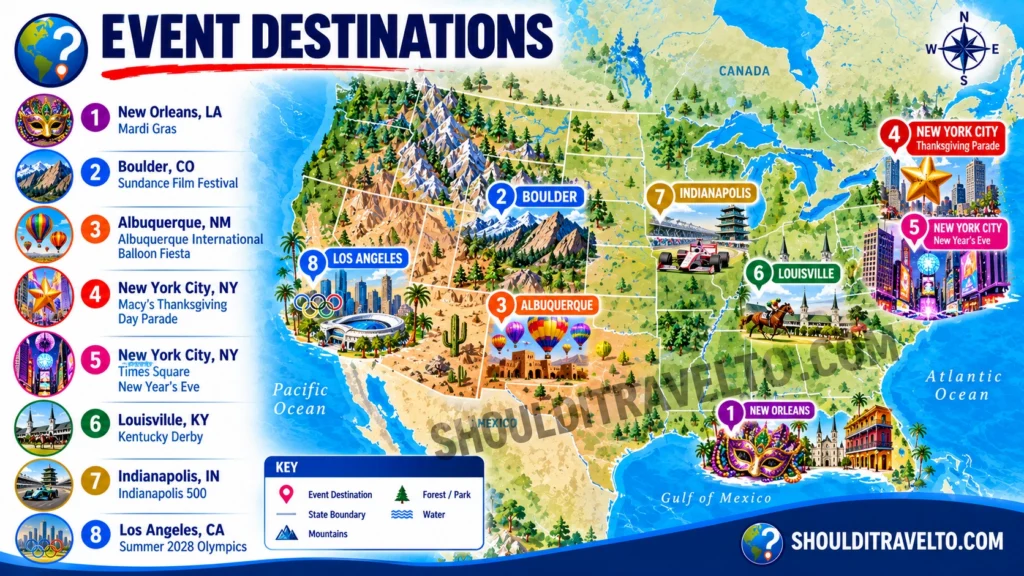
Event Destinations
These destinations offer different kinds of event travel, from New Orleans during Mardi Gras to Los Angeles for the 2028 Olympics.
Each pairs a major event with a distinct setting, local culture, and practical trade-offs around crowds, transportation, lodging, and what else you can do while you’re there.
New Orleans, Louisiana, for Mardi Gras
Mardi Gras gives travelers a reason to experience New Orleans at one of its most energetic times of year. Parades, music, distinctive traditions, historic neighborhoods, and Creole and Cajun food make the city part of the attraction. But Carnival season also brings heavy crowds, high lodging demand, road closures, and a different pace from an ordinary visit.
New Orleans is especially appealing if you want the celebration alongside the city’s food, music, and cultural character.
Boulder, Colorado, for the Sundance Film Festival
Beginning in 2027, Boulder will host the Sundance Film Festival, bringing independent film screenings and festival events to a Colorado university city known for its walkable downtown, local dining, and Flatirons views.
Travelers can combine the festival with Pearl Street and nearby outdoor scenery.
January weather, lodging availability, and individual screening locations will all factor into trip planning.
Albuquerque, New Mexico, for the International Balloon Fiesta
The Albuquerque International Balloon Fiesta transforms the city into a destination for one of the world’s best-known hot-air balloon gatherings. Mass ascensions and colorful balloons fill the morning sky, while the surrounding desert landscape gives the event a distinctly Southwestern setting.
Visitors can also explore Albuquerque’s local food, historic Old Town, and regional culture.
When planning a trip, consider early starts, weather-dependent balloon launches, traffic, and accommodation demand.
New York City for the Macy’s Thanksgiving Day Parade
The Macy’s Thanksgiving Day Parade offers a holiday-season reason to visit New York City for Thanksgiving, with giant character balloons, floats, marching bands, and a longstanding Thanksgiving tradition. The parade can be the centerpiece of a longer trip that includes the city’s museums, restaurants, holiday displays, and neighborhoods.
The trade-offs are crowded viewing areas, early-morning logistics, chilly weather, and potentially premium hotel prices around Thanksgiving.
Times Square, New York City, for New Year’s Eve
Times Square is one of the world’s most recognizable places to welcome the New Year, with the famous ball drop and a large live crowd counting down to midnight. Traveling for the occasion means planning around security restrictions, lengthy waits, limited access to restrooms and food, cold weather, and substantial crowds.
New York City offers plenty to do beyond the countdown, but travelers should decide whether the event is worth the logistical demands, or whether a different celebration in the city would suit them better.
Louisville, Kentucky, for the Kentucky Derby
The Kentucky Derby gives Louisville a distinctive combination of horse racing, tradition, fashion, hospitality, and Southern character. Churchill Downs is the main draw, but the trip can also include Louisville’s bourbon heritage, local restaurants, and waterfront attractions. Derby weekend brings a festive atmosphere and higher demand for hotels and transportation.
Travelers should decide whether they want the full race-day experience, a broader Louisville getaway, or a more budget-conscious visit outside the event.
Indianapolis, Indiana, for the Indianapolis 500
The Indianapolis 500 makes Indianapolis a destination for motorsports fans and travelers who want to experience one of America’s major racing traditions. The race at Indianapolis Motor Speedway is the main attraction, while the city’s downtown, restaurants, museums, and sports culture offer plenty to do beyond race day.
The event draws a large crowd, so plan ahead for traffic, parking, accommodation, and travel to and from the Speedway. It’s a strong choice for racing enthusiasts, especially those who want to pair the event with a city visit.
Los Angeles, California, for the 2028 Summer Olympics
The 2028 Summer Olympics will let travelers experience Los Angeles through a major international sporting event while exploring one of America’s most geographically spread-out cities. Beaches, museums, entertainment landmarks, diverse neighborhoods, and an extensive food scene offer reasons to stay beyond the competitions.
The main trade-offs are likely to include high demand for lodging, busy transportation routes in Los Angeles, and the challenge of traveling between venues across the region. For this trip, where you stay and how you plan your days will matter almost as much as which events you attend.
An event can be the reason you travel, but the destination will shape much of what you experience once you arrive. The right choice depends on the event you want to see, the kind of city or region you want to explore, and how much planning, cost, and crowding you’re willing to accept.
Planning Your Destinations for Events Trip
Once you’ve decided an event is worth considering, plan around its demands. Every event is different, but a few decisions can make a significant difference.
When Should You Book?
Start with the event’s official dates and ticket-release schedule.
For events that draw large crowds, lodging and transportation can fill up well before the event begins. Major sporting events, popular festivals, and internationally recognized gatherings may require planning well in advance.
Check cancellation policies before committing, particularly if event dates, venues, or ticket availability could change.
Where Should You Stay?
The closest hotel isn’t automatically the best choice.
Staying near the venue can cut down on travel time, but nearby lodging may come at a premium. A farther hotel may offer better value if public transportation or event shuttles make the trip straightforward.
Consider the entire itinerary, not just the distance to the main event. You may prefer a neighborhood with restaurants, attractions, and things to do during your free time.
How Much Time Should You Allow?
The right length of stay depends on the event schedule and the destination.
A single-day event might work as a short getaway, while a film festival, multi-day celebration, or Olympic visit could justify a longer trip.
Allow time for travel, security, transportation delays, and activities outside the event itself. If you’re traveling a long distance, consider whether adding a day before or after the main event would make the trip more worthwhile.
What Else Can You Do at the Destination?
Don’t assume the event needs to occupy every hour of your trip.
Look for museums, historic sites, restaurants, neighborhoods, outdoor activities, or other attractions that complement your main reason for visiting.
This is especially useful if your event schedule is limited or you’re traveling with someone with different interests.
A destination with a strong identity beyond the event can offer better value and a more satisfying overall vacation.
Should You Combine the Event With Another Destination?
Sometimes an event works well as part of a larger trip. Other times, adding another destination creates more transportation, hotel changes, and scheduling pressure than it’s worth.
Consider combining destinations when the travel between them is manageable and the contrast adds something meaningful to the vacation.
If the event already requires a complicated itinerary, staying in one area may be the better decision.
How Should You Prepare for Unexpected Changes?
Events can involve schedule changes, weather disruptions, transportation delays, or sold-out activities.
Confirm essential details through official event sources, understand the relevant cancellation policies, and avoid building an itinerary that depends on every connection working perfectly.
The goal is to plan enough to protect the experience without scheduling away all your flexibility.
The Decision Is Yours
Traveling for an event can turn an ordinary vacation into a memorable experience. It can also mean paying more, navigating crowds, and organizing your trip around a fixed schedule.
The right choice depends on whether the event offers something you genuinely value—and whether the destination and overall trip justify the time, money, and effort.
You don’t have to travel for every major event. You just have to find the ones worth traveling for.
3 Pros. 3 Cons. You Decide.
Destinations for Events Frequently Asked Questions
Is it worth traveling for an event?
Traveling for an event can be worthwhile when the experience matches your interests and justifies the cost, time, and planning involved. Cultural celebrations, film festivals, and major sporting events can offer experiences you wouldn’t get from an ordinary vacation. Consider what makes the event special, what else the destination offers, and whether the overall trip fits your budget.
What are the biggest benefits of traveling for an event?
Event travel gives you a specific experience to plan around, a chance to connect with a destination’s culture, and the opportunity to attend something that may not be available locally. It can also give a trip a stronger sense of purpose, whether you’re attending a festival, celebrating a tradition, or watching a major sporting competition.
What are the downsides of traveling for an event?
The main drawbacks are potentially higher prices, larger crowds, and more complicated logistics. Hotels may cost more, tickets and transportation can be limited, and event schedules may restrict your flexibility. The trip may also feel less worthwhile if the event doesn’t meet your expectations or the destination offers little else that interests you.
When should I book a trip for a major event?
Book according to the event’s popularity, ticket-release schedule, and lodging availability. For high-demand events, research accommodation and transportation early to avoid limited choices and higher prices. Confirm official dates before making nonrefundable reservations, and review cancellation policies in case plans change.
Should I stay near the event venue or farther away?
Staying near the venue can reduce travel time and simplify your schedule, but nearby hotels may command a premium. Staying farther away can offer better value if public transportation or event shuttles provide convenient access. Compare the total cost, travel time, and proximity to other attractions before deciding.
How long should I stay at an event destination?
Your ideal trip length depends on the event schedule, travel distance, and what else you want to experience. A single-day event may work as a short getaway, while a multi-day festival or major sporting event may justify a longer stay. Consider adding time to explore the destination beyond the main event, especially if you’re traveling a long distance.
Should I combine an event with sightseeing or another destination?
Often, yes. Exploring local neighborhoods, museums, restaurants, historic sites, or outdoor attractions can make the trip more rewarding and help you get more from your travel budget. You might also combine nearby destinations if the additional travel is manageable. However, if the event already requires extensive travel or a packed schedule, staying in one area may be more enjoyable.