

Should You Visit Big Sur, California, for a Scenic Coastal Escape?
Quick Answer
Yes, you should consider visiting Big Sur, California if you want dramatic coastal scenery, winding oceanfront roads, rugged cliffs, redwood forests, secluded beaches, mountain views, and one of California’s most memorable road-trip experiences.
However, Big Sur isn’t a conventional vacation destination.
There’s no downtown to explore, no single main attraction, and no neighborhood where you can experience everything.
Instead, Big Sur is a stretch of California’s central coast where the Pacific Ocean meets steep cliffs, forested mountains, narrow valleys, and some of the state’s most spectacular coastal landscapes.
Highway 1 is the backbone of the experience.
You can drive along the coast, stop at scenic viewpoints with parking, explore redwood forests, visit state parks when they’re open, take a hike, or spend the night surrounded by the landscape.
And then there’s the scenery itself.
The question isn’t simply whether Big Sur is beautiful. It is.
The better question is whether you want a vacation built around scenery, driving, outdoor exploration, and the experience of being somewhere that feels dramatically different from everyday life.
What Makes Big Sur Different?
Big Sur is best understood as a destination you experience along a journey rather than a place you explore from one central location.
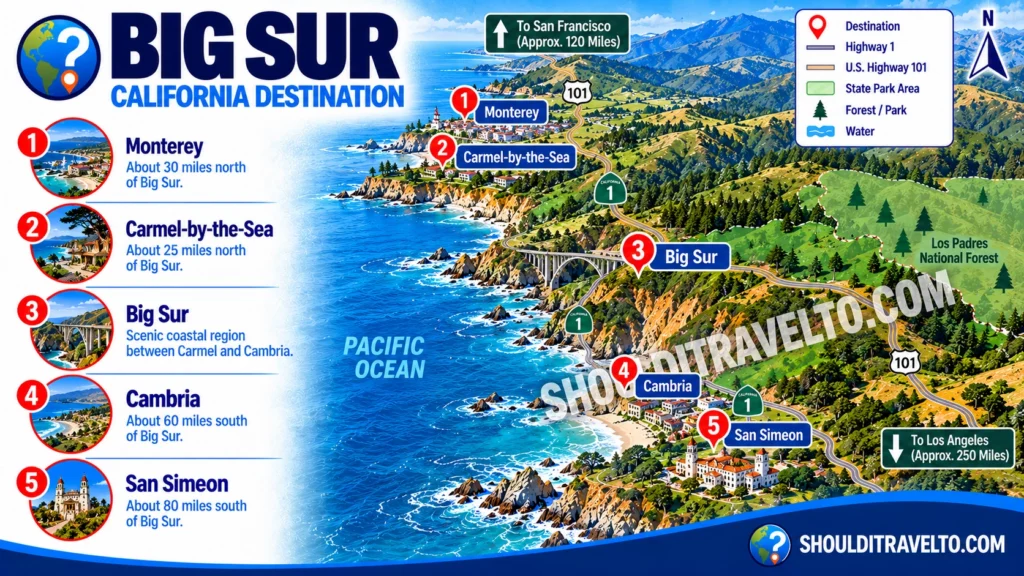
The region stretches along California’s central coast, roughly between Carmel-by-the-Sea and San Simeon. Highway 1 connects much of the coastline, passing dramatic cliffs, beaches, forests, viewpoints, and access points for parks and outdoor recreation.
That geography defines the vacation.
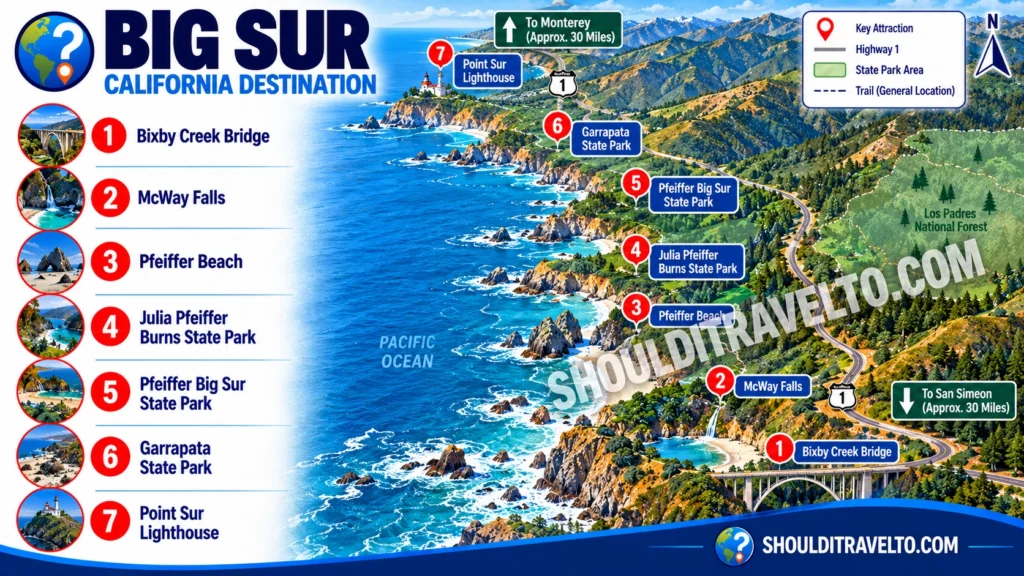
You might start near Carmel, drive south along the coast, stop to admire Bixby Creek Bridge, explore a forest when park access allows, and continue to the region’s southern end.
Or you might approach from the south, spend the day exploring the coastline, then return to Cambria or San Simeon.
Either way, the journey becomes part of the attraction.
Big Sur is not a destination where you need to fill every hour with activities. Sometimes the best part of the trip is finding a safe, legal place to stop, looking toward the Pacific, and taking in the view.
But that doesn’t mean you should simply start driving without a plan.
The region is long, the road is winding, and not every attraction is immediately accessible from the highway. A good itinerary balances scenic driving with a few carefully selected stops.
Big Sur is less about how many attractions you can visit and more about how much of the landscape you can experience.
The 3 Biggest Reasons to Visit Big Sur
Big Sur appeals for its scenery, outdoor exploration, and a coastal road trip that feels fundamentally different from visiting California’s larger cities.
1. The Coastline Is the Main Attraction
The coastline combines steep cliffs, rocky coves, beaches, offshore formations, and expansive views of the Pacific Ocean. The Santa Lucia Mountains rise immediately inland, creating a dramatic contrast between the mountains and the sea.
Highway 1 lets you experience that scenery from multiple perspectives.
At times, the road hugs the coastline with open ocean views. Elsewhere, it curves through wooded hillsides before revealing another stretch of cliffs or shoreline.
Bixby Creek Bridge is one of the best-known landmarks, but it isn’t the only reason to make the drive.
The scenery continues well beyond the bridge, and much of Big Sur’s appeal comes from the succession of views rather than one individual stop.
You don’t need to be a serious hiker to appreciate the landscape, either. Scenic driving, photography, short walks where permitted, and simply looking out across the Pacific can be enough to make the trip worthwhile.
That’s what separates Big Sur from destinations where the main attractions are museums, shopping districts, or a long checklist of activities.
In Big Sur, the landscape is the attraction.
2. You Can Experience Coastline, Mountains, and Redwood Forests in One Trip
Big Sur isn’t just an ocean-view destination.
The region’s terrain changes as you move between the coast and the mountains. Coastal scrub, rocky headlands, forested valleys, redwoods, and steep mountain slopes all contribute to the experience.
When open, Pfeiffer Big Sur State Park provides access to coastal redwoods and the Big Sur River. Other parks and protected areas offer different perspectives on the coastline, forests, and mountain terrain.
That variety matters because you can build a trip around more than driving.
You might spend part of the day admiring ocean views, another walking through a forest, and another exploring a beach or public coastal trail.
The result is a much richer experience than simply following Highway 1 from one overlook to the next.
It also appeals to travelers with different interests. One person may prioritize photography, another may want to hike, and someone else may be perfectly happy enjoying the drive.
The important caveat is that access to trails, beaches, and parks varies. Not every popular destination is always open, and some trails require considerably more effort than a roadside stop.
3. Big Sur Makes a Memorable California Road Trip
Big Sur is particularly rewarding when you treat the drive as part of the vacation rather than simply a way to get somewhere else.
The winding coastline, dramatic bridges, changing scenery, and remote stretches of road encourage a slower pace.
You can combine Big Sur with Monterey and Carmel-by-the-Sea to the north, or with Cambria and San Simeon to the south.
That creates a natural California Central Coast itinerary.
Monterey offers a more conventional town-based vacation with restaurants, accommodations, waterfront attractions, and the Monterey Bay Aquarium.
Carmel-by-the-Sea provides a compact village environment, galleries, restaurants, and beach access.
Big Sur offers something different: a landscape-focused experience in which the coastline and mountains dominate.
That combination makes the region especially useful for travelers who want to experience several sides of California in one trip.
You don’t have to choose between a coastal town and a scenic drive.
You can experience both.
The 3 Biggest Downsides of Visiting Big Sur
Big Sur’s natural beauty is why you go, but the region’s geography also creates practical limitations travelers should understand before planning a trip.
1. You Need to Plan Around a Winding, Time-Consuming Drive
Highway 1 is one of Big Sur’s biggest attractions, but it’s not a road to rush through.
Curves, elevation changes, narrow sections, scenic stops, and slower driving conditions mean distances can take longer than you expect.
A stop that looks close on a map may take longer than you expect, especially when you factor in parking, walking to a viewpoint, or waiting for traffic to clear.
That makes overambitious itineraries a common mistake.
Trying to see every famous bridge, beach, waterfall, park, and viewpoint in a single day can leave you spending most of the trip behind the wheel.
Big Sur is more rewarding when you choose a few priorities and leave time to enjoy them.
Also, don’t assume the full coastal route will always be open. Wildfires, landslides, road repairs, and other conditions can affect Highway 1 and access to individual attractions.
Check current road conditions before deciding how far to drive.
2. Big Sur Has Limited Services and Can Be Expensive
Big Sur isn’t a major city, and services aren’t on every corner.
Restaurants, fuel, lodging, and other amenities are more spread out, and some stretches offer few convenient stops.
That means you should plan meals, fuel, restrooms, and supplies more carefully than you might on a conventional city vacation.
Lodging can also get expensive, especially if you want to stay within Big Sur itself. The selection is more limited than in nearby cities, and demand for distinctive coastal accommodations can be substantial.
You can stay in nearby communities and explore Big Sur as a day trip, but that’s a different experience from waking up in the region.
Neither approach is automatically better.
The key point is that convenience isn’t Big Sur’s strongest attribute.
You’re trading some convenience for scenery, solitude, and a much stronger connection to the landscape.
3. Weather and Access Can Change the Experience
Big Sur’s scenery is extraordinary, but you cannot guarantee that every viewpoint will be clear, every trail will be open, or every planned stop will be accessible.
Coastal fog can obscure ocean views, particularly at certain times of year. Rain and wind can make outdoor activities less comfortable, while winter storms can affect roads and trails.
Wildfires, landslides, erosion, and repair projects can also close roads and trails.
This matters because many visitors arrive with a specific image in mind.
They want to photograph Bixby Creek Bridge, see McWay Falls, walk through redwood forests, or hike to a secluded beach.
But individual attractions can have different access restrictions, and some well-known viewpoints require walking trails that may not be open.
Don’t build your entire itinerary around a single attraction without checking its current status.
A more flexible approach is to identify several possible stops and then choose the ones that are safely accessible when you arrive.
Big Sur is worth visiting for its broader landscape, not simply for one photograph.
What Is Big Sur Really Like?
Big Sur can feel remote, dramatic, peaceful, rugged, and surprisingly quiet in some places.
It’s a destination where the road, ocean, and mountains often dominate the experience.
You might spend the morning looking out over the Pacific, the afternoon walking through a forest, and the evening watching the light change over the coastline.
Restaurants, inns, campgrounds, resorts, and other visitor services exist, but they don’t form one continuous commercial district.
Instead, development is spread along the region, separated by stretches of protected land and natural scenery.
That gives Big Sur a very different feel from the California destinations many travelers know.
Los Angeles is built around a large metropolitan area.
Anaheim is centered on theme parks.
Palm Springs combines a desert city with resorts, architecture, and outdoor recreation.
Big Sur is primarily about experiencing a landscape.
It rewards travelers who like being outdoors, don’t mind driving, and can appreciate a destination without needing a packed schedule.
It is less suitable for travelers who want extensive nightlife, public transportation, or a long list of indoor attractions.
And that distinction is important.
Big Sur isn’t a conventional sightseeing vacation. It’s a landscape-focused getaway.
Planning Your Big Sur Trip
A good Big Sur itinerary starts with your route, available time, and the experiences you most want to include.
Because the region is spread out, it’s often better to focus on one section than try to fit every well-known stop into the same day.
Best Things to Do in Big Sur
Big Sur’s main experiences revolve around the coast, forests, scenic viewpoints, and outdoor recreation. The right combination depends on your interests, the time you have, and which locations are open when you visit.
Drive Highway 1
The coastal drive is the foundation of a Big Sur trip.
Highway 1 connects much of the region and provides repeated views of cliffs, the Pacific, wooded slopes, and coastal formations.
Don’t treat the drive as something to finish as quickly as possible.
Allow time for scenic pullouts where stopping is permitted, short walks, and unexpected views along the way.
The most rewarding route is often the one that lets you slow down.
However, check the current road conditions before setting out. Temporary closures can affect how much of the coast you can access in a single trip.
See Bixby Creek Bridge
Bixby Creek Bridge is one of the most recognizable landmarks along the Big Sur coast.
The concrete arch bridge spans a deep coastal canyon, surrounded by steep hillsides and dramatic ocean scenery.
It is a major photo spot, but you must view it safely and legally.
Do not stop or park at the bridge ends. Use only legal designated parking areas or permitted pullouts, and follow posted restrictions. The roadside environment is not designed for unrestricted sightseeing, and unsafe stopping can put visitors and other drivers at risk.
The bridge is a memorable stop, but it should be one part of your coastal drive rather than the sole reason to visit.
Explore the Redwood Forests
The redwoods provide a completely different perspective on Big Sur.
Instead of exposed cliffs and ocean views, you enter shaded forest environments where towering trees and flowing water create a quieter atmosphere.
Pfeiffer Big Sur State Park is especially known for this experience, with coast redwoods and the Big Sur River shaping its landscape.
When the park and its trails are open, walking among the trees can provide a welcome contrast to the coastal highway.
Plan for the actual access conditions rather than assuming every forest trail is available. The region’s natural areas are subject to fire recovery, storm damage, maintenance, and other restrictions.
See McWay Falls
McWay Falls is among Big Sur’s most famous natural landmarks.
The waterfall descends over a coastal cliff into a small cove, creating a scene that combines the rugged coastline with a striking waterfall.
It is often featured in photographs of the California coast, but access to its viewing area has been subject to extended closures.
Check the official Julia Pfeiffer Burns State Park information before planning a visit specifically around McWay Falls. Do not enter closed trails or cross barriers to obtain a view.
Even when a particular overlook is unavailable, Big Sur has many other ways to experience its dramatic coastline.
Visit the Beaches
Big Sur’s beaches vary considerably.
Some are broad and sandy, while others are rocky coves reached by narrow roads or trails.
Pfeiffer Beach is particularly well known for its distinctive coastal scenery and rock formations. Other beaches and coastal access points offer opportunities for walking, photography, and ocean observation.
But don’t assume every beach is suitable for swimming or that every access road is easy to navigate.
The Pacific can have powerful waves and currents, and some beaches are isolated from immediate assistance.
Check access instructions, tides, and conditions before heading down to the water. Stay well back from the surf and never turn your back on the ocean.
The best beach visit may simply involve watching the waves rather than entering the water.
Take a Hike
Hiking allows you to experience Big Sur beyond the highway.
Depending on which areas are open, you can find coastal walks, forest trails, and routes that climb into the surrounding landscape.
The experience ranges from short walks to longer hikes that require preparation and a reasonable level of fitness.
Before setting out, check trail conditions, distance, elevation gain, weather, available water, and access restrictions.
Do not assume that an advertised trail remains open. Wildfires, landslides, erosion, and repair projects can affect Big Sur’s parks and backcountry areas.
A shorter hike on an open trail may be a better choice than building your trip around a longer route that proves inaccessible.
Explore Point Sur and the Historic Coast
Big Sur isn’t exclusively about natural scenery.
Point Sur State Historic Park adds a historic dimension with its lighthouse and the surrounding maritime landscape.
When tours or access are available, the site offers a different way to understand the coast and the challenges associated with navigating it.
Check the current operating schedule before planning around a tour, since access is controlled and visitor opportunities can vary.
This is a useful addition for travelers who want a little history alongside the scenery.
Best Time to Visit Big Sur
Big Sur can be rewarding year-round, but the experience changes with the weather, coastal conditions, and availability of outdoor areas. There is no single season that guarantees perfect views or unrestricted access.
Spring
Spring can bring green hillsides, wildflowers, and a fresh landscape after winter rains.
It can be especially appealing for scenic drives and hikes when weather and trail conditions cooperate.
The trade-off is that rainfall, erosion, and lingering storm damage can affect access.
Summer
Summer is a popular time to visit Big Sur because many travelers want a coastal road trip during their summer vacation.
Conditions can be comfortable for driving and outdoor exploration, although coastal fog may reduce visibility or obscure some views.
Crowds can also be heavier at famous landmarks and popular pullouts.
Plan your stops carefully, and don’t assume a summer visit guarantees sunshine.
Fall
Fall can be an excellent time for a Big Sur road trip.
The season often shifts away from summer travel demand, while the coast stays great for scenic drives and outdoor exploration when conditions cooperate.
It is also a good time to build a longer Central Coast itinerary, combining Big Sur with Carmel, Monterey, Cambria, or other nearby destinations.
As always, check the forecast and road conditions before your visit.
Winter
Winter offers a different, sometimes moody view of Big Sur.
Storm clouds, waves, fog, and dramatic coastal conditions can give the landscape a powerful atmosphere.
But winter also presents the greatest practical considerations for a road trip.
Rain and landslides can affect Highway 1, while storms may close trails, beaches, or parks.
If you’re visiting in winter, stay flexible and avoid planning an itinerary that depends on reaching every stop.
How Long Do You Need in Big Sur?
The ideal trip length depends on whether you’re passing through on a longer California road trip or making Big Sur the main reason for your vacation.
A Few Hours: A Scenic Drive
A few hours can provide a taste of Big Sur if you’re already nearby and want to experience a section of Highway 1.
You’ll need to be selective, focusing on the drive and a small number of accessible stops.
This is a useful option for travelers staying in Monterey or Carmel who want a brief introduction to the coast.
One Day: The Main Highlights
One day can be enough to experience a substantial portion of the coastline and visit a few major viewpoints or outdoor areas, provided they are open and accessible.
But you should not expect to see everything.
Choose a section of the coast, allow ample driving time, and avoid packing in stops that are far apart.
Two Days: Best for a Deeper Experience
Two days give you more time to explore without making the drive the entire vacation.
Spend one day on scenic drives and coastal viewpoints, then use the second day for forest walks, hikes, beach visits, or other interests.
An overnight stay also lets you experience the region during quieter hours.
For many travelers, this is the most satisfying approach.
Three Days or More: Combine Big Sur With the Central Coast
Three days lets you explore Big Sur at a more relaxed pace or pair it with other destinations along California’s Central Coast.
You might add Carmel-by-the-Sea, Monterey, Cambria, or San Simeon, depending on your route.
The extra time can also help you adapt to road closures or weather changes without sacrificing the entire trip.
For most travelers, one full day is a good introduction, while two days provide a more rewarding Big Sur experience.
Where Should You Stay?
Where you stay determines whether Big Sur feels like a scenic day trip or a destination where you can slow down and immerse yourself in the landscape.
Stay in Big Sur: Best for Immersion
Staying within the Big Sur region is ideal if you want to wake up surrounded by coastal scenery, forest, and mountains.
The area offers a limited selection of accommodations ranging from campgrounds to distinctive inns and upscale retreats.
The advantage is atmosphere.
You can enjoy the landscape outside the busiest driving hours and cut down on long drives at the start and end of each day.
The trade-off is price and availability. Reservations can be expensive, and limited lodging supply means you should plan ahead.
Carmel-by-the-Sea: Best for a Village Base
Carmel-by-the-Sea is a strong choice if you want a compact coastal town with restaurants, galleries, shops, and beach access, while keeping Big Sur within reach for a day trip.
It offers a more conventional visitor experience than staying in Big Sur itself.
It also works well for travelers who want to combine Big Sur with Carmel’s attractions.
Monterey: Best for More Amenities
Monterey provides a broader range of hotels, restaurants, and visitor services.
It is particularly useful for travelers who want Big Sur to be one component of a larger Central Coast trip.
The Monterey Bay Aquarium, waterfront, historic sites, and nearby coastal communities offer plenty to do on days when you aren’t driving through Big Sur.
Cambria or San Simeon: Best for the Southern Approach
Cambria and San Simeon are useful bases if your itinerary approaches Big Sur from the south or combines the coast with other Central Coast attractions.
They provide alternatives to staying within Big Sur itself and can work well as part of a longer Highway 1 journey.
The best base depends on your route and how much time you want to spend in the region.
How to Plan a Big Sur Road Trip
Big Sur is more enjoyable when you plan around the geography rather than treating every landmark as a separate destination.
Start by deciding which part of the coast you want to explore. Then identify several stops that fit naturally along that route.
Avoid planning a day that repeatedly doubles back along Highway 1 unless you have a specific reason to do so.
Allow time for the drive, meals, parking, short walks, and unexpected changes.
Before leaving, check current conditions through Caltrans QuickMap and the relevant California State Parks pages. These are especially important if your plan depends on a particular park, trail, beach, or section of highway.
Also plan for limited cell coverage in parts of the region. Download maps in advance, carry drinking water, keep your vehicle fueled, and know where the next reliable services are.
Finally, use designated pullouts and legal parking areas. Do not stop in the roadway for photographs or enter closed areas to reach a viewpoint.
A flexible itinerary is much better than a rigid schedule in a region where access and travel times can change.
Big Sur Without Hiking
You don’t have to be a hiker to enjoy Big Sur.
For many visitors, the drive itself is the main event.
You can experience the coastline from Highway 1, stop at legal scenic viewpoints, photograph the mountains and ocean, enjoy a meal, or spend time at an accessible beach.
A scenic road trip can be a complete Big Sur vacation.
The key difference is that you’re experiencing the landscape primarily from the road rather than through longer walks or hikes.
That can be the right decision for families with young children, travelers with limited time, or people who simply prefer scenic driving.
Just remember that access to viewpoints and facilities varies. A coastal destination doesn’t automatically mean you can recreate every famous photo from an easily accessible roadside stop.
Big Sur for Couples
Big Sur can be especially appealing to couples who want a scenic getaway rather than a vacation packed with scheduled attractions.
Spend the day driving the coast, visiting open natural areas, enjoying a long lunch, and returning to an inn or resort surrounded by the landscape.
The region’s dramatic scenery makes it especially attractive for photography, special occasions, and slower road trips.
But the best couples itinerary doesn’t have to be expensive.
You could stay in Carmel or Cambria, explore accessible parts of the coast, and make the landscape the trip’s centerpiece.
The key is choosing accommodations and activities that match the getaway you actually want.
Big Sur for Families
Big Sur can work for families who enjoy outdoor travel and scenic road trips.
Children may enjoy seeing the bridge, observing marine life, exploring open beaches where safe, and walking through accessible natural areas.
But the region is less convenient than a city with numerous family attractions close together.
Driving distances can be tiring, services are limited in places, and not every coastal trail or beach is suitable for young children.
Families should prioritize short, accessible stops, plan bathroom and meal breaks, and avoid trying to cover too much coastline in one day.
Big Sur is most rewarding for families who appreciate the journey as much as the individual attractions.
Big Sur vs. Monterey and Carmel
Big Sur, Monterey, and Carmel-by-the-Sea are natural companions on a California Central Coast trip, but they offer very different vacations.
Choose Big Sur if you want:
- Dramatic coastal scenery
- A scenic drive
- Rugged cliffs and mountain views
- Redwood forests
- Outdoor exploration
- A landscape-focused getaway
Choose Monterey if you want:
- A larger selection of hotels and restaurants
- Waterfront attractions
- The Monterey Bay Aquarium
- Historic sites
- A convenient base for exploring the coast
Choose Carmel-by-the-Sea if you want:
- A compact coastal village
- Galleries and boutique shops
- Restaurants and cafés
- A walkable town
- Beach access
- A relaxed town-centered getaway
The simplest distinction is this: Monterey and Carmel give you towns to explore. Big Sur gives you a landscape to experience.
With enough time, combining them can create a more complete California Central Coast vacation.
Who Should Visit Big Sur?
Big Sur is particularly well suited to travelers who enjoy:
- Scenic road trips
- Dramatic coastal landscapes
- Photography
- Hiking
- Redwood forests
- Beaches and coastal viewpoints
- Outdoor recreation
- Quiet getaways
- Nature-focused vacations
- California’s Central Coast
- Combining multiple destinations into one road trip
You may want to think twice if you:
- Prefer a walkable city
- Want extensive nightlife
- Dislike winding roads
- Need frequent public transportation
- Expect a packed list of indoor attractions
- Want a vacation that requires very little planning
- Are uncomfortable driving in remote areas
- Have very limited time and expect to see the entire region
The question isn’t whether Big Sur is beautiful. It’s whether you enjoy travel that lets the landscape become the main attraction.
If you do, Big Sur can be an exceptional experience.
Big Sur and the Rest of California
Big Sur is an important addition to a broader California destination plan because it offers something that the state’s major cities, desert communities, and theme parks cannot replicate.
Los Angeles gives you a sprawling city experience.
Anaheim gives you Disneyland.
Palm Springs provides a desert getaway built around architecture, resorts, pools, and outdoor recreation.
Joshua Tree offers a different desert landscape.
Lake Tahoe and Mammoth Lakes bring mountain scenery and winter recreation.
Big Sur adds the rugged Pacific coast.
That variety is one of California’s biggest travel advantages.
You can spend a few days in a major city, then drive toward the coast and experience a landscape that feels almost completely disconnected from the urban environment.
Big Sur is especially useful on a broader road trip linking Monterey, Carmel, the Central Coast, and other California destinations.
It doesn’t need to be the entire vacation. But it can be one of the most memorable parts.
The Decision Is Yours
So, should you travel to Big Sur?
Yes, if you want a California destination where the landscape is the main attraction.
Big Sur offers dramatic cliffs, the Pacific Ocean, coastal forests, redwoods, scenic driving, and opportunities to explore some of California’s most recognizable natural scenery.
It is not a conventional town vacation.
Choose a section of the coast, pick a few experiences that genuinely interest you, and allow time for the landscape.
For some travelers, Big Sur is a scenic drive between two larger destinations.
For others, it deserves an overnight stay and a slower exploration of the coast.
Both approaches can work.
Come for the coastline. Stay for the landscape. Let the drive become part of the vacation.
3 Pros. 3 Cons. You Decide.
Big Sur Frequently Asked Questions
Is Big Sur worth visiting?
Yes, particularly for travelers who enjoy scenic drives, dramatic coastal views, rugged landscapes, redwood forests, and outdoor exploration. Big Sur is most rewarding when you treat it as a destination rather than just a road between other places.
Is Big Sur a town?
No. Big Sur is a stretch of California’s central coast, not a conventional incorporated town. The region includes scattered communities, natural areas, accommodations, and visitor services along Highway 1.
How many days do you need in Big Sur?
One full day can provide a good introduction, while two days allow more time for scenery, open parks, short walks, and a slower pace. Three days or more work well when you combine Big Sur with Monterey, Carmel, Cambria, or other Central Coast destinations.
Do you need a car to visit Big Sur?
For most visitors, yes. Big Sur’s attractions and services are spread out along Highway 1, and public transportation is limited. A vehicle gives you the flexibility to travel between scenic areas and accommodations.
What is the best time to visit Big Sur?
Spring and fall offer great conditions for scenic drives and outdoor exploration, while summer is popular for coastal trips. Winter can create dramatic ocean scenery but also brings a higher chance of storms, road disruptions, and closures. Weather and access vary throughout the year.
Can you visit Big Sur as a day trip from Monterey?
Yes. A day trip can provide a worthwhile introduction to the region. However, driving times, scenic stops, and road conditions determine how much you can see. Choose a manageable itinerary instead of attempting to visit every major landmark.
What is Big Sur most famous for?
Big Sur is best known for its dramatic Pacific coastline, Highway 1, Bixby Creek Bridge, McWay Falls, coastal cliffs, redwood forests, and scenic road-trip experience.
Can you visit Big Sur without hiking?
Absolutely. You can enjoy the scenery from the road, stop at legal viewpoints, take photos, visit accessible areas, and take in the landscape without long hikes. Individual viewpoints and parks may have access restrictions.
Is McWay Falls accessible?
Access to the McWay Falls overlook trail has been closed for an extended period. Check the official Julia Pfeiffer Burns State Park information before planning a visit, especially if you’re going to see the waterfall. Never enter a closed trail or cross a barrier to reach a viewpoint.
Is Bixby Creek Bridge worth visiting?
Yes. It is one of Big Sur’s most recognizable landmarks and a memorable feature of the coastal drive. However, stopping and parking at the bridge ends is prohibited for safety reasons. Use only legal designated parking areas or permitted pullouts.
Can you drive the entire Big Sur coast in one day?
Depending on road conditions and your route, you can drive a substantial portion of the coast in a day. But frequent scenic stops, winding roads, and temporary closures can significantly affect travel time. For a more relaxed experience, consider staying overnight and exploring in stages.
Is Big Sur expensive?
It can be, especially if you stay at a distinctive inn or resort in the area. Lodging options are limited compared with nearby towns, and dining and transportation costs can add up. Staying in Monterey, Carmel, Cambria, or San Simeon offers more accommodation options.
Is Big Sur good for families?
It can be, especially for families who enjoy scenery, short walks, safe beaches, and outdoor exploration. Families should plan shorter driving segments, identify restroom stops, check access restrictions, and avoid assuming all trails or beaches are suitable for children.
Is Big Sur worth visiting in winter?
Yes, if you enjoy dramatic coastal weather and a quieter seasonal experience. However, winter storms, erosion, landslides, and temporary closures can affect access. Check official road and park conditions before traveling.
What should you combine with a Big Sur trip?
Monterey and Carmel-by-the-Sea are the most natural northern companions, while Cambria and San Simeon work well for itineraries continuing south. Combining destinations lets you enjoy Big Sur’s scenery while still having access to towns, restaurants, accommodations, and other attractions.