

If You Have a Week Off for Spring Break, Where Should You Go?
Quick Answer
Spring break sounds simple. You have a week off. Where should you go?
But a family traveling with young children, college students traveling with friends, and a couple looking to escape winter don’t necessarily want the same vacation.
Maybe you want a beach and warm weather. Maybe you want to take your kids to a theme park. Maybe you want a major city filled with museums, restaurants, and attractions. Or maybe you’d rather spend a week by the pool, explore the desert, hike through the mountains, or visit some of America’s most important historic sites.
Those are completely different vacations, even if they all happen during spring break.
The best spring break destination isn’t necessarily the most popular one. It’s the destination that gives you the experience you actually want from your week off.
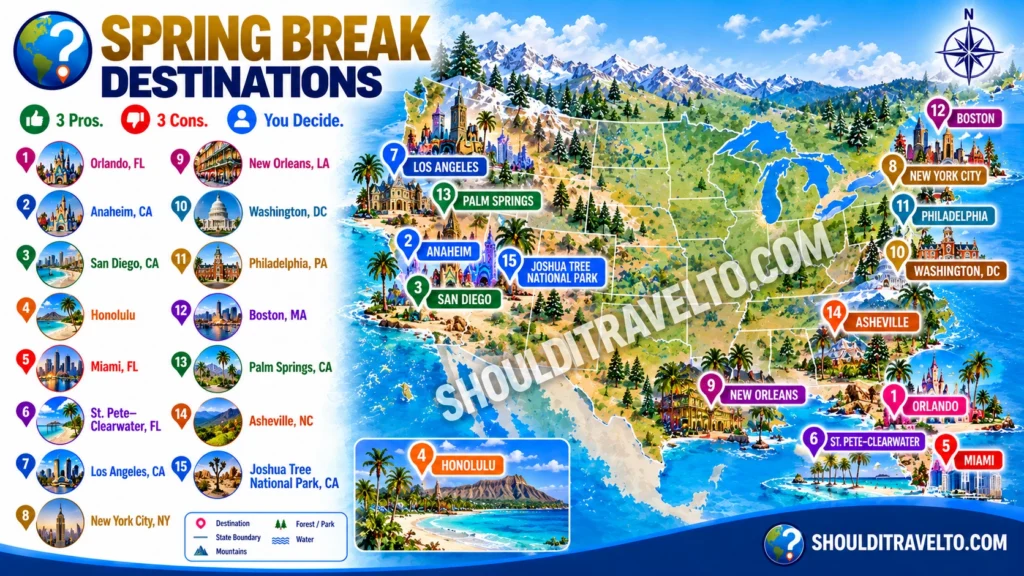
This guide brings together 15 destinations and travel experiences to help you choose. We’ll cover beach vacations, theme parks, cities, history, and outdoor escapes, along with the trade-offs that can affect your trip.
The goal isn’t to tell everyone where to go. It’s to help you decide which spring break makes sense for you.
What Is Spring Break, and Why Does Your Timing Matter?
Spring break isn’t a single national holiday with one set of travel dates. School districts, colleges, and universities establish their own calendars, spreading spring break travel across March and April and, in some cases, other weeks.
That matters because two travelers visiting the same destination can have very different experiences depending on their dates.
A theme park visit during a busy school-break period can involve long lines and packed walkways. A beach destination may have higher hotel rates when demand peaks. A national park may offer excellent spring conditions in one location while another remains cold, muddy, or difficult to access.
Weather varies just as much as crowds. Spring in Florida can feel like summer, while Washington, DC, might be experiencing cherry blossoms, or chilly rain. California’s sunny reputation doesn’t guarantee warm ocean water, and mountain destinations can still have winter conditions.
Before choosing a destination, consider three questions:
- When is your actual week off?
- What kind of experience do you want?
- How much are you comfortable spending to get it?
Answer those questions first, and choosing a destination becomes much easier.
Why Travel for Spring Break?
Spring break offers a useful opportunity to take a meaningful trip without needing a long summer vacation. But its value depends on what you want to get out of that time away.
A Week Off Can Support a Complete Vacation
A week gives you enough time to do more than squeeze in a quick weekend getaway. You can spend several days at a theme park, combine a city with nearby attractions, enjoy a beach vacation, or explore a region at a relaxed pace.
It also gives families a chance to travel together when school schedules naturally break up.
The trade-off is that millions of other travelers may have similar plans. Popular destinations can become crowded precisely when you have time to visit.
Spring Break Doesn’t Have to Mean a Beach Party
The traditional image of spring break often involves crowded beaches, nightlife, and college students. That experience exists, but it represents only one version of the season.
Families may prioritize theme parks, zoos, aquariums, and beaches. Couples might prefer a resort, a restaurant-filled city, or a quiet outdoor escape. History enthusiasts can use the week to explore museums and historic landmarks, while outdoor travelers may want hiking, desert scenery, or a national park.
Spring break is better understood as a vacation window than a specific type of trip.
Spring Can Be a Useful Time to Explore Different Regions
Some destinations become especially attractive in spring because the weather is more comfortable than during summer.
Orlando, Palm Springs, and parts of the Southwest can be appealing before summer heat intensifies. Washington, DC, may offer cherry blossoms. California cities combine outdoor activities and attractions, while farther-north destinations may be transitioning out of winter.
None of these seasonal experiences is guaranteed on a particular date. But planning around the season can help you find a destination that better matches your preferred activities.
The 3 Biggest Pros and 3 Biggest Cons of Traveling for Spring Break
Spring break can be an ideal time to travel, but the same calendar that makes the vacation convenient can also create challenges. Consider the main advantages and drawbacks before committing to a destination.
The 3 Biggest Pros of Traveling for Spring Break
1. You Can Build a Complete Vacation Around One Week
Spring break is long enough for a focused vacation without requiring you to take an extended period away from school or work.
You can devote the week to Orlando’s theme parks, spend several days exploring Los Angeles, or combine San Diego’s beaches with Balboa Park and other attractions.
The key is choosing a destination that fits your available time. You don’t need to cover an entire state or visit every attraction to have a rewarding trip.
2. There Are Options for Almost Every Travel Style
Spring break offers an unusually broad range of choices.
Beach travelers can consider San Diego, Honolulu, Miami, and St. Pete–Clearwater. Families can focus on Orlando or Anaheim. Culture travelers can visit New Orleans, while history enthusiasts can choose Washington, DC, Philadelphia, or Boston.
For travelers who would rather avoid major tourist districts, Palm Springs, Asheville, and Joshua Tree offer different ways to spend time outdoors or escape into another landscape.
That variety lets you plan spring break around your interests instead of following a single national trend.
3. You Can Escape Winter Without Planning a Summer-Length Vacation
For travelers from colder climates, spring break can offer a chance to get outdoors, visit warmer destinations, or enjoy a change of scenery.
A week in Miami, Honolulu, or Palm Springs can feel very different from a week at home. Even if warm weather isn’t your main goal, a city break or outdoor trip can provide a welcome change in routine.
Just remember that “spring” means different things in different regions. Choose the weather and activities you want rather than assuming every destination will be warm.
The 3 Biggest Cons
1. School Breaks Can Create Crowds and Higher Prices
Popular theme parks, beaches, hotels, and attractions may see increased demand during spring break. The best accommodations can become expensive, and timed tickets and restaurant reservations may require more advance planning.
If your dates are fixed, book important parts of the trip early. If your dates are flexible, compare weeks and consider destinations where your preferred activities depend less on a single crowded attraction.
2. Spring Weather Can Be Unpredictable
Spring doesn’t guarantee summer conditions.
A beach trip may bring cool evenings or chilly water. Cities can experience rain and temperature swings, while mountain areas may still have snow or seasonal road restrictions. Cherry blossoms and other seasonal events may peak earlier or later than expected.
The best approach is to choose a destination with enough activities to make the trip worthwhile even if the weather doesn’t cooperate.
For example, a city with museums and restaurants gives you indoor alternatives, while a theme-park trip may benefit from a rain or cooler-day plan.
3. A Week Can Disappear Quickly if You Try to Do Too Much
Spring break can encourage ambitious planning because the time away feels limited.
Trying to combine several cities, multiple theme parks, distant beaches, and outdoor excursions can turn a vacation into a transportation itinerary. Each hotel change, long drive, or travel day reduces the time available to enjoy the destination.
Instead, choose one main destination or a compatible combination of two places.
A week can support a substantial vacation, but it isn’t enough to experience everything in a large state or region. Focus on what matters most and leave room to enjoy it.
Who Is Taking the Spring Break?
The right destination depends partly on who is traveling and what everyone wants from the week. A trip that works for a couple may not suit a family with young children, and a college group may have very different priorities than a family traveling with teenagers.
Spring Break With Young Children
Families with young children often benefit from destinations with convenient attractions, manageable travel distances, and options for taking breaks throughout the day.
Orlando is the obvious choice for families who want theme parks, resorts, and entertainment. Anaheim offers a more concentrated Disney vacation, while San Diego pairs beaches with Balboa Park, the San Diego Zoo, museums, and other family attractions.
Washington, DC, can also work well for families who want museums, monuments, and educational experiences. Just remember that even family-friendly destinations can involve considerable walking and crowded attractions during school breaks.
For young children, the number of activities isn’t always the most important factor. Easy logistics, downtime, and a hotel that fits the family’s needs can matter just as much.
Spring Break With Teenagers
Teenagers may want more independence, variety, or active experiences than younger children. This can make destinations with multiple attractions particularly appealing.
Los Angeles offers beaches, museums, Hollywood-related attractions, food, sports, and entertainment. Orlando is a strong choice for theme-park enthusiasts, while New York City provides museums, shows, shopping, and neighborhoods to explore.
San Diego can also combine beach time, outdoor activities, and major attractions. Honolulu adds surfing, ocean activities, and Hawaiian culture.
The best choice depends on the teenager’s interests. A week centered on theme parks differs greatly from one built around beaches and outdoor adventure, even if both destinations are family-friendly.
Spring Break for College Students
College students traveling with friends may prioritize beaches, nightlife, affordability, outdoor activities, or simply having a week away together.
Miami offers beaches, restaurants, nightlife, and a major-city atmosphere. Honolulu offers a tropical setting and outdoor activities, while Los Angeles provides a wide range of neighborhoods, attractions, and entertainment.
But spring break does not have to mean partying. Groups of friends can also choose New Orleans for food and music, Palm Springs for a pool-focused escape, or Joshua Tree for desert exploration.
The practical considerations remain the same: transportation, lodging, budgets, age restrictions at certain venues, and how everyone wants to spend the time. Agreeing on those priorities before booking can prevent a trip built around incompatible expectations.
Spring Break for Couples and Adults
Couples and adults without school-age children can build a spring break around their own interests.
Palm Springs is appealing for pool time, resorts, dining, and desert scenery. Honolulu combines beaches with culture and outdoor activities, while New Orleans offers food, music, architecture, and a distinctive local identity.
Los Angeles provides maximum variety, and New York City can support a full week of museums, food, shopping, and entertainment without requiring beach weather.
If relaxation is the main goal, avoid turning the trip into a checklist. A destination with a comfortable hotel, a few activities, and time to unwind may be more rewarding than one where every day is fully scheduled.
What Kind of Spring Break Do You Want?
Once you know who is traveling, narrow the choices by experience. These categories offer a quick way to identify destinations that match your preferred vacation.
| If you want… | Start with… |
| Theme parks and family entertainment | Orlando |
| A compact Disney vacation | Anaheim |
| Beaches and family attractions | San Diego |
| A tropical getaway | Honolulu |
| Beaches, dining, and nightlife | Miami |
| A classic Florida beach vacation | St. Pete–Clearwater |
| Maximum variety in one city | Los Angeles |
| A major-city vacation | New York City |
| Food, music, and culture | New Orleans |
| Museums and national monuments | Washington, DC |
| American independence history | Philadelphia |
| History and a walkable city | Boston |
| Pools, resorts, and relaxation | Palm Springs |
| Mountains, food, and outdoor scenery | Asheville |
| Desert landscapes and outdoor exploration | Joshua Tree National Park |
Best Beach and Warm-Weather Spring Break Destinations
Beach destinations are natural spring break choices, but they offer very different experiences. Some suit families, others offer nightlife or tropical scenery, and some are best for travelers who simply want time by the water.
San Diego, California: The Family Beach Spring Break
San Diego is one of the most versatile spring break choices if you want beaches without giving up family attractions, museums, and outdoor activities.
The city combines a long coastline with Balboa Park, the San Diego Zoo, La Jolla, museums, neighborhoods, and attractions such as SeaWorld San Diego. That variety lets you combine beach time with other activities instead of spending every day on the sand.
Families can build a trip around the zoo and Balboa Park, while older children and adults may prefer surfing, coastal walks, kayaking, or exploring San Diego’s different neighborhoods.
The trade-off is that the city is spread out, so a car helps if you plan to visit multiple areas. Also, spring sunshine doesn’t guarantee warm ocean water. California’s Pacific coast can feel cooler than tropical beach destinations.
Best for: Families, beach lovers, outdoor activities, and travelers who want more variety than a beach-only vacation.
Biggest trade-off: Transportation and cooler coastal water can affect the experience.
Choose San Diego if: You want a family-friendly coastal vacation that combines beaches, attractions, and outdoor exploration.
Honolulu, Hawaii: The Tropical Spring Break
Choose Honolulu if you want a spring break that feels truly tropical.
Waikiki offers a recognizable beach setting with restaurants, hotels, shopping, and access to ocean activities. Beyond the resort area, Oahu offers hiking, scenic coastlines, cultural attractions, and places connected to Hawaiian history.
You can spend time on the beach, learn to surf, explore the island, visit Pearl Harbor, or simply enjoy the change of scenery. Honolulu also provides more urban infrastructure than a remote beach destination, making it a useful option for travelers who want both beach time and city amenities.
The biggest trade-off is cost. Flights, accommodation, dining, and island activities can make Hawaii a more expensive spring break than many mainland alternatives. Travel time can also be substantial if you’re coming from the eastern United States.
Best for: Tropical beaches, surfing, outdoor activities, island culture, and a more complete vacation.
Biggest trade-off: Travel time and overall cost.
Choose Honolulu if: You want a tropical getaway that combines beaches with culture and outdoor adventure.
Miami, Florida: The Warm-Weather City for Spring Break
Miami is a strong choice if you want beaches and warm-weather activities alongside a major city’s energy.
South Beach offers sand, Art Deco architecture, and a recognizable beach scene. Elsewhere, Miami’s restaurant scene, Cuban and broader Latin American influences, museums, and neighborhoods provide reasons to explore beyond the shoreline.
Nightlife is part of Miami’s identity, but it isn’t the only reason to visit. You can build a spring break around food, architecture, beaches, cultural experiences, or a mixture of all four.
The trade-offs are cost, crowds, and a potentially busy atmosphere during peak spring break. Popular hotels and venues may charge higher seasonal rates, and the most famous beach areas can be crowded.
Best for: Beaches, restaurants, cultural experiences, nightlife, and exploring a warm-weather city.
Biggest trade-off: Crowded tourist areas and potentially high accommodation and entertainment costs.
Choose Miami if: You want a city vacation where the beach, dining, culture, and nightlife are all part of the experience.
St. Pete–Clearwater, Florida: The Florida Beach Spring Break
St. Pete–Clearwater is for travelers who want a beach vacation to be the main event, not just one activity among many.
The area offers white-sand beaches, Gulf Coast sunsets, waterfront parks, dolphin-watching excursions, and family-oriented attractions. Clearwater Beach is a major draw, while nearby communities such as Treasure Island and Indian Rocks Beach offer different coastal settings.
For families, the mix of beach time and nearby attractions makes it easier to balance kids’ activities with relaxation time. Couples can use the area for a beach-focused getaway without making nightlife the centerpiece.
The trade-off is that much of the experience revolves around the coast. If you want major-city attractions or a packed itinerary of museums and cultural landmarks, other destinations may be more appealing.
You’ll also want to consider traffic and transportation between beach communities, especially during busy spring break.
Best for: Families, beach lovers, Gulf Coast sunsets, and a relaxed coastal vacation.
Biggest trade-off: Less urban variety than a major city destination, and seasonal crowds can affect convenience.
Choose St. Pete–Clearwater if: Your ideal spring break means spending plenty of time on the beach, with family activities available nearby.
Best Theme-Park Spring Break Destinations
Theme parks can be ideal when the main purpose of the vacation is built-in entertainment. The key decision is whether you want a large, multi-park trip or a more focused visit to a single resort.
Orlando, Florida: The Ultimate Family Spring Break
Orlando is the benchmark for an attraction-focused family spring break.
Walt Disney World, Universal Orlando, SeaWorld Orlando, water parks, and other attractions create enough entertainment to fill an entire week—or longer. Resorts and tourism-focused services also let you structure much of the trip around the attractions your family cares about most.
Orlando works particularly well for families who want a vacation with a clear purpose. If theme parks are the main goal, you can plan tickets, hotels, transport, and rest days before you arrive.
But the scale is also a drawback. Major parks require substantial walking, multiple days to see different attractions, and school-break crowds that can mean long waits.
The total cost can rise quickly once you add park tickets, accommodations, meals, and transportation. Orlando is more rewarding when you choose priorities rather than attempting to do everything.
Best for: Families, theme-park enthusiasts, multi-generational trips, and entertainment-focused vacations.
Biggest trade-off: Crowds, park expenses, and the time required to explore large attractions.
Choose Orlando if: You want a spring break built around major theme parks and a full schedule of family entertainment.
Anaheim, California: The Compact Theme-Park Spring Break
Anaheim provides another approach to a theme-park vacation.
Disneyland Resort and Disney California Adventure are concentrated in a comparatively compact resort district, letting visitors build a shorter, more focused Disney trip. Nearby hotels, restaurants, and entertainment let you spend several days around the parks without covering the same distances as a sprawling destination.
Anaheim can also be combined with other Southern California attractions if you have a longer break. You can add variety by pairing it with Los Angeles beaches, entertainment, or other regional destinations.
The main trade-off is that Disneyland visits still require planning and can be expensive, particularly during school breaks. Anaheim itself may be less appealing if you aren’t interested in its theme parks or nearby attractions.
Best for: Disney fans, families, and travelers who want a concentrated theme-park vacation.
Biggest trade-off: Park costs and crowds, with fewer reasons to stay in Anaheim itself if theme parks aren’t your priority.
Choose Anaheim if: Disneyland is the main reason you’re taking spring break and you prefer a more compact trip than Orlando.
Best Big-City and Culture Spring Break Destinations
Not every spring break needs a beach or an amusement park. Major cities offer another advantage: a wide range of indoor and outdoor activities that help when spring weather is unpredictable.
Los Angeles, California: The Everything-in-One Spring Break
Los Angeles is one of the country’s most versatile spring break destinations.
The city combines beaches, Hollywood attractions, museums, sports, food, shopping, hiking, entertainment, and distinctive neighborhoods. You can spend one day near the coast, another exploring museums or Hollywood, and another enjoying the food scene or outdoor recreation.
This makes Los Angeles appealing to families, couples, groups of friends, and travelers who want to build their own itinerary instead of choosing a single vacation theme.
Its greatest strength is variety. But that variety comes with a practical downside: distance. Beaches, studios, museums, neighborhoods, and other attractions can be spread across a large metropolitan area. Crossing the city repeatedly can take a considerable amount of time.
For spring break, the best strategy is to organize your days geographically and prioritize a few experiences rather than treating every major attraction as equally convenient.
Best for: Maximum variety, beaches, entertainment, food, museums, and mixed-interest groups.
Biggest trade-off: Traffic, distance, and transportation planning.
Choose Los Angeles if: You want a spring break that can combine beaches, city attractions, outdoor activities, and entertainment.
New York City: The Big-City Spring Break
New York City is a strong choice if you want a week full of things to do, even if beach weather isn’t available.
You can explore neighborhoods, visit museums, attend a Broadway show, enjoy restaurants, shop, and experience some of America’s most recognizable landmarks. The subway lets you explore much of the city without renting a car.
That flexibility matters for groups with different interests. One traveler may prefer museums, another may want shopping, and someone else may be most interested in food or entertainment. New York can accommodate all those preferences in the same trip.
The trade-offs are cost, crowds, and variable spring weather. Cold temperatures and rain can still occur, especially early in spring, and convenient accommodations can be expensive.
Best for: Museums, entertainment, food, shopping, walkable neighborhoods, and a full urban vacation.
Biggest trade-off: Cost, crowds, and unpredictable early-spring weather.
Choose New York City if: You want a major-city vacation with enough variety to fill a week without needing warm-weather activities.
New Orleans, Louisiana: The Culture-and-Food Spring Break
New Orleans offers a spring break built around culture, food, music, architecture, and neighborhoods.
Explore the French Quarter, admire historic buildings, sample Creole- and Cajun-influenced cuisine, listen to live music, and learn about the city’s complex history. Neighborhoods beyond the most famous tourist areas offer more ways to experience New Orleans’ character.
It’s a distinctive option for couples, adults, and groups of friends who want more than a conventional beach vacation. Families can also find museums, historic sites, parks, and other attractions to suit their interests.
The trade-off is that the nightlife-centered parts of the city may not suit every traveler, and popular periods can bring crowds and higher prices. Warm weather is possible, but spring conditions can still vary.
Best for: Food, music, architecture, culture, history, and a distinctive urban atmosphere.
Biggest trade-off: Busy tourist areas and nightlife that may not appeal to everyone.
Choose New Orleans if: You want a spring break defined by food, music, and cultural experiences rather than a resort or theme park.
Best Educational and Historic Spring Break Destinations
Spring break can also be a chance to explore American history, museums, and historic landmarks without turning the vacation into a classroom exercise. Washington, Philadelphia, and Boston each offer a different version of a history-focused city trip.
Washington, DC: The Educational Spring Break
Washington, DC, is an excellent option for travelers who want to combine a city vacation with American history, museums, monuments, and national landmarks.
The National Mall brings together many of the capital’s most recognizable memorials and monuments. The Smithsonian museums cover a wide range of subjects, while historic neighborhoods and other landmarks offer more places to explore.
Many major museums and national attractions offer free admission, which can help balance the cost of lodging, meals, and transportation. Cherry blossoms can also be part of a spring visit if your dates coincide with the bloom, although peak timing changes from year to year.
DC can be especially valuable for families with school-age children and teenagers because it provides ways to explore history, science, art, and culture outside the classroom.
The main trade-offs are walking distances, crowds around popular memorials, and unpredictable spring weather.
Best for: Museums, American history, monuments, educational family trips, and springtime city exploration.
Biggest trade-off: Extensive walking and seasonal demand around popular attractions.
Choose Washington, DC, if: You want a city vacation that combines sightseeing and learning, with many major attractions that don’t require admission tickets.
Philadelphia, Pennsylvania: The American History Spring Break
Philadelphia offers a focused way to explore American founding history while enjoying a major city with food, museums, neighborhoods, and cultural attractions.
Independence Hall, the Liberty Bell, and the Museum of the American Revolution help tell the story of the nation’s founding. Reading Terminal Market offers a different kind of experience, with food and a lively indoor setting, while museums and neighborhoods round out the itinerary.
Philadelphia is particularly useful for travelers who want a history-focused trip without committing to the scale of New York City or Washington, DC.
Many historic attractions are concentrated in the central area, so you can combine multiple stops without constant long-distance travel. You can also build the trip around food and neighborhood exploration rather than spending every hour at historic sites.
The trade-off is that popular attractions may require planning, and early spring weather can be cool or wet.
Best for: American independence history, museums, food, historic streets, and a city break with a clear focus.
Biggest trade-off: The experience is less beach- or outdoors-focused, and spring weather can vary.
Choose Philadelphia if: You want to explore the founding of the United States while enjoying a compact, food-oriented city vacation.
Boston, Massachusetts: The History-City Spring Break
Boston blends American history, museums, walkable neighborhoods, food, and city culture, making it an appealing alternative to a warm-weather spring break.
The Freedom Trail connects sites associated with the American Revolution. Boston Common, Beacon Hill, the USS Constitution, Boston Harbor, and the city’s many museums offer additional ways to explore.
You can also enjoy the North End’s food scene, visit Fenway Park if the baseball schedule aligns with your trip, or explore neighborhoods that show a different side of Boston’s character.
The city’s walkability is a major advantage compared with sprawling destinations. Many visitors can explore central Boston without renting a car.
But the weather is an important trade-off. Early spring can still feel like winter, and Boston isn’t the destination to choose if warmth and beach time are essential.
Best for: American history, museums, food, walkability, and a compact city break.
Biggest trade-off: Cool, changeable spring weather and accommodation costs that may be high.
Choose Boston if: You want a walkable city with a rich history and a strong range of indoor and outdoor attractions.
Best Desert and Mountain Spring Break Destinations
If your ideal spring break involves relaxing beside a pool, exploring dramatic landscapes, or spending time outdoors, the desert and mountains offer an alternative to beaches and major cities.
Palm Springs, California: The Relaxing Spring Break
Palm Springs is an excellent choice when you want spring break to feel restorative rather than hectic.
The destination is known for its resorts, pools, midcentury architecture, restaurants, desert scenery, and mountain views. You can relax by the pool, explore the city’s architecture and dining, ride the Palm Springs Aerial Tramway, or take short outings into the surrounding desert.
Spring is especially attractive for a pool-focused desert getaway because it offers more comfortable conditions for outdoor activities than peak summer heat.
The trade-off is that Palm Springs suits travelers who want relaxation and select outings more than those who want a packed schedule of major attractions. Some nearby outdoor destinations also require separate transportation and planning.
Best for: Couples, pool time, resort stays, architecture, dining, and desert scenery.
Biggest trade-off: A quieter, relaxation-oriented vacation may feel too slow for travelers who want constant entertainment.
Choose Palm Springs if: You want to slow down, enjoy the sun, and escape your normal routine.
Asheville, North Carolina: The Mountain Spring Break
Asheville combines mountain scenery with a distinctive small-city atmosphere, making it a useful alternative to a beach or theme-park vacation.
Downtown Asheville offers restaurants, galleries, independent shops, architecture, and local culture. Biltmore offers a major historic attraction, while the surrounding Blue Ridge Mountains provide scenic drives, hiking, and outdoor exploration.
Spring can be an appealing time to explore the region as the landscape transitions out of winter, although temperatures and trail conditions vary with elevation and weather.
Asheville works particularly well for couples, families who enjoy outdoor activities, and travelers who want a mix of nature and city amenities.
The trade-off is that mountain activities depend on current conditions, and a car helps you reach many outdoor attractions beyond downtown.
Best for: Mountain scenery, hiking, food, local culture, and a mix of city and outdoor activities.
Biggest trade-off: Weather and trail conditions can affect outdoor plans, and the best scenery often requires additional driving.
Choose Asheville if: You want a mountain-focused spring break with a good mix of nature, history, and local culture.
Joshua Tree National Park, California: The Desert Adventure Spring Break
Joshua Tree offers a completely different desert experience from Palm Springs.
Instead of spending most of your time relaxing at a resort, you can explore unusual rock formations, hike among Joshua trees, enjoy dramatic desert landscapes, photograph the scenery, and experience the desert sky after dark.
Spring can be an appealing time for outdoor exploration before the extreme heat that can occur later in the year. That said, desert conditions can change, so check the forecast and plan your activities carefully.
Joshua Tree is especially appealing to outdoor enthusiasts, photographers, and travelers seeking a more nature-focused vacation. You can also pair it with Palm Springs if you want both relaxation and adventure in one trip.
The trade-off is that the park offers fewer services than a city or resort area. You’ll need to plan for water, fuel, food, transportation, and time spent driving between locations.
Best for: Hiking, photography, rock formations, desert landscapes, and stargazing.
Biggest trade-off: Limited services inside the park and the need to prepare for desert conditions.
Choose Joshua Tree if: You want to explore the desert rather than simply relax beside it.
Planning note: Check current National Park Service alerts, trail information, and park conditions before your visit.
Which Spring Break Destination Should You Choose?
The right choice becomes clearer when you compare different experiences side by side. Use the following guide to narrow your options before researching accommodation and transportation.
| If you want… | Start with… |
| A major theme-park vacation | Orlando |
| A more concentrated Disney trip | Anaheim |
| Family beaches and attractions | San Diego |
| A tropical island vacation | Honolulu |
| Beaches and nightlife | Miami |
| A Gulf Coast beach getaway | St. Pete–Clearwater |
| Beaches, entertainment, and variety | Los Angeles |
| Museums, Broadway, shopping, and food | New York City |
| Food and music | New Orleans |
| Museums and monuments | Washington, DC |
| The nation’s founding history | Philadelphia |
| Revolutionary history and walkable neighborhoods | Boston |
| Relaxation and pool time | Palm Springs |
| Mountain scenery and local culture | Asheville |
| Desert hiking and outdoor exploration | Joshua Tree |
Beach vs. Theme Parks vs. City vs. Outdoors
If you’re still deciding, reduce the options to the kind of week you want to have.
Want to Relax?
Start with Palm Springs, Honolulu, or St. Pete–Clearwater.
These options let you make downtime part of the vacation, whether that’s relaxing by a pool, enjoying the beach, or spending time in a tropical setting.
Honolulu offers more variety beyond relaxation, while Palm Springs is especially suited to a resort-oriented trip.
Want Built-In Entertainment?
Start with Orlando or Anaheim.
Theme parks give you a clear reason to visit and can fill several days without requiring you to plan every activity yourself. The main trade-offs are admission costs, crowds, and the time needed to experience the attractions.
Want Maximum Variety?
Start with Los Angeles, New York City, or San Diego.
These destinations give you a range of experiences, from food and museums to outdoor attractions, shopping, and entertainment. They work well when your travel group wants different things.
The trade-off is that some attractions may be spread out, so planning your geography matters.
Want to Learn Something?
Start with Washington, DC, Philadelphia, or Boston.
Each combines museums and historic landmarks with a broader city experience. They’re particularly useful for families who want an educational vacation or travelers interested in American history.
Want to Explore the Outdoors?
Start with Joshua Tree or Asheville.
Joshua Tree offers desert landscapes and outdoor exploration, while Asheville combines mountains with a city full of restaurants, history, and cultural attractions.
Both require attention to conditions and transportation, but they offer a different experience than a beach or theme-park trip.
Planning Your Spring Vacation
Once you’ve chosen a destination, a little preparation can help you avoid the most common spring break frustrations.
Start With Your Actual Dates
School calendars differ, so confirm your dates before booking flights, hotels, or tickets. If your schedule is flexible, compare prices across different weeks and days.
Don’t assume that all of March or April has the same crowd levels or weather.
Check Weather and Seasonal Conditions
Look beyond average temperatures. Consider rain, nighttime temperatures, water temperature, mountain conditions, and whether your desired activities are operating during your visit.
If cherry blossoms, a particular festival, or a seasonal attraction is central to your plans, check official updates closer to departure.
Book the Activities That Need Advance Planning
Theme parks, popular restaurants, performances, and special excursions may require reservations. Secure the experiences that matter most, then leave room around them for flexible activities.
That is especially useful for family trips, where the schedule can fill quickly.
Decide Whether You Need a Car
A car helps with destinations like Joshua Tree and many regional outdoor trips. In contrast, visitors concentrating on central Boston, New York City, or Washington, DC, may find public transportation and walking more practical.
In Los Angeles, San Diego, Orlando, and other sprawling destinations, transportation needs depend on where you’re staying and what you plan to do.
Choose accommodation based on your actual itinerary, rather than assuming every attraction will be nearby.
Budget for the Entire Vacation
The headline price of a flight or a hotel is only part of the cost.
Include accommodation, meals, transportation, parking, tickets, equipment rentals, and any special activities. Theme parks and popular holiday destinations can create expenses that are easy to underestimate.
If you’re traveling with a group, agree on the broad budget before everyone commits to the same plan.
How Many Days Do You Need for Spring Break?
A week off doesn’t necessarily mean you need a seven-night vacation. Your ideal trip length depends on travel time, how many attractions you want to visit, and how much of the week you want to spend relaxing.
The 3–4 Day Spring Break
A shorter trip works best when you choose one compact destination or a focused experience.
You might spend several days in New York City, explore central Boston, visit Philadelphia’s historic district, or enjoy a long weekend in Palm Springs.
A short Orlando or Anaheim trip also works if you focus on a limited number of theme parks rather than trying to visit every major attraction.
The main advantage is convenience. You spend less time traveling between locations and can often build a satisfying trip without using the entire week.
The 5–7 Day Spring Break
With five to seven days, you have more flexibility to explore multiple neighborhoods, enjoy several activities, and build in downtime.
Families can devote several days to theme parks, while beach travelers can alternate between activities and relaxation. A week can also support a city vacation with day trips, or a combination such as Palm Springs and Joshua Tree.
The key is to avoid filling every day to capacity. Leave time for meals, travel between attractions, and unexpected weather changes or shifts in operating hours.
A week is long enough for a complete vacation, but not long enough to do everything.
Spring Break With Young Kids vs. Teenagers
Families often benefit from choosing destinations based on their children’s ages and interests rather than the place with the most attractions.
Best Options for Young Children
Orlando and Anaheim are natural choices for families whose children enjoy theme parks. San Diego is another strong option because you can combine beaches, the zoo, Balboa Park, and family attractions in one trip.
Washington, DC, may suit families who want museums and outdoor landmarks, though some days will involve substantial walking.
With younger children, build in rest time, predictable meals, and fewer transfers on travel days. A hotel with a pool or convenient access to attractions can be more valuable than a longer list of activities.
Best Options for Teenagers
Teenagers may appreciate destinations with more variety and opportunities to choose their own activities.
Los Angeles combines beaches, entertainment, food, sports, and museums. New York City offers an enormous range of urban attractions, while Honolulu adds ocean activities and outdoor adventure. San Diego combines coastal scenery with attractions that can appeal to different ages.
Orlando remains a strong choice for teenagers who love theme parks, especially if the family plans around their preferred rides and experiences.
The best trip is one where everyone has a few activities they’re excited about, not one where adults or children choose the itinerary alone.
Spring Break vs. Summer Vacation
Spring break and summer vacation share some destination options, but the time available can change what kind of trip makes sense.
Spring break typically rewards a focused itinerary. With roughly a week, it’s easier to enjoy one destination or combine two nearby experiences than to cover a large region.
Summer often makes longer road trips, extended national park visits, and multi-city vacations more practical because travelers may have more days available. However, summer also brings crowds, heat, and seasonal price pressures.
Spring break is a good opportunity to try one destination you’ve wanted to visit. Summer may be a better time for a more ambitious journey across a state or region.
You don’t need to make spring break the biggest trip of the year. You need to make it the right trip for the time you have.
The Decision Is Yours
No single spring break destination is best.
Orlando is built for theme-park vacations. Anaheim offers a more concentrated Disney trip. San Diego combines beaches with family attractions, while Honolulu provides a tropical escape. Miami pairs beaches with a major-city atmosphere, and St. Pete–Clearwater is a stronger fit for a beach-centered vacation.
Los Angeles offers variety, New York City offers big-city culture, and New Orleans offers food and music. Washington, DC, Philadelphia, and Boston provide different ways to explore American history. Palm Springs suits relaxation, Asheville blends mountains and city culture, and Joshua Tree offers desert adventure.
The right destination depends on who you’re traveling with, when your break falls, what you want to do, and how much you want to spend.
Don’t start by asking what the best spring break destination is. Start by asking what you want to do with your week off.
Then choose the destination that fits.
3 Pros. 3 Cons. You Decide.
Spring Break Frequently Asked Questions
Spring break raises practical questions about destinations, weather, cost, and trip length. These answers can help you narrow down your options before booking.
What are the best spring break destinations for families?
Orlando and Anaheim are strong options for families who want theme parks. San Diego combines beaches with attractions such as Balboa Park and the San Diego Zoo, while Washington, DC, offers museums and historic landmarks. The best choice depends on children’s ages, interests, and your budget.
Where should you go for a warm spring break?
Miami, Honolulu, Orlando, and St. Pete–Clearwater offer warmer-weather activities. Palm Springs can also be a great option for pool time and desert scenery. Actual conditions vary by date, so check typical and forecast temperatures before planning outdoor activities.
What are the best spring break destinations that aren’t party destinations?
San Diego, Washington, DC, Philadelphia, Boston, Palm Springs, Asheville, and Joshua Tree offer experiences centered on attractions, history, culture, relaxation, or outdoor exploration. You don’t need a nightlife destination to enjoy spring break.
Where should you go for spring break with teenagers?
Los Angeles, Orlando, New York City, Honolulu, and San Diego offer a broad range of activities that can appeal to teenagers. The best destination depends on whether they prefer theme parks, beaches, city exploration, sports, entertainment, or outdoor adventures.
Where should couples go for spring break?
Couples might prefer Palm Springs for relaxation, Honolulu for a tropical getaway, Miami for beaches and dining, or New Orleans for food and culture. Los Angeles and New York City can also work well for couples who prefer museums, restaurants, and entertainment.
Is California good for spring break?
California offers several distinct choices. San Diego combines beaches and family attractions, Los Angeles offers wide-ranging entertainment, Anaheim suits Disneyland, Palm Springs offers a pool-oriented desert escape, and Joshua Tree offers outdoor exploration. Choose a region based on your interests and how much time you have to travel.
Is Florida good for spring break?
Florida can be a strong option if you want theme parks, warm-weather activities, or beaches. Orlando centers on attractions, Miami combines beaches and city life, and St. Pete–Clearwater focuses more on a Gulf Coast beach vacation. Crowds and prices depend on your dates and location.
Is spring break a good time to visit national parks?
It can be, particularly for parks where spring offers comfortable outdoor conditions. But conditions vary considerably by park and elevation. Check current road access, trail conditions, weather, and any reservation requirements before building your vacation around a specific park.
How many days should a spring break trip be?
A three- or four-day trip can work well for one city or a focused attraction. Five to seven days allows more room for theme parks, beach time, or a combination of two nearby destinations. Avoid adding long travel days simply to visit more places.
When should you book a spring break vacation?
Start planning after confirming your exact school or work dates. Booking early gives you more choice for popular flights, hotels, theme parks, and special activities. If dates are flexible, compare different weeks and travel days before committing.