

Should You Travel To New Orleans for Mardi Gras?
Quick Answer
Yes, you should travel to New Orleans for Mardi Gras if you want to experience one of America’s most distinctive cultural celebrations.
For several weeks, parades roll through neighborhoods, elaborate floats move along historic routes, and marching bands fill the streets with music. Spectators catch beads, cups, doubloons, toys, and signature throws from krewe members. King cakes appear in bakeries and at gatherings, while costumes become part of everyday life during Carnival season.
Then everything builds toward Fat Tuesday, Mardi Gras’s final day.
For first-time visitors, Mardi Gras can be one of the most memorable ways to experience New Orleans. It brings together the city’s history, food, music, traditions, and unmistakable personality on a remarkable scale.
Understanding how Mardi Gras unfolds is the first step toward deciding whether this is the right time to visit New Orleans.
Things First-Time Visitors Misunderstand About Mardi Gras
First-time visitors should know that Mardi Gras isn’t the entire Carnival season.
Mardi Gras literally refers to Fat Tuesday, the final day of Carnival, immediately before Ash Wednesday and the beginning of Lent. Carnival begins much earlier, on January 6 (Twelfth Night), and celebrations build over the following weeks.
That distinction matters because you do not have to arrive on Fat Tuesday to experience Mardi Gras. Many major parades take place in the days leading up to it, and the broader season includes balls, neighborhood celebrations, costumes, king cakes, and traditions associated with individual krewes. For some visitors, the days before Fat Tuesday offer a better balance of major parades and time to explore the city.
Another common misconception is that Mardi Gras is simply a party on Bourbon Street.
Bourbon Street is part of the New Orleans Mardi Gras experience, but it is not the whole celebration.
Traditional parades travel through neighborhoods well beyond the French Quarter, including Uptown routes along St. Charles Avenue. Those routes are central to the parade experience and are often a better fit for families looking to watch floats and marching bands.
Mardi Gras can certainly be loud, crowded, and alcohol-focused in some areas. But the celebration is also about family traditions, neighborhood identity, music, costume design, elaborate floats, food, history, and the organizations known as krewes. Generations of New Orleanians participate in traditions that extend well beyond the tourist party atmosphere.
The Biggest Mistake First-Time Visitors Make
One of the easiest ways to make Mardi Gras exhausting is to try to experience everything.
Too many parades, neighborhoods, events, traditions, and simultaneous celebrations make it hard to fit everything into a single trip. A first-time visitor can end up rushing from one parade to another, trying to squeeze in Bourbon Street, searching for a famous restaurant, and staying out late before repeating the process the next day.
That approach can turn an extraordinary cultural experience into a checklist.
Instead, choose a few parades that interest you, decide where you want to watch them, and leave enough time between events to eat, walk around, and explore New Orleans. You do not need to see every float or attend every celebration to appreciate the season.
Some of the best moments may come when you stop trying to get somewhere else. You might discover a neighborhood tradition, watch a marching band pass by, talk with people who have attended the same parade for years, or simply enjoy the atmosphere around you.
You don’t need to see all of Mardi Gras. You need time to experience it.
3 Pros and 3 Cons of Visiting New Orleans for Mardi Gras
Mardi Gras can turn a New Orleans vacation into something more than an ordinary city break. But the same crowds, celebrations, and logistics that make the season exciting can also make it more demanding.
The 3 Biggest Pros of Traveling to New Orleans for Mardi Gras
1. You’re Experiencing One of America’s Great Cultural Traditions
Mardi Gras in New Orleans has centuries of history, shaped by French colonial influences, local communities, and generations of people who have developed their own Carnival traditions.
New Orleans was founded in 1718, and Mardi Gras celebrations took root early in the city’s history. By the nineteenth century, street processions had become increasingly elaborate. The Mistick Krewe of Comus, formed in 1856, helped establish the themed floats and formalized pageantry associated with modern Carnival. Rex followed in 1872, adding traditions that remain central to Mardi Gras today.
For travelers who enjoy history and culture, Mardi Gras offers an opportunity to see those traditions in action rather than only learning about them in a museum.
2. The Parades Are Unlike Ordinary Parades
A Mardi Gras parade is not just something you watch from the sidewalk. Spectators are part of the experience.
Float riders toss beads, cups, doubloons, toys, and other throws into the crowd. Some krewes have developed signature items that spectators especially look forward to, giving them something to anticipate beyond the floats themselves. The tradition of throws dates back to the nineteenth century and has become an important part of Carnival’s identity.
The floats are another major attraction. Some are artistic and elaborate, while others use humor, political commentary, satire, or wonderfully absurd themes. Marching bands, dance groups, costumes, and other performers add to the spectacle.
Every krewe brings its own personality to the route. The themes, designs, music, and throws can make one parade feel quite different from another.
3. You Experience New Orleans at Its Most New Orleans
New Orleans already has one of the strongest cultural identities of any American city. Mardi Gras brings many of its defining characteristics together at once: music, food, costumes, history, humor, pageantry, neighborhood traditions, and improvisation.
The celebration also extends far beyond the largest parade organizations. Black Masking Indian traditions, for example, reflect Black community identity, artistry, resistance, and historical connections with Native peoples. Elaborately beaded suits can take months of work to create, and the traditions surrounding them are deeply rooted in community and cultural expression.
Mardi Gras reflects the people and traditions that give New Orleans its distinctive character.
For travelers who want to understand what makes the city different, Mardi Gras offers an unusually concentrated introduction. The party is part of the experience, but the culture gives the celebration its lasting significance.
The 3 Biggest Cons of Visiting New Orleans for Mardi Gras
1. The Crowds Can Be Enormous
Popular parade routes can fill well before a procession begins. Sidewalks get crowded, restaurants fill up, and getting from one part of the city to another can take much longer than on an ordinary visit.
The closer you get to Mardi Gras Day, the more important planning becomes. Road closures and parade routes can affect driving, walking, and public transportation, while popular viewing locations may require arriving well in advance.
For travelers who enjoy energetic crowds, that atmosphere is part of the appeal. But if crowded streets, noise, and waiting regularly ruin your experience, Mardi Gras may not be the best time for your first trip to New Orleans.
2. Mardi Gras Can Be Expensive
Hotel demand can push accommodation prices considerably higher than during quieter periods. Your hotel’s location also matters more because parade routes and street closures can complicate transportation.
A less expensive hotel farther away may not be the better value if getting to and from the celebrations takes significant time and effort. Meanwhile, dining, transportation, and other travel expenses can add up during a busy trip.
If Mardi Gras is the reason for your visit, book accommodation early and plan how you’ll get to the parades you want to see. Paying more for a convenient location may be worthwhile if it saves you repeated transportation hassles.
3. Mardi Gras Makes Ordinary Sightseeing Harder
New Orleans offers plenty beyond Carnival, including historic architecture, museums, restaurants, music venues, and distinctive neighborhoods. But during Mardi Gras, the city operates around the celebration.
Parades, street closures, crowds, altered schedules, and high demand at restaurants can make it harder to explore at your own pace. A route that looks simple on a map may take much longer, and an itinerary built around several timed activities can become frustrating when you have to work around parade schedules.
If your main goal is a quiet few days exploring historic homes, museums, and neighborhoods, Mardi Gras may work against the trip you want.
That doesn’t mean New Orleans is a poor destination during Carnival. It means you should understand what you’re choosing.
Don’t visit during Mardi Gras expecting an ordinary New Orleans vacation. During Carnival, Mardi Gras becomes the trip.
Mardi Gras Has a Long History
Understanding Mardi Gras’s history makes the parades and traditions more meaningful. The celebration has European roots, but its development in Louisiana created a distinct local identity.
Before New Orleans
Mardi Gras traditions developed from European Carnival customs associated with the period before Lent. French colonial influences brought those traditions to North America before New Orleans existed.
In 1699, French-Canadian explorer Jean-Baptiste Le Moyne de Bienville reached a location south of present-day New Orleans on March 2, the eve of Mardi Gras, and named it Pointe du Mardi Gras. Mobile, then part of French Louisiana, held an early Mardi Gras celebration in 1703. New Orleans was founded in 1718, and celebrations took root there during the city’s early decades.
The Krewes Transform Mardi Gras
By the nineteenth century, street celebrations were becoming increasingly elaborate. The emergence of organized krewes helped transform Carnival into the parade-centered spectacle visitors know today.
The Mistick Krewe of Comus was formed in 1856 and introduced elaborate themed floats, masked participants, and formalized pageantry. The Twelfth Night Revelers followed, and Rex debuted in 1872.
Krewes remain central to Mardi Gras. Each organization may have its own history, identity, parade themes, costumes, balls, and signature throws. Some have been part of Carnival for generations, while others have developed their own traditions more recently.
Why Is Mardi Gras Purple, Green, and Gold?
Rex adopted purple, green, and gold in 1872, and they’re now Mardi Gras’ signature colors.
The colors are traditionally associated with three values:
- Purple: Justice
- Green: Faith
- Gold: Power
During Carnival season, you’ll see these colors on beads, costumes, decorations, flags, buildings, and king cakes. They become part of New Orleans’ visual language, signaling that the city is in the midst of its annual celebration.
What Are Mardi Gras Krewes?
A krewe is an organization that participates in Carnival traditions, often producing parades, balls, costumes, floats, and other events. Some are historic institutions, while others are smaller or newer organizations. Their styles and traditions can differ considerably.
Among the best-known krewes are Rex, Zulu, Bacchus, Endymion, Muses, and Orpheus. Each has its own identity and place in the Carnival calendar.
Rex is closely associated with traditional Mardi Gras pageantry and the colors purple, green, and gold. Zulu is famous for its decorated coconuts, while Bacchus and Endymion are known for large-scale parades. Muses is especially known for its creative throws, including decorated shoes.
What Are Mardi Gras Throws?
Throws are the items that krewe members toss from parade floats to spectators. Beads are the most recognizable, but they are only part of the tradition. Riders also throw cups, doubloons, toys, stuffed animals, and other items, and some krewes offer signature collectibles that spectators especially want to catch.
For many visitors, catching a throw becomes one of the most memorable parts of the parade. You may leave with a handful of beads, a cup, or an unexpected souvenir.
Some throws are especially associated with particular krewes. Zulu’s decorated coconuts are among the most famous, while other organizations have developed their own distinctive items over time.
Bring a small bag to carry what you collect, and stay alert when items are being tossed. The excitement is part of the experience, but you don’t need to catch everything to enjoy the parade.
What Is King Cake?
King cake is a defining food of Carnival season. It is traditionally associated with the period beginning on January 6 (Twelfth Night) and continuing through Mardi Gras.
People often decorate the cake with purple, green, and gold sugar or icing. Traditional versions are available alongside filled varieties and more elaborate creations, and bakeries throughout the region develop their own takes on the seasonal favorite.
A small plastic baby is traditionally hidden inside the cake, although serving practices vary. In many traditions, the person who receives the piece with the baby takes on a responsibility tied to continuing the celebration, often by providing the next king cake.
What Visitors Need to Know Before Traveling to New Orleans for Mardi Gras
The following information will help travelers planning a trip to New Orleans for Mardi Gras.
When Should You Visit for Mardi Gras?
Timing is probably the most important decision you’ll make when planning a Mardi Gras trip.
Carnival begins on January 6, but celebrations grow in number and scale as Fat Tuesday approaches. The major parade schedule varies each year, so check the calendar for the season you’re considering before booking flights or accommodation.
For many first-time visitors, the days leading up to the final weekend deliver the experience they’re imagining: major parades, elaborate floats, marching bands, throws, costumes, crowds, and a city fully immersed in Carnival.
Mardi Gras Day itself offers something different. As the season’s culmination, Fat Tuesday has its own atmosphere and traditions. Costumes are especially prominent, the streets fill with celebrations, and knowing Carnival is ending adds a sense of occasion. At midnight, Mardi Gras ends and Ash Wednesday begins.
The right dates depend on what you want from the trip. If you’re primarily interested in major parades and the Carnival atmosphere, you may not need to stay through Fat Tuesday. If experiencing the culmination is part of your bucket list, plan around Mardi Gras Day itself.
Ask yourself one question before you book: Do you want to experience Carnival season, or do you specifically want to experience Mardi Gras Day?
They’re related experiences, but they are not exactly the same trip.
Do You Need to Visit on Mardi Gras Day?
No. You can experience plenty of Mardi Gras before Fat Tuesday.
If you mainly want to see major parades, floats, marching bands, costumes, and throws, the days leading up to Mardi Gras can deliver those experiences. Visiting earlier in the season also gives you more opportunities to combine Carnival with traditional sightseeing around New Orleans.
Mardi Gras Day is worth considering if you want to experience the culmination itself. The atmosphere can feel different when you know the entire season has been building toward this final day, and traditional celebrations take on particular significance.
Neither option is inherently better. The choice depends on whether you want a Carnival-focused trip with room for other activities or a vacation centered on the celebration’s final day.
Think of it this way: visit before Fat Tuesday to experience Carnival; stay through Fat Tuesday if you want to experience the culmination.
Where Should First-Time Visitors Watch a Parade?
For a classic Mardi Gras parade experience, don’t assume Bourbon Street is the place to go. Many major traditional parades follow routes outside the French Quarter, and the Uptown route, particularly along St. Charles Avenue, is one of the best places to watch them.
St. Charles Avenue offers a more traditional parade setting, with floats, marching bands, and spectators gathering along the route. It is also commonly recommended as a family-friendly option, although conditions vary by parade, location, and crowd.
Choose your parade and viewing location before parade day. Don’t assume you can wander over at the last minute and find a convenient place to watch. Popular routes draw large crowds, and street closures can make it harder to move between locations.
Is Mardi Gras Family-Friendly?
Yes, Mardi Gras can be family-friendly, and families play an important role in the celebration. Children gather along parade routes, catch throws, watch marching bands, and take part in traditions passed down through generations.
But the experience varies significantly by location. Watching a daytime parade along St. Charles Avenue differs greatly from spending an evening in the French Quarter’s party-focused areas. Families should choose their viewing locations and parade times intentionally rather than assuming the entire city offers the same atmosphere.
Consider how long your children can comfortably stand or sit along a parade route, how you’ll manage food and restroom breaks, and how you’ll get back to your accommodation. Crowds and traffic disruptions can make simple logistics more complicated than usual.
Mardi Gras can be a memorable family trip, especially for children who enjoy parades, music, costumes, and collecting throws. Just remember, Bourbon Street isn’t the whole celebration.
Is Mardi Gras Just a Party?
No. Although partying and drinking are part of Mardi Gras for many people, reducing the celebration to Bourbon Street misses much of what makes it culturally significant.
Carnival includes centuries of history, neighborhood traditions, krewes, formal balls, marching bands, float building, costume design, food, satire, and community participation. Black Masking Indian traditions are another important part of the broader cultural landscape, reflecting artistic expression and histories that cannot be understood through the party atmosphere alone.
You can enjoy Mardi Gras nightlife, but you don’t have to make it the purpose of your trip. Focus on parades, learn about the krewes, sample seasonal foods, explore neighborhoods, and observe how different communities celebrate.
For culture-focused visitors, that broader perspective can make the trip much more rewarding. Mardi Gras is not one attraction or one kind of party. It is a season of traditions and celebrations that come together across the city.
Planning a Mardi Gras Trip
Mardi Gras rewards advance planning more than an ordinary New Orleans vacation. High demand, parade schedules, crowds, and street closures can affect nearly every part of your itinerary.

Book Your Hotel Early
Accommodation demand can be especially high around the major parade weekends and Mardi Gras Day. Booking early gives you more choices in both price and location.
Think about where you’ll spend most of your time. A hotel that lets you walk to your preferred parade route or nearby attractions may be worth the extra cost, especially if transportation is likely to be complicated. Compare the total convenience of a location, not just the nightly rate.
Choose Your Parades Before You Arrive
Instead of trying to attend every parade, review the schedule and pick a few that interest you most. Consider the krewes, dates, routes, and times, then build the rest of your itinerary around those priorities.
This approach gives you a plan without making every hour rigid. It also helps you decide where to stay and how much time to leave between activities.
Don’t Try to Drive Everywhere
Driving during Mardi Gras can be frustrating because parade routes and street closures affect access across the city. Walking may be the simplest option for some trips, while public transportation or other options may work better for others. The best approach depends on where you’re staying and where you plan to go.
Check route information and transportation updates before heading out, and allow extra time to reach your destination. Don’t assume a normal driving route will remain available during a parade.
Bring What You Need to the Parade
You may spend several hours along a parade route, so prepare for the weather and the conditions. Comfortable shoes are essential, along with weather-appropriate clothing, water, a bag for throws, and a portable phone charger.
Also check the forecast and any parade-specific guidance before leaving your hotel. The right preparation can make a long day outdoors much more comfortable.
Follow local rules about where you can stand or place belongings along parade routes. Don’t block intersections, public rights-of-way, or access for emergency services, and respect any restrictions local authorities communicate.
Plan for Restrooms and Food
Restrooms are easy to overlook when planning a parade day, but knowing where you’ll find one matters when you expect to remain in one place for hours. Identify options before settling into a viewing spot, and make a plan for meals and water.
Restaurants may be busy, and getting off a parade route and back can take longer than expected. If you have a particular restaurant in mind, check its hours and reservation policies rather than assuming it will be easy to visit between parades.
Leave Flexibility in Your Itinerary
Mardi Gras rarely works well when every activity is scheduled to the minute. Parades take time, crowds slow movement, meals may take longer, and walking routes can change.
Build your itinerary around a few priorities, but leave space between them. You may decide to stay longer at a parade, explore a neighborhood, or change plans because of weather or crowd conditions.
Plan enough to keep the trip manageable, but don’t try to control every part of the experience. Mardi Gras is more enjoyable when you leave room for the celebration to unfold.
How Many Days Do You Need for Mardi Gras in New Orleans?
The right trip length depends on how many parades you want to attend and whether you also want time to explore New Orleans beyond Carnival.
Three days can be enough for a focused Mardi Gras experience built around a few parades and some time in the city. You’ll need to prioritize, particularly if your visit falls close to Fat Tuesday.
Four days offers a better balance between Carnival and conventional sightseeing. You can attend several parades, explore part of the city, and still leave room for meals and downtime. For many first-time visitors, four days is a practical starting point.
Five days works well if Mardi Gras is a bucket-list trip and you want more than a quick introduction. You’ll have additional opportunities to see different parades, explore neighborhoods, and experience some of the city’s food, music, and history.
Six or seven days can make sense if you want to attend multiple major parades while also exploring New Orleans more deeply. A longer stay offers flexibility, but the balance between Carnival and sightseeing depends on your dates.
The timing matters as much as the number of days. A three-day trip during the final Mardi Gras weekend can be almost entirely devoted to Carnival, while an earlier visit may leave more room for other activities.
What Else Should You Do in New Orleans During Mardi Gras?
Even during Carnival, remember that you’re visiting New Orleans, a city with plenty to offer beyond the parades.
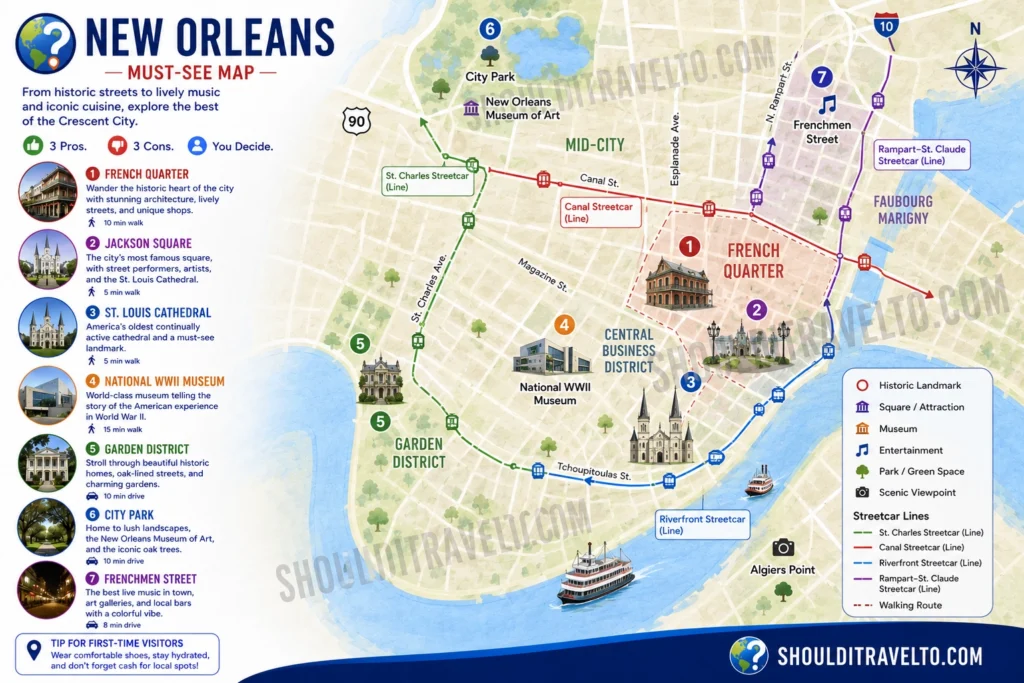
If your schedule allows, explore the French Quarter and Jackson Square, listen to live music on Frenchmen Street, visit the Garden District, or learn about the city’s architecture and historic neighborhoods. The National WWII Museum offers a major museum experience, while the Mississippi River provides another perspective on the city’s history and geography. If you’re interested in cemetery history, research appropriate guided experiences and current access rules before you go.
Food should also be part of the trip. New Orleans is known for its distinctive culinary traditions, and trying local dishes gives you another way to experience the city beyond the parade routes.
The challenge is deciding how much sightseeing to include. Three days during the final Mardi Gras weekend may leave little time for anything beyond Carnival. Five days can provide more flexibility, depending on the parade schedule and your priorities.
For a more complete first visit, consider prioritizing a mix of experiences:
- Attend at least one major nighttime parade and one daytime parade, if the schedule allows.
- Try king cake and explore the city’s food traditions.
- Spend time in the French Quarter outside the busiest party hours.
- Learn about at least one krewe before watching its parade.
- Explore a historic neighborhood or visit a museum.
- Leave unscheduled time to enjoy Carnival without rushing to the next activity.
You don’t need to fit every attraction into one trip. A few carefully chosen experiences can provide a more rewarding introduction to both Mardi Gras and New Orleans.
Mardi Gras vs. an Ordinary New Orleans Vacation
A trip during Mardi Gras is fundamentally different from a trip to New Orleans at another time of year. The question isn’t which is better; it’s which experience you want.
Choose Mardi Gras if you want a celebration-centered trip
Mardi Gras is a strong choice if you want parades, elaborate costumes, marching bands, throws, crowds, neighborhood traditions, and a city running at the height of Carnival. It is especially appealing to travelers who enjoy major cultural celebrations and don’t mind planning ahead or adapting to changing conditions.
You’ll need to accept that transportation can be complicated, accommodations can be expensive, and ordinary sightseeing may take more effort. In return, you’ll experience New Orleans during one of its most distinctive annual traditions.
Choose an ordinary New Orleans vacation if you want more flexibility
Outside Carnival season, you can plan a more conventional city trip focused on restaurants, museums, music, historic neighborhoods, architecture, and other attractions. Transportation and restaurant reservations may be easier to manage, and accommodation prices can be lower during quieter periods.
This option suits travelers who want to explore the city at a slower pace or aren’t particularly interested in parades and large crowds.
Neither trip is inherently better. They simply offer different experiences. During an ordinary visit, New Orleans is the main destination. During Mardi Gras, Carnival becomes the focus of the vacation.
Who Should Visit New Orleans for Mardi Gras?
Mardi Gras suits travelers who want a bucket-list cultural experience and enjoy parades, music, costumes, photography, food, history, and energetic public celebrations. It can be especially rewarding if you’re curious about the traditions behind the spectacle and want to see how a city celebrates an event and destination that has shaped its identity for generations.
It also suits travelers who plan ahead but want to stay flexible once they arrive. Choose a few priority parades, book a convenient place to stay, and allow time for crowds to make the experience more manageable.
On the other hand, consider visiting New Orleans at another time if you strongly dislike huge crowds, noise, street closures, expensive hotels, waiting, or plans that may need to change. Travelers whose main goal is to explore museums, restaurants, architecture, and neighborhoods at a relaxed pace may appreciate the city more outside Carnival season.
That isn’t an argument against New Orleans. It’s a reminder to choose the version of New Orleans that matches the vacation you want.
The Decision Is Yours
Mardi Gras in New Orleans means floats rolling along St. Charles Avenue, marching bands filling the streets, beads flying through the air, and king cake appearing on tables throughout the city. Krewes continue traditions built over generations, while neighborhoods and cultural communities contribute their own celebrations.
For a few weeks, one of America’s most distinctive cities becomes something even more distinctive.
If you want to experience New Orleans through Carnival, Mardi Gras can be an extraordinary trip. If you would rather explore the city’s history, food, music, and neighborhoods at your own pace, another time of year may be a better fit.
On a typical trip, New Orleans is the destination. During Mardi Gras, Carnival becomes the destination.
3 Pros. 3 Cons. You Decide.
New Orleans for Mardi Gras Frequently Asked Questions
When is Mardi Gras?
Mardi Gras is always the Tuesday before Ash Wednesday and can fall between early February and early March. Carnival season begins on January 6 and continues until midnight on Mardi Gras, when Ash Wednesday begins. Because the date changes every year, confirm the calendar for your intended travel year before booking.
Is Mardi Gras worth visiting?
Mardi Gras is worth considering if you enjoy major cultural celebrations, parades, music, costumes, food, history, and energetic street environments. It offers a distinctive way to experience New Orleans, but the crowds, higher accommodation costs, and transportation disruptions may not suit travelers who prefer a quiet city break.
Do you have to visit on Mardi Gras Day?
No. Many major parades and Carnival celebrations take place during the days and weeks before Fat Tuesday. Visiting earlier can still provide a substantial Mardi Gras experience and may leave more room for sightseeing around New Orleans. Visit on Mardi Gras Day if experiencing the season’s culmination is particularly important to you.
Is Mardi Gras family-friendly?
Yes, Mardi Gras can be family-friendly, especially along traditional parade routes such as St. Charles Avenue. Families attend parades, catch throws, and enjoy the music and costumes. The atmosphere varies by location, so families should choose their viewing areas carefully rather than assuming the entire city offers the same experience.
Is Mardi Gras just on Bourbon Street?
No. Bourbon Street is one part of the celebration, but many traditional parades take place elsewhere in New Orleans, including along Uptown routes. Mardi Gras also includes neighborhood traditions, marching bands, krewes, balls, food, and cultural events throughout the Carnival season.
What should you wear to Mardi Gras?
Wear comfortable shoes and clothing suited to the forecast, especially if you plan to spend several hours outdoors. Purple, green, and gold are traditional Mardi Gras colors, and costumes are common, particularly as Fat Tuesday approaches. Check the weather before you go out, and bring a bag for any throws you collect.
What are Mardi Gras throws?
Throws are items parade floats toss to spectators. Beads are the most recognizable, but throws can also include cups, doubloons, toys, stuffed animals, and krewe-specific collectibles. Some items, such as Zulu’s decorated coconuts, are particularly associated with individual krewes.
How many days should you spend in New Orleans for Mardi Gras?
Three days can provide a focused Mardi Gras experience, while four or five days give first-time visitors more time to attend multiple parades and explore New Orleans beyond Carnival. Six or seven days may suit travelers who want to experience several major celebrations alongside the city’s food, music, museums, and historic neighborhoods.
Is Mardi Gras expensive?
It can be. Hotel demand, transportation, dining, and other travel expenses can make Mardi Gras more expensive than quieter periods in New Orleans. Booking accommodation early and choosing a convenient location can help you manage costs, but prices depend on your dates and travel style.
Is New Orleans still worth visiting if you don’t want to attend Mardi Gras?
Absolutely. New Orleans offers distinctive food, music, architecture, history, museums, and neighborhoods year-round. If you prefer a more flexible itinerary, easier sightseeing, and a slower introduction to the city, visiting outside Carnival season may be a better choice.