

If You Have a Summer Vacation, Where Should You Go?
Quick Answer
Summer gives you something many other travel seasons don’t: time. Given the time, a summer vacation also offers several possibilities.
For some travelers, that means a week at the beach. For others, it’s a family theme-park vacation, a national park road trip, a few days exploring a major city, or a longer journey that combines several destinations.
But those vacations are not interchangeable.
A family with young children may want convenient attractions, swimming pools, and manageable travel days. A couple may prefer a coastal town, mountain scenery, or a relaxing resort. Outdoor enthusiasts may want to hike national parks, explore lakes, or drive through spectacular landscapes. And travelers who enjoy museums, food, history, and entertainment can use summer’s longer days to explore major cities.
The best summer destination isn’t necessarily the most famous national park, the most popular beach, or the city with the most attractions. It’s the place that offers the experiences you want without making you spend more time, money, or energy than you intended.
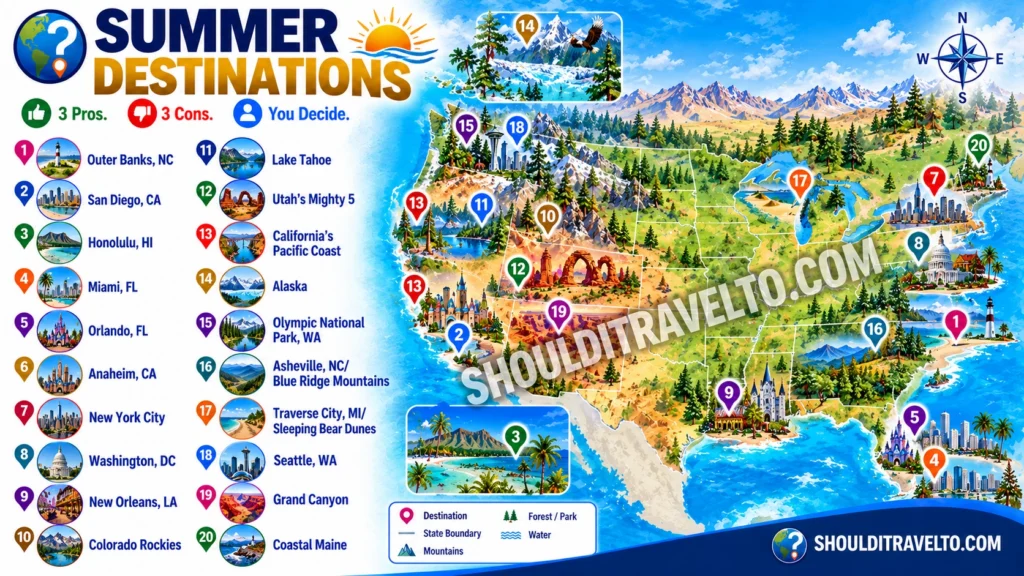
Explore destinations and vacation styles across the United States, including beaches, theme parks, cities, national parks, mountain escapes, lakes, and road trips. We’ll look at what makes each option appealing, what can complicate the experience, and which travelers are most likely to enjoy it.
The goal isn’t to tell everyone where to go. It’s to help you decide which summer vacation makes sense for you.
What Counts as Summer Travel, and Why Does Timing Matter?
For most travelers, summer means June, July, and August. But summer conditions can vary considerably depending on where you go and when you arrive.
A coastal destination in California may offer mild afternoons while inland areas experience intense heat. Florida can be hot, humid, and stormy. Mountain destinations may offer comfortable hiking weather, while higher elevations can still have lingering snow or limited access early in the season. In northern states, summer can provide a relatively short window for enjoying lakes, scenic drives, and outdoor activities.
Your exact dates matter, too.
June, July, and August do not necessarily offer the same experience. Early summer may bring fewer visitors to some destinations, although school calendars and regional holidays affect demand. July is a particularly popular month for family vacations and travel around Independence Day. August can still be busy, especially at beaches, theme parks, and national parks, while some destinations begin to see changing demand as school resumes.
Before choosing a destination, consider three questions:
- When are you traveling? Your dates affect weather, crowds, prices, seasonal access, and which activities are available.
- What do you want to do? A beach vacation, national park trip, city break, and theme-park vacation require different plans.
- How much time and money do you have? A longer vacation can make a road trip worthwhile, but more destinations also mean more transportation, lodging, and planning.
Summer offers many possibilities. The trick is to choose a trip that fits the time you actually have.
Why Travel During Summer?
Summer is one of the most flexible times of year to take a vacation, especially for families and travelers who want to spend more time outdoors. But its advantages depend on where you go and what you want from the trip.
Longer Days Give You More Time to Explore
In many parts of the country, long summer daylight hours make it easier to fit outdoor activities into the day.
You can take an early hike, spend the afternoon at a lake, explore a town in the evening, or make several stops along a scenic drive without losing daylight as quickly as you might in winter.
This is particularly useful for national parks, mountain destinations, coastal road trips, and itineraries that combine several outdoor experiences.
The trade-off is that long days can encourage overplanning. More daylight does not mean you need to fill every hour.
Summer Opens Up Seasonal Experiences
Some of America’s most appealing summer experiences are tied to the season.
National parks offer hiking, wildlife viewing, scenic drives, and access to areas that may be difficult to reach at other times of year. Lakes and coastal destinations become natural places for swimming, boating, and water sports. Mountain towns offer hiking, biking, and outdoor recreation, while cities host concerts, festivals, outdoor dining, and other seasonal activities.
These experiences are not guaranteed everywhere or on every date. Weather, wildfire conditions, water temperatures, park access, and local operating schedules can affect your plans.
Still, summer provides a particularly broad range of ways to experience the country.
You Have Time for More Than One Destination
A three- or four-day weekend usually favors one destination. A week or two can support a more ambitious trip.
You might combine San Francisco with Yosemite, explore several national parks in Utah, drive along the California coast, or visit multiple New England towns. A longer vacation also gives you time to mix activities: a few days in a city, time outdoors, and a quieter stop to relax.
The trade-off is transportation. Long drives, airport transfers, hotel changes, and one-night stays all consume vacation time.
A successful multi-stop trip is not necessarily the one that covers the most ground. It is the one where the journey itself is part of the experience.
The 3 Biggest Pros and 3 Biggest Cons of Traveling in Summer
Summer can be an excellent time to travel, but it is also one of the busiest periods for many American destinations. Before booking, consider what the season makes possible—and what it makes more difficult.
The 3 Biggest Pros of Summer Travel
1. You Have More Choices for Outdoor Activities
Summer opens up a wide range of activities, from swimming and boating to hiking, cycling, wildlife viewing, and scenic drives.
Mountain destinations such as the Colorado Rockies can offer comfortable conditions for outdoor exploration. National parks provide access to many trails and landscapes, while lake destinations give travelers opportunities to swim, paddle, fish, or simply spend time near the water.
Coastal cities and beach towns can combine outdoor recreation with restaurants, museums, and other attractions.
The advantage is flexibility: you can choose the kind of outdoor experience that suits you rather than planning around a single activity.
2. Summer Works for Many Different Travel Styles
Summer is not one type of vacation.
Families can choose theme parks, beaches, and educational city trips. Couples may prefer coastal towns, mountain resorts, or national park scenery. Groups of friends might want a lively city, a lake house, or a road trip. History enthusiasts can explore historic cities and landmarks, while outdoor travelers can build an entire itinerary around hiking, water activities, or scenic drives.
You can also combine different travel styles in one trip, provided the destinations are reasonably close together.
3. Longer Vacations Make Bigger Trips Possible
If you have a week or more, summer can be an opportunity to take a trip that would be difficult to fit into a long weekend.
You can spend several days exploring a national park, drive through a region at a relaxed pace, visit multiple cities, or include both a destination and its surrounding area.
A longer vacation also gives you room for rest days, weather delays, and unplanned discoveries.
The key is to use the extra time to enjoy a destination—not simply to add more destinations to your itinerary.
The 3 Biggest Cons of Summer Travel
1. Crowds and High Demand Can Affect the Entire Trip
Summer school holidays, family vacations, and popular seasonal activities create strong demand for beaches, national parks, hotels, attractions, and rental cars.
That demand can mean higher accommodation rates, crowded trails, busy roads, long attraction lines, and limited availability at desirable places to stay.
The busiest destinations may require advance reservations for lodging, timed-entry attractions, tours, or transportation. Even a destination that is normally manageable can feel very different during a holiday weekend.
If your dates are flexible, compare different weeks. If they are fixed, reserve the parts of the trip that are most difficult to replace.
2. Heat, Humidity, Storms, and Wildfires Can Change Your Plans
Summer does not guarantee ideal weather.
Parts of the Southwest can experience extreme heat. Florida and the Gulf Coast can be hot and humid, with thunderstorms and tropical-weather risks. Mountain and forest destinations may face thunderstorms, wildfire smoke, or temporary closures. Coastal water can remain cool in some areas, even during summer.
These conditions can affect comfort and safety as well as the activities you planned.
Choose destinations that offer alternatives if the weather changes. A city with museums and indoor attractions may provide more flexibility during a heat wave, while a national park trip needs contingency plans for trail closures, storms, or smoke.
Check current forecasts and local advisories before outdoor activities, and be willing to change your plans when conditions warrant it.
3. Longer Trips Can Become Expensive and Complicated
A summer vacation can involve more than flights and hotels. Rental cars, fuel, park reservations, attraction tickets, meals, parking, tours, and transportation between destinations all add to the total.
Road trips can also become tiring if you underestimate driving distances or schedule a different hotel every night. Families may find that frequent packing, long drives, and tightly scheduled activities leave little time to relax.
A longer vacation gives you more options, but it also creates more opportunities to overspend or overplan.
Decide which experiences matter most, establish a realistic budget, and leave room in the itinerary for downtime.
Who Is Taking the Summer Vacation?
The right destination depends partly on who is traveling. A trip that works for a family with young children may not suit teenagers, and a couple looking for quiet scenery may have little interest in a crowded entertainment district.
Summer Travel With Young Children
Families with young children often benefit from convenient attractions, manageable travel distances, swimming opportunities, and accommodation that makes rest breaks easy.
San Diego combines beaches with the San Diego Zoo, Balboa Park, and other family attractions. Orlando offers a large concentration of theme parks and resort options. Anaheim can work well for a more focused Disneyland vacation. Beach destinations such as St. Pete–Clearwater can make swimming and time by the water the center of the trip.
For families interested in learning, Washington, DC, offers museums and monuments, while national parks can introduce children to wildlife and landscapes when the activities are appropriate for their ages.
The trade-off is that heat, crowds, long walks, and travel days can be tiring for younger children.
Choose an itinerary that allows for breaks. A comfortable hotel, convenient transportation, and a little unplanned time may matter more than the number of attractions you manage to visit.
Summer Travel With Teenagers
Teenagers may want more independence, variety, and active experiences than younger children.
Los Angeles offers beaches, entertainment, museums, sports, shopping, and food. New York City provides museums, shows, shopping, and neighborhoods to explore. Orlando is a natural option for theme-park enthusiasts, while San Diego combines coastal activities with major attractions.
Older teens and active families may prefer destinations with hiking, rafting, kayaking, mountain biking, or other outdoor activities. National parks and mountain towns can be rewarding when the group enjoys being outside and is prepared for the conditions.
The important question is what your teenagers actually enjoy. A theme-park vacation, a week in a major city, and a national park road trip can all be memorable, but they require different budgets, energy levels, and expectations.
Summer Travel for Couples and Adults
Couples and adults without school-age children have more flexibility to choose a vacation around personal interests.
You might focus on restaurants and museums in a major city, relax at a coastal resort, explore a scenic mountain town, or spend several days visiting national parks. A road trip can be especially appealing if you enjoy the journey as much as the destination.
Summer also offers opportunities to combine experiences. You could spend a few days in San Francisco before exploring the California coast, or pair a city stay with hiking and scenery nearby.
The trade-off is that popular summer destinations can be busy and expensive. If relaxation is your priority, consider traveling outside holiday weekends, staying longer in one place, or choosing a less crowded base near the activities you want.
Summer Travel With Friends
Groups of friends may want beaches, nightlife, outdoor adventure, live music, food, or simply a place where everyone can spend time together.
Miami and New Orleans offer dining, culture, entertainment, and nightlife. Lake destinations can support swimming, boating, fishing, and shared vacation rentals. National parks and mountain towns can suit groups who enjoy hiking, scenic drives, and outdoor activities.
But group trips work best when everyone agrees on the basic plan.
Discuss budgets, transportation, sleeping arrangements, activity levels, and how much time people want to spend together before booking. A destination that works for everyone is often a better choice than the one person in the group finds most exciting.
Summer Travel for Outdoor Enthusiasts
For travelers who want to spend most of the vacation outside, summer can be one of the best opportunities to explore the country’s mountains, lakes, coastlines, and national parks.
The Rocky Mountains, the Pacific Northwest, the Great Lakes, Alaska, and many national parks offer different combinations of hiking, wildlife, water activities, and scenic landscapes.
However, outdoor travel requires more preparation than simply choosing a beautiful place. Consider elevation, heat, trail difficulty, water availability, road access, wildfire conditions, and how far you will be from services.
A destination’s most famous hike or viewpoint may not be appropriate for every visitor. Match activities to your experience and current conditions rather than treating every attraction as a must-do.
What Kind of Summer Vacation Do You Want?
Once you know who is traveling, narrow the choices by the experience you want. This quick guide can help you decide where to start.
| If you want… | Start with… |
| A classic beach vacation | Outer Banks, North Carolina |
| Beaches plus family attractions | San Diego, California |
| A tropical island vacation | Honolulu, Hawaii |
| Beach time with a lively city atmosphere | Miami, Florida |
| Theme parks and family entertainment | Orlando, Florida |
| A focused Disney vacation | Anaheim, California |
| A major city with endless activities | New York City |
| Museums, monuments, and American history | Washington, DC |
| Food, music, and distinctive culture | New Orleans, Louisiana |
| Mountain scenery and outdoor adventure | Colorado Rockies |
| Lakes, boating, and a summer cabin | Lake Tahoe, California/Nevada |
| National parks and dramatic landscapes | Utah’s Mighty 5 |
| A classic scenic road trip | California’s Pacific Coast |
| Wildlife and wide-open landscapes | Alaska |
| Waterfalls, forests, and coastal scenery | Olympic National Park, Washington |
| A quieter mountain-town escape | Asheville and the Blue Ridge Mountains |
| A Great Lakes summer vacation | Michigan’s Traverse City and Sleeping Bear Dunes |
| A mix of city attractions and nearby nature | Seattle, Washington |
| A desert landscape and stargazing | Grand Canyon and northern Arizona |
| A New England coastal and historic trip | Coastal Maine |
These are starting points, not rankings. A destination that is ideal for one travel style may be less appealing if you want a completely different kind of vacation.
Best Beach and Coastal Summer Destinations
A beach vacation can mean very different things. Some travelers want warm water and long days on the sand. Others want coastal scenery, seafood, water sports, or a beach town with activities beyond swimming.
Summer is a popular time for coastal travel, but water temperature, humidity, storms, traffic, and seasonal crowds vary considerably by region.
San Diego, California: The Beach Vacation With City Attractions
San Diego is a versatile summer choice if you want coastal scenery without giving up major attractions, museums, dining, and outdoor activities.
You can spend time at beaches, explore La Jolla, visit Balboa Park and the San Diego Zoo, or plan activities around the city’s different neighborhoods. The combination makes it possible to alternate beach time with other experiences rather than spending every day on the sand.
San Diego can work particularly well for families and mixed-interest groups. Some travelers can prioritize beaches and water activities while others explore museums, parks, restaurants, and local neighborhoods.
The trade-off is that San Diego is spread out. A car can make it easier to visit several areas, although your transportation needs depend on where you stay and what you plan to do. Summer demand can also affect lodging prices and popular beach areas can become busy.
Best for: Families, beach lovers, outdoor activities, and travelers who want coastal scenery plus city attractions.
Biggest trade-off: Distances between attractions and the cost of a popular summer destination.
Choose San Diego if: You want a coastal vacation with enough variety to fill a week without relying entirely on the beach.
Honolulu, Hawaii: The Tropical Summer Vacation
Honolulu offers a combination of tropical beaches, urban conveniences, Hawaiian culture, and outdoor adventure.
Waikiki provides a familiar beach setting with hotels, restaurants, shopping, and access to ocean activities. Beyond the main resort area, Oahu offers hiking, scenic coastlines, cultural attractions, and important historic sites, including Pearl Harbor.
You can build a vacation around the beach, learn to surf, explore the island, or mix outdoor activities with time in the city. For travelers who want more than a resort stay, that variety can make Honolulu a rewarding base.
The main trade-off is cost. Flights, accommodation, dining, rental cars, and activities can make Hawaii a premium-priced vacation compared with many mainland destinations. Travel time can also be substantial, particularly for visitors coming from the eastern United States.
Summer conditions are generally favorable for many outdoor activities, but ocean conditions and weather still vary. Respect local guidance and ocean-safety warnings, and remember that Hawaii is a living island community, not simply a resort destination.
Best for: Tropical beaches, surfing, outdoor activities, Hawaiian culture, and travelers seeking an island vacation with city amenities.
Biggest trade-off: Overall cost and the time required to reach the islands.
Choose Honolulu if: You want a tropical vacation that combines beaches with culture, food, and outdoor exploration.
Miami, Florida: Beaches, Dining, and City Energy
Miami suits travelers who want beach time alongside a major city’s restaurants, neighborhoods, cultural attractions, and nightlife.
South Beach is known for its shoreline and Art Deco architecture, while other parts of the Miami area offer distinct dining, cultural, and recreational experiences. You can build a trip around the beach, explore different neighborhoods, or combine sightseeing with evenings out.
Miami can appeal to couples, groups of friends, and travelers who prefer an active urban atmosphere over a quiet beach resort.
The trade-offs are summer heat, humidity, thunderstorms, and the possibility of tropical weather. Beaches and popular tourist areas can be crowded, while hotels, dining, parking, and entertainment can add up quickly.
If your primary goal is comfortable weather and hours on the beach, compare seasonal conditions and accommodation costs before committing.
Best for: Beaches, restaurants, cultural experiences, nightlife, and a lively city atmosphere.
Biggest trade-off: Heat, humidity, seasonal weather risks, crowds, and cost.
Choose Miami if: You want a beach vacation that also includes city life, dining, and entertainment.
Outer Banks, North Carolina: A Beach Vacation Built Around the Coast
The Outer Banks offers a different style of beach trip, with barrier islands, broad beaches, coastal communities, historic sites, and opportunities for water activities.
Depending on where you stay, you can spend your days swimming, fishing, kayaking, visiting lighthouses, exploring maritime history, or simply enjoying a rental near the beach. The region can be especially appealing to families and groups who prefer a house-based vacation over a hotel in a large city.
The trade-off is transportation and planning. The Outer Banks stretches across a long coastal area, so your experience depends on where you stay and how far you want to drive. Some areas have limited services compared with a major city, and summer traffic can affect travel times.
Weather also matters. Coastal storms can disrupt plans, and ocean conditions may make swimming unsafe at times. Check local beach advisories and plan for activities beyond the shoreline.
Best for: Families, beach-house vacations, fishing, coastal scenery, and travelers who want a slower pace.
Biggest trade-off: A car is useful, distances can be longer than expected, and the trip is more weather-dependent than a city vacation.
Choose the Outer Banks if: You want a coastal getaway centered on beaches, a shared rental, and outdoor activities rather than a dense schedule of urban attractions.
St. Pete–Clearwater, Florida: Gulf Coast Beaches and Relaxation
St. Pete–Clearwater is a strong option if you want the beach to be the main event.
The area offers Gulf Coast beaches, waterfront parks, sunset views, boating excursions, and family-friendly attractions. Clearwater Beach is a major draw, while nearby coastal communities provide different places to stay and explore.
Families can combine beach time with nearby activities, while couples may appreciate the area’s resort options and coastal atmosphere. You can keep the schedule simple without needing to fill every day with major attractions.
The trade-off is summer heat and humidity, along with thunderstorms and potential tropical-weather disruptions. Popular beaches can be busy, and moving between beach communities may require a car or careful transportation planning.
If your idea of a vacation involves museums, major landmarks, and a packed urban itinerary, another destination may offer more variety.
Best for: Beach lovers, families, Gulf Coast sunsets, and travelers seeking a relaxed coastal trip.
Biggest trade-off: Hot, humid conditions and less urban variety than a major city.
Choose St. Pete–Clearwater if: You want to spend most of your vacation near the water, with additional attractions available when you want a break from the beach.
Best Theme-Park Summer Destinations
Theme parks offer a clear purpose for a family vacation: rides, shows, character experiences, and entertainment that can fill several days.
The decision is often between a large, multi-park destination and a more concentrated resort trip. Either way, summer demand, heat, ticket prices, and time spent waiting can have a major effect on the experience.
Orlando, Florida: A Full Week of Theme-Park Entertainment
Orlando is a natural choice for travelers who want to build a vacation around major theme parks.
Walt Disney World, Universal Orlando, SeaWorld Orlando, water parks, and other attractions create enough options to fill a week or more. Resorts and tourism-oriented services make it possible to organize much of the trip around your preferred attractions.
Orlando works particularly well for families, multigenerational groups, and travelers who want a vacation with a clear focus. You can plan park days, rest days, dining, and other activities before arriving.
But the scale is also a drawback. Different parks require time, and trying to do everything can create an exhausting schedule. Tickets, accommodation, meals, parking, transportation, and optional experiences can push the total cost well beyond the initial hotel price.
Summer heat, thunderstorms, and crowds can also affect your plans. Build in breaks, check attraction policies, and decide which experiences are most important rather than trying to visit every park.
Best for: Families, theme-park enthusiasts, multigenerational groups, and travelers seeking a vacation centered on entertainment.
Biggest trade-off: Cost, crowds, heat, and the time needed to experience large parks.
Choose Orlando if: You want several days of theme-park attractions and are prepared to plan around tickets, transportation, and rest.
Anaheim, California: A More Focused Disney Vacation
Anaheim offers a concentrated alternative for travelers whose main goal is Disneyland Resort.
Disneyland Park and Disney California Adventure are located within a compact resort district, allowing visitors to focus several days on the parks without covering the distances involved in a sprawling destination.
Anaheim can also serve as part of a longer Southern California trip. Travelers with additional time may combine the parks with beaches or attractions in the greater Los Angeles area.
The trade-off is that Disneyland visits still require planning and can be expensive, particularly during busy periods. Anaheim itself may be less compelling if theme parks are not your priority, and adding other Southern California destinations introduces additional transportation time.
Best for: Disney fans, families, and travelers seeking a focused theme-park vacation.
Biggest trade-off: Park costs and crowds, with fewer reasons to stay in Anaheim if you aren’t interested in the resort or nearby attractions.
Choose Anaheim if: Disneyland is the main purpose of your trip and you prefer a concentrated park vacation over a larger Orlando itinerary.
Best Big-City Summer Destinations
Summer cities can offer outdoor dining, waterfront areas, parks, festivals, museums, sports, and long evenings for exploring neighborhoods.
The downside is that some major cities become hot, humid, crowded, or expensive during peak travel periods. If you choose a city vacation, consider the weather, how easily you can get around, and whether the attractions you want are close enough to combine efficiently.
New York City: The City With Almost Endless Options
New York City is a strong choice for travelers who want a vacation filled with attractions, neighborhoods, food, museums, shopping, entertainment, and recognizable landmarks.
Summer brings opportunities to explore parks, waterfront areas, outdoor events, and neighborhoods after spending time in museums or other indoor attractions. The subway makes it possible to cover much of the city without renting a car.
The city’s variety works well for groups with different interests. One traveler may want museums, another may prefer shopping, and someone else may be most interested in food, architecture, or live performances.
The trade-offs are cost, crowds, and summer heat. Walking and public transportation are convenient, but they also mean spending time outdoors in hot or humid weather. Hotels can be expensive, and popular attractions may need advance planning.
Best for: Museums, entertainment, food, shopping, parks, and travelers who want a full urban vacation.
Biggest trade-off: Cost, crowds, heat, and the amount of walking involved.
Choose New York City if: You want enough variety to fill several days without needing a beach or a rental car.
Los Angeles, California: Beaches, Entertainment, and Variety
Los Angeles offers a broad mix of beaches, entertainment, museums, shopping, food, hiking, sports, and distinctive neighborhoods.
You could spend one day near the coast, another exploring museums or Hollywood-related attractions, and another hiking or visiting neighborhoods known for their food and culture. This flexibility makes Los Angeles appealing to families, couples, and groups who want to build their own itinerary.
The main trade-off is distance. Attractions are spread across a large metropolitan area, and driving between beaches, studios, museums, and neighborhoods can take considerable time. Summer traffic can make inefficient planning particularly frustrating.
Organize activities by area rather than crossing the city repeatedly. You may also want to choose accommodation based on your main priorities instead of assuming one location will be convenient for everything.
Best for: Beaches, entertainment, food, museums, hiking, and mixed-interest groups.
Biggest trade-off: Transportation, traffic, and distances between attractions.
Choose Los Angeles if: You want a flexible summer vacation that can combine urban attractions, beaches, and outdoor activities.
San Francisco, California: A Cooler Coastal City Break
San Francisco offers waterfront scenery, distinctive neighborhoods, museums, food, architecture, and access to nearby coastal and regional attractions.
You can explore the waterfront, ride the city’s famous cable cars, visit museums, sample different neighborhoods, or use the city as a starting point for excursions around the Bay Area. Its public transportation options can make a car-free city stay possible, depending on your itinerary.
One important trade-off is weather. Summer in San Francisco does not necessarily mean hot, sunny beach conditions. Fog, wind, and cool temperatures can be part of the experience, even when other parts of California are warm.
The city also has hills, and getting between some attractions may take more effort than a map suggests. Accommodation and dining can be costly, particularly in convenient locations.
Best for: Food, neighborhoods, waterfront scenery, museums, and travelers who prefer milder weather to extreme heat.
Biggest trade-off: Cool and changeable coastal weather, hills, and city costs.
Choose San Francisco if: You want a walkable-in-parts urban vacation with distinctive neighborhoods, food, and coastal scenery—and don’t require consistently hot weather.
Seattle, Washington: City Attractions and Pacific Northwest Scenery
Seattle combines a major city’s food, museums, waterfront, markets, and cultural attractions with access to the landscapes of the Pacific Northwest.
You can spend time exploring the city, visiting museums, enjoying waterfront areas, or taking day trips into the surrounding region. Travelers with more time can combine Seattle with mountain scenery, islands, or other destinations in Washington.
Summer can be an appealing season for exploring outdoors, but the weather is not guaranteed to be sunny every day. Popular regional excursions can also involve long drives, ferry schedules, reservations, or seasonal crowds.
The trade-off is deciding how much of your vacation should be spent in Seattle itself versus the surrounding region. Trying to fit the city, mountains, islands, and national parks into a short stay can lead to more travel time than expected.
Best for: City exploration, food, waterfront attractions, and travelers who want to combine urban experiences with Pacific Northwest scenery.
Biggest trade-off: Regional distances and the extra planning required for excursions outside the city.
Choose Seattle if: You want a city break that can serve as a base for a longer Pacific Northwest vacation.
New Orleans, Louisiana: Food, Music, and Culture
New Orleans is an option for travelers who want their vacation to revolve around food, music, architecture, and local culture.
You can explore the French Quarter, admire historic buildings, listen to live music, sample Creole- and Cajun-influenced cuisine, and learn about the city’s complex history. Neighborhoods beyond the most famous tourist areas offer additional ways to experience its character.
The main trade-off is summer weather. Heat and humidity can make long walks uncomfortable, and thunderstorms or tropical weather can affect plans. The city’s nightlife-centered areas may also be less appealing to travelers seeking quiet evenings or a family-focused atmosphere.
Plan outdoor exploration for more comfortable parts of the day, and leave room for indoor attractions, restaurants, and breaks.
Best for: Food, music, architecture, culture, and travelers seeking a distinctive city experience.
Biggest trade-off: Heat, humidity, and an atmosphere that may not suit every travel style.
Choose New Orleans if: You want a culture-and-food vacation and are comfortable planning around hot summer conditions.
Best Educational and Historic Summer Destinations
Summer is a useful time for families and history enthusiasts to explore America’s major historic cities and landmarks. Longer days can make it easier to combine museums, walking tours, monuments, and historic neighborhoods.
These trips can also be more flexible than a vacation built around a single outdoor attraction, because museums and other indoor sites provide alternatives during hot or rainy weather.
Washington, DC: Museums, Monuments, and American History
Washington, DC, offers a summer vacation built around museums, monuments, national landmarks, and historic neighborhoods.
The National Mall connects many of the capital’s best-known monuments and memorials. Smithsonian museums cover art, science, history, and other subjects, while additional sites provide opportunities to explore the country’s political and cultural history.
Many major museums offer free admission, which can help balance accommodation, dining, and transportation costs. However, free admission does not mean the whole trip is inexpensive, and popular attractions may have timed-entry requirements or busy periods.
The main trade-offs are heat, walking distances, and crowds. Much of the sightseeing involves spending time outdoors between attractions, so comfortable footwear, water, and breaks are important during hot weather.
Best for: American history, museums, monuments, educational family trips, and travelers who want a city vacation with substantial cultural content.
Biggest trade-off: Heat, walking, and the effort required to explore a large number of sites.
Choose Washington, DC, if: You want a history-rich city vacation with many major attractions that do not require admission tickets.
Philadelphia, Pennsylvania: Founding-Era History and a Major City
Philadelphia offers a mix of American history, museums, food, neighborhoods, and urban attractions.
Historic sites connected to the nation’s founding provide a clear reason to visit, while the city’s museums, public spaces, and food scene offer variety beyond history. Philadelphia can also be part of a longer Northeast trip, although adding other cities requires realistic transportation planning.
Compared with some larger tourist destinations, Philadelphia can provide a more concentrated history-focused itinerary. But summer heat, crowds at major attractions, and the time required to explore different neighborhoods still affect the experience.
Best for: American history, museums, food, and travelers who want a city vacation with a strong historic identity.
Biggest trade-off: Summer heat and the need to balance historic sites with the rest of the city.
Choose Philadelphia if: You want to explore the nation’s founding history without giving up restaurants, museums, and other city attractions.
Boston, Massachusetts: History and a Walkable City
Boston combines American history, historic neighborhoods, museums, waterfront areas, restaurants, and access to nearby New England destinations.
You can explore sites connected to the American Revolution, walk through historic neighborhoods, visit museums, and spend time along the waterfront. For travelers with more time, Boston can be a starting point for excursions into coastal New England or other nearby areas.
Summer generally provides more opportunities for walking and outdoor sightseeing than winter, although hot or rainy days are still possible. Popular periods can bring higher accommodation rates, and the city’s historic streets and busy attractions may require more time than expected.
Best for: American history, walkable sightseeing, museums, food, and travelers interested in New England.
Biggest trade-off: Seasonal accommodation costs and the need to plan carefully if adding distant regional excursions.
Choose Boston if: You want a city vacation that combines American history with neighborhoods, museums, and opportunities to explore the wider New England region.
Best National Park and Outdoor Summer Destinations
National parks and outdoor destinations can be among the most rewarding summer vacations, particularly for travelers who want hiking, wildlife, dramatic landscapes, and time away from dense urban areas.
But summer is also the peak season for many popular parks. Roads, campgrounds, lodges, trails, and visitor centers can be busy, and some areas require advance reservations or have limited parking.
Before choosing a park, consider the difficulty of the activities you want, the weather, elevation, driving distances, available services, and current access conditions. The most famous destination is not automatically the best fit for your group.
Yellowstone National Park: Wildlife, Geothermal Features, and Wide-Open Landscapes
Yellowstone offers an unusual combination of geothermal features, wildlife, forests, rivers, lakes, and mountain scenery.
Visitors can explore geysers and hot springs, watch for wildlife from appropriate distances, drive scenic park roads, and choose hikes suited to their experience. The variety makes Yellowstone appealing to families, photographers, nature enthusiasts, and travelers who want several days of outdoor exploration.
The trade-off is scale. The park is enormous, and driving between major areas can take substantial time. Summer is a popular period, so traffic, parking, lodging, and crowded viewpoints can affect the experience.
Weather can also change quickly, and wildlife viewing is never guaranteed. Keep safe distances from animals, follow park rules, and plan around current access information rather than assuming every road or attraction will be available.
Best for: Wildlife, geothermal landscapes, scenic drives, hiking, and travelers who want a large national park experience.
Biggest trade-off: Distances, summer crowds, and the need for careful logistics.
Choose Yellowstone if: You want several days of varied natural attractions and are prepared to plan around the park’s size and seasonal demand.
Grand Canyon National Park, Arizona: A Landscape That Requires No Introduction
The Grand Canyon offers one of America’s most recognizable natural landscapes, with expansive viewpoints, hiking opportunities, and a sense of scale that is difficult to appreciate from photographs alone.
Many visitors focus on the South Rim, where viewpoints, visitor facilities, and a range of services support sightseeing. Travelers can take short walks, explore viewpoints, learn about the geology, or plan more strenuous activities with appropriate preparation.
The most important trade-off is summer heat, particularly at lower elevations and on trails descending into the canyon. Conditions at the rim can be very different from those below it. Hiking into the canyon is not simply a walk downhill; the return climb can be demanding, especially in hot weather.
Crowds and parking can also affect the experience. Check park guidance, carry sufficient water for your planned activities, and choose hikes that match your fitness and the current conditions.
Best for: Dramatic scenery, photography, geology, scenic viewpoints, and travelers who want to experience a major natural landmark.
Biggest trade-off: Heat, crowds, and the physical demands of hiking below the rim.
Choose the Grand Canyon if: You want a spectacular landscape and are willing to plan activities around heat, distance, and your ability level.
Utah’s Mighty 5: A National Park Road Trip
Utah’s Mighty 5 refers to Arches, Bryce Canyon, Canyonlands, Capitol Reef, and Zion national parks.
Together, these parks offer red-rock formations, canyons, natural arches, desert scenery, and distinctive hiking opportunities. For travelers who enjoy road trips, the combination can create a memorable journey through several very different landscapes.
The challenge is fitting the parks into a realistic itinerary. Driving distances, trail conditions, park access, and time spent at viewpoints all affect how many places you can enjoy. Summer heat can be intense in lower-elevation desert areas, while popular parks and trails can be crowded.
You do not need to visit all five parks to make the trip worthwhile. A shorter route focused on two or three parks may offer more time for hiking and exploration than an itinerary that tries to cover everything.
Best for: Road trips, red-rock landscapes, photography, hiking, and travelers who want to visit multiple national parks.
Biggest trade-off: Heat, driving time, crowds, and the temptation to fit too many parks into one vacation.
Choose Utah’s Mighty 5 if: You enjoy scenic drives and dramatic desert landscapes and have enough time to travel between parks without rushing.
Yosemite National Park, California: Waterfalls, Granite Cliffs, and Mountain Scenery
Yosemite is known for its granite cliffs, waterfalls, forests, meadows, and mountain landscapes.
Summer can provide access to areas and activities that are harder to reach at other times of year. Visitors can explore Yosemite Valley, take scenic drives, walk to viewpoints, and choose hiking routes suited to their experience. The park’s scenery can reward both travelers who prefer short walks and those who plan more demanding outdoor days.
The trade-off is popularity. Yosemite Valley can be crowded during summer, accommodation inside or near the park can be in high demand, and some activities may require advance planning. Waterfalls also change with the season, so their flow may differ depending on snowpack and timing.
The park is large enough that travel time matters. Choose a base and prioritize the areas you most want to see rather than assuming every landmark is a quick drive away.
Best for: Mountain scenery, waterfalls, granite landscapes, hiking, photography, and outdoor-focused vacations.
Biggest trade-off: Summer crowds, lodging demand, and the logistics of navigating a popular park.
Choose Yosemite if: You want iconic Sierra Nevada scenery and are willing to plan ahead for access, accommodation, and outdoor activities.
Olympic National Park, Washington: Rainforests, Mountains, and Rugged Coastline
Olympic National Park offers an unusually varied landscape, including temperate rainforest, mountain scenery, lakes, and rugged Pacific coastline.
That variety can make it especially appealing for travelers who want more than one kind of outdoor experience. You can explore forest trails, visit coastal areas, enjoy lakes and viewpoints, or spend time in surrounding communities.
The main trade-off is geography. The park is spread across a large area, and its different landscapes are not all close together. A trip that tries to cover the rainforest, mountains, and coast may involve considerable driving and more than one overnight base.
Summer can offer favorable conditions for many activities, but rain, fog, changing mountain weather, and local access restrictions remain possible.
Best for: Forests, mountain scenery, coastal exploration, hiking, and travelers who want varied landscapes.
Biggest trade-off: Distances between areas and the need to plan around different weather and access conditions.
Choose Olympic National Park if: You want a varied Pacific Northwest outdoor vacation and have enough time to explore different parts of the region.
Alaska: Wildlife, Mountains, and a Bigger Adventure
Alaska offers a summer vacation built around dramatic scenery, wildlife, glaciers, mountain landscapes, and a sense of distance from everyday routines.
Depending on your itinerary, you might explore Anchorage and nearby areas, visit national parks, take a wildlife or glacier excursion, or travel through communities connected by road, rail, or boat. The state offers opportunities for travelers who want a more ambitious trip than a conventional city or beach vacation.
The trade-off is planning and cost. Alaska is vast, and travel between destinations can require considerable time, additional transportation, tours, or flights. Lodging and activities can be expensive, while weather and seasonal operating schedules can affect what is possible.
A shorter trip should focus on one region rather than attempting to cover the state. A longer vacation gives you more options, but it still helps to choose a few priorities.
Best for: Wildlife, glaciers, mountain scenery, outdoor adventure, and travelers seeking a distinctive long-distance vacation.
Biggest trade-off: Cost, distance, and the need to coordinate transportation and seasonal activities.
Choose Alaska if: You want a more ambitious outdoor trip and are prepared to plan around the scale and logistics of the state.
Best Mountain, Lake, and Small-Town Summer Destinations
Not every summer vacation needs to revolve around a major city or a famous national park.
Mountain towns, lake communities, and smaller destinations can offer a different pace, with swimming, hiking, boating, scenic drives, local restaurants, and time to relax. They can also work well for travelers who prefer a rental home or cabin to a tightly scheduled sightseeing trip.
The main trade-off is that smaller destinations may have fewer services, limited public transportation, and seasonal demand concentrated around a small number of popular areas.
Lake Tahoe, California and Nevada: Mountain Scenery and Water Activities
Lake Tahoe combines a large alpine lake with mountain scenery, beaches, hiking, boating, and nearby communities offering restaurants and accommodation.
Summer visitors can spend time near the water, explore scenic viewpoints, hike in the surrounding mountains, or use the area as a base for outdoor recreation. The combination of lake and mountains offers more variety than a beach-only destination.
The trade-off is seasonal demand. Popular beaches, roads, parking areas, and accommodation can be busy, especially during holiday periods. Costs can vary considerably depending on where you stay and what activities you plan.
The lake’s water can also be cold, and mountain weather can change. Do not assume that a sunny day means every water activity or trail will be comfortable or safe.
Best for: Lake scenery, swimming, boating, hiking, and travelers who want a mix of water and mountain activities.
Biggest trade-off: Summer crowds, accommodation costs, and the need to plan transportation around a large lake.
Choose Lake Tahoe if: You want an outdoor vacation that combines water activities with mountain scenery and nearby town amenities.
Colorado Rockies: Mountain Towns, Hiking, and Cooler Days
The Colorado Rockies offer a broad range of summer experiences, from hiking and scenic drives to mountain towns, lakes, wildlife viewing, and outdoor recreation.
Travelers can build a trip around a single base or combine several communities and mountain areas. Destinations such as Aspen, Breckenridge, and other Colorado mountain towns provide different combinations of restaurants, outdoor activities, accommodation, and access to surrounding landscapes.
Summer is a popular season for hiking and exploring at higher elevations, but mountain weather can change quickly. Afternoon thunderstorms, altitude, trail conditions, and driving distances all deserve attention. Some travelers may need time to adjust to elevation, and strenuous activities can feel more demanding than expected.
The trade-off is that mountain towns can be expensive during peak season, while popular trailheads and scenic routes can be busy.
Best for: Hiking, mountain scenery, outdoor recreation, and travelers seeking a cooler alternative to hot lowland destinations.
Biggest trade-off: Seasonal lodging prices, elevation, and changeable mountain weather.
Choose the Colorado Rockies if: You want an outdoor-focused vacation with mountain scenery and access to hiking, scenic drives, and mountain-town amenities.
Traverse City and Sleeping Bear Dunes, Michigan: Great Lakes Summer
Northern Michigan offers a summer vacation built around freshwater beaches, lakeside communities, scenic drives, and outdoor recreation.
Traverse City can serve as a base for restaurants, local attractions, and exploring the surrounding region. Nearby Sleeping Bear Dunes National Lakeshore offers sand dunes, scenic overlooks, hiking, and access to Lake Michigan.
This part of the country can appeal to travelers who want a beach-and-lake vacation without going to the ocean. It can also suit families and couples who prefer small-town amenities and outdoor activities to a major resort district.
The trade-off is seasonal timing. Summer is a popular period for Great Lakes destinations, and accommodation in desirable areas can book up. Water temperatures vary, and the lake is not the same as a warm tropical beach. A car is useful for exploring beyond one town.
Best for: Freshwater beaches, dunes, lake scenery, scenic drives, and a relaxed small-town vacation.
Biggest trade-off: Seasonal crowds, limited transportation options, and water temperatures that may be cooler than expected.
Choose Traverse City and Sleeping Bear Dunes if: You want a Great Lakes summer trip with beaches, scenery, and outdoor activities rather than an oceanfront resort.
Asheville and the Blue Ridge Mountains, North Carolina: Mountain Scenery and Local Character
Asheville offers access to Blue Ridge Mountain scenery, outdoor recreation, restaurants, arts, and nearby scenic drives.
You can spend time exploring the city, visit nearby mountain communities, hike in the surrounding region, or travel sections of the Blue Ridge Parkway when they are open. The combination of urban amenities and outdoor scenery can make Asheville a flexible base for a summer trip.
The trade-off is that the region is not a single compact attraction. Scenic drives, trailheads, and nearby communities may require a car, and mountain weather can affect outdoor plans. Summer can also bring humidity, thunderstorms, and crowds at popular viewpoints.
Best for: Mountain scenery, scenic drives, hiking, food, arts, and travelers who want both town amenities and outdoor exploration.
Biggest trade-off: Transportation between attractions and weather that can interrupt outdoor plans.
Choose Asheville if: You want a mountain vacation with restaurants and cultural activities, rather than a trip devoted entirely to remote wilderness.
Best Summer Road Trips
A road trip changes the purpose of a vacation. Instead of choosing one destination and staying there, you use the journey to experience a series of landscapes, towns, parks, and attractions.
Summer can be an excellent time for scenic driving, but road trips are most rewarding when the distances are realistic. Long drives, traffic, fuel, accommodation, and changing weather can take more time and money than expected.
California’s Pacific Coast: Beaches, Coastal Towns, and Scenic Drives
A California coastal road trip can combine beaches, dramatic cliffs, small towns, coastal cities, and outdoor stops.
Depending on the route, you might combine San Francisco, Monterey and Carmel, Big Sur, and other parts of the coast. A longer trip can continue toward Southern California, while a shorter vacation can focus on one stretch rather than attempting to drive the entire coastline.
The main advantage is variety. The trip itself becomes part of the vacation, with opportunities to stop at viewpoints, explore coastal communities, and spend time outdoors.
The trade-off is that scenic routes can take longer than the mileage suggests. Road conditions, closures, parking, and time spent at stops all affect the schedule. Ocean water can also be cold, and coastal weather may be cooler or foggier than inland conditions.
Best for: Scenic driving, coastal towns, photography, beaches, and travelers who enjoy stopping along the way.
Biggest trade-off: Driving time, road conditions, and the temptation to cover too much coastline.
Choose a California coastal road trip if: You want a journey built around scenery and towns rather than a single resort or city.
New England Coast: Historic Towns, Beaches, and Coastal Scenery
A New England summer trip can combine coastal towns, historic communities, beaches, seafood, lighthouses, and scenic drives.
You could focus on coastal Maine, explore parts of Massachusetts, or combine Boston with nearby destinations. With more time, you can create a multi-stop itinerary that includes different communities rather than staying in one city.
The appeal is variety and regional character. Historic towns and coastal landscapes offer a different experience from a large urban vacation, while restaurants, museums, and local attractions provide alternatives to time at the beach.
The trade-off is seasonal demand. Popular coastal towns can be expensive and busy during summer, and driving between several regions takes time. A multi-stop itinerary also means more packing and accommodation changes.
Best for: Coastal scenery, historic towns, seafood, beaches, and travelers who enjoy regional road trips.
Biggest trade-off: Summer prices, traffic, and the time needed to travel between destinations.
Choose a New England coastal road trip if: You want to combine small towns, history, beaches, and scenic drives over several days.
The Pacific Northwest: Seattle, Mountains, and Coastal Landscapes
A Pacific Northwest road trip can combine Seattle with mountain scenery, forests, islands, coastal areas, and outdoor destinations in Washington or Oregon.
The region offers plenty of variety, but it requires thoughtful routing. A city stay, a national park visit, a ferry trip, and a coastal drive may each need more time than expected.
The trade-off is geography. The region may look compact on a map, but mountain roads, ferry schedules, and distances between attractions can make travel slower. Weather and seasonal access conditions also vary by location.
Best for: Forests, mountain scenery, coastal landscapes, city exploration, and travelers who enjoy varied outdoor experiences.
Biggest trade-off: Transportation logistics and the risk of spending too much of the vacation driving.
Choose a Pacific Northwest road trip if: You want to combine city attractions and dramatic landscapes, with enough time to explore each stop.
Which Summer Destination Should You Choose?
By now, you may have a few destinations in mind. The next step is to decide which one best matches your priorities.
| If you want… | Consider… |
| A straightforward beach vacation | Outer Banks or St. Pete–Clearwater |
| A beach trip with major attractions | San Diego |
| A tropical island experience | Honolulu |
| A city with beaches and nightlife | Miami |
| A full week of theme parks | Orlando |
| A more focused Disney trip | Anaheim |
| A city vacation with extensive attractions | New York City |
| A coastal city with varied neighborhoods | San Francisco |
| A city combined with Pacific Northwest scenery | Seattle |
| American history and museums | Washington, DC, Philadelphia, or Boston |
| Wildlife and geothermal landscapes | Yellowstone |
| A famous natural landmark | Grand Canyon National Park |
| A multi-park desert road trip | Utah’s Mighty 5 |
| Waterfalls and mountain scenery | Yosemite |
| Rainforests, mountains, and coastline | Olympic National Park |
| A big outdoor adventure | Alaska |
| A lake-and-mountain vacation | Lake Tahoe |
| Mountain towns and hiking | Colorado Rockies |
| Freshwater beaches and dunes | Traverse City and Sleeping Bear Dunes |
| Food, arts, and mountain scenery | Asheville and the Blue Ridge Mountains |
| Coastal scenery and scenic driving | California’s Pacific Coast |
| Historic towns and coastal communities | New England Coast |
Use this list to narrow your choices, not to decide automatically. Two destinations may offer similar activities but have very different costs, weather, transportation needs, and levels of activity.
Planning Your Summer Vacation
Once you have selected a destination, a few practical decisions can make a substantial difference in the experience.
Beach vs. City vs. Theme Parks vs. National Parks
Sometimes the biggest decision is not where to go, but what kind of vacation you want.
Choose a Beach Vacation if Relaxation Is the Priority
Beach vacations, such as Miami and Honolulu, can offer a simple routine: time near the water, meals, outdoor activities, and fewer scheduled attractions.
But beaches are not interchangeable. Some destinations offer warm water and resort amenities, while others are better for coastal scenery, surfing, walking, or exploring nearby towns. Water temperature, weather, transportation, and accommodation costs can change the experience considerably.
Choose a beach vacation if you want time by the water and are comfortable with a trip whose activities may depend partly on the weather.
Choose a City Vacation if You Want Variety
Major cities, such as Washington, DC, Philadelphia, and New York City, offer museums, restaurants, neighborhoods, shopping, performances, historic sites, and other attractions. They can be especially useful when your group has different interests or you want alternatives to outdoor activities.
Cities can also provide flexibility when the weather changes. A rainy afternoon may be a good time for a museum or show, while a cooler evening can be an opportunity to explore a neighborhood.
The trade-off is cost, crowds, walking, and—in some cities—heat or traffic.
Choose a city vacation if you want multiple types of activities and prefer to spend less time traveling between distant destinations.
Choose a Theme-Park Vacation if Entertainment Is the Main Goal
Theme parks provide a built-in itinerary, particularly for families. You can plan days around rides, shows, character experiences, and other attractions.
The challenge is that popular parks require time, money, and advance planning. Long lines, summer heat, and large walking distances can make a theme-park vacation tiring if you try to do too much.
Choose a theme-park destination, such as Anaheim and Orlando, if the attractions themselves are the main reason for traveling and you are prepared to organize the trip around them.
Choose a National Park if You Want Nature and Outdoor Exploration
National parks, such as Yosemite, can offer hiking, wildlife, scenic drives, waterfalls, mountains, canyons, and landscapes that are difficult to experience in a major city.
But outdoor vacations require more attention to conditions. Heat, altitude, storms, wildfire smoke, trail difficulty, limited services, and park reservations can affect what is possible.
Choose a national park if you enjoy being outdoors and are willing to plan around safety, access, and the physical demands of your intended activities.
Choose a Road Trip if You Enjoy the Journey
Road trips make it possible to combine destinations and experience a region rather than focusing on a single city or attraction.
They can also be flexible. You can stop at scenic viewpoints, explore smaller communities, and change your plans when something catches your interest.
The trade-off is that driving can consume more vacation time than expected. Long distances, traffic, fuel, parking, accommodation, and frequent hotel changes can make an ambitious route tiring.
Choose a road trip if you enjoy the journey itself and have enough time to travel at a comfortable pace.
Choose a Mountain or Lake Vacation if You Want a Change of Pace
Mountain towns, such as Asheville, and lake destinations can provide a mix of outdoor activities, scenic views, local restaurants, and time to relax.
They may feel less hectic than a major city, but popular mountain and lake communities can still be crowded and expensive during summer. Some require a car, and weather conditions can affect outdoor activities.
Choose this kind of vacation if you want scenery and recreation without building the entire trip around a major attraction.
Planning Your Summer Vacation Steps
Once you have selected a destination, a few practical decisions can make a substantial difference in the experience.
1. Choose Dates Before You Commit to the Destination
Summer prices and crowds vary by destination, week, and holiday period. If your dates are flexible, compare more than one travel window.
If you are traveling around Independence Day or another busy period, check accommodation and transportation costs early. A destination that looks affordable in general may be considerably more expensive on the dates you need.
2. Book the Parts of the Trip That Are Hardest to Replace
Some trips require advance planning for lodging, rental cars, park access, tours, timed-entry attractions, ferries, or other limited-capacity activities.
Research the requirements for your chosen destination before assuming you can arrange everything on arrival. National parks and remote destinations can have fewer alternatives when preferred lodging or transportation sells out.
3. Build Your Plans Around the Weather
Summer weather can affect both comfort and access.
For hot destinations, plan strenuous outdoor activities for cooler parts of the day and allow time for breaks. In mountain areas, check forecasts and local guidance before hiking. In coastal regions, monitor storm conditions and beach advisories.
Have a backup plan for the activities that matter most. Museums, indoor attractions, scenic drives, and flexible days can help you adapt when weather changes.
4. Be Realistic About Transportation
A destination may look compact on a map but require substantial driving between attractions.
In Los Angeles, the neighborhood you stay in can affect how much time you spend in traffic. In national parks, driving between major areas may take hours. In a road-trip itinerary, each additional stop means time spent packing, checking out, driving, and checking in.
Plan around the places you most want to visit rather than assuming you can easily reach everything.
5. Establish a Total Trip Budget
Consider the full cost of the vacation, not just airfare or accommodation.
Include transportation, fuel, parking, admission tickets, tours, meals, equipment, and any reservations or activities you need to arrange in advance. A destination with inexpensive lodging may still be costly if transportation and activities add up.
If the trip is becoming more expensive than expected, reduce the number of stops or choose fewer paid activities instead of trying to preserve every part of an overambitious itinerary.
6. Leave Room for Rest
Longer summer vacations can tempt travelers to fill every day with activities.
But a trip can become exhausting if you schedule early starts, long drives, strenuous hikes, and late evenings without breaks. Families may need downtime between major attractions, while outdoor travelers may benefit from a rest day between demanding hikes.
A successful vacation should leave you with time to enjoy the destination, not simply a record of how many places you visited.
How Many Days Do You Need for a Summer Vacation?
The right trip length depends on the destination, the distance you need to travel, and how much you want to do.
3–4 Days: A Focused Getaway
A long weekend can work well for one city, a nearby beach, a mountain town, or a destination that does not require a long journey.
For a short trip, choose a small number of priorities and limit transportation between them. A destination with convenient attractions may be more rewarding than a remote place that requires most of the first and last days to travel.
If flights or long drives take up a significant part of the trip, consider whether a longer stay would provide better value.
5–7 Days: A Complete Vacation
A week gives you enough time for a substantial city visit, a beach vacation, a focused theme-park trip, or a national park stay centered on one main region.
You may also be able to combine two nearby destinations, provided the transportation is manageable.
The key is to avoid treating seven days as an invitation to cover an entire state. Choose a main base, prioritize a few experiences, and allow enough time to enjoy each one.
8–14 Days: A Road Trip or Multi-Stop Vacation
A longer trip can make a road trip more practical.
You may have time to visit several national parks, explore a stretch of coastline, combine a major city with surrounding regions, or travel through a larger area without changing hotels every night.
Even with two weeks, distances matter. A large region may require more time than expected, and travel days reduce the time available for sightseeing.
Build your route around a few main stops rather than trying to see every famous attraction in one trip.
More Than Two Weeks: Explore a Region in Depth
If you have more than two weeks, consider choosing a region and exploring it at a comfortable pace.
You might combine cities with national parks, spend time in several coastal communities, or follow a scenic route with room for spontaneous stops. A longer vacation can also support rest days and activities that require additional travel.
The trade-off is cost. More days mean more accommodation, meals, transportation, and other expenses. Longer is not automatically better if the itinerary becomes repetitive or your budget is stretched.
Summer Vacation With Young Kids vs. Teenagers
Families often face a different decision from couples or solo travelers: choosing a destination that everyone can enjoy.
With Young Kids: Prioritize Convenience and Downtime
For younger children, a successful vacation often depends on simple logistics.
Look for accommodation that makes breaks easy, attractions that suit their ages, manageable travel distances, and opportunities for swimming or outdoor play. A theme park can be a good choice if the family wants structured entertainment, while a beach or lake vacation can allow a more flexible daily schedule.
Avoid assuming that the destination with the most attractions is automatically the best. Heat, crowds, long lines, and frequent transfers can make a packed itinerary difficult for young children.
With Teenagers: Add Variety and Independence
Teenagers may appreciate destinations that combine different activities and offer opportunities to explore.
Major cities, beaches, theme parks, and outdoor destinations can all work, depending on their interests. Some teenagers may enjoy museums, sports, and entertainment; others may prefer hiking, kayaking, or other outdoor adventures.
Involve them in choosing the trip. A vacation built around shared interests is more likely to work than one based entirely on what adults assume they should enjoy.
For Both: Don’t Confuse a Full Schedule With a Better Vacation
Families can benefit from a clear plan, but every day does not need to be packed.
Choose a few must-do activities, understand the transportation involved, and allow time for rest. A trip with a manageable schedule can be more enjoyable than one that attempts to fit every attraction into the available days.
Summer Vacation vs. Spring Break
Summer and spring break both offer opportunities to travel, but they support different types of trips.
Spring break gives you a defined week. Summer gives you the possibility of more time.
Spring break often works well for a focused vacation: several days at a beach, a theme-park visit, a city break, or a short outdoor escape. The challenge is that many school calendars overlap, creating high demand at popular destinations during a limited window.
Summer can support longer vacations, regional road trips, national park itineraries, and combinations of cities and outdoor destinations. Longer daylight hours also create more opportunities for some outdoor activities.
But summer has its own trade-offs. Many destinations experience peak-season prices and crowds, while heat and seasonal weather can affect comfort and access.
Neither season is automatically better. If you have only a few days, a focused spring break trip may make sense. If you have a week or more and want to explore a larger region, summer may give you more flexibility.
The Decision Is Yours
Summer offers an unusually wide range of vacation possibilities.
You can spend your time on a beach, exploring a major city, visiting theme parks, hiking through national parks, relaxing beside a lake, or taking a road trip through a region you’ve always wanted to see.
But every choice involves trade-offs.
Start with the experience you want, the people traveling with you, the time available, and the budget you can comfortably spend. Then choose a destination that matches those priorities.
You don’t need to see the most places or take the longest trip. You need a vacation that works for you.
3 Pros. 3 Cons. You Decide.
Frequently Asked Questions About Summer Destinations
1. What are the best summer vacation destinations in the United States?
The best summer destination depends on the experience you want. San Diego and the Outer Banks offer beach vacations, Orlando is a popular choice for theme parks, New York City and Washington, DC, offer museums and cultural attractions, and national parks such as Yellowstone and Yosemite provide opportunities for hiking, wildlife viewing, and scenic drives. For a longer trip, consider a road trip through California, New England, or the Pacific Northwest.
2. Where should I go for a summer vacation with kids?
Orlando and Anaheim are strong choices for families who want theme parks, while San Diego combines beaches with attractions such as the San Diego Zoo. Washington, DC, offers museums and monuments, and lake or beach destinations can provide a more relaxed schedule. Consider your children’s ages, the amount of walking involved, travel distances, and opportunities for downtime when choosing a destination.
3. What are the best summer destinations for avoiding extreme heat?
Coastal destinations and higher-elevation mountain areas can offer cooler conditions than many inland and desert locations. San Francisco, parts of the Pacific Northwest, and mountain destinations in Colorado are worth considering. However, summer weather varies, and no destination guarantees comfortable temperatures every day. Check typical conditions for your travel dates and have alternatives for unusually hot or rainy weather.
4. Where can I go for a summer vacation that isn’t a beach trip?
You have plenty of alternatives to the beach. Explore national parks such as Yellowstone, Yosemite, or Olympic; plan a city vacation in New York City or Boston; visit theme parks in Orlando; or spend time in mountain and lake destinations such as the Colorado Rockies and Lake Tahoe. A scenic road trip can also combine several types of experiences in one vacation.
5. Are summer vacations more expensive than traveling at other times of year?
Summer can be more expensive because school holidays and favorable seasonal conditions increase demand at many beaches, national parks, theme parks, and popular cities. Prices vary by destination and travel dates, however. You may be able to manage costs by avoiding holiday weekends, booking accommodation early, limiting the number of stops on a road trip, or choosing destinations with plenty of free or lower-cost activities.
6. How many days should I plan for a summer vacation?
A three- or four-day trip can work well for one city, beach, or nearby getaway. Five to seven days allows time for a more complete vacation, such as a theme-park visit or a stay focused on one national park region. Eight to fourteen days can make a multi-stop road trip more practical. Choose a trip length that gives you enough time to enjoy your destination without spending too much of the vacation traveling between stops.
7. When is the best time to travel during the summer?
June, July, and August each have advantages and trade-offs. July is a particularly popular month for family vacations and Independence Day travel, while June and August may offer different crowd levels and prices depending on the destination. The best timing also depends on weather, seasonal activities, school schedules, and park access. Compare your destination’s conditions and accommodation costs for your specific dates before booking.