

Should I Travel To Newport, Rhode Island, the City by the Sea?
Quick Answer
Yes, Newport, Rhode Island, is worth visiting if you want a New England coastal getaway built around historic mansions, sailing, ocean views, and a walkable historic downtown.
Newport is especially appealing to history enthusiasts, architecture lovers, couples, sailing fans, and travelers who enjoy coastal scenery with a distinctive sense of place.
The city’s biggest attraction is the mix of experiences it offers. You can tour The Breakers, the Vanderbilt family’s spectacular Gilded Age mansion, walk along the Atlantic coastline, explore historic streets, and watch sailboats move through Newport Harbor, all during the same trip.
If that combination appeals to you, Newport may be one of New England’s most distinctive places to visit.
Things First-Time Visitors Misunderstand About Newport, Rhode Island
Newport is both a historic city and a gateway to a broader coastal Rhode Island vacation.
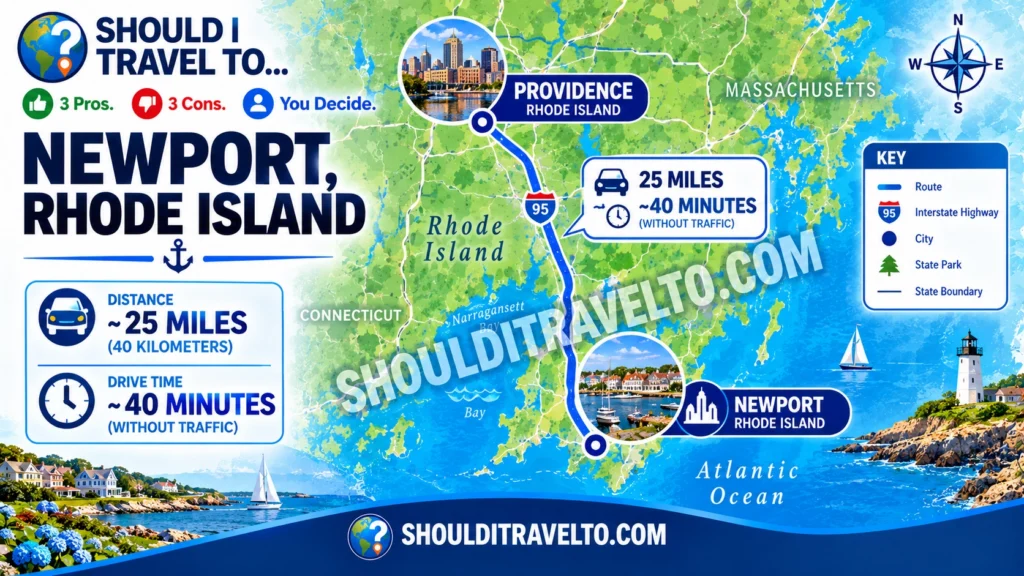
The city sits at the southern end of Aquidneck Island in Narragansett Bay, off Rhode Island’s mainland. It’s in southern New England, south of Providence and within driving distance of Boston. It’s also a reasonable option for travelers building a larger New England itinerary around Boston, Providence, or the Rhode Island coast.
That location matters.
Newport is surrounded by water, but it isn’t an isolated island destination that requires a ferry to reach. Visitors can drive onto Aquidneck Island via bridges, and the historic downtown, harbor, and major mansion attractions form a relatively compact visitor area.
There’s another misconception.
The mansions are a major attraction, but they represent only one chapter of the city’s history. Newport was founded in 1639 and became an important colonial seaport. Its history includes maritime trade, skilled craftspeople, religious diversity, the American Revolution, and the growth of sailing and yachting culture.
Travelers can enjoy historic architecture, restaurants, sailing, beaches, cultural attractions, and coastal scenery.
The Biggest Mistake First-Time Visitors Make
The biggest mistake first-time visitors make in Newport is treating it as a checklist of mansions and waterfront attractions.
Travelers should visit:
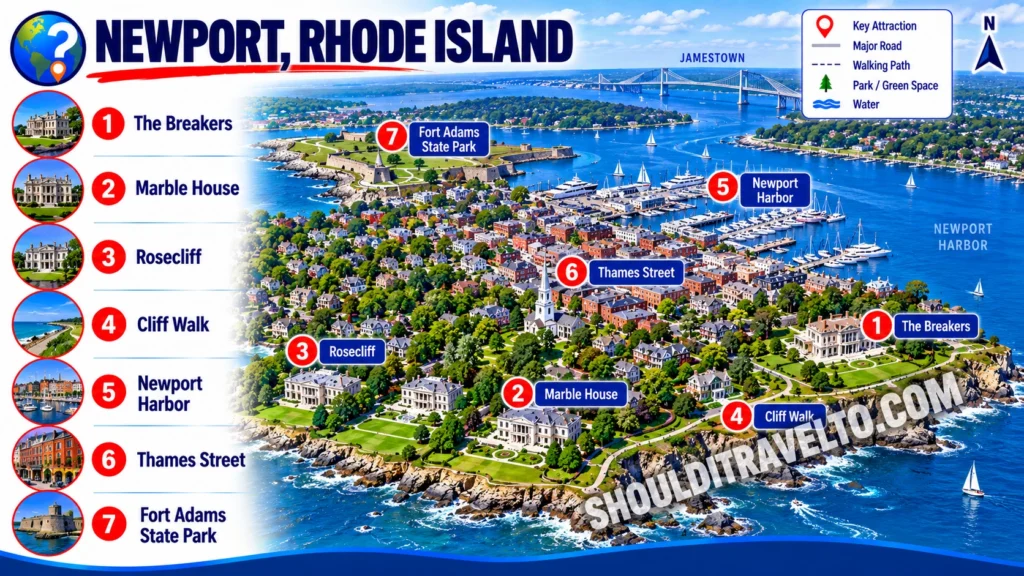
- The Breakers and other historic mansions
- The Cliff Walk
- Newport Harbor and the historic waterfront
- Ocean Drive
- Fort Adams State Park
- The International Tennis Hall of Fame
They can also experience the city between attractions.
Tour a mansion in the morning, walk along the coast in the afternoon, explore downtown shops and historic streets, and finish with seafood or dinner overlooking the harbor.
You could also take a sailing excursion or simply watch the boats move through the water.
Newport is compact enough to make a short visit rewarding, but it’s better when you don’t rush from one attraction to the next.
What’s the Biggest Difference Between Newport and Other New England Destinations?
Newport offers a combination that few other New England destinations replicate: Gilded Age grandeur beside an active sailing harbor and dramatic Atlantic coastline.
Boston is about major-city attractions, Revolutionary history, museums, and walkable neighborhoods.
Coastal Maine offers rugged shorelines, lighthouses, fishing communities, and access to places like Acadia National Park.
Vermont is about mountain towns, rural scenery, and fall foliage.
Newport is about mansions, maritime history, sailing, and coastal elegance.
That identity is visible throughout the city.
The Breakers illustrates the Gilded Age’s wealth and ambition. Newport Harbor connects the city to its maritime past and present. The Cliff Walk combines public coastal access with views of the ocean and the grounds of historic estates.
3 Pros and 3 Cons of Visiting Newport, Rhode Island
Newport can be an excellent coastal getaway, but its strengths are specific: history, architecture, sailing, and seaside scenery.
The 3 Biggest Pros of Traveling to Newport
1. Newport Offers an Extraordinary Window Into the Gilded Age
Newport’s mansions are among its most distinctive attractions.
During the late 19th and early 20th centuries, wealthy American families built elaborate summer residences in Newport. These estates were designed to display wealth, artistic taste, and social standing during a period of dramatic economic growth and inequality.
The Breakers, associated with the Vanderbilt family, is the best-known example. Its scale and elaborate interiors make it feel more like a European palace than a typical American home.
Other mansions, including Marble House, The Elms, and Rosecliff, offer different architectural styles and stories.
The mansions help explain how America’s industrial wealth transformed leisure, architecture, and social life. Their scale also raises questions about the people and economic systems that supported this privileged world.
For travelers who enjoy architecture, decorative arts, and American social history, this is one of Newport’s biggest advantages.
2. The Coastal Scenery Is Part of the Historic Experience
Newport doesn’t keep its history indoors.
The city’s coastline is a defining feature, and the relationship between the ocean and the mansions is part of what makes the destination unusual.
The Cliff Walk is the clearest example. This approximately 3.5-mile coastal trail combines Atlantic Ocean views with glimpses of historic estates and their grounds.
You can experience Newport’s natural scenery while also seeing how the city’s wealthy summer residents positioned their homes along the shoreline.
Ocean Drive offers another way to experience the coast, with scenic views, historic properties, and changing perspectives across the water.
The harbor adds a different dimension. Boats, marinas, and sailing activity connect Newport’s historic waterfront to its continuing maritime identity.
For travelers who want more than indoor museums and architectural tours, Newport provides a balance of history and outdoor scenery.
Just remember that coastal walks and scenic drives depend on weather and access conditions. Check current conditions before planning your day around a particular section of the shoreline.
3. Newport Has a Distinctive Sailing and Maritime Identity
Newport’s sailing heritage is another reason to visit.
The city became internationally associated with the America’s Cup, hosting the competition from 1930 to 1983. Its harbor and surrounding waters remain closely connected to sailing, yachting, and competitive maritime events.
That heritage gives Newport a different atmosphere than destinations where the waterfront is mainly for restaurants and sightseeing boats.
Here, sailing is part of the city’s identity.
Depending on the season and schedule, visitors can book a sailing excursion, take a harbor cruise, watch boats from the waterfront, or experience a major sailing event.
Newport also offers maritime history, waterfront dining, and attractions connected to sailing and other sports.
For travelers who appreciate the water, Newport delivers more than a pretty view. It offers a destination shaped by its relationship with the sea.
The 3 Biggest Cons of Visiting Newport
Those strengths come with some trade-offs.
1. Newport Can Be a Premium Destination During Popular Travel Periods
Newport’s coastal setting, historic mansions, restaurants, and established resort reputation make it a popular getaway.
During summer and busy weekends, accommodation can be expensive, especially near the waterfront or historic downtown.
Dining, sailing excursions, mansion admissions, and special events can add to the cost.
The value depends on the kind of trip you want.
A visit centered on walking the historic streets, enjoying coastal views, and choosing one or two paid attractions can cost less than a weekend built around a waterfront hotel, multiple mansion tours, and premium dining.
2. The Weather Can Change the Entire Experience
Newport is a coastal New England destination, so the season matters.
Summer is popular for sailing, outdoor dining, beach visits, and coastal walks. But it can also bring crowds, higher prices, and a busier waterfront.
Spring and autumn can offer attractive conditions for exploring historic streets and coastal scenery, although temperatures and weather can vary.
Winter brings a quieter atmosphere, but it also means colder conditions, shorter daylight hours, and fewer opportunities for some outdoor activities. Seasonal hours may affect mansion tours, boat excursions, and other attractions.
The Atlantic setting can also bring wind and changing shoreline conditions.
If the Cliff Walk, sailing, or Ocean Drive is central to your trip, allow some flexibility rather than assuming every outdoor activity will go exactly as planned.
Newport can be rewarding in more than one season, but each season offers a different kind of visit.
3. Newport Has a More Focused Sightseeing Portfolio Than a Major City
Newport offers plenty for a short getaway, but its attractions focus on history, architecture, coastal scenery, sailing, and downtown exploration.
If you prefer a dense urban destination with a huge range of museums, neighborhoods, major attractions, and public transportation, Newport may feel limited after a few days.
That’s not necessarily a weakness.
The city’s scale lets you enjoy a slower trip without constantly traveling between distant attractions.
But if you want a new major landmark every few hours, Boston or another larger city may be a better fit.
You can also pair Newport with Providence or Boston for a more varied New England trip.
The key is to understand Newport’s identity before you decide how long to stay.
The Should I Travel To … Newport, Rhode Island, Scorecard
| Category | Newport |
| Cost / Value | Expensive |
| Weather & Climate | Good |
| Crowds & Tourist Density | Crowded |
| Walkability & Transportation | Car Helpful |
| Things To Do | Very Good |
| Food & Dining | Very Good |
| Tourist Comfort & Safety | Generally Comfortable |
| Culture & Character | Highly Distinctive |
| Cleanliness & Infrastructure | Good |
| Uniqueness | Highly Distinctive |
Cost / Value: Expensive
Newport can be expensive, particularly for waterfront accommodation, popular summer weekends, dining, and paid mansion tours. You can manage costs by choosing your dates carefully and focusing on a few key experiences rather than trying to do everything.
Weather & Climate: Good
Summer suits sailing, coastal walks, and outdoor dining, while spring and autumn can be great for sightseeing. Winter is quieter but colder, and some outdoor or seasonal activities may be limited. The right time to visit depends on whether you prioritize warm-weather activities, fewer crowds, or a quieter historic getaway.
Crowds & Tourist Density: Crowded
Newport is smaller than a major tourist city, but its popularity can make downtown, the waterfront, the mansions, and coastal attractions busy on summer weekends and during major events. Weekdays and shoulder-season dates may offer a more relaxed experience.
Walkability & Transportation: Car Helpful
Historic downtown Newport is walkable, with shops, restaurants, and waterfront attractions relatively close together. However, the mansions, beaches, Ocean Drive, and other attractions are spread across the city and island. A car makes it easier to explore beyond the central visitor area, though parking and traffic can be challenging during busy periods.
Things To Do: Very Good
Newport offers mansion tours, coastal walking, sailing, historic sites, beaches, museums, dining, and scenic drives. It offers plenty for a satisfying weekend or several days, especially if you enjoy history and the outdoors. Travelers who want the breadth of attractions a large city offers may want to add Providence or Boston.
Food & Dining: Very Good
Newport has a strong dining scene, with seafood, waterfront restaurants, cafés, and options ranging from casual meals to upscale dining. The harbor and historic downtown make dining part of the overall experience, although popular restaurants can be busy during peak periods.
Tourist Comfort & Safety: Generally Comfortable
Newport is an established visitor destination with accommodation, restaurants, attractions, and visitor services. As with any destination, use normal precautions with valuables and parking, and plan for coastal conditions when walking or spending time on the water. Some shoreline paths are uneven or exposed, so choose activities that match your comfort and mobility.
Culture & Character: Highly Distinctive
Newport combines colonial-era history, maritime traditions, Gilded Age architecture, sailing culture, and a modern coastal getaway atmosphere. Its historic waterfront and grand estates give it an identity distinct from New England’s larger cities and rural destinations.
Cleanliness & Infrastructure: Good
Newport has established tourism infrastructure and a compact historic visitor area. Conditions and convenience vary by location, and busy-season traffic and parking can affect the experience. Check access information for specific attractions before you go.
Uniqueness: Highly Distinctive
Newport’s mix of grand Gilded Age mansions, an Atlantic coastline, a sailing heritage, and historic streets is hard to replicate elsewhere. Seeing a Vanderbilt mansion, walking along the ocean, and returning to an active sailing harbor define the destination.
Newport Has More History Than You Might Expect
Newport is often associated with mansions, yachts, and summer vacations. But those attractions represent only part of its history.
From Colonial Seaport to Gilded Age Resort
Newport was founded in 1639 and developed into an important colonial seaport. Its harbor supported maritime commerce, and the city became known for skilled craftspeople and a diverse colonial community.
The American Revolution brought major disruption. British occupation from 1776 to 1779 affected the city, and Newport’s role in the conflict forms another chapter in its history.
In the 19th century, Newport developed into a fashionable summer resort. By the Gilded Age, some of America’s wealthiest families were building elaborate seasonal residences along Bellevue Avenue and the coastline.
These homes were often called “summer cottages,” despite their extraordinary scale.
The Breakers, Marble House, The Elms, and Rosecliff became enduring symbols of that period. Today, they help visitors understand the era’s architecture, social life, and economic inequality.
Newport and the Rise of American Sailing
Newport’s maritime identity continued to evolve.
The city hosted the America’s Cup from 1930 to 1983, bringing international attention to its harbor and sailing community.
The surrounding waters remain important for recreational sailing, racing, and maritime events.
This connection between history and the present is one of Newport’s most appealing qualities. The harbor is not just a picturesque setting for photographs. It remains an active part of the city’s life.
When you visit, you can experience that history through waterfront walks, sailing excursions, maritime attractions, and boats moving across Narragansett Bay.
Planning Your Newport Trip
Newport is easy to over-plan if you try to tour every mansion and visit every coastal attraction. Choose a few experiences that interest you most, then leave time to explore downtown and enjoy the water.
Best Things to Do in Newport
Tour The Breakers
The Breakers is Newport’s best-known Gilded Age mansion and an excellent starting point for understanding the city’s architectural identity.
Built for the Vanderbilt family, the mansion showcases the scale and craftsmanship of America’s late-19th-century industrial wealth.
A visit lets you explore the interiors and learn about the people who built and lived in these extraordinary residences.
Check the official operating schedule, admission details, and tour options before visiting.
Explore Other Newport Mansions
If you want to go beyond The Breakers, consider Marble House, The Elms, or Rosecliff.
Each property offers a different perspective on the period’s architecture, decorative arts, and social history.
You don’t need to visit all of them. One or two thoughtfully chosen tours may be enough for a short visit, leaving more time for the coastline and historic downtown.
Walk the Cliff Walk
The Cliff Walk is one of Newport’s signature experiences.
This coastal route offers views of the Atlantic Ocean, rocky shoreline, and the grounds of several Gilded Age estates. It connects the natural setting with the architectural history that makes Newport distinctive.
The full route is about 3.5 miles and can take two hours or more, depending on your pace and how many stops you make. Sections vary in surface and difficulty, so choose the portion that matches your abilities and plans.
Check current conditions before you go. Parts of the Cliff Walk have experienced structural damage and detours. Confirm the latest access information with the City of Newport rather than assuming the entire route is open.
Explore Historic Downtown and the Waterfront
Downtown Newport offers a different view of the city, away from the grand estates.
Explore the historic streets, browse local shops, visit galleries, and walk around the waterfront. Thames Street and the surrounding area offer plenty of places to eat, shop, and experience Newport’s maritime atmosphere.
The waterfront is also a good place to appreciate the city’s relationship with the harbor. Depending on the time of year, you may see recreational boats, sailing activity, and visitors preparing for excursions.
Allow time to explore without a strict schedule. Newport’s appeal lies in the mix of historic buildings, waterfront views, and small discoveries along the way.
Drive Ocean Drive
Ocean Drive offers another way to experience Newport’s coastline.
The scenic route passes coastal landscapes, waterfront views, and historic properties. It is particularly useful if you want to see more of Newport beyond the walkable downtown area.
You can combine the drive with stops at suitable viewpoints and coastal areas, but be mindful of parking restrictions, private property, and current access rules.
Ocean Drive is less about ticking off attractions and more about seeing how the city meets the Atlantic.
Visit Fort Adams State Park
Fort Adams provides a different perspective on Newport’s history and harbor.
The fort and surrounding park connect military history with coastal scenery and views across the water. Depending on the season, visitors may also find nearby events and outdoor activities.
Check tour availability, park access, and the event calendar before making it a centerpiece of your visit.
Explore the International Tennis Hall of Fame
Newport’s history extends beyond sailing and mansions.
The International Tennis Hall of Fame connects the city to the development of tennis in the United States and offers a different cultural attraction for sports enthusiasts.
It’s a useful addition if you want to balance architecture and coastal scenery with a visit focused on sports history.
Experience Newport on the Water
If sailing is part of the reason you’re visiting, consider a sailing excursion or harbor cruise.
Seeing Newport from the water provides a different perspective on the harbor, shoreline, and historic city. Available options vary by season and operator, so check schedules and conditions before booking.
You don’t need to be an experienced sailor to enjoy it.
For some visitors, time on the water is what makes Newport feel different from a conventional historic-city weekend.
Worth the Detour: Providence, Rhode Island
Pair Newport with Providence if you want a more urban experience alongside your coastal getaway.
Providence offers a different mix of restaurants, arts, cultural attractions, and city neighborhoods. It also gives you another perspective on Rhode Island beyond its best-known coastal destination.
The two cities complement each other:
- Newport: Gilded Age mansions, sailing, coastal scenery, and historic waterfront streets.
- Providence: City culture, restaurants, arts, and urban neighborhoods.
If you have enough time, combining the two gives you a broader picture of Rhode Island without requiring a multi-state road trip.
Should You Combine Newport and Boston?
Yes, particularly if you’re traveling to New England for the first time.
Boston and Newport offer different experiences that complement each other.
Boston gives you major-city attractions, museums, neighborhoods, and Revolutionary War history. Newport offers a smaller-scale coastal destination centered on mansions, sailing, and ocean views.
Boston gives you the city. Newport gives you the coast.
The two are close enough to be reasonable partners on a wider New England itinerary, although actual driving times depend on traffic and your route. You can also plan transportation between them without assuming you need a car for the entire vacation.
If you combine the destinations, give each enough time. Newport is more rewarding when you can enjoy its coastal setting rather than rushing through it as a brief stop.
How Many Days Do You Need in Newport?
Two to three days works well for many first-time visitors. That gives you time for a mansion tour, the waterfront, coastal scenery, and a few additional attractions without rushing.
| Stay | What it allows |
| 1 day | One mansion, a walk through downtown, and a short coastal visit |
| 2 days | Add the Cliff Walk or Ocean Drive, plus time for the harbor and dining |
| 3 days | A more balanced first visit with another mansion, a sailing experience, or Fort Adams |
| 4–5 days | Add Providence, more coastal exploration, beaches, or a slower-paced getaway |
The right length depends on your interests.
Architecture enthusiasts may want to tour several mansions. Sailing fans may prefer to schedule time on the water. Travelers who mainly want coastal scenery and historic streets may be satisfied with a shorter visit.
The goal isn’t to stay longer just to see more attractions. It’s to give yourself enough time to enjoy Newport’s particular combination of history and coastline.
Best Time to Visit Newport
Newport is a seasonal destination, and the best time to visit depends on the experience you want.
Summer is the most natural choice for sailing, outdoor dining, coastal walks, and beach activities. It also brings greater demand, busier attractions, and potentially higher accommodation costs.
Late spring and early autumn can be appealing for mansion tours, exploring historic downtown, and enjoying coastal scenery. Conditions vary, so plan for changing temperatures and check seasonal activity schedules.
Autumn offers a quieter coastal atmosphere for some travelers, although weekends and special events can still attract crowds.
Winter can be a different kind of visit, with fewer visitors at some attractions and a more subdued seaside atmosphere. However, cold and wind can limit outdoor activities, and some tours or businesses may have reduced seasonal schedules.
For most first-time visitors who want to experience Newport’s full mix of outdoor and historic attractions, late spring through early autumn is a practical starting point. Choose specific dates based on accommodation prices, event schedules, and the activities you most want to enjoy.
Who Should Visit Newport, Rhode Island?
Newport makes the most sense for travelers who want:
- Gilded Age mansions and American architectural history
- Sailing and maritime heritage
- Atlantic Ocean views and coastal walks
- Historic streets and a walkable downtown
- Seafood, waterfront dining, and local restaurants
- A romantic weekend or couples getaway
- A short New England coastal vacation
- A destination that combines history with outdoor scenery
- A stop that complements Boston or Providence
It is especially appealing if you want a destination with a strong identity rather than a long list of unrelated attractions.
You can build a trip around history, architecture, sailing, or the coastline—or combine all four.
Newport may be less appealing if you want:
- A budget-first vacation during peak summer
- A large city with extensive museums, nightlife, and public transportation
- A beach vacation centered on reliably warm swimming conditions
- A trip with a huge number of major attractions spread across many neighborhoods
- A destination where you can ignore the weather and still enjoy every activity
- A fully car-free vacation that includes many attractions outside downtown
- A quiet visit during major summer weekends or popular events
In those cases, another New England destination may be a better fit.
Newport vs. Boston
The biggest difference between Newport and Boston is the kind of history and atmosphere you experience.
Choose Boston for American Revolutionary sites, landmarks, museums, city neighborhoods, food, and a broader urban vacation.
Choose Newport for Gilded Age mansions, sailing heritage, coastal scenery, and a smaller historic destination.
Boston asks: Which neighborhood, museum, or landmark should we explore next?
Newport asks: Which mansion, coastal walk, or harbor experience do we want to enjoy?
If you have enough time, they complement each other well. If you must choose one, start with the experience that matters most to you.
The Decision Is Yours
Newport, Rhode Island, is worth visiting if you want a New England coastal getaway built around Gilded Age mansions, sailing, historic architecture, and Atlantic views.
Tour The Breakers, walk the coast, explore the historic waterfront, and watch sailboats move across the harbor, all in a destination whose history stretches from colonial maritime commerce to the Gilded Age and modern sailing culture.
If you want a destination where American history and coastal scenery come together, Newport is one of New England’s most distinctive choices.
Choose Newport for the mansions, the harbor, and the coast.
Choose the right season, leave time to explore, and don’t try to see everything in one day.
3 Pros. 3 Cons. You Decide.
Newport, Rhode Island, Frequently Asked Questions
Is Newport, Rhode Island, worth visiting?
Yes, if you enjoy Gilded Age mansions, American history, sailing, coastal scenery, and historic downtowns. It works especially well as a weekend getaway or part of a broader New England trip. Travelers looking for a large city or a low-cost summer beach vacation may prefer another destination.
What is Newport, Rhode Island, famous for?
Newport is best known for its Gilded Age mansions, including The Breakers, its sailing heritage, the Cliff Walk, its historic waterfront, and its coastal scenery. The city also has colonial-era history and a long connection to maritime commerce.
Where is Newport, Rhode Island?
Newport sits at the southern end of Aquidneck Island in Narragansett Bay, southern Rhode Island. It lies south of Providence and is within driving distance of Boston. Bridges connect the city to the mainland.
How many days do you need in Newport?
Two to three days is a good starting point for most first-time visitors. That gives you time to tour a mansion, enjoy coastal scenery, explore downtown, and do other activities like sailing or visiting Fort Adams. A one-day visit is possible, but you’ll need to choose a few priorities.
Do you need a car in Newport?
Not necessarily if you stay near historic downtown and focus on nearby attractions. Walking works well for exploring central Newport. A car helps you reach farther-apart attractions, including parts of Ocean Drive, beaches, and other areas of Aquidneck Island. Be mindful of parking and traffic during busy periods.
What is the best time to visit Newport?
Late spring through early autumn is a practical starting point for visitors who want to combine mansion tours, coastal walks, sailing, and outdoor dining. Summer offers the fullest warm-weather experience but can be crowded and expensive. Spring, autumn, and winter each offer a distinct atmosphere and come with seasonal limitations.
Can you visit The Breakers and the Cliff Walk on the same day?
Yes, many visitors combine a mansion tour with a portion of the Cliff Walk. Allow enough time for the mansion, walking, and transportation between locations. Check current Cliff Walk access and detours before planning your route.
Is Newport a good destination for a New England road trip?
Yes. Newport pairs well with Providence and Boston, offering coastal scenery, historic mansions, city culture, and American history. It can also fit into a broader Rhode Island coastal itinerary.