

Should You Visit Washington, DC, for the National Cherry Blossom Festival?
Quick Answer
Yes, you should travel to Washington, DC, for the National Cherry Blossom Festival if you want to experience one of America’s most recognizable spring celebrations while exploring the nation’s capital.
Each spring, Washington’s cherry trees produce a spectacular display of blossoms around the Tidal Basin, with the Jefferson Memorial, Washington Monument, and other historic landmarks providing a setting unlike almost anywhere else in the United States.
The National Cherry Blossom Festival adds cultural performances, community celebrations, a parade, and other activities inspired by the longstanding friendship between the United States and Japan.
But the blossoms are only part of the appeal.
Washington, DC, offers Smithsonian museums, national monuments, historic neighborhoods, restaurants, and cultural attractions that can turn a cherry blossom trip into a complete spring vacation.
There is one important complication. The festival calendar is predictable, but peak bloom is not.
Cherry blossom timing depends on weather conditions, and the most impressive displays may occur before or after your scheduled visit. Popular viewing areas can also become extremely crowded.
The question isn’t simply whether Washington’s cherry blossoms are worth seeing.
The better question is whether you want to experience Washington, DC, in spring, with the cherry blossoms and festival as the centerpiece of a broader trip.

What Makes Washington, DC’s National Cherry Blossom Festival Different?
The National Cherry Blossom Festival is more than an opportunity to photograph flowering trees.
It celebrates the arrival of spring, Washington’s historic landscape, and the friendship between the United States and Japan.
The celebration traces its origins to Japan’s 1912 gift of cherry trees to the United States.
Over time, those trees became one of Washington’s most recognizable seasonal attractions.
Today, the festival brings together cultural performances, community events, art, family activities, and celebrations throughout the city.
The setting is a major part of what makes the experience special.
Around the Tidal Basin, pale pink and white blossoms frame the Jefferson Memorial, with views toward the Washington Monument and other landmarks.
The trees transform a landscape already associated with American history into one of the country’s most photographed spring destinations.
But the festival isn’t limited to the Tidal Basin.
Cherry trees also grow in East Potomac Park and near the Washington Monument, while festival activities take place at multiple locations throughout the city.
Visitors can combine blossom viewing with museums, monuments, historic neighborhoods, and restaurants.
That creates an experience unlike a festival held at a single stadium, park, or event venue.
The combination is what makes the trip distinctive: Cherry blossoms + national monuments + Japanese American cultural connections + springtime Washington, DC.
Unlike a destination where the event is the only attraction, Washington offers enough sightseeing to justify a longer vacation, even if the blossoms don’t reach peak bloom during your stay.
The 3 Biggest Pros of Visiting Washington, DC, for the National Cherry Blossom Festival
Washington’s cherry blossoms are an extraordinary seasonal attraction, but the city’s museums, monuments, and cultural experiences give the festival a much broader vacation appeal.
1. You Can Experience One of America’s Most Beautiful Spring Traditions
Cherry blossoms give travelers a specific reason to visit Washington in spring.
Rather than seeing the National Mall and monuments in their usual setting, you can experience them surrounded by flowering trees.
The Tidal Basin is the centerpiece.
Its waterside paths offer views of the Jefferson Memorial, with cherry blossoms creating a striking contrast against the city’s monumental architecture.
For photographers, couples, families, and travelers who enjoy seasonal scenery, the experience can be memorable.
The blossoms also have cultural significance.
Their history is closely connected to the relationship between Japan and the United States, and the festival celebrates that connection through cultural programming and community activities.
The experience isn’t limited to taking photographs.
Walking beneath the blossoms, exploring the surrounding monuments, and enjoying the arrival of spring are part of the appeal.
If you enjoy destinations where nature and history come together, Washington during cherry blossom season is particularly compelling.
2. You Can Combine the Festival With Washington’s Museums and Monuments
Washington, DC, is a major destination even without the cherry blossoms.
The National Mall includes some of America’s most recognizable monuments and memorials.
The Smithsonian Institution offers an extraordinary collection of museums, many with free general admission.
Visitors can explore American history, art, science, aviation, natural history, and culture.
The city’s neighborhoods also provide restaurants, historic architecture, shopping, and experiences beyond the federal landmarks.
That variety makes Washington especially appealing for travelers coming from outside the region.
You can spend a morning viewing cherry blossoms around the Tidal Basin, visit a museum in the afternoon, and explore a neighborhood restaurant in the evening.
Another day might include the Lincoln Memorial, National World War II Memorial, and other landmarks.
This flexibility matters because cherry blossoms depend on the weather.
If rain or wind makes outdoor viewing less appealing, Washington offers substantial indoor alternatives.
And if you miss peak bloom entirely, the city still has enough attractions to make the vacation worthwhile.
3. The Festival Offers More Than Cherry Blossom Viewing
The National Cherry Blossom Festival isn’t simply a period when trees are in bloom.
It includes a calendar of events and cultural activities that give visitors additional reasons to travel.
Depending on the annual schedule, these can include the opening ceremony, Blossom Kite Festival, National Cherry Blossom Festival Parade, Petalpalooza, performances, and family-friendly activities.
The festival celebrates Japanese culture and the broader relationship between Japan and the United States while also bringing together local communities and visitors.
For families, cultural performances and outdoor celebrations can add variety to a sightseeing itinerary.
For couples and adults, the festival offers opportunities to enjoy seasonal activities alongside museums, dining, and neighborhood exploration.
And for travelers who miss the exact peak bloom period, a scheduled festival event may still provide a meaningful centerpiece for the trip.
The trade-off is that these events don’t necessarily occur on the same dates as peak bloom.
Some activities may require tickets, and others may be crowded or weather-dependent.
But the festival offers several ways to experience Washington’s spring celebration beyond the flowering trees.
The 3 Biggest Cons of Visiting Washington, DC, for the National Cherry Blossom Festival
The cherry blossoms make Washington an appealing spring destination, but their popularity and unpredictable timing create challenges.
1. Peak Bloom Is Difficult to Predict
The biggest drawback is also the most important planning consideration. Cherry blossoms don’t follow a fixed calendar.
The National Park Service monitors the trees and announces peak bloom forecasts as spring approaches.
Peak bloom occurs when approximately 70 percent of the Yoshino cherry blossoms are open.
But the timing changes each year.
Warmer weather can accelerate blooming. Cooler temperatures can delay it.
Wind, rain, and other conditions can shorten the display.
That means booking a trip months in advance involves uncertainty.
You might arrive before the blossoms open. You might arrive during an extraordinary display. Or you might visit after many petals have fallen.
The National Cherry Blossom Festival spans several weeks to accommodate the broader spring celebration, but it cannot guarantee peak bloom throughout the festival.
If seeing the blossoms at their absolute best is your only reason for traveling, that uncertainty is a significant drawback.
A better approach is to plan a Washington vacation you’ll enjoy even if the timing isn’t perfect.
2. The Tidal Basin Can Become Extremely Crowded
Washington’s cherry blossoms attract large crowds.
During favorable bloom conditions, the Tidal Basin and surrounding pathways can become crowded with tourists, photographers, families, and local residents.
Popular viewpoints near the Jefferson Memorial may be particularly busy.
The experience can differ greatly from the peaceful photographs often used to promote cherry blossom season.
You may encounter crowded walkways, limited opportunities for unobstructed photographs, and delays moving between popular areas.
Traffic and parking near the National Mall can also be difficult. Large festival events add another source of demand.
If you prefer quiet gardens and uncrowded walking paths, the most popular blossom locations may not match what you’re imagining.
Early morning visits can sometimes offer a calmer atmosphere, although they don’t guarantee solitude.
You can also explore other cherry blossom locations, including East Potomac Park, but conditions and crowd levels vary.
3. Spring Weather and Travel Costs Can Complicate the Trip
Spring is generally an appealing season to visit Washington, but the weather can be unpredictable.
Cool mornings, warm afternoons, rain, and windy conditions are all possible. Those conditions can affect blossom viewing, outdoor events, and sightseeing.
Popular travel periods may also increase hotel demand.
Accommodation near the National Mall, downtown, and convenient Metro stations can come at a premium.
Restaurants, tours, transportation, and selected festival activities may add to the overall cost.
Washington does offer an important advantage: many monuments and Smithsonian museums are free to visit.
But a free attraction doesn’t necessarily mean an inexpensive vacation. Hotels, travel, meals, and transportation can still make a cherry blossom trip costly.
The best approach is to calculate your total vacation budget rather than focusing only on festival admission.
What Is the National Cherry Blossom Festival Like?
The National Cherry Blossom Festival combines a natural spring spectacle with cultural celebrations and organized events throughout Washington.
For many visitors, the central experience is walking around the Tidal Basin.
Cherry trees line portions of the water, framing views of the Jefferson Memorial and nearby monuments.
When conditions are favorable, the blossoms create a canopy of pale pink and white flowers.
The atmosphere can be beautiful, festive, and crowded. Visitors take photographs, explore the monuments, and walk along the surrounding paths.
But the experience changes depending on when you arrive.
Before peak bloom, many buds may still be closed. During peak bloom, the display can be spectacular.
Afterward, falling petals can create another memorable scene, though wind and rain may quickly change the trees’ appearance.
The festival adds a separate dimension.
Scheduled events may feature cultural performances, music, art, family activities, a parade, and other celebrations.
Some events take place near the National Mall, while others are held elsewhere in the city.
The important distinction is that the National Cherry Blossom Festival isn’t a single event with one fixed viewing location.
It’s a multiweek celebration spread across Washington, with the blossoms providing the seasonal identity.
You can attend festival events without seeing peak bloom. You can also enjoy the blossoms without attending a scheduled festival activity.
For the most complete experience, try to include both.
Where Does the National Cherry Blossom Festival Take Place?
The National Cherry Blossom Festival takes place throughout Washington, DC, rather than at one central venue.
However, the Tidal Basin is the most famous location for cherry blossom viewing.
The trees surrounding the basin create iconic views of the Jefferson Memorial and other landmarks.
| Location | Why Visit |
| Tidal Basin | Washington’s iconic cherry blossom scenery and Jefferson Memorial views |
| East Potomac Park / Hains Point | Additional cherry trees and waterfront scenery |
| Washington Monument Grounds | Cherry blossoms near one of the city’s best-known landmarks |
| National Mall | Museums, monuments, and sightseeing near blossom-viewing areas |
| Festival event venues | Scheduled cultural performances, parade activities, and other celebrations |
Not all festival events take place beside the cherry trees. The parade, kite festival, cultural performances, and other activities may use different venues and routes.
Check the official festival schedule before planning your itinerary.
When Is the National Cherry Blossom Festival?
The National Cherry Blossom Festival generally takes place in late March and early April, with a multiday schedule designed to celebrate the arrival of spring.
However, festival dates and peak bloom dates differ. The festival calendar is established in advance. Peak bloom depends on weather and cherry tree development.
Historically, peak bloom has often occurred around late March or early April, but it can arrive earlier or later.
The National Park Service monitors the blossoms and publishes forecasts as the season approaches.
Because predictions become more accurate closer to bloom, travelers booking far in advance should stay flexible.
| What to Check | Why It Matters |
| Official festival dates | Determines which organized events may occur during your visit |
| National Park Service peak bloom forecast | Helps estimate when the trees may be at their best |
| Opening ceremony | May provide a cultural centerpiece for the trip |
| Blossom Kite Festival | Offers a popular outdoor spring activity |
| National Cherry Blossom Festival Parade | Provides a scheduled celebration independent of exact bloom timing |
| Petalpalooza and other events | Adds entertainment and activities beyond blossom viewing |
| Weather forecast | Rain, wind, and temperature affect comfort and blossoms |
| Hotel availability | Popular dates can increase demand and prices |
For the latest schedules and bloom forecasts, consult the National Cherry Blossom Festival and National Park Service websites before making nonrefundable travel arrangements.
Planning Your Washington, DC, Cherry Blossom Festival Trip
Where Should You See the Cherry Blossoms?
The Tidal Basin is the classic choice.
If this is your first cherry blossom visit to Washington, it’s the location most closely associated with the experience.
The Jefferson Memorial, water, and flowering trees create the city’s most recognizable spring views.
However, it’s also one of the busiest areas.
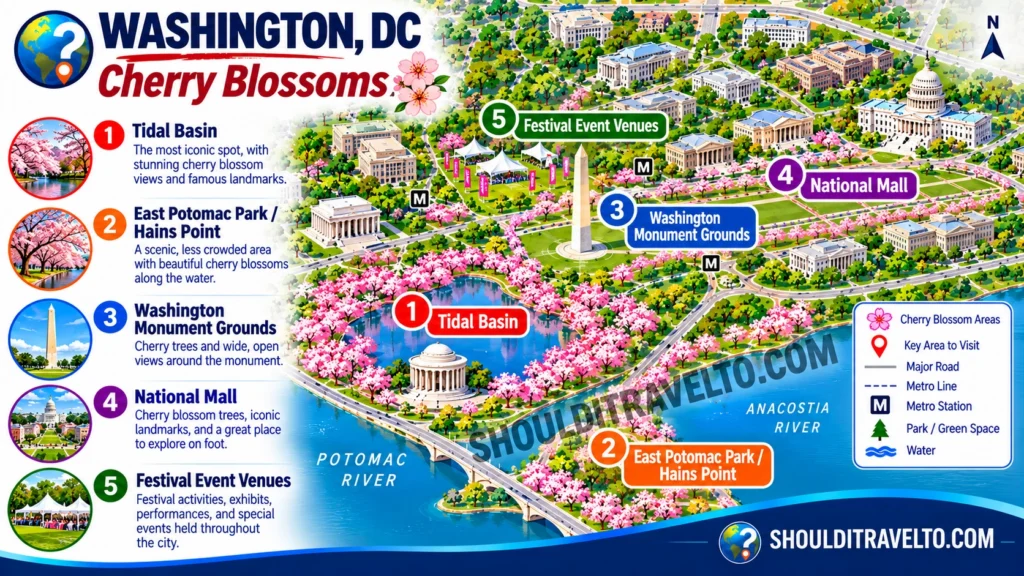
For a different perspective, consider East Potomac Park or the cherry trees near the Washington Monument.
These locations offer more blossom-viewing opportunities, though they can also get crowded. The best location depends on your priorities.
For iconic photographs, prioritize the Tidal Basin.
For a broader walk, consider combining the Tidal Basin with nearby monuments.
Travelers who want a more varied experience can explore additional cherry tree locations during their stay.
Whatever you choose, avoid treating the blossoms as a quick stop between unrelated attractions.
Allow time to walk, enjoy the setting, and appreciate the scenery.
How Many Days Do You Need?
The ideal trip length depends on whether you want to focus on the cherry blossoms or explore Washington more broadly.
1 Day: Cherry Blossoms and the National Mall
A one-day visit can work for travelers who live within a reasonable distance. Focus on the Tidal Basin, Jefferson Memorial, and selected nearby monuments.
You might add one museum if time allows. But expect a lot of walking and potentially large crowds.
This is best for visitors who want a focused spring outing rather than a complete Washington vacation.
2 Days: Cherry Blossoms + Washington’s Landmarks
Two days give you more flexibility. Spend one day exploring the Tidal Basin, monuments, and blossom-viewing areas. Use the second day for Smithsonian museums, the National Mall, or a scheduled festival event.
This is a practical option for a short weekend getaway.
3 Days: The Best First-Time Balance
Three days is an excellent starting point for a first-time visit to Washington. You can enjoy the cherry blossoms without rushing through the city’s other attractions.
Spend one day around the Tidal Basin and monuments. Another day exploring museums and national history. And a third day attending festival activities or discovering neighborhoods.
This also provides some flexibility if weather conditions change.
4–5 Days: A More Complete Spring Vacation
Four or five days allow you to explore Washington beyond the National Mall.
You can visit additional museums, historic neighborhoods, restaurants, gardens, and nearby destinations. You may also be able to include multiple festival events if their schedules align.
For travelers coming from farther away, this longer trip can make the journey more worthwhile.
Three to four days offers the best balance for most first-time visitors.
What Else Should You Do in Washington, DC?
One of the biggest mistakes is visiting Washington for the cherry blossoms without exploring the city itself.
The National Cherry Blossom Festival is an excellent reason to travel, but Washington offers attractions worth seeing year-round.
Explore the National Mall
The National Mall is home to some of America’s most recognizable monuments and memorials.
Visit the Lincoln Memorial, Washington Monument, National World War II Memorial, and other landmarks.
Many are within walking distance of the Tidal Basin, although the distances can be greater than expected.
Visit the Smithsonian Museums
The Smithsonian museums are one of Washington’s greatest advantages.
Explore the National Museum of American History, the National Museum of Natural History, the National Air and Space Museum, the National Museum of African American History and Culture, or the National Gallery of Art.
Many offer free general admission, although selected museums may require timed-entry passes.
They also provide excellent alternatives during rainy weather.
Explore Georgetown
Georgetown offers historic streets, shops, restaurants, and waterfront scenery. It’s a useful contrast to the monumental architecture of the National Mall.
Spend time walking through the neighborhood, enjoying a meal, or exploring the waterfront.
Visit Capitol Hill
Capitol Hill offers another perspective on Washington. Explore the area around the US Capitol, Library of Congress, and surrounding historic streets.
Check tour arrangements and security requirements before visiting government buildings. Discover Washington’s Neighborhoods
Washington is more than federal monuments.
Dupont Circle, Adams Morgan, Penn Quarter, and other neighborhoods offer restaurants, shops, architecture, and cultural experiences.
Exploring them can make the vacation feel like a visit to a living city rather than only a tour of national landmarks.
Add Another Historical Destination
If you have additional time, consider Mount Vernon in nearby Virginia.
George Washington’s estate provides a direct connection to presidential history and can complement a visit to the nation’s capital.
It requires additional transportation and planning, but it can be particularly worthwhile for history enthusiasts.
Where Should You Stay?
Your hotel location can affect how easy the cherry blossom trip feels.
The most convenient accommodation isn’t necessarily the hotel closest to the Tidal Basin.
Because Washington’s attractions are spread across several areas, access to Metro stations and your other sightseeing priorities can be just as important.
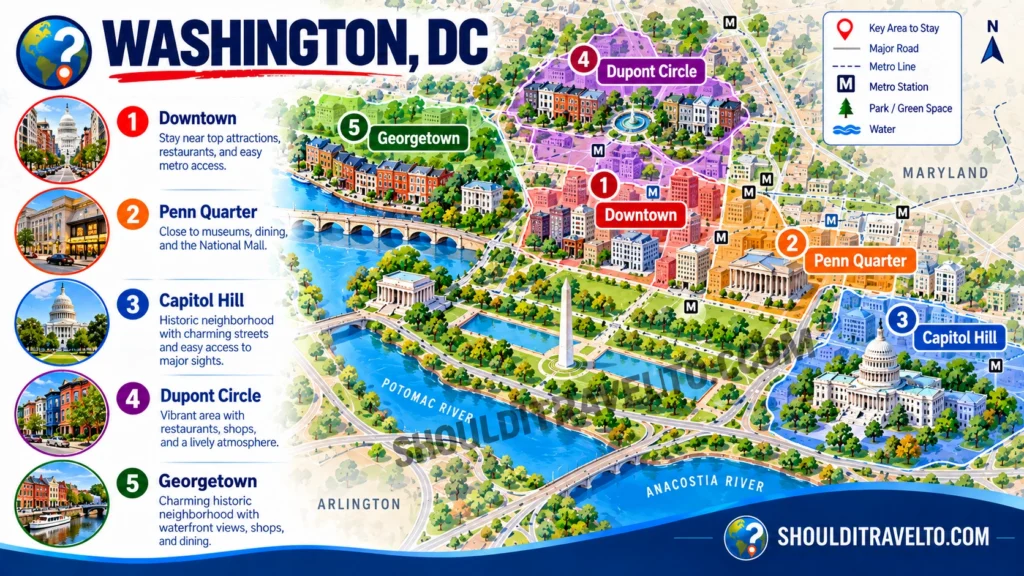
National Mall and Downtown: Best for First-Time Visitors
Staying downtown can provide convenient access to museums, monuments, restaurants, and public transportation.
Some hotels are within walking distance of major attractions. But popular locations may command premium rates during cherry blossom season.
Penn Quarter: Best for Museums and Dining
Penn Quarter offers restaurants, entertainment, museums, and Metro access. It’s a practical choice for travelers who want to explore the city beyond the blossoms.
Capitol Hill: Best for History
Capitol Hill can appeal to travelers interested in government buildings, historic streets, and a neighborhood atmosphere. Transportation planning is still important if you intend to visit the Tidal Basin.
Dupont Circle: Best for Neighborhood Atmosphere
Dupont Circle offers restaurants, historic architecture, and a more residential city experience. It can be appealing if you want to balance sightseeing with time in Washington’s neighborhoods.
Arlington, Virginia: An Alternative Base
Selected hotels in Arlington may provide convenient Metro access to Washington. Depending on the property and dates, they can be worth comparing with downtown accommodation.
However, don’t assume that staying outside the District automatically means lower overall costs.
Consider transportation time, hotel rates, and your itinerary.
Getting Around During the National Cherry Blossom Festival
Washington is one of America’s better major cities for visitors who prefer not to rent a car.
The Metrorail system connects many major sightseeing areas, neighborhoods, and transportation hubs.
For cherry blossom viewing, the Smithsonian Metro station is a common starting point for walking to the National Mall and Tidal Basin.
Other stations may be useful depending on your hotel and itinerary. However, Metro doesn’t eliminate the need for walking.
Reaching the Tidal Basin and moving between monuments can involve substantial distances.
Festival crowds and special events may also affect pedestrian routes, road access, and transportation demand.
Driving directly to the Tidal Basin is generally less convenient during busy blossom periods.
Parking is limited, and temporary restrictions may apply.
Before traveling:
- Check the current WMATA Metrorail schedule.
- Identify the best station for your viewing location.
- Allow extra time for walking and crowds.
- Check event-specific road closures.
- Consider visiting popular areas early in the day.
- Use comfortable walking shoes.
- Build flexibility into your itinerary.
For most visitors staying near Metro, a rental car isn’t necessary for the main cherry blossom experience.
What Else Should You Know Before You Go?
A successful cherry blossom trip requires a little more flexibility than many other seasonal vacations.
Don’t Confuse Festival Dates With Peak Bloom
The festival follows a set schedule. The blossoms follow nature. You may experience one without the other.
Monitor the National Park Service Bloom Forecast
The National Park Service provides updates as the season approaches. Check its official bloom information before traveling rather than relying on a prediction made months earlier.
Visit Popular Areas Early
The Tidal Basin can become very crowded during favorable bloom conditions. An early morning visit may offer a more comfortable experience and better photography opportunities.
Prepare for Changing Weather
Bring layers and be prepared for cool temperatures, rain, and wind. Spring weather in Washington can change quickly.
Don’t Damage the Cherry Trees
Enjoy the blossoms without climbing trees, breaking branches, or picking flowers. The trees are part of a protected historic landscape and should be treated with care.
Check Museum Reservations
Many Smithsonian museums offer free admission, but some require timed-entry passes. Check requirements before building your itinerary.
Leave Room for Washington Beyond the Blossoms
If peak bloom doesn’t align with your trip, Washington’s museums, monuments, restaurants, and neighborhoods can still make the vacation worthwhile.
That’s one of the strongest reasons to choose the city for a spring getaway.
Who Should Travel to Washington, DC, for the National Cherry Blossom Festival?
Washington is particularly well suited to travelers who want:
- Beautiful spring scenery and seasonal photography
- Iconic cherry blossom views
- National monuments and American history
- Smithsonian museums
- Japanese cultural celebrations and performances
- A family-friendly spring vacation
- A romantic spring city getaway
- Walkable sightseeing and public transportation
- A combination of nature and urban attractions
- A destination with plenty to do beyond the festival
It may be less appealing if you primarily want:
- Guaranteed peak bloom on specific dates
- Quiet, uncrowded nature experiences
- A warm-weather beach vacation
- Minimal walking
- A completely spontaneous trip during a popular travel period
- An inexpensive vacation without advance planning
- A destination where every attraction is concentrated in one small area
Washington is particularly rewarding when you view the cherry blossoms as the highlight of a broader city vacation.
It’s less appealing if your entire trip depends on seeing the trees at their absolute peak on one specific day.
Is the National Cherry Blossom Festival Family-Friendly?
Yes. The National Cherry Blossom Festival can be an excellent family experience.
Children may enjoy the colorful blossoms, outdoor celebrations, cultural performances, kite-flying activities, and festival entertainment.
Washington’s museums also provide outstanding educational opportunities.
Families can combine blossom viewing with the National Museum of Natural History, National Air and Space Museum, National Museum of American History, and other attractions.
Many major museums offer free general admission, which can help balance the cost of accommodation and transportation.
For families with younger children, a shorter morning blossom visit followed by a museum or indoor activity may be more enjoyable than spending the entire day outdoors.
The festival is particularly rewarding for families who enjoy combining seasonal scenery with educational sightseeing.
The Best Washington, DC, Cherry Blossom Trip Isn’t Just About the Blossoms
The easiest mistake is to build the entire vacation around one predicted peak bloom date.
Cherry blossoms are beautiful, but their timing is uncertain.
Instead, think of the National Cherry Blossom Festival as the centerpiece of a spring vacation in Washington.
- Walk around the Tidal Basin.
- Photograph the Jefferson Memorial surrounded by blossoms.
- Explore additional cherry tree locations.
- Attend a festival event if the schedule works.
- Visit Smithsonian museums.
- Explore the National Mall and monuments.
- Enjoy Washington’s neighborhoods and restaurants.
- Leave flexibility for weather and bloom conditions.
You don’t need to do everything.
Choose the experiences that matter most and build a realistic itinerary around them.
The cherry blossoms give you a special reason to visit Washington in spring. The city gives you reasons to enjoy the trip regardless of the exact bloom timing.
That’s when the vacation becomes more than a single seasonal photo opportunity.
The Decision Is Yours
Washington, DC, offers one of America’s most recognizable spring travel experiences and event destinations.
The cherry blossoms surrounding the Tidal Basin create a beautiful setting for the Jefferson Memorial and other national landmarks.
The National Cherry Blossom Festival adds cultural performances, community celebrations, and scheduled events that make the season more than a natural spectacle.
And Washington’s museums, monuments, neighborhoods, and restaurants provide enough attractions to justify a multi-day vacation.
So, should you travel to Washington, DC, for the National Cherry Blossom Festival?
Yes, if you want to combine an iconic spring tradition with American history, museums, cultural experiences, and a visit to the nation’s capital.
Choose the experience first. Then choose the destination.
Explore More Washington, DC
Washington, DC, is worth exploring beyond Thanksgiving. From spring cherry blossoms and presidential history to Christmas celebrations and national commemorations, the capital offers year-round experiences.
Washington, DC, for Holidays, Events & History
- Washington, DC, for Thanksgiving: A history-rich Thanksgiving getaway with national landmarks, quieter sightseeing, and opportunities to reflect on America’s heritage.
- Washington, DC, for Veterans Day: National memorials, Arlington National Cemetery, and military history.
- Spring Break: Educational family vacations and museum sightseeing.
- Summer Vacation: National landmarks, museums, and Independence Day traditions.
- Labor Day Weekend: A three-day getaway focused on history and culture.
- Fall Foliage: Autumn scenery, parks, and historic neighborhoods.
- Christmas: Holiday lights, seasonal traditions, and museums.
- Christmas & New Year’s Eve: An extended winter vacation combining holiday celebrations and sightseeing.
Washington, DC, Compared to Other Cities
- Boston vs. Washington, DC: Revolutionary history vs. national museums and monuments.
- New York City vs. Washington, DC: Entertainment and big-city energy vs. American history and culture.
- Philadelphia vs. Washington, DC: Founding-era landmarks vs. national institutions and memorials.
Explore the Complete Washington, DC, City Guide for attractions, neighborhoods, transportation, costs, and travel planning.
Washington, DC, National Cherry Blossom Festival Frequently Asked Questions
Is Washington, DC, worth visiting for the National Cherry Blossom Festival?
Yes. The festival combines iconic cherry blossom scenery, cultural celebrations, national monuments, and museums. Washington is especially worthwhile for travelers who want a broader spring city vacation rather than a trip focused only on peak bloom.
When is the National Cherry Blossom Festival?
The festival generally takes place in late March and early April. Its dates are announced in advance, but peak bloom varies each year depending on weather conditions. Check the official festival calendar and National Park Service bloom forecasts before planning your trip.
When do Washington’s cherry blossoms reach peak bloom?
Peak bloom often occurs in late March or early April, but the timing changes each year. The National Park Service defines peak bloom as when about 70 percent of the Yoshino cherry blossoms are open. Weather can cause blooms to arrive earlier or later than expected.
Where is the best place to see cherry blossoms in Washington, DC?
The Tidal Basin is the most famous location, offering views of the Jefferson Memorial surrounded by cherry blossoms. East Potomac Park and the Washington Monument grounds also have cherry trees and provide additional viewing opportunities.
Is the National Cherry Blossom Festival free?
Viewing the cherry blossoms around the Tidal Basin and visiting many public monuments is free. The festival includes free public activities, although some special events or reserved experiences may require tickets. Check individual event details before attending.
How many days do you need for the National Cherry Blossom Festival?
Two days can work for a short visit focused on the blossoms and National Mall. Three to four days is a better choice for first-time visitors who want to combine the festival with museums, monuments, neighborhoods, and restaurants.
Is Washington, DC, crowded during cherry blossom season?
Yes, particularly around the Tidal Basin during favorable bloom conditions and on weekends. Popular festival events can also attract substantial crowds. Visiting early, using Metro, and exploring additional cherry blossom locations can help make the experience more manageable.