

Should You Visit San Antonio, Texas, the Alamo City?
Quick Answer
Yes, you should consider visiting San Antonio, Texas, if you want a city with distinctive history, Mexican American culture, excellent food, outdoor attractions, and a famous River Walk that gives downtown a different atmosphere from most major American cities.
San Antonio is best known for the Alamo and the River Walk, but those attractions tell only part of the story.
The city combines Spanish colonial history, the Texas Revolution, Mexican American cultural traditions, military heritage, Tex-Mex food, modern attractions, and the everyday character of a large Texas city.
So the question isn’t simply whether San Antonio has enough to do. It does.
The better question is whether you want a destination where history, regional culture, food, and a relaxed urban vacation come together.
If you want a compact, consistently walkable city, cooler summer weather, or a destination centered primarily on modern skyscrapers and big-city nightlife, San Antonio may not be the right fit.
The city is at its best when you look beyond the Alamo and River Walk without ignoring either one.
The Biggest Mistake First-Time San Antonio Visitors Make
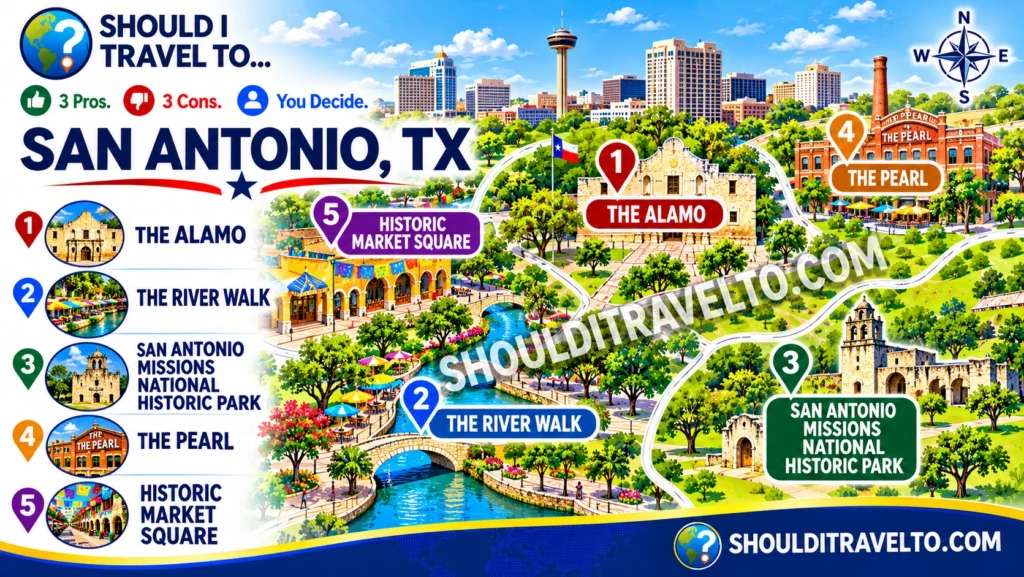
The biggest mistake is thinking San Antonio equals the Alamo and the River Walk.
Those are two of the city’s most recognizable attractions, and both deserve attention. But treating them as the entire destination can leave you with an incomplete understanding of San Antonio.
The Alamo is part of a much larger story about Texas, Mexico, and the development of the American Southwest.
The River Walk is a distinctive urban attraction, but it represents only one part of the city’s cultural and dining scene.
If you spend your entire trip in the downtown tourist district, you may miss:
- The other Spanish colonial missions
- Historic King William and Southtown
- The Pearl and the Museum Reach
- Mexican American history and cultural traditions
- Historic Market Square
- Local restaurants beyond the River Walk
- Art museums and neighborhood galleries
- Parks and gardens
- Family attractions outside downtown
- The city’s military history
San Antonio’s major attractions are not all concentrated in one walkable area.
Downtown is a convenient base for first-time visitors, but a fuller trip requires deciding which other parts of the city deserve your time.
That’s why a good San Antonio itinerary should include at least one experience beyond the Alamo and central River Walk.
Visit the famous attractions. Then explore the city that surrounds them.
What Makes San Antonio Special?
San Antonio is special because its history and culture are layered, not defined by a single industry or attraction.
The city grew out of Spanish colonial settlements and Indigenous communities. Its history later became connected to Mexico, the Texas Revolution, the Republic of Texas, and the development of the United States.
That history remains visible in the city’s missions, architecture, historic sites, food, and cultural traditions.
The Alamo is the best-known symbol of the Texas Revolution. San Antonio Missions National Historical Park provides a broader look at the Spanish colonial mission system and the Indigenous communities connected to it. The five missions associated with the World Heritage designation, the Alamo and the four missions managed by the National Park Service, help tell a story that extends far beyond one battle.
San Antonio’s Mexican American heritage is equally important to understanding the city today.
You can see its influence in the food, markets, festivals, neighborhoods, architecture, and public spaces. Tex-Mex is part of the city’s visitor appeal, but its broader food culture goes well beyond one restaurant category.
Then there is the River Walk.
The downtown section of the San Antonio River Walk creates a pedestrian-oriented setting with restaurants, hotels, shops, bridges, and river-level walkways. It gives the city a distinctive atmosphere, especially in the evening.
But the River Walk is not the whole city.
San Antonio is a large metropolitan area with residential neighborhoods, modern commercial districts, theme parks, museums, military installations, and attractions that require more planning to reach.
That combination gives San Antonio a different personality from other Texas cities.
The Biggest Difference
The biggest difference between San Antonio and many other major American cities is how much of its identity is tied to the meeting of Spanish, Mexican, Indigenous, Texan, and American history.
Visitors can spend the same day:
- Exploring the Alamo
- Walking along the River Walk
- Visiting a Spanish colonial mission
- Eating Tex-Mex food
- Exploring historic neighborhoods
- Visiting the Pearl
- Learning about the city’s military heritage
- Attending a sporting event
- Exploring a museum or garden
- Spending time at a theme park
That variety makes San Antonio more than a historic sightseeing destination.
It can be a history vacation, a food vacation, a family trip, a cultural getaway, or a combination of all four.
The 3 Biggest Pros of Visiting San Antonio
San Antonio’s strongest qualities are its distinctive historical identity, its food and cultural experiences, and its ability to accommodate different kinds of travelers.
1. San Antonio Has an Unusually Rich Historical Identity
San Antonio is one of the strongest American city destinations for travelers who want to explore history across several eras.
The Alamo is the most famous site, but the city’s historical appeal extends well beyond it.
San Antonio Missions National Historical Park preserves four Spanish colonial missions: Concepción, San José, San Juan, and Espada. Together with the Alamo, these sites form a UNESCO World Heritage property.
The missions help explain Spanish colonial settlement, Indigenous communities, religious institutions, agriculture, and the region’s development.
The Alamo introduces a different chapter through the 1836 battle during the Texas Revolution.
You can also explore historic buildings, neighborhoods, museums, and sites associated with San Antonio’s later development.
That gives history-minded travelers several different ways to experience the city.
2. The Food and Cultural Experience Is a Major Part of the Trip
San Antonio’s food scene is one of its defining strengths.
Tex-Mex is the obvious starting point, but the city’s Mexican American cultural heritage influences much more than restaurant menus.
You can explore historic markets, neighborhood restaurants, bakeries, food traditions, and modern dining districts. You can also experience the city’s cultural identity through festivals, public art, historic buildings, and neighborhood businesses.
For first-time visitors, the Riverwalk offers an easy introduction to the city’s restaurant scene. But the restaurants immediately beside the river are only one part of the experience.
Historic Market Square offers a different atmosphere, while the Pearl has become a major destination for restaurants, shopping, and public gathering spaces.
Southtown and the King William Historic District offer another perspective, combining historic architecture, galleries, restaurants, and a neighborhood feel.
That variety makes San Antonio a strong destination for travelers who like to explore a city through food and local culture.
3. San Antonio Works for Several Different Kinds of Vacations
San Antonio is not limited to history enthusiasts or couples looking for a weekend getaway.
It can work for families, food travelers, couples, groups of friends, and travelers who want a mix of sightseeing and relaxation.
Families can combine the Alamo and the missions with the San Antonio Zoo, museums, gardens, and theme parks.
Couples can spend their days exploring historic sites and neighborhoods, then enjoy dinner or an evening walk along the River Walk.
History enthusiasts can build an itinerary around the missions, the Alamo, museums, and the city’s military connections.
Food travelers can focus on Tex-Mex, Mexican American food traditions, local restaurants, and the Pearl.
And if you want a less structured vacation, San Antonio can provide that too. You can explore downtown on foot, stop for a meal, take a river cruise, and spend time in public spaces without scheduling every hour.
The 3 Biggest Cons of Visiting San Antonio
San Antonio has plenty to offer, but the same factors that make it a broad destination also create some practical trade-offs.
1. Summer Heat Can Make Sightseeing Uncomfortable
San Antonio’s warm climate is an advantage for travelers seeking a sunny getaway, but summer heat can be a significant drawback.
June, July, and August can bring very hot conditions, and daytime temperatures can make extended outdoor sightseeing uncomfortable.
This matters because many of San Antonio’s most distinctive attractions take place outdoors.
The missions require time outdoors. The Alamo and historic districts involve a lot of walking. The River Walk is enjoyable on foot, but much of the experience still takes place outside.
Heat can also affect how much you want to accomplish in one day.
Instead of moving between several outdoor attractions from late morning through the afternoon, you may need to start early, take an indoor break, and resume sightseeing later.
Spring and fall can offer more comfortable conditions for walking and exploring. Winter can also be pleasant, although cold fronts and variable weather are possible.
San Antonio can be a great year-round destination, but the season changes what kind of itinerary makes sense.
If you dislike heat or want to spend most of your vacation outdoors, summer may not be the best time to visit.
2. The City Is More Spread Out Than Downtown Makes It Appear
The central visitor district is relatively easy to explore on foot.
The Alamo, the downtown River Walk, La Villita, and several other attractions are close enough to combine in one day.
But San Antonio is a large city, and many of its other attractions are not within easy walking distance of downtown.
The missions are spread along the southern part of the city. The Pearl is north of the central River Walk. Theme parks are farther out, and neighborhoods such as Southtown and areas around the historic districts may require additional travel depending on where you stay.
Public transportation, rideshares, tours, and rental cars can all help, but they require planning.
This can be especially important if you want to visit multiple attractions in different parts of the city.
3. The Most Famous Areas Can Feel Tourist-Oriented
The River Walk is one of San Antonio’s greatest strengths, but the most heavily visited sections can also feel commercial.
Restaurants, hotels, shops, tour boats, and crowds are part of the experience.
For many travelers, that’s exactly what makes the River Walk enjoyable. It’s lively, convenient, and designed for visitors.
But if you’re expecting a quiet historic district with few tourists, the central River Walk may not match that image.
The Alamo area also draws substantial visitor attention, and popular attractions can get busy on weekends, holidays, festivals, and school vacation periods.
This doesn’t mean you should avoid these places. You should experience them, particularly on your first visit.
The key is not to confuse San Antonio’s most tourist-oriented parts with the entire city.
Explore the Pearl, visit Southtown or King William, try restaurants away from the main tourist corridor, or spend time in areas that match your interests.
San Antonio rewards travelers who balance the famous attractions with a few experiences beyond the visitor core.
The Should I Travel To… San Antonio Scorecard
San Antonio’s scorecard reflects the city as a whole, not just the River Walk or historic downtown.
| Category | Rating |
| Cost / Value | Average |
| Weather & Climate | Good |
| Crowds & Tourist Density | Crowded |
| Walkability & Transportation | Car Helpful |
| Things To Do | Extensive |
| Food & Dining | Excellent |
| Tourist Comfort & Safety | Comfortable |
| Culture & Character | Highly Distinctive |
| Cleanliness & Infrastructure | Good |
| Uniqueness | One-of-a-Kind |
Cost / Value: Average
San Antonio offers experiences at several price points.
You can spend a lot on hotels, restaurants, tours, theme parks, and paid attractions, especially if you stay in a popular downtown location or travel during a major event.
But you can also build a trip around historic sites, the River Walk, public spaces, and other relatively inexpensive activities.
San Antonio can offer good value if you plan carefully, but it isn’t automatically a budget destination. A hotel beside the River Walk, several restaurant meals, and a theme park visit can quickly raise the total cost.
Weather & Climate: Good
San Antonio has a generally warm climate, with hot summers and milder winters than many northern American destinations.
Spring and fall can be particularly attractive for sightseeing because temperatures are often more comfortable for walking and outdoor activities.
Summer offers long days and plenty of sunshine, but the heat can make extended outdoor exploration difficult.
Winter can work well for historic sites, museums, food, and city sightseeing, although temperatures can vary.
Crowds & Tourist Density: Crowded
San Antonio’s major attractions can become busy, particularly the Alamo, central River Walk, and popular restaurants.
Weekends, holidays, school breaks, major conventions, and citywide celebrations can increase visitor demand.
Fiesta San Antonio is a particularly important event period, bringing a large calendar of celebrations and activities to the city.
But crowding varies by location.
Walkability & Transportation: Car Helpful
San Antonio’s downtown is walkable, and you can visit several major attractions on foot if you choose a centrally located hotel.
The Alamo, the central River Walk, La Villita, and other downtown sights are relatively close together.
However, the city is spread out.
You may need a rental car, rideshare, public transportation, or a tour to reach the missions, theme parks, and attractions outside downtown.
Things To Do: Extensive
San Antonio can easily fill a long weekend and can support a longer trip for travelers who want to explore in depth.
You can:
- Visit the Alamo
- Explore the four missions in San Antonio Missions National Historical Park
- Walk along the River Walk
- Visit the Pearl
- Explore Market Square
- Tour museums
- Discover historic neighborhoods
- Visit the San Antonio Zoo
- Explore gardens and parks
- Visit theme parks
- Attend sporting events
- Explore art galleries
- Learn about military history
- Try regional food
- Attend festivals and cultural events
The range of attractions makes San Antonio particularly versatile for families and travelers with different interests.
The main challenge is not finding enough to do. It’s deciding what fits your trip and leaving enough time to move between areas.
Food & Dining: Excellent
San Antonio’s food scene is one of its strongest attributes.
Tex-Mex is a major part of the city’s identity, but you can find much more than tacos, enchiladas, and combination plates.
The broader dining scene includes Mexican American food traditions, barbecue, casual neighborhood restaurants, modern Texas cuisine, bakeries, coffee shops, markets, and more upscale dining.
Tourist Comfort & Safety: Comfortable
San Antonio is an established tourism destination with extensive hotels, restaurants, attractions, and visitor services.
Downtown is accustomed to visitors, and the main attractions are well established.
The biggest practical considerations are managing summer heat, planning transportation between areas, protecting belongings in crowded places, and staying aware of your surroundings when exploring unfamiliar neighborhoods.
As in any major city, conditions vary by location and time of day. Use normal precautions, particularly at night, in crowded entertainment areas, and when traveling between attractions.
Culture & Character: Highly Distinctive
San Antonio’s identity comes from the combination of:
- Spanish colonial history
- Indigenous history
- The Texas Revolution
- Mexican American culture
- Tex-Mex food
- Historic architecture
- Military heritage
- The River Walk
- Contemporary Texas city life
Few major American cities combine these elements in quite the same way.
San Antonio isn’t simply a city with a famous historical landmark. Its history and cultural traditions are visible throughout the broader visitor experience.
That is what gives it a distinct identity among Texas destinations.
Cleanliness & Infrastructure: Good
San Antonio has extensive visitor infrastructure, including hotels, restaurants, major attractions, roads, and transportation services.
The central tourist areas are designed to accommodate large numbers of visitors, and downtown provides a convenient base for many first-time itineraries.
However, the experience varies across the city.
Uniqueness: One-of-a-Kind
Many American cities have historic landmarks, Mexican restaurants, museums, and attractive waterfront or public spaces.
San Antonio’s combination is different.
The Alamo, the Spanish colonial missions, Mexican American cultural heritage, Tex-Mex food, the River Walk, and the city’s continuing military identity create a destination with a recognizable personality.
The city also offers a distinctive contrast between its historic core and the much larger metropolitan area surrounding it.
Planning Your San Antonio Vacation
Planning a San Antonio trip is less about figuring out whether there is enough to do and more about deciding which parts of the city you want to experience.
The most useful first step is to separate your trip into a few geographic areas: downtown, the missions, the Pearl and Museum Reach, historic neighborhoods, and any attractions farther from the center.
That makes it easier to decide where to stay, how to get around, and how many days you need.
Atmosphere
San Antonio can feel:
- Historic
- Warm and sunny
- Cultural
- Family-friendly
- Food-focused
- Tourist-oriented
- Relaxed
- Festive
- Urban
- Sprawling
- Lively around the River Walk
- Quieter in residential neighborhoods
And sometimes several of those things in the same day.
Downtown offers the most familiar visitor experience, with the Alamo, the River Walk, hotels, restaurants, and major attractions.
The Pearl has a more contemporary dining and gathering atmosphere.
Southtown and King William offer historic architecture, galleries, and a more neighborhood-oriented experience.
Market Square connects visitors with Mexican American culture and food traditions.
The missions provide a very different setting, with historic buildings and outdoor landscapes farther from the central visitor district.
That diversity is one of San Antonio’s strengths.
You can build a trip around the famous landmarks or use them as a starting point for exploring the city’s wider identity.
Best Time to Visit San Antonio
No single season is perfect for San Antonio.
Spring and fall generally offer the most comfortable conditions for outdoor sightseeing. Summer brings long days and a busy vacation season, but the heat can be intense. Winter can be a good time for historic attractions, museums, restaurants, and a more relaxed city visit.
Spring ★★★★★
- Comfortable conditions for sightseeing
- Flowers and greenery
- Outdoor dining
- Historic sites and missions
- Festivals and cultural events
- Pleasant opportunities for walking
Spring can be an excellent time to explore San Antonio before the most intense summer heat.
One important consideration is Fiesta San Antonio, a major citywide celebration held in the spring. If you want to experience the festivities, it can be a highlight. If you prefer quieter streets and more flexible hotel choices, check the dates before booking.
Spring weather can still vary, so plan for warm afternoons and occasional rain.
Summer ★★★☆☆
- Long daylight hours
- Theme parks and family attractions
- Outdoor dining
- Busy vacation season
- Hot conditions
- More demanding outdoor sightseeing
Summer works well if you want family attractions and don’t mind the heat.
But this is the season when planning matters most.
The missions, River Walk, historic districts, and other outdoor attractions can be uncomfortable during the hottest part of the day. Start early, take indoor breaks, and save some activities for the evening.
If your ideal vacation involves walking outdoors for hours, consider spring or fall instead.
Fall ★★★★★
- More comfortable sightseeing conditions
- Historic sites and museums
- Outdoor dining
- Festivals and events
- Pleasant opportunities for neighborhood exploration
- A good balance of indoor and outdoor activities
Fall is particularly attractive for travelers who want to explore San Antonio without the most intense summer heat.
It’s a great time to visit the missions, downtown, the Pearl, and historic neighborhoods.
Early fall can still be hot, so check the forecast rather than assuming cool weather has arrived.
If your trip coincides with a major event or holiday weekend, book lodging ahead and allow extra time for transportation.
Winter ★★★★☆
- Historic attractions
- Museums and indoor activities
- Restaurants and cultural experiences
- Holiday decorations and seasonal events
- Potentially comfortable daytime weather
- Variable temperatures and occasional cold fronts
Winter can work well if you prioritize history, food, museums, and the downtown experience over long outdoor days.
San Antonio’s winters are generally milder than those in many northern cities, but cold weather is still possible.
The holiday season can be especially appealing around the River Walk, when seasonal decorations and events add another dimension to the city.
Winter is also a useful option for travelers who want to avoid the most intense summer heat.
Ideal Trip Length
San Antonio’s ideal trip length is generally 3–4 days.
A shorter visit can cover the major downtown attractions, but adding another day or two gives you time to explore the missions, neighborhoods, and other parts of the city.
2 Days: Classic San Antonio Weekend
Two days can work for a focused first visit.
You can explore:
- The Alamo
- The central River Walk
- La Villita and nearby downtown attractions
- A restaurant or two
- The Pearl or another neighborhood, depending on your interests
You will need to be selective. A two-day visit is not enough to explore every major attraction comfortably.
3 Days: Best First-Visit Balance
Three days gives you more flexibility.
You can spend one day exploring the Alamo and downtown, another visiting San Antonio Missions National Historical Park, and a third exploring the Pearl, historic neighborhoods, museums, or other attractions.
This is a strong choice for travelers who want to understand San Antonio beyond the main tourist corridor without turning the trip into a checklist.
4 Days: Explore Beyond Downtown
Four days gives you enough time to add another part of the city.
Depending on your interests, you could visit the San Antonio Zoo, spend more time at museums, explore Southtown and King William, or add a theme park.
You can also spread the major historic attractions across the trip rather than trying to visit them all in one day.
5 Days: A Broader San Antonio Vacation
Five days makes sense if you want to explore the city more slowly or include several family attractions.
You could combine history, food, museums, parks, theme parks, and neighborhood exploration.
A longer trip is particularly useful if San Antonio is the main destination for a family vacation rather than one stop on a larger Texas itinerary.
Don’t Miss
San Antonio’s must-see experiences combine history, architecture, food, and the distinctive atmosphere of the River Walk.
The Alamo
The Alamo is the city’s most famous historic landmark and a natural starting point for a first visit.
It is associated with the 1836 Battle of the Alamo during the Texas Revolution. The site provides context for an important chapter in Texas history, though the region’s full story is much broader than the battle itself.
Allow time to explore the site and understand its historical significance rather than treating it as a quick photo stop.
Admission arrangements can vary by area or exhibit, so check current visitor information before you go.
The River Walk
You should experience the River Walk at least once.
Its pedestrian paths follow the river through downtown, with restaurants, shops, hotels, bridges, and public spaces along the water.
You can explore on foot, enjoy a meal, or take a narrated river cruise.
The River Walk is particularly appealing in the evening, when the atmosphere changes and the city lights reflect off the water.
But don’t confuse the River Walk with the whole city.
Enjoy it, then leave time to explore other neighborhoods and attractions.
San Antonio Missions National Historical Park
The missions are among San Antonio’s most important historical attractions.
Mission Concepción, Mission San José, Mission San Juan, and Mission Espada help tell the story of Spanish colonial settlement and Indigenous communities in the region.
The sites offer a different experience from the Alamo and downtown.
They involve more outdoor exploration and require you to think about transportation between locations. If you want to visit several missions, allow enough time rather than squeezing them into a short gap between other activities.
For history enthusiasts, the missions are essential to understanding San Antonio.
The Pearl
The Pearl is a former brewery complex that has become a popular destination for dining, shopping, public spaces, and gathering.
It provides a different atmosphere from the central River Walk.
You can explore restaurants, browse shops, walk through the grounds, and spend time enjoying the area without focusing on a single major attraction.
The Pearl is a good addition if you want to experience San Antonio’s contemporary food and cultural scene.
It is also a useful way to balance a history-heavy itinerary with something more relaxed.
Historic Market Square
Market Square is a well-known destination for Mexican American culture, shopping, and food.
It offers a different experience from the River Walk, with shops, market-style spaces, and businesses connected to San Antonio’s cultural identity.
It’s a good place to browse, try local food, and explore a part of the city that helps explain its broader character.
Explore a Historic Neighborhood
San Antonio’s neighborhoods add depth to a visit.
King William is known for historic homes and architecture. Southtown offers galleries, restaurants, and a creative atmosphere. Both can provide a more neighborhood-oriented experience than the busiest parts of downtown.
You don’t need to visit every neighborhood.
Choose one that matches your interests and spend enough time there to enjoy it rather than treating neighborhoods as brief stops on a long checklist.
San Antonio’s History
San Antonio’s history is one of its defining attractions, but it is important to understand that the city represents several different historical stories.
The Spanish colonial missions tell part of the story of settlement, religion, Indigenous communities, and the region’s development.
The Alamo is associated with the Texas Revolution and the 1836 battle.
Other historic buildings and museums help explain the city’s growth and its changing political, cultural, and economic identity.
Military history is also part of San Antonio’s story, including the continuing presence of military installations and institutions.
For travelers interested in American history, the advantage is variety. You can explore colonial history, Texas history, military history, and the development of Mexican American culture in one destination.
San Antonio’s Food Scene
San Antonio’s food culture is one of the best reasons to explore beyond the main attractions.
Tex-Mex
Tex-Mex is one of the city’s signature food traditions.
Look for tacos, enchiladas, fajitas, breakfast tacos, combination plates, and other regional favorites.
The best approach is to explore different restaurants rather than assuming every menu offers the same experience.
Mexican American Food Traditions
San Antonio’s Mexican American cultural heritage is central to its food identity.
Historic markets, neighborhood restaurants, bakeries, and family-run businesses can help you experience that heritage beyond the most heavily visited tourist areas.
Food is one way to understand the city as a living community, not just a historic destination.
Barbecue and Texas Cuisine
San Antonio also offers barbecue and broader Texas dining traditions.
You can find casual restaurants, contemporary Texas cuisine, steakhouses, and restaurants that combine regional influences with modern approaches.
The Pearl and Contemporary Dining
The Pearl is a strong option if you want a concentrated selection of restaurants in a distinctive setting.
It is particularly useful for travelers who want to combine a meal with walking, browsing, and time in a public gathering area.
River Walk Dining
The River Walk offers convenience and atmosphere.
A meal beside the water can be a memorable part of the trip, particularly in the evening.
The trade-off is that the most prominent visitor areas can be tourist-oriented. If food is a major priority, plan at least one meal away from the central River Walk.
San Antonio Beyond the Historic Core
San Antonio offers plenty beyond its most famous historic sites.
You can visit:
- San Antonio Zoo
- Witte Museum
- San Antonio Museum of Art
- McNay Art Museum
- Japanese Tea Garden
- Brackenridge Park
- Hemisfair
- Historic neighborhoods
- The Pearl
- Local markets and galleries
- Theme parks
- Professional sporting events
- Seasonal festivals
This variety makes San Antonio more versatile than a destination built around one historic landmark.
Getting Around San Antonio
Downtown is walkable.
If you stay in a convenient location, you can explore the Alamo, the central River Walk, La Villita, and nearby attractions on foot.
But San Antonio as a whole is not a compact walking city.
You may use:
- Walking
- Rideshares
- Rental cars
- VIA Metropolitan Transit buses
- Tours
- Taxis
- River cruises and shuttle services on parts of the river system
Public transportation can help you reach some attractions, but routes, travel times, and convenience depend on where you’re staying and where you want to go.
The San Antonio International Airport is roughly 10 miles from the central River Walk area, so plan your airport transfer based on your hotel and travel preferences.
Do You Need a Car?
Not necessarily.
If you’re staying downtown and primarily want to visit:
- The Alamo
- The central River Walk
- La Villita
- Market Square
- Downtown museums and attractions
- Restaurants and shops in the central visitor area
You can manage without a rental car.
Where Should You Stay?
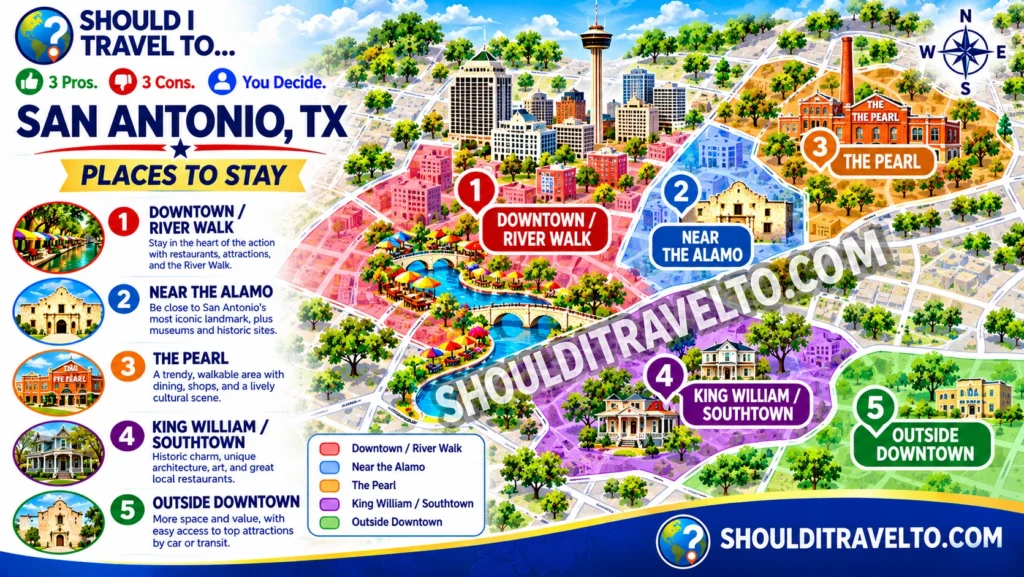
Your hotel location can dramatically change your San Antonio experience.
Downtown / River Walk: Best for First-Time Visitors
Stay downtown if you want:
- The Alamo
- The River Walk
- Major historic attractions
- Restaurants and shops
- Easy access to the central visitor area
- A short first visit without a rental car
Downtown is the most convenient base for many first-time travelers.
The trade-off is that the most popular blocks can be busy, tourist-oriented, and more expensive than accommodations farther from the central attractions.
If you want quiet evenings, pay attention to the hotel’s exact location rather than choosing based on the neighborhood name alone.
Near the Alamo: Best for History
Staying near the Alamo makes it easy to begin sightseeing early and return to your hotel between activities.
It is a practical option if historic sites are the main purpose of your trip.
The trade-off is that you may be in one of the city’s busiest visitor areas.
The Pearl / Museum Reach: Best for Food and a Contemporary Urban Feel
The Pearl and Museum Reach area works well for travelers interested in restaurants, public spaces, and a more contemporary urban atmosphere.
It is a good alternative if you want to spend time outside the busiest part of the River Walk.
However, it is not as close to every downtown attraction, so plan for the extra travel time.
King William / Southtown: Best for Historic Character
King William and Southtown appeal to travelers who enjoy historic architecture, galleries, restaurants, and neighborhood exploration.
These areas offer a different atmosphere from the central tourist district.
They can be especially appealing for couples or repeat visitors who want a more neighborhood-oriented stay.
The trade-off is that you may need additional transportation depending on which attractions you plan to visit.
Outside Downtown: Best for Theme Parks and a Road Trip
A hotel farther from downtown may be more practical if your main priorities are theme parks, suburban attractions, or a broader Texas road trip.
Some properties may offer easier parking or more space, but you should expect to travel farther for the Alamo and River Walk.
If your first visit is mainly about San Antonio’s historic core, staying downtown is usually the simpler choice.
What Else Should You Know Before Visiting San Antonio?
San Antonio is an established tourism destination, but a few practical details about heat, transportation, crowds, and attraction planning can make a significant difference in your experience.
The River Walk Isn’t the Whole City
Experience it. Then explore another part of San Antonio.
The River Walk is a highlight, but the missions, neighborhoods, museums, and food scene add much more depth.
Summer Heat Can Change Your Itinerary
If you’re visiting during the hottest months, plan outdoor sightseeing for early morning or late afternoon.
Bring water, use sun protection, and leave time for indoor breaks.
The Missions Need More Planning Than Downtown
The four missions in San Antonio Missions National Historical Park are not all located beside the Alamo.
If you want to explore them, plan transportation and allow enough time for the outdoor portions of the visit.
Check Event Dates Before Booking
Fiesta San Antonio and other major events can affect hotel availability, prices, and crowd levels.
If a particular festival or sporting event is the reason for your trip, confirm the dates before making nonrefundable reservations.
Book Popular Attractions and Restaurants Ahead When Appropriate
Some tours, special experiences, restaurants, and attractions may require or benefit from advance planning.
Check current hours, admission arrangements, and reservation requirements rather than assuming everything will be available when you arrive.
Don’t Plan Every Meal on the River Walk
The River Walk offers atmosphere and convenience, but San Antonio’s broader food scene is part of the destination’s identity.
Try at least one restaurant or market outside the central visitor corridor.
Wear Comfortable Shoes
San Antonio rewards walking in the right areas.
Even if you use transportation between neighborhoods, you’ll likely spend time on foot at the Alamo, the River Walk, the missions, and historic districts.
Don’t Assume San Antonio Is Only for History Fans
History is one of the city’s strongest attractions, but food, museums, family attractions, gardens, sports, and contemporary neighborhoods make it a much broader destination.
You can have a worthwhile trip even if you don’t want to spend every day in a museum or historic site.
Who Should Travel to San Antonio?
San Antonio Is Best For:
- American and Texas history enthusiasts
- Travelers interested in Spanish colonial history
- Mexican American culture and food enthusiasts
- Families
- Couples
- Food travelers
- Museum and architecture enthusiasts
- First-time visitors to Texas
- Travelers who enjoy historic neighborhoods
- Visitors who want a warm-weather city getaway
- Travelers interested in military history
- People who enjoy a mix of sightseeing and relaxed evenings
- Visitors who want to combine history with theme parks or other family attractions
However, San Antonio Isn’t Ideal For:
- Travelers who strongly dislike summer heat
- Visitors who want a compact, entirely walkable city
- Travelers who want every attraction close to their hotel
- People seeking a destination centered on modern skyscrapers and big-city nightlife
- Visitors who dislike tourist-oriented attractions
- Travelers who want a quiet, small-town atmosphere throughout the trip
- People who want to explore multiple distant attractions without driving or using rideshares
- Travelers who want to spend most of their vacation hiking in cool weather
San Antonio is at its best when you appreciate both its history and its modern city experience.
San Antonio for Families
San Antonio can be an excellent family destination because it offers more than one type of attraction.
Families can combine historic sites with museums, parks, the zoo, gardens, and theme parks.
The Alamo can introduce children to Texas history, while the missions provide a broader look at the region’s past. The River Walk offers an easy place to walk and eat, and attractions beyond downtown can provide variety for children with different interests.
The main consideration is planning around heat and travel distances.
A day that combines several outdoor historic sites can be tiring during summer. Families may prefer to start early, take a midday break, and choose a manageable number of attractions.
You should also consider your children’s interests. If they prefer rides and interactive attractions over history, balance the historic core with other activities.
San Antonio for Couples
San Antonio can be a strong couples destination if you want a mixture of history, food, architecture, and relaxed evenings.
A couple can spend one day exploring the Alamo and River Walk, another visiting the missions or historic neighborhoods, and an evening enjoying dinner at the Pearl or along the river.
The city can feel romantic without requiring the trip to revolve around nightlife.
The key is choosing the right base. Downtown offers convenience and atmosphere, while areas like King William and the Pearl offer a different experience.
San Antonio is particularly appealing for couples who prefer cultural sightseeing and good food over a vacation centered on clubs or high-energy nightlife.
San Antonio for History Enthusiasts
San Antonio is one of the more versatile American city destinations for travelers interested in history.
You can explore Spanish colonial missions, the Texas Revolution, Texas’s development, Mexican American cultural history, and the city’s military connections.
The Alamo is an obvious starting point, but the missions are essential for a broader understanding of the region.
The main planning challenge is that these sites represent different eras and are spread across the city.
Give yourself enough time to explore rather than trying to visit every historic attraction in a single day.
San Antonio for Food Travelers
San Antonio is particularly well suited to travelers who want food to be part of the reason for the trip.
Tex-Mex is an important starting point, but the city’s dining scene includes Mexican American traditions, barbecue, contemporary Texas cuisine, casual neighborhood restaurants, and more upscale options.
Pair food with market visits, historic neighborhoods, and time at the Pearl.
For the fullest experience, avoid limiting every meal to the central River Walk.
Explore at least one other dining area and leave room for a restaurant or specialty you discover along the way.
San Antonio for Veterans Day
Best for: Military history, veterans and military families, Texas history, and travelers interested in American military culture.
San Antonio is one of America’s most meaningful destinations for Veterans Day, particularly for travelers who want to experience a city where military service remains an important part of the local identity.
Known as Military City, USA, San Antonio has longstanding connections to the US Armed Forces, including Joint Base San Antonio, Fort Sam Houston, Lackland Air Force Base, and Randolph Air Force Base.
Unlike Washington, DC, where Veterans Day is closely associated with national memorials and ceremonies, San Antonio offers an opportunity to explore the relationship between military service, Texas history, and a living military community.
Visitors can explore the city’s military heritage alongside some of its most recognizable attractions, including the Alamo, San Antonio Missions, and River Walk.
But there are trade-offs.
San Antonio doesn’t offer the same concentration of national military memorials as Washington, DC, and some military installations are not generally open to casual visitors. Veterans Day ceremonies and commemorative events may also vary from year to year.
Travelers planning to attend a specific ceremony should confirm the schedule and public access requirements before booking.
Why Visit: Military heritage, veterans’ commemorations, Texas history, the Alamo, San Antonio Missions, and the River Walk.
Explore More: Best Veterans Day Destinations
San Antonio vs. Other Texas Destinations
The best Texas city depends on whether you want history, live music, nightlife, museums, food, or a more contemporary urban experience.
Austin: Live music, a strong creative and tech culture, outdoor recreation, and a contemporary Texas city feel.
Dallas: Major museums, professional sports, shopping, dining, and a large metropolitan experience.
Houston: Major museums, a diverse international food scene, space exploration history, and a large, sprawling urban area.
Fort Worth: Western heritage, art museums, the Stockyards, and a different take on North Texas culture.
San Antonio: Spanish colonial history, the Alamo, Mexican American culture, Tex-Mex food, the River Walk, and a broad range of family attractions.
The distinction is important.
San Antonio is the strongest fit if you want a Texas city where history and regional culture are central to the visitor experience.
San Antonio vs. Austin
San Antonio and Austin are often compared because both offer a distinctive Texas identity, good food, cultural attractions, and opportunities to spend time outdoors.
But they feel different.
Choose San Antonio If You Want:
- The Alamo and Texas Revolution history
- Spanish colonial missions
- The River Walk
- Mexican American cultural experiences
- Tex-Mex food
- Historic architecture
- A destination with strong family appeal
Choose Austin If You Want:
- A contemporary creative-city atmosphere
- Live music
- A prominent food and entertainment scene
- Outdoor recreation around the city and nearby waterways
- A different perspective on modern Texas culture
- A city break centered less on Spanish colonial history
The simplest distinction: San Antonio is more history-oriented and culturally rooted in its Spanish, Mexican, and Texan past. Austin is more associated with contemporary Texas culture, live music, and its creative identity.
Neither city needs to be treated as a substitute for the other.
If you have enough time, you can combine them for a broader Texas trip, but allow time for the drive and plan each city separately.
San Antonio vs. New Orleans
San Antonio and New Orleans both offer distinctive cultural identities, historic districts, food, and architecture, but their histories and atmospheres are different.
Choose San Antonio If You Want:
- The Alamo and Texas Revolution history
- Spanish colonial missions
- Mexican American cultural traditions
- Tex-Mex food
- The River Walk
- Family attractions and theme parks
- A broader Texas city vacation
Choose New Orleans If You Want:
- French and Spanish colonial architecture
- Jazz and a distinctive music culture
- Creole and Cajun food
- The French Quarter
- Mardi Gras traditions
- A city with a strong association with nightlife and historic neighborhoods
The simplest distinction: San Antonio’s identity is shaped by Spanish colonial history, Texas, and Mexican American culture. New Orleans is shaped by its own French, Spanish, African American, Creole, and Gulf Coast traditions.
Both are highly distinctive, but they offer different cultural experiences.
San Antonio vs. Nashville
San Antonio and Nashville are both popular city destinations with recognizable identities, strong food scenes, and attractions that extend beyond their best-known tourist areas.
But their central experiences are different.
Choose San Antonio If You Want:
- Historic landmarks and missions
- Texas and Spanish colonial history
- Mexican American culture
- Tex-Mex food
- The River Walk
- Family attractions
- A city vacation with a strong historical component
Choose Nashville If You Want:
- Live music
- Country music history
- Songwriting and recording-industry heritage
- Honky-tonks and nightlife
- Southern food
- A lively weekend focused on music and entertainment
The simplest distinction: San Antonio is a city where history and Mexican American culture define much of the visitor experience. Nashville is a city where music is the central attraction.
Both offer food, neighborhoods, museums, and a broader city vacation, but the reason to choose one over the other is quite different.
The Decision Is Yours
San Antonio is one of America’s most distinctive city destinations because it brings together several layers of history and culture.
You can explore the Alamo and the Texas Revolution, visit Spanish colonial missions, experience Mexican American cultural traditions, eat Tex-Mex food, and enjoy a downtown River Walk that gives the city a recognizable atmosphere.
You can also discover that San Antonio offers much more than its two most famous attractions.
The trade-off is equally clear.
San Antonio can be very hot in summer, spread out beyond downtown, crowded around major attractions, and more tourist-oriented in its best-known visitor areas.
But if you plan around the weather, choose your base carefully, and explore beyond the central tourist district, those drawbacks become easier to manage.
If you want a compact city where every major attraction is within walking distance, San Antonio may not be the best fit.
If you want history, food, culture, and a warm-weather city vacation, it deserves serious consideration.
Come for the Alamo. Stay for the history, food, missions, and culture. Explore beyond the River Walk.
3 Pros. 3 Cons. You Decide.
San Antonio, Texas, Frequently Asked Questions
Is San Antonio worth visiting?
Yes, particularly if you enjoy history, Mexican American culture, Tex-Mex food, historic architecture, and a mix of sightseeing and relaxed city experiences. San Antonio also offers family attractions, museums, parks, and theme parks beyond its famous historic sites.
What is San Antonio best known for?
San Antonio is best known for the Alamo, the River Walk, Spanish colonial missions, Texas history, Mexican American culture, and Tex-Mex food. Its combination of history and contemporary city attractions makes it one of Texas’s most distinctive destinations.
How many days do you need in San Antonio?
Two days can cover the main downtown attractions. Three days provides a better first-visit balance by allowing time for the Alamo, the River Walk, the missions, and another neighborhood or museum. Four or five days works well if you want to add theme parks, more museums, or a broader range of attractions.
Do you need a car in San Antonio?
Not necessarily. If you stay downtown and focus on the Alamo, the central River Walk, and nearby attractions, you can manage without a rental car. A car becomes more useful if you want to visit several missions, theme parks, or neighborhoods farther from the city center.
Is San Antonio walkable?
Parts of it are. Downtown is walkable, and several major attractions are close together. However, San Antonio is a large, spread-out city, and transportation is useful when moving between downtown, the missions, theme parks, and other neighborhoods.
Is San Antonio expensive?
San Antonio offers a range of price points. Hotels, restaurants, tours, and theme parks can add up, especially during major events or busy travel periods. You can also build a trip around historic sites, public spaces, and other relatively inexpensive activities. Your lodging choice and transportation needs will have a major impact on the total cost.
When is the best time to visit San Antonio?
Spring and fall generally offer more comfortable conditions for outdoor sightseeing. Summer can be extremely hot, while winter can be a good time for history, museums, restaurants, and city exploration. Check the dates of major events such as Fiesta San Antonio before booking.
Is San Antonio good for families?
Yes. San Antonio offers historic attractions, museums, the zoo, parks, gardens, and theme parks. Families can combine history with activities that appeal to different ages. Summer heat and transportation between attractions are the main practical considerations.
Is San Antonio good for couples?
Yes. Couples can combine historic sites, neighborhood exploration, restaurants, and evenings along the River Walk. The Pearl and historic neighborhoods offer alternatives to the busiest tourist areas, making it possible to build a trip around food, culture, and relaxed sightseeing.
Is the River Walk worth visiting?
Yes. The River Walk is one of San Antonio’s most distinctive attractions. You can walk along the river, explore restaurants and shops, or take a narrated cruise. It is particularly appealing in the evening, but it represents only one part of the city.
Is the Alamo worth visiting?
Yes, especially if you are interested in Texas history. The Alamo is associated with the 1836 Battle of the Alamo during the Texas Revolution. Visiting it alongside the other Spanish colonial missions provides a broader understanding of San Antonio’s history.
What are the San Antonio Missions?
San Antonio Missions National Historical Park preserves four Spanish colonial missions: Concepción, San José, San Juan, and Espada. Together with the Alamo, they form part of a UNESCO World Heritage property. The missions help explain Spanish colonial history, Indigenous communities, and the development of the region.
What food is San Antonio known for?
San Antonio is particularly known for Tex-Mex and Mexican American food traditions. Visitors can also explore barbecue, Texas cuisine, contemporary restaurants, bakeries, and local markets. The River Walk is convenient for dining, but exploring other neighborhoods provides a broader experience.
Is San Antonio better than Austin?
It depends on your interests. San Antonio is stronger for the Alamo, Spanish colonial missions, Mexican American culture, and the River Walk. Austin is better suited to travelers interested in live music, contemporary Texas culture, and its creative-city atmosphere.
Is San Antonio better than New Orleans?
Neither city is universally better. San Antonio is a strong choice for Texas history, Spanish colonial missions, Mexican American culture, and family attractions. New Orleans is better suited to travelers interested in its distinctive French and Spanish history, jazz, Creole and Cajun food, and Mardi Gras culture.
Is San Antonio good for a weekend trip?
Yes. A two- or three-day weekend can cover the main downtown attractions and provide time for another part of the city. A longer trip is worthwhile if you want to explore the missions, museums, theme parks, and neighborhoods beyond the central visitor area.
Can you combine San Antonio with Austin?
Yes. San Antonio and Austin can be combined into a broader Texas trip. Allow enough time for the drive and plan separate itineraries for each city, since they offer different experiences and both have enough attractions to justify more than a brief stop.