

Should You Travel for St. Patrick’s Day Celebrations?
Quick Answer
Yes, you should travel to St. Patrick’s Day Destinations in the United States if you want to participate in one of the bigger celebrations.
Communities across the United States celebrate St. Patrick’s Day. Small towns hold parades. Neighborhood pubs host Irish music. Restaurants offer holiday menus, and local organizations organize cultural celebrations.
For many people, these hometown traditions are more than enough to enjoy the holiday.
But what if you want something bigger?
What if you want to experience a major St. Patrick’s Day parade, watch a river turn green, explore a city with deep Irish-American roots, or spend an entire weekend surrounded by holiday celebrations?
That’s when St. Patrick’s Day becomes a travel destination, not just a date on the calendar.
Exploring Your St. Patrick’s Day Celebration Options
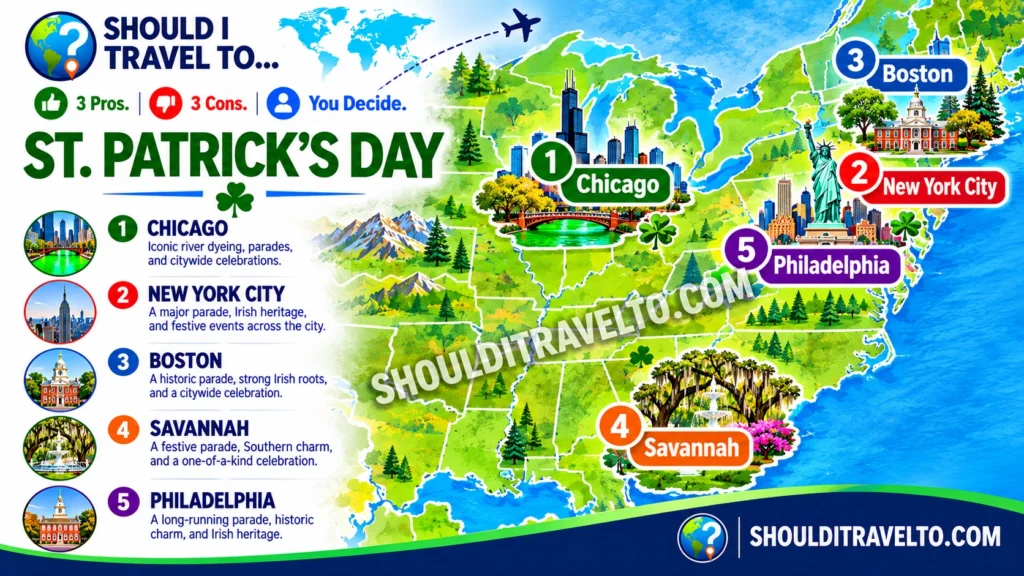
Boston, Chicago, New York City, Savannah, and Philadelphia offer five distinctive ways to experience the holiday.
Chicago is famous for turning its river green. New York City hosts a massive parade along Fifth Avenue. Boston combines Irish-American heritage with Revolutionary War history. Savannah transforms its historic Southern setting into a major celebration, while Philadelphia offers one of America’s oldest St. Patrick’s Day parade traditions.
But these destinations aren’t interchangeable.
Some celebrations are especially crowded. Others suit families or travelers interested in Irish-American history. Weather, accommodation costs, parade schedules, and transportation can also change the experience considerably.
Unlike a typical city vacation, the event you want to attend may take place in a single day.
This guide compares five major American St. Patrick’s Day destinations to help you decide which celebration is worth traveling for.
The goal isn’t to convince everyone to travel for St. Patrick’s Day.
It’s to help you decide whether a major celebration offers something you can’t experience closer to home.
The 3 Biggest Pros and 3 Biggest Cons of Traveling for St. Patrick’s Day
A major St. Patrick’s Day celebration can become the centerpiece of a memorable city vacation.
But the same crowds and traditions that make these events special can also create challenges.
The 3 Biggest Pros of Traveling for St. Patrick’s Day
1. You Can Experience a Celebration That Goes Beyond Your Local Event
Many American communities celebrate St. Patrick’s Day with parades, music, food, and gatherings.
But some cities have developed traditions that attract visitors from well beyond their local communities.
Chicago’s green river is an experience you can’t replicate simply by visiting an Irish pub.
New York City’s Fifth Avenue parade brings together Irish organizations, marching bands, and participants in a historic procession.
Boston’s South Boston celebration reflects generations of Irish-American history, while Savannah’s parade has become one of the city’s defining annual events.
Traveling for these celebrations offers a sense of scale, tradition, and atmosphere that smaller local events may not provide.
The key is choosing a destination whose signature celebration interests you.
2. St. Patrick’s Day Can Be Part of a Complete City Vacation
A major advantage of choosing Boston, Chicago, New York City, Savannah, or Philadelphia is that each offers plenty to do beyond the holiday.
You can explore Boston’s Freedom Trail, visit Chicago’s architecture and museums, enjoy Broadway in New York City, walk through Savannah’s historic squares, or discover Philadelphia’s American founding history.
That makes a St. Patrick’s Day trip more than a parade.
You can build a two-, three-, or four-day vacation around the celebration and use the remaining time to experience the destination.
This is especially valuable if you’re traveling a considerable distance.
Rather than spending an entire trip waiting for one event, you can enjoy the city before and after the festivities.
3. You Can Experience Irish-American Heritage in Different Settings
St. Patrick’s Day in America is about more than wearing green.
Major celebrations reflect the history of Irish immigration, neighborhood communities, religious traditions, cultural organizations, and generations of Irish-American life.
Boston offers one of the strongest connections between Irish-American identity and a city’s broader history.
Philadelphia’s parade tradition reaches back to the colonial era.
New York City’s celebration reflects the scale and diversity of Irish-American organizations, while Chicago and Savannah have developed distinctive traditions of their own.
For travelers interested in history and culture, these celebrations offer a chance to learn about the communities that created them.
The 3 Biggest Cons of Traveling for St. Patrick’s Day
1. Major Celebrations Can Be Extremely Crowded
Large St. Patrick’s Day events attract substantial crowds.
Popular parade-viewing areas can fill up early, public transportation may be busy, and streets may close to vehicles.
Chicago’s river dyeing and New York City’s Fifth Avenue parade are especially recognizable events, but their popularity means you shouldn’t expect a quiet experience.
South Boston and Savannah can also become exceptionally busy during their celebrations.
Crowds aren’t necessarily a reason to avoid these destinations.
For many visitors, the atmosphere is part of the attraction.
But travelers who dislike large gatherings, standing for long periods, or navigating busy streets may prefer smaller local events.
2. March Weather Can Be Unpredictable
St. Patrick’s Day is observed on March 17, but March doesn’t guarantee spring weather.
Boston, Chicago, New York City, and Philadelphia can still experience cold temperatures, wind, rain, and occasionally snow.
Chicago’s riverfront can feel particularly cold when the wind picks up.
Savannah generally offers a milder climate, but rain and cool temperatures are still possible.
If your main reason for traveling is an outdoor parade, prepare for weather that may be less comfortable than expected.
Warm clothing, comfortable shoes, and a flexible itinerary can make a major difference.
3. The Celebration May Not Happen on March 17
One of the biggest mistakes travelers make is assuming that every major St. Patrick’s Day event takes place on the holiday itself.
That isn’t always the case.
Chicago traditionally schedules its downtown parade and river dyeing on a nearby Saturday.
Boston’s South Boston parade is commonly held on a nearby Sunday.
Philadelphia’s parade is also typically scheduled on a Sunday around the holiday.
New York City’s main parade generally takes place on March 17, with exceptions for certain calendar circumstances.
Savannah’s parade is traditionally closely tied to March 17.
This creates an important travel-planning challenge.
You could arrive in the right city on St. Patrick’s Day and still miss its most famous celebration.
Always confirm the official event date before booking nonrefundable travel.
What Kind of St. Patrick’s Day Celebration Do You Want?
Before choosing a destination, decide which part of the holiday interests you most.
| If you want… | Start with… |
| An iconic, one-of-a-kind visual celebration | Chicago |
| A massive traditional parade | New York City |
| Irish-American heritage and neighborhood tradition | Boston |
| A major celebration in a historic Southern city | Savannah |
| A historic parade combined with American founding history | Philadelphia |
| A city vacation with museums and architecture | Chicago |
| Broadway, restaurants, and major-city attractions | New York City |
| Revolutionary War history and Irish heritage | Boston |
| Walkable historic squares and a festive atmosphere | Savannah |
| A history-focused long weekend | Philadelphia |
All five cities offer parades, cultural experiences, and reasons to explore beyond St. Patrick’s Day.
The biggest difference is what makes each celebration distinctive.
Major St. Patrick’s Day Destinations in America
Chicago, Illinois: The Green River St. Patrick’s Day
Chicago offers one of America’s most recognizable St. Patrick’s Day experiences.
Every year, the Chicago River is famously dyed bright green as part of the city’s holiday celebrations.
The tradition has become a defining image of St. Patrick’s Day in the United States.
Visitors gather along the river and surrounding bridges to watch the transformation, while the city’s downtown parade adds marching bands, Irish dancers, cultural organizations, and a festive atmosphere.
Chicago also hosts neighborhood celebrations, including the South Side Irish Parade, reflecting the city’s Irish-American communities.
For first-time visitors, the green river most clearly distinguishes Chicago from other St. Patrick’s Day destinations.
It’s visually dramatic, closely associated with the city, and unlike the traditional parade-centered celebrations elsewhere.
But Chicago offers much more than one holiday tradition.
Visitors can explore Millennium Park, the Art Institute of Chicago, the Chicago Riverwalk, museums, architecture, restaurants, and distinctive neighborhoods.
That makes it possible to turn the holiday into a complete city vacation.
The biggest drawback is the combination of crowds and March weather.
Popular river-viewing locations can become packed, and the city’s wind and cold temperatures can make standing outside uncomfortable.
River dyeing also happens at a specific time, so arriving late can mean missing the main event.
Best for: The green river tradition, downtown celebrations, architecture, museums, food, and travelers who want a distinctive St. Patrick’s Day spectacle.
Biggest trade-off: Large crowds, cold weather, and the need to arrive at the right time for the river dyeing.
Choose Chicago if: You want a St. Patrick’s Day experience that feels visually different from celebrations anywhere else in the country.
New York City, New York: The Grand Fifth Avenue St. Patrick’s Day
New York City offers one of the most historic and largest St. Patrick’s Day parade experiences in the world.
The city’s parade tradition dates to 1762, before the United States declared independence.
Today, the celebration brings Irish organizations, marching bands, cultural groups, and spectators to Fifth Avenue in Manhattan.
The procession passes St. Patrick’s Cathedral, one of the city’s most recognizable religious landmarks.
Unlike Chicago, where the green river is the signature attraction, New York’s celebration is centered on the scale and tradition of the parade itself.
For travelers who want to experience a major Irish-American procession, New York City is a particularly strong choice.
The city also offers an enormous range of attractions beyond the holiday.
You can visit museums, explore Central Park, attend a Broadway show, enjoy restaurants, and discover neighborhoods throughout Manhattan and the other boroughs.
The subway system makes it possible to build a trip without renting a car.
But New York’s advantages come with familiar trade-offs.
Hotels can be expensive, parade crowds can be enormous, and March weather may still feel like winter.
The parade also occupies a major section of Fifth Avenue, affecting movement through parts of Manhattan.
Travelers should plan their viewing location and transportation rather than expecting to move easily through the area during the event.
Best for: A massive traditional parade, Irish-American history, museums, Broadway, dining, and a complete big-city vacation.
Biggest trade-off: High costs, enormous crowds, and cold or unpredictable March weather.
Choose New York City if: You want to experience one of the world’s most famous St. Patrick’s Day parades while enjoying everything a major city has to offer.
Boston, Massachusetts: The Irish-American Heritage St. Patrick’s Day
Boston offers a St. Patrick’s Day experience closely connected to the city’s Irish-American identity.
The South Boston St. Patrick’s Day Parade is one of the country’s best-known celebrations of Irish heritage.
Marching bands, bagpipes, community organizations, and large crowds help transform South Boston into a major holiday destination.
But Boston’s celebration has another historical connection.
March 17 is also Evacuation Day, commemorating the British departure from Boston in 1776 during the American Revolution.
That creates an unusual combination of Irish-American heritage and Revolutionary War history.
For travelers interested in American history, this gives Boston an identity that extends beyond the parade itself.
You can explore the Freedom Trail, visit Boston Common, walk through Beacon Hill, experience the North End, and discover sites associated with the American Revolution.
Boston also offers museums, restaurants, waterfront attractions, and walkable central neighborhoods.
The important distinction is that the main parade takes place in South Boston rather than throughout the city’s entire historic center.
Visitors should plan transportation and allow time to reach the parade route.
The MBTA is generally more practical than driving into the neighborhood during the event.
Boston’s biggest drawback is the crowd intensity and the possibility of cold, windy, or wet weather.
South Boston can get extremely busy, and some areas may feel more party-oriented than families or quieter travelers expect.
Best for: Irish-American heritage, neighborhood traditions, Revolutionary War history, museums, and a walkable city vacation.
Biggest trade-off: Crowded South Boston streets, limited parking, and unpredictable March weather.
Choose Boston if: You want a major St. Patrick’s Day celebration with a particularly strong connection to Irish-American history and the American Revolution.
Savannah, Georgia: The Southern St. Patrick’s Day Celebration
Savannah offers one of America’s most distinctive St. Patrick’s Day experiences.
The city is famous for its historic squares, oak-lined streets, architecture, and relaxed Southern atmosphere.
But around St. Patrick’s Day, that setting changes dramatically.
Savannah hosts one of the country’s major St. Patrick’s Day parades, drawing visitors to a celebration that has become central to the city’s identity.
Marching bands, Irish dancers, floats, cultural organizations, and enthusiastic crowds bring a festive atmosphere to the historic city.
What makes Savannah different is the contrast between the celebration’s scale and the destination’s character.
New York and Chicago are enormous cities.
Savannah is much smaller, with a historic district that visitors can explore on foot.
That creates an experience where the holiday can feel particularly concentrated in the city’s central neighborhoods.
Outside the celebration, visitors can explore Forsyth Park, River Street, historic squares, museums, and restaurants.
Savannah also appeals to travelers who enjoy architecture and a slower-paced city vacation.
But don’t assume the holiday weekend will feel slow.
St. Patrick’s Day can be one of Savannah’s busiest periods, and accommodation prices may increase considerably.
The historic district can become crowded, traffic and parking may be difficult, and the celebration may feel more energetic than visitors expecting a quiet Southern getaway anticipate.
Savannah’s March weather is generally milder than in northern destinations, but rain remains possible.
Best for: A major parade in a historic Southern city, architecture, walkable squares, restaurants, and a lively holiday atmosphere.
Biggest trade-off: Heavy event crowds, premium accommodation prices, and a much busier atmosphere than Savannah usually offers.
Choose Savannah if: You want a large St. Patrick’s Day celebration in a smaller, historic city with a distinctly Southern setting.
Philadelphia, Pennsylvania: The Historic St. Patrick’s Day Parade
Philadelphia offers one of America’s longest-running St. Patrick’s Day parade traditions.
Its first documented St. Patrick’s Day celebration parade dates to 1771, connecting the city’s Irish-American heritage to the period before American independence.
Today, the annual parade brings marching bands, Irish dancers, cultural organizations, and spectators together for a celebration that reflects generations of Irish-American contributions.
Philadelphia’s greatest advantage is the ability to combine the holiday with American history.
Visitors can explore Independence Hall, the Liberty Bell, the Museum of the American Revolution, and other attractions associated with the founding of the United States.
Reading Terminal Market, museums, restaurants, and historic neighborhoods provide additional reasons to stay beyond the parade.
For travelers who want a meaningful St. Patrick’s Day event without making the entire vacation revolve around nightlife, Philadelphia can be an appealing option.
The city’s historic core also lets visitors combine several major attractions in a relatively concentrated area.
But Philadelphia’s celebration differs from Chicago’s Green River or New York’s enormous Fifth Avenue procession.
Its main appeal is the historic parade tradition and the opportunity to explore the city around it.
March weather can be cold or wet, and parade-day street closures may affect transportation.
Visitors should also verify the parade’s annual date and route before planning their trip.
Best for: Irish-American parade history, American founding history, museums, food, and a focused city getaway.
Biggest trade-off: Unpredictable March weather, parade-related street closures, and a less singular visual spectacle than Chicago’s river dyeing.
Choose Philadelphia if: You want to experience a historic St. Patrick’s Day parade while exploring one of America’s most important cities for Revolutionary-era history.
Which St. Patrick’s Day Destination Should You Choose?
The right choice becomes clearer when you compare the signature experiences.
| Destination | Signature experience | Best reason to visit | Biggest trade-off |
| Chicago | Chicago River dyed green | A unique visual spectacle | Crowds and cold weather |
| New York City | Fifth Avenue parade | A massive traditional procession | Cost and crowd density |
| Boston | South Boston parade | Irish heritage and Revolutionary history | Crowded neighborhood streets |
| Savannah | Major parade through a historic Southern city | Festive atmosphere and historic charm | High holiday demand |
| Philadelphia | Historic Irish-American parade | Parade tradition and founding history | Weather and event logistics |
None is automatically the best destination for everyone. Instead, choose the experience that interests you most.
Parade vs. Irish Heritage vs. City Vacation
If you’re still deciding, narrow your options by what you want from the trip.
Want a Once-in-a-Lifetime St. Patrick’s Day Spectacle?
Start with Chicago.
Watching the Chicago River turn green is a distinctive experience closely associated with the holiday.
The downtown parade and neighborhood celebrations provide additional activities, but the river is the main reason many travelers choose Chicago.
If that tradition is your priority, plan your arrival around the official river-dyeing schedule.
Want a Massive Traditional Parade?
Start with New York City.
The Fifth Avenue procession offers extraordinary scale and a long history.
Savannah is another strong choice if you prefer a major parade in a smaller city.
The difference is the surrounding destination.
New York offers a major metropolitan vacation, while Savannah provides a more concentrated historic Southern setting.
Want Irish-American History and Culture?
Start with Boston or Philadelphia.
Boston’s South Boston celebration is closely connected to Irish-American neighborhood history and Evacuation Day.
Philadelphia offers a parade tradition that reaches back to colonial America.
Both cities also provide opportunities to explore the American Revolution, museums, and historic neighborhoods.
Want a Lively Holiday Weekend?
Start with Savannah, Chicago, or New York City.
These destinations can offer an energetic atmosphere around their major celebrations.
But the experience depends on the neighborhood, event, and time of day.
A parade can be a family-oriented cultural experience, while nearby nightlife districts may become considerably louder and busier.
Choose accommodation and activities that fit the atmosphere you prefer.
Want to Combine St. Patrick’s Day With American History?
Start with Boston or Philadelphia.
Boston’s Freedom Trail and Revolutionary War sites make it easy to add historical sightseeing.
Philadelphia offers Independence Hall, the Liberty Bell, and the Museum of the American Revolution.
New York City also has extensive historical attractions, though it offers a broader range of experiences rather than a concentrated Revolutionary War itinerary.
Planning Your St. Patrick’s Day Trip
Major St. Patrick’s Day events require more planning than an ordinary weekend city break.
The most important decisions involve dates, accommodation, transportation, and how much of the celebration you want to experience.
Confirm the Parade Date Before Booking
St. Patrick’s Day is always March 17, but major events may be held on a nearby weekend.
Some cities schedule their parades before the holiday. Others celebrate on March 17 itself.
Local traditions, calendar circumstances, or event logistics can also affect the official date.
Don’t assume that arriving on March 17 guarantees you’ll see the city’s main parade.
Check the organizer’s website before booking flights or hotels.
Choose Accommodation Based on the Event Location
A hotel that works well for ordinary sightseeing may not be the most convenient choice for a parade weekend.
In Chicago, consider how easily you can reach the river and downtown parade area.
In New York City, review subway access to the Fifth Avenue route.
Next, in Boston, remember that the South Boston parade is separate from many of the city’s most famous downtown attractions.
In Savannah, staying in or near the Historic District can be convenient but may cost more.
In Philadelphia, consider access to the parade route and the historic attractions you want to visit.
The lowest hotel rate isn’t always the best value if it creates substantial transportation difficulties.
Arrive Early for Major Events
Large parades and the Chicago River dyeing attract crowds well before the main event begins.
Arriving early improves your chances of finding a comfortable viewing location. It also gives you time to navigate street closures and public transportation changes.
If you’re traveling with children or anyone who may have difficulty standing for long periods, consider viewing areas and accessibility before the event.
Don’t assume you’ll be able to move easily along the parade route once the crowds have gathered.
Use Public Transportation When Practical
Driving into a major parade area can be frustrating.
Street closures, parking restrictions, traffic, and large pedestrian crowds can make a car more of a liability than a convenience.
New York City’s subway, Chicago’s transit system, Boston’s MBTA, and Philadelphia’s SEPTA provide alternatives for many visitors.
Savannah’s historic center is relatively walkable, although access to parking and roads may be restricted during major festivities.
Always check the city’s current event transportation guidance.
Prepare for March Weather
For Boston, Chicago, New York City, and Philadelphia, pack clothing suitable for cold, windy conditions.
Even if the forecast looks mild, standing outdoors for an extended parade can feel colder than walking around the city.
Savannah may offer more comfortable temperatures, but rain is possible.
Comfortable walking shoes matter at every destination.
If your trip includes several days, plan indoor attractions in case the weather turns unpleasant.
Decide Whether You Want the Parade or the Party Atmosphere
St. Patrick’s Day celebrations can include several different experiences.
Some visitors want to watch marching bands, dancers, and cultural organizations. Others prefer restaurants, live music, or nightlife.
Families may prefer an earlier parade experience, while groups of adults may prefer evening entertainment.
Don’t assume every part of a major St. Patrick’s Day celebration has the same atmosphere. Choose your activities and accommodation accordingly.
How Many Days Do You Need for St. Patrick’s Day?
The ideal trip length depends on whether you’re traveling primarily for the celebration or want to explore the city as well.
| Destination | Suggested trip length |
| Chicago | 3–4 days |
| New York City | 3–5 days |
| Boston | 2–4 days |
| Savannah | 2–3 days |
| Philadelphia | 2–3 days |
These are suggested vacation lengths, not the duration of the celebrations themselves.
The 2-Day St. Patrick’s Day Trip
A two-day visit works best if your main goal is to attend the signature celebration.
You might travel to Savannah for its parade, Boston for the South Boston festivities, or Philadelphia for its historic procession.
But short trips require careful scheduling.
If the parade takes place before you arrive or after you leave, you may miss the main reason for traveling.
A short trip works best when you can confirm the event schedule before booking.
The 3–4 Day St. Patrick’s Day Trip
Three or four days provide a better balance between the holiday and the city itself.
In Chicago, you can experience the river dyeing and explore museums or architecture.
In Boston, you can attend the South Boston parade and spend additional days exploring Revolutionary War sites.
Savannah offers enough historic neighborhoods, museums, restaurants, and nearby attractions for a long weekend.
Philadelphia works particularly well for a combination of parade festivities and American history.
The 5-Day St. Patrick’s Day Trip
A longer visit makes the most sense in a city with enough attractions to justify the additional time.
New York City can easily support five days of museums, neighborhoods, theater, food, and sightseeing.
Chicago can also reward a longer visit, especially for travelers interested in architecture, museums, and neighborhoods.
But more days aren’t automatically better. If your main goal is one parade, you may prefer a shorter trip focused on the celebration.
St. Patrick’s Day Itinerary Ideas
A well-planned St. Patrick’s Day trip combines the signature event with the attractions that make each city worth visiting.
1. Chicago: Green River + Architecture + Museums
Suggested duration: 3 days
Spend one day experiencing the river dyeing and downtown St. Patrick’s Day celebrations.
Use the remaining time to explore Chicago’s architecture, Millennium Park, museums, and restaurants.
If your schedule allows, consider an architecture-focused experience or exploring a neighborhood beyond downtown.
Best for: Travelers who want a memorable holiday spectacle and a complete city vacation.
Biggest trade-off: The main event requires careful timing, and March weather can be cold.
2. New York City: Fifth Avenue Parade + Manhattan
Suggested duration: 3–4 days
Build one day around the Fifth Avenue parade.
Spend the remaining days exploring neighborhoods, museums, Central Park, Broadway, and restaurants.
This itinerary works especially well for first-time visitors because the city offers enough attractions to make the trip worthwhile beyond the holiday.
Best for: Major-city enthusiasts, parade spectators, theater lovers, and first-time New York visitors.
Biggest trade-off: Accommodation costs and large crowds.
3. Boston: South Boston Parade + Freedom Trail
Suggested duration: 3 days
Devote one day to the South Boston St. Patrick’s Day celebration.
Use another day to explore the Freedom Trail and Revolutionary War history.
Spend additional time enjoying Boston’s neighborhoods, restaurants, museums, and waterfront.
This combination connects two important parts of Boston’s identity: Irish-American heritage and the American Revolution.
Best for: History enthusiasts and travelers interested in Irish-American culture.
Biggest trade-off: Parade crowds and unpredictable March weather.
4. Savannah: St. Patrick’s Day + Historic Squares
Suggested duration: 3 days
Plan one day around Savannah’s parade and holiday atmosphere.
Use the remaining time to explore the Historic District, Forsyth Park, River Street, museums, and restaurants.
This is an appealing option for travelers who want a major celebration without spending the entire trip in a large metropolitan environment.
Best for: Couples, groups of friends, architecture enthusiasts, and travelers who enjoy historic cities.
Biggest trade-off: The celebration can make Savannah significantly busier and more expensive than usual.
5. Philadelphia: St. Patrick’s Day + America’s Founding
Suggested duration: 3 days
Attend Philadelphia’s historic St. Patrick’s Day parade.
Spend another day exploring Independence Hall, the Liberty Bell, and the Museum of the American Revolution.
Use additional time for Reading Terminal Market, museums, and historic neighborhoods.
This itinerary offers a useful balance between the holiday and American history.
Best for: Families, history enthusiasts, and travelers who want a focused long-weekend city vacation.
Biggest trade-off: March weather and parade-related transportation changes.
Who Should Travel for St. Patrick’s Day?
A major St. Patrick’s Day trip can be particularly rewarding for travelers who enjoy festivals, parades, cultural celebrations, and the atmosphere of a city during a major event.
It’s a strong option for groups of friends who want a shared experience.
Families may enjoy the marching bands, dancers, and cultural traditions, as long as they choose suitable viewing areas and prepare for crowds.
History enthusiasts may appreciate Boston and Philadelphia, where the holiday can be combined with Revolutionary War attractions and Irish-American heritage.
First-time city visitors can also benefit from combining a major event with several days of sightseeing.
The key is to choose a destination you would enjoy even without the parade. That way, the holiday becomes a highlight of the vacation rather than its only purpose.
Who Might Skip a St. Patrick’s Day Trip?
Not everyone needs to travel for St. Patrick’s Day.
If your local community offers a parade, Irish music, or cultural celebration that you enjoy, you may not gain enough from a larger event to justify the cost of travel.
Major celebrations can also be challenging for travelers who dislike crowds, noise, long periods of standing, or navigating street closures.
Families with very young children may prefer a smaller local event over an extremely crowded downtown parade.
Travelers looking for warm weather should remember that March can still feel like winter in Boston, Chicago, New York City, and Philadelphia.
And if your travel dates don’t align with the main event, the holiday atmosphere alone may not justify a special trip.
A major St. Patrick’s Day destination is most rewarding when you genuinely want to experience its signature celebration.
The Decision Is Yours
St. Patrick’s Day is celebrated throughout the United States.
You don’t have to travel hundreds of miles to enjoy Irish music, a parade, or time with friends and family.
But if you want to experience one of America’s major St. Patrick’s Day celebrations, five cities stand out for different reasons.
Chicago offers the unforgettable sight of a river turning green.
New York City provides a massive, historic parade along Fifth Avenue.
Boston combines Irish-American neighborhood traditions with Revolutionary War history.
Savannah brings a major celebration to one of the South’s most distinctive historic cities.
Philadelphia offers a longstanding Irish-American parade tradition alongside the landmarks of America’s founding.
Each destination offers more than a typical local celebration. But each comes with trade-offs.
Begin by asking what kind of celebration you want to experience.
Then decide whether it’s worth traveling for.
3 Pros. 3 Cons. You Decide.
St. Patrick’s Day Travel Frequently Asked Questions
What are the best cities for St. Patrick’s Day in the United States?
Chicago, New York City, Boston, Savannah, and Philadelphia are five strong choices for major St. Patrick’s Day celebrations. Chicago is famous for its green river, New York City for its Fifth Avenue parade, Boston for its Irish-American heritage, Savannah for its major Southern celebration, and Philadelphia for its historic parade tradition.
Which city has the biggest St. Patrick’s Day parade?
New York City’s St. Patrick’s Day Parade is widely recognized as one of the largest and oldest in the world. Its Fifth Avenue procession attracts enormous numbers of participants and spectators. Other cities, including Chicago, Boston, Savannah, and Philadelphia, also host major celebrations.
Where can you see a river dyed green for St. Patrick’s Day?
Chicago is famous for dyeing the Chicago River green as part of its St. Patrick’s Day celebrations. The tradition usually takes place on a Saturday near March 17 and is one of the most recognizable holiday events in the United States. Check the official schedule before traveling.
Is Boston or New York City better for St. Patrick’s Day?
Choose Boston if you’re particularly interested in Irish-American neighborhood history, the South Boston parade, and Revolutionary War attractions. Choose New York City if you want a massive traditional parade along Fifth Avenue and a broader big-city vacation with museums, restaurants, and entertainment.
Is Savannah worth visiting for St. Patrick’s Day?
Yes, particularly for travelers who want a major celebration in a smaller historic city. Savannah’s parade and festive atmosphere are a significant part of its annual calendar. However, the crowds and accommodation prices may be considerably higher than during an ordinary March visit.
Do St. Patrick’s Day parades always take place on March 17?
No. Although St. Patrick’s Day is March 17, many cities schedule their main celebrations on nearby weekends. Chicago, Boston, and Philadelphia often hold major events on weekends, while New York City and Savannah traditionally celebrate close to March 17. Always verify the annual schedule.
How many days do you need for a St. Patrick’s Day trip?
Two or three days can be enough for a parade-focused trip. Three or four days provide more time to explore the city, while New York City and Chicago can support longer visits. The ideal trip length depends on travel time, your interests, and how much sightseeing you want beyond the celebration.