

Should You Travel to American Presidential History Sites?
Quick Answer
Presidential history isn’t confined to Washington, DC. Across the United States, American Presidential History sites include presidential homes, historic neighborhoods, plantations, museums, libraries, memorials, and entire communities that help tell the story of how the American presidency developed, and how the country changed alongside it.
But not every presidential destination tells the same story.
At Mount Vernon, you can explore George Washington’s life and the precedents established by the nation’s first president. At Monticello, you can examine Thomas Jefferson’s political ideas in the context of the early republic. In Springfield, Illinois, you can discover the community and political world that shaped Abraham Lincoln before he entered the White House.
These are very different historical experiences, even though they all concern the American presidency.
The best presidential history destination isn’t necessarily the one associated with the most famous president. It’s the destination that helps you understand the period, people, and questions that interest you.
We explore presidential history destinations across the United States, from the Founding Era through the 20th century, along with practical travel considerations, suggested road trips, and the advantages and limitations of presidential history travel.
Explore the Founding Era, Jacksonian Era, Civil War, Progressive Era, Great Depression, World War II, and Cold War to choose the chapter of American history you want to understand.
Why the Presidential History Sites Matter
Presidential history travel means exploring the places associated with American presidents, their families, their administrations, and the events that shaped their time in office.
That can mean touring a historic house, walking through a preserved neighborhood, visiting a presidential library, examining a battlefield, or standing in a memorial built generations after a president’s death.
But these experiences reveal different things.
Presidential homes show where presidents lived, worked, raised families, and developed their ideas. Some also reveal how estates operated.
Presidential libraries and museums offer documents, artifacts, exhibitions, and historical interpretation that connect individual administrations with national and international events.
Memorials and monuments reveal how later generations chose to commemorate presidents and interpret their legacies.
Cities and communities provide the broader context: the economies, political movements, conflicts, institutions, and ordinary people who shaped the world in which presidents lived.
This distinction matters because a visitor to Springfield and a visitor to Washington, DC, can learn about Abraham Lincoln in very different ways.
Springfield explores Lincoln’s family life, legal career, and political development before the presidency.
Washington, DC, examines Lincoln’s presidency, the Civil War, emancipation, assassination, and national remembrance.
Neither destination replaces the other.
Before choosing a presidential history destination, consider three questions:
- Which president or period of American history do you want to understand?
- Would you prefer a historic home, a museum, a city, or a broader regional itinerary?
- How much time are you willing to spend traveling between historic sites?
Answer those questions first, and choosing a destination becomes much easier.
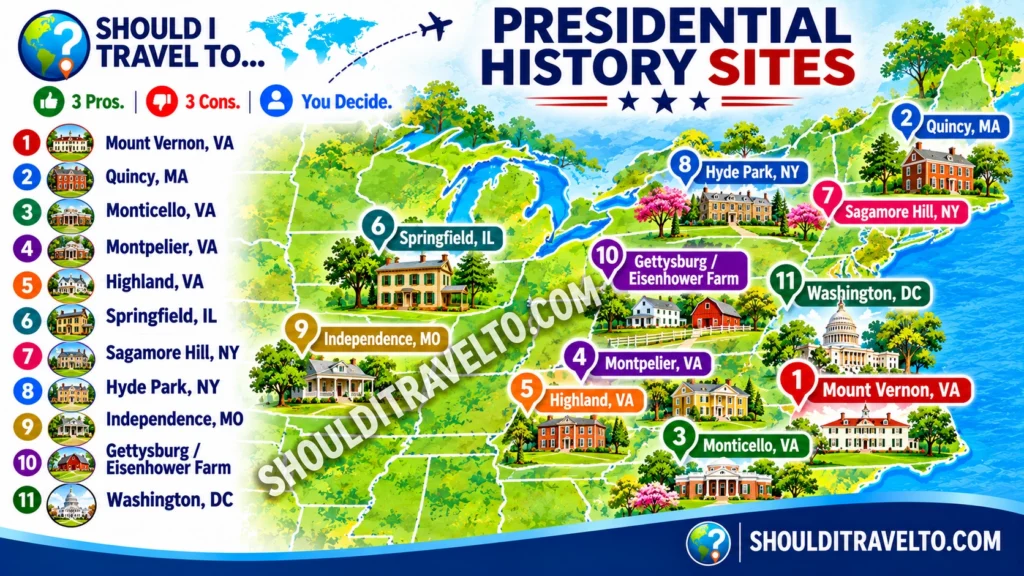
Why Travel to Presidential History Sites?
Presidential history lets you explore American history through the places where decisions were made, families lived, political careers developed, and major events unfolded.
But a presidential history trip offers more than learning about the presidents themselves.
Historic Places Reveal the People Behind the Office
People often remember a president’s public life through elections, speeches, legislation, wars, and major national decisions.
Historic homes and communities can reveal another side of that story.
Mount Vernon introduces Washington as a landowner, Revolutionary War commander, family member, and retired president.
Springfield lets visitors explore Lincoln’s life before the White House, including the neighborhood where he raised his family and built his political career.
Hyde Park connects Franklin Roosevelt’s presidency with his lifelong home, personal relationships, and the Hudson Valley landscape.
These places help explain the difference between the public institution of the presidency and the individuals who occupied it.
Presidential Destinations Connect Major Chapters of American History
The history of the presidency is closely connected to the history of the United States.
Washington, Adams, Jefferson, Madison, and Monroe connect visitors with the Revolution, Constitution, early republic, and territorial expansion.
Lincoln’s presidency connects directly with the Civil War, slavery, emancipation, and the preservation of the Union.
Theodore Roosevelt’s era introduces industrialization, conservation, reform movements, and America’s expanding international role.
Franklin Roosevelt’s presidency encompasses the Great Depression, New Deal, World War II, and major changes in the federal government’s responsibilities.
Harry Truman’s presidency connects the end of World War II with the early Cold War, the Korean War, and the emerging postwar international order.
A presidential history trip can therefore introduce an entire historical period rather than a biography of one person.
Presidential History Can Be Part of a Larger American History Vacation
Many presidential sites are close to other important historical destinations.
Combine Mount Vernon with Washington, DC.
Monticello, Montpelier, and Highland form a Virginia itinerary connecting three consecutive presidents.
Quincy pairs well with Boston’s Revolutionary history.
Hyde Park fits naturally into a broader Hudson Valley itinerary.
Springfield offers several Lincoln-related sites within one city.
These combinations make presidential history especially useful for travelers who want to spend several days exploring a region rather than visiting a single house or museum.
The 3 Biggest Pros and 3 Biggest Cons of Presidential History Travel
Presidential history destinations can offer rewarding experiences for travelers interested in American history, architecture, politics, and cultural heritage.
But they also come with limitations. Some are geographically isolated, and some require reservations.
The 3 Biggest Pros of Presidential History Travel
1. You Can See the Person Behind the Presidency
Historic homes and preserved communities reveal the environments where presidents lived.
Visitors can explore Washington’s Mount Vernon estate, Lincoln’s Springfield neighborhood, or the Roosevelt family properties in Hyde Park.
These experiences add personal and geographic context to events often taught primarily through dates, speeches, and elections.
2. Presidential Sites Connect Different Periods of American History
The presidency provides a chronological framework for understanding major changes in the United States.
A trip focused on Jefferson and Madison can explore the early republic and constitutional government, while a Lincoln-focused visit can examine the political conflicts leading to the Civil War.
A visit to Hyde Park can connect the Great Depression, New Deal, and World War II.
Rather than studying each historical event in isolation, travelers can see how different issues and periods relate.
3. Many Destinations Can Become Complete History Vacations
Presidential history isn’t limited to one building.
Washington and Mount Vernon can fill several days. Boston and Quincy combine presidential and Revolutionary history. Virginia’s presidential estates can form a multi-day road trip.
This flexibility makes presidential history travel suitable for weekend getaways, regional road trips, and longer educational vacations.
The 3 Biggest Cons of Presidential History Travel
1. Presidential History Can Become Too Focused on the Presidents
A historic site can unintentionally make one individual appear responsible for changes that involved millions of people.
The American Revolution, the Civil War, industrialization, and the Great Depression cannot be explained solely through presidents’ decisions.
A meaningful historical trip should also examine the experiences of political opponents and others whose lives were affected by the events being interpreted.
The most useful presidential sites place individual presidents within the larger history of their time.
2. Some Sites Require a Car and Significant Travel
Many presidential homes are outside major urban tourism districts.
Monticello, Montpelier, Highland, Mount Vernon, and Sagamore Hill require more transportation planning than a museum in central Washington.
Even sites within the same region may be far enough apart that visiting several in one day becomes rushed.
Travelers without cars should carefully review transportation options before building an itinerary.
3. Historic Sites Vary Considerably in Scope and Visitor Experience
Not every presidential destination requires the same amount of time.
Some historic homes can be visited in a few hours. Others are part of larger landscapes with museums, exhibitions, gardens, walking trails, and additional historical sites.
Interior tours may require reservations or operate seasonally. Some buildings have limited accessibility because of their age and preservation requirements.
A presidential home that looks like a quick stop on a map may require more planning than expected.
What Kind of Presidential History Do You Want to Explore?
The most useful way to choose a destination is to begin with the historical subject that interests you.
| Era | Destinations | Main historical focus |
| Founding Era | Mount Vernon, Quincy, Monticello, Montpelier, Highland | Revolution, Constitution, early republic |
| Jacksonian Era | The Hermitage | Presidential power |
| Civil War Era | Springfield | Lincoln’s development and the Civil War |
| Progressive Era | Sagamore Hill | Theodore Roosevelt, reform, conservation |
| Great Depression and World War II | Hyde Park | Franklin and Eleanor Roosevelt |
| World War II and Cold War | Independence, Eisenhower Farm | Truman and Eisenhower |
| The Presidency Itself | Washington, DC | The presidency across administrations |
You can also pick the destination based on what you want to understand.
| If you want to understand… | Start with… |
| George Washington and the creation of presidential precedent | Mount Vernon, Virginia |
| John Adams, John Quincy Adams, and an early presidential family | Quincy, Massachusetts |
| Thomas Jefferson and the contradictions of the early republic | Monticello, Virginia |
| James Madison, the Constitution, and the Bill of Rights | Montpelier, Virginia |
| James Monroe and early American expansion | Highland, Virginia |
| Abraham Lincoln’s life before the presidency | Springfield, Illinois |
| Theodore Roosevelt and the Progressive Era | Sagamore Hill, New York |
| Franklin and Eleanor Roosevelt, the New Deal, and World War II | Hyde Park, New York |
| Harry Truman and postwar America | Independence, Missouri |
| Eisenhower, World War II, and the Cold War | Gettysburg / Eisenhower Farm |
| The presidency as a national institution | Washington, DC |
A traveler interested in the Constitution may prefer Montpelier. Someone studying Lincoln’s early life may choose Springfield. A visitor who wants several centuries of presidential history in one city may prefer Washington.
The right destination depends on the question you want your trip to answer.
Founding-Era Presidential History Sites
The Founding Era offers several presidential destinations that connect the American Revolution, Constitution, early republic, and the country’s expansion.
Five destinations are particularly useful for exploring this period.
Mount Vernon, Virginia: George Washington
Presidential identity: The Presidency Begins
Mount Vernon introduces visitors to Washington as more than the nation’s first president.
He was a Revolutionary War commander, plantation owner, political leader, and central figure in establishing the new federal government.
Washington’s presidency established important precedents concerning executive authority, the cabinet, public conduct, and the peaceful transfer of power.
The grounds, historic buildings, exhibitions, and landscape of Mount Vernon help connect Washington’s public achievements with the social and economic realities of his private life.
What makes Mount Vernon different: This is where travelers can explore Washington’s life before, during, and after the presidency, including the decision to relinquish power and return to private life.
Don’t miss: The mansion, grounds, Washington’s tomb, and museum exhibitions.
Biggest trade-off: Mount Vernon is outside central Washington, and a complete visit requires more time than a quick stop at a monument.
Best for: First-time presidential history travelers, Revolutionary War enthusiasts, and visitors combining Mount Vernon with Washington, DC.
Suggested visit: Most of a day at Mount Vernon, or three to four days when combined with Washington.
Explore more: Should I Travel To … Mount Vernon?
Quincy, Massachusetts: John Adams and John Quincy Adams
Presidential identity: America’s First Presidential Dynasty
Quincy offers something unusual: a single destination associated with two presidents from the same family.
Adams National Historical Park preserves the birthplaces of John Adams and John Quincy Adams, the Old House at Peace field, and the Stone Library.
Together, these places introduce several generations of the Adams family and their involvement in American political, diplomatic, and intellectual life.
John Adams connects visitors with the Revolution, independence, diplomacy, and the early presidency.
John Quincy Adams connects the story with American diplomacy, the presidency, and his later congressional career.
The experiences of Abigail Adams, Louisa Catherine Adams, and other family members also provide important perspectives on the political and social worlds surrounding the two presidents.
What makes Quincy different: Instead of focusing on one president, Quincy reveals how public service, politics, family relationships, and national events intersected across generations.
Don’t miss: The Adams birthplaces when accessible, Peace Field, the Stone Library, and nearby Adams family landmarks.
Biggest trade-off: Historic-house access can be seasonal or limited, so visitors should check the current tour schedule before traveling.
Best for: Founding Era enthusiasts, travelers interested in early American diplomacy, and visitors exploring Boston’s Revolutionary history.
Suggested visit: One day in Quincy, or three to four days when combined with Boston.
Monticello, Virginia: Thomas Jefferson
Presidential identity: The Ideas and Contradictions of the Early Republic
Monticello, near Charlottesville, Virginia, was the home and plantation of Thomas Jefferson, the nation’s third president.
Jefferson’s life connects several major chapters of early American history.
He was the principal author of the Declaration of Independence, served as president during the Louisiana Purchase, and pursued interests in architecture, science, agriculture, and education.
Monticello reflects those intellectual interests through its architecture, landscape, collections, and relationship with the nearby University of Virginia.
What makes Monticello different: It allows travelers to examine the relationship between revolutionary ideals, political power, architecture, and everyday life in the early United States.
Don’t miss: The house, grounds, Mulberry Row, exhibitions, and the historical interpretation of Sally Hemings and her family.
Biggest trade-off: Monticello is not simply an architectural attraction. Visitors who want to understand its history should allow time for exhibitions and interpretation beyond the main house tour.
Best for: Travelers interested in the Declaration of Independence, Jefferson, architecture, and the early republic.
Suggested visit: Most of a day at Monticello, or two days when combined with Charlottesville.
Montpelier, Virginia: James Madison
Presidential identity: The Constitution President
James Madison’s Montpelier estate in Orange County, Virginia, connects visitors with the formation of the United States Constitution, the Bill of Rights, and the development of the early federal government.
Madison played a central role in the Constitutional Convention and later served as the nation’s fourth president.
His presidency included the War of 1812, making Montpelier relevant to both the creation of the constitutional system and the challenges the young republic faced.
What makes Montpelier different: It connects the design of American constitutional government with the society in which that government emerged.
Don’t miss: The mansion, constitutional history interpretation, exhibits, and the estate landscape.
Biggest trade-off: Montpelier is a rural destination and generally requires a car. It works especially well as part of a larger Virginia history itinerary.
Best for: Visitors interested in the Constitution, Bill of Rights, early American government, and the War of 1812.
Suggested visit: Several hours to most of a day, or part of a three-day presidential Virginia road trip.
Highland, Virginia: James Monroe
Presidential identity: The Early Republic Expands
James Monroe’s Highland, near Charlottesville, offers another perspective on the early American presidency.
Monroe served as the nation’s fifth president, following Washington, John Adams, Jefferson, and Madison.
His presidency is associated with the Era of Good Feelings, the Missouri Compromise, and the Monroe Doctrine, a key statement of American foreign policy.
Highland was Monroe’s plantation and part-time residence for many years.
Its proximity to Monticello makes the geographical relationship between Monroe and Jefferson part of the visitor experience.
What makes Highland different: It connects the early republic’s expansion and foreign-policy development with the plantation world of Virginia’s presidential families.
Don’t miss: The historic landscape, exhibitions, reconstructed and surviving historic features.
Biggest trade-off: Highland is smaller in scale than some presidential destinations and may be most rewarding when combined with Monticello and other nearby sites.
Best for: Travelers interested in Monroe, early American foreign policy, and Virginia’s presidential history.
Suggested visit: Several hours, preferably as part of a Charlottesville-area itinerary.
Three Presidents. One Virginia Road Trip.
Monticello, Montpelier, and Highland can form a distinctive presidential history road trip.
Thomas Jefferson, James Madison, and James Monroe served consecutively as the third, fourth, and fifth presidents of the United States.
Their homes connect visitors to the early republic, constitutional government, territorial expansion, and Virginia’s political culture.
Rather than visiting three unrelated historic houses, travelers can use the region to explore how these presidents knew one another, how their political ideas overlapped and differed, and how plantation society shaped their lives.
Suggested duration: Three days.
Spend one day at Monticello and in Charlottesville, another at Montpelier, and a third exploring Highland and additional Charlottesville-area history.
The itinerary is particularly suitable for travelers with a car who want a concentrated Founding Era history trip.
Presidential History Sites for the Jacksonian Era
Nashville, Tennessee: Andrew Jackson’s Hermitage
Presidential identity: The Expansion of Presidential Power
The Hermitage, near Nashville, Tennessee, was the home and plantation of Andrew Jackson, the nation’s seventh president.
Jackson’s presidency marked a significant period in American political development.
His administration saw expanded political participation among white men, major conflicts over federal authority, debates over the national bank, and a growing presidential influence.
The Hermitage provides an opportunity to examine these developments alongside Jackson’s personal life and plantation economy.
Visitors can explore the mansion, historic grounds, gardens, and exhibitions.
The property helps connect Jackson’s public career with the society in which he lived and the consequences of policies pursued during his administration.
What makes The Hermitage different: It connects the development of presidential power and Jacksonian-era politics with the changing history of the United States in the 19th century.
Don’t miss: The mansion, historic grounds, and exhibitions.
Biggest trade-off: The Hermitage requires transportation outside central Nashville, and visitors should approach the site as a complex historical experience rather than simply a tour of a presidential mansion.
Best for: Travelers interested in Andrew Jackson, early 19th-century politics, and presidential power.
Suggested visit: Several hours at The Hermitage, or two to three days when combined with Nashville.
Why visit: Andrew Jackson • Jacksonian Era • Presidential Power • Early 19th-Century America
Presidential History Sites for the Civil War Era
Springfield, Illinois: Abraham Lincoln
Presidential identity: The Making of Abraham Lincoln
Washington, DC, tells much of the story of Abraham Lincoln’s presidency.
Springfield tells the story of the life and political career that preceded it.
Lincoln lived in Springfield for approximately 24 years, practicing law, raising a family, and developing the political career that eventually brought him to the White House.
The Lincoln Home was the only house Lincoln ever owned. He and his family lived there for 17 years before moving to Washington.
Today, Springfield offers several important Lincoln-related destinations, including Lincoln Home National Historic Site, the Old State Capitol, the Abraham Lincoln Presidential Library and Museum, and Lincoln Tomb.
Together, these places allow visitors to explore Lincoln’s family life, legal career, political development, presidency, and legacy.
The preserved neighborhood around the Lincoln Home is particularly valuable because it places the family within the community where Lincoln lived before becoming president.
What makes Springfield different: It offers a broader Lincoln-focused historical experience, not just a single memorial or museum.
Don’t miss: Lincoln Home National Historic Site, the Old State Capitol, the Abraham Lincoln Presidential Library and Museum, and Lincoln Tomb.
Biggest trade-off: Springfield is a destination that requires deliberate travel for many visitors. Its appeal is strongest for those who want to spend significant time exploring Lincoln-related history.
Best for: Civil War history enthusiasts, Lincoln-focused travelers, families interested in American history, and visitors seeking an educational regional getaway.
Suggested visit: Two to three days.
The distinction is simple: Washington, DC, shows you President Lincoln. Springfield shows you how Lincoln became president.
Presidential History Sites for the 20th Century
The 20th century transformed the presidency.
Industrialization, reform movements, two world wars, the Great Depression, and the Cold War changed both the United States and the federal government’s responsibilities.
Three destinations help visitors explore different parts of that transformation.
Oyster Bay, New York: Theodore Roosevelt
Presidential identity: The Progressive Presidency
Sagamore Hill National Historic Site, in Oyster Bay on Long Island, was the home of Theodore Roosevelt and his family.
During Roosevelt’s presidency, it also served as his Summer White House.
The property connects visitors with Roosevelt’s family life, political career, conservation interests, foreign policy, and the Progressive Era.
Roosevelt’s presidency unfolded amid industrial expansion, debates over corporate power, labor issues, and changing ideas about the federal government’s role in American society.
Sagamore Hill offers a personal setting for examining those national developments.
The home and surrounding grounds also provide insight into Roosevelt’s interests outside formal politics.
What makes Sagamore Hill different: It connects a major Progressive Era figure with the domestic environment and landscape that shaped his public and private life.
Don’t miss: The Theodore Roosevelt Home (when tours are available), the grounds, historic exhibits, and the surrounding Oyster Bay area.
Biggest trade-off: Sagamore Hill requires transportation planning, and interior access depends on guided-tour availability.
Best for: Travelers interested in Theodore Roosevelt, conservation history, the Progressive Era, and presidential homes.
Suggested visit: Several hours at Sagamore Hill, or two to four days when combined with Long Island and New York City.
Hyde Park, New York: Franklin D. Roosevelt and Eleanor Roosevelt
Presidential identity: The Modern Presidency
Hyde Park, in New York’s Hudson Valley, offers one of the most comprehensive presidential history experiences in the country.
Franklin D. Roosevelt’s lifelong home, Springwood, connects visitors with his family background, political life, and presidency.
Nearby, the Franklin D. Roosevelt Presidential Library and Museum explores the Great Depression, New Deal, World War II, and the expansion of the federal government’s role in American life.
It was the nation’s first presidential library.
Eleanor Roosevelt’s Val-Kill adds another important dimension, introducing her independent public life, social activism, and work on human rights.
Together, these sites offer a more complete picture of the Roosevelt era than any single house or museum could.
Hyde Park also places the presidential story within the Hudson Valley, a region associated with Revolutionary War history, river commerce, historic estates, art, and the development of the United States.
What makes Hyde Park different: It combines a presidential home, a presidential library, and a historic site associated with an influential first lady within one destination.
Don’t miss: Springwood, the FDR Presidential Library and Museum, Eleanor Roosevelt’s Val-Kill, and the surrounding historic landscape.
Biggest trade-off: The attractions require time, and visitors who rush through Hyde Park may miss much of the museum and historical interpretation.
Best for: Travelers interested in Franklin Roosevelt, Eleanor Roosevelt, the Great Depression, New Deal, World War II, and 20th-century American history.
Suggested visit: One to two days for the Roosevelt sites, or two to three days as part of a broader Hudson Valley trip.
Independence, Missouri: Harry S. Truman
Presidential identity: The Presidency Comes Home
Independence, Missouri, introduces visitors to Harry S. Truman through his longtime home, community, and presidential library.
Truman’s presidency began during the final months of World War II and extended into the early Cold War.
His administration confronted major decisions involving the war’s conclusion, postwar reconstruction, the creation of new international institutions, the Berlin Airlift, the Korean War, and civil rights.
The Harry S. Truman National Historic Site preserves the Truman Home in Independence and the Truman Farm Home in nearby Grandview.
Next, the Harry S. Truman Presidential Library and Museum provides additional historical context through documents, artifacts, and exhibitions.
Together, these sites connect national and international events with the life of a president who maintained a strong personal connection to his Missouri community.
What makes Independence different: It places a major 20th-century presidency within a relatively ordinary American community rather than a grand estate or national capital.
Don’t miss: The Truman Home (when accessible), the Truman Presidential Library and Museum, and historic Independence.
Biggest trade-off: Independence works best for travelers interested in Truman or broader Kansas City-area history, not those expecting a large, resort-style tourist destination.
Best for: Travelers interested in World War II, the Cold War, postwar America, and presidential libraries.
Suggested visit: One day in Independence, or two to three days when combined with Kansas City.
Gettysburg, Pennsylvania: Dwight D. Eisenhower
Presidential identity: From World War II to the Cold War
Eisenhower National Historic Site, near Gettysburg, Pennsylvania, preserves the home and farm of Dwight D. Eisenhower and his wife, Mamie.
Eisenhower’s career connects two major chapters of 20th-century American history.
As Supreme Allied Commander in Europe during World War II, Eisenhower played a central role in coordinating Allied military operations, including the Normandy invasion.
He later served as the nation’s 34th president during a period defined by the Cold War, nuclear competition, economic growth, and the United States’ expanding international responsibilities.
The Eisenhower Farm
The Eisenhower farm provides a personal setting for examining both chapters.
Located adjacent to Gettysburg National Military Park, the property served as a family retreat and a place where Eisenhower met with foreign leaders during his presidency.
Visitors can explore the historic grounds, learn about Eisenhower’s military and political careers, and examine the relationship between his personal life and public responsibilities.
The site’s proximity to Gettysburg creates a particularly interesting historical combination. Gettysburg connects visitors with the Civil War and Abraham Lincoln’s presidency.
The Eisenhower Farm introduces World War II and the Cold War.
Together, they let travelers explore different periods of American conflict, military leadership, and presidential history in one destination.
What makes Eisenhower National Historic Site different: It connects a World War II military leader and Cold War president with one of the country’s most important Civil War landscapes.
Don’t miss: The Eisenhower home when tours are available, historic grounds, farm landscape, and nearby Gettysburg National Military Park.
Biggest trade-off: Interior tours operate on select dates and seasonally, so visitors should verify availability before traveling. The Gettysburg area is generally easier to explore by car.
Best for: Travelers interested in Dwight Eisenhower, World War II, the Cold War, military history, and Gettysburg.
Suggested visit: Several hours at the Eisenhower farm, or two to three days when combined with Gettysburg.
Why visit: Dwight Eisenhower • World War II • Cold War • Presidential Retreat • Gettysburg • Military History
Washington, DC: Understanding the Presidency
Presidential identity: The Office of the Presidency
Washington, DC, deserves its own category because it is fundamentally different from the presidential homes in this guide.
While Mount Vernon, Monticello, Springfield, and Hyde Park introduce visitors to individual presidents and their lives, Washington explores the presidency as a national institution.
Presidents have worked, been inaugurated, made major decisions, and been memorialized here.
The White House represents the presidency as both an official residence and the executive branch’s center, and the Washington Monument commemorates the nation’s first president.
The Lincoln Memorial connects visitors to the Civil War, emancipation, national unity, and how later generations have remembered Lincoln, and the Jefferson Memorial commemorates the author of the Declaration of Independence and third president.
Ford’s Theatre connects visitors directly with Lincoln’s assassination.
The National Portrait Gallery, Smithsonian museums, and other institutions offer additional perspectives on the presidency, American politics, and the country’s changing identity.
Washington is also useful because presidential history here is not limited to a single administration.
A visitor can explore the Founding Era, Civil War, 20th-century history, and modern government during one trip.
What makes Washington different: It connects presidential history across multiple administrations and centuries through memorials, museums, government buildings, and historic places.
Don’t miss: The White House exterior and any available prearranged tour, the Washington Monument, the Lincoln Memorial, the Jefferson Memorial, Ford’s Theatre, the National Portrait Gallery, and selected Smithsonian museums.
Biggest trade-off: Washington has more presidential history than most visitors can reasonably cover in a short trip. Some sites require advance arrangements, and the National Mall involves a lot of walking.
Best for: First-time presidential history travelers, families, museum enthusiasts, and visitors interested in the presidency as an institution.
Suggested visit: Three to five days.
Presidential homes show you the presidents. Washington shows you the presidency.
Which Presidential History Destination Should You Choose?
Each destination answers a different historical question.
| Your main interest | Destination to consider |
| The first president and presidential precedent | Mount Vernon |
| Two presidents from one family | Quincy |
| Jefferson and the Declaration of Independence | Monticello |
| The Constitution and Bill of Rights | Montpelier |
| Monroe and the early republic | Highland |
| Lincoln’s life before the White House | Springfield |
| Theodore Roosevelt and Progressive America | Sagamore Hill |
| FDR, Eleanor Roosevelt, and the modern presidency | Hyde Park |
| Truman and postwar America | Independence |
| The presidency across American history | Washington, DC |
| Several Founding Era presidents in one trip | Virginia presidential road trip |
| Presidential and Revolutionary history together | Boston and Quincy |
| A presidential library and historic home together | Hyde Park or Independence |
If you are interested in the founding of the presidency, Mount Vernon provides a direct connection with George Washington.
If you want to explore the ideas and contradictions of the early republic, Monticello and Montpelier offer different but complementary experiences.
Or, if Lincoln is your primary interest, Springfield lets you focus on his life before the presidency.
If you want to understand how the federal government changed during the Great Depression and World War II, Hyde Park provides a concentrated Roosevelt-era experience.
And if you want to explore multiple presidents and the presidency as an institution, Washington offers the broadest chronological range within one city.
The most useful destination is the one that answers the historical questions you’re bringing to the trip.
Best Presidential History Road Trips
Presidential history can be especially rewarding when you combine several related destinations into one itinerary.
These trips offer different ways to explore the subject.
Washington, DC + Mount Vernon
Theme: The Presidency and the First President
Suggested duration: 3–4 days
Begin in Washington, DC, where the White House, presidential memorials, museums, and historic sites introduce the presidency.
Then travel to Mount Vernon to explore Washington’s life as a Revolutionary leader, plantation owner, first president, and private citizen.
This combination allows visitors to compare the national institution Washington helped establish with the estate to which he returned after leaving office.
Best for: First-time presidential history travelers and visitors who want a combination of museums, monuments, and a historic home.
Biggest trade-off: Washington requires considerable walking, while Mount Vernon requires additional transportation planning.
Mount Vernon + Monticello + Montpelier
Theme: Explore Virginia’s Presidential History
Virginia offers an unusually concentrated collection of historic sites associated with the early American presidency.
Mount Vernon, Monticello, and Montpelier introduce three connected but distinct chapters of the Founding Era:
Mount Vernon, George Washington: Establishing the presidency and its precedents.
Monticello, Thomas Jefferson: The Declaration of Independence and revolutionary ideals.
Montpelier, James Madison: The Constitution, Bill of Rights, and development of the American system of government.
James Monroe’s Highland adds another chapter, connecting the early republic with territorial expansion and the development of American foreign policy.
Together, these four destinations provide a framework for exploring four of the nation’s first five presidents.
They also invite visitors to examine the contradiction between the ideals of liberty these political leaders expressed.
Two ways to explore Virginia’s presidential history: For a concentrated Charlottesville-area trip, combine Monticello, Montpelier, and Highland over approximately three days.
For a broader Founding Era road trip, add Mount Vernon and Washington, DC, and allow about five to seven days, depending on your interests.
Visit four presidential homes and understand how the early American presidency developed within the political, social, and economic world of the Founding Era.
Boston + Quincy
Theme: Revolutionary Boston and America’s First Presidential Family
Suggested duration: 3–4 days
Begin with Boston’s Revolutionary history, including the Freedom Trail and other sites associated with the movement toward independence.
Then visit Quincy to explore the lives of John Adams, John Quincy Adams, and the broader Adams family.
This trip connects Revolutionary Massachusetts’ political environment with the personal and family history of two early presidents.
Best for: Travelers interested in the Revolution, early American politics, and New England history.
Biggest trade-off: Access to the historic Adams properties varies by season, and visitors should confirm tour arrangements before traveling.
Hudson Valley + Hyde Park
Theme: From the American Revolution to the Modern Presidency
Suggested duration: 2–3 days
The Hudson Valley offers a broad range of American history, including Revolutionary War sites, historic estates, river communities, and cultural landmarks.
Hyde Park adds Franklin and Eleanor Roosevelt to that story.
Visit Springwood, the FDR Presidential Library and Museum, and Val-Kill, then use the surrounding region to explore other periods of American history.
The result is a trip that connects regional history with the Great Depression, World War II, and the modern presidency.
Best for: Travelers interested in FDR, Eleanor Roosevelt, the Hudson Valley, and multi-period American history.
Biggest trade-off: Attractions are spread across the region, so a car and careful itinerary planning are helpful.
Springfield, Illinois: The Lincoln History Trip
Theme: The Making of Abraham Lincoln
Suggested duration: 2–3 days
Springfield works as a concentrated Lincoln-focused history trip.
Visit the Lincoln Home and preserved neighborhood, explore the Old State Capitol, spend time at the Abraham Lincoln Presidential Library and Museum, and visit Lincoln Tomb.
Together, these sites allow travelers to follow Lincoln’s life from his Springfield years through his presidency and remembrance.
Best for: Civil War enthusiasts, Lincoln-focused travelers, and families interested in American history.
Biggest trade-off: Springfield’s main appeal is its historical concentration, not a broad mix of unrelated tourist attractions.
Gettysburg + Eisenhower National Historic Site
Theme: From the Civil War to World War II and the Cold War
Suggested duration: 2–3 days
Gettysburg offers a distinctive opportunity to explore several chapters of American history within one destination.
Begin at Gettysburg National Military Park, where the July 1863 battle became a turning point in the Civil War.
Visit the battlefield, Gettysburg National Cemetery, and sites associated with Abraham Lincoln’s Gettysburg Address.
Then explore Eisenhower National Historic Site, the home and farm of Dwight and Mamie Eisenhower.
Eisenhower’s military career during World War II and his presidency during the Cold War provide a different perspective on American military leadership and national responsibilities.
Together, they connect the Civil War, World War II, and the Cold War through two presidents from different periods of American history.
Best for: Civil War enthusiasts, World War II history travelers, presidential history enthusiasts, and visitors interested in military history.
Biggest trade-off: The Gettysburg battlefield covers a large area, and the Eisenhower home has limited tour availability. Plan transportation and reservations carefully.
How Many Days Do You Need for Presidential History Travel?
The amount of time you need depends on whether you are visiting one historic property or exploring an entire region.
| Destination or combination | Suggested trip length |
| Mount Vernon + Washington, DC | 3–4 days |
| Quincy + Boston | 3–4 days |
| Monticello + Charlottesville | 2 days |
| Monticello + Montpelier + Highland | 3 days |
| Springfield, Illinois | 2–3 days |
| Sagamore Hill + Long Island/New York City | 2–4 days |
| Hyde Park + Hudson Valley | 2–3 days |
| Independence + Kansas City | 2–3 days |
| Washington, DC alone | 3–5 days |
| The Hermitage + Nashville | 2–3 days |
| Eisenhower National Historic Site + Gettysburg | 2-3 days |
| Mount Vernon + Monticello + Montpelier + Highland + Washington | 5-7 days |
These are suggested vacation lengths, not the amount of time required to tour each historic property.
A single presidential home may take only a few hours, but traveling to the region, visiting nearby attractions, and allowing time for museums can justify a longer stay.
If you have only one day, choose a destination where several related attractions are close together.
If you have a long weekend, consider Springfield, Hyde Park, Charlottesville, or Independence.
But, if you have several days, Washington, Boston and Quincy, or a Virginia presidential road trip can support a broader historical itinerary.
Planning Your Presidential History Trip
Presidential history travel rewards advance planning, particularly when your itinerary includes historic homes with limited tour capacity or several destinations in one region.
Choose the Historical Period Before the Destination
Start with the question you want your trip to answer.
Are you interested in the Founding Era, Constitution, Civil War, Progressive Era, Great Depression, World War II, or Cold War?
Choosing a historical period can help narrow the destination list and create a more coherent itinerary.
A traveler interested in constitutional history may prefer Montpelier and nearby Founding Era sites.
Someone interested in World War II and the postwar period may find Hyde Park and Independence especially relevant.
Check Tour Availability Before Booking
Historic homes may require advance reservations, guided tours, or timed admission.
Some properties operate seasonally or restrict access to particular rooms and buildings.
Before making nonrefundable travel arrangements, check each historic site’s official website.
Pay particular attention to opening days, tour times, ticket availability, accessibility information, and any temporary closures.
Decide Whether You Need a Car
Transportation requirements vary significantly.
Washington, DC, offers public transportation and many attractions within established visitor areas.
You can incorporate Quincy into a Boston-area trip, although access to individual historic properties requires planning.
Virginia’s presidential estates, Sagamore Hill, and the broader Hudson Valley are generally easier to explore by car.
If you prefer not to drive, choose destinations with practical public transportation or organized tour options.
Allow Time for Museums and Historical Interpretation
Don’t judge a presidential destination solely by the time required to tour the main house.
Museums, exhibits, grounds, and interpretation of the surrounding community may be essential to understanding the site.
At Monticello and Montpelier, slavery-related interpretation provides important historical context.
At Hyde Park, the presidential library adds substantial depth beyond the historic home.
In Springfield, the museum and other Lincoln sites broaden the experience beyond the house where he lived.
Build enough time into your schedule to explore the history rather than simply photograph the buildings.
Consider the Season
Many presidential history destinations are open year-round, but the experience changes with the season.
Spring and fall can offer comfortable conditions for walking through historic neighborhoods, estates, and gardens.
Summer may provide longer daylight hours and additional programming, but heat and crowds can affect some destinations.
Winter may offer quieter conditions at certain sites, although seasonal closures, weather, and reduced tour availability can limit access.
Check the current operating calendar rather than assuming every attraction is open year-round.
Presidents’ Day vs. Presidential History Travel
Presidents’ Day provides a natural opportunity to explore American presidential history, but it shouldn’t determine when you take the trip.
The federal holiday, officially Washington’s Birthday, is observed on the third Monday in February.
Museums, historic sites, and educational institutions may offer special programming around the holiday, making February a useful time to discover presidential history destinations.
But these places are not February-only attractions.
In fact, winter can be a less convenient time to visit some historic estates because of weather, seasonal tours, or limited access.
Mount Vernon, Monticello, Springfield, Hyde Park, and Washington each offer experiences you can explore at other times of year.
If Presidents’ Day inspires your interest, use it as a reason to begin planning.
Then choose the season that best fits the destination and the experience you want.
Who Should Travel for Presidential History?
Presidential history travel suits travelers who enjoy museums, historic homes, political history, architecture, and educational vacations.
It can appeal to families introducing children to American history, adults revisiting subjects they studied in school, and enthusiasts interested in specific presidents or historical periods.
It also suits travelers who enjoy combining historic sites with larger city or regional vacations.
Boston, Washington, the Hudson Valley, and Charlottesville offer opportunities to explore other attractions alongside presidential history.
But presidential history travel may be less appealing to visitors who prefer resort vacations, nightlife, beaches, or itineraries with little advance planning.
Some destinations require substantial driving, walking, reading, or museum time.
That doesn’t make those destinations less valuable. It means visitors should understand the experience before choosing it.
The Decision Is Yours
So, where should you travel to explore presidential history?
That depends on which part of American history you want to understand.
At Mount Vernon, you can explore George Washington’s life and the precedents established by the first presidency, while at Quincy, you can examine two presidents and several generations of one family.
At Monticello, you can explore Thomas Jefferson’s ideas and the early republic, while at Montpelier, you can connect James Madison with the Constitution and the challenges of early American government.
And at Highland, you can learn about James Monroe and the country’s changing position in the world.
Springfield reveals the community and political environment that shaped Abraham Lincoln before the Civil War.
Sagamore Hill introduces Theodore Roosevelt and the Progressive Era.
Hyde Park connects Franklin and Eleanor Roosevelt with the Great Depression, New Deal, and World War II.
Independence offers a personal perspective on Harry Truman and postwar America.
At The Hermitage, you can explore Andrew Jackson’s presidency and the expansion of executive power.
At Gettysburg, Eisenhower’s farm connects World War II and the Cold War with a landscape already closely associated with Abraham Lincoln and the Civil War.
And Washington, DC, brings the presidency into focus across more than two centuries of American history.
You don’t need to visit every presidential home to have a meaningful historical vacation.
Choose the subject that interests you, allow enough time to explore the surrounding history, and consider the people and events beyond the presidency itself.
Because presidential history isn’t only the story of presidents.
It’s also the story of the country they governed, and the millions of people whose lives were shaped by the decisions made during their administrations.
Choose the chapter first. Then choose the destination.
3 Pros. 3 Cons. You Decide.
Presidential History Sites Frequently Asked Questions
What is the difference between a presidential home and a presidential library?
A presidential home focuses on a place where a president lived, while a presidential library generally preserves records, artifacts, and museum exhibits associated with a presidency. Some destinations, such as Hyde Park, offer both.
Can you visit presidential history sites without a car?
Yes, especially in Washington, DC, and parts of the Boston area. However, many rural presidential estates are easier to reach by car, and public transportation may not provide direct access.
Which presidential destinations are useful for learning about the Founding Fathers?
Mount Vernon, Quincy, Monticello, Montpelier, and Highland connect visitors with different figures and issues of the Founding Era. Each emphasizes a different part of early American history.
Where can you learn about Abraham Lincoln beyond Washington, DC?
Springfield, Illinois, offers the Lincoln Home, Old State Capitol, Abraham Lincoln Presidential Library and Museum, and Lincoln Tomb. It is particularly useful for exploring Lincoln’s life before the presidency.
Are presidential history destinations suitable for families?
Many offer family-oriented exhibitions, educational programs, and opportunities to explore historic buildings and grounds. The experience varies by location, so families should check age-appropriate activities, tour lengths, and accessibility before visiting.
Is Presidents’ Day a good time to visit presidential sites?
It can be, especially when sites offer holiday programming. However, winter operating schedules and weather may limit some experiences, so visitors should verify availability.
Can you combine several presidential homes into one road trip?
Yes. Monticello, Montpelier, and Highland form a Virginia itinerary associated with Jefferson, Madison, and Monroe. Other useful combinations include Washington and Mount Vernon, Boston and Quincy, and Hyde Park with the broader Hudson Valley.
Can you combine presidential history with Civil War or military history?
Yes. Springfield, Illinois, connects Abraham Lincoln’s life with the Civil War, while Gettysburg, Pennsylvania, combines Civil War history with Dwight Eisenhower’s World War II and Cold War legacy. Washington, DC, also includes numerous military memorials and museums that complement its presidential attractions.