

Should You Visit New York City to Explore the End of the American Revolution?
Quick Answer
Yes, you should visit New York City for Evacuation Day if you’re interested in the American Revolution, George Washington, American independence, or the events that marked the end of British occupation in the United States.
Evacuation Day commemorates November 25, 1783, when the last British troops departed New York City and George Washington returned with American forces.
It was one of the final symbolic moments of the American Revolution.
The British had occupied New York City since September 1776. For more than seven years, the city served as a major British military headquarters and base of operations.
Even after the American victory at Yorktown in 1781, the British kept New York under control.
The Treaty of Paris formally ended the war in September 1783, but British forces did not complete their withdrawal from New York City until November 25.
That day became known as Evacuation Day.
Today, visitors can explore historic Lower Manhattan sites connected to the British occupation, Washington’s return, and the early history of the United States.
The most important stop is Fraunces Tavern Museum, where Washington later said farewell to his officers.
Bowling Green and the surrounding Financial District also offer opportunities to explore the area tied to the British departure and the return of American authority.
But Evacuation Day isn’t a major modern holiday like Thanksgiving or Independence Day.
Visitors shouldn’t expect a citywide festival, large parade, or extensive entertainment program every November 25.
Instead, the experience is primarily historical.
Visit New York City for Evacuation Day if you want to explore Revolutionary War history in Lower Manhattan. Allow half a day to a full day for the historic sites, and combine them with a broader New York City vacation.
The anniversary gives a meaningful reason to visit, but the history is worth exploring year-round.

Why Visit New York City for Evacuation Day?
New York City played a major role in the American Revolution.
Today, visitors usually associate the city with Times Square, Broadway, Central Park, skyscrapers, and the Statue of Liberty.
But during the Revolutionary War, New York was one of Britain’s most important military strongholds in North America.
The city became a center for British military operations, Loyalist activity, prisoners of war, and the eventual evacuation of British forces and civilians who had supported the Crown.
That makes Evacuation Day an important part of New York’s history.
The simplest way to understand the Revolutionary War’s conclusion is through four events:
- Saratoga, 1777: The American victory helped persuade France to formally enter the war as an American ally.
- Yorktown, 1781: American and French forces defeated Cornwallis’s army, ending major military operations.
- Treaty of Paris, 1783: Britain formally recognized American independence.
- Evacuation Day, November 25, 1783: British troops completed their withdrawal from New York City, and American forces returned.
Yorktown was the decisive military victory. The Treaty of Paris formally ended the war.
But Evacuation Day was the moment New York City returned to American control. For people who had lived through seven years of occupation, that distinction mattered.
Washington’s return wasn’t simply a military procession.
It represented the end of British rule in a city that would soon become an important political center of the new nation.
Unlike some Revolutionary War destinations, where visitors explore battlefields and rural landscapes, New York lets you connect these events to a modern urban environment.
You can walk through Lower Manhattan, visit historic buildings, and discover how a city known for commerce and skyscrapers helped shape American independence.
The History of Evacuation Day
New York City During the American Revolution
When the Revolutionary War began in 1775, New York City was strategically important to both the Americans and the British.
Its harbor provided access to the Atlantic Ocean. The Hudson River offered a route into the interior. The city’s location also made it valuable for military operations throughout the region.
After the Declaration of Independence in July 1776, British forces launched a major campaign to capture New York.
The Battle of Long Island, also known as the Battle of Brooklyn, took place in August 1776.
British forces defeated Washington’s army, but the Americans escaped across the East River to Manhattan. Additional fighting followed.
Washington eventually withdrew from Manhattan, and British forces established control over New York City.
The occupation lasted until November 1783. During those years, New York became one of Britain’s principal military bases in North America.
British troops occupied buildings, established military facilities, and used the harbor to support operations. The city also became a destination for Loyalists who remained committed to the British Crown.
But occupation had consequences. Residents faced disruption, military restrictions, and uncertainty.
Prisoners of war suffered under harsh conditions, including aboard British prison ships in New York waters. The city also experienced major fires during the occupation.
New York wasn’t simply a military headquarters. War transformed it.
Why Did the British Remain in New York After Yorktown?
One of the most important details about Evacuation Day is that it occurred more than two years after the British surrender at Yorktown.
On October 19, 1781, General Charles Cornwallis surrendered his army to American and French forces at Yorktown, Virginia.
The victory made continued British military efforts to defeat the American rebellion increasingly difficult. But Yorktown didn’t end the war immediately. British troops still occupied New York City.
Diplomatic negotiations continued. And the final peace treaty wasn’t signed until September 3, 1783.
The Treaty of Paris formally recognized the United States’ independence. But withdrawing British forces from New York required additional planning.
Troops, supplies, Loyalists, and other civilians had to leave the city. The evacuation was therefore both a military operation and a major population movement.
It wasn’t simply a matter of lowering one flag and raising another.
Evacuation Day marked a triumph for the new United States.
But it also represented displacement, uncertainty, and very different experiences for people on opposing sides of the Revolution.
November 25, 1783: The British Leave New York City
By November 1783, the British evacuation was nearing completion. British forces withdrew from their remaining positions.
American troops prepared to enter the city. And residents gathered to witness the transfer of control.
On November 25, the last British troops departed.
General George Washington and New York Governor George Clinton entered the city with American forces.
The occasion included a procession through Manhattan. For supporters of independence, it was a moment of celebration.
After years of occupation, the city was once again under American authority.
One of the day’s most memorable stories involves the British flag at Fort George, near present-day Bowling Green.
According to historical accounts, British forces left their flag flying from a pole that had been made difficult to climb.
An American sailor, John Van Arsdale, removed the British flag and raised the American flag. The story became an enduring symbol of the transfer of control.
The flag-raising tradition would later become an important part of Evacuation Day commemorations. But the day’s significance extended beyond one ceremony.
It represented the end of British military occupation of New York and a major transition from war to independence.
December 4, 1783: Washington’s Farewell at Fraunces Tavern
Evacuation Day is closely connected to another important event.
On December 4, 1783, George Washington gathered with his officers at Fraunces Tavern.
The meeting took place nine days after the British departure. Washington was preparing to leave the army and return to civilian life.
His farewell was emotional. The officers had endured years of war together.
They had experienced defeats, difficult winters, shortages, and ultimately victory.
Washington’s decision to relinquish military command became an important moment in the development of the American republic. Rather than retaining military power, he returned to civilian life.
Today, Fraunces Tavern Museum preserves and interprets this history.
For visitors exploring Evacuation Day, it provides one of the strongest connections between the events of November 1783 and the surviving historic landscape of Lower Manhattan.
The 3 Biggest Reasons to Visit New York City for Evacuation Day
1. You Can Explore the Final Chapter of the American Revolution
Evacuation Day provides a different perspective on the Revolutionary War. Many historic destinations focus on battles.
Lexington and Concord tell the story of the war’s beginning. Saratoga explains a major turning point.
Valley Forge illustrates the endurance and transformation of Washington’s army. Yorktown represents the decisive military victory.
But New York City tells the story of what happened after the fighting.
The war had to end politically and militarily. British troops had to leave.
American authority had to be established. And the people who had lived through occupation had to begin a new chapter.
Evacuation Day brings those developments together.
It’s especially rewarding for travelers who have already visited other Revolutionary War sites and want to understand how the conflict concluded.
Why it matters: New York City connects the Revolution’s military victories to the practical reality of independence.
2. Fraunces Tavern and Lower Manhattan Preserve Important Historical Connections
Unlike a battlefield destination where visitors primarily explore open landscapes, New York offers a historic walking experience.
Fraunces Tavern Museum provides an opportunity to learn about Washington, the Revolutionary War, and the early United States.
Bowling Green marks an important location associated with the British departure.
Nearby streets connect visitors to Manhattan’s colonial and Revolutionary-era geography.
Other historic attractions, including Federal Hall and Trinity Church, help broaden the experience. The original colonial landscape has changed dramatically.
But visitors can still explore the places where important events occurred.
The contrast between historic locations and modern skyscrapers is part of the experience.
Why it matters: You can explore Revolutionary War history while visiting one of America’s most famous modern cities.
3. Evacuation Day Connects New York to the Larger American Revolution
New York City’s role in the Revolution is sometimes overshadowed by Boston, Philadelphia, Saratoga, and Yorktown.
But the city was central to the war.
The British campaign of 1776 helped force Washington’s army out of New York. The occupation provided Britain with an important military base.
And the final evacuation marked the restoration of American control.
For travelers following the Revolutionary War chronologically, New York provides a meaningful final chapter.
You can connect the British capture of the city in 1776 with the American return in 1783. You can also connect Washington’s farewell at Fraunces Tavern to his later resignation of military command in Annapolis.
Why it matters: Evacuation Day helps complete the story of the American Revolution rather than treating Yorktown as the only event that mattered at the war’s conclusion.
The 3 Biggest Downsides of Visiting New York City for Evacuation Day
1. Evacuation Day Isn’t a Major Modern Tourist Celebration
Evacuation Day has historical importance, but visitors shouldn’t expect the scale of a modern national holiday.
New York City doesn’t generally organize the kind of citywide celebration associated with the Macy’s Thanksgiving Day Parade or New Year’s Eve in Times Square.
Historical organizations may offer walking tours, commemorations, lectures, or other programming. But activities vary by year.
Some events may occur on a nearby weekend rather than November 25 itself. That makes advance research important.
Visitors traveling specifically for a commemorative event should verify its date, location, admission requirements, and availability.
The trade-off: Evacuation Day is more rewarding as a historical exploration than as a major annual festival.
2. Much of Revolutionary-Era New York Has Disappeared
New York City has changed dramatically since 1783. The original Fort George no longer stands.
Many colonial-era buildings have disappeared. Streets have changed.
And Lower Manhattan has become one of the world’s most recognizable financial districts.
Visitors shouldn’t expect a preserved colonial town comparable to Colonial Williamsburg.
Instead, the experience includes museums, surviving historic structures, markers, and locations tied to historical events.
You may need to imagine what the area looked like before skyscrapers, modern streets, and contemporary development.
For history enthusiasts, that can be fascinating.
Visitors expecting an extensive collection of original Revolutionary War buildings may be disappointed.
The trade-off: The historical significance is substantial, but much of the physical setting requires interpretation.
3. November Weather and Thanksgiving Travel Can Complicate the Trip
Evacuation Day falls on November 25. That’s late autumn in New York City.
Temperatures can be cool, and rain or wind may affect outdoor walking tours. The anniversary also falls close to Thanksgiving.
In some years, November 25 is Thanksgiving Day itself or part of the holiday travel period.
Hotels, transportation, restaurants, and attractions may experience increased demand.
The Macy’s Thanksgiving Day Parade and other holiday activities can also affect access and traffic in parts of Manhattan.
Visitors should account for both weather and holiday logistics.
Fortunately, most Evacuation Day historic sites can be explored at other times of year.
The trade-off: November 25 has historical significance, but it isn’t necessarily the easiest date for a Lower Manhattan walking vacation.
Why Was Evacuation Day So Important?
Evacuation Day marked the final British military withdrawal from New York City. But its importance extends beyond that event.
It represented the restoration of American control over a city occupied for more than seven years. It also demonstrated that the new United States was entering a different stage.
The struggle for independence was ending. The challenge of governing an independent country was beginning.
New York would soon play an important role in the nation’s early political development.
From 1785 to 1790, New York City served as the meeting place of the national government under the Articles of Confederation and then the Constitution.
In 1789, George Washington took the oath of office as the first president of the United States at Federal Hall.
These developments make Lower Manhattan an important place to understand the transition from revolution to republic.
Evacuation Day is therefore more than a military anniversary. It bridges the Revolutionary War and the early American government.
How New Yorkers Celebrated Evacuation Day
For generations, Evacuation Day was an important patriotic occasion in New York City.
Celebrations included ceremonies, public gatherings, and traditions associated with raising the American flag.
The anniversary helped preserve the memory of the city’s liberation from British occupation. Over time, however, its prominence declined.
Thanksgiving became an increasingly important late-November holiday. The Revolutionary generation passed away.
And New York City’s public commemorations changed.
Today, Evacuation Day is less familiar than Independence Day.
But historical organizations continue to preserve its significance through educational programming and commemorative activities.
For travelers, that creates an opportunity to discover an important historical event that many visitors overlook.
George Washington’s Return to New York
Washington’s return was particularly significant because of what had happened in 1776.
He had been forced to abandon the city during the British campaign. His army had suffered major setbacks. And the British had occupied New York for years.
In November 1783, Washington returned as the commander of the victorious American army.
The contrast was remarkable. The city he couldn’t defend was now returning to American control. But Washington’s story didn’t end there.
His farewell at Fraunces Tavern and subsequent resignation of his military commission helped establish an important precedent for civilian government.
That makes Evacuation Day part of a larger story about military leadership, political authority, and the early American republic.
Planning Your New York City Evacuation Day Trip
Best Things to Do for Evacuation Day
Fraunces Tavern Museum
Fraunces Tavern Museum should be the centerpiece of an Evacuation Day visit.
Located at 54 Pearl Street in Lower Manhattan, the museum explores the Revolutionary War, George Washington, and early US history.
The site is closely associated with Washington’s farewell to his officers on December 4, 1783.
Visitors can explore exhibits that provide context for the British occupation, the evacuation, and Washington’s military leadership.
Allow approximately one to two hours, depending on your interest in the exhibits. Check admission, hours, and special programming before visiting.
Bowling Green
Bowling Green is one of Lower Manhattan’s most important Revolutionary War locations.
The area was associated with Fort George and the events surrounding the British departure. It also connects to earlier revolutionary unrest.
In July 1776, following news of the Declaration of Independence, New Yorkers pulled down a statue of King George III that stood at Bowling Green.
That event symbolized the rejection of British royal authority. Years later, the area became associated with the final British withdrawal.
The original fort and statue are gone.
But the location provides an important connection between the beginning and end of New York’s Revolutionary War story.
Federal Hall
Federal Hall is especially useful for understanding what happened after independence.
The site is associated with the early federal government and George Washington’s inauguration as the first president in 1789.
The current building dates to the nineteenth century, not the Revolutionary era. But the location helps connect Evacuation Day with the establishment of the new government.
For travelers interested in the transition from war to nationhood, it’s a worthwhile stop.
Trinity Church and the Historic Churchyard
Trinity Church and its churchyard provide another connection to early New York history.
The churchyard contains graves associated with important figures from the colonial and early national periods.
The current church building dates from the nineteenth century.
However, the site has a much longer history. It’s a useful stop for travelers exploring Lower Manhattan’s development.
Historic Lower Manhattan Streets
A walking tour through Lower Manhattan helps visitors understand Revolutionary-era New York’s geography.
Pearl Street, Broad Street, Wall Street, Broadway, and the Bowling Green area all connect to the city’s colonial and early American history.
The streets don’t look the way they did in 1783. But understanding their historical locations can make the story more meaningful.
For the best experience, use a historically researched walking route or join a guided tour.
New York City’s Revolutionary War History Beyond Lower Manhattan
Visitors with additional time can explore other locations connected to the Revolution.
Brooklyn played a major role in the 1776 campaign.
Fort Greene Park contains the Prison Ship Martyrs’ Monument, commemorating Americans who died aboard British prison ships.
Upper Manhattan also contains sites associated with Revolutionary War fighting and fortifications.
These attractions provide a broader understanding of the war in New York. But they require additional travel.
For a focused Evacuation Day itinerary, begin with Lower Manhattan.
Suggested Evacuation Day Walking Itinerary
Recommended duration: Half a day to a full day
Begin at Bowling Green. Explore the area associated with Fort George and the final British departure.
Continue through the historic Financial District. Visit Fraunces Tavern Museum to learn about the evacuation and Washington’s farewell.
Then explore Wall Street and Federal Hall.
If time allows, continue to Trinity Church and its historic churchyard.
This route combines the end of British occupation with the beginnings of the American republic. It doesn’t reproduce every step of Washington’s original procession.
Instead, it focuses on surviving sites and accessible historic locations that help explain the events.
For visitors interested in the Revolution’s broader military history, add a separate excursion to Brooklyn or Upper Manhattan.
When Is the Best Time to Visit for Evacuation Day?
November 25: The Historical Anniversary
November 25 is the most meaningful date. It lets visitors explore sites on the anniversary of the British departure.
However, commemorative programming isn’t guaranteed. Verify events before traveling.
Spring: Best for Comfortable Walking
Spring generally offers more comfortable conditions for exploring Lower Manhattan.
It’s a good choice for visitors who want to focus on the historic sites without the complications of late-November holiday travel.
Summer: Best for Combining History With a Longer NYC Vacation
Summer offers long daylight hours and opportunities to combine Revolutionary War sightseeing with other New York attractions.
But heat, humidity, and crowds can make walking uncomfortable.
Fall: Best Overall Historical Atmosphere
October and November offer a strong combination of seasonal atmosphere and historical sightseeing.
Late November also marks the Evacuation Day anniversary. But consider the weather and Thanksgiving travel.
Winter: Best for a Museum-Focused Visit
Winter can be a good time to explore indoor attractions such as Fraunces Tavern Museum.
However, cold weather and shorter daylight hours can limit outdoor walking.
Visit on November 25 if the anniversary itself matters to you. Otherwise, spring and fall generally provide more comfortable conditions for exploring the historic sites.
How Long Do You Need?
Two to Three Hours: Historic Highlights
Enough time for a focused visit to Fraunces Tavern Museum and nearby historic locations.
This is practical for visitors already staying in Lower Manhattan.
Half a Day: Best for Most Visitors
A half day allows you to explore Bowling Green, Fraunces Tavern, Federal Hall, and surrounding historic streets.
The best option for a focused Evacuation Day experience.
Full Day: Deeper Revolutionary War History
A full day allows more time for museums, guided tours, historical interpretation, and additional Lower Manhattan sites.
Dedicated history travelers may want to extend the itinerary into Brooklyn or Upper Manhattan on another day.
Three to Five Days: Combine With New York City
Evacuation Day is best experienced as part of a broader New York City vacation.
A three-to-five-day trip allows you to explore Revolutionary War history while also visiting Central Park, major museums, the Statue of Liberty, Broadway, and other attractions.
For first-time visitors, this is generally the strongest approach.
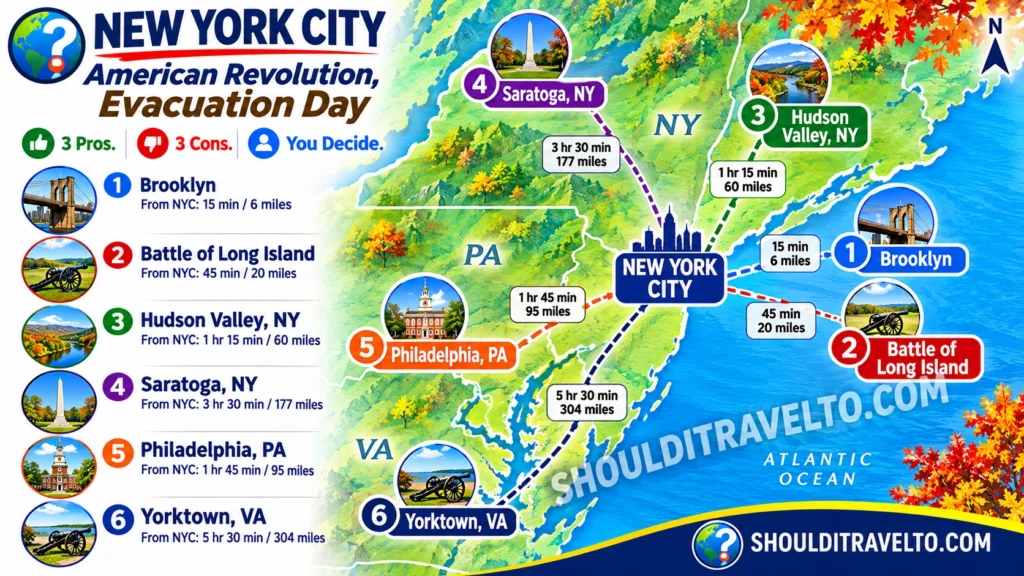
Nearby American Revolutionary War Destinations
Evacuation Day connects naturally to other American Revolutionary War destinations.
Brooklyn: The Battle of Long Island
The Battle of Long Island in August 1776 was one of the war’s most important early battles.
The British victory forced Washington’s army to retreat.
Visiting Brooklyn’s Revolutionary War sites helps explain how the British gained control of New York.
Hudson Valley, New York
The Hudson Valley played an important strategic role during the Revolution.
West Point, the Hudson River, and surrounding fortifications supported military efforts to control the region.
The Hudson Valley also offers historic estates and other American history destinations.
Saratoga, New York
Saratoga represents the turning point of the American Revolution. The American victory in October 1777 helped bring France into the war as a formal ally.
Evacuation Day marks a later chapter: the withdrawal of British troops after independence was recognized.
Together, Saratoga and New York City help explain the transition from military struggle to victory.
Philadelphia, Pennsylvania
Philadelphia tells the political story of American independence. Independence Hall is associated with the Declaration of Independence and the Constitution.
New York’s Evacuation Day sites tell the story of the end of British occupation.
The two cities complement each other.
Yorktown, Virginia
Yorktown was the decisive military victory of the Revolutionary War. The British surrender occurred on October 19, 1781. But New York remained under British occupation for more than two additional years.
Evacuation Day helps explain why the war’s end wasn’t a single event.
The Revolutionary War Timeline
For travelers building an American history itinerary:
- Lexington & Concord: The war begins in April 1775.
- Philadelphia: Independence is declared in July 1776.
- New York City: British occupation begins in 1776.
- Saratoga: American victory in October 1777 helps secure the French alliance.
- Valley Forge: Washington’s army endures the winter of 1777–1778.
- Yorktown: Cornwallis surrenders in October 1781.
- Treaty of Paris: American independence is formally recognized in September 1783.
- New York City: Evacuation Day marks the final British withdrawal on November 25, 1783.
Who Should Visit New York City for Evacuation Day?
Evacuation Day is particularly rewarding for:
- American Revolution enthusiasts.
- George Washington history enthusiasts.
- Travelers following Revolutionary War sites.
- Families with children studying American history.
- Visitors interested in the founding of the United States.
- Travelers interested in colonial New York.
- Visitors who enjoy historic walking tours.
- People interested in the transition from the Revolutionary War to the early American republic.
- Travelers already planning a New York City vacation.
You may want to skip a dedicated Evacuation Day itinerary if:
- You aren’t particularly interested in American history.
- You’re expecting a large annual festival.
- You prefer preserved battlefields or colonial towns.
- You have only one or two days in New York City and want to prioritize major attractions.
- You dislike walking through busy urban neighborhoods.
- You want a holiday centered on entertainment rather than historical interpretation.
The history is important. But the visitor experience is specialized.
For some travelers, Fraunces Tavern and Lower Manhattan will be among the most meaningful stops in New York.
For others, the Statue of Liberty, Central Park, Broadway, or the Metropolitan Museum of Art may be more rewarding.
The Decision Is Yours
Should you travel to New York City for Evacuation Day?
Yes, if you want to explore a final chapter of the American Revolution.
November 25, 1783, marked the end of British military occupation in New York City. After more than seven years under British control, the city returned to American authority.
But Evacuation Day isn’t a major modern tourist festival. And much of Revolutionary-era New York has disappeared beneath the modern city.
Visitors need an interest in history to appreciate the experience fully. That’s why we recommend treating Evacuation Day as a focused historical itinerary within a larger New York City vacation.
For travelers interested in American independence, Evacuation Day deserves a place on the itinerary.
3 Pros. 3 Cons. You Decide.
Explore More New York City
New York City is worth exploring beyond any single holiday or season. From Broadway and world-famous landmarks to fall foliage in Central Park, Thanksgiving traditions, Christmas celebrations, and New Year’s Eve in Times Square, the city offers year-round experiences for every type of traveler.
New York City for Holidays, Events & History
- Major Events: The Macy’s Thanksgiving Day Parade, Times Square New Year’s Eve, and other major celebrations.
- Valentine’s Day: Romantic restaurants, Broadway shows, Central Park, and winter city getaways.
- St. Patrick’s Day: The Fifth Avenue parade, Irish-American traditions, and festive neighborhoods.
- Spring Break: Museums, Broadway, Central Park, and family-friendly sightseeing.
- Summer Vacation: Outdoor attractions, waterfront experiences, parks, and summer entertainment.
- Labor Day Weekend: A three-day getaway featuring iconic landmarks, neighborhoods, and entertainment.
- Fall Foliage: Autumn colors in Central Park, Prospect Park, and the city’s green spaces.
- Halloween: The Village Halloween Parade, elaborate costumes, and seasonal city experiences.
- Thanksgiving in New York City: The Macy’s Thanksgiving Day Parade, holiday traditions, and the beginning of the Christmas season.
- Christmas in New York City: Rockefeller Center, Fifth Avenue decorations, holiday markets, and seasonal performances.
- Christmas + New Year’s Eve: An extended holiday vacation combining Christmas attractions with New Year’s celebrations.
- New Year’s Eve: The Times Square Ball Drop, celebrations, and one of the world’s most recognizable New Year’s Eve experiences.
New York City Compared to Other Cities
- Chicago vs. New York City: Chicago’s architecture, lakefront, and value vs. New York’s landmarks, entertainment, and variety.
- Los Angeles vs. New York City: Hollywood, beaches, and car-oriented sightseeing vs. Broadway, walkability, and big-city energy.
- Boston vs. New York City: Revolutionary history and New England character vs. world-famous attractions and entertainment.
- Boston vs. New York City for Fall Foliage: Boston’s New England autumn atmosphere and historic neighborhoods vs. New York City’s Central Park foliage, iconic landmarks, and fall activities.
- New York City vs. Philadelphia: Iconic landmarks, Broadway, and nonstop activity vs. founding-era history, walkability, and value.
- New York City vs. Washington, DC: Entertainment and big-city energy vs. national museums, monuments, and American history.
Explore the Complete New York City Guide for attractions, neighborhoods, where to stay, transportation, costs, the ten-category scorecard, and travel planning.
New York City for Evacuation Day Frequently Asked Questions
When Was Evacuation Day in New York City?
Evacuation Day was November 25, 1783. It commemorates the departure of the last British troops from New York City and the return of American forces under George Washington.
Why Is Evacuation Day Important?
Evacuation Day marked the end of British military occupation of New York City after more than seven years. It was a symbolic moment marking the end of the American Revolution.
Is Evacuation Day Still Celebrated in New York City?
Historical organizations commemorate Evacuation Day through occasional tours, ceremonies, and educational events. However, it isn’t a major citywide public holiday. Visitors should verify current programming before traveling.
Where Should You Go to Learn About Evacuation Day?
Fraunces Tavern Museum is one of the best places to begin. Bowling Green, Federal Hall, and the historic streets of Lower Manhattan also provide important connections to the Revolutionary War and early American history.
Did the Revolutionary War End on Evacuation Day?
Not formally. The Treaty of Paris was signed on September 3, 1783, formally recognizing American independence. Evacuation Day on November 25 marked the final British military withdrawal from New York City.
How Much Time Do You Need to Explore Evacuation Day Sites?
A half day is enough for most visitors to explore Fraunces Tavern Museum, Bowling Green, Federal Hall, and nearby historic locations. A full day allows for a deeper historical experience.
Is Evacuation Day Worth a Special Trip to New York City?
For dedicated Revolutionary War enthusiasts, yes. For most travelers, the better approach is to combine Evacuation Day history with a broader New York City vacation rather than traveling solely for the anniversary.