

Should You Visit Washington, DC, America’s Capital?
Quick Answer
Yes. You should visit Washington, DC, if you enjoy American history, world-class museums, iconic monuments, government landmarks, and an educational city vacation with many free attractions.
Washington offers a unique mix of experiences. You can visit the Lincoln Memorial, explore the Smithsonian museums, see the US Capitol, walk along the National Mall, and discover neighborhoods filled with restaurants, historic architecture, and cultural attractions.
Few American cities offer so many nationally significant landmarks within a relatively compact visitor area.
But Washington isn’t the right destination for everyone. Washington also changes throughout the year.
For travelers interested in American history and national traditions, Washington can be worth visiting more than once.
The biggest question isn’t whether Washington, DC, has enough to see.
It’s whether you want a vacation centered on museums, monuments, history, culture, and exploration rather than beaches, nightlife, or nonstop entertainment.
For travelers who enjoy those experiences, Washington is one of America’s strongest destinations.
Washington, DC, at a Glance
| Category | Washington, DC |
| Location | District of Columbia, Mid-Atlantic United States |
| Best known for | Smithsonian museums, National Mall, monuments, U.S. Capitol, White House, American history |
| Best time to visit | April–May and September–October |
| Best trip length | 4 days for first-time visitors; 3–5 days overall |
| Cost | Average to expensive, depending on hotel and travel dates |
| Weather | Four seasons; hot, humid summers and generally cool winters |
| Crowds | High around major attractions, cherry blossom season, holidays, and special events |
| Walkability | Excellent around the National Mall and many central neighborhoods |
| Public transportation | Extensive Metrorail and bus network |
| Rental car | Not recommended for most visitors |
| Food | Diverse international dining and strong neighborhood restaurant scenes |
| Atmosphere | Historic, monumental, educational, international, and politically significant |
| Best for | History enthusiasts, families, museum lovers, first-time visitors, educational trips |
| Biggest drawback | Hotel costs, extensive walking, and summer heat |
Quick Verdict: Washington, DC, is one of America’s best destinations for travelers who enjoy history, museums, and nationally significant landmarks. Its greatest advantage is the concentration of free attractions. Its biggest drawback is that experiencing them requires considerable walking, planning, and sometimes expensive accommodations.
The Biggest Mistake First-Time Washington, DC, Visitors Make
The biggest mistake first-time visitors make is trying to see all of Washington’s museums and monuments in two or three days.
Washington may appear compact on a map.
The White House, US Capitol, Washington Monument, Lincoln Memorial, and Smithsonian museums are all relatively close to one another compared with attractions in many other major cities.
But that doesn’t mean you can comfortably experience them all in a single day.
The National Mall stretches about two miles between the Capitol and the Lincoln Memorial. Visiting the Jefferson Memorial or other attractions around the Tidal Basin adds additional walking.
And museums require time.
The National Museum of American History, National Air and Space Museum, and National Museum of Natural History each offer enough exhibits to occupy several hours.
Trying to visit multiple major museums while also exploring the monuments can quickly turn an enjoyable vacation into an exhausting checklist.
Another mistake is assuming Washington ends at the National Mall.
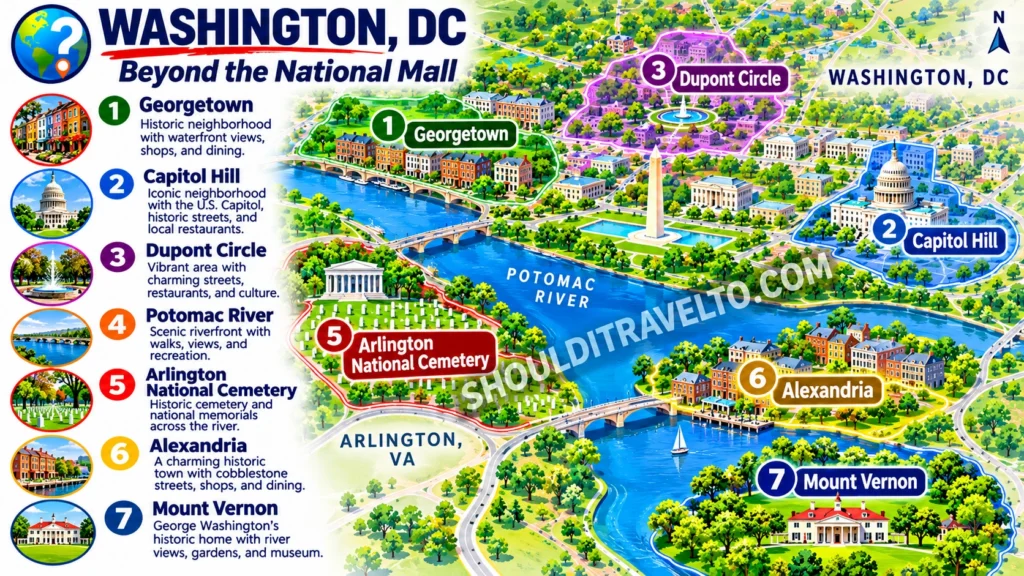
Washington, DC, Beyond the National Mall
Georgetown offers historic streets, restaurants, shopping, and waterfront scenery.
Capitol Hill provides historic neighborhoods and government landmarks.
Dupont Circle offers a different atmosphere, with restaurants, architecture, and cultural attractions.
Across the Potomac River, Arlington National Cemetery is an important destination for American military history.
Nearby Alexandria offers a historic waterfront and colonial-era streets, while Mount Vernon lets you explore George Washington’s estate.
You don’t need to visit all these locations during one vacation. The better approach is to organize your itinerary geographically.
Spend one day exploring the western National Mall and memorials, another visiting Smithsonian museums, and another discovering Capitol Hill or Washington’s neighborhoods.
Add Arlington, Alexandria, or Mount Vernon when your interests and trip length justify the additional travel.
The goal isn’t to see every monument or museum. It’s to experience enough of Washington to understand why the nation’s capital is worth visiting.
What Makes Washington, DC, Special?
Washington’s greatest distinction is its concentration of nationally significant history, government institutions, museums, and monuments.
Other American cities offer excellent museums and historic attractions.
Boston and Philadelphia are particularly important for understanding America’s founding.
New York City offers extraordinary cultural diversity, entertainment, and globally recognized landmarks.
But Washington brings together the institutions, memorials, and historical collections associated with the United States.
Visitors can stand outside the US Capitol, explore the National Archives, visit the Lincoln Memorial, and discover Smithsonian collections during the same vacation.
The city is also home to embassies, international organizations, universities, and cultural institutions that give it an international character.
Its monuments and museums tell stories about American history, government, military service, science, art, and culture.
But Washington is more than a collection of federal buildings.
Neighborhoods such as Georgetown, Dupont Circle, Adams Morgan, Capitol Hill, and Shaw offer restaurants, historic architecture, music, shopping, and local character.
The Potomac River, Rock Creek Park, and other green spaces provide an important contrast to the monumental landscape.
And Washington’s seasonal traditions create different reasons to visit throughout the year.
The 3 Biggest Reasons to Visit Washington, DC
Washington offers several compelling reasons to visit, but three advantages stand above the others.
1. World-Class Museums, Many With Free Admission
Washington’s museum collection is one of its greatest strengths.
The Smithsonian Institution operates an extraordinary network of museums covering American history, science, aviation, space, art, culture, and natural history.
Many offer free general admission.
This makes Washington especially appealing for families, students, history enthusiasts, and travelers who want an educational vacation without paying admission fees at every attraction.
You can explore the National Museum of American History, see aircraft and spacecraft at the National Air and Space Museum, or discover natural history collections without purchasing a standard admission ticket.
The National Gallery of Art offers another major cultural experience.
The National Archives also offers opportunities to learn about foundational American documents.
Must-See Museums:
- National Museum of American History
- National Air and Space Museum
- National Museum of Natural History
- National Gallery of Art
Additional Museums and Cultural Attractions:
- National Portrait Gallery
- Smithsonian American Art Museum
- National Postal Museum
- National Museum of the American Indian
- International Spy Museum
- Library of Congress
Not every museum is free.
The International Spy Museum, for example, charges admission.
Some Smithsonian museums also require free timed-entry passes, depending on the museum and current policies.
Visitors should check requirements before arriving.
The biggest advantage isn’t simply that Washington has excellent museums.
It’s that you can build several days of sightseeing around major cultural attractions without spending hundreds of dollars on admission.
For travelers who enjoy museums, Washington offers exceptional value.
2. America’s Most Recognizable Monuments and Government Landmarks
Washington’s second major advantage is its concentration of nationally significant landmarks.
The Lincoln Memorial, Washington Monument, Jefferson Memorial, US Capitol, and White House are among the country’s most recognizable structures.
Many are located around the National Mall or within the broader central sightseeing area.
Visitors can explore monuments dedicated to presidents, military service members, historical events, and national ideals.
Must-See Monuments and Memorials:
- Lincoln Memorial
- Washington Monument
- Jefferson Memorial
Additional Memorials Worth Visiting:
- Vietnam Veterans Memorial
- Korean War Veterans Memorial
- World War I Memorial
- Franklin Delano Roosevelt Memorial
- Dwight D. Eisenhower Memorial
- US Navy Memorial
Major Government and Historical Landmarks:
- US Capitol
- White House
- Supreme Court
- Library of Congress
- National Archives
One of Washington’s greatest advantages is that many monuments and memorials are free to enter.
However, access to government buildings and certain attractions is different.
Tours may require reservations, security screening, or advance arrangements. Some buildings may have limited public access.
The monuments are also spread across a large area.
Visitors should plan realistically rather than assuming they can see everything in one afternoon.
For travelers interested in American history and government, Washington offers an experience few cities can match.
3. A Major American City You Can Explore Without a Car
Washington’s third advantage is its public transportation and walkable sightseeing areas.
The Metrorail system connects major neighborhoods, transportation hubs, and many visitor destinations.
Visitors can use Metro to reach areas near the National Mall, Capitol Hill, Dupont Circle, Arlington, and other locations.
Walking is also practical within central sightseeing districts.
You can explore several museums along the National Mall without arranging transportation between every attraction.
This makes Washington appealing for visitors who want to avoid the expense and inconvenience of renting a car.
Parking near major attractions can be difficult and expensive. Traffic congestion and road closures can also complicate driving.
However, Washington isn’t completely walkable.
The National Mall is extensive, and reaching some attractions requires long walks even after using Metro. Nearby destinations such as Mount Vernon may require additional transportation arrangements.
For most first-time visitors, a combination of Metro, walking, and occasional rideshares is sufficient.
That gives Washington an advantage over cities where visitors depend heavily on rental cars.
The 3 Biggest Downsides of Visiting Washington, DC
Washington offers exceptional attractions, but its strengths come with trade-offs.
1. Summer Heat and Humidity Can Make Sightseeing Uncomfortable
Washington’s summer weather is one of its biggest drawbacks.
Temperatures can be high, humidity can make conditions feel more uncomfortable, and thunderstorms are possible.
This matters because many of Washington’s most recognizable attractions are outdoors.
Visiting the Lincoln Memorial, Washington Monument, Jefferson Memorial, and other landmarks can involve hours of walking with limited shade.
The National Mall is particularly exposed during hot afternoons.
Families with younger children and travelers who are sensitive to heat may find summer sightseeing exhausting.
Summer isn’t necessarily a bad time to visit. Long daylight hours, school vacations, museums, and seasonal events make Washington appealing.
But visitors should plan carefully.
- Start outdoor sightseeing early
- Schedule museums during the hottest part of the day
- Drink plenty of water
- Allow time for rest
If your ideal vacation involves walking outdoors for several hours, spring and fall generally offer a more comfortable experience.
2. Hotels Can Be Expensive During Popular Travel Periods
Washington’s many free attractions create excellent sightseeing value. But that doesn’t automatically make it inexpensive.
Hotels near the National Mall, downtown, and major Metro stations can be costly.
Rates may rise during cherry blossom season, conventions, major political events, school travel periods, and popular holidays.
Restaurants and transportation also add up in the overall vacation budget.
A family might save money by visiting free Smithsonian museums but spend considerably more on accommodations than expected.
The best approach is to compare total trip costs.
A hotel farther from the National Mall may offer better rates, but extra travel time and cost can offset the savings.
Staying near a convenient Metro station is often more important than staying directly beside a famous monument.
Washington can provide excellent value. But travelers should not confuse free attractions with an inexpensive overall vacation.
3. Washington May Feel Too Museum- and History-Focused for Some Travelers
Washington’s greatest strengths won’t appeal equally to everyone.
The city is particularly rewarding for travelers who enjoy museums, history, architecture, government landmarks, and cultural sightseeing.
But travelers seeking beaches, theme parks, or nonstop entertainment may prefer another destination.
Washington does have restaurants, nightlife, theaters, concerts, sporting events, and active neighborhoods.
Areas such as Adams Morgan, Shaw, and parts of downtown offer evening entertainment.
However, Washington’s most recognizable visitor experience is centered on museums, monuments, and historical institutions.
Some government-oriented business districts also quiet down after normal working hours.
Visitors expecting the constant entertainment atmosphere of New York City or Las Vegas may find Washington less exciting.
The issue isn’t that Washington lacks things to do. Its most distinctive attractions appeal to particular interests.
If history and museums aren’t important to your vacation, another city may be a better choice.
The Should I Travel To … Washington, DC, Scorecard
Washington performs particularly well for museums, historical significance, transportation, and value from free attractions.
Its main weaknesses are summer weather, hotel costs, and the amount of walking required.
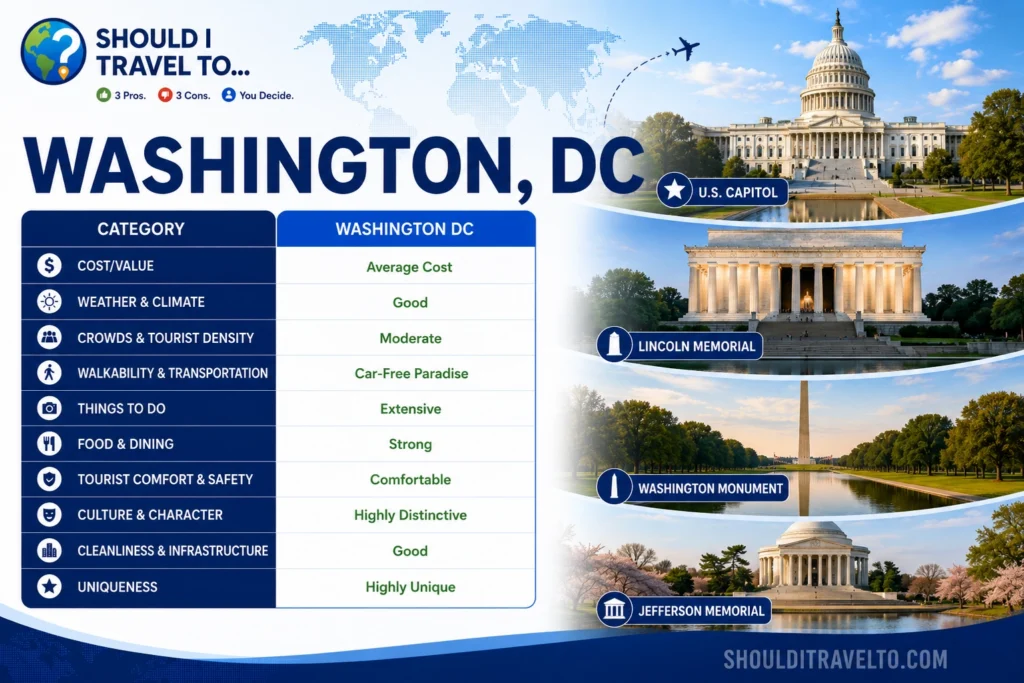
Cost / Value: Average Cost
Washington isn’t an inexpensive destination, but it offers excellent value for travelers who enjoy museums and monuments.
Many Smithsonian museums and national memorials are free. That can significantly reduce sightseeing expenses.
However, hotels, restaurants, transportation, and paid attractions can increase the total cost.
Washington is best described as an average-to-expensive city vacation with unusually strong value from free cultural attractions.
Weather & Climate: Good
Washington has four distinct seasons.
Spring and fall generally provide the most comfortable conditions for outdoor sightseeing. Summer can be hot and humid.
Winter is often cool, with occasional freezing temperatures and snow.
Weather can vary considerably from day to day, particularly during transitional seasons. If you plan to spend hours walking around the National Mall, timing matters.
Crowds & Tourist Density: Crowded
Washington attracts tourists, school groups, business travelers, and visitors attending major events.
The National Mall and popular museums can become crowded during spring, summer, and holidays.
Cherry blossom season is particularly busy around the Tidal Basin. Major national events can also affect crowds, security, and transportation.
However, visitor density varies by neighborhood and season.
Travelers can often find quieter experiences by exploring less-visited museums and neighborhoods.
Walkability & Transportation: Excellent
Washington offers one of America’s stronger public transportation systems for tourists.
Metrorail, buses, walking routes, and regional rail connections make many attractions accessible without a rental car.
The National Mall is pedestrian-friendly, although distances are substantial. Some destinations outside central Washington require additional planning.
For most first-time visitors, renting a car is unnecessary.
Things to Do: Excellent
Washington offers museums, monuments, historic landmarks, neighborhoods, restaurants, theaters, gardens, parks, and seasonal events.
History enthusiasts could spend an entire week exploring major attractions. Families can combine educational museums with outdoor activities.
The city also offers day trips to nearby Virginia and Maryland. Its biggest strength is the depth of cultural and historical sightseeing.
Food & Dining: Very Good
Washington has a diverse restaurant scene influenced by its international population, neighborhoods, and diplomatic community.
Visitors can enjoy Ethiopian cuisine, international restaurants, contemporary American dining, neighborhood cafés, and historic food destinations.
Georgetown, Dupont Circle, Penn Quarter, Shaw, and other neighborhoods offer different dining experiences.
Washington isn’t as strongly identified with one signature cuisine as New Orleans or Philadelphia. But its variety is a major advantage.
Tourist Comfort & Safety: Generally Comfortable
Washington’s major tourist areas are well established and accustomed to visitors.
Museums, monuments, public transportation, and hotels provide extensive visitor infrastructure.
However, safety conditions vary by neighborhood, time of day, and circumstances.
Visitors should use normal urban precautions, remain aware of their surroundings, and research accommodation locations.
Large events may also involve additional security screening and temporary restrictions.
Summer heat and extensive walking are important comfort considerations.
Culture & Character: Historically Significant
Washington’s identity is closely connected to the American government, national history, international diplomacy, and cultural institutions.
Its monuments, museums, and federal architecture create a distinctive atmosphere.
But its neighborhoods also contribute to the city’s character through restaurants, historic buildings, music, and community traditions.
Washington offers more cultural variety than visitors who remain exclusively on the National Mall may realize.
Cleanliness & Infrastructure: Good
Washington’s major museums, monuments, transportation systems, and visitor districts provide substantial infrastructure.
Many central attractions are well maintained.
However, visitors may encounter construction, aging transit facilities, crowded public spaces, and varying neighborhood conditions.
The city is generally convenient for sightseeing, but it isn’t uniformly polished or easy to navigate.
Uniqueness: One-of-a-Kind
Washington offers a combination of national monuments, government institutions, museums, and historical landmarks unlike any other American city.
Boston and Philadelphia offer important connections to the nation’s founding. New York City provides a broader entertainment and urban experience.
But Washington is uniquely positioned as the capital of the United States.
Its concentration of national institutions and memorials makes it a destination that cannot be fully replicated elsewhere.
Planning Your Trip to Washington, DC
A successful Washington vacation depends on choosing the right season, organizing attractions geographically, and allowing enough time for museums and monuments.
Many first-time visitors underestimate the size of the National Mall.
Others spend their entire vacation around federal landmarks without exploring Washington’s neighborhoods.
The best approach is to balance major attractions with experiences beyond the monumental core.
What Is the Atmosphere Like in Washington, DC?
Washington feels:
- Historic
- Monumental
- Educational
- International
- Cultural
- Walkable in central districts
- Formal around government institutions
- Neighborhood-oriented beyond the National Mall
The atmosphere varies considerably by location.
The National Mall is dominated by monuments, museums, open lawns, and major government landmarks.
It can feel ceremonial and monumental, especially around the Lincoln Memorial, the Washington Monument, and the US Capitol.
Georgetown offers historic streets, shopping, restaurants, and waterfront scenery.
Dupont Circle feels more residential and international, with restaurants, embassies, and cultural institutions.
Capitol Hill combines government buildings with historic row houses and neighborhood businesses.
Adams Morgan and Shaw offer restaurants, nightlife, and a different perspective on the city.
Rock Creek Park provides green space and outdoor recreation.
Washington can feel formal in one neighborhood and relaxed in another.
Visitors who explore beyond the National Mall often discover a more complete and interesting city.
When Is the Best Time to Visit Washington, DC?
April through May and September through October are generally the best periods to visit Washington.
These months often provide more comfortable temperatures for walking, sightseeing, and exploring neighborhoods.
But Washington is a year-round destination. Each season offers different advantages.
Spring: March–May
Spring is one of Washington’s most appealing seasons. Temperatures generally become more comfortable as the season progresses.
Parks and gardens begin to bloom. And the National Cherry Blossom Festival gives travelers a particularly memorable reason to visit.
The Tidal Basin becomes one of America’s most recognizable spring landscapes when the cherry trees bloom around the Jefferson Memorial.
However, peak bloom varies each year. The festival calendar doesn’t guarantee that the blossoms will be at their best during your visit.
Spring can also bring rain, changing temperatures, and substantial crowds. April and May are excellent for sightseeing, but cherry blossom season requires advance planning.
Summer: June–August
Summer offers long daylight hours, school vacations, outdoor events, and Independence Day celebrations.
Families can explore museums, monuments, and national history during the school break.
But Washington’s summer heat and humidity can make outdoor sightseeing uncomfortable. Walking across the National Mall during a hot afternoon can be exhausting.
The best summer itinerary combines early outdoor activities with museums and other indoor attractions during the hottest part of the day.
Summer works well for travelers who can tolerate heat and want a vacation built around educational sightseeing.
Fall: September–November
Fall is another excellent season to visit Washington.
Temperatures generally become more comfortable after summer, making outdoor sightseeing more enjoyable.
Changing foliage adds color to parks, historic neighborhoods, and areas around the Potomac River.
Fall also includes opportunities to explore Washington during Labor Day weekend, Veterans Day, and Thanksgiving.
Early September can still feel like summer. Late November can be cool.
But for travelers who want to explore monuments, museums, and neighborhoods without intense summer heat, fall offers a strong balance.
Winter: December–February
Winter offers a different Washington experience.
Temperatures are generally cool, and occasional snow can transform the National Mall and monuments.
December brings holiday decorations, seasonal performances, and Christmas activities.
Presidents’ Day in February provides another opportunity to explore the city’s presidential history.
Some winter periods may have fewer leisure tourists than spring or summer. However, major political events, conventions, and holidays can still increase demand.
Cold weather, shorter daylight hours, and occasional winter storms are important considerations.
Winter is particularly appealing for museum-focused travelers who don’t need warm weather to enjoy the city.
How Many Days Should You Spend in Washington, DC?
The ideal first-time Washington vacation is approximately four days.
Three days offer a good introduction, while five days allow a more complete experience.
2 Days: A Focused Introduction
Two days are enough to see some of Washington’s most recognizable attractions.
Spend one day exploring the National Mall and major monuments.
Use the second day for one or two Smithsonian museums and perhaps the US Capitol area.
You’ll need to be selective.
3 Days: A Strong Long Weekend
Three days allow a better balance.
You can dedicate one day to monuments and memorials. Another to Smithsonian museums.
Use the third day for Capitol Hill, Georgetown, or additional attractions.
This is a practical option for first-time visitors with limited vacation time.
4 Days: The Best First-Time Balance
Four days provides enough time to explore Washington without rushing through every attraction.
You can spend separate days visiting monuments, museums, government landmarks, and neighborhoods.
It also provides flexibility for special events or additional museums.
For most first-time visitors, four days is the best balance between cost, time, and sightseeing.
5 Days: Deeper Exploration
Five days allows visitors to explore Washington beyond the National Mall.
You can visit additional museums, discover neighborhoods, explore Arlington National Cemetery, or consider nearby Alexandria.
History enthusiasts may also want to include Mount Vernon.
A longer trip is particularly appealing for families and travelers who want to understand Washington rather than simply photograph its most famous landmarks.
Where Should You Stay in Washington, DC?
Hotel location can significantly affect the convenience and cost of a Washington vacation.
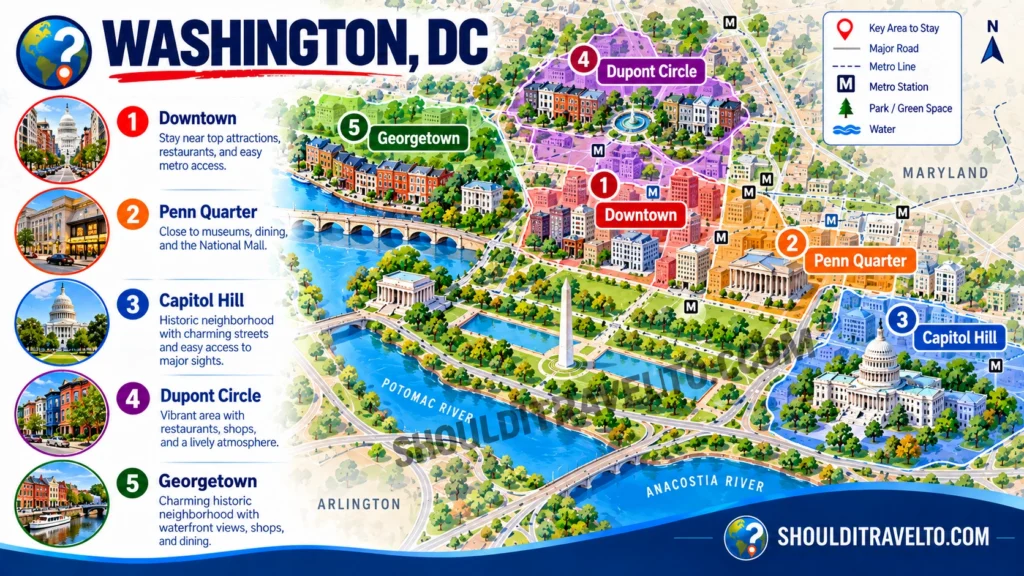
Downtown and Penn Quarter: Best for First-Time Visitors
Downtown and Penn Quarter provide convenient access to museums, restaurants, entertainment, and Metro stations.
Many major attractions are within walking distance or a short transit ride.
This area works particularly well for first-time visitors who want to spend much of their trip exploring the National Mall.
However, hotel rates can be high, and some business-oriented blocks become quieter outside working hours.
Capitol Hill: Best for American History
Capitol Hill is a strong choice for visitors interested in the US Capitol, Library of Congress, Supreme Court, and historic neighborhoods.
The area combines major government landmarks with residential streets, restaurants, and neighborhood businesses.
It’s especially appealing for travelers who want history at the center of their vacation.
But reaching attractions on the western National Mall requires additional walking or transportation.
Dupont Circle: Best for Restaurants and Neighborhood Atmosphere
Dupont Circle offers restaurants, historic architecture, cultural institutions, and convenient Metro connections.
It provides a different atmosphere from the monumental core.
Visitors who want to combine sightseeing with neighborhood exploration may prefer this area.
Georgetown: Best for Historic Character
Georgetown is known for historic streets, restaurants, shopping, and waterfront scenery.
It’s one of Washington’s most attractive neighborhoods for visitors who enjoy walking and exploring.
However, Georgetown doesn’t have its own Metrorail station. Travelers may need buses, rideshares, or longer walks to reach rail connections.
That makes it less convenient for some first-time visitors.
Foggy Bottom: Best for the Western National Mall
Foggy Bottom offers access to George Washington University, the Kennedy Center, and western central Washington.
It can be convenient for travelers planning to visit the Lincoln Memorial and nearby attractions.
Metro access also makes it practical for exploring other parts of the city.
Arlington, Virginia: An Alternative Base
Hotels in Arlington can provide convenient access to Washington through Metro.
Areas near Rosslyn, Crystal City, and Pentagon City may be worth comparing with hotels in the District.
But staying outside Washington doesn’t automatically guarantee lower costs. Compare hotel rates, transportation time, and your planned attractions.
For a first visit, prioritize Downtown, Penn Quarter, or another hotel near a convenient Metro station.
Getting Around Washington, DC
Washington is one of America’s more convenient major cities to explore without renting a car.
Metrorail connects major visitor districts, neighborhoods, and transportation hubs.
Buses, walking, and rideshares provide additional options.
The National Mall is pedestrian-friendly, but distances are substantial. Visitors should plan for extensive walking even when using Metro.
Buses and Rideshares
Buses can help reach neighborhoods and attractions not directly served by Metro.
Rideshares may be convenient for shorter trips, evenings, or destinations with less direct transit access.
However, traffic and special-event road closures can affect travel times.
Rental Cars
Most visitors don’t need a rental car for central Washington. Parking can be expensive and inconvenient.
Traffic congestion and security restrictions can also complicate driving.
A car may be useful for certain regional excursions, but it generally isn’t necessary for the main city attractions.
What Should You Not Miss in Washington, DC?
Washington has enough attractions to fill several vacations.
For a first visit, prioritize a manageable combination of monuments, museums, and neighborhoods.
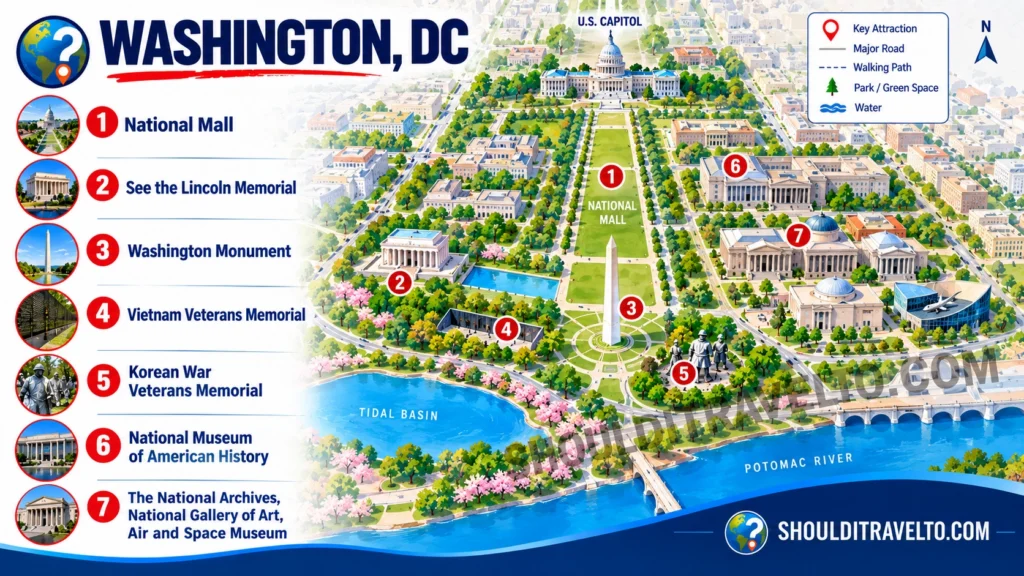
National Mall and Monuments
The National Mall is the centerpiece of Washington sightseeing.
Visit the Lincoln Memorial, Washington Monument, National World War II Memorial, and other landmarks.
The Jefferson Memorial and Tidal Basin are also important, particularly during cherry blossom season.
Smithsonian Museums
Choose museums based on your interests.
The National Museum of American History is particularly appealing for travelers interested in the nation’s cultural and political development.
The National Air and Space Museum offers aviation and space exploration exhibits, and the National Museum of Natural History is a strong choice for families.
Don’t attempt to visit every major museum in one day.
US Capitol and Library of Congress
The US Capitol and Library of Congress are important landmarks for visitors interested in American government, architecture, and history.
Check current tour availability and reservation requirements.
White House
The White House is one of America’s most recognizable buildings. Visitors can view it from designated public areas.
Interior tours require advance arrangements and are subject to security and availability requirements.
Arlington National Cemetery
Located across the Potomac River in Virginia, Arlington National Cemetery is one of America’s most significant military cemeteries.
The Tomb of the Unknown Soldier and other memorials make it particularly meaningful for visitors interested in military history.
Allow sufficient time and approach the site respectfully.
Georgetown
Georgetown contrasts with the National Mall.
Its historic streets, restaurants, shops, and waterfront make it an appealing neighborhood to explore.
Mount Vernon
George Washington’s Mount Vernon estate is located in nearby Virginia.
It’s particularly worthwhile for travelers interested in presidential history and the nation’s founding.
Visiting Mount Vernon takes extra time and transportation, so it’s best included in a longer itinerary.
What Else Should You Know Before Visiting Washington, DC?
A few practical considerations can make a major difference.
Don’t underestimate walking distances. The National Mall is much larger than it appears in photographs.
Check museum admission requirements. Many Smithsonian museums are free, but some require timed-entry passes.
Reserve government tours when necessary. Public access to the White House, US Capitol, and other buildings may require advance arrangements.
Prepare for security screening. Government buildings, museums, and major events may have bag restrictions or security procedures.
Plan around major events. Demonstrations, ceremonies, marathons, and national celebrations can affect transportation and access.
Use Metro when practical. A rental car is generally unnecessary for central Washington.
Explore beyond the National Mall. Georgetown, Capitol Hill, Dupont Circle, and other neighborhoods offer a more complete experience.
Be flexible with seasonal travel. Cherry blossom timing, weather, and special-event schedules can change.
Choose museums carefully. One museum enjoyed thoroughly is often better than three rushed visits.
Remember that Washington is a living city. Its neighborhoods, restaurants, parks, and cultural institutions are part of the destination, not simply the monuments.
Washington, DC, for Holidays, Seasonal Travel, and Major Events
Washington is one of America’s strongest destinations for travelers interested in history, national traditions, seasonal celebrations, and major events.
Unlike cities where tourism centers on beaches, nightlife, or entertainment, Washington’s seasonal appeal often centers on American history, cultural institutions, national monuments, and commemorations.
That variety makes Washington worth considering at different times of the year.
Washington, DC, for the National Cherry Blossom Festival
Best for: Spring scenery, photography, couples, families, cultural celebrations, and first-time visitors.
Washington’s National Cherry Blossom Festival is one of America’s most recognizable spring travel experiences.
Each spring, cherry trees around the Tidal Basin produce a beautiful display of pale pink and white blossoms, framing views of the Jefferson Memorial and nearby monuments.
The festival celebrates the longstanding friendship between Japan and the United States, with cultural performances, community activities, and seasonal events.
But the blossoms aren’t the only reason to visit.
Travelers can combine cherry blossom viewing with Smithsonian museums, the National Mall, historic neighborhoods, restaurants, and other Washington attractions.
That makes the festival particularly appealing for visitors who want a complete spring city vacation.
There is one important complication. Peak bloom doesn’t follow a fixed calendar.
The National Park Service monitors the trees and announces forecasts as spring approaches. Warm weather can accelerate blooming, while cooler conditions can delay it.
The most impressive blossoms may appear before or after your scheduled trip.
Crowds are another consideration.
The Tidal Basin can become extremely busy during favorable bloom conditions, particularly on weekends.
Travelers should also prepare for changing spring weather and potentially premium hotel rates.
Why Visit: Cherry blossoms around the Tidal Basin, Jefferson Memorial views, spring photography, Japanese cultural celebrations, and Smithsonian museums.
Explore More: Washington, DC, for the National Cherry Blossom Festival | Events Destinations
Washington, DC, for Presidents’ Day
Best for: Presidential history, American history enthusiasts, families, educational travel, and February weekend getaways.
Washington is one of America’s most meaningful destinations for Presidents’ Day because of its connection to the presidency and the nation’s political history.
Visitors can explore memorials dedicated to George Washington, Abraham Lincoln, Thomas Jefferson, Franklin D. Roosevelt, and Dwight D. Eisenhower.
The White House, the US Capitol, the National Archives, Smithsonian museums, and other landmarks offer opportunities to learn about the American government and the presidency.
The National Portrait Gallery offers another perspective through portraits of presidents and other influential Americans.
Travelers with additional time can visit George Washington’s Mount Vernon estate in nearby Virginia.
Mount Vernon is particularly relevant to Presidents’ Day because the federal holiday is officially Washington’s Birthday.
But Presidents’ Day isn’t necessarily the best time to visit every presidential landmark.
February can be cold, outdoor sightseeing may be uncomfortable, and some attractions operate on winter schedules.
Holiday programming also varies from year to year.
Visitors should confirm museum hours, special events, and tour requirements before traveling.
For travelers interested in presidential history, Washington offers a meaningful experience even without a special holiday event.
Why Visit: Presidential monuments, the White House, National Portrait Gallery, Smithsonian museums, National Archives, and nearby Mount Vernon.
Explore More: Presidents’ Day Destinations
Washington, DC, for Presidential History
Best for: American history enthusiasts, presidential history, educational travel, families, and travelers interested in government.
Washington is one of America’s most important destinations for exploring presidential history.
The city contains monuments and memorials dedicated to several presidents, along with institutions that preserve the history of the presidency and federal government.
Visitors can explore the Washington Monument, Lincoln Memorial, Jefferson Memorial, Franklin Delano Roosevelt Memorial, and Dwight D. Eisenhower Memorial.
The White House connects visitors to the modern presidency, while the National Archives preserves important documents tied to the nation’s founding and government.
The National Portrait Gallery offers an opportunity to explore presidential portraits and the people who shaped American history.
But Washington’s presidential history extends beyond the District.
George Washington’s Mount Vernon estate is located nearby in Virginia.
Monticello, Thomas Jefferson’s estate near Charlottesville, can also fit into a broader Virginia presidential history itinerary, though it isn’t a convenient addition to a short Washington city vacation.
Washington is particularly valuable because it introduces several presidential eras in one destination.
However, the city doesn’t provide the same intimate experience as visiting a president’s home or presidential library.
Travelers who want to understand individual presidents in greater depth may prefer to combine Washington with historic homes and presidential museums elsewhere.
Why Visit: Presidential monuments, the White House, National Archives, National Portrait Gallery, and access to nearby presidential historic sites.
Explore More: Presidential History Sites
Washington, DC, for American History
Best for: History enthusiasts, families, educational travel, museums, and travelers interested in America’s founding and development.
Washington is one of America’s strongest destinations for exploring the nation’s history.
The National Mall, Smithsonian museums, National Archives, and government landmarks provide an unusually concentrated collection of historical experiences.
Visitors can explore the nation’s founding documents, learn about the American government, examine military history, and discover the cultural developments that shaped the United States.
The National Museum of American History is particularly relevant.
The National Archives, Library of Congress, and major monuments offer additional opportunities for historical exploration.
Washington also works as a starting point for nearby destinations connected to America’s founding.
Mount Vernon provides insight into George Washington’s life.
Alexandria offers historic streets and colonial-era connections.
Longer regional trips can incorporate Revolutionary War and colonial history destinations elsewhere in Virginia.
But Washington isn’t a substitute for every American history destination.
Boston and Philadelphia offer more direct connections to many events of the American Revolution.
Colonial Williamsburg and Yorktown provide different historical experiences.
Washington is strongest for travelers who want a broad introduction to American history through museums, monuments, and national institutions.
Why Visit: Smithsonian museums, national monuments, founding documents, presidential history, military history, and nearby historic destinations.
Explore More: American History Destinations | American Revolutionary War Sites
Washington, DC, for Spring Break
Best for: Families, educational vacations, museums, history, and travelers seeking an alternative to beach destinations.
Washington is an excellent spring break destination for families who want a vacation centered on learning, sightseeing, and cultural experiences.
The Smithsonian museums provide opportunities to explore American history, science, aviation, space, art, and natural history.
Many offer free general admission, making Washington particularly appealing for families managing vacation expenses.
The National Mall provides outdoor sightseeing, while the city’s neighborhoods offer restaurants, shopping, and cultural attractions.
Depending on the school calendar, spring break may also overlap with cherry blossom season. That can make Washington especially appealing.
But there are trade-offs. Spring break can bring large numbers of families and school groups.
Popular museums may require timed-entry passes, and hotels can become expensive.
Weather can also be unpredictable. Families should avoid scheduling too many museums in one day.
A balanced itinerary with outdoor sightseeing, indoor attractions, and breaks will generally be more enjoyable.
Why Visit: Smithsonian museums, national monuments, educational attractions, cherry blossoms, and family-friendly sightseeing.
Explore More: Best Spring Break Destinations
Washington, DC, for Summer Vacation
Best for: Families, educational travel, American history, museums, and longer city vacations.
Summer is one of Washington’s busiest travel seasons.
School vacations make the city especially appealing for families who want to explore American history and national landmarks.
The Smithsonian museums, National Mall, government buildings, and memorials provide enough attractions to fill several days.
Summer also offers long daylight hours, outdoor activities, and opportunities to attend seasonal events.
Independence Day is especially significant in the nation’s capital, with celebrations traditionally centered on the National Mall and national landmarks.
But summer weather is Washington’s biggest drawback.
Heat and humidity can make extended outdoor sightseeing uncomfortable.
Visitors should schedule monuments early in the morning or later in the day and use museums for indoor breaks.
Crowds and hotel demand are additional considerations.
Washington can be an excellent summer vacation destination, but it requires a more carefully planned itinerary than a spring or fall visit.
Why Visit: Smithsonian museums, national monuments, Independence Day traditions, educational sightseeing, and family attractions.
Explore More: Best Summer Vacation Destinations
Washington, DC, for Labor Day Weekend
Best for: Three-day city breaks, American history, museums, families, and end-of-summer sightseeing.
Labor Day weekend offers a chance to visit Washington without committing to a full weeklong vacation.
Three days is enough to explore the National Mall, visit selected Smithsonian museums, and experience some of the city’s most recognizable landmarks.
Visitors can also enjoy restaurants, neighborhoods, and outdoor attractions.
Washington is particularly appealing for travelers who want a long weekend centered on history and culture rather than beaches or resort activities.
But early September can still feel like summer. Heat and humidity may make outdoor sightseeing uncomfortable, particularly during the afternoon.
Holiday travel can also increase transportation demand and hotel prices.
For a successful Labor Day weekend, focus on a manageable itinerary.
Choose a few museums and monuments rather than trying to see the entire city.
Why Visit: National Mall, Smithsonian museums, monuments, historic neighborhoods, and a three-day educational getaway.
Explore More: Best Labor Day Weekend Destinations
Washington, DC, for Fall Foliage
Best for: Fall scenery, photography, parks, historic neighborhoods, and travelers who enjoy comfortable sightseeing weather.
Washington isn’t usually the first destination travelers consider for fall foliage.
New England, the Hudson Valley, and mountain destinations offer more extensive autumn landscapes.
But Washington can be an appealing fall destination for travelers who want seasonal color alongside museums, monuments, and historic neighborhoods.
Rock Creek Park is one of the city’s strongest locations for autumn scenery. The National Arboretum and other parks also provide opportunities to enjoy changing foliage.
Visitors can combine these outdoor experiences with the National Mall, Georgetown, and neighborhood exploration.
Fall is particularly appealing because temperatures generally become more comfortable after summer.
But Washington isn’t a traditional fall foliage destination like Vermont or the White Mountains.
Color intensity and timing vary with weather conditions. And visitors seeking expansive mountain landscapes may prefer another destination.
Washington works best when fall foliage complements a broader city vacation.
Why Visit: Rock Creek Park, National Arboretum, historic neighborhoods, comfortable sightseeing weather, and seasonal color.
Explore More: Best Fall Foliage Destinations
Washington, DC, for Veterans Day
Best for: Military history, veterans and military families, American history, memorials, and meaningful commemorative travel.
Washington is one of America’s most significant destinations for Veterans Day.
The nation’s capital contains memorials dedicated to military service members, veterans, and major conflicts in American history.
Visitors can explore the Vietnam Veterans Memorial, Korean War Veterans Memorial, National World War II Memorial, and World War I Memorial.
Across the Potomac River, Arlington National Cemetery provides another important destination.
The Tomb of the Unknown Soldier and other memorials offer opportunities for reflection and remembrance.
Washington also hosts Veterans Day ceremonies and commemorative activities, although schedules and public access requirements vary.
But Veterans Day isn’t simply another sightseeing holiday. The memorials and ceremonies recognize military service and sacrifice.
Visitors should approach commemorative sites respectfully and confirm event details before traveling.
November weather can be cool, and some ceremonies may attract significant crowds or involve security restrictions.
For travelers interested in military history and national remembrance, Washington offers a particularly meaningful experience.
Why Visit: Arlington National Cemetery, Tomb of the Unknown Soldier, national veterans memorials, military history, and commemorative ceremonies.
Explore More: Washington, DC, for Veterans Day | Best Veterans Day Destinations
Washington, DC, for Thanksgiving
Best for: Families, history enthusiasts, holiday weekend travel, museums, and travelers who prefer a quieter holiday atmosphere.
Washington offers a different Thanksgiving experience from destinations centered on major parades or large holiday entertainment districts.
The city’s appeal lies in its mix of American history, national monuments, museums, and opportunities for a relaxed long weekend.
Visitors can explore the National Mall, visit selected Smithsonian museums, and enjoy historic neighborhoods.
Restaurants and hotels may offer Thanksgiving dining experiences, but check reservations and holiday hours in advance.
Late November can be cool, making indoor museums particularly appealing.
Some government buildings, museums, and attractions may have reduced hours or closures on Thanksgiving Day.
Washington may feel quieter in some business-oriented districts during the holiday. But that can be an advantage for travelers who want a more relaxed city vacation.
If your ideal Thanksgiving includes a major nationally televised parade, New York City may be a better fit.
If you prefer American history, museums, and a less entertainment-focused holiday experience, Washington deserves consideration.
Why Visit: American history, Smithsonian museums, national monuments, historic neighborhoods, and a quieter Thanksgiving weekend.
Explore More: Washington, DC, for Thanksgiving | Best Thanksgiving Destinations
Washington, DC, for Christmas
Best for: Holiday lights, museums, historic neighborhoods, couples, families, and Christmas sightseeing.
Washington offers a Christmas experience centered on national landmarks, seasonal decorations, cultural performances, and historic neighborhoods.
The National Christmas Tree near the White House is one of the city’s best-known holiday traditions.
Other seasonal attractions may include holiday markets, concerts, decorated neighborhoods, and special museum or cultural programming.
Visitors can combine Christmas activities with Smithsonian museums, national monuments, and historic landmarks.
Georgetown and other neighborhoods provide restaurants, shopping, and seasonal atmosphere.
But Washington isn’t a traditional Christmas village or mountain destination.
Snow isn’t guaranteed, and the city doesn’t offer the same concentrated Christmas entertainment experience as New York City. Some attractions may also operate on reduced holiday schedules.
Washington works best for travelers who want Christmas atmosphere alongside history, museums, and a major city vacation.
Why Visit: National Christmas Tree, holiday decorations, seasonal performances, museums, monuments, and historic neighborhoods.
Explore More: Best Christmas Destinations
Washington, DC, for Christmas + New Year’s Eve
Best for: Extended holiday vacations, couples, families, museums, history, and travelers who want to combine Christmas sightseeing with a winter city getaway.
Washington can be an appealing destination for travelers who want to spend several days between Christmas and New Year’s Eve exploring museums, monuments, and seasonal attractions.
The holiday period offers opportunities to enjoy Christmas decorations, cultural performances, restaurants, and historic neighborhoods. Visitors can explore the National Mall, Smithsonian museums, and other landmarks while enjoying a longer vacation.
But Washington doesn’t offer the same globally recognized New Year’s Eve experience as Times Square in New York City.
New Year’s celebrations tend to be more spread out across restaurants, hotels, entertainment venues, and nearby communities.
Travelers should also prepare for cold weather, holiday closures, and possible changes to attraction schedules.
Washington is best for visitors who want an extended winter sightseeing vacation rather than a trip centered on one enormous New Year’s Eve celebration.
Why Visit: Christmas decorations, museums, national monuments, holiday dining, and an extended winter city vacation.
Explore More: Best Christmas + New Year’s Eve Destinations
Who Should Visit Washington, DC?
Washington appeals to several types of travelers, particularly those who enjoy museums, history, and cultural experiences.
- First-Time Visitors to the United States
- Families
- History Enthusiasts
- Museum Lovers
- Couples
- Travelers Interested in Presidential and Military History
However, Washington may be less appealing if you primarily want:
- Beaches and warm-weather relaxation
- Theme parks and resort entertainment
- A vacation with minimal walking
- A destination focused on nightlife rather than museums
- A low-cost hotel stay during a major event
- Guaranteed comfortable weather throughout the year
Washington isn’t automatically the best American city for every traveler. Its strongest attractions appeal to visitors who enjoy history, museums, culture, and exploration.
Washington, DC, Compared to Other Cities
Washington is often compared with Boston, New York City, and Philadelphia. All four cities offer important American history, museums, and recognizable landmarks.
But the travel experiences are different.
Washington, DC, vs. Boston
Washington and Boston are two of America’s strongest destinations for history enthusiasts. Both offer museums, historic landmarks, walkable neighborhoods, and public transportation.
But their historical emphasis differs.
Choose Washington, DC, over Boston if:
- You want Smithsonian museums, national monuments, and government landmarks.
- You prefer an educational vacation focused on American history across multiple eras.
- You want access to numerous free museums and memorials.
- You’re particularly interested in presidential or military history.
Choose Boston over Washington, DC, if:
- You want to explore the American Revolution through the Freedom Trail, Boston Tea Party history, and nearby Lexington and Concord.
- You prefer historic neighborhoods with a stronger New England identity.
- You want to combine a city vacation with coastal New England destinations.
- You enjoy a compact historic core and waterfront atmosphere.
Washington is particularly strong for national museums and monuments.
Boston offers a different experience centered on Revolutionary history, New England culture, and historic neighborhoods.
Explore More: Boston vs. Washington, DC
Washington, DC, vs. New York City
Washington and New York City are two of America’s most recognizable urban destinations. Both offer world-famous landmarks, museums, diverse restaurants, and public transportation.
But they appeal to different interests.
Choose Washington, DC, over New York City if:
- You want Smithsonian museums, monuments, and American history.
- You prefer an educational vacation centered on national landmarks.
- You want access to numerous free museums and memorials.
- You prefer a somewhat less intense urban atmosphere.
Choose New York City over Washington, DC, if:
- You want Broadway, famous skyscrapers, and a more energetic entertainment scene.
- You enjoy exploring neighborhoods, restaurants, and cultural attractions across a very large city.
- You want extensive nightlife, shopping, and theater.
- You prefer an urban vacation with almost endless entertainment choices.
Washington is particularly rewarding for history and museum enthusiasts. New York offers broader entertainment and a true big-city experience.
Explore More: New York City vs. Washington, DC
Washington, DC, vs. Philadelphia
Washington and Philadelphia are closely connected to American history. Both offer museums, historic landmarks, and opportunities to explore the nation’s founding.
But they emphasize different periods and experiences.
Choose Washington, DC, over Philadelphia if:
- You want national monuments, Smithsonian museums, and federal government landmarks.
- You’re interested in presidential history and national institutions.
- You want a larger collection of free museums and memorials.
- You prefer a vacation centered on the National Mall and major historical attractions.
Choose Philadelphia over Washington, DC, if:
- You want Independence Hall, the Liberty Bell, and the historic sites associated with the Declaration of Independence and US Constitution.
- You’re particularly interested in the American Revolution and founding era.
- You prefer a compact historic district.
- You want a different combination of food, neighborhoods, and urban history.
Washington provides a broader national history experience through monuments and museums.
Philadelphia offers a particularly direct connection to the nation’s founding.
Explore More: Philadelphia vs. Washington, DC
Washington stands out for its concentration of national museums, monuments, government institutions, and American history.
The right choice depends on the vacation you want.
Final Assessment
Washington, DC, is one of America’s most rewarding destinations for travelers interested in history, museums, national landmarks, and cultural experiences.
Its concentration of Smithsonian museums, monuments, memorials, and government institutions creates a visitor experience unlike any other American city.
You can spend a weekend exploring famous landmarks, four days visiting museums and neighborhoods, or a full week discovering Washington and nearby historic destinations.
The city also offers something different year-round.
The city’s strongest attractions may also feel too focused on museums and history for travelers seeking beaches, theme parks, or nonstop entertainment.
Visit Washington, DC, if you want a culturally rich, educational city vacation filled with nationally significant landmarks and museums.
Consider another destination if you want warm-weather relaxation, resort entertainment, or minimal walking.
The best city isn’t necessarily the one with the most attractions. It’s the one whose strengths match the vacation you want.
3 Pros. 3 Cons. You Decide.
Washington, DC, Frequently Asked Questions
Is Washington, DC, worth visiting for the first time?
Yes. Washington is one of America’s strongest destinations for first-time visitors who enjoy museums, monuments, American history, and nationally significant landmarks. Many major attractions are free, but factor in hotel costs and extensive walking.
How many days do you need in Washington, DC?
Four days is a good starting point for a first-time visit. Three days can provide a strong introduction, while five days allows more time for museums, neighborhoods, Arlington National Cemetery, or nearby Mount Vernon.
When is the best time to visit Washington, DC?
April through May and September through October generally offer comfortable sightseeing conditions. Spring is particularly appealing during cherry blossom season, while fall offers pleasant temperatures and changing foliage.
Do you need a car in Washington, DC?
No. Most visitors can explore central Washington using Metrorail, buses, walking, and occasional rideshares. A rental car may be useful for selected regional excursions, but it usually isn’t necessary for the National Mall and major attractions.
Are Washington, DC, museums free?
Many Smithsonian museums and other major cultural institutions offer free general admission. However, some museums require timed-entry passes, and privately operated museums may charge admission. Check individual museum policies before visiting.
Is Washington, DC, safe for tourists?
Many visitors explore Washington without serious problems, particularly around established sightseeing areas. However, safety conditions vary by neighborhood and time of day. Travelers should research accommodation locations, remain aware of their surroundings, and follow normal urban safety precautions.
Is Washington, DC, better than Boston, New York City, or Philadelphia?
It depends on your interests. Washington is particularly strong for national monuments, Smithsonian museums, and government history. Boston emphasizes Revolutionary history and New England character, Philadelphia offers important founding-era landmarks, and New York City provides more extensive entertainment, theater, and big-city experiences.