

Should You Visit the Catskills & Hudson Valley for a Scenic & Nature Getaway?
Quick Answer
Yes, the Catskills and Hudson Valley are worth visiting for a scenic, nature-focused getaway if you enjoy mountain scenery, waterfalls, hiking, scenic drives, historic towns, river views, and countryside getaways that combine nature with culture.
Located in southeastern New York, the Catskills and Hudson Valley offer two distinctive landscapes that work particularly well together.
The Catskills provide the mountains. The Hudson Valley provides the river, historic towns, estates, gardens, and cultural attractions.
Together, they create one of New York’s most varied scenic destinations.
Visitors can spend the morning hiking through the Catskill Mountains, explore a waterfall in the afternoon, and finish the day enjoying dinner in a historic Hudson Valley town. Or they can organize a quieter vacation around scenic drives, riverfront communities, historic estates, and countryside accommodations without committing to strenuous outdoor activities.
Although the region is particularly famous for fall foliage, its appeal extends throughout the year.
The biggest question is whether you want a vacation centered on mountains, river scenery, historic towns, and the freedom to explore at your own pace.
If that combination appeals to you, the Catskills and Hudson Valley deserve serious consideration.
Catskills & Hudson Valley at a Glance
| Category | Catskills & Hudson Valley |
| Location | Southeastern New York, primarily west of and along the Hudson River |
| Best Known For | Catskill Mountains, waterfalls, hiking, Hudson River scenery, historic towns, estates, art, and fall foliage |
| Best Time to Visit | May–June and September–October; summer is also excellent for outdoor recreation |
| Ideal Trip Length | 2–3 days for one area; 3–5 days for a combined Catskills and Hudson Valley trip |
| Cost | Moderate / Standard Cost ($1,200-$2,500 typical trip); Value / Budget-Friendly options and Premium retreats are also available |
| Weather | Four distinct seasons; warm, humid summers, colorful autumns, cold winters, and variable spring conditions |
| Crowds | Moderate overall; heavier during summer weekends, fall foliage season, and popular holiday periods |
| Transportation | Personal vehicle strongly recommended for a combined regional trip |
| Entrance Fees | No general regional entrance fee; individual parks, historic sites, attractions, and parking areas may charge fees |
| Atmosphere | Scenic, outdoors-oriented, historic, artistic, relaxed, and countryside-focused |
| Best For | Couples, families, hikers, photographers, history enthusiasts, road-trip travelers, and New York City weekend visitors |
| Biggest Advantage | Mountains, waterfalls, river scenery, historic towns, and cultural attractions within one region |
| Biggest Drawback | Driving distances and the difficulty of exploring both regions without a car |
The Biggest Mistake First-Time Visitors Make
The biggest mistake first-time visitors make is trying to explore the entire Catskills and Hudson Valley in one short trip. On a map, the region may appear manageable.
The Hudson Valley follows the Hudson River north from the New York City metropolitan area toward Albany, while the Catskill Mountains extend west of the river.
However, the region includes multiple counties, mountain communities, historic towns, parks, and scenic areas.
Visitors might begin planning a trip and immediately add:
- Bear Mountain
- Cold Spring
- Beacon
- New Paltz
- Hyde Park
- Kingston
- Woodstock
- Phoenicia
- Kaaterskill Falls
- Hunter
- Catskill
- Hudson
Each destination offers something worthwhile. But trying to visit all of them in a weekend can turn a relaxing countryside getaway into an exhausting driving itinerary.
The better approach is to choose a particular section of the region.
For most first-time visitors, the best strategy is simple: Choose a region, select a convenient base, and explore the surrounding attractions before moving to another area.
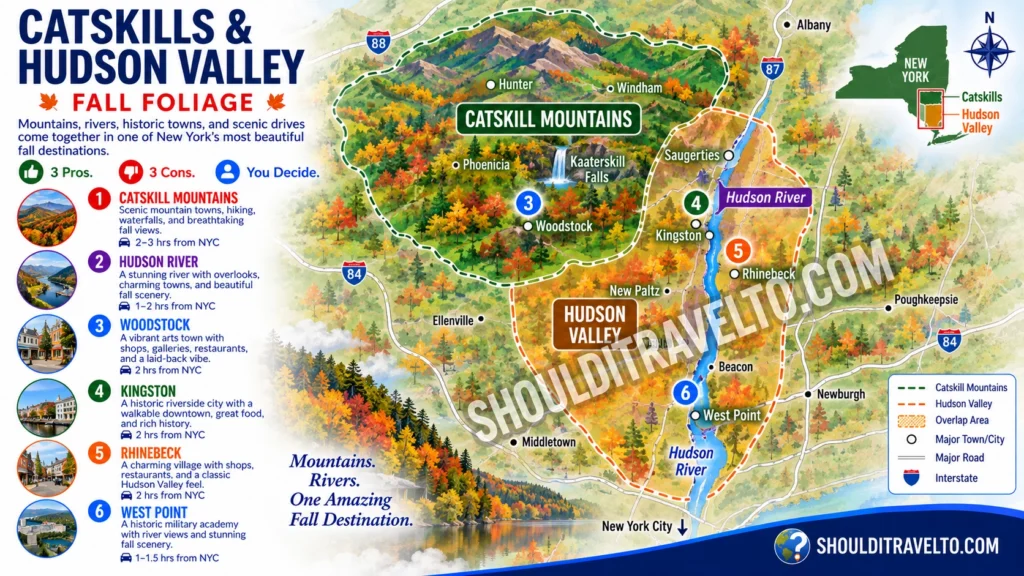
What Makes the Catskills & Hudson Valley Special?
The Catskills and Hudson Valley are unusual because they combine two complementary travel experiences. Many scenic destinations are defined primarily by one landscape.
Some offer mountains. Others offer lakes, rivers, forests, or coastal scenery.
The Catskills and Hudson Valley offer several of these experiences within one broader region.
The Catskill Mountains provide forested peaks, waterfalls, scenic drives, hiking trails, and mountain communities, while the Hudson Valley adds a major river landscape, historic estates, small towns, gardens, restaurants, museums, and cultural attractions.
This combination gives visitors considerably more flexibility than a destination focused almost exclusively on outdoor recreation.
A rainy day doesn’t necessarily mean losing an entire day of sightseeing. Instead of hiking, travelers might visit a museum, tour a historic estate, explore a small town, or enjoy a restaurant overlooking the river.
Likewise, visitors who spend one day exploring historic sites can dedicate the next to mountain scenery and waterfalls.
What Are the Catskills?
The Catskills are a mountainous region of southeastern New York, primarily west of the Hudson River. Much of the area’s outdoor appeal centers on Catskill Park, which includes public Forest Preserve lands, hiking trails, mountains, waterfalls, and seasonal recreation opportunities.
The landscape features forested mountains, deep valleys, streams, and scenic roads.
Popular destinations include Kaaterskill Falls, the Hunter Mountain region, the Slide Mountain Wilderness, and communities such as Woodstock and Phoenicia.
The Catskills are particularly appealing to travelers who want to spend a lot of time outdoors. Hiking, photography, waterfalls, scenic driving, camping, and winter recreation are among the region’s principal attractions.
What Is the Hudson Valley?
The Hudson Valley follows the Hudson River through southeastern and eastern New York. Its landscape includes riverfront communities, wooded hills, farmland, historic estates, gardens, and the dramatic terrain of the Hudson Highlands.
The region is also closely connected to American history. Its strategic location along the Hudson River made it important during the American Revolution.
Later, its landscapes inspired the Hudson River School of American painting.
The region also contains important presidential sites, Gilded Age estates, and historic communities. Popular destinations include Beacon, Cold Spring, Hyde Park, Rhinebeck, Kingston, Hudson, and the Hudson Highlands.
The Hudson Valley is particularly appealing to travelers who want scenic landscapes combined with history, culture, restaurants, and comfortable small-town experiences.
Why Combine the Catskills and Hudson Valley?
Travelers can combine the Catskills and Hudson Valley in one trip because each region complements the other’s strengths.
A dedicated Catskills vacation offers mountains, forests, hiking, waterfalls, and outdoor recreation. But the Hudson Valley adds historic estates, restaurants, art, museums, gardens, and riverfront communities.
A dedicated Hudson Valley vacation offers scenic river landscapes, historic towns, and cultural attractions. But the Catskills add the dramatic mountain scenery many travelers want from a nature-focused getaway.
Together, visitors can enjoy a vacation with considerably more variety.
The 3 Biggest Pros of Visiting the Catskills & Hudson Valley
1. Mountains, Waterfalls, River Scenery, and Forests in One Destination
The biggest reason to visit the Catskills and Hudson Valley is the variety of natural landscapes. The Catskills provide mountain scenery, waterfalls, hiking trails, forests, and scenic roads.
The Hudson Valley adds river views, wooded hills, farmland, gardens, and distinctive riverfront landscapes. Travelers can experience several different types of scenery without planning separate vacations.
In the Catskills, Kaaterskill Falls is one of the region’s best-known natural attractions. The waterfall descends through a forested mountain setting and attracts visitors interested in hiking, photography, and scenic landscapes.
The region also offers mountain trails ranging from relatively short walks to strenuous summit hikes. Slide Mountain, one of the Catskills’ best-known peaks, appeals to experienced hikers seeking a more demanding mountain experience.
In the Hudson Valley, the Hudson Highlands offer a different landscape. Here, steep wooded hills rise above the Hudson River, creating dramatic viewpoints and hiking opportunities.
Breakneck Ridge is one of the region’s best-known challenging hikes, while easier riverfront walks and park trails provide alternatives.
Farther north, the river valley opens into countryside landscapes, farms, historic estates, and small towns.
Few destinations so close to New York City offer this combination of mountain scenery and river landscapes.
2. Historic Towns, Art, and Culture Make This More Than a Nature Vacation
The second major advantage is the region’s cultural and historical variety. Unlike destinations centered almost entirely on hiking or scenic driving, the Catskills and Hudson Valley offer numerous attractions beyond the natural landscape.
The Hudson River played an important role in American history, transportation, commerce, and cultural development.
During the American Revolution, control of the Hudson River was strategically important. The Hudson Highlands and West Point were central to efforts to defend the river corridor.
Visitors can explore historic sites associated with this period, including Washington’s Headquarters in Newburgh and other Revolutionary War landmarks.
The region also played an important role in American art. Artists associated with the Hudson River School helped establish landscape painting as an important American artistic tradition.
Thomas Cole’s home and studio in Catskill and Frederic Church’s Olana near Hudson provide opportunities to explore this artistic heritage.
Presidential history is another major attraction.
Hyde Park contains the Home of Franklin D. Roosevelt National Historic Site, the Franklin D. Roosevelt Presidential Library and Museum, and Eleanor Roosevelt’s Val-Kill.
Nearby, the Vanderbilt Mansion National Historic Site provides a different perspective on the region’s history.
The towns also contribute to the experience.
Woodstock is associated with arts and music. Kingston offers historic districts, restaurants, and waterfront attractions. Beacon is known for contemporary art and its walkable downtown.
Cold Spring combines historic architecture with Hudson River scenery. Rhinebeck and Hudson offer restaurants, shops, historic buildings, and countryside atmosphere.
3. Four Distinct Seasons and Convenient Access From New York City
The third major advantage is the region’s seasonal variety and accessibility. The Catskills and Hudson Valley offer different experiences throughout the year.
Spring emphasizes waterfalls, gardens, wildflowers, and green landscapes. Summer brings hiking, swimming areas, river recreation, outdoor dining, and longer daylight hours.
Fall transforms the mountains and river valley into colorful scenery. Winter offers skiing, snowboarding, mountain retreats, and quieter historic-town experiences.
This makes the region suitable for different types of vacations.
A couple might visit in spring for gardens and romantic countryside accommodations. A family might choose summer for hiking and outdoor recreation. A photographer might visit during fall foliage season.
And travelers seeking a winter mountain getaway might choose the Hunter or Windham area.
The region is also relatively accessible from New York City and other parts of the Northeast.
Many southern Hudson Valley destinations are within a few hours by car, depending on the starting point and traffic.
Metro-North Railroad also connects New York City with several Hudson River communities, including Cold Spring and Beacon.
This provides an option for travelers who want a focused Hudson Valley getaway without driving.
The 3 Biggest Cons of Visiting the Catskills & Hudson Valley
1. The Region Is Spread Out and Requires Considerable Driving
The biggest drawback is geography. The Catskills and Hudson Valley cover a large area with attractions spread across mountains, river towns, historic estates, and rural communities.
A destination that looks close on a map may take longer to reach than expected.
Mountain roads can be winding, and traveling between communities may involve smaller highways rather than direct interstate routes. This becomes particularly important for visitors trying to combine several different attractions in one day.
For a combined Catskills and Hudson Valley vacation, a personal vehicle is strongly recommended.
The best way to reduce this drawback is to organize the trip geographically.
2. Weather and Seasonal Conditions Can Limit Outdoor Activities
The second drawback is the region’s variable weather. The Catskills and Hudson Valley experience four distinct seasons, but conditions can vary considerably by elevation and location.
Spring can bring rain, muddy trails, and changing temperatures. Summer may be warm and humid, with thunderstorms that can affect hiking and outdoor activities.
Fall offers beautiful scenery but can also bring chilly mornings, wet weather, and increased visitor traffic. Winter introduces snow, ice, freezing temperatures, and more difficult driving conditions in mountain areas.
Higher elevations in the Catskills generally experience colder conditions than lower Hudson Valley communities. Some hiking trails can become slippery or hazardous during wet or icy weather.
Waterfall viewpoints may also require caution because of steep terrain, exposed ledges, and changing trail conditions.
Visitors should check official park information and choose activities appropriate to the season and their abilities.
3. Popular Attractions and Towns Can Become Crowded
The third drawback is seasonal crowding. Although the Catskills and Hudson Valley offer extensive natural landscapes, some attractions are extremely popular.
Fall foliage weekends can bring substantial traffic to scenic roads, mountain trailheads, and small towns. Kaaterskill Falls is a particularly recognizable destination, and parking and access require planning.
Popular Hudson Highlands hiking trails can also attract large numbers of visitors. Towns such as Woodstock, Beacon, Cold Spring, and Hudson may get busy on weekends and during holidays.
Summer brings additional demand for hiking, outdoor recreation, and countryside accommodations. Winter weekends can be busy near ski areas.
The key is recognizing that the Catskills and Hudson Valley are popular regional getaways, not remote wilderness destinations.
Which Part of the Catskills & Hudson Valley Should You Visit?
The best area depends on whether you prefer mountain recreation, river scenery, historic attractions, or small-town experiences.
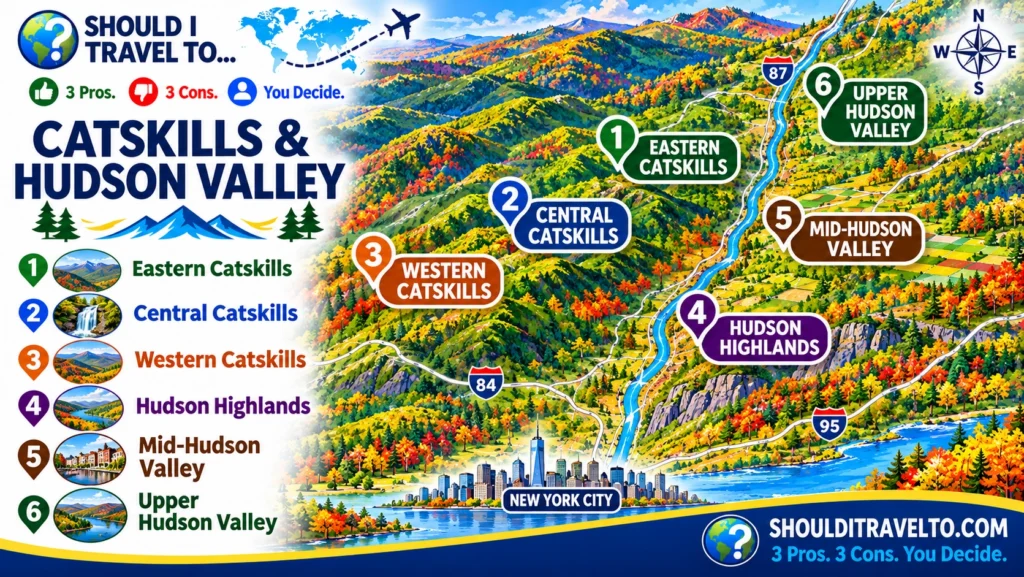
Eastern Catskills: Best for Waterfalls, Mountain Scenery, and First-Time Visitors
The eastern Catskills are among the region’s most recognizable scenic areas. Communities such as Hunter, Tannersville, Palenville, and Catskill provide access to mountain landscapes, waterfalls, and nearby attractions.
Kaaterskill Falls is one of the area’s major highlights. The Hunter Mountain region also offers seasonal recreation, including skiing and other mountain activities.
The eastern Catskills are particularly appealing to visitors who want a traditional mountain getaway with recognizable natural attractions.
However, popular trailheads and recreation areas can become crowded.
Best for: Waterfalls, mountain scenery, hiking, photography, and outdoor recreation.
Central Catskills: Best for Forests, Hiking, and Mountain-Town Getaways
The central Catskills offer a quieter mountain atmosphere centered on forests, valleys, hiking trails, and small communities.
Woodstock and Phoenicia are useful bases for exploring nearby scenic areas. Woodstock is known for its artistic identity, shops, restaurants, and proximity to outdoor recreation.
Phoenicia offers a smaller mountain-town atmosphere with access to forests, streams, and hiking areas. The Ashokan Reservoir area provides expansive views of water and surrounding mountains.
The region is particularly appealing for couples, photographers, hikers, and travelers seeking a slower countryside vacation.
Best for: Forest scenery, hiking, artistic towns, scenic drives, and relaxed mountain retreats.
Western Catskills: Best for Quieter Mountain Recreation
The western Catskills offer a different experience from the region’s better-known eastern attractions. The landscape includes forested hills, valleys, reservoirs, and rural communities.
Areas around Margaretville and the surrounding mountains can appeal to travelers seeking a quieter setting. Outdoor recreation, countryside drives, fishing opportunities, and mountain accommodations are among the principal attractions.
However, services and attractions can be more widely dispersed. Visitors should plan accommodations and activities carefully.
Best for: Quiet countryside getaways, outdoor recreation, scenic driving, and travelers seeking fewer crowds.
Hudson Highlands: Best for River Views and Dramatic Hiking
The Hudson Highlands provide some of the Hudson Valley’s most dramatic scenery. Here, steep hills rise above the Hudson River, creating viewpoints, hiking trails, and scenic communities.
Popular destinations include Bear Mountain, Cold Spring, and the Breakneck Ridge area.
Bear Mountain State Park offers outdoor recreation and scenic landscapes. Cold Spring provides a walkable historic town with restaurants, shops, and riverfront scenery. Breakneck Ridge is known for challenging hiking and expansive views of the Hudson River.
However, not every trail is suitable for beginners. Some routes involve steep climbs, rocky terrain, and exposed sections.
Visitors should choose hikes based on experience and physical ability.
Best for: Hudson River scenery, hiking, photography, historic towns, and weekend trips from New York City.
Mid-Hudson Valley: Best for Historic Estates, Gardens, and Culture
The Mid-Hudson Valley offers a particularly strong combination of scenery and American history. Communities such as New Paltz, Kingston, Hyde Park, and Rhinebeck provide access to historic attractions, restaurants, gardens, and river landscapes.
Hyde Park is especially important for presidential history. Visitors can explore the Home of Franklin D. Roosevelt, the FDR Presidential Library and Museum, Eleanor Roosevelt’s Val-Kill, and the Vanderbilt Mansion.
New Paltz offers historic architecture and access to nearby outdoor attractions, including the Shawangunk Mountains. Kingston combines historic districts with waterfront attractions and dining. Rhinebeck provides a charming village setting with restaurants, shops, and nearby historic sites.
This region is particularly appealing to travelers who want nature and cultural attractions in roughly equal measure.
Best for: American history, historic estates, gardens, restaurants, and scenic countryside.
Upper Hudson Valley: Best for Art, Historic Towns, and River Landscapes
The Upper Hudson Valley offers a distinctive combination of art, architecture, small towns, and countryside scenery. Hudson and Catskill are useful starting points.
The Thomas Cole National Historic Site in Catskill and Olana State Historic Site near Hudson connect visitors with the Hudson River School of American painting. Olana also offers scenic views across the Hudson River landscape.
Hudson provides restaurants, galleries, shops, and historic architecture. The surrounding countryside offers additional opportunities for scenic drives and rural exploration.
This region is particularly appealing for couples, art enthusiasts, photographers, and travelers seeking a relaxed cultural getaway.
Best for: Art, historic architecture, Hudson River scenery, countryside dining, and small-town exploration.
Planning Your Catskills & Hudson Valley Trip
What Is the Atmosphere Like in the Catskills & Hudson Valley?
The atmosphere varies considerably depending on where you stay.
In the Catskills, the experience is primarily outdoors-oriented. Visitors encounter forested mountains, winding roads, waterfalls, hiking trails, cabins, and small mountain communities. Some areas feel remote and quiet. Others, particularly near popular recreation destinations, offer restaurants, resorts, and seasonal visitor activity.
The Hudson Valley has a more varied cultural atmosphere. Historic river towns, farms, estates, gardens, museums, and restaurants create a countryside experience that isn’t limited to outdoor recreation.
Communities such as Beacon, Cold Spring, Kingston, Rhinebeck, and Hudson offer opportunities to spend an afternoon exploring shops, galleries, restaurants, and historic streets.
When Is the Best Time to Visit the Catskills & Hudson Valley?
The best time to visit depends on the experience you want.
Late spring through early fall generally provides the broadest range of opportunities for hiking, scenic driving, gardens, and outdoor recreation. Fall is particularly famous for foliage, but it isn’t necessarily the best season for every traveler.
Spring: March Through May
Spring gradually transforms the Catskills and Hudson Valley from winter landscapes into green countryside. As temperatures rise, forests begin to leaf out, gardens bloom, and waterfalls can become especially impressive following seasonal rainfall.
April and May can be attractive for visitors interested in waterfalls, gardens, photography, and quieter scenic drives. The Hudson Valley’s historic estates and landscaped grounds can be particularly appealing as spring progresses.
However, early spring conditions can be unpredictable. Higher elevations in the Catskills may remain cold, and some trails can be muddy or icy.
Spring is best for flexible travelers who enjoy changing landscapes and don’t require consistently warm weather.
Summer: June Through August
Summer is one of the strongest seasons for a traditional Catskills and Hudson Valley vacation. Forests are green, hiking trails are accessible, and longer daylight hours provide additional time for sightseeing.
Visitors can combine mountain hikes, waterfall visits, riverfront activities, historic towns, and outdoor dining. The Catskills can offer cooler conditions at higher elevations, although lower valleys may become warm and humid.
Summer is particularly appealing for families, outdoor enthusiasts, and travelers planning a longer regional vacation.
However, popular parks, trails, swimming areas, and towns can become busy on weekends. Afternoon thunderstorms and humidity are also factors to consider.
Fall: September Through November
Fall is the Catskills and Hudson Valley’s most recognizable scenic season. Forests across the mountains and river valley change color, creating landscapes of red, orange, gold, and yellow.
The Catskills provide expansive mountain foliage, while the Hudson Valley adds river views, historic estates, farms, and colorful towns. Together, they create one of New York’s most varied autumn road trips.
However, peak foliage timing varies by elevation, weather, and year. Higher mountain areas generally begin changing before lower elevations along the Hudson River.
October is particularly popular, and accommodations and attractions can become crowded during peak weekends.
For travelers whose primary goal is fall color, autumn is an excellent choice. However, visitors seeking a quieter experience may prefer late spring or early summer.
Winter: December Through February
Winter offers a different experience. Snow-covered mountains, bare forests, frozen landscapes, and quieter countryside towns can create an appealing atmosphere. The Catskills offer skiing, snowboarding, and winter recreation in areas such as Hunter and Windham. Mountain cabins, inns, and resorts can also provide a cozy winter getaway.
The Hudson Valley offers a quieter cultural experience centered on historic towns, restaurants, and selected year-round attractions. However, winter is the most challenging season for hiking and mountain driving. Snow, ice, freezing temperatures, and limited seasonal access can affect outdoor activities.
Visitors should avoid planning a winter itinerary that depends on specific trails or mountain roads being accessible.
Winter is best for travelers interested in seasonal recreation, quiet retreats, and flexible sightseeing.
How Many Days Should You Spend in the Catskills & Hudson Valley?
The ideal trip length depends on how much of the region you want to explore. For most first-time visitors, three to five days provides a good balance between mountain scenery and Hudson Valley attractions.
One Day: A Scenic Introduction
A day trip can be worthwhile if you’re traveling from New York City or another nearby location. Choose one area rather than trying to visit both regions.
For example, visitors might explore Cold Spring and the Hudson Highlands, spend a day in Beacon, or visit a Catskills waterfall and a nearby town.
However, one day isn’t enough for a meaningful combined Catskills and Hudson Valley experience.
Two Days: A Weekend Getaway
A weekend allows visitors to explore one section more thoroughly. You might spend two days in the eastern Catskills, combining a waterfall visit with hiking and a mountain-town stay.
Alternatively, you could explore Beacon, Cold Spring, and nearby Hudson River scenery.
Two days works particularly well for couples and regional travelers.
Three to Five Days: Best Overall Balance
Three to five days is the recommended trip length for most first-time visitors who want to combine the Catskills and Hudson Valley. Travelers can spend time in the mountains, visit waterfalls, explore historic towns, and include several cultural attractions.
A three-day trip is best organized around one convenient base and nearby excursions.
Four or five days allows more flexibility and may justify changing accommodations between the mountain and river regions.
Six to Seven Days: A More Complete Regional Road Trip
A longer vacation allows visitors to explore multiple areas without rushing. For example, travelers might begin in the Hudson Highlands, continue through the Mid-Hudson Valley, and finish with several days in the Catskills.
Alternatively, they could focus on the central and eastern Catskills before exploring historic estates and towns farther north along the Hudson River.
The goal should be to experience the region rather than simply visit as many places as possible.
Where Should You Stay in the Catskills & Hudson Valley?
There isn’t one best place to stay. Your accommodation location should depend on whether you prioritize mountain recreation, river scenery, history, or small-town experiences.
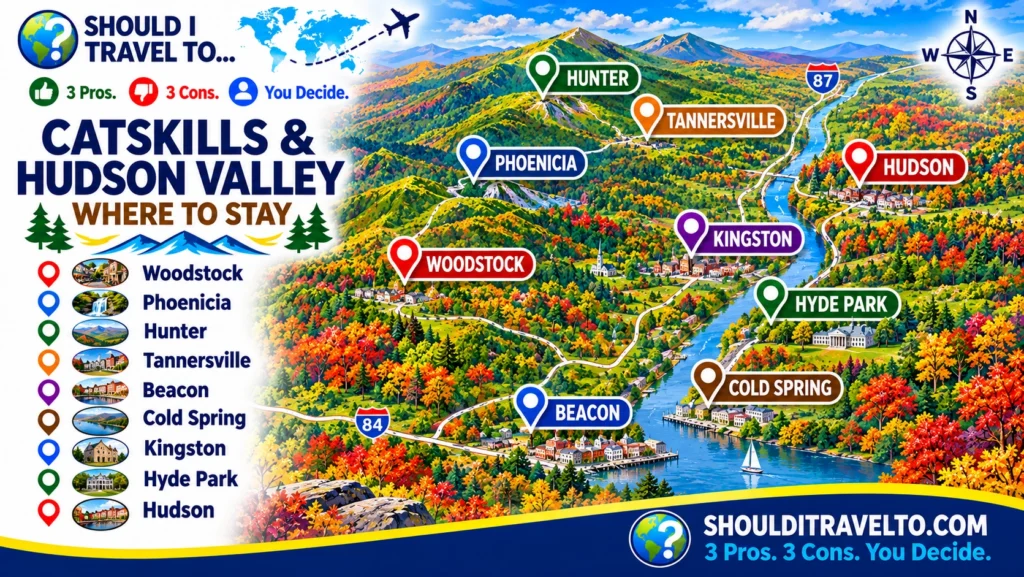
Woodstock: Best for Artistic Character and Catskills Access
Woodstock offers a distinctive mountain-town atmosphere with restaurants, shops, galleries, and nearby outdoor recreation. It is particularly appealing for couples and travelers who want a combination of Catskills scenery and cultural experiences.
However, Woodstock isn’t equally convenient for every Catskills attraction.
Phoenicia: Best for a Quiet Mountain Getaway
Phoenicia provides a smaller, relaxed mountain setting. It offers access to forests, streams, hiking areas, and nearby scenic drives.
This is a good choice for travelers who want to spend a lot of time outdoors.
Hunter or Tannersville: Best for Waterfalls and Mountain Recreation
Hunter and Tannersville provide convenient access to the eastern Catskills. They are great bases for exploring Kaaterskill Falls, nearby hiking, and seasonal mountain recreation.
Winter visitors may also appreciate proximity to ski areas.
Beacon: Best for Art, River Scenery, and Car-Free Weekend Possibilities
Beacon combines a walkable downtown with restaurants, galleries, contemporary art, and nearby Hudson River scenery. Metro-North service makes it particularly convenient for travelers arriving from New York City.
However, visitors planning extensive mountain exploration will still benefit from a car.
Cold Spring: Best for Hudson Highlands Scenery
Cold Spring is a strong choice for travelers who want a historic village atmosphere with Hudson River views. Its walkable center, restaurants, shops, and nearby hiking opportunities make it appealing for couples and weekend visitors.
However, popular weekends can be crowded.
Kingston: Best for Combining the Catskills and Hudson Valley
Kingston is one of the most practical bases for travelers interested in both regions. Its location provides access to the eastern Catskills while offering historic districts, restaurants, and Hudson River attractions.
For a first-time visitor planning a combined trip, Kingston deserves serious consideration.
Rhinebeck or Hyde Park: Best for History and Countryside Attractions
Rhinebeck offers a charming village atmosphere with restaurants, shops, and nearby historic attractions. Hyde Park is especially convenient for presidential history, historic estates, and cultural sightseeing.
These areas are particularly appealing for travelers who want history and scenic countryside rather than extensive mountain hiking.
Hudson: Best for Art, Dining, and Upper Hudson Valley Exploration
Hudson offers historic architecture, restaurants, galleries, shops, and access to the surrounding countryside. It is particularly appealing for couples and travelers interested in art, culture, and relaxed sightseeing.
However, it is farther from many southern Hudson Valley attractions.
Getting to the Catskills & Hudson Valley
You can reach the Catskills and Hudson Valley by road from New York City, Albany, and other parts of the Northeast. Major highways provide access to different sections of the region, including the New York State Thruway and roads connecting the Hudson River communities with the Catskill Mountains.
Visitors arriving from farther away may consider airports serving the New York City metropolitan area or Albany, depending on their destination. Rail transportation is also available to selected Hudson Valley communities.
Travelers planning a combined Catskills and Hudson Valley road trip should generally rent a car or bring their own vehicle.
Getting Around the Catskills & Hudson Valley
Driving is the most practical way to explore the region. The Catskills contain rural roads, mountain highways, and attractions spread across a large area.
The Hudson Valley also includes numerous towns, estates, parks, and scenic areas separated by driving distances. Visitors should organize activities geographically.
Don’t Miss: Best Things to Do in the Catskills & Hudson Valley
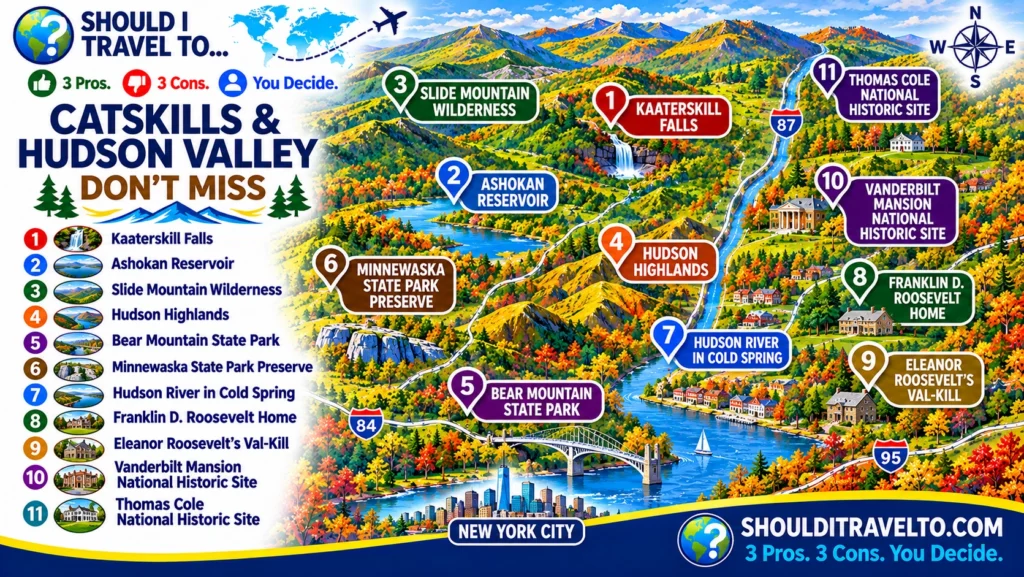
Visit Kaaterskill Falls
Kaaterskill Falls is one of the Catskills’ most recognizable natural attractions. The two-tiered waterfall descends through a dramatic forested setting and provides opportunities for photography and hiking.
Different viewing areas and trails offer varying perspectives. However, the terrain can be steep and hazardous, especially near exposed ledges and during wet or icy conditions.
Visitors should stay on designated trails and in designated viewing areas.
Explore the Ashokan Reservoir
The Ashokan Reservoir offers expansive views of water, surrounding mountains, and forested hills. Its scenic setting makes it appealing for photography, walking, and relaxed sightseeing.
The Ashokan Rail Trail provides an accessible way to experience portions of the surrounding landscape. The area is particularly attractive for travelers who want Catskills scenery without a strenuous mountain hike.
Hike in the Slide Mountain Wilderness
The Slide Mountain Wilderness offers more demanding hiking in the Catskills. Slide Mountain is the highest peak in the Catskill Mountains and attracts experienced hikers interested in forested mountain terrain.
However, trails can be steep, rocky, and physically demanding. Visitors should choose routes appropriate to their abilities and prepare for changing mountain weather.
Explore the Hudson Highlands
The Hudson Highlands offer some of the region’s most dramatic river scenery. Steep hills rise above the Hudson River, creating viewpoints and hiking opportunities.
The area includes popular destinations near Cold Spring, Bear Mountain, and Breakneck Ridge. Some hikes are strenuous, but easier park walks and riverfront viewpoints provide alternatives.
Visit Bear Mountain State Park
Bear Mountain State Park is one of the Hudson Valley’s best-known outdoor destinations. Visitors can enjoy scenic landscapes, hiking, picnic areas, and views of the surrounding Hudson Highlands.
The park is particularly appealing for families and travelers seeking outdoor recreation within reach of New York City. However, popular weekends can bring crowds and parking demand.
Explore Minnewaska State Park Preserve
Minnewaska State Park Preserve, near New Paltz, offers lakes, waterfalls, cliffs, forests, and scenic carriage roads. The preserve is located in the Shawangunk Mountains, which are geographically distinct from the Catskills.
Its landscapes provide an excellent addition to a broader Hudson Valley nature vacation.
Visitors can enjoy hiking, photography, and scenic viewpoints. Trail difficulty and seasonal access vary.
Walk Along the Hudson River in Cold Spring
Cold Spring offers one of the Hudson Valley’s most appealing combinations of historic-town character and river scenery. Visitors can explore shops and restaurants before enjoying views of the Hudson River and surrounding mountains.
The town is particularly attractive for couples and travelers seeking a relaxed weekend getaway.
Visit the Home of Franklin D. Roosevelt
Hyde Park is home to one of the Hudson Valley’s most important historic attractions. The Home of Franklin D. Roosevelt National Historic Site provides insight into the life and presidency of Franklin D. Roosevelt.
The nearby presidential library and museum add another dimension to the experience. The surrounding estate landscape also contributes to the region’s scenic and historical character.
Explore Eleanor Roosevelt’s Val-Kill
Val-Kill provides an opportunity to learn about Eleanor Roosevelt’s life and legacy. Located in Hyde Park, the site is associated with her personal retreat and later home.
It complements a visit to the Roosevelt family estate and other nearby historic attractions.
Visit Vanderbilt Mansion National Historic Site
The Vanderbilt Mansion in Hyde Park offers a different perspective on Hudson Valley history. The estate reflects the wealth and architecture of America’s Gilded Age.
Its landscaped grounds and views of the Hudson River also appeal to visitors interested in scenic settings.
Discover Olana State Historic Site
Olana, near Hudson, was the home of artist Frederic Edwin Church. The property combines distinctive architecture, art history, and expansive views of the Hudson River landscape.
It is particularly appealing for travelers interested in the Hudson River School of American painting.
Visit the Thomas Cole National Historic Site
The Thomas Cole National Historic Site in Catskill preserves the home and studio of a central figure associated with the Hudson River School. The site provides insight into how the region’s landscapes influenced American art.
Combining Thomas Cole’s home with Olana creates an especially rewarding cultural itinerary.
Explore Historic Huguenot Street in New Paltz
Historic Huguenot Street preserves an important collection of historic buildings associated with the region’s early European settlement. It provides opportunities to learn about local history, architecture, and the communities that shaped the Hudson Valley.
Nearby New Paltz also offers restaurants, shops, and access to the Shawangunk Mountains.
Enjoy the Region’s Historic Towns
The Catskills and Hudson Valley contain numerous towns worth exploring.
Woodstock offers artistic character and mountain-town atmosphere. Phoenicia provides a quieter Catskills setting.
Kingston combines historic districts and waterfront attractions. Beacon offers art and a walkable downtown.
Cold Spring provides river views and historic architecture. Rhinebeck offers restaurants and countryside charm.
Hudson is known for art, dining, shopping, and historic buildings.
These communities are an important part of what makes the region more than a conventional mountain vacation.
Catskills & Hudson Valley for Holidays, Events & Seasonal Travel
Catskills & Hudson Valley for Spring Travel
Spring is an appealing time to experience waterfalls, gardens, fresh greenery, and changing mountain landscapes. The Catskills gradually transition from winter conditions to green forests, while the Hudson Valley’s gardens and historic estates become particularly attractive as temperatures rise.
Visitors can combine scenic drives, waterfall photography, historic towns, and outdoor recreation. However, early spring may bring muddy trails and unpredictable weather.
Best for: Waterfalls, gardens, photographers, couples, and quieter countryside getaways.
Why Visit: Spring Greenery • Waterfalls • Gardens • Historic Estates • Scenic Drives
Explore More: Best Spring Break Destinations
Catskills & Hudson Valley for Summer Vacation
Summer offers one of the broadest ranges of activities. Green forests, hiking trails, river scenery, outdoor dining, and longer daylight hours make the region appealing for families and outdoor enthusiasts.
Visitors can explore mountain trails, waterfalls, parks, historic towns, and cultural attractions. The Hudson Valley also offers opportunities for riverfront recreation and countryside sightseeing.
However, summer weekends can be busy, and warm, humid weather may affect outdoor activities.
Best for: Families, hikers, couples, road-trip travelers, and outdoor enthusiasts.
Why Visit: Hiking • Waterfalls • River Scenery • Forests • Outdoor Recreation • Historic Towns
Explore More: Best Summer Vacation Destinations
Catskills & Hudson Valley for Fall Foliage
Fall is the region’s signature scenic season. The Catskills provide forested mountains and waterfalls surrounded by autumn colors.
The Hudson Valley adds colorful river landscapes, historic estates, farms, and picturesque towns. Together, they offer one of New York’s most complete fall foliage road trips.
However, October weekends can be crowded, and accommodations near popular attractions may require advance planning. For travelers whose primary goal is colorful scenery, fall is an excellent choice.
Best for: Fall foliage enthusiasts, photographers, couples, scenic road-trip travelers, and history lovers.
Why Visit: Autumn Colors • Mountain Views • Hudson River Scenery • Historic Towns • Photography
Explore More: Catskills & Hudson Valley for Fall Foliage | Fall Foliage Destinations
Catskills & Hudson Valley for Winter Travel
Winter offers snow-covered mountains, quieter towns, and opportunities for seasonal recreation. The Catskills are particularly appealing for skiing, snowboarding, and mountain retreats.
The Hudson Valley offers historic towns, restaurants, and selected cultural attractions. However, snow, ice, and cold temperatures can make mountain driving and hiking more difficult.
Some outdoor attractions and historic properties operate on seasonal schedules.
Winter is best for travelers who appreciate a quieter atmosphere and can remain flexible about outdoor activities.
Best for: Skiers, couples, winter photographers, and quiet countryside getaways.
Why Visit: Skiing • Snowy Mountains • Cozy Retreats • Historic Towns • Winter Scenery
Explore More: Best Winter Destinations
Hudson Valley for American History
The Hudson Valley is particularly appealing for travelers interested in the American Revolution, presidential history, historic estates, and American art. Visitors can explore Revolutionary War sites, presidential landmarks in Hyde Park, Gilded Age estates, and places associated with the Hudson River School.
These attractions complement the region’s scenic landscapes and provide worthwhile alternatives to outdoor recreation.
For history enthusiasts, the Hudson Valley can support a dedicated multi-day vacation.
Best for: American history enthusiasts, families, educational travel, art lovers, and historic architecture.
Why Visit: Revolutionary War History • Presidential Sites • Historic Estates • Hudson River School • Museums
Explore More: Hudson Valley for American History
Who Should Visit the Catskills & Hudson Valley?
- Scenic Road-Trip Travelers
- Couples and Romantic Getaways
- Photographers
- Hikers and Outdoor Enthusiasts
- Families
- History Enthusiasts
- New York City Weekend Travelers
- Travelers Who Enjoy Nature Without Strenuous Hiking
Skip the Catskills & Hudson Valley If
- Travelers Who Dislike Driving
- Travelers Seeking One Compact Destination
- Visitors With Very Limited Time
- Travelers Seeking Guaranteed Outdoor Weather
- Visitors Expecting Complete Solitude
- Travelers Seeking Major Urban Entertainment
Catskills & Hudson Valley Compared to Other Scenic & Nature Destinations
Catskills & Hudson Valley vs. the Adirondacks
The Catskills and Adirondacks are both major mountain destinations in New York. However, they offer different experiences.
The Adirondacks provide a larger mountain-and-lake region with extensive wilderness, hiking, paddling, and outdoor recreation. The Catskills offer mountain scenery, waterfalls, and hiking, while the neighboring Hudson Valley adds historic towns, art, museums, and river landscapes.
Choose the Catskills and Hudson Valley for a vacation combining nature with history and culture.
Choose the Adirondacks for a more wilderness-oriented mountain-and-lake getaway.
Explore More: Adirondacks for Fall Foliage
Catskills & Hudson Valley vs. the Berkshires
The Catskills and Hudson Valley share several characteristics with the Berkshires of western Massachusetts. Both offer forested hills, historic towns, scenic drives, cultural attractions, and seasonal foliage.
However, the Catskills and Hudson Valley cover a broader geographic area and combine mountain scenery with a major river corridor.
The Berkshires offer a more concentrated regional experience centered on cultural attractions, countryside towns, and the mountains of western Massachusetts.
Choose the Catskills and Hudson Valley for greater geographic variety and a combination of mountain and river scenery.
Choose the Berkshires for a more compact cultural and countryside getaway.
Explore More: Berkshires for Fall Foliage
Catskills & Hudson Valley vs. the White Mountains
The Catskills and New Hampshire’s White Mountains both offer forested mountain scenery, hiking, waterfalls, and seasonal recreation. However, the White Mountains provide a more mountain-centered experience with higher elevations, dramatic ridgelines, and scenic highways such as the Kancamagus Highway.
The Catskills and Hudson Valley offer a broader mix of outdoor recreation, historic estates, art, river towns, and cultural attractions.
Choose the White Mountains for a dedicated mountain vacation.
Choose the Catskills and Hudson Valley for a more varied road trip combining nature and culture.
Explore More: White Mountains for Fall Foliage
Catskills & Hudson Valley vs. Shenandoah National Park
Shenandoah National Park and the Catskills both offer forested mountains, hiking, waterfalls, and fall foliage. However, Shenandoah is a more concentrated national park destination centered on Skyline Drive and the Blue Ridge Mountains.
The Catskills and Hudson Valley are a broader regional destination with numerous towns, historic sites, cultural attractions, and scenic areas.
Choose Shenandoah for a national park vacation emphasizing mountain scenery and scenic driving.
Choose the Catskills and Hudson Valley for a combination of mountain recreation, river scenery, history, and small-town experiences.
Explore More: Shenandoah National Park for Fall Foliage
Catskills & Hudson Valley vs. the Blue Ridge Parkway
The Catskills and Hudson Valley and the Blue Ridge Parkway both appeal to travelers who enjoy scenic drives, mountains, forests, and seasonal landscapes. However, the Blue Ridge Parkway is centered on a continuous scenic road through Virginia and North Carolina.
The Catskills and Hudson Valley are a broader regional destination with multiple towns, parks, mountain areas, historic estates, and river landscapes.
Choose the Blue Ridge Parkway if the scenic drive itself is the main attraction.
Choose the Catskills and Hudson Valley if you want a more varied vacation combining nature, history, art, and countryside communities.
Explore More: Blue Ridge Parkway Scenic & Nature Guide | Blue Ridge Parway for Fall Foliage
Final Assessment
The Catskills and Hudson Valley are worth visiting if you enjoy mountain scenery, waterfalls, hiking, scenic drives, historic towns, river views, and countryside travel.
As complementary regions, the Catskills provide forests, mountains, waterfalls, hiking, and outdoor recreation, and the Hudson Valley adds river landscapes, historic estates, art, restaurants, gardens, and distinctive communities.
Together, they create a vacation with considerably more variety than a destination centered exclusively on one type of scenery.
A year-round scenic and nature destination, the Catskills and Hudson Valley offer visitors who appreciate the freedom to combine mountains, waterfalls, river scenery, historic towns, and cultural attractions one of New York’s most rewarding scenic getaways.
3 Pros. 3 Cons. You Decide.
Catskills & Hudson Valley Frequently Asked Questions
Are the Catskills and Hudson Valley Worth Visiting Outside Fall Foliage Season?
Yes. Spring offers waterfalls, gardens, and fresh greenery. Summer provides hiking, outdoor recreation, and river scenery. Winter offers skiing, quiet mountain retreats, and historic-town experiences. Fall is especially popular for foliage, but the region offers different attractions year-round.
Are the Catskills and Hudson Valley the Same Place?
No. The Catskills are a mountainous region primarily west of the Hudson River, while the Hudson Valley follows the river through southeastern and eastern New York. The regions overlap geographically and complement one another, making them appealing for a combined road trip.
How Many Days Do You Need in the Catskills and Hudson Valley?
Three to five days is recommended for a combined trip. Two or three days can work well for one area, such as the eastern Catskills or Hudson Highlands. A longer vacation allows visitors to explore several regions without rushing.
What Is the Best Time of Year to Visit?
Late spring through early fall provides the broadest range of hiking, scenic driving, and outdoor recreation opportunities. October is particularly popular for fall foliage. Winter is appealing for skiing and mountain retreats, although snow and ice can affect travel.
Do You Need a Car to Visit the Catskills and Hudson Valley?
A car is strongly recommended for exploring both regions. Some Hudson Valley towns, including Beacon and Cold Spring, are reachable by train from New York City. However, many Catskills attractions, rural parks, and historic sites require additional transportation.
Which Is Better for Nature: the Catskills or Hudson Valley?
The Catskills are generally better for mountain scenery, waterfalls, forests, and hiking. The Hudson Valley is particularly appealing for river landscapes, historic estates, gardens, and scenic towns. The best choice depends on whether you prefer mountain recreation or a broader mix of scenery and cultural attractions.
Can You Visit the Catskills and Hudson Valley on the Same Trip?
Yes. Combining the regions is one of the strongest reasons to visit. However, travelers should choose a manageable section rather than trying to explore the entire area. Three to five days provides a good introduction to both mountain and river scenery.